#geometry-and-trigonometry
1 messages · Page 176 of 1
 twin prawn
A = a*h_a/2 as we all know, same thing for b and c
So 1/h_a = a/(2A)
But since a < b + c (triangle inequality) we have that
1/h_a < (b + c)/(2A) = 1/h_b + 1/h_c
@thin wasp
 thin wasp
Yep, thanks
twin prawn
🍮
thin wasp
The median to a 10cm side of a triangle has length 9cm and is perpendicular to a second median of the triangle. Find the exact value of centimeters of the length of the third median.
We were specifically told NOT to use the law of cosines
I found the sidelengths of the triangle
So what I suppose I could do, is draw a perpendicular down from the centroid to the 10cm base
then calculate the area of the triangle using heron's formula, which would be a pain to do cause I've got multiple surds
and then show that 10*(that perpendicular)/2 = (Area of the triangle/3), and thus calculate the perpendicular length
and then use pythag/similarity
thin wasp
Nvm got it ^
 upper karma
could i have something to prove
 fallen ivy
of what nature?
 neon fossil
prove that a dog is topologically a sphere
 fallow edge
Do spheres have hair?
 zenith ember
But a dog isn't topologically a sphere, I don't think. It's a torus,
 plain wigeon
Wow, deep conversation
neon fossil
here is the solution if you were curious -_- https://i.warosu.org/data/sci/img/0089/00/1494491021652.png
 fallow edge
Ahh, math memes
 pliant rivet
i’m fuckin dying
 tender adder
oof
 strange crow
upper karma
strange crow
upper karma

twin prawn
I’ve got this
In the triangle ABC denote the angles at the respective vertices by a, b and c
PC is tangent to the circle and touches one of the vertices of ABC so by the alternate segment theorem (you might want to look this up) the angle BCP is the same as the angle a
So the angle PCQ has size a + c/2 because CQ bisects c
What’s more, we know that a + b + c = 180 degrees
But also b + BCQ + PQC = 180 degrees, but BCQ = c/2, so we must have that PQC = PCQ = a + c/2
This shows that PQC is isosceles so PC = PQ
@coral kiln
 coral kiln
ty @twin prawn
twin prawn
🍮
twin prawn
What have you tried
coral kiln
uh
ye
so the three rules to solve PBCX are opposite angels are sup, exterior angle = opp interior and <XPY = <YBC/<PXY=BCY
can't seem to get any tho
@twin prawn
upper karma
@coral kiln you need to prove it by proving <CXP = <CPB
As a chord subtends equal angle anywhere on the circumference...here BC being taken as the chord
And then it is pretty easy to prove
Hint:use property of rhombus's diagonals
 main totem
There is triangle ABC with all acute angles(Point B is up,A is on the left and C is on the eight ). The length of the height from point B is 7, The length of the height from point C is 9. Then we draw median from A to side BC then marke point M. Then we draw point symetric to point M relative to line AC then name it P.then we draw point symetric to point M relative to line AB then name it Q. Fine the perimeter of quarilater APMQ.
Please help <@&286206848099549185>
 hollow edge
@main totem sorry for the late reply; I just saw this. Assuming AM is 8, as it is in the diagram (but not your explanation), the answer is 7 + 9 + 8*2.
main totem
But 7 is height of triangle
hollow edge
oh 7 as part of the answer?
main totem
Yes
main totem
Can u please xplain i am dumb
main totem
Yes
hollow edge
what's the ratio of similarity?
main totem
1/2
main totem
3.5
main totem
@hollow edge thank u very much ur a legend
 fallen ivy
lol
 manic grail
HOW DO I DO THAT THING
fallen ivy
angle BDC is 44
fallen ivy
yeah it will be
pliant rivet
and inscribed angles dont change their measure no matter where you put the middle vertex bit
as long as its still on the circle ofc
or rather "in a circle, two inscribed angles with the same intercepted arc are congruent"
manic grail
my brain is frozen
i am taking summer geomrtry class
i dont understand anything outside of algebra 1
 past mantle
Angle bac is half of that arc
fallen ivy
We already gave that answer
fallen ivy
It's okay we still love you <3
 last otter

hi. Is this shit even true?
I have counterexample. Let B be (0,3) and let E be disjoint union of (0,2), (0,2), (1,3),(1,3),(1,3)
and let p map number t to number t in (0,3)
then p^-1(1.5) has 5 elements but p^-1(0.5) has only 2 elements
this is so annoying
last otter
how can u be so sure? points in B are evenly covered by intervals (0,2) and (1,3)
oh shit they're not
 mint sandal
what is the preimage of (1.5, 2.5)
it's disjoint collection of open sets, but not all of them map homeomorphically to (1.5, 2.5)
mint sandal
want a hint?
last otter
no 😄 I meant this one you gave me
I meant to say that generally I cant prove shit without someone giving me hint
mint sandal
alright
 steady widget
geometry is killing me also, what do i need to do to get this?
@manic grail also same, trying to get into precalc because I know alg 2 and alg 1 so if i learn geometry I can do that
mint sandal
yah
steady widget
nice, thanks for the help
 opal blaze
Can someone confirm that when they talk about the circles being externally tangent. they do not refer to the angle APB being 90 degrees. (I don't know all the terminology for English mathematics) <@&286206848099549185>
opal blaze
cause if it is 90 degrees that means that the solution to this (2+1)^2 = (2+r)^2 + (1+r)^2 should give you the radius...
but I get the incorrect answer...
 hearty barn
Noe it doesnt mean that
External tangent means that there exists a particular tangent
When when drawn
Meets A at one point and B in the other
Internal tangent means that there exists a particular tangent line
Which when drawn
Meets the two (semi)circles at the SAME point
@opal blaze
opal blaze
ok
 torpid perch
Hello. What is the usual order of describing a triangle. Should the points be given clockwise or counterclockwise. Would be great to get some references as well. Thanks
zenith ember
I don't think there is a strong convention
opal blaze
@torpid perch You should think of the unit circle. so counterclockwise.
torpid perch
ok thanks
 dreamy wraith
usually counterclockwise is the positive direction in mathematics
hollow edge
because x and y are in a counterclockwise direction in that order
 eager pendant
problem:
I tried extending PQ and LM to meet, and connecting tangency points in hopes of finding something with similar triangles - but I couldn't go from there(edited)
there's a coordinate bash solution here:
but I'm looking for a geometric solution
if someone has a hint, please ping me.
eager pendant
<@&286206848099549185>
hollow edge
I think this is how you do it
@eager pendant pythagorean with 10 and 26/5
don't forget x2 since it's half of LM
 ebon gyro
What is the notation used to define a gradient between two points?
is it ∇f ∇(arrow)f or just ∇?,
like say if I had a line on a grid, and the endpoints marked A and B,
straight line,
scalar function.
main totem
Guys i have a little hard problem that i cant solve can anyone The smartest person in this server help me out?
So i need to prove thar triangle BAD = triangle AED
<@&286206848099549185>
BC or AD is not diameter btw
ebon gyro
warning not to scale
 mild cargo
This looks like it can be done pretty sufficiently with congruency theorems and tangent-secant theorems
main totem
I ma de a mistake lol
It says prove that they are similart..
Im so dumb i cant eve read right
mild cargo
Could still try tangent-secant theorems
I don't have too much time right now, but I will help out later if I can
mild cargo
Just try to find relationships between angles or sides.
Triangles are similar if all corresponding sides are equal, a pair of corresponding angles are equal or a corresponding angle and the two sides that share its vertex are equal (however in the last case they would also be congruent, so it doesn't look like it will work here)
ebon gyro
What is the notation used to define a gradient between two points?
is it ∇f  ∇(arrow)f or just ∇? or neither???,
like say if I had a line on a grid, and the endpoints marked A and B,
straight line,
scalar function.
<@&286206848099549185>
mild cargo
=tex \frac{\Delta x}{\Delta y}
 charred spearBOT
mild cargo
charred spearBOT
mild cargo
The gradient is just the tangent of the angle between the x-axis and the graph of your function for linear functions
ebon gyro
It's just that I came across this =
Definition
The gradient of the function f(x,y) = −(cos2x + cos2y)2 depicted as a projected vector field on the bottom plane.
The gradient (or gradient vector field) of a scalar function f(x1, x2, x3,... xn) is denoted ∇f or ∇→f where ∇ (the nabla symbol) denotes the vector differential operator, del. The notation grad f is also commonly used for the gradient. The gradient of f is defined as the unique vector field whose dot product with any unit vector v at each point x is the directional derivative of f along v. That is,
some people use 'm' to denote gradient
=tex m =\frac{\Delta x}{\Delta y}
charred spearBOT
charred spearBOT
mild cargo
I mean
ebon gyro
like if you wanted to be technical
mild cargo
You can literally put anything instead of m
Assuming the variable is viable
In the context
mild cargo
In vector calculus it is generally accepted to use nabla as the symbol for the gradient
ebon gyro
grad f
mild cargo
Just as you would denote divergence by $$ \Nabla \cdot $$
charred spearBOT
Rendering failed. Check your code. You can edit your existing message if needed.
ebon gyro
ow
ebon gyro
=tex \Nabla
Is the gradient applied to a scalar f(x,y,z)
charred spearBOT
Rendering failed. Check your code. You can edit your existing message if needed.
mild cargo
$$ \nabla $$
Is the gradient applied to a scalar f(x,y,z)
charred spearBOT
mild cargo
There we go
charred spearBOT
charred spearBOT
ebon gyro
for gradient
eager pendant
Could someone help me with this?
I tried arranging it symmetrically, and I managed to get a solution via a tedious coordinate bash
But I'm not even sure if that's right, and I'm wondering what would be an easier way to do it
eager pendant
<@&286206848099549185>
hollow edge
um
this might be a possible method
probs not the easiest
use ptolemy's theorem
set the diameter to d
d^3 - 7 d^2 - 2 * 20^2 d = 0
that wasn't as messy as I expected
d (d + 25) (d - 32)
diameter is 32, and radius is 16 @eager pendant
actually I canceled out (d + 7) at one point
so it should be
d (d + 7) (d + 25) (d - 32)
this would be my method
zenith ember
Hm.
I find it interesting that you assumed the two 7 length sides were adjacent.
And yet, you get the same answer if you do not make that assumption.
hollow edge
well
thinking in terms of arc length
they should all have the same circle
since they would "fit" all the segments the same way
and you can abuse the fact that the question implies that it doens't matter
zenith ember
True
 eager plume
false
eager pendant
@hollow edge is there a way of doing it without ptolemy?
hollow edge
idk
any ideas anyone?
the reason ptolemy is useful here is that it uses the fact that it's an inscribed quadilateral
eager pendant
Given triangle ABC with a right angle at B, D is a point on AC such that BD is an altitude to AC and F is a point on BC such that AF is the angle bisector of angle A. If AP=12 and PF=8, find tan(<BAF) and find PD.
I've tried using the angle bisector theorem and made a few fruitless constructions. I know that the three right angled triangles are all similar to each other and that ABF is similar to ADP but I don't know how to start
Diagram for reference:
zenith ember
Is this pure geometry? Or can we use trig?
eager pendant
I mean, I'd prefer a purely geometric solution but if you can solve it using trig I'd be interested to know how you did it
zenith ember
Well, with trig I'd be looking at double-angle formulas
eager pendant
Yeah, I know tanx=sinx/(1+cosx)
or at least i think its that
but still, I dont know how I'd go about finding sin BAC
zenith ember
Well, in ABF, I know angle B and AF. So I can use Law of Sines to get angle BAF.
angle BAC is then twice that.
eager pendant
yeah
hollow edge
3:4:5 triangles
zenith ember
Ah. Nice.
hollow edge
you can get AB:BF using the angle bisector theorem
eager pendant
yep
hollow edge
which is the tangent you're looking for
using that you can get DP from triangle ADP
(last two because of similarities again)
did that work?
eager pendant
i dont understand the context of 345 triangles here. like, i can eventually prove that AB:BC:AC = 3:4:5 through a convoluted but i cant see why its relevant here
hollow edge
well it's not really important
just a note because it's a special case
3:5 sin always means it's a 3:4:5 triangle
not used here, it's just a note because it's a special case (pythagorean triangle)
eager pendant
hm, can you elaborate on
you can get AB:BF using the angle bisector theorem
ik BF/AB=FC/AC
but how are you using this?
zenith ember
Hm. I have completely forgotten the angle bisector theorem...
eager pendant
given triangle ABC with angle bisector AD, BD/DC=AB/AC
zenith ember
Yeah. I'm looking at the wiki page. :)
I think you'll want to apply the angle bisector theorem to ABD.
zenith ember
One sec. I need a piece of paper. I can't do this in my head. :)
eager pendant
@hollow edge Could you elaborate on how you used the angle bisector theorem?
eager pendant
How did you know AB:AC=3:5?
(as a side note, thanks to you and samantha for helping. im sorry if my persistent questions are bothering you in any way)
zenith ember
What's clear is that I am not actually awake enough to do math.
hollow edge
np
hollow edge
gn
 severe folio
quick question
im writing an essay within n-spheres
and i was wondering how to best give a quick introduction
as im working within a wordcount
could you guys give me a list of things to include so i dont miss anything
mint sandal
@severe folio
Essay at what level
Theres a ton of stuff in maths about spheres
What do you want to covee?
eager pendant
@hollow edge for what it's worth, I found a solution without ptolemy
hollow edge
let's see it
zenith ember
It's 20-7-20 arcs
Since you know the 7 is parallel to the diameter, you know that from the center to the perpendicular is 3.5
Equalize the height of the perpendicular
And solve.
That's how I solved it, originally.
hollow edge
hmm nice
severe folio
@mint sandal its for an extended essay within the IB so it should roughly translate to grade 12 - university level
 hollow gazelle
 serene yacht
ye?
 wide herald
Any good with Compound Area?
serene yacht
no just simple area

 covert idol
That's just 2 rectangles added together
wide herald
for compound area
at the top of the assignment it says "round to the nearest whole number" so if i got 37, would it be 40
covert idol
37 is a whole number
wide herald
im retarded, i give up
covert idol
The answer is 37 though...
twin prawn
A sad story
last otter
Hi. Is [0,1) union {5 } (as subspace of R) homeomorphic to disjoint union of [0,1) with single element space?
serene yacht
yeah
check that the function which sends [0,1) to itself and {5} to some other singleton is a homeomorphism
last otter
Hi. Could anybody help me in questions-3 ?
 slender gyro
Does anybody understand celestial mechanics? I don't have a question yet but I'd be nice to know
zenith ember
Celestial mechanics in the planetary orbit sense?
slender gyro
@zenith ember Yeah! Kepler Problem, Hohmann Transer Orbit, Sundman Inequality, etc
zenith ember
I kind of do.
slender gyro
nice ❤ , it's nice to know.
It's a topic I rarely hear questions about
slender gyro
It's taught like a mathematics course unfortunately. But yes, it's extremely physicy
fallow edge
Unfortunately?
slender gyro
My opinion is not too well founded, I still need to study more. But the notation seems to feels somewhat unnatural, not very well chosen. A lot of intuition that could come from physics, an extra simplicity gained from using physics concepts seems to be somewhat disregarded. For example conservation of energy is proved for the gravitational case rather than as a property of conservative forces. Don't trust me though. I might be wrong
fallow edge
I see
I thought it was nearly impossible to predict long-term orbits due to the three body problem
But now I hear there’s a whole file devoted to it
Field*
slender gyro
I mean sure. But you can always add extra restrictions. Like a 2 body problem. Or for example moon-earth-sun is a three body problem and I think the mass of the moon is considered approximately 0 and that helps out. (unless I misunderstood my teacher. Because it does seem weird to consider the mass of the moon to be 0 when the earth is not so, so radically heavier than the moon)
slender gyro
Well yeah. She told me a very interesting thing today. If you have a satellite around some body (say the earth). Orbiting in an elipse. And you want the satellite to orbit in some other different ellipse. How can you change from one to the other?
slender gyro
If the problem is too hard you just have to avoid it. All you can do for the hard cases is get approximations. And you do have to develop some fancy math for those approximations, like perturbation theory and stuff
fallen ivy
Numerical analysis
slender gyro
Hm. Just imagine one ellipse on the solar system, and another ellipse on the solar system. I'm trying to find a video
fallen ivy
They're homotopic to each other so they're already the same, topological answer
slender gyro
Well, that makes sense
@fallow edge I wish I could find a better example but this is one

This LabRat video is a companion to the classroom lesson that can be found at LabRatScientific.com in the future. It briefly discusses the concept of how to ...
I just find it to be a super elegant solution. I thought it was cool
zenith ember
If you really want an intuition for that stuff... play Kerbal Space Program.
https://xkcd.com/1356/ <-- It's funny, because it's true.
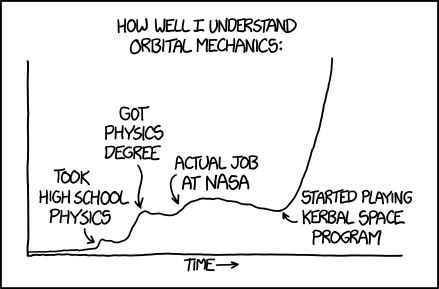
To be fair, my job at NASA was working on robots and didn't actually involve any orbital mechanics. The small positive slope over that period is because it turns out that if you hang around at NASA, you get in a lot of conversations about space.
fallow edge
I do actually play that
I’ve heard that it has fixed spheres of influence though, so it’s definitely not a perfect simulation
fallow edge
True

 rugged bridge
Is there a simple equation for lines in 3d space?
Like for planes there's y=mx+c
Or do you just use parametric equations for 3d
 wanton forge
zenith ember
wanton forge
zenith ember
In 3d, it is far more likely that any two given lines do not intersect than that they do.
 jolly wigeon
In the diagram A is the point (-1,3) and B is the point (3,1). the line L1 passes through A and is parallel to OB the line L2 passes through B and is perpendicular to AB the lines L1 and L2 meets at C. Find C
jolly wigeon
ye
slender gyro
A light weight satellite orbiting around earth elliptically MUST have earth as on of is focci? Right?
It's just keplers laws for two bodies
zenith ember
Yes.
slender gyro
Thanks mate!
opal blaze
<@&286206848099549185> How can you find the area of a regular pentagon. without using trigonometry to solve for angles with no exact value? (or rather no calculator)
 keen aspen
(1/2)a*p
Where a and p are apothem and perimeter respectively
If you know the length of one of the sides, multiply it by 5 to get your perimeter, and with that its pretty easy to find the apothem with triangles
But that involves trig :/
hollow edge
well, you could do stuff with golden ratios
upper karma
could you do something with the length of the points to the center (or centroid)?
hollow edge
if you can find that without trig, sure
zenith ember
You can get the exact value for sin(72) and cos(72) without a calculator.
It's just tricksy
 pure ember
pure ember
pure ember
 grim lion
@zenith ember http://puu.sh/AZLBY/96148487fa.jpg

I'm not sure how I could do this. it's a triangle that has 150 degrees in the inside
how would I know what the side angles are?
I feel like I'm forgetting some key formula
@hollow edge
 thorn valley
the question is whether the angle is bigger than 30 or not
grim lion
yeah
not entirely sure. it appears to be smaller
but
I can't prove it
i mean
d is the only alteernative imo
but it's strange logic
since triangle has 150
thorn valley
visually, you can draw a 30 degree line from the very beginning
grim lion
u cannot have any angl 30 or greeateer
cause if one side is 30 or more
then 150 + 30 + third angle = 180
impossible
so 25 is the only one that would work
but it sounds janky as fuck
lolz
thorn valley
yeah i think you got it
the answer must be within the range 0~30 degrees
and D is the only one
thorn valley
lol
happens a lot in math where the answer ends up being a lot easier than expected
 cinder crag
i hate questions like that
 gloomy parcel
how do i do this
thorn valley
like divide by 2 see where that takes you
 pallid comet
@grim lion haven't done geometry in a while, but you could've tried making a parallelogram using the parallelogram law
 static bronze
how the goemetrical shapes have an equation. like circle,parabola,ellipse.
 upper sedge
What do you mean?
hollow edge
they are the set of points that satisfy an equation @static bronze
static bronze
i mean how can they formulated the equations from the geometry of shapes on what,which bases they are deriving the equations.
hollow edge
the definition of a circle is "the set of points that are a fixed distance away from the center"
the equation for distance is sqrt(x^2 + y^2)
let's say the center is the origin
and the "fixed distance" is r
then the set of points that distance away can be represented as "the set of points satisfying the equation sqrt(x^2 + y^2) = r"
upper karma
What is the difference between a vector and a line segment?
 umbral snow
You can use a vector to represent a line segment. Not all vectors are line segments
Why. Any question in mind?
upper karma
I'm learning how to be a game developer.
And there's something about vectors.
Now what's the difference between magnitude and length?
umbral snow
Vectors have an addition, you can take any two, add them together, and get a new vector
Line segments can't do that
upper karma
So you cannot add two lengths and get one length?
 clear haven
yeah but thats a scalar quantity
1 dimensional
not good for game development haha
if you go north 1 meter and go east one meter after that, the total distance you have traveled would be 2 meters, but as a vector you would take the shortest path
 unborn bane
Hi can I get a rigorous definition of a pseudo vector?
 sour furnace
 raven citrus
I need a couple of hard geometry finals practice tests pls send if u guys found any
 rugged moat
What level? (Uni, high school, middle school) etc.
 steep temple
I have a 40m sphere. On an 'infinite' graph, what are the possibilities of a 1x1x1 brick being in the sphere. I hope I've explained this clear enough. I need a function/formula for always getting the brick in the sphere. If anyone could help, that'd be great.
^ Imagine it in the same space as kind of like 3B1B's Putnam problem
upper karma
Point Z is on side PR of triangle PQR such that m<PZQ = m<PQZ, and m<PQR - m<PRQ = 42. Find m<RQZ
 naive scarab
quick sanity check: for the last sentence, we would need the regular value to be in F(U), not just R^m (so we need a non-trivial regular value).
 dense holly
consider the contrapositive with n=1,m=2 and F(x)=(x,0). then (0,1) is a regular value, contradicting their conclusion that there are no such regular values
you're correct
rugged moat
Hmm... Middle school, Lemme check if I have any
(The maths taught is quite advanced compared to most countries)
Nope.... I think I threw all of them out
cinder crag
can someone give me a quick rundown of vectors?
 white harness
The vectors live in a vector space.
cinder crag
okay
but like what EXACTLY are they
the stuff online doesnt really help me grasp the whole concept
dense holly
look at the wiki page for euclidean vectors
that's probably what you want, but vectors are more general than that
real answer is that first you have a vector space, then vectors are elements of the set the vector space is defined over
cinder crag
ok...
how would you show vectors on paper?
and what are they used for?
like ik its used for physics and geometry but
dense holly
do you know if you want to know about euclidean vectors (like in hs physics) or general vectors like in math?
 real mulch
And everything can be a vector space that satisfies certain criteria.
dense holly
OK, those you can draw as arrows, add them by connecting tip to tail, and multiply with scalars by stretching them
real mulch
https://en.wikipedia.org/wiki/Vector_space - look for "axioms"
To qualify as a vector space, the set V and the operations of addition and multiplication must adhere to a number of requirements called axioms.
cinder crag
o
dense holly
the point of euclidean vectors is to have a direction and a length/magnitude
zenith ember
Don't go all formal right out of the gate...
dense holly
yeah those axioms are satisfied by euclidean vectors, but they are also much more general
dense holly
and euclidean vectors have a dot product as well anyway
cinder crag
in physics
dense holly
representations?
cinder crag
of things moving
like
lets say you throw a ball
and you wanted to represent that on a 3d graph
would you use a vector?
zenith ember
Yes
dense holly
uh kinda?
cinder crag
and if you want to calculate the amount of force needed for it to higher you could mess with the vector?
dense holly
you would use a vector to represent the velocity of the ball at any single point in time
or the force acting on it
zenith ember
No
cinder crag
hmm ok
zenith ember
Not euclidean vectors
dense holly
you represent the trajectory as a sequence of vectors, not a single one
dense holly
although you don't actually use vectors for position really
zenith ember
Eh. Sometimes
cinder crag
ok
dense holly
more like a function from time to position, which is just undecorated R^3
(cause adding positions is meaningless)
cinder crag
okay
zenith ember
I mean, vectors in 3d graphics are used for positioning objects.
cinder crag
thats what i need it for actually
im learning some programming and im trying to use vectors
zenith ember
This is a big topic...
cinder crag
yeah i just wish there was some place that would simplify it
dense holly
what is and isn't a vector is a mathematical distinction, which goes out the window in CG
zenith ember
And I think it's worth learning properly.
cinder crag
okay
cinder crag
alright ill check it out
thanks for the help
i guess sometimes advanced is too advanced
zenith ember
There is also a 3blue1brown series on the essence of linear algebra. I haven't watched it, but I've heard others say it is good.
That may be helpful.
dense holly
oh yeah actually 3b1b is excellent for this

YouTube
A geometric understanding of matrices, determinants, eigen-stuffs and more.
fallow edge
^^^
cinder crag
alright thanks
zenith ember
Just watched that first video. Pretty good intro.
hollow edge
yeah I love that series
naive scarab
Anyone here familiar with the discontinuous action of a group on a manifold? I'm trying to work out how this induces a differential structure on the quotient manifold and I'm having some trouble with a technical point.
so this is the relevant part of do carmo, my question is with the very last claim. I can see why this is true:
=tex \text{for each } p_2 \in X_2(W) \text{ there exists a unique } g \in G \text{ such that } \pi_1^{-1}\circ \pi_2(p_2) = gp_2.
charred spearBOT
naive scarab
I'm having trouble proving that's there's one g which makes this equality hold on all of X_2(W). Anyone have any ideas?
white harness
If p_1 and p_2 are equivalent then there is g such that p_2 = gp_1.
naive scarab
yeah I get that. I want to say pi_1^{-1} \circ pi_2(p) = g(p), but how do I know it's the same g in the entire domain?
dense holly
how does one act with an entire group G on a point p?
is the result the set of points {gp | g in G}?
also what is pi | U in this context?
naive scarab
so we have a group G, acting on a manifold M. We first require that the map taking p to gp is smooth for each g in G
we're considering a discontinuous action, which means that for each point p in M, there is a neighborhood U such that g(U) is disjoint from U
this basically makes the action faithful
then we quotient out by the orbit of the action, so p1 is equivalent to p2 if p1 = gp2 for some g in G
we call the set of equivalence classes induced by this relation M/G
pi is just the canonical projection from M to M/G, so pi | U is the restriction of pi to an open set U in M
 forest dove
Okay yeah I do see the concern, do Carmo does it for a point and just says "It follows easily"
naive scarab
always a trap lol
forest dove
So we already know that pi_i is continuous, yeah?
I'm wondering if that coupled with the fact that the action of G is discontinuous does it
So like, you sorta say okay, assume that for a different point also in that neighborhood g' is what does it for you, then somehow take tiny neighborhoods where g and g' send it to disjoint stuff
forest dove
I think so
naive scarab
and we also know g(U) and h(U) should be disjoint if g is not equal to h
forest dove
Err, for some small enough U, yeah
 eternal orchid
g maps a n'hood U of p_1 diffeomorphically to a n'hood V of p_2 (excuse my differing notation).
If for some other point q in U we have hq in V, then g^(-1)hq is in U. So by discontinuity, h=g.
naive scarab
oh I see it
eternal orchid
(essentially what you guys were saying above, just slightly different phrasing)
forest dove
Well that's a convenient way to show that RP^n is a manifold
eternal orchid
Np, good practice for me. I didn't take any good formal manifolds courses in undergrad so I mostly taught myself this stuff, and often skipped the somewhat technical/dreary stuff like this.
forest dove
Sorta same, my difftop prof didn't really want to get too technical so everything was in R^n, etc
And he'll be teaching big boy difftop next year, wonder how that'll go
eternal orchid
Yeah my first geometry course was classical diffgeom of curves and surfaces in the style of do carmos book with that title pretty much, so more emphasis on computations of curvature etc. abstract manifold stuff was all on me to learn when I needed it.
I remember it being a headache to get used to the way of thinking
but after "getting" the way charts and invariant objects work its nice, and you don't get bogged down anymore.
forest dove
Makes sense
steady widget
wait so are the distance between these two points 6, or sqrt(37)? because using the formula its sqrt(37) but logically 6 makes better sense.
but 0^2=1
o wait fuck
yeah just realized
jesus i can be stupid sometimes, thanks @ebon vapor
forest dove
= p
upper karma
So obviously a Straw has one hole, but if you took a straw and poked a needle through it (two layers of plastic) then how many holes would a straw have?
 jagged oracle
3
upper karma
Because the one hole goes all the way through, similar to the one it started out with
 shadow anvil
Shrink the straw into a donut
It's still the same p much right?
1 hole going through
now the holes made by the pin will create two holes on opposite sides of the donut
Unlike the original hole they're in no way connected
upper karma
Ok
shadow anvil
If that makes sense?
upper karma
So then does that mean that a t-shirt has 3 holes then? If you had a fabric that you could stretch and bend to your hearts desire then could you not form this 3 holes straw into a shape resembling a t-shirt?
shadow anvil
Urm yeah
I guess so
in a topological mind set
If you're ignoring all of the weird creases and stuff
and you make the tshirt into a tube
with the two arm holes being holes in the sides of the tube
upper karma
So then topologically speaking a t-shirt only has 3 holes then
shadow anvil
I guess so
jagged oracle
do the other holes go through the shirt completely?
upper karma
Yea
shadow anvil
Then yes
upper karma
Ok thank you
Another question, if somebody got shot with a bullet, but it doesn’t go all the way through, is it still considered a hole
upper karma
Because I got into a debate about this with my dad
shadow anvil
Or
More exactly
In topology
"A hole in a mathematical object is a topological structure which prevents the object from being continuously shrunk to a point. When dealing with topological spaces, a disconnectivity is interpreted as a hole in the space."
So no
It's more of a crater type thing
upper karma
Well he said that a straw has two holes, so if the bullet goes in you that’s one, and if it goes all the way through you you’d had two
upper karma
Exactly
jagged oracle
technically the human body is genus 1 cuz the the digestive system runs continuously to two openings
"technically"
upper karma
But it can be continuously deformed
All life on earth, begins as the sacred topology: the torus.
Although now That I think about it this might not be 7
shadow anvil
Why not
The only thing that would change that
Is if the holes don't pass out on the other side
upper karma
You don’t know if the hole is the back is two small holes aligned with the front, or it could just be one big hole in the back
shadow anvil
Maybe
If this is a question given to you though
From some school or whatever
You'd hope they wouldn't leave ambiguities like that
upper karma
No, i saw it online
shadow anvil
ah oke
upper karma
Could be
 sacred pilot
lmao
upper karma
Anyway @shadow anvil and @jagged oracle thanks guys
jagged oracle
np
shadow anvil
A friend of mine just actually raised an interesting point
If you consider the shirt to be homeomorphic to a sphere
Then it has 4 holes
(A normal shirt not the one with holes)
jagged oracle
i suppose it depends whether you consider a straw to be a sphere with 2 holes or a torus
upper karma
Is it thicc
jagged oracle
i can see the logic for both
shadow anvil
Yeah
I guess you could take either route
What would be correct though
I guess torus tbh given it's a shirt
It's gonna have thickness
Just found this
Or rather my friend did
jagged oracle
ah, so really we need to find how many holes are in a t-shirt because it's made of cloth
shadow anvil
lmao
many
But are they actually holes
The fabric isn't a continuous sheet
They're actually just ropes winding
and tangled
but now
This is scaling way out of control and nobody really cares 😂
So I'm going to walk away
upper karma
So then taking into account the thickness of the cloth strands, what would the collection of cloth be homeomorphic to? Can we ignore the holes in the shirt at this micro-scale?
shadow anvil
Both
Torus and sphere
I'd say torus though
Is the winner
just because thickness
but still
Either works
upper karma
Yeah that’s what I think as well
dense holly
easiest way for me to think about T-shirt problems is to take the waist hole and stretch it out all the way to infinity, so the shirt is now a flat plane with some holes in it, maybe with shirt arms reaching up to some of them
if you do this, a T-shirt clearly has n-1 holes where n is the number of different openings (ie, equivalence classes of paths you could take from over the shirt plane to under it which are homeomorphic without intersecting the shirt)
steep temple
Think I asked this a couple days ago but here we go again
On an infinite 2D graph with a circle plotted on it, points are randomly dotted against the whole graph. How can I make it so they are always dotted inside the circle?
 errant ether
consider only points with radius less than that of the circle?
how are you generating points
steep temple
Solved ^
thin wasp
Let PA and PB be tangents to a given circle with P outside the circle. Draw a line through A parallel to PB such that it intersects the circle again at C. PC intersects the circle once more at D. Prove that AD extended bisects PB.
(prove PM=MB here)
thin wasp
<@&286206848099549185>
hollow edge
this is cool
eager pendant
@rugged moat why? angle bisector isn't the same as a median
 hard gale
jazza well in an isoceles triangle yes
thin wasp
@hard gale I think he meant in the diagram here
Also, PAB is isosceles but the line comes from the vertex A not p
Actually, what happens if you extend AC to D such that DAPB is a parallelogram
or rhombus in this case
And then extend DB and AM to meet at X
How could we prove that PMA is congruent to BMX? That would imply PM=MB as desired.
Please ping me if you can help
hollow edge
PAM BAM
nice
sry I went out for something for a bit
I'm guessing you use the fact that PAM = ACD
I got to AB = BC
 tiny sphinx
Equivalent to proving angle APB = acos(1/4)
hollow edge
why
no
the answer doesn't depend on the angle
you could construct this with any angle for APB
 tiny sphinx
AP . BP = ||AP|| ||BP|| cos(PAB) = 2Lcos(PAB). 2Lcos(PAB) = 1/2 L => cos(PAB) = 1/4 ?
hollow edge
no @rugged moat I don't think so
rugged moat
y tho
hollow edge
angles have a literal meaning
the arc length along a unit circle
length (or ratios of lengths) are real
@tiny sphinx I don't follow
define L
PB?
tiny sphinx
Dot the vector A - P onto the vector B - P.
||A - P|| = L
||B - P|| = L
(A - P) . (B - P) = 2Lcos(PAB)
2Lcos(PAB) = L/2 => cos(PAB) = 1/4 => PAB = acos(1/4)
hollow edge
PM?
hollow edge
length isn't imaginary
shadow anvil
no lmao
rugged moat
y tho
rugged moat
Sure, I can't comprehend it
hollow edge
t!wiki Euclidian distance
rugged moat
But it should mean something
 loud cedarBOT

In mathematics, the Euclidean distance or Euclidean metric is the "ordinary" straight-line distance between two points in Euclidean space. With this distance, Euclidean space becomes a metric space. The associated norm is called the Euclidean norm. Older literature refers to ...
hollow edge
the idea of "length"
rugged moat
We can just say that it is not a concept definable by Euclidean geometry?
hollow edge
that's like saying "2.3 stair steps" should mean something
rugged moat
Maybe
I think I have come up with my goal in life
To prove that imaginary angles and lengths exists
hollow edge
congrats now your life is meaningless
rugged moat

hollow edge
@tiny sphinx where tf did you get 2L


 hollow edge


 hollow edge
you dot vectors, not scalars
tiny sphinx
I think my mistake is assuming the line is perpendicular
hollow edge
||A - P|| is a scalar
tiny sphinx
That's a typo
hollow edge
where did 2L come from though
tiny sphinx
Dot the vector A - P onto the vector B - P.
||A - P|| = L
||B - P|| = L
(A - P) . (B - P) = L^2cos(PAB)
L^2cos(PAB) = L/2 => cos(PAB) = 1/2L => PAB = acos(1/2L)
This is wrong though
hollow edge
shouldn't that be L^2
hollow edge
where'd you get L/2
hollow edge
how can you say that the dot product is equal to the length of PM?
tiny sphinx
Only if AM is perpendicular to AC, right?
tiny sphinx
I don't know what you're saying, but I'm convinced I made a mistake anyway
hollow edge
I mean the equality depends on what "unit" you use for length
tiny sphinx
Equality of what?
hollow edge
it doesn't hold if you scale the entire thing
of your equation
that seems to be randomly put together
rugged moat
g/s works?
rugged moat
Or should I use V/m
tiny sphinx
All I can intuit is that APB is an isosceles triangle, but I can't even prove that.
It just seems that if it's not, PA and PB wont be tangent
hollow edge
it is
you can prove it by using the center
and proving that two triangles are congruent
PAO and PBO
when O is the center
therefore AP = BP
tiny sphinx
How do you prove they're congruent?
I see that ABO has two sides of length r
Oh
I see
PAO and PBO both have sides of length r and... k
And I guess we can assume PO bisects APB
So SSA
Wait
Why can I assume that
zenith ember
Tangent lines make right angles to radii
tiny sphinx
Oh, so I get those two right angles
It implies that PAO and PBO are also right angles
So the triangles both have right angles and have sides of length r and PO
SSA
zenith ember
Don't think SSA, because in general that's similarity, not congruence.
But for right triangles, we can use Pythagoras to find the missing side.
tiny sphinx
If two triangles are similar and have two sides of the same length, then doesn't the last side have to be the same length?
hollow edge
well
tiny sphinx

In geometry, two figures or objects are congruent if they have the same shape and size, or if one has the same shape and size as the mirror image of the other.More formally, two sets of points are called congruent if, and only if, one can be transformed into the other by an ...
It says SSA applies to definition of congruence
tiny sphinx
Oh, no it doesn't
hollow edge
you need additional information
tiny sphinx
"The SSA condition (Side-Side-Angle) which specifies two sides and a non-included angle (also known as ASS, or Angle-Side-Side) does not by itself prove congruence."
zenith ember
Right. That was my point
zenith ember
I remember it due to the ASS ordering.
tiny sphinx
But since the angle in question is a right angle, we know the sides are equal as you said due to the pythagorean theorem
zenith ember
Yes
hollow edge
I'm working on it
tiny sphinx
How do you know AB and BC are equal?
tiny sphinx
Hm, I got that AB and AC are equal by a different way
tiny sphinx
tiny sphinx
tiny sphinx
I think I'm done for now. Let me know if you figure it out
Kinda just procrastinated not figuring much out
 thorny depot
After drawing AB, CB, and DB and angle chasing a lot with the inscribed triangles and all, we've got a lot of similar triangles
which i think combining that w/ ptolemys might do the trick?
eg, we have that MDB and BPC are similar
and PDM, CDA
AMB, BMD, CBD
tiny sphinx
How do you get that MDB and BPC are similar?
thorny depot
One sec, I'll go back and retrace my steps
tiny sphinx
I do see that ABC is similar to PAB
thorny depot
oh oops, i think i typoed that one
ugh why is my handwriting bad lol
ok total similar trianlges i see: PDM~CDA, ABM~BDM~CDB, PBD~BAD~PCB
and thena lso the PAB to BAC
tiny sphinx
Looks right, but I haven't proved all of those
Anyway, I think your strategy is right
You can use the quad ACBD to apply Ptolemy's theorem
thorny depot
yeah
i just don't wanna bash out the similar triangles w/ ptolemys
but something there should end up cancelling
tiny sphinx
I'm sure at some point you can get 2MB = PB
thorny depot
i just wonder if there's a cleaner way
yeah its just a matter of getting there
i wonder if it would be possible to just snow from teh similars that pm = mb but idk if that'll be possible
tiny sphinx
I didn't know about this theorem. I wouldn't have figured it out
tiny sphinx
Oh, yeah, maybe you can show PM = MB too
I'm sleepy
I'm going to check back for the spoiler when I wake up 😛
thin wasp
By circle geometry I assume he means the alternate segment theorem
<@&286206848099549185> Could someone help? My question is posted above
 bright shard
maybe tangent-secant theorem? idk if things will simplify down though
i think it'll work out if you can prove that CD = 2AD (or PD = 2MD), but i can't see how to prove that
hollow edge
@thin wasp what was your approach exactly?
tiny sphinx
I have a geometry problem. I found a paper for computing the soft shadow of a sphere occluder and sphere light analytically here: https://sourceforge.net/p/stellarium/mailman/attachment/CALF0saQECTyXqoS%3D%3DG1g54zE2medxgTQiju-Awdv3aqU2zg%2Bhg@mail.gmail.com/2/
To determine how much the light is occluded from point p, the method projects the spheres onto a hemisphere of radius 1 around p, scaling the spheres by their distance from p. From here, it treats the spheres as circles on a plane and computes the overlap.
I am interested in finding the area overlapped by the intersection of two spheres (purple volume) and a sphere light. How can I extend the above method to solve this problem? I'd like to know alternative easier methods too.
mint sandal
?
mint sandal
What are you trying to do
opal blaze
h needs to be equal to g
opal blaze
yeah
mint sandal
Why a circle?
opal blaze
because they need to have the same length and a circle is shows you all the points a certain distance apart from each other.
mint sandal
Then triangle CAB is congruent to triangle ACB
Hence angle CAB is equal to angle ACB
opal blaze
It says 2 sides in the exercise?
mint sandal
...
Im talking about 2 triangles
CAB and ACB
They are equal
Because 2 sides are equal
opal blaze
ohh