#geometry-and-trigonometry
1 messages · Page 156 of 1
 tidal notch
first the bottom one
the bottom picture
that looks more confusing
but its probably not
 thorn talon
Its a trapezium and rhombus right?
 dark sparrow
i'm actually a bit busy right now, sorry
 crude kraken
If big square is four, radius of each circle is 1
Length of each corner to the edge of the circle is thus sqrt(2)-1
Length across big square is 4sqrt(2) diagonally, and we know that the circles each take up 2+sqrt(2)-1
So length of one side of the small square is
4sqrt(2) - 4+2sqrt(2)-2
I think
4sqrt(2) - 2(2+sqrt(2)-1)
So yea, 4sqrt(2) - 4 + 2sqrt(2) - 2
Or 6sqrt(2) - 6
How?
If one side of big square is 4, then radius is 1
diameter is 2
😛
So the area is
by squaring the above
108-72sqrt(2)
Or roughly 6.177
You're welcome -2
(tfw I'm not -1)
They have an interesting approach actually
drawing the triangle there
Since length of side is 2sqrt(2), the square length is 2sqrt(2)-2
And if you square that you get .6something...
...
Where'd I mess up D:
dark sparrow
and you didn't mess up, dw
dark sparrow
== (2 * sqrt(2) - 2)^2
 charred spearBOT
0.6862915
charred spearBOT
0.70710678+0.70710678i
 dark sparrow
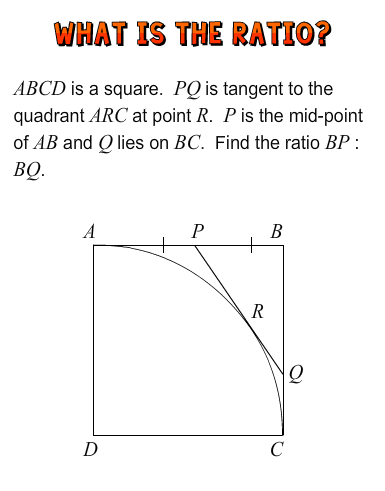
what have you tried?
dark sparrow
are you allowed trigonometry?
 marsh rover
Anything will do
dark sparrow
then you can do this
marsh rover
the ratio is a trig function
dark sparrow
indeed
marsh rover
Oh when I saw this problem i thought it would be a number just some number
dark sparrow
angle BPQ = 180° - 2θ
so φ = 90° - (180° - 2θ) = 2θ - 90°
tan(θ) = 2
is that clear so far?
@marsh rover
marsh rover
Im not sure
I havent learn trig identity yet
But is the answer really a trig function? Why cant it be a number
dark sparrow
it is a number
and i was about to explain how to find it
=tex \tan(2\theta) = \frac{2\tan(\theta)}{1 - \tan^2(\theta)} = -\frac{4}{3} \ \tan(2\theta - 90^\circ) = -\frac{1}{\tan(2\theta)} = \frac{3}{4}
charred spearBOT
marsh rover
hold on
I remember posting this question on quora
x2+y2=(x+2x−y)2⇒8x2−6xy=0⇒4x=3y⇒xy=34x2+y2=(x+2x−y)2⇒8x2−6xy=0⇒4x=3y⇒xy=3/4
marsh rover
I dont understand why the Hypotenuse is x + 2x - y
The answer the guy gave is 3/4
which is quite close if you draw the thing on paper and actually measure
Is there some theorem?
dark sparrow
well i mean, the side of the square is 2x
and so QC = 2x - y
which i hope is clear
dark sparrow
yes
marsh rover
why is that
dark sparrow
do you understand why QR = 2x - y?
marsh rover
QC = 2x-y yes
dark sparrow
no, i'm asking you whether you understand why QR = 2x - y
dark sparrow
i take it that you also don't understand why PR = x, then
dark sparrow
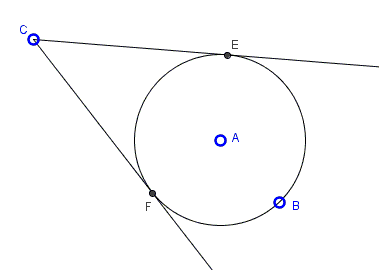
if you draw two tangents to a circle from the same points, the line segments you get will be equal
 inner lantern
Can anyone create some problem?
And please with the answer, I will trick my friend.
dark sparrow
what kind of problem
inner lantern
some advanced problem
dark sparrow
that's still too vague
inner lantern
if you refers “problem” to something like triangle or quadrilateral
dark sparrow
@tropic island can you repost those definitions and the problem? i forgot which was which and which one you needed
well, theorems, not definitions
 tropic island
Wait gtg
Brb is like 10 secs
Theorem (Leg opposite to 30° ∠): In a right triangle with a 30°-angle, the leg opposite to the 30°-angle is half of the hypotenuse.
Proof: Extend AM to point B so that AM = BM. Then, ΔAMC ≅ ΔBMC by SAS and AC = BC by CPCTC. But m∠A = 60° and ΔABC is equilateral (as isosceles triangle with 60°-angle). Thus, if AC = a, AM = a/2.
Theorem (Leg opposite to 30°∠ Converse): If one of the legs in a right triangle is half of the hypotenuse then the angle opposite to that leg is with 30°-measure.
This goes with the first one
dark sparrow
mhm
and what problem were you doing again?
idr which of these you actually needed there
of these two, the "direct" theorem can be summed up as "if angle = 30°, then leg = hyp/2" and the "converse" can be summed up as "if leg = hyp/2, then angle = 30°"
tropic island
In △ABC, m∠CAB = 60° and point D ∈ BC so that AD = 10 in, and the distance from D to AB is 5in. Prove that AD is the angle bisector of ∠A.
Which theorem used to prove problem?
a) Leg opposite to 30°∠
b) Leg opposite to 30°∠ converse
c) Median to hypotenuse th.
d) Median to hypotenuse th. converse
dark sparrow
ok gimme a sec
tropic island
Yeah I got that picture
dark sparrow
so since you want to prove that AD bisects angle A, and you're given angle A = 60°, that means you want to prove angle DAB = 30°
tropic island
And you know DHA is 90°
dark sparrow
yeah, you know ADH is a right triangle
in this case, you have leg = hyp/2, and you want angle = 30°, so you'll need the converse
dark sparrow
as i said earlier, i feel like the forceful division of a single biconditional ("both-ways", if you will) theorem into a "direct" and a "converse" is idiotic
dark sparrow
because like, both this labeling and the reverse are equally valid
tropic island
Yep
dark sparrow
personally, i was taught this fact as one theorem which went both ways
it required a slightly lengthier proof, but it was better in terms of organization
and honestly, that's how all the theorems i've been taught have been presented
dark sparrow
i'm in my first year of uni
dark sparrow
and i'll let you in on a little secret: in uni, none of these biconditional theorems are broken up
if an implication (an "if this, then that" statement) only goes one way, it's presented as such, but otherwise, it's like "these statements are equivalent: 1. [blah] 2. [blah]"
i've had a few theorems stating the equivalence of three statements actually
which would be a nightmare to break up into one-way implications
since you'd have 6 of those
1->2, 2->1, 1->3, 3->1, 2->3, 3->2
 cobalt folio
Does anyone remember the matrix for symmetry with the yz plane? in R3
Can't find it on my notes and I can't find it on Google
does symmetry mean the same as reflection?
We use "simetria" in Spanish I never heard of Reflections
 upper karma
kj,h
marsh rover
What is your answer?
dark sparrow
what've you tried, and where did you get stuck?
marsh rover
Well i tried and my answer was 60 something
i just want to confirm
I used similar triangle
dark sparrow
8 cos(θ) = 8 sin(θ) + 6 cos(θ)
8 sin(θ) = 2 cos(θ)
tan(θ) = 1/4, so cos^2(θ) = 1/(tan^2(θ) + 1) = 16/17
area = 64 cos^2(θ) = 64 * 16/17
== 64 * 16/17
charred spearBOT
60.23529412
dark sparrow
looks correct
marsh rover
ok
dark sparrow
does my solution need explaining?
marsh rover
It's okay I can handle it
Can I just post 1 more Question
I know the answer and saw the solution just dont get it
dark sparrow
ok
 fluid hawk
@marsh rover
tan(ABM) = AM/AB = (AB/2)/AB=1/2
second one is either too hard, or I'm just dumb. 🤷
probably the latter
 tropic stirrup
draw a foot of perpendicular from F to AD and call it H
then by ASA congruence (AD = FH, FHE = ADG, HFE = DAG)
triangles EFH and GAD are congruent
AG = 13 by pythagorean theorem, and therefore EF = 13
you shoulda seen it earlier tho 😩 👌🏼
fluid hawk
which channel do i go if i need to ask people about college math
tropic stirrup
#question-anynumber
dark sparrow
all kinds tbh
fluid hawk
oh cool
marsh rover
The first question I posted answer is E while the second question answer is 13
 fading thorn
how do you proof this determinant identity for an nxn matrix?
oh wrong channel i guess
dark sparrow
what are you taking as the definition of the determinant?
fading thorn
have it here, one moment
these 3 properties, n is element of {1,2,...}, r is e. of R; v1,v2,...,vn,w are e. of R^n; i is e. of {1,...,n}; j is e. of {i+1,...,n}
fading thorn
any idea?
 red mango
the levi civita symbol has the same symmetry properties as the determinant
Maybe you can exploit that somehow
upper karma
@fading thorn just decompose in your basis and use the properties there is strictly nothing else
you will get a sum on the n-uplets by the n-linear property
and using alternate you will reduce it to the sum on S_n
 round isle
Yes
 urban sonnet
Okay, if it is possible @round isle please walk me througgh it.
It isn't super hard, it should be relatively easy for you but i'm just a bit dumb aha. 😅
Question 4 please.
 autumn wind
how can the squares of a tesseract move?
 half oasis
Could someone explain to me why AB/sinC = 2R ? Where R is the radius of the inscribed circle and the angle C measures pi/4 (45 degrees)
dark sparrow
uhhh
i don't think it does
AB/sin(C) would be greater than AB
which even 2R pretty clearly isn't
half oasis
the answer is R = 1 , i got it from the answers of an exam
i drew the diagram maybe that's why it looks wrong
dark sparrow
what was the question?
half oasis
Find the radius of the inscribed circle of the triangle ABC. where AB = sqrt(2) and C = pi/4
it's from the Romanian baccalaureate
dark sparrow
wat
what you're saying makes zero sense
what triangle are you applying the pythagorean theorem to?
what point are you calling D?
ahem?
C = 45°
the problem says so
ABC can't be equilateral
 spiral lintel
Question : how do you solve for the big triangle created with the diagonals of an isos. trap.
spiral lintel
The angles
 turbid bear
How would you solve this problem?
I think splitting it into triangles is how you do it but I’m not 100% confident
charred spearBOT
153
 white swift
😄 ?
round isle
What do you even need to find in this question?
turbid bear
Length of A to D using trigonometry
turbid bear
It’s a non-straight triangle
@white swift
turbid bear
Can’t say it’s curved but the hypotenuse is just split into two bits
turbid bear
Drawing a line from point b intersecting DC?
white swift
continue AB to intersect DC
turbid bear
Ok I managed to solve by splitting it into two triangles and working out their adjacent and opposite lengths thanks for the help tho @white swift
white swift
good job 😄
 whole pumice
done with my hw, lmk if you need help
marsh rover
repost
 topaz valley
What have you tried?
marsh rover
-hi-
First I let the square side be 3. Hence, DN= 1, NC = 2 (stated)
Next I realise that triangle MDN and triangle NCG are similar
DN/NC = 1/2 so MN/NG = 1/2 etc
my problem then turns into find the length of MD Why? So that I can take 3 - MD to find AM
I let MD = n
Since The black triangle is an isosceles
BC + CG = MN + NG = 3 + something
that something is 2k because of the 1/2
so 2k+3 = 3(sqrt(k^2 + 1))
solving for k gives me 2.4
ratio is hence (3-2.4) / 3
= 1/5
the problem was hard really a lot of insights had to be made
 surreal bolt
would ya like a separate solution?
I'll take that as a Yes. heh.
We'll use coordinates. Cartesian plane style.
marsh rover
Okay sure
surreal bolt
N is the origin.
N (0, 0), D (0, 1), C (0, -2), M (a, 1), B (-3,-2)
Let K be the midpoint of BM ((a-3)/2,-1/2). Note since BMG its isosceles, GK perpendicular to BM.
MN is a segment on a line.
Call it line L.
L has slope 1/a through (0, 0)
or y = (1/a)x.
BG has the equation y = -2.
G is (-2a, -2)
Again:
Let K be the midpoint of BM ((a-3)/2,-1/2). Note since BMG its isosceles, GK perpendicular to BM.
BK has slope 3/(a + 3).
GK has slope (-1/2 + 2)/((a-3)/2+2a)
negative inverses:
3/(a + 3) = -((a-3)/2+2a)/(-1/2 + 2)
3(-1/2 + 2) = -(a + 3)((a-3)/2+2a)
9 = -(a + 3)(a-3+4a) [multiply by 2]
9 = -(a + 3)(5a-3)
9 = -5a^2 - 12a + 9
a = 0, -12/5
M (-12/5, 1); A (-3, 1)
MA = 3/5
AB = 3
tan(theta) = 1/5
I admit to leaving out (forgetting) for a long time that M had a y-value of 1 in this setup. I was trying to have M be a generic (a, b) and terrible expressions happened with nothing falling out at the the end.
But the problem turned out okay after finally noticing b = 1. Hope you got something out of this solution. 😃
turbid bear
1=1
surreal bolt
... I feel mocked somehow.
marsh rover
sorry i was afk for some bit
surreal bolt
Br b
spiral lintel
wait the last problem, I got 1/5
I found ABM = 26.56...
1/2**
@ruby swallow can't, you need you know that CI = AH for M to be the midpoint
to&
@marsh rover I got 1/2 but I might be. First I assume that each side of the square is 2, so AB=2 and AM=1 just for proportions.
root of x^2 + 2x^2 = root of 5 times x
tan(cos-1(2/root of 5)) = .5
or tan(cos-1(2x/x(root of 5))= .5
maybe im wrong tho
marsh rover
You are assuming AM = 1 as M is the mid point which isnt stated
upper karma
Does anyone mind explaining why the sum of the exterior angles for regular polygons will always be 360 degrees?
 rain canyon
i'm not sure if this is the right explanation but if you divide 360 by n (360/n) , n being the number of sides of a polygon, you'll know what one of the exterior angles of the polygon is
for example, a hexagon has 6 sides and you want to find out what one of the exterior angles is. so you divide 360/6 and get 60. so 60 is one of the exterior angles of a hexagon
spiral lintel
@marsh rover is M the midpoint of AD?
spiral lintel
nvm
dark sparrow
@upper karma imagine that you're on a motorcycle going around the polygon
at every corner, you will have to turn
and each individual turn is equal to the corresponding exterior angle
but if you come full circle that means you've turned a total of 360°
dark sparrow
two column proofs 🤢
 ruby swallow
Is it at least correct
dark sparrow
idk what step 3 is meant to be
 pallid ledge
 whole forge
I also need help with that but like when they give u a number then u have find the other pair...eg...AB=5 find CH idk how to do them
dark sparrow
?
whole forge
What she sent @ruby swallow
 umbral snow
The interior angles of a triangle add up to 180 degrees
whole forge
Yes
umbral snow
So
x + 48 + 76 + 65 = 180
whole forge
Okay thx what about the second picture?
umbral snow
Similar triangles. The triangle doubles in size for every side. So 10
whole forge
Thanks i got it
Please explain me one of these
I dont get them
Is the same solving for x?
@here plz
Im sorr
Sorry
dark sparrow
okay so which one of these do you want explained?
whole forge
1 or 2
whole forge
What
 latent turtle
You just set both of the equations equal to eachother and subtract to find X
The go from there
dark sparrow
no.
you can't just blindly set the sides you're given equal to each other
you don't immediately know if they're equal
whole forge
@latent turtle i was doing it but i dont think is correct
latent turtle
Oh didn't see that my b
dark sparrow
do you know what a median is? @whole forge
whole forge
Yeah ig
dark sparrow
so
whole forge
The half
dark sparrow
no.
it's the line from a vertex of a triangle to the opposite side which divides said side in half
now, is SV supposed to be a median in that triangle?
whole forge
Yes....
dark sparrow
and so RQ = RV + VQ = 2RV
whole forge
Im confused..sorry csn u put the equation in a piece of paper its gonna be easier for me
dark sparrow
...how will me writing that on a piece of paper and sending you the pic make any difference?
whole forge
Yes it will i will understand the process
whole forge
Ohh yes i think i do
whole forge
Kinda but idk what it has to do with the numbers :(
dark sparrow
i was about to get to that.
whole forge
Okkay continue
dark sparrow
so is it clear why RQ = 2RV?
whole forge
Yeah
dark sparrow
so now we can replace RQ and RV with the expressions we're given
x + 5 = 2(x - 2)
do you understand what i just did?
and do you need help solving that for x?
dark sparrow
what?
whole forge
Nothing
dark sparrow
ok
whole forge
Ouch...u should make videos on youtube ill watch ur videos and u can get them from there
Lol ur good man
dark sparrow
psh, i would, but i sound like a dude and until i fix that i'd rather minimize the amount i need to use my voice
whole forge
U can use a program for ur voice tho
dark sparrow
that's unlikely to make me sound the way i want to sound, honestly
whole forge
But people care more about the content of what you teaching than ur voice...Well im just saying cya i gotta finish this assigment 50 questions
dark sparrow
pff
first and foremost i'd be trashed in the comments for being trans, that's for certain
because youtube
 gritty flare
@dark sparrow btw i think in america they call Median the altitude?
whole forge
But u wont tell ur sex gender...u decide tho i just u should be taking advantage from ur knowledge
U also can do like c-khan academy they just shiw their work very clearly and only using a voice
gritty flare
@dark sparrow 😗 but dont be that way... look at the opposite... people who actuallywill enjoy your vids 😄 i mean you explain like a beast in math
whole forge
Ikr^^
And the vids u put on youtibe ppl on this server will go to watch then if they really need help just create the playlists for the topics and make the kinda short
May be u wont earn millions but is better than not making anything here
 muted sequoia
 tropic yarrow
my dumbass cant go fukin geomety
im in calc III lol
anyway how do i scale things around a center poitn
like this but with a square
like that
lol nvm my dumass fogot vectors existed
i got it
 muted lichen
I need someone to go to mathematics in vc to help me on my 6th grade test corrections
muted sequoia
This is how much I understand...
tropic yarrow
rotte question pls
 blazing eagle
Which part do you think is the problem
muted sequoia
I don't understand most of this, I know the basic thing of vectors like beginners stuff
I know that OBA makes a triangle
Q is somewhere between AB near B
OP= 2/5 OQ
I don't really get the "AP produced meets OB at R"
But I think it means that if I draw a line straight through the point AP it'll touch a point in OB
And that's where R is
I'm sorry if I'm asking stupid questions but I really need to learn this
Woops I think I'm asking in the wrong channel
 tawny drum
Still in highschool, so nothing impressive, but something caught my interest. According to my book this rule follow: https://gyazo.com/4b0da1795fa479d139a11e2d2b946633
 tropic stirrup
uh
dark sparrow
you don't need the circle there 😛
tropic stirrup
that's an "of course" thing
tawny drum
Yeah, but I'll get to that
dark sparrow
perpendicular lines have the property that their slopes multiply to -1
tawny drum
That isn't my question
My question is
if the slope is a straight line vertically
that means the slope is infinite
and if the other slope is 0
0 x infinite = -1?
tropic stirrup
To be precise, the slope does not exist
dark sparrow
the m1 * m2 = -1 thing doesn't apply in that case
tawny drum
that doesnt make sense to me
dark sparrow
yeah that's the edge case
so no wonder it doesn't make any sense
m1 * m2 = -1 for perpendicular lines if both slopes exist and are finite and nonzero
tropic stirrup
They must have said the conditions somewhere in the corner of that book
tawny drum
They actually haven't
tropic stirrup
:disgust:
tawny drum
is it true that lim a -> infinite and b -> 0 with (|a| x -1 x |b|) = -1?
the first -1 is there, because 1 line always approaches from a negative side
dark sparrow
...no, if your a and b are independently approaching infinity and 0 then that limit simply doesn't exist
dark sparrow
it's defined like that, yes
 mighty slate
Hi I have a question about Diamond Hierarchies. I'm trying to understand this paper: http://citeseerx.ist.psu.edu/viewdoc/download?doi=10.1.1.540.4575&rep=rep1&type=pdf
I can't figure out how to find the parents of a diamond. Section 3.2 talks about parent diamonds but doesn't really tell you how to find them. Figure 3 shows visually where these parent diamonds are located. But I don't know how to explicitly find the offset of these parent diamonds from the split vertex of a diamond
upper karma
wtf?
dark sparrow
i can't read anything you've written
dark sparrow
yes
gritty flare
so i just used Law of Sine
dark sparrow
i understand that
gritty flare
sin(51)/11= sin(b)/10
dark sparrow
uh huh
gritty flare
so i just multiplying everything by 10
dark sparrow
uh huh
gritty flare
10sin(51)/110=sin(b)
dark sparrow
ahem?
gritty flare
so
dark sparrow
10sin(51°)/11 = sin(b), surely?
charred spearBOT
Failed to parse equation: Invalid syntax at position 8
arcsin(10sin(51)/11)
        ^
=calc asind(10*sind(51)/11)
charred spearBOT
44.95055729
 dusty gazelle
 dark sparrow
much better
dusty gazelle
Well, something like this:
The part where the radius touches the tangent would be 90
dusty gazelle
The angle TSR=90
dark sparrow
👍
dusty gazelle
And the only other part I got is <y=2<x
dusty gazelle
Okay
dark sparrow
you know and TSR, and you know angle TRS
dark sparrow
and the three angles in triangle RST have to add up to 180°, yes
this'll let you find x
then y, since you stated correctly that y = 2x
dusty gazelle
Yes
dark sparrow
and then z, similar to how you found x
dusty gazelle
Got it.
upper karma
There should be a functions theme for this category because grade 11 is functions
umbral snow
? @upper karma
upper karma
Anyone know if I did this right
tropic island
In a right triangle the leg opposite to the acute angle of 30° is 7 in. Find the hypotenuse and other leg.
Hypotenuse= [] in.
Leg= [] in.
dark sparrow
okay what have you tried so far?
tropic island
Hypotenuse is 14 in.
dark sparrow
mhm
dark sparrow
147?!
tropic island
==14*14
charred spearBOT
196
tropic island
==196-49
charred spearBOT
147
dark sparrow
okay phew you didn't just concatenate 14 and 7
it is sqrt(147) though
a.k.a. 7 sqrt(3)
😛
tropic island
No its not
dark sparrow
=tex 7\sqrt{3}
charred spearBOT
dark sparrow
...what did you put in for an answer that your system rejected?
dark sparrow
don't get what
dark sparrow
okay you know $$\sqrt{ab} = \sqrt{a}\sqrt{b}$$, right?
charred spearBOT
tropic island
Yeah
dark sparrow
=tex \sqrt{147} = \sqrt{49 \cdot 3} = \sqrt{49} \cdot \sqrt{3}
charred spearBOT
tropic island
==49*3
charred spearBOT
147
charred spearBOT
tropic island
=tex \sqrt{147}
charred spearBOT
dark sparrow
but i mean, sqrt(147) = 7sqrt(3) so it doesn't really make a difference other than aesthetics
dark sparrow
🤦
tropic island
Smackes head a little too hard
Given: ∆AFD, m ∠F = 90°
AD = 14, m ∠D = 30°
Find: Area of ∆AFD
For this
Do you change it to?
=tex \ (7*7sqrt(3))/2
charred spearBOT
tropic island
=tex \ 7*7sqrt{3}/2
charred spearBOT
tropic island
Damn it
dark sparrow
=tex 7 \cdot 7\sqrt{3}/2
tropic island
I give up!
charred spearBOT
charred spearBOT
tropic island
Is that it?
dark sparrow
yes
 final prairie
=tex a\frac{b}{c}=\frac{ab}{c}
charred spearBOT
charred spearBOT
tropic island
=tex (8\sqrt{3} \cdot 2 = 16\sqrt{6}?
charred spearBOT
tropic island
Life
white swift
8*2 = 16
tropic island
Yeah
white swift
how does your $$ \sqrt(3)$$ turn into$$ \sqrt(6)$$
tropic island
IDK
charred spearBOT
white swift
WHAT DO YOU MEAN you don't know lol
tropic island
What is $ \sqrt(3)$$ \cdot 2
white swift
okay so $$8a2=16*a$$
charred spearBOT
tropic island
no
white swift
$$a=\sqrt3$$
tropic island
wait
charred spearBOT
white swift
what do you mean no
white swift
=tex (8*\sqrt3)^2 ?
charred spearBOT
white swift
=tex (\sqrt3)^2 =?
white swift
are you legit 😄
white swift

Khan Academy
Learn about the square root symbol (the principal root) and what it means to find a square root. Also learn how to solve simple square root equations.
tropic island
Done that
white swift
have you?
white swift
=tex 3^2=9
charred spearBOT
white swift
=tex \sqrt9 = 3
charred spearBOT
white swift
yes so its just 3
tropic island
YES
white swift
great
charred spearBOT
tropic island
=tex 16 * \2sqrt{3}
charred spearBOT
Rendering failed. Check your code. You can edit your existing message if needed.
white swift
=tex 2*(16*\sqrt3) ?
charred spearBOT
white swift
@tropic island
charred spearBOT
charred spearBOT
tropic island
tex= abc
white swift
$$2*(8*\sqrt3) \to 28\sqrt3 = 16*\sqrt3$$
charred spearBOT
tropic island
No
white swift
????
charred spearBOT
tropic island
WTH
tropic island
$$8\sqrt3$$
charred spearBOT
white swift
????????????????/
tropic island
$$2(8\sqrt3)$$
white swift
$$a(bc)=?$$
tropic island
$$32 \cdot 2\sqrt3$$
charred spearBOT
 thick coyote
the first one is 45
 shy shale
send me the work with it on how to get to the answer
what about the rest of the question number
upper karma
what
shy shale
I need help with all the questions on that screenshot
upper karma
each acute angle 45?
shy shale
I need answers and the work with it on how to get to the answer
upper karma
no way
upper karma
@thick coyote if 2 angles are 45 then 3rd is 90
idk if isocles triangles can have a 90 deg angle
thick coyote
no, that has to be 45 the scam is if he really needs these questions to be answered with full working
thick coyote
well both sides are equal so $$tan{(\theta)}=1, (\theta)=45$$
charred spearBOT
upper karma
all angles are given and a side
thick coyote
for 3 across?
upper karma
with wot
thick coyote
what is this for?
thick coyote
yeah i thought so
upper karma
what's ur profile pic
upper karma
but bruh you name is tasty bagel
thick coyote
what a shocking betrayal
final prairie
This is an interesting question
thick coyote
anyone made any progress here?
upper karma
I didn't
 floral crest
I think you have to prove a before b.
floral crest
You can prove that n-1/n < n/n+1 but to put the a/b in the middle, you gotta shorten the distance between a/b and n/n+1.
upper karma
=tex \frac{a+1}{b+1}-\frac{a}{b}= \frac{ab+b-ab-a}{b(b+1)}=\frac{b-a}{b(b+1)}>0
charred spearBOT
upper karma
the process is increasing so that answers b)
thick coyote
the process is increasing?
floral crest
This is really interesting.
I think if you start off below 1/2 you always hit one half
the only other numbers that you can hit above 1/2 and not be at n/n+1 are numbers between n/n+1 numbers. Once you hit the next n/n+1 number, the number n-1/n is lower than your a/b
and one half holds, because the next number down that is n/n+1 is 0
thick coyote
can you prove that it always hits 1/2
floral crest
No I cannot. Or I haven't yet.
floral crest
I thought maybe thinking about parity would help. Like you first number can't be even/even. But I didn't get very far.
thick coyote
was part (a) solved?
floral crest
not here.
thick coyote
🤔
floral crest
@thick coyote well hey. So say you start below one half and you end up with 3/4
subtract one from that in both the numerator and the denominator
you've already hit 1/2
er
subtract one from denominator and one from the numerator
so to be able to hit any n/n+1 number at all, you have to hit the one before it unless you start between the one before and the one that you hit.
thick coyote
thats right
floral crest
The first one seems to be somewhat related. like b-a is the distance between the numbers on the number line. b has to be greater than a because a/b < 1 . so you're adding the whole distance between them to both the top and the bottom
thick coyote
yeah theres a link missing there
dark sparrow
k it seems like i'm the one in need of a hand now
since i had to skip last week's geometry class due to an unexpected illness and now the homework seems to contain a thing covered in the class i skipped
so i've got this equation describing what the problem book calls a "projective transformation of the projective line"
and i'm asked to determine when this transformation has 0, 1, 2 and infinitely many fixed points
so far i've rewritten the whole thing a bit more compactly in matrix form
=tex \lambda \mathbf{x'} = A\mathbf{x}
charred spearBOT
dark sparrow
but i'm not sure if this even makes sense
or what lambda is
<@&286206848099549185>
 hard atlas
Ok, I'm really unsure what I'm doing here, but I'll give it a shot
dark sparrow
i mean
if what i've just done makes sense then i think i can take it from there
ish
hard atlas
It does look like it makes sense to me
upper karma
Can someone please let me know if I did these two problems correctly?:
If you can't see #23, my answer is (-25, -6).
upper karma
Thank you. I'm going to redo that problem and send you my answer.
upper karma
Thank you 😛
tropic stirrup
^^
 sullen flint
area is 20 cm^2, and the perimeter is 18 cm
find a, b
is system
ab = 20
2 * (a + b) = 18
correct ?
tropic stirrup
You've set up the equations all good
sullen flint
but when i make a = 20/b and plug it into second equation i get mess
tropic stirrup
instead,
upper karma
Is this correct now, @tropic stirrup?
tropic stirrup
simplify the second one and plug it into the first equation
oh
still nope
-18 = -1 + x_2
you did an algebra mistake x'D
upper karma
Let me see....
sullen flint
2a + 2b = 18
a = -b + 9 ?
tropic stirrup
Yes
now put that in ab = 20
I'm assuming you know how to solve quadratic equations
upper karma
Is this correct? @tropic stirrup
tropic stirrup
Yep it is! Good job~
upper karma
Thank you so much 😃
sullen flint
i got that b = 5/2, now i plug b = 5/2 into ab = 20 ?
tropic stirrup
No problem! ^^
And yes, ambulas
However
Your answer to b doesn't seem correct
sullen flint
5/2 or 2.5
upper karma
@tropic stirrup, last one...is the last answer correct?
tropic stirrup
Oh uh yep it is
upper karma
Awesome 😃
tropic stirrup
^^
 versed summit
not alot of stuff to go off here
shy shale
@upper karma
versed summit
probably GH
crude kraken
AB/GH maybe?
versed summit
if its similar maybe its asking you to find each side's corresponding side in the other shape
intuitively
shy shale
Im stuck
versed summit
Dromas find each side's scaled down version
on the similar shape
like AB -> GH
and AE -> GF
BC->HJ
and so on
does help?
versed summit
when one shape is similar to another, it means simply that one shape is a mini version of the other
versed summit
each side on one shape is bigger than its corresopnding side on the other shape by some fixed ratio
as there are no distances on this shape you have to eyeball it
notice how all the angles are the same on both the shapes
anyway
if you pick a part on the big shape, the side similar to it will be in the same part on the smaller shape
for instance
side AB kinda makes the right side of the roof on the bigger shape
so the side it is paired with is the side that makes the right side of the roof on the mini shape
which is GH
also the angles on each vertex on one shape will be the same in the mini shape
thats how id do it
gtg hope that helps
shy shale
Ok thanks dude. That helped.
Appreciated for helping me
Since you gtg is their any other tutorser that will help me @versed summit
crude kraken
Did I find the area right?
crude kraken
Also, I might be able to, but I forgot proofs if it has to be two-column
shy shale
If anyone is here can someone help me with 7
crude kraken
Two polygons are similar if there is a way to make it so the ratio of one side to another is always the same.
shy shale
I neeed clarification understand how to do it
crude kraken
For instance, take a line that we cut in half, to get from the first line to the second we divide by two, and that means the scale factor is .5
Or, if we look at it from the smaller line, the scale factor is 2
shy shale
Hold up need to take notes on this but explain please
crude kraken
Expanding that to a square, obviously squares are similar (their angles are all 90 degrees), but you can find the scale factor by dividing one side by the other
I dunno if you know this but given an angle and two sides you can figure out everything about the triangle but that isn't necessary. You have two sides and an angle, so the third side must follow the pattern, so the two are similar if the scale factors of each line are the same.
One line is 18/12, the other is 15/10, does 18/12=15/10?
shy shale
Yeah im not really too sure about that or my geometry teacher taught it.
But barely understand what my teacher said when I took notes in class in a textbook pages
crude kraken
You don't need to be concerned with finding the third side and stuff yet ;p
shy shale
Ok
crude kraken
But did my point get across for the scale factor?
crude kraken
It's not how they look, the drawing isn't necessarily to scale
Here, let me put it this way
Two shapes are similar if you can multiply all the sides of one by some number to make it the same as the other. That number is the scale factor.
shy shale
Oh so its not ok. I thought it looked similar because of the picture how its scaled.
crude kraken
:p
shy shale
But says nit drawn to scale wow im dumb 🤦♂️
crude kraken
oh wait I'm doing this wrong
crude kraken
You're supposed to divide across both triangles, not across the same triangle
all I really did was prove 32 degrees = 32 degrees 😛
crude kraken
Yep
So, you want to know if when you multiply both sides of triangle VUW by any value, it's possible to have it becomes triangle SRT
To do that, you see what each side's length is relative to their counterpart
so 12/10 and 18/15
upper karma
@shy shale hey, for #7 you say it is similar by SAS
crude kraken
oh yeah you have to say it's similar by some rule or another that I never understand
shy shale
Wait what yeah I think I said it’s similar but he said its not similar when he said it was wrong
crude kraken
well yea, there's the simple answer
crude kraken
== 18/15
charred spearBOT
1.2
crude kraken
== 12/10
charred spearBOT
1.2
upper karma
mee gud why do you need a calc for those 2 fractions fam
shy shale
So basically it’s similar and why?