#geometry-and-trigonometry
1 messages · Page 155 of 1
 rare talon
Can you translate the question?
 upper karma
You are standing on a 3,6m high edge with a 6m rope
huw much closer does the boat come to the edge if you pull the rope in 1,5m
I know the solution for the answer
rare talon
To be fair, I don't understand the question
upper karma
but I don't know why
rare talon
What do you mean by "pull the rope" in 1.5 m?
upper karma
So a rope is tied to a boat from a dock
the rope is 6m long and the dock is 3,6m tall
upper karma
yes
rare talon
Which one is 1.5 m?
upper karma
rope
rare talon
Okay so the dashed line is 4.5m
upper karma
so I know that you are supposed to use
upper karma
(sqrt) (6^2)-(3,6^2)-(4,5^2)-(3,6^2)
upper karma
it tells me to
rare talon
Nah
No need, memorizing formulas will make your brain burns
Too much
Okay see my picture
upper karma
yes
rare talon
What length does the question need you to ask?
The difference between BC and BD right?
upper karma
I think so
rare talon
Yeah the question is asking how much the boat closer if you pull the rope by 1.5m
upper karma
yeah
rare talon
So you should find how close the boat to the dock at initial state
Which is BC
Okay?
Can you find BC?
rare talon
Yeah
upper karma
um first it was 6
 upper karma
D?
rare talon
Do you notice that <B is right angle?
Open the full picture
It got cut here
Open the link I mean
upper karma
yes
rare talon
And AC is the length of the initial rope before you pull it
Now
Can you find BC?
Which is the distance of the boat to the dock in it's initial state
upper karma
I can use pythagoras
rare talon
You hate decimals?
upper karma
because I know the solution already
upper karma
okay
rare talon
And the length of the rope in initial state is 25 meters
Now if you pull the rope by 8 meters, how much closer the boat will be to the boat?
upper karma
so the dotted line is 17m
rare talon
Yeah
upper karma
ABC
upper karma
yes
upper karma
sqrt (25^2)-(15^2)
rare talon
The result is?
upper karma
20
upper karma
BD?
rare talon
Make yourself consistent (hint : What triangle do you use on pythagoras? )
upper karma
oh
rare talon
So what is it?
upper karma
yeah it's BC then
rare talon
Okay
Good
Now
You pull the rope by 8 meters
So we have 17 meters on the dashed line (AD)
What you're gonna do with that?
upper karma
90 degrees
upper karma
idk what the other requirements are
rare talon
What should you do?
rare talon
I'll let you think
upper karma
is it sqrt(20^2-17^2)
rare talon
Okay
rare talon
What triangle?
upper karma
witch BD and AB
rare talon
Okay good
But in the future
Make sure name the triangles
Not the line
Which is triangle ABD
Don't worry I understand what you're doing though
And the result is?
upper karma
8?
rare talon
Which length?
upper karma
the boat shouldn't it be
upper karma
BD
rare talon
Okay
So BD = the distance of the boat to the dock after I pulled the rope = 8m
Agree?
upper karma
yes
rare talon
And BC = the distance of the boat to the dock in initial state = 20m
upper karma
yes
rare talon
So, how much closer the boat is?
upper karma
BD = 8
rare talon
It is right, but it's not the answer I'm lookng for
rare talon
What is the question asking?
upper karma
wait
rare talon
Don't guess
rare talon
Closer
upper karma
25-8 then isn't it
rare talon
?
upper karma
yes
rare talon
25 is the length of the rope
upper karma
oh
rare talon
It has nothing to do with how much does the boat come closer
rare talon
Uhhh
Not that
Okay
Let me rephrase
We know that:
- The distance of the boat to the dock in initial state = 20m = BC , as we counted before
- the distance of the boat to the dock after I pulled the rope = 8m = BD, as we counted before
So
How much the boat go closer to the dock from the initial state to the state where I pull the rope?
Use common sense in this
upper karma
12?
rare talon
Yeah
If you can give me the reasoning, it would be good
(I don't expect 20-8 as your answer)
rare talon
Hmmm
How to explain this
Okay you know that before I pull the rope
The distance from the boat to the dock is 20 meters right?
upper karma
yes
rare talon
And after I pull the rope, now obviously the boat is closer, and we know that the distance from the boat to the dock now is 8 meters
So it should make sense that the boat has COME CLOSER to the dock by (20-8 = 12) meters
upper karma
yes
upper karma
how did I come up with 8 again
rare talon
Didn't you count?
The length of BD before?
By pythagoras on triangle ABD?
(you say it from line BD and AB)
rare talon
Yeah
😄
Now do you get it?
I can think another way explaining that if you're still confused why we take 20 - 8 as the answer
With another analogies
upper karma
the dock was 15m right?
rare talon
It is 15 meters tall
But it doesn't matter, since no matter how tall the dock is, it won't affect the distance from the boat to the dock
(hey dock can't move itself, in fact we move the boat by using rope!)
So only we can control the boat to be further or closer to the dock
By pulling the rope
upper karma
upper karma
so 12m is correct?
rare talon
It is
Well actually
If you want a word from me
I can see your solution looks rather disorganized
It's hard to stay consistent on what you're looking for if you don't specify the triangle you use for pythagoras, writing pythagoras equation if possible (for example : AB^2 + BC^2 = AC^2 on triangle ABC)
So we can find BC = 20
For example that
rare talon
Wait
I would write it at least like that
I'm adapting to your solution
But I'm writing it clearer
Also I'll go to sleep, so try to mention @ help regarding that
 unique prism
hi, how do i construct a square when it says to "precipitate a normal" twice?
it says to draw a line AB and by precipitating a normal twice construct a square where all the sides are the same length as the line AB
 drowsy pilot
so if you have a line
 dark sparrow
precipitate?
drowsy pilot
normal = perpendicular
dark sparrow
drop, surely?
drowsy pilot
make your first normal, which will be perpendicular to your original line
you'll then be able to place another normal at the opposite end of the line; you should now have 3/4 of a square
the last side comes from finding the normal of the first normal
@unique prism
unique prism
ooh alright thanks
 amber tulip
HELP please
dark sparrow

dark sparrow
mhm
amber tulip
using trigonometry
dark sparrow
mhm
amber tulip
sin(41)=12/x
dark sparrow
mhm
amber tulip
there for x=12/sin(41)
dark sparrow
mhm
amber tulip
x=-75.651...
 charred spearBOT
18.29103704
amber tulip
I don't know, I'm using a graphic calculator
dark sparrow
try having it do sin(90)
if you get 1, it's in degrees
if you get something weird, it's in radians
amber tulip
sin(90)=0.8939966...
dark sparrow
yup, it's in radians
amber tulip
oh, okey. I don't know what radian means.
dark sparrow
it's a unit for measuring angles
2π radians = full circle
it's the default unit in most post-highschool math :p
amber tulip
oh, that circle thing to make sin and cos waves. I saw it on numberphile before but I haven't been taught yet
am I able to change the calculator in the "other mode"?
 vale raven
What's your calculator model?
amber tulip
@vale raven it's Casio fx-9750GII
dark sparrow
Google "Casio fx-9750GII degree mode"
vale raven
Ohh
Alright
Press Shift, then Menu
Then scroll down to the Angle option
Then press F1 for degrees
amber tulip
ohhhhh, it worked! thank you! squareroot2 and kaoffie
I'm still not entirely sure what the difference is though. I have to read it up. thanks again
vale raven
Here's a helpful chart that everyone seems to use all the time
the inner ring is degrees - what you're familiar with
the middle ring is radians
amber tulip
so 2pi is the length of the whole circle, and points across it is the ratio?
they should of used tau
it'll make the radios bit more cleaner
 topaz valley
you can use tau
vale raven

topaz valley
we wont stop you
vale raven
we'll just silently judge you for being different
You'll get used to the fact that π is a semicircle :P
amber tulip
haha, is there some sort of stigma associated with Tau?
vale raven
Not really, but kinda, but not really
amber tulip
I know, there's no tau symbol on my calculator anyway
vale raven
My calculator lets you type τ = 2⋅π
then you can just use τ
but there's no τ button so it's not practical
amber tulip
which calculator are you using?
amber tulip
wayy out of my budget. you could set it to the litter T for tau, if you want to get out of your way in using tau
vale raven
You could go for the extreme and support both tau and dozenal
then you'd have τ = 6.349416967B635108B
amber tulip
dozenal = base12?
vale raven
Yea
topaz valley
you could go real crazy and start using the medieval imperial system
amber tulip
yuck
is there any point for base12 number system except for easier divisions and ratios?
relearning how I count is really gonna throw me off.
actually the same thing could be applied for tau...
vale raven
Yea
No one's stopping you from measuring time in square root pound force per stone acre
which is about 84 milliseconds
dark sparrow
microfortnights are clearly the most sensible unit
amber tulip
according to wiki the speed of light is 1.8026 megamicrofortnight
amber tulip
what about 'gigaattodecade'
dark sparrow
according to wiki the speed of light is 1.8026 megamicrofortnight
what?
vale raven
I mean
dark sparrow
btw, you don't normally attack SI prefixes like that
amber tulip
I know, I just tried to make it more absurd
dark sparrow
giga atto is the same as nano
dark sparrow
define "kind"?
if you're classifying by angles, it's obtuse
if you're classifying by sides, it looks scalene
upper karma
Thanks.
 vestal pine
hello!
if i write cos^3(x) is the same as cos(3x) ?
i mean, no it isn't
but i'm confused by what's happening here

Khan Academy
Learn for free about math, art, computer programming, economics, physics, chemistry, biology, medicine, finance, history, and more. Khan Academy is a nonprofit with the mission of providing a free, world-class education for anyone, anywhere.
i don't understand how we can get the cos(60+60+60)
vestal pine
if i do the math i should get the same result? or is there some other intuition inbetween?
dark sparrow
there is an intuition behind the formula i just posted
multiplying by a complex number is a rotation
optionally combined with a scaling
vestal pine
mmm i think it makes sense, because i've seen that taking the powers is like rotating each time by the same angle.
so that would give me the rectangular form with that angle
thanks!
 surreal bolt
It is based on the sum of angles identity. Just n times for the same angle.
 prime urchin
what? @keen aspen
 keen aspen
Correct
prime urchin
yeah
keen aspen
Meaning all angles add up to 180
prime urchin
right
prime urchin
yea
prime urchin
47
keen aspen
Ok
So now that you have 12 you can find 11
You see how angle 11 and 12 are congruent to angle 2
prime urchin
alright
keen aspen
Because they are corresponding
So since 2 is 103
103=x+47
x is the angle value for 11
prime urchin
so 56
prime urchin
alright, thanks
keen aspen
Np
 steady widget
not sure how to solve this, too many unknown's to use heron's formula (given my luck, I'm probably missing something blatantly obvious)
 fathom wraith
the area must be 32 I think
steady widget
how?
fathom wraith
the area does not depent on where the right vertex is, so I took all of em to A
 slender socket
That’s just the nature of triangles
fathom wraith
but that's not very rigorous (I'm talking about my method)
it needs a bit more explaining
steady widget
so ur saying the bases of the three unshaded triangles are 4, 3, and 1?
slender socket
No problem, it’s a tricky looking question
steady widget
i was trying to use heron's formula lol
upper karma
yo guys
can you prove lines are parallel without any angle measures
with converse theorems?
 tropic stirrup
coordinates system
dark sparrow
@upper karma what are you given?
upper karma
That two angles are supplementary @dark sparrow
upper karma
Yeah sure, I'll draw it up when I'mm out of class
 main sluice
upper karma
main sluice
upper karma
But couldn't you say that the lines are parallel due to the corresponding angles theorem converse?
dark sparrow
what lines?
XY and AB?
there's no angle here that's related to AB
you have no information about AB
upper karma
But can't you deduce that angle 1 is corresponding to the angle next to letter A? @dark sparrow
Also on another question, are there any angle bisectors in this question?
My thought is no, but is it possible for angle B to bisect it?
dark sparrow
But can't you deduce that angle 1 is corresponding to the angle next to letter A?
no. you know nothing about ray AB
you can position it however you like
regarding the other thing
upper karma
huh
dark sparrow
upper karma
yeah i figured the other thing
upper karma
i did a dumb mistake and thought the bisector was refering to the entire line!
ok thank you
but @dark sparrow because we know that the ray AB is actually placed there in the question
doesn't that mean that the angle would have to be corresponding with the angle on top?
dark sparrow
no!
it's not specified to us how exactly the ray is placed!
just because it appears parallel to XY doesn't mean it's actually parallel!
dark sparrow
can you show the diagram in your book?
upper karma
It wasn't in a book
It was actually a test question that i'm having extremely bad after thoughts about xD
@dark sparrow but?:
Could you do that
oh wait
no youre right
you cant do any of this
because we dont know anything about ray ab
so we'd just be taking the assumption that they are equal to each oteher
and we dont know that they are equal to each other
right @dark sparrow
dark sparrow
yes
 leaden kindle
keen aspen
leaden kindle
keen aspen
Definition of a midsegment I think lol
upper karma
@dark sparrow Actually, you could technically do that question right. One of the givens is that line z and line w are parallel, so you could use the alternate interior angles to know that angle 2 is in the interior part on top of angle 1.
And if you use the converse of the corresponding angles theorem then you can say that angle 1 is 180-angle2 and because of the consecutive interior angles theorem, the angle 1 on line ab is 180-angle2 as well?
dark sparrow
...one sec
upper karma
oh yeah np
upper karma
3 and 5
upper karma
but couldn't you derive an equation
dark sparrow
from where?
upper karma
Because you know W and Z are parallel
upper karma
And you know angle 1 and 2 are supplementary
dark sparrow
yes, so what?
upper karma
well angle 2 is equal to angle 3
dark sparrow
so what?
upper karma
so angle 5 must be 180-angle 3
dark sparrow
you'd need XY and AB to be parallel to be able to make any statement about 3 and 5!
no!
no!!!
dark sparrow
so WHAT??
you could remove z from that diagram entirely
1, 3 and 5 would stay there
1 and 3 would obviously still be supplementary
upper karma
and 1 and 5 would be corresponding angles
oh crap i said something wrong again didnt i
dark sparrow
i mean i guess technically? as much as you can call the angles positioned like this for not-necessarily-parallel lines 'corresponding'
i'll repeat
you know nothing about angle 5
upper karma
xy would have to be parallel to ab to say that, right, because there is no way to say that they are supplements or that the angle formed is the same - the only way that happens would be if it was already parallel?
dark sparrow
...yes
unique prism
"what can we say do the points on the perpendicular bisector have in common?"
im bad at translating sorry
but this is for geogebra, idk if anyone knows what that is
idk the answer
i have until friday
 mossy folio
@unique prism Any gives?
Is that line cutting the circle in half?
Is AC and BC equal
unique prism
yes and yes
mossy folio
Where are you from?
unique prism
nordic country
mossy folio
oh ok
So like
What I can tell you are this
You have a line that splits the circle in half
You have a chord drawn within the circle
And AC and BC are equivalent
Thus you can assume angle A and Angle B are the same and are acute
Thus this is an isosceles triangle
unique prism
ooh okay
unique prism
i think in that school system its not even hs
mossy folio
ok
unique prism
not sure tho
mossy folio
alright
unique prism
anyway, do you know the answer to "what can we say do the points on the perpendicular bisector have in common?"
or did i missunderstand something
:/
mossy folio
hm
I mean
if you tilt the circle
you can notice
the cord is 10 units long
and the height of the triangle is 3 units
unique prism
like this? Size wasnt really mentioned in the instructions though
i could try to translate it all if you want
its pretty short
mossy folio
oh
it wasnt
you can say that the perpendicular bisector creates two right triangles
that are both equal to eachother
unique prism
hm but that doesnt exactly answer the question i think
sorry for bothering you with this
mossy folio
what can we say do the points on the perpendicular bisector have in common
Is this the exact wording?
unique prism
no not exact, its translated by me so its not perfect :/
mossy folio
oh
unique prism
"What can we say is common to all points on this midnormal?" - google translate
mossy folio
that the triangles share the same points on the midnormal for a certain range of y values
mossy folio
oof
unique prism
a. Draw a segment AB with [function]. Draw a midnormal (?) on the segment. Put a point C on the midnormal, a bit over AB. Use [function] and draw a circle with the center in C and with A on the circle pherifery (?).
b. [question]?
c. Draw the segments AC and BC. [question]?
d. Use [function] and move C. [question]?
e. What can we say is common to all points on this midnormal? (/the question i cant figure out the answer of)
 sullen flint
How to prove that triangles ABC and BCD are equal ?
is it like AC || BD
∠A = ∠BDC
∠C = ∠CBD
△ABC = △BDC
dark sparrow
what are you given?
sullen flint
nothing just question and this figure/shape
dark sparrow
uhh
is there anything written beside it?
because in the absence of any information, this is just four random points connected with lines
with nothing deducible from that
sullen flint
but it says that ABC and BCD are triangles
i said it above image
"How to prove that triangles ABC and BCD are equal ?"
dark sparrow
can you post a picture of the whole worksheet/page you got this from?
sullen flint
its in another language hold on ill translate every word
Given steady(right angle) trapezoid/trapeze ABCD. Prove that triangles ABC and BCD are equal.
sullen flint
thats it
dark sparrow
do you want to prove that those triangles are equal, as in congruent
or just that they have equal area?
sullen flint
yes equal area i think
dark sparrow
they both have height equal to AB and they both have BC as their base
sullen flint
I only know how to do triangle within the triangle but how to two triangles in right-angled trapezoid
dark sparrow
okay first off
in the thing you just posted
those two triangles aren't equal
they're similar
and second, the triangles in your question are not equal, nor are they similar
they have the same area
dark sparrow
no!
sullen flint
oh wait in that right-angled trapezoid question it says:Prove, that triangle ABC and BCD areas are equal.
sorry i missed word areas earlier
😭
sullen flint
keen aspen
Cavalieri's Principle I would say lol if you moved AD over to the left a bit and make it look like a normal trapezoid you will see visually that their the same based on their diagonals
I'm not good with proofs though lol
Using logic that's what I would say
 manic glen
area ABC = 0.5⋅AB⋅BC
area BCD = 0.5⋅AB⋅AD-0.5⋅AB⋅(AD-BC)
let's start with that and then see how things cancel out, in other words the question is:
prove that 0.5⋅AB⋅BC == 0.5⋅AB⋅AD-0.5⋅AB⋅(AD-BC)
so then you expand 0.5⋅AB⋅(AD-BC):
0.5⋅AB⋅BC == 0.5⋅AB⋅AD-0.5⋅AB⋅AD + 0.5⋅AB⋅BC
then cancel out:
0.5⋅AB⋅BC == 0.5⋅AB⋅BC
some further context:
AD and BC are parallel because A and B are right angles, according to the definition of a right-angled trapezoid
create a triangle BDD' where D' is a (right-angled) projection onto the extension of BC, since BC and AD are parallel, and A and B are right angles, ABDD' forms a rectangle.
DD' is of length AB because ABDD' is a rectangle
BD' is of length AD because ABDD' is a rectangle
CD' is of length AD'-BC
the area of BDD' is 0.5⋅AB⋅AD
the area of CDD' is 0.5⋅AB⋅(AD-BC)
the area of BCD is the area of BDD'-the area of CDD' or (0.5⋅AB⋅AD) - (0.5⋅AB⋅(AD-BC))
tropic stirrup
Uh
Why do you have to be so complex
triangle ABC and trangle BCD has the same base BC and their height is all AB
And thus their areas are equal
Done
manic glen
oh right xD
well... guess that's why i always got F's for proofs 😛 (at least i actually got an answer for a change)
sullen flint
@tropic stirrup but if you had to prove that ABC and BCD like here
tropic stirrup
Oh
sullen flint
how to write proof
tropic stirrup
I'm confused as to what you're asking me
Can you repeat what you're saying? ;;>w>
sullen flint
i have to write proof why in trapezoid ABC and BCD areas are equal but i have to write proof like shown in that triangle one
i dont know how to explain
tropic stirrup
That diagram doesn't explain a single bit about proving ABC = BCD
sullen flint
no i mean same principle that AB || MN etc.
can you explain that ABC and BCD equals are equal like this ?
AC || BD
∠A = ∠BDC
∠C = ∠CBD
△ABC = △BDC
tropic stirrup
I just don't see how in the hell that can be used for proving the formula
And no, △ABC = △BDC is not true
sullen flint
~
tropic stirrup
△ABC is similar to △BDC
And similar doesn't mean the area is equal
But really.... does ABC look like it's similar to BDC
Just look at it
sullen flint
proportionate
tropic stirrup
yes
But not equal
so for proving ABC = BCD, similar triangles are useless
at least that's what I think
sullen flint
but if i had to prove that they are proportionate a proof like this is correct ?
AC || BD
∠A = ∠BDC
∠C = ∠CBD
△ABC ~ △BDC
tropic stirrup
No that is completely false
sullen flint
AD || BC ?
tropic stirrup
You said AC || BD, not AD || BC
tropic stirrup
AD || BC in itself is correct
but
∠A = ∠BDC
∠C = ∠CBD
△ABC ~ △BDC
this is just not correct in a single bit
tropic stirrup
My conclusion: You can't write a proof with what you're trying to do
just prove it like how I did, why do you have to prove something in a certain way
sullen flint
okay
tropic stirrup
👏🏼
sullen flint
ill leave it undone
tropic stirrup
🤦🏼
sullen flint
😄
tropic stirrup
;)
sullen flint
its holiday now ill ask teacher in a week
 dense crater
dark sparrow
dense crater
dark sparrow
@upper karma nobody can answer that question without context
how much math do you know right now? are you in school, uni, or something else? what kind of geometry are you referring to?
upper karma
like, high school geometry
dark sparrow
and once again, that really depends on how comfortable you are with what came before that
ie algebra and stuff
but even then, it really depends on what the course is actually like
so my final answer is... you can't find out until you start taking the course
a forewarning, though: geometry will most likely be the first setting in which you'll encounter mathematical proof
which, for some, is a huge hurdle
so don't beat yourself up if proofs take time to get comfortable with
topaz valley
breaks into dance
mossy folio
starts a chant
dark sparrow
uh
tropic stirrup
dances insanely
 smoky violet
Given 4 vertices of a square (as position vectors), what is the center of the square? Is it just the mean average of all 4 positions?
smoky violet
ty
Does this work the same in 3 dimensions? Is it always (A+B+C+D) / 4 if A,B,C,D are the corners of a square
@slender socket
dark sparrow
i'll tell you more
it works in a space of any dimension
and in fact, the center of a regular plane polygon is always the average of its corners
smoky violet
Ooo, thanks!
To prove that statement for any regular plane polygon with n vertices, would you just prove that the distance between each vertex and the mean average of the vertices is constant for every vertex?
 prisma abyss
upper karma
prisma abyss
upper karma
I’m having trouble with the problem in the image indicated by the question mark...what am I doing wrong? Don’t those two numbers have to add to 180?
upper karma
So then what is it? Because angle 4 and 8 have relationships on the right.
dark sparrow
angle 4 isn't 54° either
i take it that the yellow numbers are the ones you put in yourself?
dark sparrow
yeah, you have 3, 5, 6, 7, 8, 11, 12, 14, 15 and 16 figured out correctly
2 and 4 are wrong
like, 1 through 4 are supposed to add up to 360°, ya feel?
upper karma
Angles 2 and 5 are same side interior and they’re supposed to be supplementary though
I know what you mean by adding up to 360 though...
Would angle 4 be 126 instead?
So angles 4 and 8 would both be 126...
dark sparrow
Angles 2 and 5 are same side interior and they’re supposed to be supplementary though
but m and q aren't parallel. that argument simply doesn't apply
yes angles 2 and 4 would be 126°
upper karma
Would this be correct, then?
dark sparrow
2 and 4 are correct, the other red ones are all wrong
angles 6 and 10 are meant to add up to 180°!!!
upper karma
Better?
dark sparrow
yes
upper karma
Thanks
 tropic island
The perpendicular bisectors of sides AC and BC of ΔABC intersect side AB at points P and Q respectively, and intersect each other in the exterior (outside) of ΔABC. Find the measure of ∠ACB if m∠CPQ = 78° and m∠CQP = 62°.
 past mantle
The point of an centroid is $$(\frac{x_1+x_2+x_3}{3},\frac{y_1+y_2+y_3}{3})$$
charred spearBOT
past mantle
Is that right?
tropic stirrup
not considering the grammar, yes
upper karma
hahahahaha
upper karma
anyone know how to do this?
upper karma
Actually, nvm.
dark sparrow
your selected answer is correct :p
 young hemlock
Is r=(2,-1,3)+t(2,-4,-2) perpendicular to r=(1,-1,2)+k(3,2,-1)?????
dark sparrow
are their direction vectors perpendicular?
young hemlock
Their dot product is equal zero.
dark sparrow
so
young hemlock
They are.
Okay. Time to search for a server that teaches how to proof your teacher wrong.
dark sparrow
what does your teacher say?
young hemlock
The question is as follows:
Find the equation of the straight line passing through the point (2,-1,3) and intersercts the line r=(1,-1,2)+t(3,2,-1) orthogonally.
dark sparrow
the issue might be that your line doesn't intersect the given line
young hemlock
Oh.
You're right.
I just noticed.
They intersect and are not just perpendicular.
I feel dumb now.
@dark sparrow Sorry. 😦
@dark sparrow THANK YOU SO MUCH. I FEEL SO MUCH BETTER NOW. LOL.
dark sparrow
:+1:
 feral fractal
When given a side and an angle in a right triangle, why won't I get the right results if I use cos(angle)=adjacent/hypotenusis => hypotenusis=cos(angle)/adjacent?
dark sparrow
- it's hypotenuse, not hypotenusis
- hyp = adj/cos(θ), not the other way around
$$a = \frac{b}{c} \iff c = \frac{b}{a}$$, not $$c = \frac{a}{b}$$
charred spearBOT
 dark sparrow
== 10.5/cosd(15 + 20/60)
charred spearBOT
10.88755628
feral fractal
and the other one 2.8?
dark sparrow
== 10.5 * tand(15 + 20/60)
charred spearBOT
2.87904182
dark sparrow
2.9, if you're rounding to one decimal place
dark sparrow
are you looking at the solution to the right problem? 👀
feral fractal
yup. seems wierd
c = 10.5*(cos15°20')
Isn't this correct?
I'm not sure what have you used up there
dark sparrow
=tex c = \frac{10.5}{\cos(15^\circ 20')}
charred spearBOT
dark sparrow
mathbot's sin, cos and tan functions are in radians
to make mathbot calculate them in degrees, you need sind, cosd and tand
feral fractal
That would be right. But there is no way that they could be ~40cm when using deg.
dark sparrow
== 10.5/sind(15 + 1/3)
charred spearBOT
39.7074263
dark sparrow
you might have marked the wrong angle
feral fractal
No, the book was acually incorrect after asking a friend. Also, my calculator has no ctg funcion, could I manually input that into a variable button in the storage of it?
dark sparrow
ctg? cotangent?
feral fractal
yes.
dark sparrow
cot(x) = 1/tan(x)
so if your calculator can do tan, just do that and take the reciprocal of the result
feral fractal
or use tan^-1?
dark sparrow
no
that's different
tan^-1 undoes tan
i.e. you give it a number, and it returns the angle whose tan is that number
feral fractal
oh, okay. so e.g tg=5 => ctg=1/5=0,2?
dark sparrow
yes, if tan(x) = 5, then cot(x) = 1/5
feral fractal
Thanks! 😄
upper karma
What is the name of a shape which has nine sides? Is it nanagon?
nonagon
Thank you.
dark sparrow
9-gon if you're lazy
tropic stirrup
9-sided polygon if you wanna be a bit less lazier
surreal bolt
nonagon I thought.
dark sparrow
yeah, nonagon
past mantle
Wish me luck on this geometry quiz today
dark sparrow
🍀
vale raven
Probably 1 or something 
 slender gyro
Begin by drawing p=p', q=q', r=r'
Obviously the second triangle can be obtained by first moving p' either up or down or not. Then q'either up or down or not. Then r'either up or down not.
WLOG you only have to try 1+1+2+4 alternatives.
The one with least intersections is 3 the one with the most of 6.
Not sure how to formalise but it's rigorous enough for me. Assuming i did all the computing right
 cobalt folio
So I have an ellipse, with the full formula, so I know eccentricity and stuff. The exercise asks me to find what's the min/max distance between a given vertex (I already know it's position) and a given focal point (I don't know how to calculate it's position?)
We just saw ellipses yesterday so maybe I'm a bit more advanced than I should be but I already managed to find all vertices and the formula so I'd like to know how can I finish the excercise
slender gyro
Can you make post a drawing with the eccentricity and some vertex and the focal point?
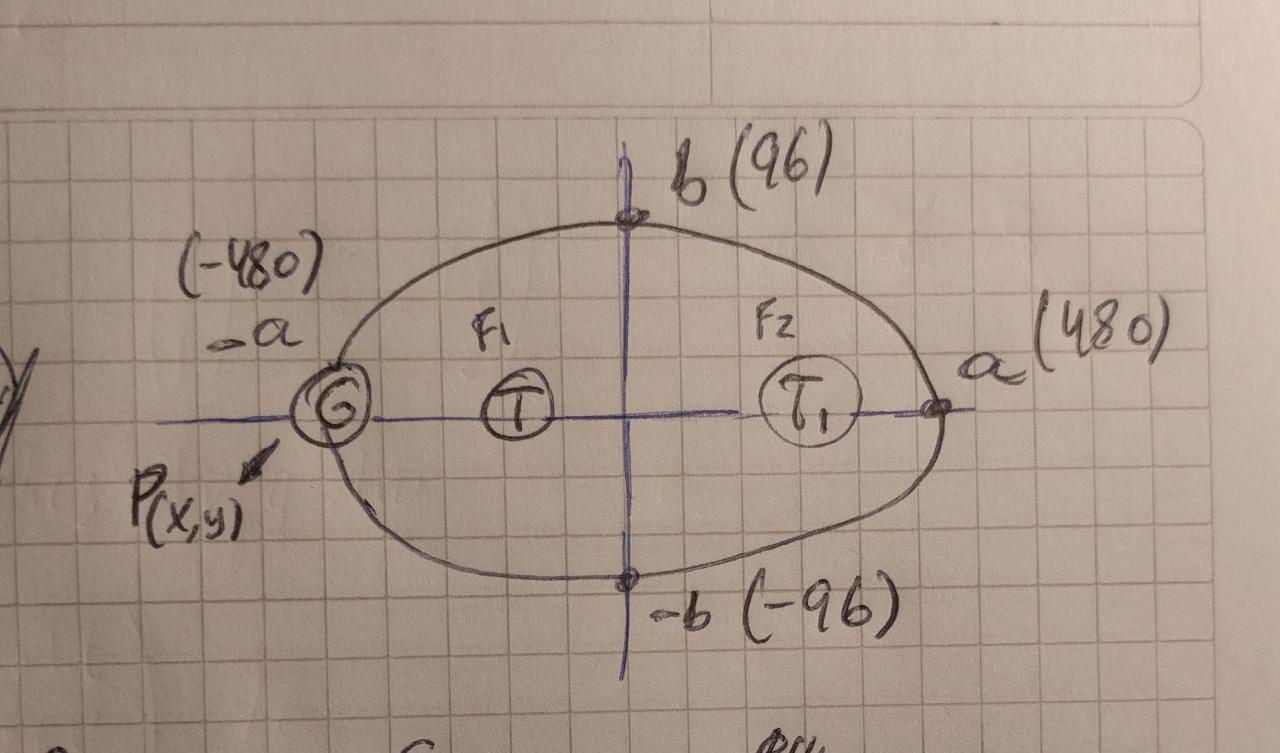 slender gyro
Sorry wasnt here
I don't know much about this but the max distance is a+c and the he minn distance is a-c right?
Since the positions that minimize the distance are (a,0) and (-a,0)
With the start being at (c,0) [oops, minor correction here]
cobalt folio
is c the center?
I got c from the eccentricity formula but I'm not sure what it represents
I guess it's the center yeah
slender gyro
Sorry c is according to wiki, the linear eccentricity
Ie the position to one of the stars is (c,0)
cobalt folio
so T is in (0, -c)
so so maybe the min distance is when G is at (0, -480) default pos, and max distance is (0, 480) ?
I have class in like an hour anyways so I'll just check with the prof. Thanks for your help!
cobalt folio
I don't think "insistency" is the word you want to use
slender gyro
Hmm, my tablet just have me Incisura. At least insistency is closer. I'm not even sure what incisura is.
Anyway inconsistency, sorry
cobalt folio
don't worry English is not my main language either
I know "incisura" in Spanish not in English idk what it means
 sterile wyvern
Whats an isometric figure?
dark sparrow
a diagram of a 3D object in which the coordinate axes are projected into lines at 120° angles to each other
@sterile wyvern
upper karma
Could someone please help with this. I'm finding it difficult to visualise
upper karma
 thorn talon
draw a diagram
sterile wyvern
Thx
 thin hound
<@&286206848099549185> http://prntscr.com/h80ext

 quasi lion
=wolf sin(x+pi/2)
charred spearBOT
Query made by @quasi lion
Data sourced from Wolfram|Alpha: http://www.wolframalpha.com/input/?i=sin(x%2Bpi%2F2)
Do more with Wolfram|Alpha Pro: http://www.wolframalpha.com/pro/
quasi lion
Does that help you?
thin hound
no
slender gyro
A triangle with hypotenuse 1 has sides equal to cosine and sine
Just use Pythagoras
dark sparrow
@thin hound do you still need assistance?
 limber bluff
what are integrals doing in geometry
dark sparrow
wolf queries tend to return Everything™
limber bluff
ahh
 long cedar
guys i really need some help
how do i do this?
my friends are gonna bully me if i get it wrong again..
topaz valley
jesus, ok
i'm guessing the final answer isn't given
what have you tried?
@long cedar
topaz valley
do you understand what it's asking?
@long cedar your silence is uninspiring
perhaps you should ask this another time
long cedar
oh sorry i was trying to do it.. but anyway thank you for trying to help
long cedar
yes
topaz valley
cause you can start pretty well with just that
long cedar
oh so should i just find the angle BEF first
topaz valley
well, to be honest, the best approach when one sees a problem like this is to fill in as many blanks as possible
i started by figuring out the lengths of the triangle DCA
long cedar
oh ok
topaz valley
from that you can find the angle GDA
then from that, the length GA (in the triangle GAD)
long cedar
ohhh
how did you find the triangle GDA?
sorry i dont really understand how to do it but i see what you are doing
long cedar
oh yeah
topaz valley
so if you make a triangle out of GDA, then you have two sides, and the angle between them
topaz valley
😃 yay
long cedar
so since i have the 2 triangles, would i need to make another 2 triangles with GFA and AFB?
oh maybe not AFB
topaz valley
i was working at afb just now
long cedar
oh ok
dark sparrow
who?
 umbral snow
sullen flint
umbral snow
sullen flint
ty
 rugged cargo
kaynex how come
dark sparrow
how come what

 grand ingot
honestly just coordbash everything except the sector
 umbral rivet
What is that shape 
 crude kraken
"Oh yeah I know a bit of geometry" gets slapped by that problem
Angle BEF is 118.875, Angle BFE 34.094, angle EBF is 27.03
Aaannd that's the extent of what I can figure out
oh wait
== 78.28 + 34.094
charred spearBOT
112.374
crude kraken
Those are the values in the order I solved them in, using law of cosines and sines.
If you have any extra questions about that, go ahead and ask. (Fun problem btw) @long cedar
crude kraken
note: We're not gonna help you cheat.
topaz valley
hint: if you want our help, don't tell us you're in a test
topaz valley
that said, probably a bad idea to ask for help on something time sensitive here
you're more likely to get a lengthy explanation than a quick answer
crude kraken
And be careful, if you send us simple stuff like finding the area of a triangle we may pull out some calculus
 vapid kettle
well there is a (perhaps dangerous) mantra
"Nothing is against the rules if nobody knows you did it."
and sometimes this mantra is
for lack of a better word
good


 tidal notch
oh