#geometry-and-trigonometry
1 messages · Page 154 of 1
 upper karma
I heard of them, never said I remember them xD
upper karma
ah
 slender socket
And the s c and t sin cos and tan
So for the first question we have to look at the SOH triangle
upper karma
ok
slender socket
Now we already know the opposite length to the angle and the length of the hypotenuse
So it’s just about plugging in values
Give the first question a go from there
upper karma
so it would be 8 / 3 in this case?
slender socket
Nice one
And because they only want the sinØ that’s your answer
Okay for the second one
Which triangle do you need
upper karma
CAH?
upper karma
the answer would be 0.92625 if I am not a complete retard
aaand 0.4048583
now this one
I dont understand what it menas
slender socket
Okay so
Ø is the angle
You’ve found sinØ cosØ and tanØ
Let’s look at the first one first
SinØ
To isolate the Ø we need to cancel out the sin
sinØ = 3/8
What could we do to both sides of the equation that would cancel out the sin
upper karma
oh goddamn
slender socket
Which you could think of as dividing by sin
So
Sin-1(sin(Ø))= sin-1(3/4)
Ø=sin-1(3/4)
Make sense?
Sorry that 4 should be an 8
On both of them
 umbral rivet
Ooh, trig 👀
slender socket
Haha sorry I forgot what the triangle was and guessed
upper karma
22.024312837, right?
upper karma
goddamit, I will have a test on trigonometry in 3 weeks and I am no good at it
 tropic stirrup
Whoops missing condition: green line is tangential to the circle
slender socket
Do you need a solution for that I don’t have a pen and paper nor can be bothered to grab one
You’ve got this BreakTruth, keep practicing and it’ll become second nature
tropic stirrup
(I made the question btw)
slender socket
Ah right nice
upper karma
I did trignometry last year as well, didnt understand jackshit
Caught Another Hippie
Tripping On Acid```
How to remember SOH CAH TOA
this is the only thing I can remember from last yearLool
slender socket
Amazing
upper karma
xD
lol found this one
Some Old Hags Can't Always Hide Their Old Age
how would I do this one?
upper karma
wut
tropic stirrup
What's the definition of tan?
slender socket
(Look at your sohcahtoa triangles)
tropic stirrup
😑 👍🏼
upper karma
ask then xd
 feral fractal
angle(b)=45 degrees, median to b=7cm and a:c=3:4
in a triangle
usually, I would break the ratio apart so a=3x and c=4x
upper karma
care to upload a picture
feral fractal
and use it in an equation but im kinda stuck
I just have this
the last value is the median of b if it's called that
I'm just stuck on the ratio part because i have no idea in what equation i could implement it
feral fractal
Sketch: https://imgur.com/a/vMhGE
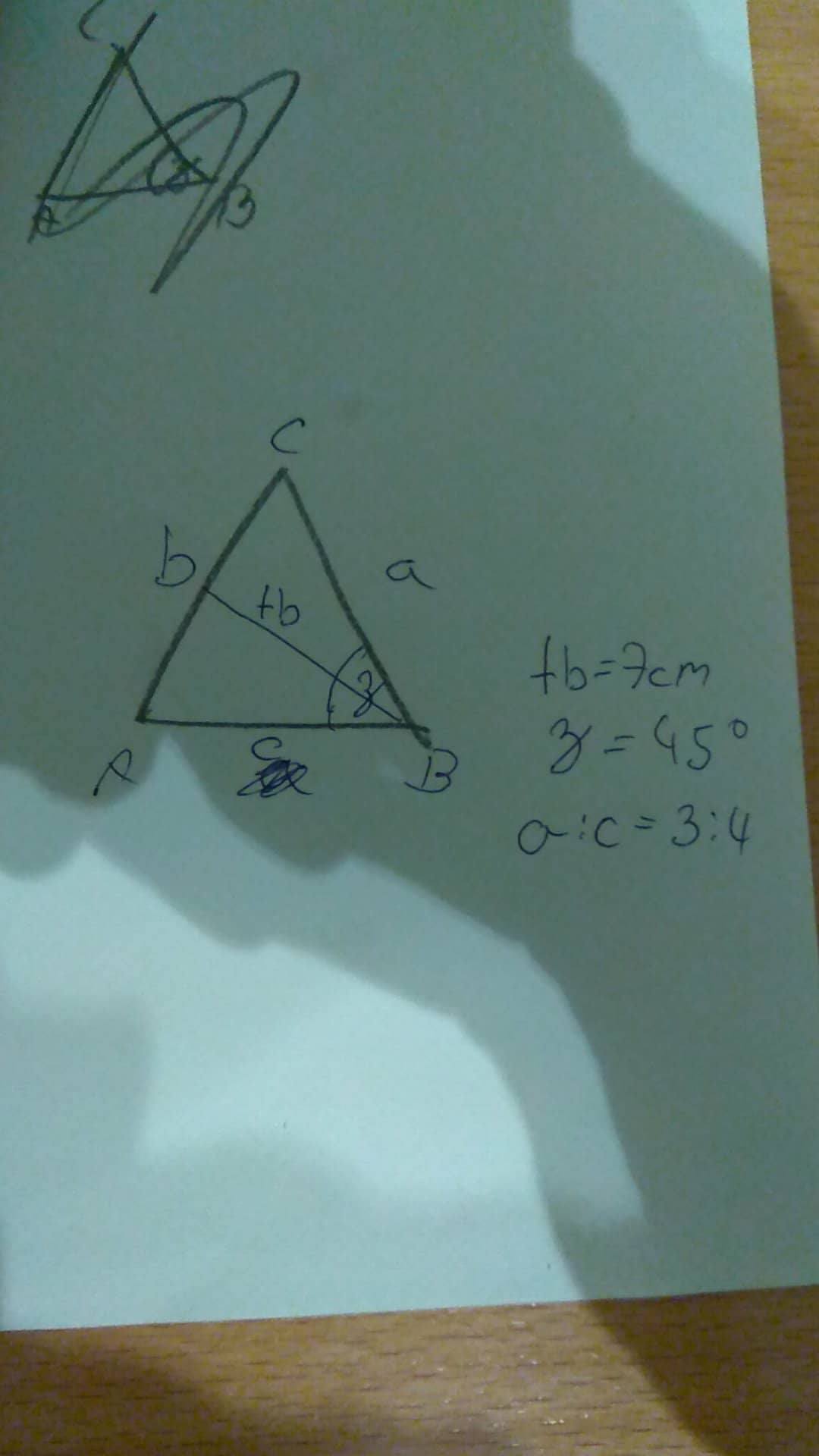 upper karma
- Calculate the volume and the total area
I'm not even sure if I am doing this right
Use the formulas.
I am but this is freaking out
am I not supposed to do
π*48*48
/3
since π*r^2
/3
Volume of a Sphere $$ = \frac{4\pir^3}{3}$$
 charred spearBOT
Rendering failed. Check your code. You can edit your existing message if needed.
upper karma
Volume of a Sphere $$ = \frac{4\pi r^3}{3}$$
charred spearBOT
upper karma
Sorry, which one are you exactly trying to solve?
sphere?
oh
a)
So surface area and volume of a cone?
yes
So surface area of a cone $$= \pi a \sqrt{h^2+r^2}
So surface area of a cone $$= \pi a \sqrt{h^2+r^2}$$
charred spearBOT
upper karma
wait not surface area
total area*
but I'm only struggling with the volume
Well surface area in English. But the volume
oh
well I have the formula for the volume
but I keep getting wrong answers
not quite sure what I am doing wrong
=tex V=\frac{\pi r^ h}{3}
charred spearBOT
upper karma
=tex V=\frac{\pi r^2 h}{3}
charred spearBOT
Support the bot on Patreon: https://www.patreon.com/dxsmiley
upper karma
Sorry.
Second one is correct.
yes
so shouldn't it be
pi*48*48*90/3
Yes.
can you tell me exactly how to type it on the calculator
(pi4848*90)/3
==(pi4848*90)/3
charred spearBOT
217146.88421613
upper karma
oh so I actually got it right
If that's the answer that you got, then yes.
then why does the answer sheet tell me that it is
v = 2,2*105cm^3 = 200dm^3 (217,14)
Do they want the answer in dm^3?
Our current solution is in cm^3.
it is not said
but I assume so
how do I make it into dm^3?
Then just divide our solution by 1000 to get dm^3.
by 1000?
1000 cm^3 = 1 dm^3
10 cm = 1 dm.
didn't know that
good to know
so I was just confused on that part
Gotta watch those units.
if I may ask
what does
π48*48
actually mean
isn't it pi*48
*48
Yep.
then how come when I do it like that on the calculator
I get different results
parenthesis I assume?
Calculator syntax isn't entirely equivalent to our own.
something like it doesn't calculate in the order I want
yeah
Might be that it recognizes 48pi and not pi48.
Convention is normally 48pi, but pi48 isn't wrong.
how would I type this on paper?
just like it says in the formula?
or do I do it the normal way
=tex V=\frac{\pi r^2 h}{3} \ =\frac{\pi (48)^2 (90)}{3}
charred spearBOT
upper karma
=tex = 217.146,884 cm^3
charred spearBOT
upper karma
=tex = 217,15 dm^3
charred spearBOT
upper karma
yeag
217146/1000
Yes.
oh wait my formula sheet only has the mantelarea
how do you do the surface area again?`
=tex S=\pi r\sqrt{h^2+r^2}
charred spearBOT
 dark sparrow
okay so ABE is an equilateral aka equal-sided triangle
what do you know about the angles in an equilateral triangle?
upper karma
indeed
upper karma
oh yeah
360/4
but can I even know what DAE is
when I don't know what the angle of DEC is
upper karma
isn't it DABC?
dark sparrow
i said angle
an angle that doesn't have its own name can be named using three points
like so: this angle is PQR
upper karma
oh
dark sparrow
cause like
think of going up one arm of the angle to the vertex and then down the other arm
upper karma
hm
dark sparrow
that's how angles are named
upper karma
like this?
wait yeah
that makes DEE into 30 degrees
since it's a square with
90 degrees angles
90-60
dark sparrow
colors are really helpful yo
if you don't have access to colors you can do single vs double arc marks
upper karma
yeah
dark sparrow
they don't have to be perfect arcs ofc, since that's just an auxiliary mark you're making
dark sparrow
well ok
so DAE is isosceles
and you know that the angles at the base of an isosceles triangle are equal
right?
upper karma
wait no
dark sparrow
isosceles
dark sparrow
they are equal to each other, not to some fixed value or anything
dark sparrow
DAE
dark sparrow
except that a) you know y = 30, and b) you don't even need to whip out a full-blown equation for this
cause like
you know these three angles have got 180 degrees to share between them
upper karma
yeah
upper karma
I got 150 left
upper karma
ohj yes
dark sparrow
this is an isosceles triangle
upper karma
jeez I keep confusing myself by looking at the other triangles
yeah I see now
one angle has taken 30 degrees
since then they are isco I cannot spell that word
they need to be split up
dark sparrow
Borrowed from Latin īsoscelēs, from Ancient Greek ἰσοσκελής (isoskelḗs), from ἴσος (ísos, “equal”) + σκέλος (skélos, “leg”)
"skelos" is kind of like "skeleton"
except k becomes c because latin
dark sparrow
likbent
upper karma
equal legs
upper karma
180-2x=y
good
now I actually understand this
In the triangle ABC is AB = BC
CE is a bisector
dark sparrow
aha
upper karma
Show that the angle is x = 75
dark sparrow
okay so first off, you know that BAC and BCA are both 70°
since again
B takes 40° and BAC and BCA have to split it evenly
upper karma
yeah
I just want to make sure
that makes it 110 left for x + ACE
BEC is 40 if I understand correctly?
wait no
dark sparrow
nnnope
upper karma
they never said that
dark sparrow
CE is a bisector though
so you know ACB gets cut in half
so ACE and BCE are both 35°
so now consider AEC
EAC took 70
upper karma
oh
dark sparrow
ACE took 35
dark sparrow
well yes that's what a bisector is
upper karma
honestly I didn't know you guys are easier to understand than my teacher
upper karma
def of bisector is a line/line seg/ arrray that splits a line segment into two equi distant parts
its can only split a ling seg
bc array and line have infin length
dark sparrow
...you're missing bisectors of angles
upper karma
can someone help me with this stuff? I dont get it
I never understand trigonometry
 thorn talon
which one?
upper karma
I guess start from top to bottom xD
thorn talon
draw a diagram
tropic stirrup
✋🏼 😩 👌🏼
thorn talon
ok let's do 6
upper karma
sure...
thorn talon
i assume you can use calculator?
 rustic talon
upper karma
rustic talon
upper karma
not much
thorn talon
ok
 topaz valley
this shit's about to blow your mind
tropic stirrup
👀
thorn talon
so anyway: SOHCAHTOA
sine: opposite/hypotenuse
cosine: adjacent/hyptenuse
tangent: opposite/adjacent
i should have used equals
but meh
so looking at that picture of 6
which one would you use?
upper karma
SOH
thorn talon
good
now
since you are trying to find out angles
you need to use inverse sine
on your calculator it probably looks like sin^-1
upper karma
I got a ti nspire cx, there is just a trignonometry button with all trig functions
thorn talon
interesting
anyway, that's how you find the angle for this
also, even though it's ^-1
it's not 1/sin
it's the inverse aka arcsine
upper karma
so arcsin(0.6/5)
thorn talon
yep
upper karma
4237
Show and prove why the area A can be calculated with the formula A = h(a+b)/2
 surreal bolt
you take the trapezoid, copy it, rotate the copy 180, connect it back to the original and you get a parallelogram.
(inc picture)
surreal bolt
That is valid also.
upper karma
I don't understand it
surreal bolt
Oh the maim trick here is to think of the trapezoid as a rectangle and the leftover area as a triangle
upper karma
I mean I do understand it just not how to explain it
surreal bolt
so if you cut out the rectangle you have two triangles. If you take the left triangle and shift it to the right until it is next to the right triangle, then you make 1 triangle out of two.
dark sparrow
surreal bolt
😃 thanks (downloading Geogebra)
surreal bolt
um, not sure. There are usually a lot of ways to prove things. If your teacher wants you to know a specific proof, you're going to have to ask him both what method and how descriptive your proofs need to be.
upper karma
he wants me to prove that it works
I don't think he cares how I do it
since he says that if I find a method that suits me, it's valid
surreal bolt
again, there's differing opinions as to how much detail is required to show it "works"
So do you know the formula for the area of a parallelogram?
surreal bolt
Sorry for the handwriting.
I dunno what detail you need. Some teachers may require you to prove that connecting the two congruent trapezoids is, in fact, possible.
As in , the angles really are supplementary
upper karma
can you explain what he wrote?
surreal bolt
Um, the picture above from root(2) pretty much says it all.
2 is a rectangle with height h and width b. That means it has area bh
1 and 3 form a triangle if you slide them together. The height of the triangle is h. The base is (a - b). The total area is h(a - b)/2.
So the area of the rectangle and the post-slide triangle is bh + h(a - b)/2
Then there are some "substitutions" an simplifications.
surreal bolt
yessir.
bh = 2bh/2 (a substitution used)
We have:
bh + h(a - b)/2 ... starting point
==> 2bh/2 + (a-b)h/2 ... bh = 2bh/2
==> (2b + (a - b))h/2 ... factor out a h/2
==> (2b + a - b)h/2 ... simplify 2b + (a - b)
==> (a + b)h/2 ... simplify 2b + a - b
surreal bolt
um h(a -b)/2 because the last part was a triangle.
i.e. area of rectangle + area of triangle --> bh + h(a-b)/2
upper karma
yeaah
surreal bolt
um yeah? h(a-b) needs a divided by 2
surreal bolt
lol okay just making sure cause you wrote ... h(a-b)+bh
upper karma
ye I forgot
surreal bolt
kk well I gotta go. Hopefully that was sufficient to answer the question
upper karma
I'm still kinda hanging on, if anyone could help
upper karma
if so, @ me
 rare talon
@upper karma divide a trapezoid by one of the diagonals
And count the area of the two triangles you made by it
You'll have two triangles, one with base a and height h, and the other with base b and height h
upper karma
@rare talon I thought they both had the base of a-b
rare talon
@upper karma I use different techniques
upper karma
hm
upper karma
is he looking for the value of the red segment ?
upper karma
that the formula is h(a+b)/2
rare talon
@upper karma
upper karma
yes
rare talon
Do you see my pic?
upper karma
I do
upper karma
oh you make it into 2 different?

 rare talon
Yeah, I guess , I don't know how you really divide it
But actually I hope you can imagine
What is the base of triangle 1 , and the height
The base of triangle 2 , and the height
^if you're doing it that way, then it's fine and you can imagine what will happen
I actually just assume you separate those 2 triangles
ABD and BCD
Ping me when you have a problem!
rare talon
@upper karma do you manage to get the proof?
upper karma
I never tried @rare talon
rare talon
Okay....
upper karma
got caught up in other stuff
rare talon
Don't worry about that 😄
rare talon
You’re lost
Remember the triangle I made for you
What is the area of triangle BCD ?
upper karma
b*h/2
?
oh
that basically just proves it
doesn't
since I have to get DAB too
which is a*h/2
which means that h(a+b)/2
I forgot how to do finite differences
Anyone know how
rare talon
Yeah
upper karma
@rare talon wait did I solve it?
rare talon
You should’ve
You got the area of BCD and ABD
Then just add it
To get the area of a trapezoid
upper karma
so ah + bh
rare talon
/2
upper karma
yeah but so is the trapezoid
upper karma
a*h + b*h /2 triangle = trapezoid h(a+b)/2
rare talon
ah/2 + bh/2 = (ah+bh)/2 = h(a+b)/2
upper karma
oh
rare talon
Problem?
upper karma
4234
dark sparrow
are you asked to find the area of the shaded region?
upper karma
yes
dark sparrow
the triangle has base 2r and height r, so its area is r^2
dark sparrow
2r * r * 1/2
yes
=tex A = \frac{\pi r^2}{2} - r^2 = r^2\left(\frac{\pi}{2}-1\right)
charred spearBOT
dark sparrow
there we go
upper karma
I just don't understand the -2
dark sparrow
=tex \frac{\pi}{2} - 1 = \frac{\pi}{2} - \frac{2}{2}
charred spearBOT
upper karma
could you explain?
dark sparrow
i just did :v
upper karma
yeah but I don't really understand
rare talon
You can rewrite r^2 as 2r^2 / 2 if you feel comfortable with it
upper karma
I mean I know that I have πr^2/2 and r^2
rare talon
Yeah then to get the shaded area, subtract the area of half circle to the area of triangle
Then it is πr^2/2 - r^2
=tex \frac{\pi r^2}{2} - \frac{2r^2}{2}
charred spearBOT
dark sparrow
=tex \frac{\pi}{2} - 1 = \frac{\pi}{2} - \frac{2}{2}
charred spearBOT
upper karma
not really
dark sparrow
2/2 = 1 😐
upper karma
oh
wait
oh yeah
it just confuses me when there are a lot of numbers
that's why I like individual calculations even though they are not as efficient
upper karma
Calculate the circumference and area of a square with the diagonal 70.7m
upper karma
yeah, that's the part of the book I am in
I just don't know how
I don't know how u do it on a rectangle
upper karma
yeah
upper karma
yeah
dark sparrow
so denoting your side with x
you know that x^2 + x^2 = 70.7^2
you can now find the values of 4x and x^2
dark sparrow
what is that meant to be
upper karma
I have no idea
charred spearBOT
4928.04
dark sparrow
yes that will get you x
charred spearBOT
4998.49
upper karma
== 4998.49/2
charred spearBOT
2499.245
upper karma
area
charred spearBOT
49.99244943
charred spearBOT
199.96979772
upper karma
perimeter
dark sparrow
yes
 drowsy pilot
so for right triangles what can you apply
what equation relates the two legs of a triangle with the hypotenuse
upper karma
I mean I guess it would be sqrt(6a^2+8a^2/7)
but how the hell do I solve it when I don't know what A is
upper karma
2nd leg?
charred spearBOT
dark sparrow
sqrt(6a^2+8a^2/7)
no
upper karma
just forgot to add ^2 to 8
dark sparrow
=tex \sqrt{\left(\frac{6a}{7}\right)^2 + \left(\frac{8a}{7}\right)^2}
charred spearBOT
drowsy pilot
^
drowsy pilot
apply the exponent to each fraction and you should be able to add them together
since denominators are equivalent
charred spearBOT
drowsy pilot
that's the denominator of your fraction, no?
upper karma
I thought you changed the 8 to a 7
drowsy pilot
yes, that'll give you the coefficient
now just remember you have an a^2 with that
inside the square root
upper karma
well isn't that just reverse
drowsy pilot
what do you have inside your square root
after applying the exponent to both fractions
drowsy pilot
the fraction we started with was 6/7
upper karma
yes
drowsy pilot
you're familiar with squaring right?
upper karma
yes
upper karma
yes
drowsy pilot
what did you get?
upper karma
0.73
drowsy pilot
you're gonna want to leave it in fraction form
upper karma
yeah but the problem with this
the only diffuculties I have
is having with variables
that aren't numbers
- having it
drowsy pilot
that's why im having you ignore the a for now
upper karma
staying as a fraction
drowsy pilot
squaring isn't multiplication
drowsy pilot
yes
upper karma
49
drowsy pilot
so what is your fraction now?
upper karma
36/49
upper karma
36/49 + 64/49
drowsy pilot
what do you get
upper karma
100/49
drowsy pilot
good
now we put our a^2 back in
so you should now have
=tex \sqrt{\left(\frac{100a^2}{49}\right)}
charred spearBOT
drowsy pilot
does that make sense
drowsy pilot
why do you make what a 2nd time
upper karma
^2
drowsy pilot
im not sure what you mean
upper karma
10*a
upper karma
I am allowed to have my calculator for the whole test
and we were supposed to use it
so if I take out a
I can always reapply it later on
as long as a doesn't change
drowsy pilot
well when you're adding or subtracting fractions yes
that was to eliminate some confusion you were having
but in general "a" can be considered as a constant you just don't know
still apply the same operations to it
upper karma
so what is this
4260
Calculate the area of ABC
I mean I know how I would solve it but idk how to get the other base
drowsy pilot
hmm
drowsy pilot
right
my objective would be to find the length of side AB
im blanking almost entirely wow this is embarassing LOL
upper karma
@rare talon by any chance you know?
upper karma
similarity? @rare talon
rare talon
Yeah
upper karma
what do you mean
rare talon
Same angle, with different length
upper karma
^
upper karma
yeah kind of
rare talon
Now name the point of the height of triangle ABC from B is D
To make me easier to explain
upper karma
ok
upper karma
yes
upper karma
what does < mean
upper karma
oh
charred spearBOT
upper karma
not the left one?
rare talon
Uhhhh
 eager saddle
I was playing with my pen today and i noticed that the shadow of the spring makes a sine wave and rotating it 90 degrees makes a cosine.
rare talon
Sorry what do you mean?
eager saddle
Nifty
upper karma
if they are all the same angle wise
and one has a 90 degree angle
then all of them have one
correct?
eager saddle
So are sine and cosine 2d parts of a 3d helix?
rare talon
Well they are
If I don't misunderstand
But let's continue
You notice that:
<ABD = <BCD
And
upper karma
yes
rare talon
<BAD = <DBC
Okay?
They are not 90 degrees
Note that
But they have the same angle
So:
AD / BD = BD / CD , agree?
upper karma
I'm confused
rare talon
You notice that:
<ABD = <BCD
<BAD = <DBC
Do you understand this?
upper karma
yes
rare talon
Then usually for similiarity, I removed the second letter from the angle representating them , and make a fraction out of it (actually I take the side opposite of corresponding angle)
So AD / BD (from 1st condition) = BD / CD (from 2nd condition)
From triangle ABD and BCD
upper karma
I am so confused and I have no idea how this has anything to do with this
I know that they are similar
rare talon
Try to review similiarity
Actually
Do you have a book with explanation of similiarity?
I will adapt to that if you want
rare talon
I don't understand what you're writing
upper karma
let me type
20/15 = 1,25 then I can use that on a bigger triangle
to get out the length of it
upper karma
yeah
upper karma
yes
rare talon
What do you think triangle BCD larger than ABD is?
rare talon
Triangle BCD has sides of 12,16, and 20
upper karma
yes
rare talon
Triangle ABD only has side as 12 right?
upper karma
yes
rare talon
Note that angle BAD in triangle ABD = angle DBC in triangle BCD
Do you agree until this?
And the side opposite to angle DBC is CD
upper karma
yes
rare talon
Now you can see
What is BD / CD ?
BD is from triangle ABD and CD is from triangle BCD
rare talon
The other way
upper karma
all of those
rare talon
BD / CD
rare talon
They are
upper karma
12/16
rare talon
Good
Which is 3/4
So triangle ABD is 3/4 "larger"(which is actually smaller) than triangle BCD
Do you agree until this?
Save this to your brain
upper karma
yes
rare talon
Now
upper karma
yes
rare talon
Tell me what do you get for AD and AB
upper karma
so
rare talon
(I actually don't need AB, but it's a good exercise for you)
upper karma
I have the lengths 9, 12 and 15
upper karma
BD
upper karma
let me just tkae a picture of my notebook
rare talon
Okay
upper karma
upper karma
1 sec then
rare talon
And
Label the angle
If possible
To show me which angle has the same angle with which angle from the other triangle
rare talon
Okay
They are good
But wait
I want you to fully understand things about similiarity
Check the picture
Now can you see which angles are the same?
rare talon
Yeah , you can take it that way
Okay now so
You get that AD = 9
And DC = 16
So AC = 25 , am I right?
upper karma
gets me the area
upper karma
which was what I was looking for
rare talon
c:
The other way
You get AB = 15
And BC = 20
And you can get the area from that too
upper karma
/2 on both?
upper karma
15*20/2
rare talon
Yeah
upper karma
yeah
rare talon
You can do that too
upper karma
then correct
rare talon
Since ABC is right triangle
Then we can treat BC as height, and AB as the base
(you can imagine it by rotating the triangle ABC to be able to see that)
Whichever way is fine, don't worry!
upper karma
can you help me with this one?
I want you to tell me why you do it like this instead of helping me with the answer
upper karma
I know the formula
rare talon
But the discussion will be lenghty