#geometry-and-trigonometry
1 messages · Page 153 of 1
 fresh quiver
Yes, as they are corresponding angles
fresh quiver
No
fresh quiver
From the position, I think it's ABR
 bleak rivet
Well ABR is angle X
But what Im saying is
Is ABQ corresponding to angle x
so is the answer 87?
bleak rivet
Angle X is RBA
Im trying to find angle X
Im trying to figure out
what angle corresponds with angle X (RBA)
Im so confused
I understand that the answer is either 87 or 46 but I dont know which one
bleak rivet
So this is what I got
fresh quiver
Yeah, QR is a straight line, so angle RBA + angle QBA = 180
Hence, angle X = 180 - angle QBA
bleak rivet
Hey another quick question
I have a few questions in a row that ask something like this
in this context what would supplement mean?
 dark sparrow
supplementary angles add up to 180°
fresh quiver
This refers to supplementary angles, two angles whose sum is 180
fresh quiver
Base 20?
dark sparrow
ignore that
dark sparrow
yes
 charred spearBOT
bleak rivet
charred spearBOT
bleak rivet
I would be done like 10 questions ago but some jerk in my class thought it would be funny to ask for 70 questions
soooo
here I am
wasting more hours
so if supplement is 180
dark sparrow
oh wait
bleak rivet
would complement be 360
dark sparrow
that's a 10 subscript there >.>
and uh
no, complementary angles add up to 90°
iirc
bc like
cosine = complementary sine
these are all
fancy terms not really worth memorizing tbh
 cobalt folio
How did you check if two lines in R3 are parallel? Was that cross/dot product = 0 with the Director Vector of each one? Can't find it on Google
dark sparrow
yes
cobalt folio
ok thanks
bleak rivet
Ummm
None of these answers are right... are they
unless he meant to put 112 for D
2x + 2y
46 x 2 = 92 + 10 x 2 = 20
92+20 = 112
OH
I misread the question lol
sorry
bleak rivet
dark sparrow
what have you tried?
dark sparrow
if you had a third measurement you'd have a 4-dimensional thing
you're given the base area and the height
V = Sh
bleak rivet
isnt is base x width x height?
dark sparrow
if you have a box, its volume is the product of length, width and height
yknow
V = lwh
bleak rivet
yea
bleak rivet
but this one is a rectangle
which should be lwh
wait
so it would be A x Height
yeah
so it just be 24 * 8.25
bleak rivet
whats a right circular cylinder?
dark sparrow
a cylinder whose base is a circle such that the line connecting the bases' centers is perpendicular to the planes of the bases
it's what you probably think of when seeing the word cylinder
 upper karma
A robot is programmed to do the following moves in a coordinate system: start at the origin facing in the positive y direction and move 1 unit. For each subsequent move, it is to turn 90 degrees and go forward 1 unit farther than it went it the previos move. What is the sum of the coordinates of the robot's posistion after it moved 14 units in one directions?
I'm confused
What do I do lmao
@crude kraken can you help?
upper karma
No???
 crude kraken
Okay
Let's say that the number of times it has moved is r, for repetitions.
The short answer is that this can be written as
=tex \sum_{n=1}^{r}n
charred spearBOT
Support the bot on Patreon: https://www.patreon.com/dxsmiley
upper karma
Idk this stuff yet ;-;
crude kraken
It's actually really simple
upper karma
o
crude kraken
So, first let's look at the scary part
The thing under the sygma is your starting number, and r is the amount you go to.
Actually, images will explain this best
upper karma
ok
crude kraken
=tex \sum_{n=1}^{3}n = 3 + 2 + 1 = 6
charred spearBOT
crude kraken
oh wait I'm figuring out the coordinates of the bot this'll be harder than I thought 🤔
But, summation is how you can figure out the total distance travelled, so that's cool I guess
Basically, for the bottom until it reaches the top, you're going to add the function on the right that many times.
=tex \sum_{n=0}^{5}f(x) = f(0)+f(1)+f(2)+f(3)+f(4)+f(5)
charred spearBOT
upper karma
ok
crude kraken
Anyways, now we figure out the hard part, sum of coordinates.
Easiest method is probably to figure out the x and y formulas separately
upper karma
Wait does it mean just adding x and y
crude kraken
Not really
upper karma
o
crude kraken
So we start at 0 and move 1, then we turn left and move 1 (Our x,y is 1,1), then we turn left and move 2 (-1,1), then we turn left and move 3 (-1,-2)
(By the way, the numbers are the fibonacci sequence)
upper karma
oh lol
crude kraken
So how can we define f(x) and g(x) so that we get the y coordinate?
*y and x
(Just so you know, i'm winging it, which is why I'm explaining so much)
(So that anyone who knows this can be like "Bro u dun messed up")
upper karma
???
crude kraken
So, first is y coordinate. if R is the fibonacci sequence, then r1 = 1, r2 = 1, r3 = 2, r4 = 3, r5 = 5.
upper karma
oooooo
crude kraken
If we look at only the y coordinate, we find that we go up r2, down r4, up r6, down r8
If we look at the x coordinate, we go right r1, left r3, right r5, left r7
so on
upper karma
ok
crude kraken
So, how can we write a formula to get the x and y (and add them
I don't actually know notation to represent the fibonacci sequence so gimme a minute to figure out how to manually have a function that will calculate it
crude kraken
Thing is I could write a program to do this in a few seconds but I can't write a formula to do it
upper karma
I can barely think
crude kraken
And, it's fine.
upper karma
Oh
crude kraken
Is it allowed if you write things like
upper karma
All I need is the work and the answer
crude kraken
=tex x = r_1 - r_3 + r_5 - r_7...
charred spearBOT
crude kraken
Gosh darnit
Okay, I don't see another way so forgive me
=tex F_n = F_{n-1} + F_{n-2}
charred spearBOT
upper karma
It's fine
crude kraken
You should write next to it that this is the fibonacci sequence
your geo teacher will be proud
;p
upper karma
xD
crude kraken
GLORY TO ARZTOCHKA
upper karma
shgidf;'hf
crude kraken
I'm trying to find a formula that you can use to define specifically Fn
crude kraken
Aha!
upper karma
You got it?
crude kraken
=tex F(n) = \frac{1}{\sqrt{5}}\left(\left(\frac{1+\sqrt{5}}{2}\right)^n-\left(\frac{1-\sqrt{5}}{2}\right)^n\right)
charred spearBOT
crude kraken
Or if you would prefer to write this instead:
=tex F(n) = \frac{\left(\frac{1+\sqrt{5}}{2}\right)^n-\left(\frac{1-\sqrt{5}}{2}\right)^n}{\sqrt{5}}
charred spearBOT
upper karma
Simplier is better for me lol
crude kraken
Whichever you prefer
upper karma
second one
crude kraken
k
Would your teacher be mad if you didn't rationalize the denominator?
Watch this, someone is gonna come in like "Oh it's just this easy thing and you're done"
and here we are with op formulas
upper karma
Lol
crude kraken
So now we have the idea that for x<=number of jumps we make
upper karma
Maybe not
crude kraken
then
upper karma
Well I gtg now sorry
crude kraken
The thing is I know exactly what I'm trying to say
but I can't represent it with notation
:I
upper karma
It's due in like 2 weeks idc lol
crude kraken
oh gg
crude kraken
Is <ABC a right angle?
And, what does it say about <XBC?
For 6-3 though, the definition of a bisector is something that cuts something into two equal parts.
So, it is liable to make that claim because BX bisects ABC and leaves you with two equal parts, ABX and CBX
For 4 and 5, this is only true if ABC is a right angle (which I assume is)
And again, definition of a bisector is something that cuts something into two equal parts.
So therefore, by the above rule that the two are equal, both must be the same, and 90/2 is 45.
If <ABC is not 90 degrees, then 4 and 5 are both false.
 rough juniper
(sorry, just came back from halfway eating dinner, will be back soon, or I'll be sleeping. Apologizes)
 raw tree
hey guys what methods do you use to solve b ? 🤔
 spare sapphire
Can someone help me real quick
im trying to write biconditional statements and are having issues.
so for the biconditional would i write it as a converse with if and only if or would i write it as a conditional with if and only if
?
pls
@ me if you get the answer
crude kraken
I can't find a formula for this, anyone have the formula for center of mass (xyz coords) of an elliptical cone with height d and width j
Oh, and the weight to count it as when comparing to rest of object would be helpful
(in the graph y=-x^2 + 9, d would be 5 and j would be 6, but a cone is 3d)
 umbral rivet
👀
crude kraken
wolfram had me covered :p
 trim belfry
is this the right place to ask about the mathematics of rotation?
dark sparrow
sure
trim belfry
okie dokie
(btw I am just stating my reasonings first and then I will ask the question)
so I think I figured out a way to determine that the specifying of any given orientation in n-dimensional space needs at most (n^2-n)/2 dimensions:
we have n n-vectors representing an n by n matrix transform which computes our rotation on a given n-vector

for each axis (represented by one of the n-vectors in the matrix) it must be orthogonal to all other axes for the overall transformation to be a valid rotation (note that this allows reflections), and it must have unit length (to exclude scaling)

the condition of unit length reduces the dimension of scaling for each axis by 1, so the overall dimension is reduced by n

meanwhile, the condition of orthogonality must by nature be separate from the condition of unit length as orthogonality is about *orientation and not scale* and meanwhile unit length is about *scale not orientation*

I will recursively figure out what dimensions are restricted by the condition of orthogonality, starting with n=2

so for n=3, the third axis is restricted in respect to the first and second axis, meaning that it is restricted in two axes (minus 2 dimensions)

then for n=4, the fourth axis can't rotate towards or away from the first, second or third axes (minus 3 dimensions)

n^2 - (n-1) - (n-2) ... - (2) - (1)  - (n)
    \_____________   _____________/  \_  _/
                  \_/                  \/
    condition of orthogonality   condition of no scaling

n + (n-1) + (n-2) + ... + 2 + 1 = (n^2+n)/2

n^2 - (n^2+n)/2 = (2*n^2 - n^2 - n)/2 = (n^2 - n)/2

Therefore, to specify any given orientation in n dimensions where scaled axes and non-orthogonal axes are rules out, you need (n^2 - n)/2 dimensions. Note that this includes reflections, however these reflections when removed as a possibility do not reduce the dimensionality (in order to specify one number out of all positive real numbers you need one dimension and to specify one number out of all real numbers you also need one dimension).
the block text is my reasoning
but according to this http://www.euclideanspace.com/maths/geometry/rotations/theory/nDimensions/ compound rotations in n dimensions are 2^n/2-1 dimensional? is this correct?
I don't understand how that's possible, surely an n by n matrix transform can specify every possible compound rotation because an n by n matrix has each column represent where the new 'axis' is? surely that covers all possible orientations? I don't understand how it couldn't cover all possible rotations
(sorry I am a noob in maths)
 ruby swallow
@spare sapphire both but only one iff
spare sapphire
i figured it out but thx
 opal rock

Given a triangle ABC. BL is the bisector of angle ABC, H is the orthocenter and P is the mid-point of AC. PH intersects BL at Q. If $\angle ABC= \beta $, find the ratio $PQ:HQ$.If $QR\perp BC$ and ...
Wondering how he got the 3rd equation?
(3)
Help pleease
 fathom seal
If you want, you could make a stackexchcange account and ask him directly.
opal rock
Dw, I got it
 versed falcon
quick question does cos have to do with 2pi and sin with pi? in any sort
opal rock
@versed falcon if you take the unit circle definition of trigonometry and if you use radians then yeah
2pi is the distance along the x-axis sin or cos goes through in 1 period
In radians
Meaning, cos(0) is the same as cos(2pi) in radians
In fact, cos(n) is the same as cos(n + 2pi) and also the same as cos(n + 4pi) ...so on
versed falcon
I have another problem with that phrase above coming from the link: https://www.khanacademy.org/math/precalculus/trig-equations-and-identities-precalc/solving-sinusoidal-models-precalc/a/trigonometric-equations-review . I dont understand how he comes up with the identity you need to use for the problem

Khan Academy
Learn for free about math, art, computer programming, economics, physics, chemistry, biology, medicine, finance, history, and more. Khan Academy is a nonprofit with the mission of providing a free, world-class education for anyone, anywhere.
 thorn talon
What do you need help with?
 thin hound
21
The image on the 2nd page is what we"re looking at
How would i det this up with law of sines
thorn talon
There is enough information to determine every angle
thin hound
Yea nvm im good
 quasi lion
@thin hound Why did you called mods?
upper karma
He thinks mods have it as a duty to help
thin hound
I was just asking fot some assistance
upper karma
hehe
 trail pollen
Who can help me to resolve the problem? i don't all understand if you can help me in private ^^
spare sapphire
what's the angle addition postulate?
 prime junco
I need help anyone?
So I'm doing a project about if then statements (easy) but what confuses me is include theorem.
<@&286206848099549185>
What is theorem?
umbral rivet
What's a theorem?
A theorem is like
Something that is true and can be supported with evidence in the form of proofs
prime junco
So the theorem will be related to the conditional or no?
Basically my if then statements is about not studying, failing a test, and falling the class.
@umbral rivet ?
 novel matrix
hey guys just wondering if there's anyone who can help me with this geometry problem 😃
crude kraken
Given two points, I know slope, but how do I find y intercept?
dark sparrow
as in, of the line passing through those points?
crude kraken
Mhm
dark sparrow
y = kx + b
you know k, and you can replace x and y with the coordinates of either point
and then just solve for b
crude kraken
Don't ask to ask, ask.
 raven vessel
what is you're problem ?
 hot grail
Quick question :
What is the normalized version of a vector called ?
Like if I have two vectors A and B and B is normalized A, then B is the ...???.... of A
Is there such a word ?
ah alright, thanks
 finite nexus
i checked the method for it and it says that tanSTC = 400/300
how is that possible?
oops
there
guys, why is tanSTC = 400/300???
<@&268886789983436800>
 topaz valley
<@&286206848099549185>
finite nexus
o yea, i see it now. thanks
 tropic island
Graph the following lines and write the equation in slope-intercept form.
Through the point (2,−4) with y-intercept of −2.
Graph the following lines and write the equation in slope-intercept form.
Through the point (2,−4) with y-intercept of −2.
Can someone help me!
upper karma
i have an assignment due in a few hours and ive finished most of the questions, having trouble with the remaining ones, if anyone could assist, this is one of them
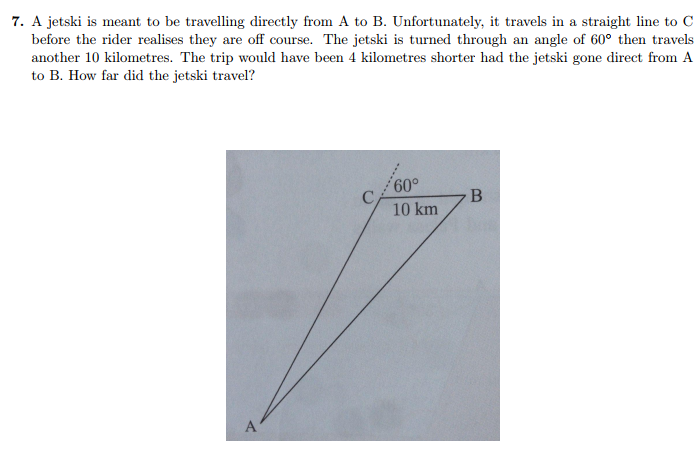
figured id start with this one first since its requires more time spent to read it
dark sparrow
k so you know AC + CB = AB + 4
or well, AC + 10 = AB + 4
so AB = AC + 6
and you know that the angle at C is 120°
law of cosines
upper karma
how'd you get 4, ive missed the past few lectures to focus on my other classes and now im behind in math, thought id be able to catch up
dark sparrow
The trip would've been 4 km shorter...
upper karma
nvm, i thought you did something fancy
yeh i saw
with knowing that angle C is 120 and CB is 10, whats the next step from what you wrote there, AB = AC + 6
dark sparrow
you know the law of cosines, right?
upper karma
a^2 = b^2+c^2 - 2bc cos A?
dark sparrow
well, yes, but with different letters in this case
AB^2 = AC^2 + BC^2 - 2 AC * BC * cos(C)
replace AB with (AC+6)
replace BC with 10
solve for AC
upper karma
ugh i am lost
dark sparrow
at what point did you get lost?
upper karma
im watching the lecture recordings, probably doesnt help that its 4am
well ive never been great at trigonometry, but
we know cb is 10, and acb = ab + 4
we only know 1 length and im not sure how to get the 2nd, let alone the 3rd at this point
dark sparrow
one moment
dark sparrow
cos(120°) = -1/2, so just replace it with that
and then you have an equation in x which you can clean up and solve
do you need help doing that?
upper karma
yeh
upper karma
well, we had the cosine rule of AB^2 = AC^2 + CB^2
the first part of it where you just substituted the values in
the order you wrote the equation in confuses me a bit too
dark sparrow
AB^2 = AC^2 + CB^2 -2 * AC * CB * cos(C)
upper karma
yep
dark sparrow
and i mean
i just wrote it on two lines
=tex x^2 = 10^2 + (x-6)^2 - 2 \cdot 10 \cdot (x-6) \cdot \cos(120^\circ)
charred spearBOT
dark sparrow
upper karma
actually pretty clear now
thanks alot for taking the time to explain it, not just giving me the answer 😃
is there a particular reason you wrote it in a different order, obv a + b = b + a, but i noticed you did AB^2 = CB^2 + AC^2, was it because of the quadratic?
or am i just reading too far into it
dark sparrow
you're reading too far into it
sometimes i write things in a certain order for clarity's sake, but not always
upper karma
i have two more questions left on my assignment, while i have you, if you could assist me here that'd be fantastic too please
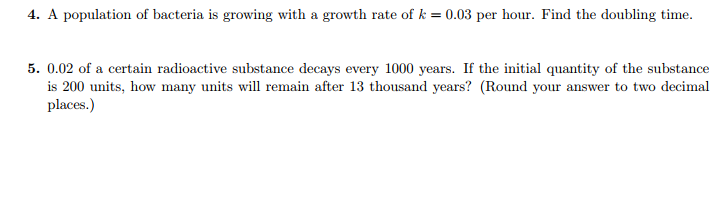 dark sparrow
okay so for number 4
let's say that the population at t = 0 has size 1
it doesn't have to be like, 1 bacterium, just 1 arbitrary unit
then the size of your population at time t is
P(t) = 1.03^t
make sense?
upper karma
unfortunately these last 2 questions i am in a similiar boat to the earlier one, where i am behind and dont really understand much of it
dark sparrow
ok so
so let's say that at the start, we have 1 unit of bacteria
then after 1 hour, we'll have 1.03 units
is that clear?
@upper karma
dark sparrow
aight
so every hour, the size of the population gets multiplied by 1.03
so P(t) = 1.03^t
is that clear?
upper karma
yep
dark sparrow
aight
so now
we started with 1 unit
and we want to find when the size of our population reaches 2 units
upper karma
ok
charred spearBOT
dark sparrow
@upper karma
upper karma
hmm
i dont know, but im reading about it, so in this
t is the power we raise 1.03 to to get..2
going through my notes, log_a b = log b/log a
so i did ln(2)/ln(1.03) got 23.44
not sure if underscore is the propery way to write it here
*proper
so 1.03^23.44 = 2
well, 1.9994
 tulip spruce
1.03^[ln2/ln1.03]= 2
upper karma
is that the correct way of writing it
dark sparrow
== log(2)/log(1.03)
charred spearBOT
23.44977225
tulip spruce
well you'll see a pattern if you write it this way
dark sparrow
23.45
tulip spruce
but your precise answer will be ln(2)/ln(1.03)
tulip spruce
iirc your t was in hours
upper karma
or hour
tulip spruce
so 23.45 hours
upper karma
i see
dark sparrow
the other one is actually a lot simpler
every 1000 years the amount of your substance gets multiplied by 0.98
== 200 * 0.98^13
charred spearBOT
153.80447785
dark sparrow
no
upper karma
could you go into a bit more detail about how you got the 200 * 0.98^13, i understand you just flipped the question
really want to understand what im doing
dark sparrow
okay so
every thousand years, the amount of your substance decreases by 2%
in other words, it gets multiplied by 0.98
upper karma
yep
dark sparrow
so
to find out what happens after 13000 yeasr
just do that 13 times
multiply the amount of your substance by 0.98, 13 times
upper karma
oh
upper karma
thanks alot for your help @dark sparrow and you too @tulip spruce
hi can anyone help me with a comp sci project?
i'm struggling with the geometry part
i'm trying to simulate a trajectory of a ball inside a billard pool, it has no acceleration or any effect whatsoever, basically we dont need to care about physics
what i'm trying to do is first :
an x and y coordinate are given as parameters, also an angle, the pool will always be a rectangle
how do i know which side it will hit first?
then whenever it's meeting with a wall, how to predict where it will go?
that 2nd part will probably be easier but i have no idea how to complete the first part pls help 😦 !!!
 umbral snow
@upper karma Obviously, there are only two walls the ball can hit, depending on the angle. So, you need to consider between the two.
I would assign a coordinate system to the table. One wall is y = 0, the other perpendicular to it is x = 5 or something
Find the distance required to hit either wall, and go with the shorter one
 coarse lagoon
just learned about the triangle inequality theorem
how come i never learned this in school
dark sparrow
the one that says detours can't be shortcuts?
tropic island
Hey!
dark sparrow
hi
upper karma
how do i find the distance? im shit at geometry 😦
umbral snow
@upper karma You can make a line for the pool ball. If we start at (a, b) with an angle w, then:
y = arctan(w)(x - a) + b
Find any points of intersection. Use Pythagorean theorem for distances
 mossy oriole
Hi
I have this problem on my HW and I was having some trouble with it
it states:
"Noel and Kirk are building a new roof. They wanted a roof with two sloping planes that meet along a curved arch. Is this possible?
"
I just drew an arc basically
Its like /curve\
charred spearBOT
2
Failed to parse equation: Invalid token at position 11
log_1.03(2)\
           ^
Failed to parse equation: Invalid syntax at position 1
log_1.03(2)
 ^
 tranquil harbor
 vale raven
Statements 3 and 4 are similar to statements 5 and 6
dark sparrow
two col proofs of trivialities 😒
 midnight oak
Hot
upper karma
is this the right place where I can ask questions about simple interest etc?
dark sparrow
that sounds more like an #prealg-and-algebra thing
upper karma
A question:
Two circles, both in 1st quadrant, are tangent to x-axis and y-axis. Both the circles pass through (9,11). Find the product of their radii
I got a method, but it's too complicated, and I am looking for an elegant solution
 surreal bolt
Is the answer necessarily a constant answer or do they want an expression?
actually it cannot be a constant unless there is also tangency of the circles and even then maybe not.
nope 😃
(9, 11) can be the right most and top most point.
(of the two circles respectively)
Diameter of circle A (9, 11) and (0, 11) while diameter of circle B (9, 11) and (9, 0)
But that isn't the only way.
um yes ...
oh nvm
I still think there is more than one solution.
I just have to show the circle tangent to the y-axis has multiple possibilities.
Or show that the circle tangent to the x-axis has multiple possibilities.
BTW
Diameter of circle A (9, 11) and (0, 11) while diameter of circle B (9, 11) and (9, 0)
is a possible answer as both circles are in the first quadrant.
Circle A has center (4.5, 11) and perpendicular diameter (4.5, 6.5) to (4.5, 15.5)
Circle B has center (9, 5.5) and perpendicular diameter (3.5, 5.5) to (14.5, 5.5)
anyway ...
upper karma
area of a trapezoid anyone?
 molten ingot
just split it up into triangles and a rectangle
 daring oxide
bleak rivet
crude kraken
daring oxide
bleak rivet
crude kraken
=tex (\pi r^2 - \pi(r-4)^2) mm^2 \ (\pi r^2 - \pi r^2 - 4r - 4r + 16) mm^2 \ (-8r + 16) mm^2
charred spearBOT
crude kraken
I would assume A at this point as it nearly matches the format of that answer, but I don't know why we don't take out the pi
@bleak rivet
Oh wait nvm
=tex (\pi r^2 - \pi(r-4)^2) mm^2 \ (\pi r^2 - \pi(r^2 - 4r - 4r + 16)) mm^2 \ (\pi r^2 - \pi r^2 - 4\pi r - 4 \pi r + 16\pi) mm^2 \ (-8 \pi r + 16\pi) mm^2
charred spearBOT
crude kraken
But that's not a choice, if anyone knows what I did wrong it'd be appreciated, would still assume A at this point.
umbral snow
You didn't distribute the negative after line 2
@crude kraken
The answer is B
@bleak rivet
crude kraken
^
bleak rivet
Thank you guys.
upper karma
A square region with perimeter 60 inches is made with square inch tiles. Bob removes one tile from the square and rearranges the remaining tiles without any overlap to make a rectangular region with minimum perimeter. How many inches are in the perimeter?
ANYONE?
60?
Sorry for the delay
@sour briar
U there still
Lol sorry
Ok
That was simple
Thanks
And I have one more question
It was thanks
Ok
I got 15 for this one
The sum
Like if it's (1,1)
The sum is 2
Ok
Yeah sorry for bothering you
gn
nvm got it
It's 15
:)
Ok last one
The Prevu Theater keeps a set of five counterweights to help stagehands move heavy props. The weights can balance exactly any load that is a multiple of 10 kg, from 10 kg, up to the total of the five weights. Give the masses of weights which meet these conditions and allow the stagehands to counterbalance the maximum possible load under the conditions below.
The weights must all go on the same side.
The weights may be used on one or both sides
I'm confused with this one
 lost jetty

why are all three of these angles θ?
well, we start with θ_1, so i guess why are the second and third angles equal to θ?
<@&286206848099549185>
crude kraken
Do you have the context of the problem? All I can say is that theta is an angle of the three triangles
upper karma
:/
lost jetty
well usually it's like
"object on an incline of angle θ"
and then the triangle with θ_2 is the mg vector with its parallel and perpendicular components
and θ_3 triangle is the normal force with its parallel and perpendicular components
 umbral snow
@lost jetty I remember being confused about this in early physics. They're all provable using geometry facts like "the Z rule" or whatever, but there's a few different cases. You gain an intuition about which angles are equal through practice
If two lines intersect at some angle, then their normal lines will also intersect at that same angle, I'm pretty sure.
upper karma
are pyth triples unique?
crude kraken
https://www.youtube.com/watch?v=QJYmyhnaaek To an extent, video will demonstrate better than me but if you have a particular question then ask away.

Can we describe all right triangles with whole number side lengths using a nice pattern? Check out Remix careers: https://www.remix.com/jobs Regarding the br...
umbral rivet
👀
crude kraken
If I'm trying to find the length of a line in 3d space between point (a,b,c) and point (x,y,z), do I just use pythagorean theorem to find the 2d length or 'shadow' that the line would make, and then just pythag that with c/z, or is there a more efficient method?
=tex L=\sqrt{\sqrt{(a-x)^2+(b-y)^2}^2+(c-z)^2} = \sqrt{(a-x)^2+(b-y)^2+(c-z)^2}
charred spearBOT
The renderer took too long to respond.
Something went wrong while handling the message:
=tex L=\sqrt{\sqrt{(a-x)^2+(b-y)^2}^2+(c-z)^2} = \sqrt{(a-x)^2+(b-y)^2+(c-z)^2}
If this error keeps recurring, you should report it to DXsmiley on the official MathBot server: https://discord.gg/JbJbRZS
charred spearBOT
The server sent back the following error:
Can be used only in preamble.
leading text: \begin{document}
Extra }, or forgotten \right.
leading text: ...m_{a=1}^{n}\left(x_i-y_i)^2}  \end{gather*}
Missing } inserted.
leading text: ...m_{a=1}^{n}\left(x_i-y_i)^2}  \end{gather*}
Extra }, or forgotten \right.
leading text: ...m_{a=1}^{n}\left(x_i-y_i)^2}  \end{gather*}
Missing } inserted.
leading text: ...m_{a=1}^{n}\left(x_i-y_i)^2}  \end{gather*}
Extra }, or forgotten \right.
leading text: ...m_{a=1}^{n}\left(x_i-y_i)^2}  \end{gather*}
Missing } inserted.
leading text: ...m_{a=1}^{n}\left(x_i-y_i)^2}  \end{gather*}
Extra }, or forgotten \right.
leading text: ...m_{a=1}^{n}\left(x_i-y_i)^2}  \end{gather*}
Missing } inserted.
leading text: ...m_{a=1}^{n}\left(x_i-y_i)^2}  \end{gather*}
Extra }, or forgotten \right.
sigh...
 simple reef
lol
crude kraken
Figured that out :p
 wide portal
=tex If the area of a circle is π cm2, how long is the radius
charred spearBOT
wide portal
great answer
upper karma
is that a question? xd
 visual field
@wide portal Not sure what you're looking for with that, but tex is a command used to render the message sent using LaTeX, a markup language that is really great at typesetting math. It can't answer any questions, just make the words and numbers you put in it into fancy and easy to understand numbers and symbols. If you actually need help with the question, remember that the area of a circle is π*radius^2, so you can set the area you have equal to that formula and then solve for r
wide portal
ok thanks
 lilac kindle
Also the answer is one @wide portal
wide portal
i know i got it right
lilac kindle
Oh nvm I didn't see someone already said
dark sparrow
this picture is too low-res to see the text
dark sparrow
okay that's better
dark sparrow
do the words "pythagorean theorem" sound familiar to you?
 night lotus
yes
night lotus
so i use pythagrean theorem to find x?
night lotus
ok thanx
 feral fractal
Ideas?
 rare talon
Noticce triangle BEH and ADH is similiar
 dense holly
namely because AD and BC are parallel
upper karma
you could also state that the potential line BD would have distance 8 too since it bisects both <ADC and <ABC
oh actually
you can set up a ratio
ill put it in english and u can translate to math
"3 is to 5 as to x is to 8+x"
this may be incorrect idk
 feral quiver
https://cdn.discordapp.com/attachments/359052604149465088/369282108977315840/image.jpg Can anyone help me with this?
feral quiver
 rustic talon
@upper karma tangent i guess
upper karma
what 2 sides are you given (in respect to the angle that you're given)
hypotenuse ? adjacent ? opposite ?
upper karma
you should see that @upper karma you have opposite and adjacent, mind telling me what each of those are ?
rustic talon
sure
upper karma
@upper karma u here
well i'll explain here anyways
you are given side ? (we'll call it x ) and 2100 cm
2100 cm is your adjacent side to the angle of 29 degrees
that makes x your opposite side
the trig function that relates these two together is tangent (since tan = opposite/adjacent)
so you'd set it up this way
=tex tan (29^\circ) = \frac{x}{2100} \
tan (29^\circ) \cdot 2100 = x
==tand(29) * 2100
charred spearBOT
1164.04900805
upper karma
1164.05 should be your answer
dark sparrow
=tex \tan(29^\circ)
charred spearBOT
dark sparrow
@upper karma
charred spearBOT
dark sparrow
yeah, tand(29) is tan(29°)
dark sparrow
the base was 21 meters
upper karma
This is to calculate my school building
There are 3 floors in the building
if you look at the triangle's angles, the angle that is related to the hyp is 90 degrees, so the hyp would have to be the largest side.
the angle that is related to the opposite side we just found is 29 degrees (the smallest), so the side that we found should be the smallest one.
the last angle is (180-119 = 61) is in the middle of the other two, so its measurement is neither the smallest nor the largest
if we were to have gotten a value of x larger than 2100 we should've been concerned since it would've been incorrect
dark sparrow
or to put it another way
29° < 45°, so tan(29°) < tan(45°) = 1
so if we'd gotten something above 2100 cm that'd mean that our angle was above 45°
upper karma
oly shit
thats good thinking lol
well i should head to do my own hw now
see ya
Used a clinometer tho
And a meter
Well actually it was a stick cause I did not have a meter
And then calculated the length of the stick
feral fractal
Looking at similarities, how would I equalize them if there are two variables?
tulip spruce
you can find the height of the smaller triangle
then you can find y
then you can find x
charred spearBOT
Query made by @tulip spruce
Data sourced from Wolfram|Alpha: http://www.wolframalpha.com/input/?i=sqrt(53^2-45^2)
Do more with Wolfram|Alpha Pro: http://www.wolframalpha.com/pro/
feral fractal
Yeah, I got confused for a sec. How do I determine how similarities are set tho. Is there some rule/law or something for it? If you get what i'm asking?
Like what is put into the num1, and why isn't it in num2,3,4 part? (num1:num2=num3:num4)
upper karma
um idk the name
but its the ratio between sides that you just described
i.e the hyp of one / hyp of the larger one = leg of one / leg of the larger one
and so on
feral fractal
wait, so it's not leg1/leg2=big leg/big leg2(y)? I'm confused now
umbral snow
The ratio of the legs stays the same. That is,
53 / 45 = (53 + x) / (45 + 28)
You don't have enough info to find y based on similarity. So you need to use pythag
 cloud shell
@Bager#9612 The rule is called Basic Proportionality Theorem
"If a line is drawn parallel to one side of a triangle intersecting other two sides, then it divides the two sides in the same ratio"

so... 53 / x = 45 / 28
then fine y using pytho-mama
mossy oriole
hey
I have this problem on my homework
it states:
The measures of the angles in a triangle have a ratio 1:4:7. Find the angles
mossy oriole
=calc 1/12(180)
charred spearBOT
Error: 12 is not a function
mossy oriole
=calc 1/12 * 180
charred spearBOT
15
mossy oriole
Its 15
mossy oriole
done all in my head totally
thorn talon
What's 4 times 15?
thorn talon
And 7 times?
charred spearBOT
105
mossy oriole
105
thorn talon
So
mossy oriole
so those are the angles
thorn talon
15:60:105
mossy oriole
- 60, 105
thorn talon
Yep
mossy oriole
thank you!
 glass canopy
Have a kind of a problem. Let's say there's a car (at X: 30 and Y: 80). It's going to X: 130 and Y: 10. The total time of the trip is 500 milliseconds. At what coordinates will it be after 200ms?
I tried with calculating the angle then velocity but I got lost... Can anyone help me?
umbral rivet
👀
upper karma
seems like you are describing something of a position/time function (x being position and t being time?)
if so then i can help if not no lol
if not it'd clear up if you stated what your x and y represented lol
upper karma
huh
shit i was hoping for one of them to be time lol
yes really it confuses me without one of them being time sadly
sry
dark sparrow
@glass canopy how familiar are you with vectors?
glass canopy
not much, unfortunately
started to play with them yesterday or so
so I'd look for another solution
upper karma
its probably related to it then if u were shown the concept yesterday
dark sparrow
you can do the x and y coordinates separately
upper karma
i'd go for that xd
dark sparrow
you start from (30, 80) and you're going to (130, 10)
now let's measure time in 500-millisecond increments
so the x coordinate of your car is
x(t) = 30 + 100t
make sense?
t here is measured in half-second units; e.g. t = 1 corresponds to 500 milliseconds, t = 0.2 to 100 milliseconds, etc
@glass canopy
dark sparrow
likewise y(t) = 80 - 70t
so now, you just need to find those coordinates when t = 0.4
since that's what 200 ms corresponds to, with the way we made it
umbral rivet
Ann 💕
glass canopy
thank you
dark sparrow
💕 @umbral rivet
 bitter moon
How would you reflect a point over any line (in f(x) format)?
upper karma
yeh sure
 gritty light
anyone that can help me, with this
please DM me!
A mini-triathlon requires the competitors to run a 230m on a bearing of 072T from point A to point B. From point B they swim 380m across to point C on a bearing of N24E. They then cycle from point c DIRECTLY back to the starting point A.
2a) Draw a diagram showing the above information
2b) Find the total distance the competitiros had to cover correct to 1 decimal place.
2c) Find the bearing of point C from A to the nearest degree and minute
umbral snow
@gritty light 072T is the angle 72 degrees counterclockwise from north?
upper karma
Is segment AD parallel to EB?
Becuase if so, you can use the Alternate Interior Angles theorem to figure that angle AD_missing point, which is what I think reads to be 105 degrees.
Other angle is 40 degrees, which makes x=35 degrees. Though this does take the assumption that those two lines are parallel, it does seem to make sense in the given diagram.
@Bager#9612
feral fractal
And that one is 40 degrees because of the aia theorem? I got 105 because of 180-75-30
What would be that theorem simplified tho?
upper karma
What do you mean @feral fractal
 quartz igloo
0
gritty light
@umbral snow yeah
It isn't counter-clockwise though, as it's stated that it rotates clockwise
so 072T Degrees
umbral snow
@gritty light The first step is to break all the vectors into their rectangular components.
A handy way to do this is to find the vector's angle away from east which I will call t, then rsin(t) is the north component, and rcos(t) is the east component
 nocturne bane
im going to find an equation for the coloured area in the circle
with AB being r and AC being 2r
pls help
The drawing shows how many half circles. The diameter in the smallest half circle is AB = r. I the second lowest half circle the diameter is AC = 2r. The diameter in the big circle is AD = 6r. Find an equation for the areal of the coloured area.
nocturne bane
where u atttt
rustic talon
yo welcome,im free,i spend most free times ,doing math hahahahaha
@nocturne bane was it hard though?
nocturne bane
@rustic talon it was kinda difficult since i wasnt into it then, but i figured it out
rustic talon
THATS good cheesey cheese
nocturne bane
@rustic talon if u can solve that task u could most likely get the highest grade
nocturne bane
School ends 15.15 here in norway
nocturne bane
But i can give u another one tomorrow though if i fins one
feral fractal
Is there a way to construct a trapeze with only given all 4 lenghts of sides?
When given a=9, b=5, c=2 and d=6 i tried to calculate the height via s=(a+c)/2 and then h=2s, although I'm getting wierd numbers that don,t work out for me, e.g h=11.
oh, nvm im just stupid lmao
 dense crater
I'm unsure of how to go ahead on this one
..Surely the third "pair" is orthogonal by symmetry?
 lusty sparrow
Can a perp slope have a 0 or does it have to be simplified?
Like the negative reciprocal of 0/4 is -4/0, is that the final answer or does it have to be -4?
upper karma
@tulip spruce I found the book. I got the pdf of it for free
topaz valley
@summer canopy it's usually best to just ask
dark sparrow
@lusty sparrow a. division by zero is not allowed
b. the perpendicular to a horizontal line is a vertical line, which cannot be put in the form y = kx + b
dark sparrow
two-col proofs? 😒
 summer canopy
Yep
dark sparrow
they are obfuscatory and useless and i really don't want to do anything pertaining to them
summer canopy
Neither do I but its a quiz grade that I really need
 slim plover
I already forgot how two column proofs work lol sorry
summer canopy
And im not cheating to be clear, she said you could look anything up you could or get any help you could
but im currently sitting at an 89% and this would push me over to an A if I did well on it
 royal dew
one column is a statement and the other is the proof
summer canopy
I got that much haha
I just dont know what reasoning to put down is the main issue
royal dew
have you done khan academy's geometry? I am pretty sure those proofs are pretty sufficient if you were to use that style
summer canopy
I understood the ones in class, but dont know how to do it with supplementary angles
just proving something is a paralellogram
summer canopy
Yeah i understand the concept, just dont understood how to write that out properly
royal dew
One is a worded statement and the other is the math equation
dark sparrow
starting from what you wrote:
mB + mC = 180 / definition of supplementary angle
mA + mB = mB + mC / transitive property of equality
mA = mC / subtraction property of equality
A congruent to C / definition of congruence
bleh
summer canopy
Wait is what I wrote so far completely correct
summer canopy
Yeah i think its completely unneccesary as well
dark sparrow
two column proofs are horrible
summer canopy
but unfortunately the curriculum thinks it matters
summer canopy
@dark sparrow mind if I ask one more question
Not 2 column proof
I know that the answer I have selected is incorrect
rare talon
Who will use two column proof in real math proof problem lmao
summer canopy
So sides must just be proportionate to be similar?
rare talon
Or, the angles of the pair of the triangles are the same (not in any choice)
dark sparrow
well, yes
upper karma
a pyramid has a quadrate base with width 2p and length 5p. Every 2 triangles face of the pyramid has its surface 2p(3p+2), and the other triangles left have the surface 5p(p-3)
A: Find a formula for the surface of the pyramid.
B: Factor the formula to find A excersise
I'd apperciate who helped me on this
topaz valley
what have you tried?
 leaden kindle
I cant seem to figure out the proof why D2 = F2
 tropic stirrup
I'm assuming DAF = DBF
Then you can see that A, B, F, d are on a circle
And therefore ADB = AFB
tulip spruce
<A = <B
and E1=E2
they're both triangles so you can only have a sum of 180 for the angles
 slim basin
Should just take a protractor and measure the angles
 hidden geode
has anyone worked with or spent any time with Geometry: A Comprehensive Introduction (Dan Pedoe)? looks interesting, wondering if it's suitable for someone with a solid calculus background & some matrix math
 visual jacinth
sorry, didn't.
 civic sigil
Hey guys, so I'm sorry if this question sounds super stupid, but what does it mean when a question asks you to calculate the slope of a rectangle? Or the midpoint of the rectangle? What does "slope of a rectangle" and "midpoint of a rectangle" means?
topaz valley
I think he just wants us to read it
 eager pendant


 vale raven
👀
upper karma
am i not allowed to say that
vale raven
Well
dark sparrow
no shitposting
vale raven
there's a channel for you to say that
upper karma
freedom of speech !
upper karma
alright man
vale raven
Okie dokie
upper karma
big apology!
dark sparrow

I can't remember where I heard this, but someone once said that defending a position by citing free speech is sort of the ultimate concession; you're saying that the most compelling thing you can say for your position is that it's not literally illegal to express.
freedom of speech does not apply
we are not a government
upper karma
Yes, but we are a community.
vale raven
the whole "freedom of speech" thing doesn't work on internet forums or chat groups
dark sparrow
yeah, what kao said
vale raven
there are rules to prevent disruption
dark sparrow
k
upper karma
A cube has the sides 1cm, calculate the space diagonals (direct translation) length
dark sparrow
what have you tried?
dark sparrow
do the words "pythagorean theorem" ring a bell to you?
upper karma
I know that I am supposed to take involvement of pythagorean theorem
I was typing when you said that, haha
dark sparrow
do you understand why the face diagonals are equal to me? 😛
upper karma
I just know that the top part is 1^2 + 1^2
upper karma
sqrt 2^2?
upper karma
oh
dark sparrow
1^2 = 1, after all
upper karma
can someone explain me, I don't get trigonometry at all
 slender socket
e?
slender socket
Ah
A good trick for trigonometry is the soh cah toa triangles
Have you heard of them?
upper karma
ye I did
slender socket
Sweet