#geometry-and-trigonometry
1 messages · Page 152 of 1
 lost hare
 fallow sapphire
Okay so
After I get two points I can get the rest without doing it?
or do I still have to do them
 crude kraken
You can get the rest if it's a line
fallow sapphire
Okay
crude kraken
So, try graphing y=3x-2
fallow sapphire
is that (0,2)?
crude kraken
No
fallow sapphire
or (3,2)?
crude kraken
3x**-**2
crude kraken
Neither
fallow sapphire
oh
crude kraken
3/1 = up 3, right 1
You know your first point is 0,-2, so what happens when you move up 3, right 1?
fallow sapphire
(3,-1)
crude kraken
(1,1)
crude kraken
(-2 + 3 = 1, 0 + 1 = 1)
crude kraken
Mhm
https://www.desmos.com/calculator/2rnqgoa6a4 Here's something where you can mess with m and b to see what happens as you change them

Desmos Graphing Calculator
fallow sapphire
so from the 3x, the 3 = the rise?
crude kraken
Mhm
fallow sapphire
oh
crude kraken
Rise over run, 3 = 3/1
fallow sapphire
ooh
crude kraken
Rise is how much you move up, run is how much you move right
crude kraken
The run is 1 because, 5/1
fallow sapphire
Because x is 1?
crude kraken
Get it?
fallow sapphire
Sorta
like
if its a fraction it represents both the rise and run?
1/2 = rise 1 run 2?
crude kraken
Mhm
fallow sapphire
So if it is not a fraction, the x represents the run
ok go do that
and if there is, the denominator represents the run
right?
fallow sapphire
Yeah
So, if its y=5x-3
the x has nothing on it so its like a (1)x
so its 5/1
so rise 5 run 1
right?
crude kraken
Mhm
fallow sapphire
oooh
crude kraken
Starting at (0,-3) because -3 is the y intercept
So your two points are (0,-3) and (1,2), you draw a line from those you and you're done
fallow sapphire
Sweet!
crude kraken
One thing you should learn is that a graph is just relating x to y.
fallow sapphire
Okay
 chilly prism
@crude kraken can you help me
chilly prism
the sum of the measures of two angles is 180 . one angle measures 3a and the other angle measures 2a - 25 find a then find the measurements of each angle
crude kraken
=tex 3a + (2a-25) = 180
 charred spearBOT
crude kraken
charred spearBOT
crude kraken
Just solve that algebraically for a
chilly prism
do i do distributive porperty
crude kraken
=tex 2a-25 = 180-3a \text{ or } 2a-25 = -3a+180
charred spearBOT
crude kraken
You simply said that the two angles add up to 180
chilly prism
lol nevermidn
crude kraken
;p
crude kraken
if you subtract 4x, you get 2 = -1x, if you subtract 3x, you get x + 2 = 0
charred spearBOT
crude kraken
Mhm
crude kraken
🍞
 umbral rivet
👀
 dark sparrow
👀
 blissful hill
Too hard
 daring cedar
Guys
My teacher wants me to know what certain equations are without using a graphing calculator. How tf do I know if an equation is linear, absolute, maximum or min, or etc
 sacred bison
from their formulas
umbral rivet
^
umbral rivet
Omg
dark sparrow
this is what all linear equations look like
umbral rivet
That image is amazing
sacred bison
@dark sparrow sorry, english is not my first language
dark sparrow
i mean dw
"template" is not a term i've heard from others
but i think it's a good term
y = |ax + b| + c
this is the template for absolute value functions
umbral rivet
🤔
dark sparrow
depends on what kind of curve
dark sparrow
parabolas
 maiden trench
Hmm, it helps to have idea of the general shapes. For example, 6 part c. Would any line at all have a maximum or minimum?
And when it comes to quadratics, eventually the squared term is most important. Like x^2 - 59999999 (as an example) will be negative for ages, but it will eventually be positive and tend to infinity. If it were -x^2 + something else, it would be the opposite. It would eventually tend to negative infinity.
 quick mural
I like "template." It's more elegant that "general form of the equation."
 upper karma
Hello,
What is the triangle OEF?
We know that AO is a radius of the circle.
that EF = 5 cm
that EO = 12cm
that OA = 13 cm
I use google translate (i'm french)
Help me
 dense crater
Test¨
upper karma
?
 whole onyx
What do you mean by "what is the triangle OEF"? I doubt you want someone to tell you what type it is. What is the objective of the problem?
I understand you're French, so I understand
upper karma
sorry @whole onyx What nature is it?
umbral rivet
uwu
whole onyx
If I'm not mistaking your question, a scalene right triangle...
OF is also the radius, and it fits for the pythagorean theorem (only works for right triangles: 5^2+12^2=13^2). I feel that I'm not answering the right question still...
 inner patrol
pls help
I need to find the total area of this
I found the circumference of this ''circle'' which is 62,8339 cm
and idk what to do now
 cunning zinc
if you have the cirumference, you can find the radius, and then the sector that is depicted
since you have the inside angle
inner patrol
how do I find the radius
cunning zinc
C = 2 pi r
cunning zinc
no problem
I have homework due and no one can seem to help me with my questions lol
or wants to, is probably more accurate
inner patrol
I'm only in 9th grade lol
cunning zinc
I didn't mean you specifically lol
inner patrol
when I get the radius what will I do
cunning zinc
do you know what a sector is?
 topaz valley
@cunning zinc people only want to help with stuff they're good at. my ability to answer multivariate calc questions has no reflection on, say, my knowlege of sets, or geometry
inner patrol
yup a part of a circle
cunning zinc
I didn't say they weren't capable people @topaz valley lol
do you know how to calculate the area of a sector?
inner patrol
yup
cunning zinc
what is the equation?
cunning zinc
you don't need to know the area specifically
just the equaiton, you can do some simplificaton
inner patrol
how
cunning zinc
well actually, just what's the area of any circle?
cunning zinc
you can do it all in terms of variables for now, and just plug in values after you formulate the answer
formulate meaning...figure out what the answer looks like, then plug in for the variables
so area of any circle is A = ?
inner patrol
sorry if I don't understand
im bad at math
yeah
oh no wait
I know now
I need to do pi x 10,0003 squared
that will give me the total area of the circle
inner patrol
yeah!
cunning zinc
or the angle fraction
inner patrol
thanks!
cunning zinc
not a problem, sorry if the help was a bit slow, I like to push people to think themselves instead of just spitting out the answers
helps you more that way ;)
cunning zinc
thanks
cunning zinc
is it a square or a rectangle?
inner patrol
its 3 squares
inner patrol
ummm not in that case
cunning zinc
if they are rectangles only, then that's not necessarily true, but if they are squares, all the sides are the same length
inner patrol
my teacher said they're only the same lenght if there's lines of isometry
cunning zinc
all sqaures are rectangles (quadrilateral with all 90 degree angles)
not all rectangles are squares
well idk then, you said squares, so I assumed they were defined as squares
inner patrol
this is exactly what is on my sheet
cunning zinc
oh
inner patrol
it says ''Calculate the total area of the package shown here''
cunning zinc
is the 14.19 the sector arc length or the side of the rectangle?
inner patrol
idk
cunning zinc
there's nothing else?
inner patrol
nope
well the 14,19 is above the arc but also above the side of the square
which is confusing
if this is ever brought up in an exam imma ask my teacher
what the measure is
cunning zinc
perhaps, the scale is not correct and it is both?
the arc length is the same as the side of the rectangle?
cunning zinc
I know the arc is curved, but it still doesn't look right based on the scale, then again the circle doesn't look like a circle :P
but it could be the value for both
inner patrol
I need help with another problem
theres a painted cone
and it is rolled on a square cardboard, therefore making a circle
and they wanna know
how much full circles beside eachother can we paint on it
and the area of the carboard thats not painted
topaz valley
how much full circles beside eachother can we paint on it
this part is confusing me
inner patrol
heres the drawing they supplied
topaz valley
well it depends how big the cardboard is
inner patrol
heres what I think it is
The cardboard is 4096cm
the image is what I meant by this
inner patrol
It has to take the whole cardboard
topaz valley
but how big is the cardboard
inner patrol
64 by 64 cm
inner patrol
''A painter sprays a sponge in the shape of a cone with paint to reproduce small or large circles.''
topaz valley
given the information in your first picture, do you know how big one of the circles is?
inner patrol
''By rolling the sponge on its side face, a large circle is obtained. What will be the unpainted surface of the 64 cm square cardboard on which the biggest amount possible of full circles side-by-side are painted".
nope
here is what they gave me
topaz valley
so if we painted that and rolled it on the ground, which part of the cone will be touching the ground?
inner patrol
its hard to explain
basically he wants to cover the surface area of the cardboard with circles
topaz valley
yes no I get that
inner patrol
but the circles have to be in a line
topaz valley
I'm asking you
inner patrol
and they have to be full
topaz valley
which part of the cone is touching the ground
inner patrol
everything except the base
topaz valley
so how long is the slanted side of the cone?
topaz valley
yeah
inner patrol
thanks
lemme try
okay so the hypotenuse is 4,1231 cm
wait
I think I got it
the hypotenuse would be the radius of our circle
is that right?
topaz valley
yes
inner patrol
oh yeah
I need to type that on my memory sheet
the teacher allows us to bring a ''memory sheet''
you can hand write exemples on it
and things you dont wanna forget
and he allows you to bring a sheet with all the formulas on it
Well thanks so much for your help and goodnight. Wish me luck for my math test tomorrow 😄 @topaz valley
umbral rivet
Good luck 👀
 quasi mesa
dark sparrow
quasi mesa
dark sparrow
@quasi mesa you still here?
dark sparrow
...
umbral rivet
F
upper karma
is here anybody into fourier transformation? i am stucked. Cant continue for some reasons.
charred spearBOT
 full bough
(180 -a)/2 because you will obtain the angle of the isoceles triangle and then to get phi just remember that phi added to angle B will be 180.
@glacial grail
 glacial grail
@full bough So it will be this =tex (180 -a)/2
Or this =tex 180-\frac{180-\alpha}{2} = \phi
full bough
Yes.
full bough
Second.
glacial grail
=tex 180-\frac{180-\alpha}{2} = \phi
charred spearBOT
glacial grail
Ok thanks
full bough
No problem :3
glacial grail
For the second it will be same?
glacial grail
How to get what?
full bough
=tex 180-\frac{180-\alpha}{2} = \phi
charred spearBOT
full bough
Yes.
glacial grail
But how I can show angle B in this task
full bough
Just use B.
glacial grail
I need to make an answer using angle a . So I need to fiugre out B by using a and phi
full bough
A = B
Because it's an isoceles triangle.
Which is why I can use 180 = alpha+a+b, and if a = b, then 180 = alpha+2b
glacial grail
@full bough But how did you figure out that it is isoceles triangle?
@full bough by some rule?
full bough
Yeah. The triangle has one point centered at the center of the circle, and by using law of Sine you'd remember that the angles A and B are equal because the sides are also equal.
full bough
Yes.
@glacial grail basically every point on the edge is equidistant from the center, therefore the two legs extending from the center are of equal length and therefore the opposing angles are also equal.
Good night and God bless :3
glacial grail
@full bough Thanks a lot
 sour whale
hey anyone knowledgeable about isometric viewpoints
 jaunty saffron
The section formula tells us the coordinates of the point which divides a given line segment into two parts such that their lengths are in the ratio ...
is this the right section to ask this
anyway um i'm trying to visualize how they got this:
can anyone explain why?? because they just say it as "take note that blabla" and i cannot understand how they got this
dark sparrow
well AP is m units and AB is m+n units
so AP/AB = m/(m+n)
or equivalently AP = AB * m/(m+n)
 shadow geyser
There is this problem with a rectangular prism, with an open top, and a thickness
I'm trying to find the volume needed to make the box and this is what I have
dark sparrow
there's a simpler way
shadow geyser
It's not the right answer but idk what else t do
dark sparrow
the picture is meant to be your box but exaggeratedly thick
thicc
the volume is the volume of the big box minus its interior
shadow geyser
Loool
Hmm
It's right, I just messed up the height part
I thought it was -2t before
Why is it just -thic
dark sparrow
well your box has an open top right
shadow geyser
Yes
jaunty saffron
thanks too!!
upper karma
@crude kraken https://gyazo.com/6c61adbefbca94eb60d19d97f9ac773e

i need help with this probability
why is the denominator expanded like that
 haughty prawn
the second expression isn't actually equal to the first or third, the third expression is baye's theorem
aka the second expression is wrong
it should be P(B) in the denominator, or whatever the bottom is called
uh wait, why is this in geometry?
@upper karma
upper karma
@haughty prawn please i need your help could i talk with you ill show you the problem
https://gyazo.com/9d96b3b7499d81a43176e4098585e02d @haughty prawn
 haughty prawn
bayes theorem 🤷
https://upload.wikimedia.org/wikipedia/commons/thumb/7/74/Bayes_theorem_simple_example_tree.svg/220px-Bayes_theorem_simple_example_tree.svg.png like this, but less complicated
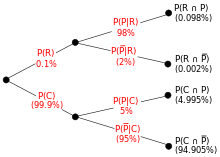

so you're finding the probability that the email is spam given that it says "free money"
upper karma
wait this is such dogshit
so its not supposed to be p(a) in the denominator?
yea
acoustic answer smh
upper karma
Hello! If someone could please help me to get started with this. Sorry its written in finnish, but I can explain anything you need to know. So we need to know alfa(degree) and beta(degree)
System is balanced. It is supposed to be really easy question, but I am so tilted and tired. And I need to get these done.
 dire bronze
whats the word if the statement,converse,inverse,and contrapostive is true
Im helping a friend out in geometry and since I am in algebra 2, I forgot
 supple ether
need help on problem 3
I don't know how to express things like slope in polar coordinate
upper karma
Having it upside down doesn't help.
 prime junco
So I've switched to Geometry pre ap and I have a test tomorrow. I know most of the stuff but there's some question I don't even understand it
 surreal bolt
/listening
surreal bolt
12?
prime junco
What about 12?
surreal bolt
Hint: Segment Addition postulate
surreal bolt
If AC is a line segment with B in between A and C ... AB + BC = AC
prime junco
Ik that the part I'm confused is finding the measures of Xy, yz, and xz
XY= x2+3
YZ= x+4
XZ= 49
How am I suppose to find the measurements of the lines???
prime junco
Doesn't it has to be in order like x2+x+3+4=49?
surreal bolt
define "be in order"
just move everything to one side and factor or use quadratic formula.
surreal bolt
kk yw
surreal bolt
ya add the two smaller angles and set the sum equal to 180
 modest locust
my problem is i didnt set it to 180. Im guessing I just thought of solving angle abc not the entire angle
modest locust
so whene ver there is a straight angle both angels will always be 180 for example 6x +40 + 3x +10 = 180
where*
surreal bolt
yup. Have you taken algebra?
modest locust
i did in high school but forgot im taking albegra on khan academy
aswell as geometry
surreal bolt
well I was going to say the roughest problem you might face here is:
two angles add to 180. The first is x^2 + 30, the other is 2x + 30. What is x?
 marsh cipher
x^2+2x+60=180?
surreal bolt
yes how would you solve that?
marsh cipher
yeah
but if youre talking about a physical shape, you would ignore the negative one
surreal bolt
actually the "rule" is plug them back in and make sure that the subbed values are both positive.
all angles / lengths etc.
marsh cipher
i just solved for x, idk what the question was
surreal bolt
Try this modified question: two angles add to 180. The first is x^2 + 50, the other is 2x + 10. What is x?
modest locust
is that a 180 or 120 u put lol?
marsh cipher
surreal bolt
ah ... so 2x + 10 is one of the angles, no? (for the revised problem)
marsh cipher
yes
surreal bolt
what happens if x = -12?
surreal bolt
yeah unless you are already in Pre-Cal you can't have negative angles. It is a geometry rule you aren't allowed to break yet.
marsh cipher
so drop the nagative one and use 10
surreal bolt
10 is fine.
There is also a possibility neither answers work. (but you have to have a very mean instructor to get a problem like that)
marsh cipher
its been a long time since ive taken geometry
i dont remember what you can and cant do
surreal bolt
ah. Yeah no negative angles nor negative lengths.
modest locust
Thank you for that question I see i need to work even harder to get better at math!
surreal bolt
yw.
modest locust
whats the highest level of math you know?
marsh cipher
im in calc 2
modest locust
i need to get to calculus level as i will be taking computer science next year lol
surreal bolt
lol are you at Uni?
marsh cipher
ye
surreal bolt
yep. In the US calculus is a major "weed out" class in colleges.
modest locust
i go to work for 8 hours then study for 4-5 so hopefully i do good when i get there lol
surreal bolt
I had friends like that. Work and study. Dunno how they did it.
modest locust
well i see how much i hate my fucking job and that motivates me very much lol
surreal bolt
I didn't have to work much and the college I went to was nice but had low tuition.
 thorn talon
I feel bad for my friends
They have to work and study hard for this
I don't work and I already feel like I don't have enough time
modest locust
i dont even know how i could balannce work and school. if possible id rather not work at all when im at school
surreal bolt
I had a job. But it was like 8-10 hours a week. Oh, and my friend lived at home. I don't even want to imagine a life where you had to make rent and not take out loans.
thorn talon
I'm already struggling balancing 6 subjects
If I had to work
I don't know how I would cope
modest locust
i went to school for music in 2014 and had to work at walmart lol
surreal bolt
Well one way is to go to a less expensive school. They're out there. Gotta look though.
modest locust
well im sure i can go for free so thats good
surreal bolt
ah nice.
For the Americans, almost everyone gets a Pell Grant. Good stuff cause it is a grant ("free" money -- no returning it)
thorn talon
School fees here kind of suck
modest locust
i owe 5k in loans right now so thats fun
surreal bolt
ah. Which year are you?
surreal bolt
(we likely shouldn't be using this channel for this discussion but ... not sure I want to talk about my finances in General. 😃 )
thorn talon
And computer subjects
surreal bolt
oh nice
thorn talon
So that's probably why
Its still like 500ish without
You have to pay fees such as library maintenance
Even if you never ever been in the library
modest locust
wtf?
well i lived in a dorm and if some dumbass broke something that belongs tot he school they take it out of each student
surreal bolt
I have another friend: his family was fairly affluent. His folks didn't help him with finances though. So he got very little funding and had to pay by himself.
thorn talon
I guess it teaches independence but still sucks
surreal bolt
I know adults who have a tough time making bills and rent. To need to make money to have a roof, a car, and have time to study at 19? Wow. (his car cost less than his computer though. hehe)
surreal bolt
anyway I gotta go. :). Laters folks.
thorn talon
Cya
surreal bolt
take care.
modest locust
Hope everyone has a amazing day.
 echo void
Hello everyone.
dark sparrow
hi
echo void
Guess everyone is in the general chat huh?
dark sparrow
if there's a question you'd like to ask, by all means ask it
echo void
I was trying to get some resource recommendations for Napier's Rules. I'm trying to solve a proof
dark sparrow
googling gives this http://www.rwgrayprojects.com/rbfnotes/trig/strig/strig.html
echo void
I've gone through that but I'm having some issues with application deriving how Mason&Dixon found the angle of a star azimuth from zenith while creating the Mason-Dixon line.
It's 89 55 51 in the image
I sketched a picture with the known variables and a Naiper's wheel...
Based from this I used the principle that "sin mid part = tan of adj part" or "sin mid part = cos of opp part" .... which gave me "sin-co A = (tan EA) / (tan PA)"
echo void
@glacial grail what are you trying to solve for?
glacial grail
@echo void find the derivative of the function y=f(x) at the point x0
I need to figure out slope angle
echo void
@glacial grail I see in your sketch that F(x) appears curved. Is that a constraint of the problem?
echo void
For number 1: Use the give angle of 150 degrees to solve for its complementary angle on the other side of x sub o. Then solve the internal angles of the right triangle. Then use those angels to solve for your angle marked in red.
@glacial grail
upper karma
for the SAT problem, wouldn't it be (area of 1/4th of circle with r = 6 - area of white triangle ) or just (3pi - 14) ?
echo void
@glacial grail you can use a similiar principle to solve for your second problem
glacial grail
@echo void Tha broblem is in your image the 150 sticks to triangle but in mine it to x0
echo void
@glacial grail My triangle is based off your sketch. Maybe this will help more....
glacial grail
@echo void I see thanks a lot.
echo void
@glacial grail No problem
upper karma
hey ann @dark sparrow for the SAT problem posted above, wouldn't it be (area of 1/4th of circle with r = 6 - area of white triangle ) or just (3pi - 14) ?
echo void
I take it that no one active in this group is familiar with euclidean geometry? XD
upper karma
you should post the question anyways someone is bound to solve it eventually
echo void
I have some images above.
echo void
I'm also here to help. I like lending a hand when and where I can. In highschool geometry was difficult for me, so I make it a point to help
upper karma
3pi would be the 1/4th of the circle right
me too in a very handwavy way
I expected 3pi +10
dark sparrow
dark sparrow
3π is the length of that one arc
upper karma
hm
i thought it would be the entire region since 1/4 (2 * pi * r ), r being 6 in this case
resulted in 3pi for the perimeter
upper karma
right right i see now
i am still a tad unsure of how 10 comes to place
i see that 6 is the hypotenuse of the triangle
6 is the only non trivial one to get no ?
and i feel that the other 4 result from SA and CT
dark sparrow
that's correct
upper karma
my question is how is it split into SA and CT
im afraid i cant make that connection on the lengths
upper karma
oohh you just do 12 - 8
dark sparrow
precisely
upper karma
and add it to the hyp of the triangle for the rest of the outline
dark sparrow
yes
upper karma
cool, thanks for the explanation
AC=6 because AC=BR= radius=6
SBT = quarter circle r=6 = 3Pi
and lets saythat RA + RC = 8 but RS +RT = 12 so our two unknown pieces add up (12-8)=4
so the perimeter is 6+4+3pi= 10+3pi
dark sparrow
correct, but you're a bit late xP
upper karma
Lil
Lol
how old are you when you take the SAT ?
Im taking it this year
And im 16
and this was the longest thing you could have on that
okay
upper karma
if i can add some context to it theres a large majority of students in the US system (including myself at the time) that are led by the wrong example of being taught shortcuts/ways to memorize problems and to operate with no logical reasoning whatsoever, I have found interest in math at age 19 but i had to revisit more basic concepts that I, along with other students, had "skipped through"
imo the importance and use of math in daily life even is not reflected upon students at times, so these have to come back to "older" more basic concepts to fully understand them
please do note though that i am not blaming the system for the lack of practice time and desire to understand since that ultimately falls on the student anyways, but some educators could use some improving
this problem doesnt exist only in the us
crude kraken
Does anyone have a graph for a circle where as n increases, the circle gets wider, but if n is smaller than the distance between the previous whole number n and the next is smaller than if n is larger? This is what I have right now but it's evenly spaced. Un-squaring s gets the effect I want but reversed where the spacing gets smaller as n (in this case s) increases.
Nvm, I'm stupid, just have to turn s^2 into 2^s
But now there's no way to have the center at zero, question stands
Okay I'm stupid still, just have to add a -1 to the end.
umbral rivet
👍
surreal bolt
the angle measure is 120. @scain2004#0398
upper karma
Can someone explain me why the length of the two vectors a and b are the same here?
Suppose that a=r*b, r>=0.
||a||+||b|| = ||a+b||.
wouldnt it be enough to know that all 3 points in b are positive?
dark sparrow
what do you mean by "all three points in b are positive"?
upper karma
sorry, i just translated it from german. i mean the coordinates
dark sparrow
this is a fact that is independent of what coordinate system you choose
so saying anything about the signs of coordinates of b is a moot point
upper karma
I see, then why is the statement right?
||a||+||b|| = ||a+b||.
only in the case of a=r*b with r>=0
upper karma
So a and b need to be parallel in order for this statement to be right?
and thus a=r*b with r>=0?
dark sparrow
well, yes
upper karma
and why is that?
dark sparrow
is it not obvious geometrically?
upper karma
Its like the Triangle inequality right?
dark sparrow
this is a degenerate triangle, if anything
 lusty sparrow
Why/how do you get a decimal from distance formula? For example, if you get radical 10 from doing distance formula and the question asks you to round to the nearest tenth, then how do you convert it to a decimal?
crude kraken
Ideally you would want to use a calculator and just round
 lean estuary
Guys help with trigonometric identities
How do i prove this >.>
Which identities should i use
dark sparrow
one way would be to rewrite tan(θ) as sin(θ)/cos(θ)
so your lefthand side becomes
=tex \cos(\theta) + \frac{\sin^2(\theta)}{\cos(\theta)}
charred spearBOT
dark sparrow
which can also be rewritten as
=tex \frac{\cos^2(\theta)}{\cos(\theta)} + \frac{\sin^2(\theta)}{\cos(\theta)}
charred spearBOT
lean estuary
Oh okay
dark sparrow
really this is less using identities and more just
moving around algebraic furniture
which is a lovely word that i saw someone on here say a few times
lean estuary
Well you already know my algebra is pretty bad 😂
dark sparrow
doesn't mean you can't/shouldn't review it
lean estuary
multiplying and dividing the left side with cos o
Never even came to my mind >.>
lean estuary
Yeah
dark sparrow
and i mean, what i had in mind is rewriting the left hand side as one fraction
lean estuary
I know for it to be equal i need to achieve 1/cos theta
dark sparrow
that is true, albeit badly worded
lean estuary
Do i convert the left side cos squared theta to 1- sin^2
dark sparrow
why not just add the two fractions together?
you're kinda overcomplicating here
i mean you can do it but it's a bit of a detour in terms of algebraic moves
lean estuary
So cos squared theta + sin theta / 2cos theta
dark sparrow
...
- that's sin**^2**(θ) you had there
- PARENTHESES!
- where'd you get that 2 multiplier?
 main sluice
this isn't geometry
lean estuary
- Woops
- So no imaginary 1 next to cos >.<
dark sparrow
sky posted his original question here and i couldn't give less of a shit right now
- So no imaginary 1 next to cos >.<
huh?
lean estuary
I thought cos+cos 2cos
dark sparrow
cos(θ) isn't any different than any other algebraic object in this respect, and @main sluice you're being a bit obstructive right now
main sluice
fine I'll take this to the trash
lean estuary
So cos^2 (theta) + sin ^2 (theta) / cos(theta)
lean estuary
Right
dark sparrow
i hope the next step is obvious
dark sparrow
👏
lean estuary
Thanks @dark sparrow
lean estuary
Where do i start
dark sparrow
what do you mean?
do you want me to link you to a resource or do you want me to say what part of algebra it seems to me you're lacking in?
if it's the former, khanacademy
if it's the latter, you seem to have trouble manipulating algebraic fractions
upper karma
ann it would be helpful if you could share a book/pdf to a college algebra book too if possible
may look into it when im done with my semester just to make sure im good with algebra
dark sparrow
don't really have any books on the radar atm sorry
lean estuary
Was the question earlier supposed to be in the algebra channel?
dark sparrow
idk, we don't really have a dedicated trig channel so it's a bit of a complicated situation
lean estuary
So i have another question with phi on it
Or like the vertical theta
Not sure how you spell it
dark sparrow
=tex \varphi
charred spearBOT
charred spearBOT
dark sparrow
i prefer the former since the latter looks too much like a russian letter pronounced the same
yep
lean estuary
I kind of got the right side already or the tan phi
But how do i get the cot theta from the left side
dark sparrow
you can cancel out cos(φ)
lean estuary
Either that or im completely wrong
dark sparrow
1/tan and cot are the same thing lol
dark sparrow
i have an autohotkey script set up so that i can type the whole greek alphabet with ease
lean estuary
On mobile?
dark sparrow
no
on pc
on mobile i just have greek enabled as one of the languages on my keyboard app
btw it wouldn't hurt to make a little cheat sheet with the greek alphabet and put it somewhere you can access it easily
since greek letters are pretty common in math
anyway on pc it actually takes me more time to type a greek letter than on mobile lol
3 keystrokes, due to the way i set my script up
umbral rivet
👀
dark sparrow
👀
i can drop the part of the AHK script that's responsible for greek letters in #chill if you want
umbral rivet
Ooh
 vale raven
I used to have a keyboard layout where
vale raven
caps lock turned on greek mode
dark sparrow
the letters commonly used in the vertex form template
umbral rivet
:)
dark sparrow
also i think h and k are common for the coordinates of a fixed point
like the template for a circle's eq is commonly given as (x-h)^2 + (y-k)^2 = r^2
though ofc it could be given just as easily as (x-a)^2 + (y-b)^2 = r^2; the letters used don't matter
umbral rivet
;o
 violet hornet
if I have 4=cos(a)
how do I solve for a?
nvm I messed up
brb
if I had 19/20 = cos(a) how do I solve for a
upper karma
put into calculator
arccos(19/20)
you have to arccos both sides
arccos(cos(a))=arccos(19/20)
@violet hornet
a=arccos(19/20)
dark sparrow
are there any restrictions on a?
bc if not
a = ± arccos(19/20) + 2πk is a solution for all k in Z
upper karma
its probably from a triangle
dark sparrow
if it's from a triangle, then yeah the only solution would be arccos(19/20)
chilly prism
@fallen ivy can you hlep me
 fallen ivy
Busy
 daring crag
can someone help D:
 covert idol
supplementary angles add up to 180
and then just need the formula for angle sum of an n sided polygon
daring crag
720/6
covert idol
==720/6
charred spearBOT
120
covert idol
yup
daring crag
welcome to 2017
 eager pendant
two angles in a line add to 180
covert idol
each interior angle is 120
eager pendant
so z=180-120=?
covert idol
^
daring crag
oh
covert idol
supplementary angles (angles in a straight line) add up to 180, so if one side is 120
the other side is 180-120
daring crag
can you help me with more
upper karma
maybe
covert idol
post away
eager pendant
dont ask to ask, just ask
daring crag
eager pendant
so you know that two angles on a line add to 180*, right?
eager pendant
so what would the angle inside the triangle (next to 135*) be equal to?
what would the red angle be equal to, if two angles on a line add to 180*?
daring crag
45?
daring crag
180-135
eager pendant
yep - because the red angle and 135* are on a straight line, they both add to 180
so the red angle is equal to 180-135
now apply the same reasoning to the blue
daring crag
80
eager pendant
absolutely right
i'll skip the external angle theorem (if you know that, you could apply it)
so you have two angles of the inside triangle
45 and 80
so what would the third angle be?
daring crag
180-125?
daring crag
==180-125
charred spearBOT
55
eager pendant
do you know the formula for the sum of interior angles for an n-sided polygon
charred spearBOT
daring crag
ack
eager pendant
and as for being distracted, i recommend you try and avoid that (e.g. by sitting away)
i know that feels bad, etc. but its up to you to decide your priorities
so we have n=6
so our angle sum is $180\times4=720$
180*4=720
so all the angles in the polygon add to 720
so we have
=tex 60+120+100+65+3x=720
charred spearBOT
eager pendant
can you go fromr there?
eager pendant
tell me if you need more help
dark sparrow
where are you stuck?
daring crag
Ive got the value of 125 for x, but now i need 2x..
eager pendant
=tex 2x=2\timesx
charred spearBOT
eager pendant
that came out wrong
daring crag
lol
dark sparrow
well if x = 125, 2 * x = ?
upper karma
250 😃
 cunning valley
Wow youre a genius
upper karma
you're 😛
 west dune
Lmao
 tropic island
hi
 quasi lion
horizontal
dark sparrow
what have you tried so far?
quasi lion
It means it's the line that looks like the horizon
dark sparrow
do you know what a horizontal line is?
quasi lion
It means it doesn't increase nor decreases
dark sparrow
no
quasi lion
So the coefficient before x is 0 (no increase nor decrease)
 past mantle
oh
past mantle
ok
dark sparrow
y = constant is what horizontal lines' equations look like
x = constant for vertical lines
 plucky perch
For 3 non-collinear points, there is exactly one plane
Can someone give me a better explanation of this?
My textbook had a tripod.
quasi lion
There is only one plane that goes through (3 points that aren't in a single line)
quasi lion
ye
 dense holly
as an exercise, try to come up with two different planes that go through the same three points
surreal bolt
um ... what is the geometry?
dark sparrow
Euclidean
 soft anvil
this is probably a bad question to ask, but can the planes have the same equation
dark sparrow
what planes?
soft anvil
oh nvm
dense holly
(excercise was for mrphp, sorry for confuse)
tropic island
A pedestrian left his house and started walking on a straight street, resting at times as necessary. The graph below shows the distance he covered as a function of time. Find the formula describing how his speed depends on the time, and graph this function.
If the speed marked as S, then :
S = , when < t <
S = , when ≤ t <
S = , when ≤ t <
S =, when≤ t <
S =, when ≤ t <_
Note : List your answers according to the intervals of t (from left to right).
upper karma
@tropic island 12
dense holly
@tropic island what have you tried so far?
dark sparrow
they seem to be offline
dark sparrow
what have you tried so far?
 bleak rivet
yeah
dark sparrow
what do you get?
bleak rivet
it comes out to 4x^2+66x
dark sparrow
yes
eager pendant
is that typeset in word?
covert idol
m is fine
 fresh quiver
No, that's not true. AB is parallel to PR, so angle RPA= angle BAQ.
bleak rivet
mmmm Right
so
Angle BQA = 47
But I dont BAQ or QBA
so how would I find one of the two of those?
OHHH
wait
so Angle RPQ = 46
and BA is parallel
so BAQ = 46 as well
so x still = 46
fresh quiver
No, PQ is not parallel to RQ. From what you're saying, you're taking angle x and angle BAQ to be alternate interior angles, which is clearly not true as these two lines meet.
You know angle BQA and angle BAQ, so you can find QBA
bleak rivet
Well thats my question