#geometry-and-trigonometry
1 messages · Page 146 of 1
 upper karma
uhm
 dark sparrow
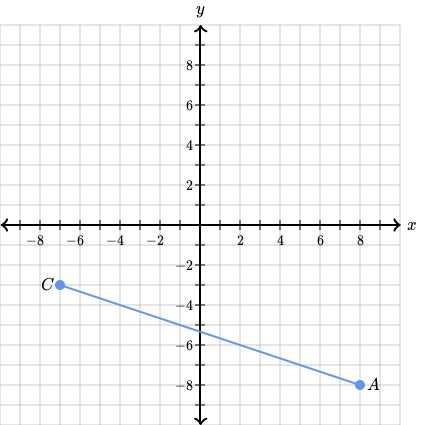
if you go 5 horizontally, you also go 1 vertically
dark sparrow
that's what it means for the slope of that line to be 1/5
dark sparrow
no
upper karma
darn
dark sparrow
5 horizontal -> 1 vertical
4 horizontal -> ?
dark sparrow
how far do you go vertically if you only move 1 unit horizontally?
upper karma
1/5?
dark sparrow
yes
upper karma
so
upper karma
0.8?
upper karma
so -1.8?
dark sparrow
💯
upper karma
so -9/5
this took me way more to understand than what I should need. why is geometry such a pain sometimes...
dark sparrow
i mean
 foggy oxide
what you were trying to understand
dark sparrow
the more boring/algorithmic route would be to write down the line's equation in point-slope form and plug in x = 0
foggy oxide
analytic geometry is very different from usual geometry
dark sparrow
y = -1 + 0.2(x-4)
foggy oxide
and it's essential just like calculus some problems that'd be hard using plane geometry can be simplified with analytic
foggy oxide
it's very similiar, isn't it ?
upper karma
yeah. minus the integrals
foggy oxide
xDD
upper karma
anyway were was I
now I am doing the same thing with r4
trying to understand it though
point-slope form... watched a video about it yesterday
but already forgot it
((I mean yesterweek))
dark sparrow
y = q + m(x-p) for a line passing through (p,q) with slope m
foggy oxide
the interception of points can be solved by a system equation of both lines
dark sparrow
or y - q = m(x-p) if you prefer
foggy oxide
i like to write, delta y = m delta x
foggy oxide
xD
upper karma
eh
foggy oxide
you have to know it
upper karma
I have to study it again
foggy oxide
m_1 * m_2 = -1
foggy oxide
there is a intuitive way to understand this, because you work with the slope in relation to the x axis
upper karma
ok
foggy oxide
you will enjoy those problems eventually trust me
upper karma
also thank you guys for the help and for making this server. ALL my friends have literally no idea of maths beyond arithmetics (and if they do they are too busy to help)
dark sparrow
lol yw
dark sparrow
coincidental
dark sparrow
although... lines have that iff they pass through (-1, 0)
upper karma
yes I know the conic sections
I meant if there is something else
basically speaking
besides distance, medium point , line, conic sections
foggy oxide
it can be connected with the notable points of a triangle (centroid, incenter etc...)
and the segments from trapezium too like euler median, harmonic median etc..
upper karma
lmao
foggy oxide
xDD
@upper karma
xD
a good thing about parallelism it's that you can perceive some triangle similiarities in problems
i always pay attention to informations like "AB is parallel to CD and perpendicular bla bla "
upper karma
oh
foggy oxide
what are you planning to do at uni ?
upper karma
thank you
if there is no place there I would like Electrical engineering
((or as they call it Engineering of electric energy)
foggy oxide
i wanted to do Civil Engineering
idk if that's the correct word for it
i still consider it as option
upper karma
Civil?
foggy oxide
Ye
foggy oxide
probably
upper karma
((of course. 10% less hard. but engineering is already one of if not the HARDEST university course))
foggy oxide
in terms of entrance ?
foggy oxide
idk, on my country they don't talk like it's thaaat hard
upper karma
what country you live in
foggy oxide
Brazil ^^
foggy oxide
What uhahuahu
upper karma
carajo ese portuguese
foggy oxide
i think bien is italian
foggy oxide
xDDDDD
upper karma
and french
foggy oxide
got it
foggy oxide
That's very nic33
foggy oxide
my ancestors are from italia
upper karma
in the now trashcan that is Venezuela
foggy oxide
xDDDDDDDD
upper karma
ok ok
foggy oxide
no one saw anything
upper karma
you are right
foggy oxide
NO ONE
upper karma
I am blind deaf and mute
upper karma
hehe
foggy oxide
xDD
upper karma
ok. after dinned I'll do more excercices condering the equation of a line
foggy oxide
that's a good idea bro xd
upper karma
namely, verify if two lines are parallel and or perpendicular. For every point, determinate the intersection of the lines and draw them. AND; for every point, find the equation and the graphic of the line with the indicated characteristics
upper karma
Sorry
foggy oxide
and solve their system in order to find the intersection
upper karma
Translating from Italian
dark sparrow
dw
foggy oxide
sqrt2
upper karma
Mhm
dark sparrow
ah
foggy oxide
i was in school, during math class and then the substitute teacher showed a problem and asked to solve it, it was about 1st degree function, (idk how to translate that from portuguese but it's basically this) i solved it with analytic geometry and then i missed a - sign and got the wrong answer (i did it in 30 seconds didn't checked ) then the teacher said that i wasn't supposed to use analytic geometry because "Variation taxe" is different from "Angle coefficient"
and that is the lvl of my teachers
(btw this wasn't exam just a usual math class)
xDDDDD
foggy oxide
xDDD
upper karma
Analytic geometry ? 👀
yeah
Googled it didnt know it was named that
kek
mhm
the geometry on the cartesian plane
Yeah coordonate geometry
da
upper karma
hi everyone. I have a question about the Mercator projection.
I wrote a script to distort a map from equirectangular to Mercator using the formula given in the image below (from the Wikipedia page) and although it gets the distortion right, it scales the whole map vertically by a value that depends on the truncation or aspect ratio, and I can't find how this value is determined.
upper karma
hold on, I might be on to something.
upper karma
Question : how to determine the truncated angle of a Mercator projection from the aspect ratio of a map ?
upper karma
If nobody knows the answer here you might want to ask again at an another discord server (maybe try 'Advanced Mathematics'?)
@upper karma that's the link by the way: https://discordapp.com/invite/5u7JPG
upper karma
@Stefan#7792 thanks. I asked there and got some great help. My problem is now solved.
upper karma
@upper karma No problem. I would have loved to help you but unfortunately geometry beyond high school syllabus is not my field of expertise.
 dull egret
i answered him over in advaced and that was like 10th grade math tbh. not difficult
upper karma
Oh hahaha shame on me! I'm don't have to use geometry anymore so my estimation was a bit off haha
dull egret
and apart from that, his question really came down to "how do i use these equations i found on wikipedia?" (sry chameleon :P)
 blazing pecan
hey guys i have a small problem calculating the coordiantes of X Y based off an angle and distance, maybe someone can help me with my formula
X + distance * Cos(Math.PI / 180 * 90)
distance = 1 so logically i would assume that X = 1
however i get x = 6.123
foggy oxide
i actually did not understand anything he typed
blazing pecan
oh my bad, let me try again
foggy oxide
oh
blazing pecan
well i wrote the code 😄 im struggling with the algorithm
foggy oxide
why 180 and 90
why distance is 1
and if you don't know x how do you get it's value since what you showed is a expression/function not a equation
are u trying to rotate/transform something ?
i'm sorry but those things are not clear for me
blazing pecan
compute the X and Y coordinate based of an existing starting point (X,Y), distance = speed (0.5 fixed) * seconds (2 seconds as an example)
dull egret
and an angle at which it is going right?
blazing pecan
direction = radians, but the user gives me normal angle so I do PI / 180 * angle
exactly
dull egret
alright
[X+speed*seconds*cos(direction*PI/180), Y+speed*seconds*sin(direction*PI/180)]
blazing pecan
so again if i go with my base example Start(0,0) move at 90 degrees should give me X = 1 (speed = 0.5 * 2 )
dull egret
why?
blazing pecan
public void Move(int seconds, int direction)
{
var distance = seconds * _speed;
var potentialXResult = X + distance * Math.Cos(AngleToRadians(direction));
X = potentialXResult > Map.X ? Map.X : potentialXResult;
        var potentialYResult = Y + distance * Math.Sin(AngleToRadians(direction));
        Y = potentialYResult > Map.Y ? Map.Y : potentialYResult;
    }

    private double AngleToRadians(int angle)
    {
        return Math.PI / 180 * angle;
    }
_speed = 0.5 fixed
foggy oxide
i still don't understand what is the unity of "angle"
foggy oxide
so it is radians or degrees ?
blazing pecan
radians
foggy oxide
ok, now this makes sense
dull egret
the only reason x could be that value is cause x or distance are wrong
or what is Map.X
if Map.X is smaller it is gonna be used
blazing pecan
these are just boundry conditions
i can remove it
im calculating the current X and Y position of the robot
and i mean in math terms this is what i got ...
distance = 2 * 0.5 = 1
then 0 + 1 * 6.1230317691118863
foggy oxide
i got what you're doing but i have no ideia why it is returning this number, i think the problem is in your code too
blazing pecan
let me write it out in 1 line
foggy oxide
maybe the problem is in the angle thing
because this number looks like it's irrational
i mean
cos(x) can return irrational values
blazing pecan
ok now i am super lost
foggy oxide
can u show more from this number?
blazing pecan
X + distance * Math.Cos(Math.PI / 180 * direction) gives me : 1.224606353822
foggy oxide
starting at 0 ?
blazing pecan
yh
blazing pecan
i literally hard coded the values
0 + 2 * 0.5 * Math.Cos(Math.PI / 180 * 90);
i still get 6.12303176911
foggy oxide
cos(77 degrees) =~ 0,224951
since the distance is 1
x has to be interpred as 1 to return this value
since cos(x) varies in the interval {-1,1}
(supposing that there is a problem in the angle thing )
maybe there is a problem in both x coordinate thing and in the angle @blazing pecan
that's what i suppose
foggy oxide
whoaaaaaaaaaaaa
wait
WAITWAITWAIT
this is from wolfram
i think this is a deeper problem well
if i press enter it'll show 0
maybe ...
ik
IK
dull egret
^-17!!!!!!!!
foggy oxide
it's
multyplying
180 per 90
and not
pi
.-.
you're actually multiplying 180 * 90
dull egret
ehh no?
dull egret
that cant be, it has to go in order
dull egret
it s just a floating point error. look at the magnitude
dull egret
whatever. it is a floating point error. he s prob missreqding the number
blazing pecan
im copying it from the debugger 😄
foggy oxide
well it is grotesque because wolfram has the error too
dull egret
no wolfram is a floating point error. it is miniscule. you are missreqding the number
foggy oxide
nvm
blazing pecan
so we're all out of ideas? 😦
foggy oxide
well
it's not a geometry problem
but the number wolfram returned is very close to yours (the inittial non zero digits)
blazing pecan
PI / 180 * 90
foggy oxide
well, your radians are not exactly this
should be very close ...
but it's actually 0
cos(pi/2) = 0
maybe
isn't the problem with the pi ?
try to type it approximately
idk
@blazing pecan
did u tried ?
foggy oxide
try to aproximate the values of cossine
nvm, that wont work i think
whatever go to a specialized chat since this is not a problem with geometry ..
foggy oxide
no, your problem is definitely with some code man
but if u get the answer tell me because i'm curious now
blazing pecan
thanks for ur help 😛 i will keep searching for the answer
if i find it i'll let you guys know
foggy oxide
ye
 golden geyser
How would I set up the equation for this question?
golden geyser
thank you
foggy oxide
np
foggy oxide
i won't answer that
but i'll ask you something
what is the measure of segment QD
@minor quest
 minor quest
21
minor quest
uh
foggy oxide
remember you're working with a circle
minor quest
u can't use pythag here right?
foggy oxide
well, nope, you don't know sufficient informations yet to deduce that
but
what is the lenght of QE
?
remember you're working with a circle
minor quest
50?
minor quest
yes
minor quest
its a radius
minor quest
mentioned
foggy oxide
what do you mean by mentioned ?
minor quest
wait what do you mean by identify QE?
foggy oxide
the lenght of QE
minor quest
yea they said r=21 and r is the length of QE?
minor quest
theyre isosceles
foggy oxide
exactly
minor quest
ok
foggy oxide
i'll help him deduce
don't try to find it on internet
if you don't remember or don't know
minor quest
wat
foggy oxide
@minor quest
minor quest
me?
minor quest
@upper karma yea
foggy oxide
i mean
minor quest
oh wait
well its area of sectore minus the triangle equal area of segment @upper karma
foggy oxide
i want to teach him how to find two areas
yes
but now
the question gives a tip
you can use trigonometry
in wich way that would help you
?
foggy oxide
remember what you pointed already, QED is isosceles and you know one angle
well, you have one angle and two sides and you know the triangle is isosceles
minor quest
hang on
foggy oxide
right
minor quest
i was thinking that i'll divide it into two right triangle and then use sin to find the opposite of the right triangle or one half of the base
minor quest
yes
foggy oxide
well, you can actually find the other two angles, but don't grip into that
minor quest
other two of isosceles?
foggy oxide
there are alot of ways to find the are of it
minor quest
theyre 65 each?
foggy oxide
what is the easiest way for you ?
considering the simmetry, yes but don't grip into that
minor quest
hmmm
foggy oxide
do you think dividing into 2 right triangles is easier ?
minor quest
well thats what came up to my mind first so yes
minor quest
about 8.87
foggy oxide
i won't check
so make sure you did it right
how do you calculate the area from one of the right triangles ?
(remember you know those right triangles are equal they have same height same hypotenuse and leg )
minor quest
u first find the h and then do bh/2
minor quest
pythag
minor quest
and then find the area of one right triangle then times 2 to get the whole thing
foggy oxide
yes !
minor quest
thanks for your patience
minor quest
still hard for me to grasp any triangle aside from those that follow b*h right of the bat so it took a while
foggy oxide
i like this kind of "Questioning" conversation
well, the important you're understanding it !
minor quest
oh.
minor quest
find the sector
foggy oxide
yes
how do you find the area of a sector ?
what do you have that can be used to find the area of the sector ?
minor quest
given deg/360 * pi r^2
foggy oxide
pie ?
minor quest
yea?
foggy oxide
i don't know if you're saying pi or pie
minor quest
pi r^2 is the area of circle but 50 deg is specific so u take area of circle times the specific deg then you get the desired sector
foggy oxide
yes, i like to think like that for the sector formula 360/(given angle) = (total area)/(piece, what you want)
now that you know how to calculate the sector
and you already have QED area
you just have to do what you said earlier
minor quest
how do you cross out a text?
foggy oxide
~~ text ~~
minor quest
~~ cool ~~
minor quest
hmm copy and paste didn't take it in
foggy oxide
@upper karma do you need something man ?
minor quest
yea i saw him lurking the whole time lol
foggy oxide
xD
@minor quest Think about a different solution for finding the x (base of the isosceles)
it's a good thing
thinking about different solutions for the same problem
this helps you seeing more solutions in the new ones
minor quest
there is a different way?
upper karma
@foggy oxide naah. I was just about to reply to an old message but eventually thought it wasn' timportant. Thanks for asking though
foggy oxide
@upper karma no problem man, if you feel like i can help you some way just ask it here xD
minor quest
im still not sure if DE is the only possible hypothenuse
foggy oxide
suppose that the triangle wasn't isosceles, how would you find it ? @minor quest
upper karma
@foggy oxide thanks 😋
minor quest
well it'll be easier if its a triangle with a distinct hypothenuse
foggy oxide
you have a angle and two sides
well hypotenuse is meant to be the bigger side for a right triangle
if it was scalene (all sides are different and all angles too ) it wouldn't have a hypotenuse
minor quest
oh
foggy oxide
legs and hypotenuse are expressions for right triangles
that's a very important fact to know
and now you know it 😉
minor quest
then how else would u solve for this
minor quest
no not yet
foggy oxide
well it's very useful
but, forget about it, you will learn it in the correct time
brb
i'll take a shower if you need a help just ask here
minor quest
ok
foggy oxide
there is a known formula for the area of a parallelogram when u have height and base (if im not mistaken)
foggy oxide
oh
sorry, didn't read it propely
if there was a angle xDD
i think you can do it
with the diagonals
true
but well
you gave him the done answer
minor quest
ima go shower be back in like 10-20 mins
foggy oxide
well i cannot drawn a proper pallalogram
foggy oxide
i still drawing a pallalelogram xDDDDDD
not only the perimeter but the area too, well
why did u deleted it
it was a good pic
why ?
xD
xDD
rip
fuckn gif
minor quest
Bruh
foggy oxide
wtf
minor quest
U got this
foggy oxide
well, it still doesn't work for me
even if i click
lol
xD
i think there is not enough information to answer the question u sent @minor quest
minor quest
Well what is the best answer out of that question then?
foggy oxide
so
no one
also
(the last option )
you can deduce that
^^
well if you had only 1 angle you could calculate everything about this parallelogram
well, i'm going to sleep
cya
 surreal bolt
um isn't the answer none of the above?
upper karma
why am I so stupid
can anyone help me find the equation of this line

just. tell me if y=-1/11x - 96/11 is correct. I don't care anymore
dark sparrow
y = -(x+16)/3
foggy oxide
a one a two - Hoje às 01:06
um isn't the answer none of the above?
@a one a two#9669
not really
because we cannot prove that the answer is not no one of the above
if i use the simmetry i could find the perimeter actually
but it's not said that the img is drawn to scale
surreal bolt
oh is someone quoting me?
upper karma
Yeah he was
surreal bolt
is it good news or bad?
surreal bolt
oh i hope so
upper karma
So uhm
https://cdn.kastatic.org/ka-perseus-graphie/a6f83535387b3fd7b8c60d7eef60d76cfc221e32.png
The problem consisted in finding B knowing that BA is 1 fifth of AC
But how do you find a point knowing how distant another point is to it?
(Or is the linear equation a better way of doing it)
dark sparrow
is B on AC?
 vapid kettle
@surreal bolt
upper karma
@dark sparrow Sorry. Yes it is
dark sparrow
okay, so
to go from A to C, you'll need to move 15 units horizontally
to go from A to B, you'll need to move 1/5 as far
- how far horizontally do you need to move to go from A to B?
- what is the x coordinate of B?
- thus, what is B?
upper karma
Hmm
foggy oxide
what is the symbol we use when two triangles are similiar, i forgot it
dark sparrow
@upper karma yes
vapid kettle
did somebody say ~?
upper karma
Ok
dark sparrow
what point on the line is 3 away horizontally from A?
vapid kettle
~
dark sparrow
~
upper karma
5 -7?
dark sparrow
💯
upper karma
Hon hon hon
Thank you
Saw. Did you need the distance formula?
Or just glance at it
dark sparrow
the distance formula is not needed
foggy oxide
~~ offtopic : what is the joke about ~ ?~~
vapid kettle
~
foggy oxide
😭
LOL
😄
LOOOOL
the ~~ reduces the size when used on a emoji
i didn't noticed that b4
maybe because it's not big when it's accompaigned of some letter/word
foggy oxide
.-.
upper karma
Or cuteness
foggy oxide
.--.
vapid kettle
I can confirm that isn't what it means ~
vapid kettle
if curious you can ask @final prairie
 final prairie
 upper karma
Tell it
foggy oxide
lol there was a question about finding the radius from the incircle of a isosceles
we are in #geometry-and-trigonometry let's talk about geometry
lol
upper karma
Ok
dark sparrow
lol there was a question about finding the radius from the incircle of a isosceles
given what
dark sparrow
=tex r = \frac{bh}{b + 4\sqrt{4h^2 + b^2}}
 charred spearBOT
foggy oxide
charred spearBOT
foggy oxide
mine was like that
:
QBR ~ QDA ~ BAP <=> QM \\ BC
LOL a fucking mess
(i considered BQ = BP and DO = QW )
i don't remember the theorem that is about BQ=BP (it's about tangent i only know that)
minor quest
@foggy oxide u here?
foggy oxide
yes
foggy oxide
i'm back
sorry
for making you wait
i was talking with a friend
well
are you here ?
minor quest
well u can too....
foggy oxide
well, i was thinking it wanted to find the GI
lol
didn't read it propely
well, yes man, i mean it's simply pyt
minor quest
ok..
foggy oxide
by the way
do you want to know how to calculate GI
?
the GI segment is the relative height to hypotenuse
minor quest
what?
foggy oxide
GI is a height from the triangle
minor quest
i was just trying to do proportion to find Gi
foggy oxide
do you want to know how to calculate it ?
it's useful
Well, i mean, you don't need to calculate GI
minor quest
sure
foggy oxide
it's just a question of sometime you need it idk
minor quest
well can you pm how?
foggy oxide
here
i'll show here
i'm drawing it
are you familiarized with the notation BÂC ?
For example this notation means the angle at the A corner starting from B and ending at C
so, the red angle
You know those facts that i pointed out because if triangle BDC is right triangle and angle BCD is in the triangle the the angle DBC is the red one
 fringe basin
is the reason that they are similar triangles because they share a side?
fringe basin
could you explain how please?
foggy oxide
here : You know those facts that i pointed out because if triangle BDC is right triangle and angle BCD is in the triangle the the angle DBC is the red one
fringe basin
like that kinda intuitively makes sense
foggy oxide
a height is a perpendicular segment
that means it makes 90 degree in relation to AC (in that case it's AC the hypotenuse that's why it's called the height relative to the hypotenuse)
imagine the red angle were 30 deg
fringe basin
oh yeah if you look at B DBC and ABD have to add to 90
foggy oxide
right?
fringe basin
and that's what the two angles which aren't 90 in a right triangle have to add to
foggy oxide
if you have 30 deg and 90 deg on triangle BDA
yes
they are complementar
i think it's complementar the correct term for that
so you can use triangle sim to solve it
fringe basin
complementary?
foggy oxide
yes, i think
it's correct "complementary"
@minor quest with those facts, the 3 angles from those triangles being the same you can use the relations of proportion
minor quest
well that is kind of what i was taught
foggy oxide
:D
dark sparrow
blurry
 short sky
dark sparrow
short sky
dark sparrow
yup, looks alright
dark sparrow
i usually prove the law with coordinates
place C at the origin, B at (a, 0), A at (b cos(x), b sin(x)) and just compute AB^2 (a.k.a. c^2) directly, and out pops the formula
c^2 = (a - b cos(x))^2 + (b sin(x))^2
= a^2 - 2ab cos(x) + b^2 cos^2(x) + b^2 sin^2(x)
= a^2 - 2ab cos(x) + b^2
💯
@short sky
 vestal cape
I know how to do Q3 a-c, e-j but I got stuck at d. and k
 thorn talon
Its the same x coordinate
So it's a vertical line
There's no gradient to work with, so special case
It just has to take the form x = number
vestal cape
Thank you!
minor quest
@foggy oxide senpai!
 vocal plinth
Guys, Can someone help me because I am retaking the Geometry Regents tomorrow?
foggy oxide
@minor quest Hello
minor quest
Nice hello edit lol
foggy oxide
@vocal plinth What do you need, i can help u tomorrow, i'm going to sleep in some minutes
foggy oxide
no i can help you very quickly
i'll just ask some things
just as advice
it's not necessary but u can draw it
it'd be better to understand
foggy oxide
i already memorized the problem
minor quest
😉
foggy oxide
you solved it ?
minor quest
proud of me senpai
foggy oxide
xDD, good boi
minor quest
lol gn
foggy oxide
cya
 gray umbra
Can someone correct my work? It's simple geo but I really don't want to screw this up, thanks in advance
foggy oxide
i think everything is correct
 bleak lintel
Talking about vectors and the distance from a point p (x1,y1) to a vector A
How do you do the top part?
as there's only this formula for me, no examples of how to use it
is it just the square root of u.x1 + v*y1 + w?
drawing that goes with it
or is it this
dark sparrow
you know what |x| means, right?
bleak lintel
the lenght of x?
or absolute value
my god im stupid
you just add those shits up, get the absolute value and then divide them with that square root?
dark sparrow
yes
upper karma
hehe, i do the same thing a lot
bleak lintel
NOW I see why you take the absolute value
my god
that took ages
because a length cant be negative
xD
foggy oxide
@bleak lintel
do you know how to deduce this formula ?
it's not reaaaaaally hard, and it's very important to understand
just involves some concepts that can trick you but aren't that complicated
dark sparrow
something something linear algebra
foggy oxide
oh xD
bleak lintel
Well, its just the derpy me
nothing to special
the full conversion is in my pdf so thats alright
foggy oxide
:D that's good
foggy oxide
?
How is this related to geometry, btw, how is this related to this server at all, (except from the fact that both servers are from discord)
dark sparrow
deleted
fringe basin
I take back what I said about the unit circle btw
but I think how it looks in american middle and high school textbooks is horrible
with all the angles around the outside and stuff
upper karma
What 😄
dark sparrow
with the multiples of π/6 and π/4 labeled?
bleak lintel
it's just there for my OCD reasons
dull egret
alright then..
dark sparrow
then there's no unique conversion
fringe basin
also yeah so the way inverse function works
is that a point (1,3) on f(x) will be (3,1) on f^-1(x)?
dark sparrow
yeah
upper karma
whats your definition of domain / codomain ?
anyone
I think i actually got it
i guess i call it 'arrival set' usually when talking
codomain that is
upper karma
Usually 'ensemble d'arrivée' which is literraly the definition for codomain = codomaine
Definition set usually
Image ^^
fringe basin
okay yeah I think I've worked it out
using facts about where stationary point is, domain and range of original function
and also knowing they have to cross on line y=x
if they ever equal each other
dark sparrow

Desmos Graphing Calculator
made a thing
if you let k bounce back and forth between 0 and 1 you get an animation of the graph flipping back and forth across the y=x line
fringe basin
so wait how do you make it do inverse?
dark sparrow
as in, desmos?
just have it graph x = f(y)
the stuff with k is just a clever lil bit of linear algebra to make it animated
upper karma
any travelers of the nth dimension here?
how does one map higher dimensional coordinates to lower dimensional ones?
projections
is one way
or do you mean bijective maps?
don't know what i mean!
well i kinda do
i have to leave for a bit, but i might be back
but if you describe what you're interested in and/or why, that might help!
the hypothetical is suppose we live in some higher dimensional space
but you need to specify a 3d coordinate within that space
to kind of shortcut 3d space
wormholes etc
as in suppose one had acquired a wormhole generator/stargate/device for interdimensional travel
but they're a cubelander
so they need to feed this device a string of coordinates in n dimensions
to specify a unique 3d point
how does that.... work?
and in n space not 3 or 4 or whatever
or even drop the special case of 3 dimensions, that's just what i'm most familiar with. but the question is more general, so i can work on one case and then induce
or even what particular topic would this be. i'll definitely look into projections and bijective maps
thanks in advance!
or in a mandelbrot set, how does one specify one particular "location" in this recursive infinite thing?
upper karma
i'm here
so the idea is projections
which are idempotent maps
so f(x) = f(f(x))
where f maps from n dimensional space
to m dimensional space
where m < n
and it's a linear map
so f(x + y ) = f(x) + f(y)
and f(a*x) = a * f(x)
when a is a scalar
and x and y are n-dimensional vectors
woah ok
a little too abstract for me
could we work like a small concrete example?
so for lets say we live in a 6 dimensional world, i assume 6 dimensions would mean each point in that space needs 6 unique values, yea?
- for background, i just finished up my second semester of calculus and am about to take vector calc and differental equations. but i've been fascinated by math in a imaginative way, mathematical fiction and imagination more than technical rigor and abstraction
so here n=6 and m=3
is a point in a space a scalar or a vector?
i asssume scalar since there's no directional aspect?
 quasi lion
a scalar is a one-dimension vector
upper karma
i was only taught vectors in physcis and so associate them with directions and forces, is that not the case in pure math?
quasi lion
lol no
upper karma
enlighten me oh wise ones
quasi lion
What do you want to know?
upper karma
vector
what makes a vector different than a scalar in pure math
or
well as you say
quasi lion
a scalar is a one-dimension vector
quasi lion
It's just multiple numbers that you put in a single mathematical object
upper karma
wiki says "an element in a real coordinate space"
quasi lion
You have 2 bananas and 6 oranges, you have (2,6) in the plane (bananas)x(oranges)
(with the origin being 0 banana and 0 orange)
quasi lion
yes they need to be orthogonal
because else the vector would be equal to another vector and the maths wouldn't fit
quasi lion
It's slightly more complicated but I get what you mean
upper karma
i really do want to understand this stuff
quasi lion
the space is generated by the span of the vectors that directs the space
upper karma
i have my primitive ideas of space
i live in euclids world
but i know, at least i believe that
at some point things become
less grounded
and so need more clear definitions
quasi lion
How old are you?
quasi lion
What do you want to know?
upper karma
zeno dialogue [at the fountain]
z; Notice the fountain…
b; What of it?
z; Particularly the transformations of each glimmering droplet
through the air. Can you identify a single one for any extended time?
b; I’m afraid not.
z; Notice too, how it seems the fountain
never resides wholly in one instant, but is rather perpetually in flux.
b; This is indeed true… why is it so?
z; It is said it would not be fitting the majesty
of the Creator to create but once,
rather to create, and then perpetually recreate!
quasi lion
I mean "vectors" is too general.
upper karma
i want to understand "space"
quasi lion
I can't answer that
upper karma
higher dimensional geometry
quasi lion
Oh
upper karma
what are the rules once i get passed 3 dimensions
quasi lion
Higher dimensional geometry isn't really fun, it's just adding an extra dimension
Hold on
upper karma
how do i deal with things in places i cant imagine
quasi lion

This is part 2 of the series. We take a look at Hyperspheres, Hypercones, and Hypercubes (tesseract). Graphics: "Cono y secciones" By Drini (Own work) [GFDL ...
This video might help you
Especially if you are physicist
quasi lion
Honestly, I don't think I can define "space"