#geometry-and-trigonometry
1 messages · Page 145 of 1
 upper karma
Yes
 cedar prawn
All these terms and ideas... so head-spinning... no matter how much I understand of math, I will always feel as if a lot of it is way over my head, I think
upper karma
Yeah
 vapid kettle
;0
upper karma
Basicially if your local ring is generated by Pi you add Pi^-1
vapid kettle
hmm
some of this sounds vaguely familiar xD
the word uniformizer is coming to mind but I could be way off 0.o
vapid kettle
algebra is fun
vapid kettle
theory is so nice
vapid kettle
oh I missed all the top matter conversation about things with MSR
upper karma
Those sheaf and schemes stuff
vapid kettle
yeah the elliptic curves class I "did"
was computational focused
and only assumed a semester of algebra
of course the first day they're talking about Galois actions but mm
"One semeseter of algebra"
upper karma
That seems like
Infinitely low
For all there is with localisation, extensions order divisors
vapid kettle
didn't even go over divisor groups
upper karma
Oh 😦
vapid kettle
interesting class though
well definitely had a style
like
first few classes were all about
how do computers do integer stuff
upper karma
Its the kind of thing that amazes me
vapid kettle
and how do computers do finite field stuff
upper karma
Weddfine a formal group over the points of the curve and get so much out of it
We can associates so much info into them
vapid kettle
mm
well I must be off to have lunch/do boring writing :(
^one of these things is much more fun than the other
I'm guessing Moon Shadow Rayne poofed off but I'll leave a couple comments
Yesterday you had some question about Graham-Schmidt
but I read through and just saw "My code works perfectly and I can't figure out the problem."
when I see something preface things by "it works perfectly" I automatically go
I don't think I can help this person :p
 waxen sorrel
 dark sparrow
try finding the area of a pentagon in terms of its side
 dire bronze
anyone have any stuff that I should definetly remember before i do my geometry final today?
(i have the formula for shapes)
dark sparrow
here you can use the pythagorean theorem to get the leftmost side of that trapezoid
and figure out the big triangle bit's area
but the small one remains unknown
dark sparrow
yeah nop
dark sparrow
you don't know how the side marked with a gets split
 minor quest
oh so i was assuming?
minor quest
yes yes i did
dark sparrow
yeah no you don't know its lower side
minor quest
i thought a-c = missing side
dark sparrow
yeah no
 foggy oxide
✧Gamercrew999✧ - Hoje às 15:16
anyone have any stuff that I should definetly remember before i do my geometry final today?
(i have the formula for shapes)
trigonometric relations
like sin law cossine law and right triangle relations
also some trigonometric identies like sin(arcsin(x)) and the other respectives also arc subtraction identities
cos(a +/- b), sin(a +/- b), and tg (a +/- b) is useful too
@dire bronze
also some properties of the notable points of a triangle (barycenter incenter etc.. ) u should google about them too
foggy oxide
lol i'm late
dire bronze
Thx doe, i got my state test tommorow
foggy oxide
well u should definitely know alot about triangles
dire bronze
Kk
foggy oxide
.0.
dire bronze
oh
dire bronze
Wut
foggy oxide
foggy oxide
maybe
foggy oxide
what this question wants to know ?
dire bronze
What trig equation can find x
foggy oxide
oh
dire bronze
And it then listed options
Then said none of the above as a option
I choose none of the above but im not so sure
dire bronze
oh
foggy oxide
wait, what the heck is the point A ?
foggy oxide
this diagram is confusing
dire bronze
probably but it was trig stuff
foggy oxide
that's so confusing because there is no point on the vertex of the big triangle
foggy oxide
i would say this is a bad elaborated question
dire bronze
but it didnt say given:X=BA
but no point of A to be there
but i cant assume stuff
idk
it was so confusing
foggy oxide
🤔 how do i face this problem
dire bronze
ye
foggy oxide
btw
can u show me another question from that exam ?
that u remember
so i can evaluate the questions difficulty level and stipulate if this one is really bad elaborated
dire bronze
To be honest
I dont really remember others
there were some find the radius if surface area was blah blah
some chord and radius questions
*tangent
*chord and tangent
my brother said i was right since u cant use trig equations for that
minor quest
Any ideas how they make 2 triangles at the bottom left of the rectangle?
One I supposed to have sidelengths 1 and 3 , 2 and 1
 surreal bolt
yes. connect (-1, -2) to (-1, -3) ... it gives you a trapezoid and a triangle.
minor quest
Well they claim them all to be triangles
Even the one on line AT they did a triangle calculation
minor quest
Yea but it's not in b X h
dark sparrow
both of which have a side aligned with an axis
minor quest
They calculated all of these in b X H
minor quest
Yes
dark sparrow
okay so
let's consider the triangle (-2,0)-(-1,-2)-(-2,-3)
what is the length of its vertical side?
minor quest
3
dark sparrow
and how far away is (-1, -2) from that side?
minor quest
1?
minor quest
1.5
dark sparrow
good
can you do a similar thing for the other triangle in that corner, (-1, -2)-(-2, -3)-(2,-3)?
 winged flicker

so I know that is a dilation of 1/3, but only from the side lengths
how do they locations of the vertices allow that to be 1/3
dark sparrow
hm?
winged flicker
should S' be at y = -2
dark sparrow
it's dilated and translated
foggy oxide
@minor quest some cases calculating triangles/whatever area would be harder so i recommend you to know the formula for the area of a quadrilateral when u have their vertex points
dark sparrow
okay so
let's call the altitude from C to AB h
- what is the slope of the line AB?
- since AB is perpendicular to h, what must the slope of h be?
- what are the slopes of the lines given in your answer options?
minor quest
Uh both are 0
dark sparrow
what?
minor quest
I mean Slope of ab is 0
dark sparrow
how did you get that?
minor quest
So slope of h is also 0
minor quest
I use y2-y1 /x2-x1
dark sparrow
...
you're missing a crucial sign there
=tex \mathrm{slope} = \frac{y_2 - y_1}{x_2 - x_1}
 charred spearBOT
dark sparrow
charred spearBOT
dark sparrow
=tex = \frac{-6-2}{2 - (-6)}
charred spearBOT
minor quest
Uh
dark sparrow
=tex = 0?!
charred spearBOT
minor quest
I think I'll try it myself first
 pseudo smelt
They have given you two right angles what dose that tell you.
 bronze shoal
that they're similar
pseudo smelt
unless stated one is not an enlargement off the other so no.
Something else that you do with right angles.
bronze shoal
hmm
 golden crater
They look similar to me....
golden crater
Precisely
bronze shoal
any clue how to solve it?
golden crater
x/7 = (x+8)/13 maybe?
pseudo smelt
how do you know that their similar.
golden crater
They're drawn overlapping and they both have right angles marked
So they share 2 angles
pseudo smelt
yes but mathematically have you proven that ABC is a result of an enlargement to ADE
First off if your given right angle and they ask for X
pseudo smelt
so what does that mean?
golden crater
I'm still getting 9.33333 which is 28/3
pseudo smelt
answer is 56/13 btw or 4.3 to 1 dp.
well x = 56/13
enlargement for smaller to bigger is 13 /7
being tired proves one thing you do bizarre things used trig and rules for work out that..
bronze shoal
the answer is 28/3
golden crater
Cool
 trail vigil
Wasn't cool
golden crater
It wasn't?
trail vigil
No
golden crater
Awww that's a bummer
trail vigil
?
 fringe basin
the equation is (x+8)/13=x/7
minor quest
I don't understand how they got the values of -15 and -29 to plug into the equation
 naive scarab
I think it might be an error
Desmos Graphing Calculator
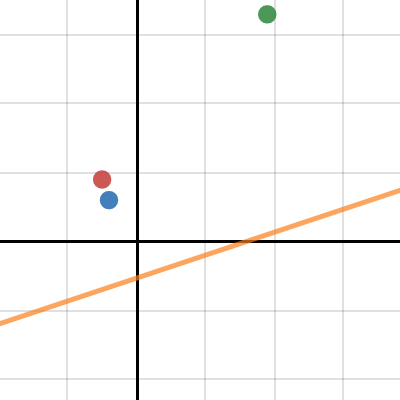
if you plot out the three points and their answer it doesn't work out, unless I did something wrong
minor quest
Feelsbadman
naive scarab
what you would want to do is get the slope of the line perpendicular to AB, and then plug in the the point at C to point slope form
minor quest
I need to understand all of these in one go to finish the course fast enough 😦
 wise sand
yeah they just like
naive scarab
they get the slope right, but instead of -15 and -29 it should be 33 and 19 respectively
minor quest
I see
naive scarab
here's what you get when you do that: https://www.desmos.com/calculator/untgiz7wcp
Desmos Graphing Calculator
 naive scarab
if you want the altitude from AB to C, you need two things
first the slope of the line perpendicular to AB
then the line with that slope which passes through C
does that make sense?
minor quest
Do I have to do point slope or can I jump right into y=mx+b
naive scarab
you can always go back and forth between the two, what do you think is easier to start with?
minor quest
Y=my+b I'm more comfortable with
naive scarab
so um, I don't see the correct answer among the choices again I think
naive scarab
that's right
minor quest
That's why I'm asking for help
naive scarab
😦
minor quest
Lul online program be like
naive scarab
so while you're here, I might as well point out something about point slope vs the regular form
the regular form wants you to know the slope and the y-intercept
point slope wants you to know the slope and a point on the line
point slope is a lot easier to work with in that way, and you can immediately rearrange it to be the form you know
cause if you have
=tex y- y_1 = m(x-x_1)
charred spearBOT
charred spearBOT
naive scarab
just by some simple algebra
so even if the regular form is easier to graph, point slope is easier to write an equation for, and then you can rewrite it immediately in the normal form
minor quest
But isn't it faster substituting a point to find the y int rather than doing the slope form and then convert?
naive scarab
I mean in practice you just have to do simple arithmetic to convert
minor quest
Don't you also do simple arithmetic for filling in a point to find the y int?
naive scarab
I guess, idk it depends on perspective
maybe I'm just as comfortable with point slope now that I've seen both for a while
I had similar feelings at first just cause it felt different
even though they're really the same
naive scarab
probably, the slope was right for the first problem which was also wrong
so that's the only sensible choice
minor quest
This is why I hate online course
naive scarab
this is pretty bad
 brazen roost
=tex \pi
charred spearBOT
 maiden trench
It's as Aozora said. It's a number that happens to be the ratio of a circles circumference to its diameter. If I had a circle of diametre 1, it's circumference is pi.
If I increase its diameter to 2, it's circumference is 2*pi
Is it? Circles are the same shape so it makes sense that circumference should increase proportionally to diametre.
I used the wrong word. Sorry. I meant circumference should increase proportionally to diameter.
I don't get what you mean by a "squared circle"
That's for area.
For circumference and diameter it's C = pi*d
Huh?
Yes, I see.
What do you mean by there aren't fixed points? Also if they square has side length 1, the radius of that circle is 1/2.
And we can measure circumference as well as we can measure the side length of the square. If we had perfect instruments we could measure it exactly.
Pi was first approximated by fitting other shapes over the circle. I'll see if I can find a link.
Because that's how they drew it.
http://personal.bgsu.edu/~carother/pi/Pi3a.html
Why should the circle jump to either square?
That link shows a picture.
Basically you can put one regular shape inside the circle and another outside it and then you can approximate pi from the perimeters of those shapes. The more sides, the better the approximation.
Anyway, I'm off. Good luck understanding circled.
golden crater
If anyone has any questions about pi, I may be able to help
dark sparrow
it's the ratio of the circumference of a circle to its diameter
...??
- i just did
- i don't see the connection you're trying to make
i mean, surely you know that numerically π is approximately 3.14159?
???
?????
define sophisticated?
maiden trench
Those are both nonsense.
dark sparrow
π is a number
so?
...
i do understand the meaning of sqrt(2)
it's the positive number that when multiplied by itself gives you 2
=tex \sqrt{2} \cdot \sqrt{2} = 2
charred spearBOT
dark sparrow
that's what
a number x multiplied by itself is x * x
i don't know what you're trying to get out of me, and i'm starting to suspect you're a troll
a real life example of what?
finding the area of a square from its side
see what?
maiden trench
She just said ...
maiden trench
To square a number is to multiply it by itself.
dark sparrow
=tex x^2 = x \cdot x
charred spearBOT
golden crater
Pi is my favorite number... so I mean maybe it's the singularity of my personal universe... is that more what you're looking for?
dark sparrow
you're talking nonsense
so what does it mean, to multiply something with itself?
we've told you.
5 times already.
golden crater
Well I do share my universe with everyone else
dark sparrow
you do realize that numbers don't need to represent an amount of apples, right
what?
what singularity?
why is geometry flawed?
maiden trench
Also why is it obvious ... I'm sure we'd be in a lot of trouble if it was obviously flawed.
dark sparrow
what?
how?
what?
you're talking gibberish
what pixels?
space is continuous
there's no "smallest length"
...ok
i've had enough
👢
minor quest
what is the equation for a line that have the slope of 0 and passes through (-4,-1)
is it just y=0-1?
dark sparrow
i mean
yes
yes it is
a line with a slope of 0 is a horizontal line
so yes it's just y = -1
minor quest
oh right
dark sparrow
yes
dark sparrow
and then you went on and on and started rambling on nonsensical topics
mate
you questioned SQUARING
and you asked the same question AT LEAST FIVE TIMES over and over and have received an adequate answer every time you asked it
 dense crater
But you're not questioning math.
You're questioning already defined and well known topics.
Which are certain
And defined
This is the geometry channel, so this is off-topic, but back when I was around 15 years old, I went through this "anti-logic" phase.
And essentially tried to convince a group of people to think "anti-logically"
It didn't make any sense
And my answers fell flat quickly
That's what I feel I'm watching back now.
But what does that even mean?
...What?
But it's two separate statements..
I'm so confused
But this is off-topic- we can move to general if talking more.
dark sparrow
what assumptions do you think should not be made, and about what?
surreal bolt
Hmm just adding empathy. I had a RL student argue with me about what the definition of the median in a triangle was. Man ...
fringe basin
as in the geometric center?
surreal bolt
no given triangle ABC, it is the segment connecting the midpoint of one side, say AB, to the other vertex, in this case C.
minor quest
What was his definition? @surreal bolt
surreal bolt
I don't remember exactly. I think he was confusing angle bisector with median -- but being very adamant that he was right.
surreal bolt
well I was tutoring at the time. Just said thanks but I'm not going back :/
minor quest
Am I on the right track?
Normally it just something like 8/5 * 5 and then you get 8
dark sparrow
what was the problem @minor quest
dark sparrow
...no, what was the problem statement?
were you asked to find the eq of a line perpendicular to one with slope 3.2 and passing through (-3, 4)?
minor quest
yes
dark sparrow
although i'd probs rewrite -1/3.2 as -5/16 :p
brazen roost
staring at a computer screen right after waking up is unhealthy
upper karma
Okay
dark sparrow
reposting your picture
upper karma
So sin 58degrees = AC/AB
brazen roost
You don't need to know AB
upper karma
Couldn't I get it with pythagoreon theorem
dark sparrow
that'd require you to know AC as well
you don't know AC either
@brazen roost i'd prefer it if you didn't interfere while i'm helping someone.
anyway
brazen roost
Ok
upper karma
back to square 1
dark sparrow
=tex \frac{AC}{BC} = \textbf{?}(58^\circ)
charred spearBOT
dark sparrow
i mean, 58° is your angle
really, you only have six possible responses to my question
sin, cos, tan, cot, sec, csc
we've ruled out sin already
upper karma
Tan
dark sparrow
no
upper karma
whattt
dark sparrow
what two sides' ratio does tan give you?
upper karma
Opposite over adjacent
dark sparrow
what is the opposite side here?
upper karma
Opposite to 58degrees is BC
dark sparrow
what?
upper karma
So i'm looking at AC, and the closest angle or length I can find is X
charred spearBOT
dark sparrow
@upper karma
upper karma
I forgot cotangent existed
upper karma
Yeah pls
dark sparrow
=tex \frac{AC}{BC} = \cot(58^\circ)
charred spearBOT
 dark sparrow
so you understand this, right?
dark sparrow
what?
upper karma
What do u mean sides are called adjacent and opposite
brazen roost
The viewpoint and singularity thing
upper karma
They can be both?
dark sparrow
no
"opposite" and "adjacent" are words that refer to the positions of a side relative to an angle
upper karma
I'm lost
brazen roost
Go learn that first
upper karma
I learned trigonometry but not well
brazen roost
Try to find similar, but simpler problems
upper karma
Yes please
dark sparrow
ok
brazen roost
So anto
dark sparrow
pm
@upper karma is it the cot that was throwing you off?
...i have to disappear for some time, ping me when you're back
in case you were confused by the cot:
BC/AC = tan(58°)
dense crater
Is Cotan = tan^-1(x)?
Or is that something else?
As in, it can also be written like that
dark sparrow
no
cot(x) = 1/tan(x)
=tex \tan^{-1}(x) \text{ denotes something different, because bad conventions}
charred spearBOT
dense crater
Right
dark sparrow
specifically, tan^-1(x) is a notation for arctan
arctan(x) = y iff -π/2 < y < π/2 and tan(y) = x
dense crater
Ahhh Arctan
brazen roost
Somehow I felt deja vu about this conversation
Well, I can see where they're coming from
brazen roost
=tex f^{-1}(x)
charred spearBOT
brazen roost
Why -1 tho
dark sparrow
because f^2(x) is used in the same context to denote f(f(x))
=tex f^1(x) = f(x) \ f^{n+1}(x) = f(f^n(x))
charred spearBOT
dark sparrow
f^n is f composed with itself n times
brazen roost
16th century logic
dense crater
@dark sparrow When you take pictures on your phone, do you copy them here via Dropbox, or?
Upload to Imgur and then link?
Or?
dark sparrow
upload directly
 azure storm
drag'n'drop
foggy oxide
LOL this is funny
well i don't think this is a level 3 question actually (max is 5)
this would be a little bit harder if they didn't say the circles radius
so ppl would have to notice it
 final prairie
Interesting tbh
dark sparrow
which ones?
upper karma
the pointy ends
dark sparrow
can you mark the angles you're referring to?
dark sparrow
upper karma
fuck that was fast thanks, yes, CAB and CDE
it took you like 5 seconds to do that how did you do it
dark sparrow
ms paint
lol
anyway, you're saying AB is perpendicular to BD and AE is perpendicular to DE?
upper karma
yes
and then there's the fact that CAB and CDE are acute
i mean if you treat DB as a rectangle's diagonal you see that CDE is equal to the angle formed at the opposite end of the diagonal, on the opposite side, and that angle is actually CAB after you use (sum of angles in triangle is 180 deg) rule
dark sparrow
upper karma
nice, thanks, your solution is much simpler
i was totally ignoring that opposite angle
upper karma
so there's a name for that?
i was just thinking about the opposite angle thing in lines and stuff like that
dark sparrow
the angles made by two straight lines like the ones i marked α in the pic are called vertical angles
...as a pair, that is
upper karma
i was doing it like this but i knew there was a simpler solution, thanks for showing me
i mean, i knew there had to be one
ah right, i see
in my country we just say they're opposite so they're equal
if they're formed by 2 lines
dark sparrow
diagrams without names for points 😓
...also, where are you from, if you don't mind sharing?
upper karma
romania
dark sparrow
ah
upper karma
sorry i felt that points would clutter the drawing
dark sparrow
labeling in a different color helps
foggy oxide
vapid kettle
Definitely not :p
foggy oxide
that's one way to show heron's formula
upper karma
Hi,
Well, I know more about how we do but basically,
I need to know the position of the point H which is the projection of the point A on the axis Bv. So, blabla the calculations is obviously BA. V, but here is how I calculate the unity of the axis v on the classical orthogonal axes X and Y. I have to make vx = Cos (Alpha) and vy = Sin (Alpha)? Or I have to calculate the slope of the style vx = DeltaY / DeltaX of the red line ?
In the example of the video below, the 4 points of the rectangle of the mouse must be projected on the other rectangle along the red axes (only the min and max points are retained), but when the rectangle rotates, exceeding one Certain value.
https://www.youtube.com/watch?v=vs4GFdhJYKw
for information
I do
xv = Cos(Alpha) yv = Sin(Alpha)
And the calculations are
`BH = ( ( xA - xB )xv + ( yA - yB )yv ) / ( Sqr ( ( xvxv) + (yvyv) ) )
xH = xB + ( ( BH * xv ) / ( Sqr ( ( xvxv) + (yvyv) ) ) )
yH = yB + ( ( BH * yv ) / ( Sqr ( ( xvxv) + (yvyv) ) ) )`

 naive scarab
expand the (x-h)^2 part
minor quest
ok?
naive scarab
try to do it. I don't want to be mean but it's not that difficult. It's best if you at least mess around with it before asking for more help.
I'm assuming that you're trying to get from the second to the first right?
minor quest
first to second
minor quest
oh ..
naive scarab
lol it's ok, it happens
 grave echo
well wrong placement it seems
minor quest
What would be the closest answer for this???
none of them seems to be correct or am i missing something?
minor quest
alright thanks! yea u can see the review for the activity is 1.9 stars lmao
surreal bolt
hehe. even + even = even, I'd go with 3x + 2y = 20
azure storm
i'd go with "there is no such thing as "closest answer", every answer is equally wrong or right" 😄
along with a "let's put it to 1.8stars"
surreal bolt
Just saying. The ones with odd constants are totally wrong ... soo 😃
surreal bolt
(the other one is wrong also)
foggy oxide
@minor quest what exactly did u get
surreal bolt
um?
I said b, c, and d are wrong. But it is a bad question. All of the choices are wrong so process of elimination doesn't apply. 😦
foggy oxide
?
foggy oxide
this question is from ITA (Brazilian institute of aeronautical technology)
well
let me translate it
fuck can't find it~
A right triangle with hypotenuse "c" = 2(1+ sqrt6) is circunscribed on a circle with unit radii. Find the surface area from the conical shape formed by the rotation of the right triangle around it's biggest leg.
very nice question btw
Obs : ITA is probably one of the best universities from my country and this is a dissertation question soo ...
 eager saddle
With a triangle of sides
a = 24.6
b = 15.9
c = 39.4
I use the law of cosines and end up with angle A as 16.7 degrees...
But that doesn't sound right, because when I try to solve the rest with law of sines, my angles do not add up to 180.
I calculated
A = 16.7
B = 10.7
C = 27.4
Can I have some help, please?
Okay, my C was miscalculated, and should have been about 153.6 degrees.
dark sparrow
the base and a side face need not be the same triangle
@minor quest do you know how to calculate the area of one side face?
minor quest
Yes
dark sparrow
do you know how to calculate the area of the base?
minor quest
Yes
dark sparrow
do you know how to calculate the surface area of the pyramid?
minor quest
I thought since its equilateral then all sides of the base are the same?
dark sparrow
all sides of the base are the same yes
minor quest
Nope they showed me some Pythagorean theorem
dark sparrow
minor quest
They did b*h /2
dark sparrow
AB = BC = AC, but ABC and PAC need not be congruent. that's what the hint said
minor quest
I did heron formula
dark sparrow
the area of an equilateral triangle is a special case worth remembering
=tex a^2 \frac{\sqrt{3}}{4}
charred spearBOT
dark sparrow
where a is its side
minor quest
Well I did the find s and then square root of s(s-a)(s-b)(s-c)
Where abc are the side lengths
surreal bolt
needlessly complicated .. 😛
You should be given the "stereotypical math instructor" award 😃
foggy oxide
@minor quest Heron formula should be used when u have all 3 lenghts soo ... or when you have the area and want a lenght etc...
and s = a+b+c/2 (semi perimeter)
dark sparrow
(a+b+c)/2
foggy oxide
lol
just by the fact of me typing semi perimeter it can be understandable that is meant to have parentheses lol
now i have school
goodbye
minor quest
Alright thanks!
dark sparrow
what exactly do you want clarified?
minor quest
the corss sectional polygon will never have more sides than the polyhedron has faces @dark sparrow
minor quest
it said the cross sectional polygon will never have more sides than the polyhedron has faces? so the polyhedron only have 3 faces so the cross sectional polygon sides can only be under 3?
dark sparrow
i mean, a polyhedron can't have only three faces :p
but yes, for example if your polyhedron has say 8 faces you can't have a cross sectional polygon with more than 8 sides
minor quest
alright so a tetrahedron have 4 faces so can a pentagon be in there?
minor quest
Alright
foggy oxide
i hate when i'm doing geometry and my intuition see something but i can't prove
😭
or when i see the solution using analityc geometry / calc
;((((((((((
this is even worse
;(((((((((((((((((((((((((((((((((((
fringe basin
I really like it when I my sketches are good so that I can see what an angle is then I check and I'm right
foggy oxide
what about the angles that are very unusual ?
like the arctg(1/2)
you can guess that's the ratio but well,
the angle is very strange when working with degrees
dark sparrow
how many odd prime numbers are there between 1 and 6?
(also, this belongs in #probability-statistics, as it's a probability question :P)
@minor quest
dark sparrow
yeah
minor quest
3 and 5?
dark sparrow
yes
minor quest
ohhh i get it now thanks! it didn't really make sense when they said odd prime for a moment
dark sparrow
why are you posting probability questions here and not in #probability-statistics?
minor quest
Right
foggy oxide
anyone
have a cool solution
for this one :
A triangle is inscribed into a unit circle, the biggest side of the triangle is 2 and its area is 1/(sqrt(2)), the minor side of the triangle is ?
my solution
needs the use of the quadratic formula so ...
dark sparrow
i mean obv the biggest side is the diameter
foggy oxide
yes
i think you already know thales theorem
(this one is from a entrance exam too)
foggy oxide
i'm back
dark sparrow
sin^2(x/2) = (1 - cos(x))/2, cos^2(x/2) = (1 + cos(x))/2
foggy oxide
i thought about using trig too, nice solution my man
i ended up solving a bi-quadratic with substitution
in a biggest circle some adjusts would be needed but this method would work too actually...
foggy oxide
someone here
if someone have a better idea
ABC is equilateral
P,M are midpoints
PN is the bissector of A ^P C
PM = 1 and i know how to calculate segment PN (by the internal bissector thing formula)
the question asks MN i can use cossine law (because i know PN)
but i would say
i'm probably inattentive and didn't see the easier sol, this is a way more complicated than it need, so if someone see a simpler solution pls tag me
 fluid stream
is theta given?
fluid stream
ok wait
foggy oxide
PC is perpendicular right ?
am i wrong ?
i slept only 5 hours past night dont judge me 😭
i'm preety sure PC is perpendicular welll
fluid stream
what does "PN is the bissector of A ^P C" the caret here mean?
fluid stream
oh
foggy oxide
well the incenter and barycenter of an equilateral triangle is in the same point
brb
fluid stream
You could use law of cosines from angle MCN, i think
foggy oxide
I was going to use from MPN
if you're saying to think about triangle MCN, i have only MC measure
so it's more logical to use law of sines
i can get the angles
fluid stream
You can find AN and NC with angle bisector theorem i think
foggy oxide
yes
PN is actually sqrt( 2) (ab) / (a + b) (where a and b are the legs of the right triangle CPA)
one of the solutions i thought was find PN then cossine law on triangle PMN, the second one is sine law on CPN
quite easier
since i know the angles from CPN too
fluid stream
Having MC and NC and angle MCN, you could also use law of cosines there
foggy oxide
yes, yes, but i think finding NC it's in terms of difficultly equivalent to finding PN or deducing the relation to find PN
the original problem if you liked it :
ABC is a equilateral triangle with sides equal to 2 such that P, M, N lies on the sides AB, BC, AC respectively and P,M are midpoints and PN is the bisector of the angle ApC, find the segment MN
 acoustic meadow
alright just to be sure i am not the best at math but there is no such thing as a "scalene equilateral triangle"
bcuz a scalene triangle has no sides that are the same but a equilateral triangle has sides that are same
right??!!
foggy oxide
yes you're right
scalene means that all sides are different
equilateral means that all sides are equal
it's very easier to explain talking about sides
not angles
but in euclidian geometry the internal angles of a triangle sum up to 180 and in the scalene all angles are different, in the equilateral the angles are 60 (degrees)
dark sparrow
ew, degrees
dark sparrow
you're dividing the circle into 360 pieces
the number 360 is arbitrary
yes it has a lot of factors
but it's still arbitrary
maiden trench
At least they're not gradians
dark sparrow
you accidentally two words
foggy oxide
i don't remember why the 360, but i already read "why" in a math history book
it came from the baby... something
babilonians
idk
foggy oxide
well, actually radians make sense but no ...
dark sparrow
what do you mean by "no"
maiden trench
It's only useful because of the number of factors, but pi and circles have a strong link.
foggy oxide
idk, when i see radians being used in non trigonometry problems i have a weird feeling
@maiden trench before the "," you were talking about 360 right ?
well radians can be explained a little bit if u think the unit circle has 2pi of circuference
that's why it makes too much sense
(that's how i face radians actually )
maiden trench
Also when would one use radians outside of trig?
foggy oxide
like Complexlma said the number of factors are a very convincent argument to the use of degrees
well, when i think about 45°
i just imagine a right triangle being distorted
or a right triangle with equal sides
whatever
(thinking about the transformation of 45° )
maiden trench
I wasn't saying it as an argument for their use. I just meant that's the only thing they have going for them.
dark sparrow
2π/5 makes more sense to me than 72°
foggy oxide
well, this is a argument actually
well, you're kinda right in this one
but i hate having to use 2pi/3 to describe 120° and etc..
dark sparrow
how come?
dark sparrow
¯_(ツ)_/¯
minor quest
is there anyway for me to convert e+12 to the actual number?
dark sparrow
what?
did your calculator output something like 5.67e+12?
that's short for 5.67 * 10^12
minor quest
yea but i want to do the actual 5.67 times whatever 10^12 is but it will just revert back to e+12
dark sparrow
...10^12 is just 1,000,000,000,000
you do realize powers of 10 are easy to calculate, right?
minor quest
oh right...
dark sparrow
and multiplying by a power of 10 is trivial
 prisma abyss
@foggy oxide tau I guess is only useful in radians
but if you want to do area you have to divide by 2
and if there's anything more ugly then timesing by two is dividing ew
 vale raven
multiplying is the word 
foggy oxide
lol
prisma abyss
ye I sun goofed
@vale raven is your name a reference to o gochuumon wa usagi desu ka
vale raven
No, people ask that a lot xD
I had this name before I found out about the green tea coffee thing
prisma abyss
is it meant to be an -autistic- special way of saying coffee
vale raven
In the anime?
prisma abyss
your name
vale raven
My name is a combination of my real name and Dutch for coffee
prisma abyss
o
cause I thought you were trying to say coffee in japnese
which is hoohii
コーヒー
koohii*
more like
vale raven
うん
prisma abyss
あの
vale raven
でも、英語を話せない日本人は
vale raven
あっ
fringe basin
fuck is this weeb shit
fluid stream
how does one mass point?
 scarlet quail
mass point?
foggy oxide
i always forget the identities for cos(arctg(x)) and sin(arctg(x))
surreal bolt
just fill in the right-angled triangle.
surreal bolt
no no ... make the tutors here look good 😃
foggy oxide
what ?
surreal bolt
nvm
foggy oxide
because my area is 6.666... not 6.67
the problem answer is 6.67 (it wanted aproximated to 3 decimal values)
i actually don't remember the rules for aproximation
surreal bolt
if it s homework that is usually close enough.
foggy oxide
no it's a problem from brilliant
surreal bolt
you mean 3 significant figures?
surreal bolt
2 decimal places ... says the problem
surreal bolt
that is not what you said earlier ...
surreal bolt
3 places ...
foggy oxide
well 3 is very close to (2) on my keyboard, i'm sorry
surreal bolt
btw the way you round depends on your instructor.
surreal bolt
Are you in the US?
foggy oxide
nope
surreal bolt
oh. well go ask your instructor.
dark sparrow
@foggy oxide round up at and above 5
foggy oxide
i think i got it
upper karma
guys
dark sparrow
mm?
dark sparrow
you can upload your image directly
dark sparrow
okay, those are four lines
upper karma
I haven't done anylitic geometry in so long. I am literally learning it now
the y interfect of r3
dark sparrow
well, what do you think the slope of r3 is?
upper karma
1/5
dark sparrow
mhm
dark sparrow
and you know (4,-1) is a point on r3
upper karma
yes