#geometry-and-trigonometry
1 messages · Page 139 of 1
 slim plinth
 proven monolith
Lets try another special triangle, shall we

 tiny acorn
proven monolith
Lets try another special triangle, shall we
tiny acorn
proven monolith
Lets try another special triangle, shall we
x^2+(x-31)^2 = (x+1)^2
damp.
slim plinth
Sure
 slim plinth
proven monolith
It is also a quick one
slim plinth
proven monolith
It is also a quick one
Can you make one where two solutions are real
If not do this

Good luck
tiny acorn
slim plinth
If not do this
x^4+x^6=x^8?
tiny acorn
dividing both sides by x^4 gives 1+x^2 = x^4
tiny acorn
1+x^2 = x^4 = (x^2)^2
let u = x^2
we have 1+u = u^2, u is the golden ratio
slim plinth
And yes
tiny acorn
slim plinth
That’s ur ans
i guess
slim plinth
The sqrt(golden ratio)
tiny acorn
,w x^4+x^6=x^8
 somber coyoteBOT


 Requested by multiplexer_12
tiny acorn
Requested by multiplexer_12
tiny acorn
.... negative sqrt(phi) doesnt count, nor the complex conjugates
proven monolith
somber coyote
Me when I have find the velocity of the car -3000km/h on the test
tiny acorn
proven monolith
Me when I have find the velocity of the car -3000km/h on the test
or worse, sqrt(10)*i km/h
slim plinth
What
slim plinth
proven monolith
Me when I have find the velocity of the car -3000km/h on the test
What about velocity of the car -3000km/s on the test
tiny acorn
slim plinth
What about velocity of the car -3000km/s on the test
its a joke
normally they wouldnt make it so the velocity is -3000 or sqrt(10)i
 spice oar
how could 0 be a answer tho?
proven monolith
spice oar
how could 0 be a answer tho?
Its an invalid answer
tiny acorn
spice oar
how could 0 be a answer tho?
1 it would leave the triangle degenerate
2 tfw triangle inequality
tiny acorn
proven monolith
Also thats because x⁸ - x⁶ - x⁴ -> (x⁴)(x⁴-x²-1)
and the -1 term
that looks sus
proven monolith
Hm?
tiny acorn
spice oar
how could 0 be a answer tho?
better explaination: 0 is a solution to the resulting polynomial but would make it invalid as the edge length of a non-degenerate right triangle (degenerate triangles are triangles whose all 3 points lay on the same line)
spice oar
i didn't knew about degenerate triangles, thank you.
 uneven siren
tiny acorn
better explaination: 0 is a solution to the resulting polynomial but would make ...
uneven siren
tiny acorn
better explaination: 0 is a solution to the resulting polynomial but would make ...
Wouldn't that be just a line??
"Degenerate" triangles I mean
tiny acorn
uneven siren
"Degenerate" triangles I mean
uhm somewhat
you can make out the supposed edges
but since all 3 points are collinear some property is lost
hence "degenerate"
uneven siren
tiny acorn
you can make out the supposed edges
U cant
I feel like
It's just a line
How can u make out sides
From a line
tiny acorn
uneven siren
U cant
suppose ABC where a,b,c are collinear, i can still specify AB, AC, BC
but its kinda meaningless
uneven siren
tiny acorn
but its kinda meaningless
Exactly
Like
Whats the point
Waitt
So in that sense
r there "degenerate" version of every polygon?
Square
Hexagon
Pentagon
Etc
tiny acorn
uneven siren
r there "degenerate" version of every polygon?
probably yes
uneven siren
tiny acorn
probably yes
😭
That's just
Like
Cool and useless
And the same time
Like imagine going to my teacher
And showing him a line and saying "that's a degenerate triangle"
Bro would beat me up
Deadahh
 minor heron
oh ic idk my math teacher said like say we get an extraneous solution on an frq, notate it with the not equals sign and make sure your ap grader knows its extraneous clearly so u dont get marked off for not showing all solutions
 blazing steeple
I was taught to write a comment and disregard it, for UK exams
slim plinth
proven monolith
Lets try another special triangle, shall we
Can you generate a problem that two solutions both works
 raven laurel
velkoz
 umbral rivet
👀
 hot grail
Can a quaternion be invalid even if it's norm is equal to 1 ?
 trail matrix
uh whay?
hot grail
I'm making a rendering engine and when I extract a rotation matrix from a quaternion I get a non-invertible matrix for some reason, although the quaternion's is normalized
 vapid kettle
Probably a good question for software
 meager thunder
Phlimy why don't you invert the quaternion and convert that to a matrix?
 honest socket
hi peeps
let's say we have a vector
and this vector ends in point A
this vector is normalized, so it has length of 1
we also have another vector, i call it Offset
X value of Offset means offset from A in direction of the first vector
and Y value of Offset means offset from B in kinda direction upwards from point A
u know what i mean?
 craggy shale
B also a normalized vector? Linearly independent from A?
Do you mean a change of basis?
honest socket
a picture
if offset will be (1, 0) then we just go further in direction of A, i mean we just extend the A by 1
craggy shale
And (0,1) we go orthogonal to A?
craggy shale
Looks like a change of basis
honest socket
what is that?
craggy shale
So you know normally
If you have the vector (1,0)
Basically you're saying
1 unit to the right
0 units up
Or otherwise
1 unit in the direction of the vector pointing to the right
0 units in the direction of the vector pointing straight up
honest socket
ooooh
craggy shale
Now then the question is
honest socket
it has something common with i j k?
craggy shale
Right so (1,0) = 1 i + 0 j
Or more general
(a,b) = a i + b j
Now I'm going to be mean to you
I'm going to say
I've got a vector v
And it is x units in the direction of a vector pointing kinda diagonally upwards
y units in the direction of a vector pointing straight down
=tex \vec{v} = x \begin{bmatrix} 1 \ 1 \end{bmatrix} + y \begin{bmatrix} 0 \ -1 \end{bmatrix}
 charred spearBOT
craggy shale
charred spearBOT
craggy shale
Why would this be better than the x i + y j thing?
We're just using different vectors that tell which direction we're going in
How many units along which vector
We're just changing what vectors we're going along
That's called a change of basis
honest socket
so i need to break the vector A into two basis vectors and then multiply and blablabla?
 dark sparrow
we're changing the vectors we choose as our "building blocks"
craggy shale
Do you want to take this over? Or shall I continue? You know me.
craggy shale
Sure
craggy shale
I'm going to be a little bit lazy.... But I really like this video https://www.youtube.com/watch?v=P2LTAUO1TdA
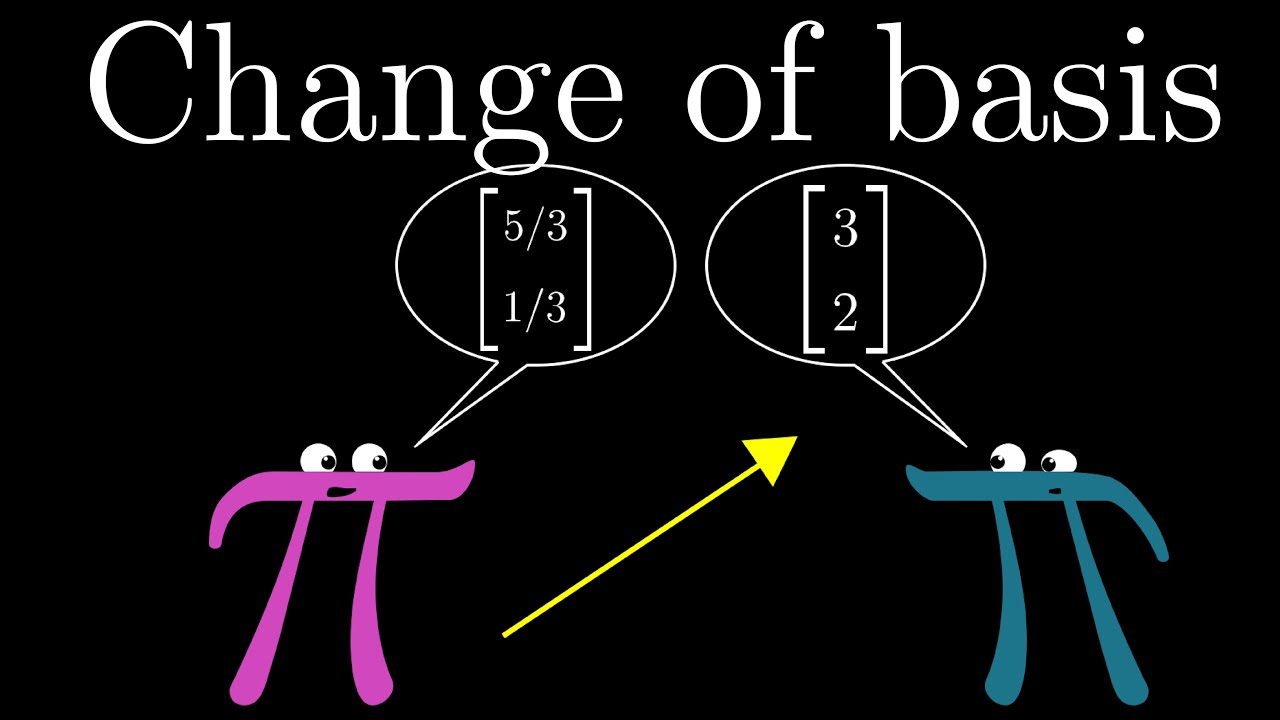
How do you translate back and forth between coordinate systems that use different basis vectors? Watch the full "Essence of linear algebra" playlist here: ht...
dark sparrow
ayyy
honest socket
i was googling too, and found khan academia's video but it's so bad, uhh..
craggy shale
Khan is pretty bad
I don't like it
Well I like the humanities part of Khan Academy
But the maths part? No thanks
Oh he goes into change of basis matrix also
Do you know matrices?
honest socket
yeah
craggy shale
👌 Excellent!
honest socket
horizontal by vertical
craggy shale
Yep
honest socket
i c already what i need
craggy shale
That times that plus that times that plus that times that plus ....
honest socket
i have 0.7; 0.7 as i, and i need to rotate it by 90 degrees counter clockwise and this will be j
craggy shale
So do you know what your change of basis matrix would be?
honest socket
not yet, i want to finish the video, maybe i will find out something new
craggy shale
Cool
 upper karma
How do I figure the center of rotation between 2 of points in a 2d plane?
dark sparrow
...what?
upper karma
uhm sorry for phrasing it poorly
Is it possible to determine the center of rotation of 2 different points in the 2d plane?
dark sparrow
what do you mean by center of rotation
upper karma
assuming i know the angle it's being rotated
dark sparrow
the center of a rotation that sends one point to the other?
upper karma
i'll define it as the point where you rotate a given coordinate, (x, y) to another coordinate (a, b) by some angle
dark sparrow
you're still wording things way too vaguely and confusingly for me to understand
upper karma
i guess an example would be the unit circle and trig
say if i have point (1, 0)
and the point (0, 1)
dark sparrow
mhm
craggy shale
There's lots of centers you could rotate around to rotate one point into another
craggy shale
Those two points have to lie on the same circle
But 3 points define a unique circle
dark sparrow
any point on the two points' perpendicular bisector is a possible center of rotation
knowing the angle of rotation narrows it down to two points on that; knowing the direction narrows it down to one
upper karma
ah
Gee thanks for the help
I was trying to find an analytic way to find a point A', which is the result of rotating the point, A by some arbitrary angle
upper karma
Nah, an arbitrary point
Writing the circle's equation seems to help
I'll try it out
upper karma
Suppose if you have a point (x, y) and you want to rotate it by some angle, θ about an arbitrary center of rotation, (a, b) other than the origin
one way to approach this
upper karma
yes
one can do a translation such that the center of rotation maps to the origin
and subsequently do a rotation about the origin at there
then
translate it back to where it's supposed to be
why does this work?
am i phrasing this poorly
like if you want to rotate a point by some angle θ about an arbitrary center of rotation
dark sparrow
imagine that instead of shifting the plane, you shift your coordinate system
in the opposite direction, ofc
dark sparrow
so then your center becomes (0,0) in the new coordinate system
you do your rotation about the origin and the center stays intact
and then you just shift your coordinate system back to where it started
=tex \begin{bmatrix} x \ y \end{bmatrix} \mapsto \begin{bmatrix} (x-a)\cos(\theta) - (y-b)\sin(\theta) + a \ (x-a)\sin(\theta) + (y-b)\cos(\theta) + b \end{bmatrix}
charred spearBOT
upper karma
is this a rotation matrix?
dark sparrow
not quite
finding that did involve using a rotation matrix though
i've denoted it with R here
upper karma
ah it makes sense now
so basically, what you had wrote down is that
to rotate a point (x, y) by an angle θ about the point (a, b)
one would do a translation such that the center of rotation is at the origin
or
(v-c)
and apply the rotation matrix for it
dark sparrow
yeah
dark sparrow
ye
honest socket
let's say we have a 2d array of dots (pixels), it starts from top-left corner and has width and height 512
we place a point at some pixel and say that this is center of a circle
then we check every point in the array, and if distance between this point and the center is less then radius, we mark this pixel, so that we have a circle of marked pixels
but what, if some dimension of our array is doubled
dark sparrow
you don't have to check all of the array, just the square given by x0 - r ≤ x ≤ x0 + r and y0 - r ≤ y ≤ y0 + r
honest socket
so, we have the same amount of pixels, but their width is doubled
 dusk snow
hold on
honest socket
yeah i know, bounding box, i do this
dusk snow
since when do pixels have a width
honest socket
i'm working in some game engine, and there is sprites that are created from texture, they don't change the texture, but i can scale the sprites
so it looks different, but the texture is the same
and then i want to make a hole in a sprite, so i translate world space point into pixel space, and then check pixels in bounding box, you know..
so if i scale the sprite, the hole is scaled also
and i want to fix it
dusk snow
ah
honest socket
yeah
dusk snow
well depending on the kind of scaling yeah
either you do a circle equation with the coordinates post-scaling
either you do an ellipse equation with the coordinates pre-scaling
 tranquil yew
can't you just make the hole smaller initially
honest socket
what do u mean?
the hole has its radius
radius can be different
oh well, i will be back with this tomorrow, i have already closed my ide and that game engine
honest socket
either you do an ellipse equation with the coordinates pre-scaling(edited)``` what's faster?so, all i needed is if (Vector2.Distance(pointOfImpact, new Vector2(x*xScale, y*yScale)) < radius) to add xScale and yScale -_-
honest socket
oh no, i was wrong
it works with objects that has width 1 and height 0.5, but doesn't work with object that has width and height 0.5
honest socket
k, this works ```float distance = Mathf.Sqrt(Mathf.Pow((xxScale)-(pointOfImpact.xxScale), 2)+Mathf.Pow((yyScale)-(pointOfImpact.yyScale),2));
if (distance < radius)```
🖐
 ashen blaze
im actually struggling rn
determine the area of the composite figure
we tried that
but we didnt get the answer (34 sq inches)\
unless we had the wrong measurements
i erased it all
lol
oh i think we had it as 4
alright thank you
upper karma
im lost i dont get it 😢
dark sparrow
don't get what
upper karma
the explanation
dark sparrow
is it that same problem with the hole? xP
dark sparrow
ok
honest socket
and this pixel array is represented as sprite that is streched 2 times by X axis
so it looks like a rectangle
dark sparrow
=tex \begin{bmatrix} 2 & 0 \ 0 & 1 \end{bmatrix}
charred spearBOT
honest socket
is this scaling matrix?
dark sparrow
yeah 😛
honest socket
so. Then I want to cut a rectangular hole in that sprite
when its rotation angle is 0, everything is okay
the hole isn't rectangular, but imagine that it is
but when i rotate the sprite by 90 degrees the hole looks like this
sooo. i do it like this....
at first I rotate the rectangle that will make a hole, then I rotate it by needed angle and calculate bounding box for this rotated rectangle, and then I check every pixel in this bounding box, rotate it by negative angle, and check if this pixel is inside not rotated bounding box, if it's in, then I make a hole
does it make any sense to u?
green pixels indicate area of bounding box of rotated rect, red pixels indicate area of not rotated rect, when they overlap the ara becomes yellow, here is angle = 0
here is angle 45
so, if we draw rectangle in the rotated boudning box, it fits perfectly in its not rotated state
if u know what i mean
but it looks like my rotation function are wrong
or not... the area of not rotated rectangle is wrong
btw it looks okay when the sprite isn't scaled
honest socket
dat feel when no one can halp u
🤔
no.
i'll do it myself
i'm just lazy now
lazying
honest socket
well, i made some investigation
let's say i set the X scale to 2, and Y to 1. To draw a 100x100 square it has to draw a rectangle with width 50 pixels and height 100 pixels
when I rotate the sprite by 45 degrees, then I take the bounding box and rotate it by -45 degrees, and then I check pixels of this new, rotated rectangle, whether they are inside another bounding box or not
so the problem is, that this rotated rectangle is destorted
here is the sprite isn't scaled
so, the green rectangle is bounding box for another, and black rect is rotated green rectangle
but when i scale it by to along X axis it looks like this
since i use black rect to draw a picture, the picture is distorted as well
also, if i will remove scaling from the last picture, it looks like this
so it rotates good, the problem is in scaling
a few weeks ago i was playing with rotation and found the shear matrix, i was told that i can rotate an image by 3 shear operations, but i didn't get how it works anyway..
but it's good that i remember that shear matrix is exists
my eyes helped me to figure out, that the distorted rectangle looks like sheared
so by experementation with values i have found values like 0.37 and 0.63
here is the sprite is scaled by 2 along X axis and rotated by 45 degrees
but i applied shearing with value 0.37 to X axis, and shearing with value 0.63 to Y axis
so it kinda fixed the problem, but rotation and scaling of the sprite can be different, so i can't searching values for each case
for now i noticed that 0.37 and 0.64 is actually 1
also, it's not perfect, i mean the shape of black rectangle
hm.. when i scale it by 2 along Y axis, the magic numbers are -0.63 for X and -0.37 for Y
here i found some info
for 36.87 degrees 3/5 is 0.6 and -1/3 is -0.33, the values are pretty close to mine
 eager saddle
How do I find the value of a trigonometric function of theta when given a line and a quadrant?
This is something really simple. ><
Oh wait I think I got it.
Make a triangle with line and X-axis, then find the respective trigonometric function value of the angle you want to find.
trail matrix
@eager saddle I learned a nemonic that helps with trig functions. A Spiffy Trig Chart. The first letter of each word stands for All, Sin, Tan, Cos. The position is in what quadrant that function will be positive in
So Tangent is positive in 1st and 3rd quadrants
Sin in 1st and 2nd
Etc
 eager saddle
@trail matrix I learned that as 'All Students Take Calculus,' but yeah. It's better to know how it works than a mnemonic.
trail matrix
@upper karma sometimes mnemonics help
eager saddle
How do you find on paper the trigonometric function value of a non-special and non-quadrantal angle?
Like, how do I find sin(91°)?
The calculator spits out .998... something in degree mode, but where did that come from?
 lean crest
you can use the taylor series of sin(x) or cos(x)
but u gotta work with radians
i.e the cos of an angle x is approximately 1-x^2/2
 grave echo
OMG
@lean crest UR HERE TOO
WHAT A SURPRISING COINCIDENCE
omg so many people here
i thought i entered a server with random peeps
lean crest
who r u
tranquil yew
@eager saddle It turns out pretty much all of the functions we commonly use can be represented by some infinite polynomial
And polynomials are easy to calculate
so you can calculate any elementary function to any digit of precision you want by just using more and more terms of that infinite polynomial that represents it
Just to clarify, each elementary function has a distinct infinite polynomial that represents it
dark sparrow
@eager saddle convert your angle to radians and then use the Taylor series for sine
sin(x) = x - x^3/3! + x^5/5! - x^7/7! + x^9/9! - x^11/11! ...
cos(x) = 1 - x^2/2! + x^4/4! - x^6/6! + x^8/8! - x^10/10! ...
honest socket
it seems i don't understand how vector's scaling work -_-
uh, nvm
oooh, okay, now i understand it a little bit
once again, in my case i have a square 1x1 which i have to display on a sprite 2x1, since sprite's ratio is 2x1, i need to make my square 0.5x1, otherwise it will look stretched along X axis
when I rotate the sprite by 90 degrees, and then try to rotate the square by -90 degrees, i rotate a rectangle 0.5x1 which placed on the sprite, and since the rotated square already is 1x0.5, and the sprite is scaled by 2 along X axis, it produce this
where green rectangle is original 0.5x1 square, and black rectangle is rotated version of the first rectangle
if i cancel scaling of the sprite it look like this
so basically we have two similar rectangles, but the black is rotated by -90 degree
and since the sprite is rotated by 90 degree, its X axis is vertical now, so that's why the black rectangle looks stretched vertically on the first image
my task is to make the black rectangle on the first image look like the green one
now it's obvious that i need to scale it by 0.5 along its X axis and scale it by 2 alongs its Y axis
but I want to make it work for an arbitrary angle
with 15 degrees rotation it looks like this
on a sprite with 2x1
and like this without scaling
so yeah, scaling for the green rect is okay since its X axis is aligned with X axis of the sprite, but for the black rect X axis isn't aligned with X axis of the sprite
can I change and use basis vectors for scaling?
i mean this
honest socket
hm...
so, for 45 degrees my X basis vector should be 0.7; 0.7, and Y basis vector is -0.7; 0.7, right?
honest socket
oh, i know i know, it's not so important for now
cause i don't need it to has exact values, it just should look good
oka, so here is what i have without changing basis vectors and scaling
the degree is 45
now i use changed basis vectors and scale it by 0.5 along X axis
looks pretty good, it's what i need
but now i want to scale it by 2 along Y axis
i drew axes
on the first image X is (0.7;0.7) and Y is (-0.7; 0.7)
so i scaled the black rectangle along X axis by 2
and now i want to scale it along blue axis by 2
so it should be (0; 1), yeah?
oh god, i'm dying.....
i guess i poke the right thing
tranquil yew
Well the exact values might help you
do you know what might have the answer of sqrt(2)/2
oh wait im 4 hours late
 hybrid cypress
How do you find the measure of an arc, given that you have an angle of 90 degrees and circumference of 180cm
dark sparrow
what fraction of a full circle is 90°?
hybrid cypress
hybrid cypress
1/4?
hybrid cypress
45
dark sparrow
that's your answer
hybrid cypress
ooh ty
how about finding the circumference of a circle if you dont have
radius or diameter?
dark sparrow
what do you have?
hybrid cypress
arc length of 90cm and an angle of 81 degrees
dark sparrow
what fraction of a full circle is 81°?
hybrid cypress
roughly 1/4
dark sparrow
i don't want any approximations
@upper karma please don't
i'd rather help lordyonetime by myself
@hybrid cypress how many degrees are there in a circle?
hybrid cypress
360
hybrid cypress
sorry idk is it 2/5?
dark sparrow
how did you get that?
dark sparrow
it is, yes
hybrid cypress
its like 4 2/5 of the circlr
dark sparrow
🤦
you chop up a circle into 360 pieces (a.k.a. degrees) and take 81 of them
what's the fraction that represents that?
@hybrid cypress
hybrid cypress
o god im laughing so sorry
dark sparrow
i'm surprised at how you managed to answer the same question correctly when the angle in question was 90°
do i need to go over how to simplify that fraction down to 9/40?
hybrid cypress
no
hybrid cypress
wai what
dark sparrow
you said your arc's length was 90 cm, right?
9/40 of a circle is 90 cm
how much is the whole circle?
hybrid cypress
yhe whole circle is 360
hybrid cypress
idk im sorry 😱 i cant see my question anymore
dark sparrow
your question was "an 81° arc of a circle is 90 cm long. what is the circumference of the whole circle?"
hybrid cypress
yesyes
dark sparrow
we have established that the arc is 9/40 of the whole circle
hybrid cypress
Ok
hybrid cypress
IM SCARED UM 400?
dark sparrow
i apologize for scaring you :/
hybrid cypress
oh no dont im just super slow
ty foe your help i appreciate it
instead of just giving me the answer 👌
dark sparrow
yeah, that's something i'm never doing to anyone
and i mean, i am planning to become a tutor once some irl stuff is sorted out, fwiw
hybrid cypress
that's good, and yay i hope you do
good luck with your future, hope everything works out
 tough saffron
 tranquil yew
I would refrain from using the face palm emoji
 weak hemlock
whast wrong with the face palm emoji
oh alright lol, just seemed out of nowhere. i guess it was deleted or something
 sour sorrel
the comment was lost on me as well, but now it makes perfect sense XD
 spiral lintel
hey guys I need help with this one prob
A circle is tangent to lines y=4/3x -12, y=3/4x +29/4, and y=4/3x +14/3. Find the equation of the cirlce
spiral lintel
okay I'll do the hard ones later
can you go to alg section, there's another question that didnt make sense to me
tranquil yew
@spiral lintel do you know any properties about tangents and their relationship to radiuses of a circle?
upper karma
They are also perpendicular to the radius
The one that touches them
Good point lol
There exists a perpendicular radius :p
 slim gorge
hey guys
 surreal bolt
hi
slim gorge
check out this prob:
In rectangle ABCD, AB = 8 and BC = 20. Let P be a point on AD such that angle BPC = 90 degrees. If r_1, r_2, r_3 are the radii of the incircles of triangles APB, BPC and CPD respectively, what is r_1 + r_2 + r_3?
took me a couple hrs to decode as im not good at geo
surreal bolt
is the answer a scalar?
surreal bolt
oops I meant a constant
slim gorge
lol, ya it is
dark sparrow
think i can solve it, hold on
surreal bolt
you could theoretically just draw it out
slim gorge
i did
surreal bolt
even using analytic geometry 😃
slim gorge
loll
surreal bolt
okay I am on it. Geogebra
slim gorge
just take a pen and paper
upper karma
Does a point on AD even exist such that it's 90°?
upper karma
Ohh I misread the lengths
slim gorge
after i found the "trick", it seemed like i am just stupid
surreal bolt
kk found the sides of all three right triangles
dark sparrow
dark sparrow
there's no trig involved here
dark sparrow
there is no trig involved here
=tex \frac{24}{3+\sqrt{5}} + \frac{40}{5+3\sqrt{5}} = 6(3-\sqrt{5}) + \frac{4}{5}(3\sqrt{5}-5) = 18 - 6\sqrt{5} + \frac{12}{5}\sqrt{5} - 4 = 14 - \frac{18}{5}\sqrt{5}
charred spearBOT
upper karma
I got 20 + 12 sqrt(5)
surreal bolt
I got a headache 😃
slim gorge
i wont tell the answer
dark sparrow
arithmetic
dark sparrow
it's already been discussed so prob not
upper karma
Is my answer correct or not?
slim gorge
lol
surreal bolt
Triangle dimensions:
8, 14, 2rt(65)
8, 6, 10
10, 2rt(65), rt(360)
r = (ab)/(a + b + c)
Too lazy? 😃
upper karma
8
slim gorge
BRAVO
upper karma
Gg
slim gorge
this took me hours to do
upper karma
I didn't use any tricks, I just used incircle radius = area / semiperimeter
slim gorge
to "figure out" to be more accurate
upper karma
The summed those
upper karma
I thought there was a trick like the way the radii line up and make it perfect for something to happen
slim gorge
me too
like the sum of the indiameters = 20 and stuff
so sum = 10
i just made the word indiameters :p
upper karma
I read that as india meters
upper karma
it's a five sided polygon
honest socket
yeah
upper karma
What do you wanna know about it
honest socket
so, let's say we have an ordered list of points
and sometimes they form a pentagon
i know that in this case there is only 5 points
how to check whether it's a pentagon or not?
dark sparrow
do you want a regular pentagon?
upper karma
Regular meaning all the 5 sides have equal length
dark sparrow
with all sides equal and all angles 108° / 3π/5?
@upper karma regular polygons have to have all equal angles as well
upper karma
Isn't that a consequence of them having equal sides?
honest socket
yes, regular
ofc i can check all 5 angles, but maybe there is a faster way to check whether it's a pentagon or not?
oh, i c, i can also check distance between the points
it must be faster
i think
upper karma
Are you saying that the 5 points given can be anywhere on the pentagon?
Assuming it does lie on the pentagon
upper karma
oh so you're saying the 5 points are on the vertex of the pentagon?
dark sparrow
@honest socket i don't think there's a faster way honestly
upper karma
@honest socket Maybe try inscribing this one into a circle
And determine an equation for the circle
and plug in those points into the equation
honest socket
🤔 i need to code it, so it's better to keep it simple
upper karma
Simple as in it uses less memory?
upper karma
Ah well I'm ignorant about this but isn't using less memory implies less time being spent?
No
Usually it's a compromise between the two
If you use more memory you can store some things to save on time
Or you can take more time to do something but end up using less memory
Ah okay
dark sparrow
@honest socket figure out the lengths first. if they're all the same, then take dot products between the vectors representing adjacent sides. if they're all the same up to sign, you have a regular pentagon
honest socket
okay, ty
dark sparrow
@ember kraken you know right triangles, right?
dark sparrow
a triangle with a 90° angle, yeah
slim gorge
SOH CAH TOA is my jam
dark sparrow
ಠ_ಠ
okay so basically
sometimes you know the angles in a right triangle, but want to know its sides
the trigonometric functions serve precisely this purpose
slim gorge
how do u write in bold?
slim gorge
ok
dark sparrow
in that triangle,
 ember kraken
Guys
dark sparrow
=tex \sin(\alpha) = \frac{a}{c}, \cos(\alpha) = \frac{b}{c}
charred spearBOT
ember kraken
I need to take a bath can you leave explanation here please?
I mean just write explanation I will read after I finish my bath
dark sparrow
ok
so just to expand on that a bit, sine tells you what fraction/percentage/whatever you want to call it the opposite side to the angle is when compared to the hypotenuse
and cosine tells you the same, but for the adjacent side to the angle
(this means sin and cos are always between 0 and 1 for an angle between 0 and 90°)
slim gorge
its easy to prove too
dark sparrow
the legs are always shorter than the hypotenuse
slim gorge
so u dont even have to prove it for acute angles
so to summarize
=tex \sin(\alpha) = \frac{a}{c} \ \cos(\alpha) = \frac{b}{c} \ \tan(\alpha) = \frac{\sin(\alpha)}{\cos(\alpha)} = \frac{a/c}{b/c} = \frac{a}{b}
dark sparrow
double backslashes for newlines
slim gorge
i did put double
dark sparrow
you didn't seem to
slim gorge
=tex \sin(\alpha) = \frac{a}{c} \ \cos(\alpha) = \frac{b}{c} \ \tan(\alpha) = \frac{\sin(\alpha)}{\cos(\alpha)} = \frac{a/c}{b/c} = \frac{a}{b}
charred spearBOT
slim gorge
oh sry
dark sparrow
oh yeah, tan stands for tangent and is the ratio of the two legs
slim gorge
cotan(x) = 1/tan(x) right?
ember kraken
Hi im back
upper karma
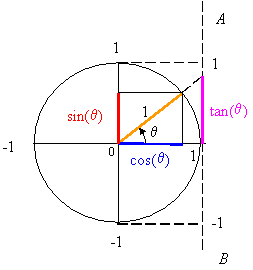
You can also check out on the unit circle definition of the trig ratios
cosine being the x coordinate and sine being the y coordinate
tangent being the slope
upper karma
If you take a circle of radius 1 and put it in the center then its circumference is 2pi, so we can define the angle by a point on the circle, and 2pi is a full angle (360 degrees)
tranquil yew
@upper karma Geometrically, tangent is the slope of the hypotenuse of the triangle when it's legs are aligned with the axes
upper karma
what do you mean by "its legs are align with the axes"
Well I interpret it as the y coordinate of the point of intersection between the line when you extend the hypotenuse of the triangle outside of the unit circle and the line x=1
tranquil yew
As in like the legs are parallel to the axes
That's the same thing daniel
slope is rise over run
if you make the run 1
then the rise will be the slope
upper karma
Well I didn't really get what you meant initially
tranquil yew
The slope of the line from the origin to a point on the unit circle is given by tan(theta)
upper karma
But the thing is
That's not a geometric definition
Like
It gives a quantity
If you define it as the slope of the hypotenuse, that is
I think the picture given above is the geometric definition
Slope is just a measure of how steep the line is
tranquil yew
Exactlyu
so tangent is also
it is a geometric definition
it ties the value of tangent to a geometric value
upper karma
Yes
dark sparrow
power of a point?
slim gorge
Um... Ya
upper karma
What do you mean without circle?
slim gorge
I mean that no circle is involved
surreal bolt
tan(x) = opposite / adjacent. If the adjacent leg is 1, then tan(x) is equal to the opposite leg. Note that in the picture the two triangles are similar. SO, the central angle is the same and the tangent of that central angle is the same. BUT note for the bigger triangle the adjacent side = 1 so the vertical leg is equal to the tangent.
 violet nest
Anyone remember the sine rule I was talking about?
This is my proof, I think
I discovered it when I was at high school, there were a crap ton of class work and I was too bored with using the sine and cosine rule, so I thought this would be a nice change
But then I noticed after rearranging, asinC and csinA part
 rare talon
It will still require a circle, whether stated on the problem or we've constructing a circle when the problem need it
slim gorge
so, given ANY four distinct points A, B, C and D that make the quadrilateral ABCD, and AC and BD intersect at X, is
AX * CX = BX * DX ?
slim gorge
me too, but sometimes it feels very true
dark sparrow
hmm
slim gorge
every quadrilateral isn't cyclic is it?
dusk snow
some are, some aren't
slim gorge
so no?
upper karma
it's not hard to prove either
upper karma
exactly
slim gorge
add a point outside the circle, done
or even inside, who cares
btw, in which field of mathematics (or geometry) are cyclic quadrilaterals used the most?
upper karma
https://math.stackexchange.com/questions/1859652/where-do-you-see-cyclic-quadrilaterals-in-real-life

I've just been studying cyclic quads in geometry at school and I'm thinking see seems pretty interesting, but where would I actually find these in the real world? They seem pretty useless to me...
hybrid cypress
Does anyone know how I'd solve for AE?
dark sparrow
...are you not able to take screenshots?
dark sparrow
redrew your pic for clarity
so for starters, @hybrid cypress, what can you tell me about this whole picture?
hybrid cypress
The circles are equal
dark sparrow
no they aren't
if they were, their shared tangents would be parallel
which they clearly aren't
dark sparrow
you certainly can!
hybrid cypress
Using Pythagorean Theorem
dark sparrow
but can you tell me what GD equals first, and why?
hybrid cypress
7?
hybrid cypress
Because GF equals 7
hybrid cypress
bc they have common external tangents?
dark sparrow
radius
aha!
that's the key word
GF and GD are radii of the same circle
so they are equal by definition
hybrid cypress
Ohh
hybrid cypress
24
hybrid cypress
So
dark sparrow
is that it is symmetric across the line EB
hybrid cypress
Is AE 68
dark sparrow
why is AE equal to 68?
hybrid cypress
Because we know that ED is 24 and DC is 44
hybrid cypress
bc theyre common ex tangents? 😓
dark sparrow
that works, sure.
hybrid cypress
What makes them equal otherwise?
dark sparrow
well, you could also tell me they're equal because they're symmetric across EB
but saying they're tangents to the same circle from the same point works
hybrid cypress
Ah gotcha
dark sparrow
yknow, in geometry, and for that matter in math in general, you really ought to know why the things you say or learn are true
not just that they're true
hybrid cypress
I know. You have to know how you're getting the answers you do and why
I'm just not in the program rn
But I'll get better at understanding why things are in math
oh gosh lol sorry
btw what do you go by?
dark sparrow
shoot
hybrid cypress
except its with internal tangents this time
dark sparrow
ok
hybrid cypress
Can I show you?
dark sparrow
is it implied that E lies on HB?
hybrid cypress
I believe so but theres no point
dark sparrow
it's not marked, hence my request for a clarification
dark sparrow
i mean, it must lie on HB, since those tangents to the circles are symmetric to each other across the line joining the circles' centers
hybrid cypress
Yeah
dark sparrow
actually, the whole pic has twofold rotational symmetry around E!
and i hope it's obvious that EI = EG and EA = EC
and due to that rotational symmetry, EI = EC, so EA = EC = EI = EG
can you find the length of any of these lines?
hybrid cypress
Im thinking its 7
dark sparrow
and why is that? 😛
dark sparrow
yup!
dark sparrow
i assume you're trying to take the square root of a number that isn't a perfect square?
hybrid cypress
Hey Anto I have one last problem
dark sparrow
post it
hybrid cypress
dark sparrow
what can you say about triangles DEC and DAB?
hybrid cypress
Theyre symmetrical at D?
dark sparrow
nope
there is a transformation with its own name that turns one into the other though
but anyway
they are similar
hybrid cypress
ok bc its a transformation in size
hybrid cypress
ahh
dark sparrow
can you figure out the scaling factor?
hybrid cypress
Yes, by figuring out the lengths of either the smaller or larger figure first?
We already know the larger ones
AD = 20, DB = 25 and AB = 15
dark sparrow
DEC and DAB are similar, remember?
DE = 4 and DA = 20, so the scaling factor between them is 5
one triangle is exactly 5 times as big as the other
dark sparrow
👍
 dim plover
Could someone point out which step of the following process is losing me answers?
Q: Find the exact solutions of the equation in the interval [0, 2pi)
Eq: 2tan(2x) - 2cot(x) = 0
Steps:
2tan(2x) = 2cot(x)
2((2tan(x))/1-tan^2(x)) = (2/tan(x))
4tan(x) = (2(1-tan^2(x)))/tan(x)
4tan(x) = (2 - 2tan^2(x)) / tan(x)
4tan^2(x) = 2 - 2tan^2(x)
6tan^2(x) = 2
tan^2(x) = 1/3
tan(x) = +-1/sqrt(3)
dark sparrow
all your steps are correct so far
it's weird that you didn't halve both sides in 2tan(2x) = 2cot(x) tho xP
@dim plover
anyway yeah you haven't lost anything, dw
dim plover
Hmm, sorry wasn't paying attention
I should have lost something though since i only get 4 of the 6 answers
If I turn the tangent and cotangent into their sine and cosine components I get all six
Any ideas?
dark sparrow
hang on, yeah, that's true
gimme a sec
ah
you're losing pi/2 and 3pi/2 because you're involving tan(x) in your manipulations, which is undefined at those points
dim plover
Oh, then really whats the point of the double angle formula for tangent :/ if I can just end up losing things
Doesn't that sort of imply that you should avoid working directly with tangent manipulations then?
dark sparrow
it does make sense to be careful with them
they're safe if you know cos(x) != 0 though
dim plover
So preventatively I would have just had to plug in the values where cosine or sine are 0 to avoid this?
(since we also had a cotangent)
I guess then... The only reason this was an issue was because of the double angle, does that mean I always need to check for this when working with the double angle of tangent?
dark sparrow
yeah
dim plover
Hmm, alrightie, glad I wasn't doing something blatantly wrong in the math
Thanks for the help
dark sparrow
=tex \vec{r}(t) = \left< \cos(t)e^{p\sin(t)}, \sin(t)e^{p\cos(t)} \right>
charred spearBOT
dark sparrow
TIL the curve given by this parametric eq has a cusp precisely when p = sqrt(2)
upper karma
it'd be something else if the cusp looked like the radical
dark sparrow
cusps correspond to r'(t) = 0
differentiate this thing and see for yourself that t = π/4 is the point of the cusp
 final prairie
@dark sparrow Does there exist another p such that r(t) has a cusp?
final prairie
Nope, apparently
maybe sqrt(2)+πu for all u in Z
Nope apparently nope
Oh wait -sqrt(2) does have a cusp
I just graphed t from 0 to 1 not 2π
Fishh
lean crest
this feels so oddly satisfying
final prairie
yeah hehe
umbral rivet
👀
 azure storm
What have you tried so far?
upper karma
There are 2 main ways you can approach this
You can find a point on the line that's closest to Q, and then find distance between 2 points
Or you can use some formula if you were taught any for this
azure storm
I'd minimize the general distance
 torpid galleon
upper karma
torpid galleon
upper karma
I think point and then distance is easier @azure storm
torpid galleon
Something like this
upper karma
Okay so
You see how the closest path to the line from point is a perpendicular line?
upper karma
So, you could take a perpendicular line that goes through Q, and you know that the nearest point to Q is where those 2 lines intersect
azure storm
This only works for lines though
torpid galleon
Oh
dark sparrow
anyway
if you draw a line that is perpendicular to h and goes through Q, it'll meet h at the point you're looking for
the slopes of any two perpendicular lines multiply to -1
torpid galleon
How come
dark sparrow
er, gimme a moment
okay, so basically if you have a line with slope m1 and a line with slope m2, then the (signed) angles they make with the x-axis are arctan(m1) and arctan(m2)
and the angle between them is arctan(m1)-arctan(m2)
so denoting that angle with θ, we get
=tex \tan(\theta) = \frac{m_1 - m_2}{1 + m_1m_2}
charred spearBOT
dark sparrow
and if θ = π/2, then the left hand side is undefined, which means that there must be a division by zero error on the right hand side
thus m1m2 + 1 = 0, and m1m2 = -1
or more rigorously you could calculate cot(θ), which would then be zero for θ = π/2
@torpid galleon
upper karma
I tried finding a function that inputs the number of sides of a regular polygon and that it can outputs me the area of any regular n-sided polygon
=tex A(n)=\frac{nx^2}{4\tan(\frac{\pi}{n})}
charred spearBOT
upper karma
where x is the length of one of the side of the polygon
and n is the number of sides
of course
this is just
a conjecture
I want to prove this by induction
but how do I start?
I've never dealt a proof by induction that involves the trig functions
dark sparrow
p sure you don't need induction for that
upper karma
So how do I prove this tho
dark sparrow
split your n-gon into n isosceles triangles
upper karma
I actually used that reasoning to arrive to this formula
upper karma
what