
#geometry-and-trigonometry
1 messages · Page 53 of 1
 somber coyoteBOT

 upper karma
I'm referring to number 2...
 primal jasper
Neat! I’m also going to be trying to myself out of precalc to go straight into BC calc when I get back from Germany. I’ll look and try and find some good ones for you!
primal jasper
upper karma
I'm referring to number 2...
They’re both arcs
upper karma
Well I must go find videos online about chords because this packet just sends problems at me
primal jasper
upper karma
Well I must go find videos online about chords because this packet just sends pr...
Organic chem tutor has some good videos
upper karma
primal jasper
Organic chem tutor has some good videos
So far none of them explain a problem like or similar to mine
 sturdy dirge
ok so the formula is y= A cos (Bx-c)+D. im missing B and im not sure if theres a C value?

so one period goes to 2pi/3. but idk what to do with that ooooff
its so hard to get past a hurdle when i dont know what it is im not understanding
upper karma
Would this be a valid way to solve it

Oh my God nvm
I keep solv8ng for the wrong darn thing
 rugged shuttle
There’s not much to algebra beyond like rational functions and logarithms
If ur a senior in high school, maybe try reaching out to some math professors and doing research on algebra
 maiden brook
rugged shuttle
There’s not much to algebra beyond like rational functions and logarithms
maiden brook
rugged shuttle
There’s not much to algebra beyond like rational functions and logarithms
not true bruh
in fact rational functions and logs are probably two of the easier units in algebra
sturdy dirge
maiden brook
in fact rational functions and logs are probably two of the easier units in alge...
truth
i think my brain is mush fr fr

 blazing veldt
sturdy dirge
i think my brain is mush fr fr
blazing veldt
sturdy dirge
i think my brain is mush fr fr
Try finding the amplitude, period, phase shift, and midline.
sturdy dirge
im having a hard time understanding what to do with a period. i know a period equals 2pi/b. and on this graph one period is 4 right? so would i do 2pi/b = 4 and solve for b?
i did it 😄
maiden brook
rugged shuttle
There’s not much to algebra beyond like rational functions and logarithms
stuff with inequalities can get very hard
and theres obviously much more than that
maiden brook
sturdy dirge
i think my brain is mush fr fr
just transformations of functions
sturdy dirge
maiden brook
just transformations of functions
its difficult for me is all but i figured it out
rugged shuttle
maiden brook
and theres obviously much more than that
Like what
Like as an actual question not trying to be rude
I’m curious
 clear anvil
A corollary of the Pythagorean theorem's converse is a simple means of determining whether a triangle is right, obtuse, or acute,
Obviously i know how to show this, but my actual question is
why is it called "pythagorean theorem's converse"
 dark sparrow
pythagoras is "right triangle => a^2 + b^2 = c^2"
its converse is "a^2 + b^2 = c^2 => right triangle"
(suppressing details™️)
clear anvil
correct
so like how does that relate to the triangle being acute/obtuse
well a^2 + b^2 > c^2 -> acute
and the reverse for the obtuse case
sorry if i'm missing definitions
but how does a^2 + b^2 = c^2 -> right triangle talk about acute/obtuse case
(i'm more concerned about the definitions of maybe corollary and the converse and how that relates than the actual theorem)
dark sparrow
clear anvil
but how does a^2 + b^2 = c^2 -> right triangle talk about acute/obtuse case
it does not
clear anvil
dark sparrow
it does not
hmm okay so uhhh how do they use that green sentence to introduce the red thing
 dark sparrow
are you concerned about understanding why the red stuff is true or the formal logical linking in this paragraph
clear anvil
😭 maybe both? unless you're busy to explain both
dark sparrow
idk like
the formal logic seems a little bit shoddy here
as for why the red stuff is true idk like
do you know the law of cosines
clear anvil
dark sparrow
do you know the law of cosines
😭 yes i'm aware how to derive it with law of cosines
sorry i didn't see your message
you can ping me
i guess i was concerned about how they link stuffs
because i wanted to "parse this information" for someone who isn't familiar with law of cosines and the like
 merry mulch
A rectangular sheet of paper 30cm*60cm can be formed two right circular cylinders in two ways, thus the ratio of volumes between the cylinders equals to:
dark sparrow
!status
 lime crownBOT
What step are you on?
1. I don't know where to begin.
2. I have begun but got stuck midway.
3. I got an answer but I was told that it's wrong.
4. I got an answer and would like my work checked.
5. I have a question about someone else's work/solution.
6. I have completed the problem and don't need help anymore. Thank you.
7. None of the above
@merry mulch
merry mulch
dark sparrow
<@1089152158710108160>
4
dark sparrow
you could have posted your work and answer
merry mulch
I think the ratio should be 1:1
dark sparrow
ok show how you got that
merry mulch
as the volume shouldn't be different since both would occupy same amount of space
dark sparrow
that's your entire reasoning?
how do you know they occupy the same amount of space?
merry mulch
as they are formed from the same rectangular sheet
dark sparrow
their lateral surface areas would be the same maybe, bc you're folding the same sheet up. but this doesn't by itself imply their volumes are also the same!
ok so to not run around the bush, you are wrong.
merry mulch
does volume differ even though it's from the same sheet? How's that possible
dark sparrow
do you want to be taken through how to work out the 2 different volumes? yes/no
if you say yes i will need you to NOT JUMP AHEAD
merry mulch
yes
dark sparrow
do you understand that you are now not supposed to jump ahead of my explanation?
merry mulch
remain silent?
dark sparrow
no, i didn't say to remain silent.
im gonna take you through the reasoning, and you should work things out, but you should do only what i tell you to do.
understood?
merry mulch
ok. got it
dark sparrow
alright.
so this is gonna be cleaner to do if we make variables for the dimensions of our original sheet of paper. that way there's less numbers to worry about.
wait actually no, before this:
do you know how to find the volume of a cylinder in general? yes/no
merry mulch
yes
dark sparrow
ok, tell me the formula.
merry mulch
pier^2h
dark sparrow
pi, not pie.
and put spaces around your asterisks so they don't get eaten as italics
but ok, great.
so we have this rectangle, whose sides i will call a and b. (for our specific problem, we'll have a=60 and b=30 -- but we will NOT use these numbers until the VERY END)

let us first imagine gluing together the vertical sides of this sheet, so that b becomes the height and the a-sides roll up into circumferences of the bases.
tell me: what will be the radius of the base?
(if you try to tell me the volume at this stage, i will reject it.)
merry mulch
dark sparrow
tell me: **what will be the radius of the base?**
a/2
merry mulch
radius is the distance form the centre towards circumference and here a is the diameter. so divide it by two
dark sparrow
no, a is not the diameter.
so that b becomes the height and the a-sides roll up into circumferences of the bases.
merry mulch
b/2
dark sparrow
how did you get that?
merry mulch
merry mulch
b/2
random guess.
dark sparrow
bad!!!
i will repeat myself: we're gluing this cylinder vertically, so that:
- b, the height of the rectangle, becomes the height of the cylinder.
- a, the length of the rectangle, becomes the circumference of the base.
i ask you again: what is the radius of the base?
merry mulch
by using the formula of curcumference we can get radius
dark sparrow
do it.
merry mulch
is it a/2* pi
dark sparrow
no, it is not $\frac{a}{2} \cdot \pi$.
somber coyoteBOT
|Ann⟩
 merry mulch
it's $\frac{a}{2\pi}$
somber coyoteBOT
Nischal
 dark sparrow
that's more like it.
note that a/2 *pi can ONLY be read as pi being outside the fraction.
you should have put parentheses, like so: a/(2pi)
understood?
merry mulch
yeah. i realized it now.
dark sparrow
ok, good.
now
we have the formula for the volume of a cylinder, as written by you earlier: $$V = \pi r^2 h$$ where $r$ is the base radius and $h$ is the height.
for us, the radius is $\frac{a}{2\pi}$ and the height is $b$.
your next instruction is to \textbf{write down the volume of the cylinder in this scenario}. your answer should begin with $V_1 =$ [as after this we will have a $V_2$ for the other scenario.]
{\Huge Leave your expression UNsimplified until I tell you otherwise.}
somber coyoteBOT
|Ann⟩
 dark sparrow
write it in latex or on paper.
merry mulch
dark sparrow
write it in latex or on paper.
i wanna try latex even though it takes time for me
$V_1=\pi\frac{a^2}{4\pi^2}b$
somber coyoteBOT
Nischal
 upper karma
π*(a/2π)²b
merry mulch
$V_1=\frac{a^2b}{4\pi}$
dark sparrow
upper karma
π*(a/2π)²b
that is what i wanted to see from nischal, yes. but i will ask you to please not interrupt me here.
upper karma
bet
dark sparrow
merry mulch
$V_1=\frac{a^2b}{4\pi}$
put a space after the pi so that latex does not get confused at the nonexistent command \pia
also check for typos.
upper karma
9th grade mathematics
dark sparrow
@merry mulch check for typos again, and you messed the latex up.
and you have a typo in addition to messing up the latex.
somber coyoteBOT
Nischal
 merry mulch
upper karma
9th grade mathematics
merry mulch
upper karma
9th grade mathematics
yeah
merry mulch
similarly shall I calculate V2?
dark sparrow
let me speak.
the second scenario involves gluing the a-sides together, so that they become the heights, while b rolls up into the base circumference.
you have 2 options:
(1) Do the same song and dance one more time, with all of the tedium involved.
(2) Recognize that the calculation and result will be exactly the same, only with the roles of a and b interchanged -- and from this, write down V_2 directly.
pick one of these two options.
merry mulch
dark sparrow
you have 2 options:
(1) Do the same song and dance one more time, with all of th...
2nd one
merry mulch
$V_2=\frac{ab^2}{4\pi}$
somber coyoteBOT
Nischal
 somber coyoteBOT
|Ann⟩
 merry mulch
a/b
dark sparrow
how did you get that?
merry mulch
by dividing
dark sparrow
ok, i guess i can trust you on this one...
since it is algebraic fuckery and you got it right
so now you almost have your answer
for a rectangle of size a by b, the volume ratio is equal to a : b
merry mulch
I see. that means the volumes are different.
merry mulch
dark sparrow
do you have anything else to ask about this problem?
No. I'm crystal clear now
upper karma
it was surface area and volumes? @merry mulch
merry mulch
no it was just the ratio of volumes
upper karma
Oh
merry mulch
My explanation: Since A conatains both scalane and isosceles triangles the right option is d(none)

correct me if I'm wrong.
 faint pasture
is it bad to look at the options before solving the question and solving it to achieve an answer that equals one of the options this sounds kinda dumb, but hear me out, for eg in this question i was stuck but then i looked at the options and they all contained a^2 + b^2, and ab so i just calculated their values seperately and chose the option that satisfied this probably wasnt the intended way to solve the problem but yea is it not reccommended?

 silent plank
situational
sometimes the options can provide an indication of what may need to be done
other times, especially with numerical calculations they don't have the same effect
faint pasture
silent plank
situational
yea but like in problems like this one should i avoid doing it this way during practice or is it just fine?
silent plank
its fine
doing enough of these, you'll have a better idea of how to do questions
where they ask you to express ____ in terms of a,b,even without options provided
faint pasture
silent plank
doing enough of these, you'll have a better idea of how to do questions
where th...
i see thank you!
 deft sail
How do you solve this? I thought it was 14sin45° or 7√2
 deft sail
I mean that
deft sail
Yup
deft sail
Yup
dark sparrow
overcomplicating imo but yes.
deft sail
Makes so much sense. Thank you 🥹
upper karma

I feel like the right answer is not here
Question is asking: State if each angle is an inscribed angle, if it is, name the angle and the intercepted arc
Yes I drew on it because the lrining it absolutely fucked
silent plank
what do you think the answer should be?
upper karma
silent plank
what do you think the answer should be?
oph my fuckinjg god i just realized its not an inscribed angle :sob\
its B
silent plank
yes
 somber coyoteBOT
 upper karma
im not sure whats going on here
also C in the center is not C the line mb
i remarked it as O
anyways
All I know that the Line C is tangent to the Center
which is like Right Angle Tangent
Wait I think if I divide 136/2 I get ? (aka the ans)
 zealous pivot
Let omega be a circle with center O, A a point outside of omega. Let B, C be points on omega such that AB and AC are tangent to omega. Is there a simple way of proving that A,B,O,C, are cyclic?
So I know that OBA and OCA are right angles, and this should be sufficient
also, I am pretty sure I can do it with coordinates, but I don't want to do that
 tardy vale
This going to sound dumb, but do circles have vertices? Because ellipses have vertices, and circles are a special type of ellipse, so I'm a little confused if they have no vertices like it was explained in early math classes, or if they do have vertices
dark sparrow
circles have only a center
otherwise no point of a circle is distinguished from any other unlike an ellipse's vertices
tardy vale
Ok, thanks
 next pumice
Do centroids always contain bisectors of the sides of the triangle
 mossy garden
next pumice
Do centroids always contain bisectors of the sides of the triangle
mossy garden
next pumice
Do centroids always contain bisectors of the sides of the triangle
The centroid of a triangle, where its three medians intersect, may not necessarily coincide with the points where the bisectors of its sides intersect, but all three of these points—centroid, incenter, and orthocenter—are collinear, forming the Euler line.
sturdy dirge
I'm so burnt out but my trig class ends basically tomorrow
Sobs
And I'm tryna prepare to do well on the final
 trail tendon
what have you learned
 quick stump
mossy garden
The centroid of a triangle, where its three medians intersect, may not necessari...
quick stump
mossy garden
The centroid of a triangle, where its three medians intersect, may not necessari...
Idk what an Euler line is but ok
@next pumice is my alt btw
maiden brook
quick stump
Idk what an Euler line is but ok

here
there are a lot of lines ig but u should be able to find it out


 vocal bison
Can somebody explain to me why this question is a permutation and not combination? the only thing i can think of is that the pencil and eraser stuff is the “order” but how do i know that for sure?
 maiden brook
I hate these types of questions because of the ambiguities
but it’s a permutation because the students are assumed to be distinct and so are the objects
so like say there are three of them A, B and C: handing A an eraser would be a different case than handing A a pencil
 iron knot
Hello iam a student in grade 10
I wanted someone to help me with a math concept
Which why we use tan theta to find slope why we don't use cos or sin
And what is slope by a simple way
Second point what does ax+by+c stands for they tell my in school equation of st line but I don't get it
Third point i solve math problem but i don't understand it's concept well is it normal
rugged shuttle
iron knot
Hello iam a student in grade 10
I wanted someone to help me with a math concept
...
I’m only in grade 9 but I’ll try to answer as best I can
I’m gonna assume we’re talking about polar equations here
iron knot
rugged shuttle
I’m only in grade 9 but I’ll try to answer as best I can
I think a grade 9 here is better than most students in our country 😂
iron knot
rugged shuttle
I’m only in grade 9 but I’ll try to answer as best I can
Thank you ♥️
rugged shuttle
I think slope as like y/x and that can change the angle at which a line is positioned
Tan theta = y/x, so if we have y and x we can use inverse tan to find theta and therefore find the slope
iron knot
rugged shuttle
Tan theta = y/x, so if we have y and x we can use inverse tan to find theta and ...
Yes I know but why exactly tan that decide the the slope of line
 random tapir
vocal bison
Can somebody explain to me why this question is a permutation and not combinatio...
random tapir
vocal bison
Can somebody explain to me why this question is a permutation and not combinatio...
dr.hren can give these three things to 3 people if she gives a pencil to A an eraser to B and the coupon to C it would be diffrent than giving a pencil to C etc. thats just my guess im kinda new to the counting principle
rugged shuttle
iron knot
Yes I know but why exactly tan that decide the the slope of line
Oh imagine a triangle with y and x as legs and r as radius
The x leg is lined up with the x axis and the right angle is on the x axis and away from the origin
The angle theta the radius makes with the x axis also defines ur slope
iron knot
Like a right angled triangle with a base of x axis and y axis is height and hypotenuse (raduis)
rugged shuttle
iron knot
Like a right angled triangle with a base of x axis and y axis is height and hypo...
Like imagine this triangle if it was moved left 1 down 1
 iron knot
Ah ok
rugged shuttle
Slope is commonly defined as rise/run or change in y/change in x
And it’s basically how steep ur line is
If we make a triangle around part of ur line we get this diagram
iron knot
rugged shuttle
Slope is commonly defined as rise/run or change in y/change in x
Ok and why it change in y/x not x/y
iron knot
rugged shuttle
If we make a triangle around part of ur line we get this diagram
Yes i got the diagram thank you♥️
rugged shuttle
iron knot
Ok and why it change in y/x not x/y
Because some mathematician years ago said so
😜
Anyways
iron knot
rugged shuttle
Because some mathematician years ago said so
Yes that's right😂
rugged shuttle
The steepness of this triangle can either be determined by (change in) y/x OR the angle between the line and the x-axis
Which can also be denoted as theta
 rugged shuttle
Yes 👍
So if we find theta we can then find out how steep the triangle is (and slope)
iron knot
rugged shuttle
So if we find theta we can then find out how steep the triangle is (and slope)
What's meaning of how steep
rugged shuttle
1 sec
iron knot
Take your time bro
rugged shuttle
iron knot
What's meaning of how steep


Sorry if this is long I’m still learning a lot of this
iron knot
rugged shuttle
Sorry if this is long I’m still learning a lot of this
It's alright and thank for caring ♥️ but iam in Arab country so i can face some difficult in English but its alright
rugged shuttle
So to find slope we just need to divide y/x
iron knot
rugged shuttle
Ok ok steep is like slope or a definition or denotation of slope
rugged shuttle
Mmm… slope is like how steep an angle/line is
iron knot
rugged shuttle
Mmm… slope is like how steep an angle/line is
I get it
rugged shuttle
I think u don’t really need tan or theta to determine slope, just y and x
iron knot
rugged shuttle
I think u don’t really need tan or theta to determine slope, just y and x
There alot of ways to get slope
rugged shuttle
iron knot
There alot of ways to get slope
Yeah pretty much if there’s a math problem that u need help on involving this topic then I’d love to help
iron knot
rugged shuttle
Yeah pretty much if there’s a math problem that u need help on involving this to...
♥️♥️♥️Thank you
rugged shuttle
iron knot
Hello iam a student in grade 10
I wanted someone to help me with a math concept
...
For ur question to find slope u only need y and x sin and cos give u either x or y but tan can give u both
iron knot
rugged shuttle
For ur question to find slope u only need y and x sin and cos give u either x or...
Yes that correct
Ah
1 min
rugged shuttle
iron knot
Yes that correct
Second point ax+by+c=0 is “standard form of a linear equation”
We can convert this to slope-intercept form to graph it a lot easier
Which is what people normally use to graph straight lines
(y=mx+b)
iron knot
Ok to find that line(slope ) coming from B we use opp/adj is that right
 iron knot
rugged shuttle
Second point ax+by+c=0 is “standard form of a linear equation”
iron knot
rugged shuttle
Second point ax+by+c=0 is “standard form of a linear equation”
What every letter stands for
rugged shuttle
iron knot
What every letter stands for
X and y are coordinates on the graph and a b and c are constant number
Uh my phone is at 2%
I’ll be home in like 30 minutes
Can I finish explaining then or should we chat in dms
merry mulch
 trim gale
Anyone?
trim gale
Anyone?
base angle of isosceles triangle are equal
that is the the reason for last statement

 grave pond
Hmm, I'd start by rewriting each term using sin²(x) = (1 - cos(2x))/2, and then hope it ends up telescoping or something.
merry mulch
grave pond
Hmm, I'd start by rewriting each term using sin²(x) = (1 - cos(2x))/2, and then ...
telescoping means?
grave pond
Just pretend I said "hope it ends up as something where, for example, a lot of terms cancel out pairwise".
silent plank
isn't complementary property + pythag easier?
grave pond
I haven't actually done it, so perhaps. Just said what I would be trying first.
... actually, go with Ramonov's suggestion.
merry mulch
silent plank
isn't complementary property + pythag easier?
how?
silent plank
do you know the complementary relation between sin and cos
grave pond
E.g. sin(85°) = cos(5°), so sin²(85°) = cos²(5°).
merry mulch
silent plank
do you know the complementary relation between sin and cos
yeah
sin(90-A)=cosA
silent plank
split the sum halfway / loop it around
sin^2(5) + sin^2(10) + ... + sin^2(40)
+sin^2(85) + sin^2(80) + ... +sin^2(50)
+sin^2(45)
+sin^2(90)
and apply the identity to the bolded terms
merry mulch
let me try
ohh! I get it so you want to use this $sin^2\theta+cos^2\theta=1$ at last right?
somber coyoteBOT
Nischal
 silent plank
yeh.
merry mulch
silent plank
yeh.
is the ans 9.5?
silent plank
yeh
merry mulch
thanks. your way was super simple.
 inner vapor
@inner vapor i’m tagging myself for reminder to try this problem later
merry mulch
inner vapor
<@937210660037726309> i’m tagging myself for reminder to try this problem later
nice idea
 fast oriole
 dark sparrow
@fast oriole do you know how to use a protractor?
fast oriole
dark sparrow
<@1083844353715347507> do you know how to use a protractor?
dw i got it correct
i was using the wrong numbers
inner vapor
what website is that
 obsidian harness
merry mulch
obsidian harness
merry mulch
sin^2 5 + sin^2 85 = 1
......
sin^2 40 + sin^2 50 = 1
So you are left with sin^2 45 and sin^2 90
Ah right already answered lol
 jagged wyvern
Could someone help? This is physics, but i assumed I was gonna use proportionality, but I got nowhere close to the answer choices

Oh nvm I just had to add the values
My bad
grave pond
I think you need to know and use the refractive index of water (which is not something mathematicians go around remembering ...)
somber coyoteBOT


 dark sparrow
yeah
faint pasture
@glacial dawn like you know the weirstrass substitutions?
Do those here after subbing in tanx = pi/sqrt(2) it solves pretty nicely after that
faint pasture
 glacial dawn
i know weierstrauss function though
glacial dawn
i know weierstrauss function though
Like basically
cos(2x) = (1-tan²x)/(1+tan²x)
And sin(2x) =2tanx/(1+tan²x)
Sub in the value for tan and youll be able to see this format in the final answer
glacial dawn
double angle identities?
faint pasture
Sure its ugly but the best way to get it done
faint pasture
glacial dawn
double angle identities?
Im not familiar with terminologies sorry
glacial dawn
i see
blazing veldt
A rectangular sheet of paper measures 12 inches by 9 inches. One corner is folded onto the diagonally opposite corner and the paper is creased. What is the length in inches of the crease?
I have actually tried folding a paper and deduced that the length of the crease is less than 15 inches but greater than 9 inches. But what now?
 ashen bay
imagine a rectangle
with length 12 and width 9
now ur basically folding the paper in half, right
so it will look like a right triangle
with one side measuring 12 inches and the other side measuring 9 inches
so now ur trying to solve for the hypotenuse
if u know pythagoreans theorem then it should be easy
 grave pond
Folding along that line is not going to take any corner onto the opposite one.
ashen bay
?
grave pond
The problem said "One corner is folded onto the diagonally opposite corner".
Your fold will not make any of the corners end up on top of any other corner.
ashen bay
um
so i was thinking
the top right corner
onto the bottom left corner
if u fold it like that
then the crease would be like what i drew
unless im wrong
grave pond
You're wrong. That would only work if the paper was square to begin with.
grave pond
If we fold the top right corner onto the bottom left corner, the crease will be the perpendicular bisector of the diagonal between those two corners.
grave pond
So the crease would be the green line here.
 jagged wyvern
grave pond
I think you need to know and use the refractive index of water (which is not som...
jagged wyvern
grave pond
I think you need to know and use the refractive index of water (which is not som...
It's suprising because i manage to used proportionality to find the missing lengths i didnt know the index of water was needed lol
grave pond
How sure are you that your answer is correct? In particular, have you taken into account that the ray should bend when it passes into the water, like the drawing clearly shows it doing?
jagged wyvern
I know it's strange but here's what I did:
For the 1.7,x,8.1 triangle, I solved for that long side,
8.1^2 - 1.7^2 = 62.72
√62.72 = 7.9
I'm giving 2 triangles, in order to find the length of the light ray (where 8.1 is the hyp, then the shorter hypothenuse for the smaller triangle
3/7.9 = x/8.1
7.9x = 24.3
x= 3.1 (approx)
now to find the length of the light rays I just add it up
8.1 + 3.1 = 11.2m (approximately)

But yeah I couldve done it the usual way with the index of refraction
grave pond
jagged wyvern
3/7.9 = x/8.1
Where on earth does that come from? It looks like you're asserting that C:A = D:B, but there's nothing in the problem description that suggests such a relation would hold.
 jagged wyvern
Can someone tell me why this is wrong? I know the proportions seem so simple, but I'l be honest i've been stuck with this for months. Could this be a system error, or is it just me?
ashen bay
um so triangle ABC is similar to triangle RST right
ashen bay
ya
jagged wyvern
Ye
ashen bay
the first option is correct because BC and ST are corresponding sides and AC and RT are corresponding sides
the second option is also correct
jagged wyvern
Wait 2nd option?
AB/AC is dividing it's side against it's own side on the triangle
ashen bay
because a property of similar triangles is that the ratio of one side to another in the first triangle is always the same as the ratio of the corresponding side to the other corresponding side in the second triangle
srry if it sounds unclear im rlly bad at explaining
ashen bay
jagged wyvern
AB/AC is dividing it's side against it's own side on the triangle
ya, but RS/RT is dividing the corresponding sides
on the triangle
and since the triangles are similar, the ratios should be equal
jagged wyvern
So
All of the options are correct but im trying to find an incorrect proportionality
ashen bay
ok um let me check the other options
idk if this is considered telling u the anser
but option 3 is incorrect
do u want me to tell u why
jagged wyvern
Ye why not
ashen bay
um so AB/RS = RT/AC is incorrect
because side AB is on first triangle but side RT is on second trianble
AB/RS = AC/RT
not RT/AC
the order is important
jagged wyvern
ashen bay
the order is important
Ty I really appreciate it 🙏
ashen bay
jagged wyvern
My mind was playing games on me wow
lol it happens to all of us
 bronze oar
if you ever need help understanding or something you can dm me and i will respond as soon as i can
 uncut grove
hi guys
hope everything is well
im learning the unit circle
and i think i get how cos is the x
and sin is y i think
i dont get what tan means and how
if any of you feel helpful could you maybe give a short explanation thank you
 hoary totem
uncut grove
hi guys
hope everything is well
im learning the unit circle
and i think i get ho...
hoary totem
uncut grove
hi guys
hope everything is well
im learning the unit circle
and i think i get ho...
the tangent of an angle is simply defined as sin/cos
the geometric interpreteation is therefore y/x, or the slope of the line
for example, tan(45 deg) = sin(45 deg)/cos(45 deg) = 0.70711/0.70711 = 1
=> a line that forms a 45 degree angle with the x axis has slope 1
its called the tangent because its also the length of this tangent segment of the unit circle

but.. u dont need to know this
hoary totem
hoary totem
for example, tan(45 deg) = sin(45 deg)/cos(45 deg) = 0.70711/0.70711 = 1
=> a li...
this is by far the most important interpretation of the tangent
if u understand that the tangent of an angle is the slope of the line it forms, its obvious why the tangent is positive in the red quadrants (I and III) and negative in the blue quadrants (II and IV)
 hoary totem
upper karma
Tl;Dr
Opposite/Adjacent
hoary totem
upper karma
Tl;Dr
Opposite/Adjacent
he's working with unit circle not triangles
ur not wrong but that only works in acute angles
upper karma
Tf they saying abt then 💯
hoary totem
the generalized tangent of an angle, that extends beyond 90 degrees, defined on a unit circle
upper karma
tan 0 = 0
upper karma
upper karma
tan 0 = 0
Amazing
hoary totem
yes tan 0 = 0
upper karma
hoary totem
if u understand that the tangent of an angle is the slope of the line it forms, ...

wtf
hoary totem
hoary totem
if u understand that the tangent of an angle is the slope of the line it forms, ...
tan 0 = tan 180 = 0
and
tan 90 = tan 270 = undefined
are easy to understand if u get that the tangent is the slope
a line with angle 0 or 180 degrees forms a flat line, thus slope = 0
a line with angle 90 or 270 degrees forms a vertical line, thus slope = undefined
upper karma
Do I need to know the unit circle for geometry
I learn trigonometry in class 8th
If my study guide for the final exam didn't have it
Learnt*
No cap
hoary totem
i also learned it in 8th grade?
upper karma
wait I'm talking to koyomi
upper karma
Wdym then no
Should I be fucking worried if it does have ot
Do u play genshin @hoary totem
hoary totem
if it wasnt on ur study guide then u dont have to study for it
upper karma
HOPEFULLY
hoary totem
upper karma
Do u play genshin <@199465678959280128>
 no
no
upper karma
Yes
💀
This is one weird away to obtain a friend
Ion think it's working
its racism
Actually
No it's basic rejection
hoary totem
guys this is #geometry-and-trigonometry
upper karma
European genshin players are clowns
hoary totem
take this somewhere else
hoary totem
upper karma
European genshin players are clowns
im neither european nor a genshin player
upper karma
Lmaoo I'm out ha e fun wit this shitter
hoary totem
upper karma
what grade are u <@199465678959280128>
im in university
upper karma
hoary totem
im neither european nor a genshin player
that's why become my friend
hoary totem
no
upper karma
can u help me with multivariable calculus
I know single variable calculus pretty basic
which I learnt in class 8th
uncut grove
hoary totem
if u understand that the tangent of an angle is the slope of the line it forms, ...
forgive me im a bit dumb why is this the case?
i get what else you said and i thank you for that
hoary totem
uncut grove
forgive me im a bit dumb why is this the case?
do u know how to tell if a line is positively sloping or negatively sloping?
uncut grove
yes
hoary totem
if its going up to the right its positively sloping
if its going up to the left (or down to the right) its negatively sloping
uncut grove
ye
hoary totem
so all the red lines here are + slope, the blue lines are - slope
 hoary totem
if u understand that the tangent of an angle is the slope of the line it forms, ...
hoary totem
hoary totem
if u understand that the tangent of an angle is the slope of the line it forms, ...
thus this
the tangent in the red parts are +, the tangent in the blue parts are -
uncut grove
so the blue lines is the sin/cos for that quadrant?
hoary totem
the blue lines have negative slope, thus the tangents of those angles have negative values
upper karma
Damn
upper karma
uncut grove
so the blue lines is the sin/cos for that quadrant?
The perpendicular one is sin
And the horizontal one is cos I think
hoary totem
hoary totem
the blue lines have negative slope, thus the tangents of those angles have negat...
more rigorously, consider:
in quadrant I, sine is positive, cosine is positive, thus sin/cos = tangent is positive
in quadrant II, sine is positive, cosine is negative, thus sin/cos = tangent is negative
in quadrant III, sine is negative, cosine is negative, thus sin/cos = tangent is positive
in quadrant IV, sine is negative, cosine is positive, thus sin/cos = tangent is negative
but u dont need to memorize this
uncut grove
hoary totem
more rigorously, consider:
in quadrant I, sine is positive, cosine is positive, ...
ahhhhh its clicking into my mind nowww
hoary totem
if u know how slopes work then it should come naturally
upper karma
That's 8th grade geometry bro
uncut grove
is it?
upper karma
whats ur major? @hoary totem
hoary totem
upper karma
That's 8th grade geometry bro
does it matter??
upper karma
uncut grove
you have no idea how much i needed that
Yeah
hoary totem
if someone is struggling with it then im glad to help
upper karma
The first quadrant has both axis positive
hoary totem
stop hating for no reason
hoary totem
uncut grove
thank you so much brother 🙏🙏🙏
np
upper karma
Second one has abcissa negative and ordinate positive
third has both negative
Fourth has abcissa positive and ordinate negative
upper karma
hoary totem
stop hating for no reason
when did I hate
Stop assuming bs for no reason
upper karma
uncut grove
is it?
The concept is taught in 8th, if you remember the concept, it's pretty simple
upper karma
hoary totem
why does it matter if its 8th grade geometry
I'm just telling that this concept was taught in class 8th
huh
merry mulch
upper karma
can u help me with multivariable calculus
You learnt calculus in 9th?
merry mulch
whose bragging i was just asking?
upper karma
merry mulch
You learnt calculus in 9th?
8th
Basic of differential calculus
And integral
Expnontial and trigonometric functions
upper karma
hoary totem
the fact that ur bragging about it is cringe tho
Tf bro whos talking to u
I suggest you mind your own business
upper karma
hoary totem
says the guy who was begging me to be their friend 5 minutes ago
You don't know the difference between begging and asking
Get some help 🙏
hoary totem
🤔 no i think i know the difference perfectly well
upper karma
then apply it
hoary totem
only when u stop malding 
take this out of #geometry-and-trigonometry anyway
stop ruining math with ur temper
upper karma
bet
merry mulch
hoary totem
its not unbelievable
It's not unbelievable but is an achievement to some extent.
upper karma
hoary totem
stop ruining math with ur temper
I'm not hro
Bro
You're just taking it to your ego
merry mulch
uncut grove
could somebody explain what the reference angle is?
the angle with which you identify base and perpendicular of a right angled triangle
hoary totem
uncut grove
could somebody explain what the reference angle is?
in which context?
oh
uncut grove
it tells me to find the reference angle (i.e related angle) in the first quadrant
for 227
hoary totem
uncut grove
it tells me to find the reference angle (i.e related angle) in the first quadran...
reference angle is the angle expressed as an acute angle
uncut grove
227*\
merry mulch
send the exact question if possible
hoary totem
uncut grove
227*\
so 227 degrees
 uncut grove
yes
hoary totem
to express this as an acute angle from the x axis (aka "reference angle"), ur looking for this angle:
 uncut grove
which is 47 degrees correct?
hoary totem
yes
uncut grove
it says to find in the first quadrant
hoary totem
47 degrees is in the 1st quadrant
u can see that any angle between 0 and 90 is in the first quadrant
in general here are the formulae

but u dont need to memorize them
uncut grove
ohhhh yeah
hoary totem
just draw
ive always hated memorizing formulas, i always solved these kinds of problems by drawing
uncut grove
its still prepping me but why is it useful to find the reference angle
hoary totem
uncut grove
its still prepping me but why is it useful to find the reference angle
uhhh
i dont know
sometimes its geometrically useful
like say ur solving for the angles in a triangle
using some formula, like the law of sines
uncut grove
ye
hoary totem
and u get an angle of 227 degrees on ur calculator after following the formulae
obviously the angle in a triangle cannot be 227 degrees
so u gotta find an equivalent acute angle
which would be 47 degrees
uncut grove
ahhhhh ok
this is saying somewhat the same thing you just said?

its the only part i didnt understand
of the page
 uncut grove
yes
uncut grove
because its mirrored ye?
hoary totem
symmetric angles like these often have properties like having the same sine value or cosine value or etc etc
uncut grove
ahhh ok
hoary totem
for example, sin(227 degree) = -sin(47 degree)
so u dont actually need to find sin 227 degree
just sin 47 degree then put a minus sign in front
this is another reason why reference angles can be useful
uncut grove
my friend you helped me understand the whole part
i cant thank you enough
my teacher was talking about this for a whole lesson and i was so worried
i greatly appreciate it 🙏💗
hoary totem
np
 uncut grove
no way you found x
primal jasper
Woah! You gotta get this published!

 dark sparrow
oh that one problem with some kind of weird trick to solve it huh
silent plank
adventitious triangle
 formal geyser
silent plank
adventitious triangle
formal geyser
silent plank
adventitious triangle
I looked it up on internet
And it's that kind of triangle
But have you figured out how to solve it?
 upper karma
formal geyser
And it's that kind of triangle
upper karma
formal geyser
And it's that kind of triangle
I thought it was like an isoceles triangle
formal geyser
It is
But this problem is also known as langley's adventitious triangle
And currently i am reading the wiki article about it to solve it
upper karma
upper karma
Well I think I may know how to find a few angles that might get closer to solving it
 undone flicker
its very easy.
undone flicker
formal geyser
is it 10 degrees?
formal geyser
I dont know
Let's assume it is
How did you do it
If x = 10 degrees, then the triangle doesn't seem to be isoceles

 formal geyser
I already found a lot of angles, but it didnt help. There is another solution
upper karma
So that whatever A + the unknown angle of the angle next to A, we get x by misusing it from 180
formal geyser
I am reading about it now
upper karma
That's based off my geometry knowledge
silent plank
basic angle chasing won't help
formal geyser
silent plank
basic angle chasing won't help
Have you solved it
silent plank
can't remember the solution
 dark sparrow
how are you getting -145?
 normal dragon
 dark sparrow
but why are you taking 18 radians
when it says very clearly the angle is 18 degrees
normal dragon
oops
dark sparrow
18 radians is like what, a bit shy of 3 full turns?
merry mulch
formal geyser
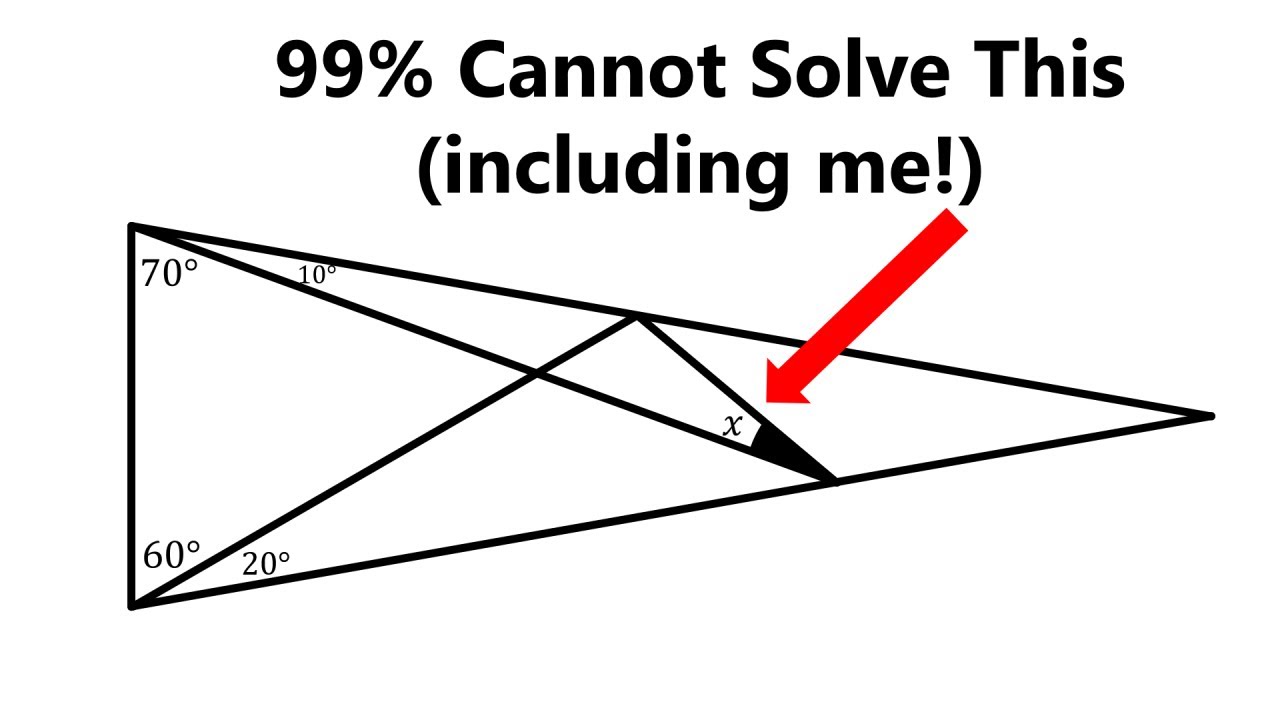
Some call this the "hardest easy geometry problem." It seems easy but it is incredibly hard to solve using elementary methods (no trigonometry allowed).
Sources
https://www.duckware.com/tech/worldshardesteasygeometryproblem.html
https://www.cut-the-knot.org/triangle/80-80-20/IndexTo60-70.shtml
Subscribe: https://www.youtube.com/user/MindYourDe...
isn't this the exact question??
formal geyser
It is
formal geyser
merry mulch
https://youtu.be/CFhFx4n3aH8?si=QSwfVlqmsqdTtldg
Thanks
merry mulch
is there a trigonometric way to solve this without those constructions?
formal geyser
I dont know
normal dragon
normal dragon
tan(18°) = x/128in
x = 41.6
is this correct?
formal geyser
normal dragon
tan(18°) = x/128in
x = 41.6
is this correct?
think, yes
merry mulch
normal dragon
tan(18°) = x/128in
x = 41.6
is this correct?
what's x?
is it the height of the tower ?
normal dragon
merry mulch
is it the height of the tower ?
yep
i need to find H
H = x + 80in
h = 4.16 + 80in?
merry mulch
isn't h the length of hypotenuse?
formal geyser
merry mulch
isn't h the length of hypotenuse?
If so, he needs to use pythagoras
merry mulch

 merry mulch
merry mulch
merry mulch
what's this angle?
formal geyser
formal geyser
If so, he needs to use pythagoras
Or cosine(18°) = adj/hyp
normal dragon
18°
merry mulch
so what do you need to find the length of?
merry mulch
use cosine trigonometric ratio.
normal dragon
we're using clinometer
normal dragon
merry mulch
use cosine trigonometric ratio.
do u have a video of that?
merry mulch
wait.
normal dragon
normal dragon
i am just base on this vid
btw it is a angle of elevation and depression thingy
merry mulch

This trigonometry video tutorial explains how to calculate the missing side length of a triangle. Examples include the use of the pythagorean theorem, trigonometry ratios such as sine, cosine, & tangent in SOH CAH TOA, the law of sines, the law of cosines, and using the geometric mean to calculate the altitude to hypotenuse triangle problems.
...

This trigonometry video tutorial explains how to solve angle of elevation and depression word problems. It covers right triangle trigonometry topics on how to find missing sides and angles of a right triangle using SOH CAH TOA and the sine, cosine, and tangent ratios including the inverse tangent function to solve for the missing angle. This v...
this one too.
normal dragon
H = 4.16 + 80in
H = 84.16
formal geyser
A also wanted to ask whether sine law is popular and often used, because i hardly ever see its applications in solving geometry problems
merry mulch
normal dragon
H = 4.16 + 80in
H = 84.16
h is the hypotenuse of the right-angled triangle. (not the total height of tower)
normal dragon
oh
but would it be technically correct?
since i don't know how to solve actually
i only copy the format of the video
merry mulch
merry mulch
https://youtu.be/tielQ3ejh70?si=7m566MuB4aKVgsJ7
Did you watch this?
normal dragon
 normal dragon
merry mulch
Did you watch this?
normal dragon
merry mulch
Did you watch this?
wait lemme watch
normal dragon
normal dragon
this is the solution i copy btw
merry mulch
merry mulch
https://youtu.be/tielQ3ejh70?si=7m566MuB4aKVgsJ7
it's based on this
you need to know this to find any missing sides/ angles in a right angled triangle.
merry mulch
normal dragon
or the sohcahtoa
do you know it?
grave pond
Try all of them and see which one sticks.
 merry mulch
so find perpendicular (opposite side) in this right angled triangle
merry mulch
merry mulch
so find perpendicular (opposite side) in this right angled triangle
and add 80
normal dragon
H = 4.16 + 80in
H = 84.16
merry mulch
normal dragon
H = 4.16 + 80in
H = 84.16
no
merry mulch
normal dragon
H = 4.16 + 80in
H = 84.16
how you got 4.16?
it's not h! the question is to find the total height of that tower. use p instead of h .
normal dragon
merry mulch
how you got 4.16?
from the h + x = height
merry mulch
can you highlight what h is??
 dark sparrow
i think that our issue is not with trigonometry as such, but with the fact that it's unclear what the letter x refers to here
normal dragon
it's 41.6
 normal dragon
yez
merry mulch
so how does adding h and 80 give you total height?
merry mulch
dark sparrow
i think that our issue is not with trigonometry as such, but with the fact that ...
it's total height
silent plank
properties of rectangles and segment addition
normal dragon
silent plank
also they've subtracted the wrong way in the image
90°- 72° = 18°
normal dragon
look athe vid
normal dragon
silent plank
also they've subtracted the wrong way in the image
90°- 72° = 18°
still 18°
but I'll guess the 90° goes first
 normal dragon
merry mulch
72-90=-18
normal dragon
merry mulch
72-90=-18
integer mb
silent plank
 merry mulch
merry mulch
merry mulch
then yeah x=41.6
silent plank
you calculated green
from rectangle properties red is also 80
add up lengths of red and green to get the total black length
normal dragon
silent plank
is that still on angle of elevation and depression
normal dragon
if i base on this is it incorrect?
 grave pond
80 inches is 203 cm; is is realistic to assume the kid is that tall? (The number on the picture looks more like 30 but that is on the other hand very short ...)
normal dragon
oh yeah he wouldn't be 6 feet 💀
god how do i fix this
so my measurements are the problem after all
bruh
it's confusing me off
should i use meter or inch?
when i measure it
 bleak yoke
normal dragon
bruv
bleak yoke
normal dragon
bruv
H is greater then 128in at least
upper karma
normal dragon
should i use meter or inch?
Inches

 somber schooner
 atomic tulip
(sin(2x))^2 = (2sin(x)cos(x))^2
atomic tulip
(sin(2x))^2 = (2sin(x)cos(x))^2
I see thank you a lot
 amber hollow
I'm wondering why im wrong here. my steps in order were:
y = cos(x +3)
y = cos(x+3) +4
y = cos(3x+9) + 4
y = **-**cos(3x+9) + 4

 nocturne remnant
Vertically compress step should be multiplying rhs by 1/3
(Also, fyi, in the last step don’t forget the minus should apply for both terms)
grave pond
And the compress step should only be scaling the x, not the constant you add to it later.
nocturne remnant
grave pond
And the compress step should only be scaling the x, not the constant you add to ...
What are you saying
amber hollow
i thought that the form was Acos(B(t-h)) +k meaning the B affects the h when you add it
amber hollow
nocturne remnant
(Also, fyi, in the last step don’t forget the minus should apply for both terms)
the 4 becomes a minus 4 as well?
amber hollow
nocturne remnant
Vertically compress step should be multiplying rhs by 1/3
i think i misunderstood what you meant by this then
 grave pond
We already have
y = cos(x+3)+4
For compressing by a factor of 3 we want more wiggles in a given horizontal space, so we need to reach large inputs to the cosine faster. This means that it is correct to replace x by 3x -- but the +3 should stay a +3, so:
y = cos(3x+3)+4
The only thing we do when compressing is modifying the input to the entire computation. The actual computation we do should be the same, including the part of the computation that says "the add three".
Argh -- I misread the task. I've been talking about horizontal compression, but they want vertical compression.
nocturne remnant
Does vertically compress not mean squeezing it from the top and bottom
😅
Alright
grave pond
Yes, I misread.
amber hollow
happens
grave pond
So nothing of what has been written is right for vertical compression.
nocturne remnant
amber hollow
i think i misunderstood what you meant by this then
The inside of cos should still be x+3, I mean multiply the whole thing on the right hand side by 1/3
amber hollow
oh B affects horizontal compression
i dont see a single mention of vertical compression in my textbook unless im blind wth
nocturne remnant
It should not be difficult to come up with the correct solution if you have a solid understanding of how functions and their graphs are related
hoary totem
amber hollow
I'm wondering why im wrong here. my steps in order were:
y = cos(x **+3**)
y = c...
vertical stretching means u multiply the cosine by a factor
also for vertically flipped id imagine ud also flip the +4 into a -4
nocturne remnant
hoary totem
vertical stretching means u multiply the cosine by a factor
The 4 would be multiplied too, no?
amber hollow
nocturne remnant
It should not be difficult to come up with the correct solution if you have a so...
I do not ✨. I honestly don't understand much from this book and the only reason I got this far is cause one of ya'll here gave me an impromptu lesson
hoary totem
nocturne remnant
The 4 would be multiplied too, no?
hmm depends on what they want
do they want the whole graph squished or just the cosine
amber hollow
i understand right triangels and the unit circle now but now they're turning it into graphs and i dont get it
hoary totem
hoary totem
hmm depends on what they want
do they want the whole graph squished or just the ...
i guess this also applies for the flipping
amber hollow
hoary totem
vertical stretching means u multiply the cosine by a factor
isnt that just amplitude?
nocturne remnant
amber hollow
isnt that just amplitude?
Wdym
amber hollow
if you multiply the cos/sine by something then that number is the amplittude isnt it
hoary totem
amber hollow
isnt that just amplitude?
yes
stretching/compressing vertically means altering the amplitude
stretching/compressing horizontally means altering the frequency
nocturne remnant
amber hollow
i understand right triangels and the unit circle now but now they're turning it ...
This question is testing your understanding of function graphs rather than trigonometry - I could replace cos(x) with just f(x) and ask the same question just as well
hoary totem
amber hollow
i understand right triangels and the unit circle now but now they're turning it ...

its simply "unraveling" the circle
nocturne remnant
nocturne remnant
This question is testing your understanding of function graphs rather than trigo...
For your information, if you have a graph whose equation is y=f(x) and you vertically compress the graph by a factor of 3, the equation for the new graph would be y=f(x)/3
If that makes sense
So in your third step, just multiply the entire RHS by 1/3
hoary totem
if thats what they want
the question also seems like theyre asking to squish just the cosine by 3
in which case ud only multiply the cosine with 1/3 and leave the vertical shift alone
nocturne remnant
hoary totem
the question also seems like theyre asking to squish just the cosine by 3
I really don’t think so…
Well
It’s an English issue rather than a math one

amber hollow
hi sorry my professor found me struggling. apparently the answer for the site is wrong and this should instead be -4 but otherwise yeah i understand compression is amplitude and flipping is making everything negative
 amber hollow
nocturne remnant
This question is testing your understanding of function graphs rather than trigo...
amber hollow
nocturne remnant
This question is testing your understanding of function graphs rather than trigo...
if you did that i would probably understand it
hoary totem
amber hollow
hi sorry my professor found me struggling. apparently the answer for the site is...
yeah so i was right
its only asking to squish the cosine
amber hollow
well it didnt word it properly but yeah
hoary totem
yea
amber hollow
tysm
amber hollow
hoary totem
https://upload.wikimedia.org/wikipedia/commons/0/08/Sine_curve_drawing_animation...
i think i might watch a video or something i guess. idk why my brain doesnt get this. it was the only topic in calculus that just completely went over my head
hoary totem
amber hollow
i think i might watch a video or something i guess. idk why my brain doesnt get ...
equivalently, u can think of it as basically
yk how a sine table works
angles on one side, sines on the other
just graphing that table
but understanding the geometrical side is definitely helpful
amber hollow
But then why is it sometimes these graphs use integers on the x axis and sometimes they instead use pi
Why is the period sometimes a legit number and sometimes it’s like pi/2
nocturne remnant
Are the “legit numbers” in degrees?
hoary totem
amber hollow
But then why is it sometimes these graphs use integers on the x axis and sometim...
radians vs degrees
ways of measuring angles
degrees are an arbitrary tradition that comes from ancient babylon
radians are a more.. mathematically natural way of measuring an angle

 hoary totem
oh, no
this is just
how do i say this
its just different markings
u see how for image 2, the sine graph hits the x axis just after 3
and in image 1, the sine graph hits the x axis at exactly pi
well guess what, pi is just after 3
lol
amber hollow
oh
hoary totem
in general the pi markings are more useful
amber hollow
there needws to be some sort of excercise i can do so that i can actually process pi as a number
hoary totem
cuz it shows u exactly where the sine and cosine graphs hit the x axis
amber hollow
pi to me looks like a word so i forget its an actual number most of the time


 frozen ocean
holy shit
 vernal pilot
hoary totem
lord help me
vernal pilot
hoary totem
lord help me
What are you trying to do?
sturdy dirge
how can anyone remember all the reciprocal identities of trigonometric expressions 
trail tendon
... There's 6
sturdy dirge
theres more than 6 things to remember
i have 13 written down on a sheet im trying to remember rn
what a yuck attitude to have in a server about learning.
sturdy dirge
trail tendon
... There's 6
this is what im referring to theres a lot to keep in mind when working through the problems.
 trail tendon
Oh you meant more than just reciprocal identities
trail tendon
sturdy dirge
what a yuck attitude to have in a server about learning.
😂 I don't think it was that bad lol
 cunning lion
many of those can be derived from the others
sturdy dirge
trail tendon
😂 I don't think it was that bad lol
im just saying its condescending when i only said that to see if anyone would have tips for me but yep
cunning lion
e.g., the second two pythagorean identities come from dividing both sides of the first one by cos^2(theta) and sin^2(theta) respectively
trail tendon
sturdy dirge
im just saying its condescending when i only said that to see if anyone would ha...
I thought u were just complaining 😂
cunning lion
as long as you remember the quotient & reciprocal identities (since they define the functions), a bunch of others just come out of it (e.g., the even odd identities for every function other than sin and cos can be found by dividing the appropriate identities involving sin and cos)
sturdy dirge
trail tendon
I thought u were just complaining 😂
and what was your goal of what you said? it had ill intent behind it and i dont appreciate it. thats all im saying.
sturdy dirge
cunning lion
as long as you remember the quotient & reciprocal identities (since they define ...
thank you yea i will keep that in mind im just cramming it in bc i have an exam at the end of the week 
trail tendon
sturdy dirge
and what was your goal of what you said? it had ill intent behind it and i dont ...
I'm sorry lol I don't mean to disincentivize learning
 empty yew
hoary totem
lord help me
empty yew
hoary totem
lord help me
Is it really pre-university math?😱😱😱
hoary totem
well technically yeah it involves no math above high school level :p
upper karma
hoary totem
lord help me
The great circle
vernal pilot
sturdy dirge
this is what im referring to theres a lot to keep in mind when working through t...
Angle identities are fun. But you really only need to know sin^2(x)+cos^2(x)=1, tan(x)=sin(x)/cos(x), and the reciprocals
sturdy dirge
vernal pilot
Angle identities are fun. But you really only need to know sin^2(x)+cos^2(x)=1, ...
Bet I'll focus on those then
Thank u 🙏
vernal pilot
Np
 boreal marsh
guys i have a quick question, when do i know pi equals 180 or 3.14 when working with angles/radians
dark sparrow
pi, the number, equals approximately 3.14 (sometimes 22/7 is also used as an approximation, but it is an approximation still)
pi radians = 180 degrees is a unit conversion
you would not say 1 = 12 just because 1 foot = 12 inches, would you?
@boreal marsh
boreal marsh
dark sparrow
<@1076274416813617303>
rlly appreciate your help
 serene tartan
could anybody hop on a call with me and explain to me these geometry questions, im in online school and i need help

 hoary totem
deft sail
hoary totem
deft sail
line 5 should be sec(x) = √(tan²(x) + 1)
other than this it seems to be correct
deft sail
Thx
grave pond
deft sail
Are these identities right. I got them from sinx^2+cosx^2. Is it possible I get ...
Several of them have possible sign errors unless you restrict the range of x.
hoary totem
well yes u should add ± in front of all the square roots
deft sail
hoary totem
well yes u should add ± in front of all the square roots
Is it necessary though? because people’ll automatically know that it’s ± anyway.
hoary totem
always good to make it explicit ¯_(ツ)_/¯
grave pond
If they already know what the correct thing is, why are they even reading your list?
 worthy acorn
what identity would 2cos^2x = sinx +1 be?
 rustic kestrel
the only thing that matters is
sin²x+cos²x = 1
and
sec²x = 1+tan²x
nothing more
just know these
and you will be better exactly
@deft sail
deft sail

 noble brook
you can derive all of them from the Pythagorean theorem
you will get them all from dividing x² + y² =r² by x² y² and r²
for example
(x²/r²) + (y²/r²) = (r²/r²) so
cos²x+sin²y =1
 lime dune
worthy acorn
what identity would 2cos^2x = sinx +1 be?
lime dune
worthy acorn
what identity would 2cos^2x = sinx +1 be?
this is not an identity
looks like you might have been trying to use one of the double angle identities $2\cos^2 x=\cos 2x+1?$
somber coyoteBOT
elrichardo1337
 lime dune
this is not an identity
lime dune
lime dune
this is not an identity
because it does not hold true for all x for which both sides are defined
grave pond
How do you get 486?
vocal bison
Equilateral triangle formula
grave pond
Hmm, you may have forgotten the other end of the prism.
amber hollow
what have i done wrong here
 dark sparrow
amber hollow
what have i done wrong here
dark sparrow
amber hollow
what have i done wrong here
your formula appears correct -- can you click on "help (entering your answer)"?
amber hollow
this just tells me to do it in the form of an equation

wait
it wanted f(x) not y, my bad
dark sparrow
yeah, was about to say
 steady sail
@grave pond what is the lore behind your name because troposphere is a sphere of earth
empty yew
Is $\mathbb{R}-{n\pi+(-1)^{n}\frac{\pi}{6}} = \mathbb{R}-{(4n-1)\frac{\pi}{6}}$ ?
somber coyoteBOT
KingDanger
 empty yew
Anyone clarify my doubt! Please!
empty yew
somber coyote
**KingDanger**
<@&286206848099549185> anyone help
upper karma
uh
empty yew
somber coyote
**KingDanger**
Is both the domains equal?
empty yew
Yes
upper karma
plot the graph
empty yew
While I am solving this (sinx=1/2) i got the second equation but my book say it's first so I am asking. is both equal?
upper karma
how did you get the second equation
empty yew
Just predicted by using unit circle i checked for two integers and it worked 😁
empty yew
!da2a
lime crownBOT
No need to ask “Can I ask…?” or “Does anyone know about…?”—it’s faster for everyone if you just ask your question! See https://dontasktoask.com/
upper karma
empty yew
Just predicted by using unit circle i checked for two integers and it worked 😁
not same
empty yew
Mm thank you
upper karma
also first one is correct
empty yew
But how
empty yew
Ok
empty yew
Yes