#geometry-and-trigonometry
1 messages · Page 30 of 1
 keen osprey
 twin crag
so i just take arccos of that?
keen osprey
yes
 somber coyoteBOT
Aman
 twin crag
wait i get the same thing though
 keen osprey
wdym
twin crag
oops sorry i didnt read the question
yeah 1-sqrt3/2 is correct
it was asking for all values of cosx 😭
wait how do i get a correct answer for cos(theta)
i got cos(x)=0
 keen osprey
double angle formula for sin
twin crag
2sinxcosx=tanx
and then i put tangent in terms of sine and cosine
so 2sinxcosx=2sinx/cosx
then multiplied by cosx to get 2sinxcos^2x=2sinx
keen osprey
can divide 2sinx on both sides
keen osprey
yes thats g
twin crag
i got cos^2x=1
sqrt
so cosx=1
then took arccos
but 1 is wrong it says (its asking for values of cosx)
or its not the only value
keen osprey
cos(x) could be -1 as well right?
keen osprey
cool
twin crag
ty
 nocturne remnant
E must be the midpoint of the chord FH because EO is perpendicular to FH
 hot token
I'm trying to help my niece with Geometry but I'm not sure what these questions are asking us to do? Can somebody help clarify?

 twin crag
hot token
I'm trying to help my niece with Geometry but I'm not sure what these questions ...
twin crag
hot token
I'm trying to help my niece with Geometry but I'm not sure what these questions ...
im pretty sure for the first one it means reflect pentagon QRSTU over line B to form pentagon Q'R'S'T'U'
twin crag
hot token
I'm trying to help my niece with Geometry but I'm not sure what these questions ...
and for the second one its reflect ABCD over line K to form A'B'C'D
hot token
that's what i thought too but i'm not sure how to do that accurately without a coordinate system

 weary torrent
what's the problem?
 vernal pilot
 autumn gorge
hey man, is this supposed to be $\cot(\theta+1)\cdot\csc(\theta-\frac{1}{2}=0$
or $(\cot(\theta)+1)\cdot(\csc(\theta)-\frac{1}{2})=0$
somber coyoteBOT
TheLord26
 weary torrent
seems like it
vernal pilot
i hate LaTeX
im going under the assumption that it is the second one
$\cot(\theta+1)\cdot\csc(\theta-\frac{1}{2}=0$
somber coyoteBOT
TheLord26
Compile Error! Click the  reaction for more information.
(You may edit your message to recompile.)
 vernal pilot
WHY DOESNT THIS WORK
 thick fable
$\cot(\theta+1)\cdot\csc(\theta-\frac{1}{2})=0$
somber coyoteBOT
🐱!Yajat! 【Catfan1398】🐱
 weary torrent
what are you trying to do
vernal pilot
weary torrent
what are you trying to do
help this dude with a math problem, and then getting severly side tracked with LaTeX and then forgetting to help the dude. dammit
vernal pilot
autumn gorge
Okay, so I'm assuming that the question is asking for (cot(theta)+1)(csc(theta)-1/2)=0
weary torrent
somber coyote
**TheLord26**
i feel that this is the question
we cant't do anything about until the one who asked it comes online
vernal pilot
immajust do both
vernal pilot
what do you mean?
weary torrent
the csc of any real angle can't be less than 1 so we can just neglect it
vernal pilot
So to start, what you want to do is see that either $(\cot(\theta+1))$ or $(\csc(\theta)-\frac{1}{2})$ must equal 0. From there, you can test to see whether $\cot(\theta)=1$ and $\csc(\theta)=\frac{1}{2}$ turn out to be.If you start with $\csc(\theta)=\frac{1}{2}$ you will find that it has no solutions $\in{\rm I!R}$.
somber coyoteBOT
TheLord26
 vernal pilot
i could see the LaTeX gods typing in the chat, oh god
This makes logical sense, if you see how $\csc$ is defined, that being $\csc(\theta)=\frac{1}{\sin(\theta)}$, and as there is no way $\frac{1}{n}$ can ever equal 0, it must mean that $\csc(\theta)$ can never equal $0$.
somber coyoteBOT
TheLord26
 vernal pilot
So, you should test $\cot(\theta)=-1$, using some simple algrebra, you can rearrange to make the equation $\arctan(-1)=\theta$, and if you know your exact value triangles, or you use a calculator, you will find $\theta=\frac{3\pi}{4}$.
somber coyoteBOT
TheLord26
 vernal pilot
You can double check the answer by plugging theta into the original equation if you want. But if that was the incorrect equation to being with, and you needed to the other equation, (cot(theta+1))*(csc(theta-1/2))=0, well, dam ig?. @autumn gorge
 haughty lichen
Thankyou guys @smoky jetty @heady scaffold @nocturne remnant
 smoky jetty
nocturne remnant
E must be the midpoint of the chord FH because EO is perpendicular to FH
smoky jetty
nocturne remnant
E must be the midpoint of the chord FH because EO is perpendicular to FH
does that mean the intersection of any chord perpendicular to a radius is always the midpoint the chord?
haughty lichen
smoky jetty
does that mean the intersection of any chord perpendicular to a radius is always...
Yes , a perpendicular through centre to chord bisect the chord hence the intersection point is the midpoint.
If you meant the radius is perpendicular to the chord (as i couldn't understand the sentence in the message) , it is not
nocturne remnant
smoky jetty
does that mean the intersection of any chord perpendicular to a radius is always...
Yes and can you not ping reply me for everything
smoky jetty
nocturne remnant
Yes and can you not ping reply me for everything
ahh mb
smoky jetty
haughty lichen
Yes , a perpendicular through centre to chord bisect the chord hence the interse...
i see, but if it were the radius that's perpendicular to the chord, would it also bisect it?
rusty on quadratics stuff, but I got 0 = (x+16)(x-4), how do u get the desired value of x for it?
haughty lichen
Radius goes through the chord so if radius is perpendicular to chord it also bisect the chord.
smoky jetty
alrighty, thanks for the clarification!
haughty lichen
smoky jetty
rusty on quadratics stuff, but I got 0 = (x+16)(x-4), how do u get the desired v...
X has to be 4 as it can't be -16 so .
smoky jetty
so u just make the -4 positive?
haughty lichen
smoky jetty
so u just make the -4 positive?
Um its not negetive 4,
smoky jetty
in the RHS?
haughty lichen
Yes the expression contain -4 but for equation to become zero x has to be either -16 or 4. Since x can't be -16 so it has to be 4
smoky jetty
but for equation to become zero x has to be either -16 or 4. Since x can't be -16 so it has to be 4
sorry but I didnt quite get that. Could u elaborate it further?
haughty lichen
smoky jetty
> but for equation to become zero x has to be either -16 or 4. Since x can't be ...
Could you once revise the ' zero product rule ' from the book.
On the rhs there are two expressions. One of them has to be zero so their product will become zero.
So if x is 4 there is only possible situation for the Rhs to become zero.
smoky jetty
oh i see now
def didnt learn that in alg before, lol
So I looked up the rule u said. And wrote my understanding upon it

since the chord lengtb camnot be negative, we choose 4 right
so essentailly in the LHS, we must make either factors =0, and since the factors are in the form of (x+a), we get the inverse/negative of a to cancel it out and thus becomes (0) as a factor
then that inverse of a, will be a value of x, then same concept applies to the other factor, giving us the 2nd value of x
so yeah, thx for the help!
 heady scaffold
haughty lichen
Thankyou guys <@802365754702823426> <@1023708420416733196> <@471271187771555844>
heady scaffold
haughty lichen
Thankyou guys <@802365754702823426> <@1023708420416733196> <@471271187771555844>
idk what i did but yw
oh ya this is that problem
smoky jetty
smoky jetty
alrighty, thanks for the clarification!
welp I did a simple proof to see it better, and found out that if the radius is perpendicular to chord and we make two triangles out of the chord segments and the radii, then the two triangles are coungrent by SSA (for right triangle)

 upper karma
keen osprey
label the relevant sides in terms of the information given
upper karma
keen osprey
label the relevant sides in terms of the information given
thats what I have trouble with
keen osprey
maybe send a photo of your diagram if possible?
 smoky jetty
it says that it's side AB that is bisected perpendicularly
smoky jetty
yeah

 upper karma
smoky jetty
hmm this is what I got apparently
upper karma
smoky jetty
hmm this is what I got apparently
ok
smoky jetty
upper karma
ok
did u get the answer? just curious
smoky jetty
Hoping this is correct (dont click if u havent solved it yet) ||By connecting A and D, we can infer that AD=BD (SAS congruence), making triangle ABD an isosceles. Hence, the Perimeter of triangle ADC = AC+CD+AD or AC+CD+BD = x. Now, since AD=BD, and BD is part of triangle ABC's perimeter, we can say that the Perimeter of ADC + AB = P_ABC = x + 12. Therefore, AB= 12.||
upper karma
smoky jetty
Hoping this is correct (dont click if u havent solved it yet) ||By connecting A ...
yea I was thinkin the same thing
i wanted to clairify
smoky jetty
sure
 hazy moat
lemme get this straight: when the pronumeral is the denominator, you just rearrange the equation to divide the numerator by the trig function, but when the pronumeral is the numerator you multiply it by the trig function?

 grave pond
What is a "pronumeral"??
 native jetty
an unknown such as a letter
you rearrange to make A the subject by multiplying or dividing
hazy moat
so i am correct right
 hasty kelp
hazy moat
so i am correct right
hasty kelp
hazy moat
so i am correct right
If you are asking question c and want to know the length of A, then it is correct.
 north wave
smoky jetty
Hoping this is correct (dont click if u havent solved it yet) ||By connecting A ...
north wave
smoky jetty
Hoping this is correct (dont click if u havent solved it yet) ||By connecting A ...
Me talking abt this
Everything else is correct except idk there is an ssa congruency
nocturne remnant
smoky jetty
Hoping this is correct (dont click if u havent solved it yet) ||By connecting A ...
Didn’t you use SAS?
hazy moat
hasty kelp
If you are asking question c and want to know the length of A, then it is correc...
right ok
thx
autumn gorge
why is this possible to do and why do you do this?
 smoky jetty
nocturne remnant
Didn’t you use SAS?
smoky jetty
nocturne remnant
Didn’t you use SAS?
oh right, yeah it's SAS btw
smoky jetty
north wave
Everything else is correct except idk there is an ssa congruency
afaik SSA isnt a congruency criterion for triangles except for right triangles
smoky jetty
hazy moat
lemme get this straight: when the pronumeral is the denominator, you just rearra...
seems right. Just remind yourself that you'd have to transform that equation into smth that would isolate that unknown value either in RHS or LHS
hazy moat
ye ok
north wave
smoky jetty
oh right, yeah it's SAS btw
Lol
 jagged venture
in the trapezoid ABCD, with the bases AB > CD, we note M,N the means of AD, respectively BC. The bisectors of angles A and B intersect MN in E and F, respectively. Prove that EF= AB+CD/2 - AD+BC/2

AB+CD/2 is equal to MN
and AD+BC/2 is equal to AM+BN
So we basically have to prove that AM = MF
and that BN=NE
 wheat sinew
what is a polynomial
heady scaffold
wheat sinew
what is a polynomial
an equation with multiple terms
wheat sinew
wow
heady scaffold
what?
nocturne remnant
heady scaffold
an equation with multiple terms
That is a very bad answer if I’ve ever seen one
 grim grotto
 heady scaffold
nocturne remnant
That is a very bad answer if I’ve ever seen one
heady scaffold
nocturne remnant
That is a very bad answer if I’ve ever seen one
😭 im sorry
 real widget
wheat sinew
what is a polynomial
real widget
wheat sinew
what is a polynomial
An equation in the form ax^n + bx^(n-1) + ... + k
Like for example quadratics like x^2 + 2x + 1 are polynomials but so are cubics (like x^3 + 6x^2+x-4) and you can really have any power of x in there
heady scaffold
real widget
An equation in the form ax^n + bx^(n-1) + ... + k
ya
and n is called the degree of the polynomial
real widget
ax + b is also a polynomial and so is just a constant "a" but I'm not sure if that's relevant to your specific needs or not
thick fable
 compact thistle
What is 1 + cos(x)?
compact thistle
What is 1 + cos(x)?
no 1+cos(x) can not be equal to cos(x/2)😭
compact thistle
EXACTLY, I have been solving an exercise in physics and when I looks at the solution if I find it...
@thick fable Look at that:
 compact thistle
Yep.
thick fable
what concept is this i dont get it, also what is $\vec{V}_{\theta}$?
somber coyoteBOT
🐱!Yajat! 【Catfan1398】🐱

 thick fable
isnt angluar velocity $\omega$
somber coyoteBOT
🐱!Yajat! 【Catfan1398】🐱
 thick fable
and also how can the time derivative of the velocity vector be equal to the velocity vector

its just too confusing
compact thistle
he made a writing mistake then fam.
thick fable
it should be acceleration tangential
compact thistle
$\ aren't Vc and omega difference?$ Because: $ Vc = frac{ds}/{dt}$ while $omega = frac{dteta}/{dt}$ ?
thick fable
yea they are different
compact thistle
$\ aren't Vc and \omega different?$ Because: $ Vc = frac{ds}/{dt}$ while $\omega = frac{dteta}/{dt}$ ?
thick fable
one is angular velocity and another is linear velocity
somber coyoteBOT
Анатолив.
 compact thistle
thick fable
one is angular velocity and another is linear velocity
compact thistle
thick fable
one is angular velocity and another is linear velocity
Oh my lord.
thick fable
also what is $\vec{e}_{\rho}$ doing there in the equation and wtf is even this
somber coyoteBOT
🐱!Yajat! 【Catfan1398】🐱
 compact thistle
$\vec{e}{\rho} $ = $\vec{u}{\rho}$ it is just a notation.
somber coyoteBOT
Анатолив.
 compact thistle
yeah because u studied english math and I studied french.
Same but different notaions.
it is just like i and j in carteesian coordinates.
ngl you are giving me heart attack, I feel like all my notes are wrong...
like is $\vec{a}_{\t}$ = R . TETA ?
somber coyoteBOT
Анатолив.
Compile Error! Click the reaction for more information.
(You may edit your message to recompile.)
 thick fable
like is $\vec{a}_{t}$ = R \cdot \theta$ ?
somber coyoteBOT
🐱!Yajat! 【Catfan1398】🐱
Compile Error! Click the reaction for more information.
(You may edit your message to recompile.)
 thick fable
you mean this?
compact thistle
yes.
 shut oxide
Help me out with proofs please I almost finished it im just stuck
 somber coyoteBOT
🐱!Yajat! 【Catfan1398】🐱
 thick fable
shut oxide
Help me out with proofs please I almost finished it im just stuck
thick fable
shut oxide
Help me out with proofs please I almost finished it im just stuck
its better if u just post 2 pics of it

 shut oxide
thick fable
its better if u just post 2 pics of it
shut oxide
thick fable
its better if u just post 2 pics of it
helpppp
thick fable
wait 15 min of my lecture is left
compact thistle
somber coyote
**🐱!Yajat! 【Catfan1398】🐱**
then if I'm not wrong, then $\vec{a}_{t}$ = R \cdot the derivative of \omega$ ?
somber coyoteBOT
Анатолив.
Compile Error! Click the reaction for more information.
(You may edit your message to recompile.)
 compact thistle
the derivative of omega.
somber coyoteBOT
🐱!Yajat! 【Catfan1398】🐱
 thick fable
as $\frac{d \omega}{dt}=\alpha$
compact thistle
what is the notation of the derivative of omega?
somber coyoteBOT
🐱!Yajat! 【Catfan1398】🐱
 thick fable
u mean formulaes?
compact thistle
y
thick fable
oh
i dont know about that sorry
i means its simple, the derivations to these formulaes are hard but if u just want the formulaes u can just search them on google, ur sstudying undergraduate circular motion so i dont have much idea about what topics r in ur syllabus
shut oxide
thick fable
okay so what have u tried so far
I tried everything that makes sense
You can look at my steps
thick fable
i really dont wanna look at all those im lazy what what u can do is, u can prove the triangles BAC and DCE congruent, with the help of RHS congruence rule, from that u can conclude that angle BCA and DCE are equal
from this can u tell me the relation between
angle BCF and DCF?
compact thistle
thick fable
i means its simple, the derivations to these formulaes are hard but if u just wa...
I appreciate your efforts, and I indeed already downloaded a pdf and I'm learning currentyl.
 lapis belfry
I don't know if this is the right place to ask this, but I don't know if {4, 4/2} is a regular polyhedron or not.
Like, it's face-, edge- and vertex-transitive, but according to wikipedia, the vertex figure also has to be a regular polygon (which it is not)
So it meets one definition, but not the (supposedly equvalent) other definition. So either it isn't f,e,v-transitive (and thus not a regular polygon), or the definitions aren't equivalent, and it is a regular polyhedra, but I cannot find it on any list.
shut oxide
@thick fable still have no clue

 heavy oar
shut oxide
<@735816115908902913> still have no clue
heavy oar
shut oxide
<@735816115908902913> still have no clue
16?! Most of my proofs were only 2-6 long
shut oxide
heavy oar
16?! Most of my proofs were only 2-6 long
Yes lol I managed to figure it out
 red flax
Yo can someone help me figure out how too use the distance formula on this I forgot how too on this equation 😭

Would be appreciated
 warped badger
red flax
Yo can someone help me figure out how too use the distance formula on this I for...
warped badger
red flax
Yo can someone help me figure out how too use the distance formula on this I for...
u would just plug the coords for the endpoints of each segment

for example for BD it would be sqrt((-5-(-2))^2 + (-2-1)^2)
warped badger
lol no worries
i hate distance formula so much lol
so many bad geometry memories
 obsidian hemlock
Can anyone figure out (xiv)??
 hazy moat
anyone know how to help me with this? im an advanced 7th grader doing year 8-9 work

i nearly cried doing this today
 vagrant onyx
You can use the pythagoras theorem
The part of the straw inside the glass, the height of the cylinder and the base diameter of the cylinder form a right angled triangle
 vernal pilot
hazy moat
anyone know how to help me with this? im an advanced 7th grader doing year 8-9 w...
vernal pilot
hazy moat
anyone know how to help me with this? im an advanced 7th grader doing year 8-9 w...
$c=\sqrt{a^{2}+b^{2}}\newline c=\sqrt{2.5^{2}+(4\cdot\sqrt{6})^{2}}\newline c\approx10.11\newline10.11+5=15.11$
somber coyoteBOT
TheLord26
 thick fable
 woven estuary
okay do u know how do we prove any 2 triangles congruent
woven estuary
thick fable
okay do u know how do we prove any 2 triangles congruent
u mean like the SAS ASA AAS stuff?
thick fable
yes
woven estuary
yea
thick fable
what can u say about thier lenthgs then
thick fable
yes
so you know that VZ is congruent to WY and UV to WX and UZ to YX
then can u prove this triangle congruent?
woven estuary
SSS
woven estuary
ooh
okay
tysm
can u help me w another problem?

i know ur supposed to solve the big trangles first
i think
oh wait
all the given stuff
thick fable
one angle in common if u see carefully
woven estuary
and angle w is congruent to angle w because of reflexive
so how do i go from there?
thick fable
well u see angle W is common in both the triangles
woven estuary
yes
thick fable
then what the part troubling you
you have 2 information given in the question itself
woven estuary
hmm
well we have one angle of the triangles given already
and theres vertical angles
then what
oh
thick fable
well you see youve given a side congruent
hazy moat
vagrant onyx
The part of the straw inside the glass, the height of the cylinder and the base ...
did that
hazy moat
vernal pilot
$c=\sqrt{a^{2}+b^{2}}\newline c=\sqrt{2.5^{2}+(4\cdot\sqrt{6})^{2}}\newline c\ap...
sorry waht?
thick fable
woven estuary
so vz is congruent to ux
no and why would u need that
thick fable
well u dont need that
thick fable
u have to prove these 2 triangles equal

congruent*
ASA?
what do u think about it
woven estuary
oh wait
i thought we were trying to prove the 2 tiny triangles congruent
oops
nvm
tyy
woven estuary
yeah i read it wrong
thick fable
hazy moat
did that
what is part troubling you
hazy moat
help again pls-
 hazy moat
thick fable
what is part troubling you
hazy moat
thick fable
what is part troubling you
doesnt matter now i figured it out
im doing a different one now
thick fable
hazy moat
help again pls-
you are writing the angles wrong
 thick fable
,rccw
somber coyoteBOT
 thick fable
yes
woven estuary
okk tysm
thick fable
wait i dont know what reflexive are but they common angles
woven estuary
 woven estuary
thick fable
wait i dont know what reflexive are but they common angles
woven estuary
thick fable
wait i dont know what reflexive are but they common angles
my teacher said its just used to prove something is equal to itself
he didn't really explain much other then that
thick fable
woven estuary
you need to write angle 1 congruent to angle 2 thru CPCT
hazy moat
thick fable
you are writing the angles wrong
then what is it cos i dont understand it
thick fable
why are u doing that question then
woven estuary
dont you still have to prove that the small triangles are congruent? or no
thick fable
if your school havent taught u yet
thick fable
woven estuary
dont you still have to prove that the small triangles are congruent? or no
no
woven estuary
oh
woven estuary
hazy moat
then what is it cos i dont understand it
omg r u doing proofs too
woven estuary
thick fable
no
so how would i continue
woven estuary
i only proved the big ones
thick fable
now u know what is meant by CPCT?
woven estuary
yes
thick fable
woven estuary
i only proved the big ones
yea that what is needed
thick fable
woven estuary
yes
then u can just use that to prove the angles equal
woven estuary
so i would just say theyre equal due to cpctc
thick fable
ye
 hazy moat
thick fable
why are u doing that question then
hazy moat
thick fable
why are u doing that question then
its an entrance ticket, meanign taht it gives u a preview of what ur gonna learn
woven estuary
 vernal pilot
hazy moat
sorry waht?
vernal pilot
hazy moat
sorry waht?
Use Pythagorean thereom, and then add 5 to it to account for the additional length of the straw.
thick fable
hazy moat
doesnt matter now i figured it out
.
 unreal sinew
shouldnt this equal 81 degrees?

finding the sum of the interior angles?
nvm i did smth wrong
hazy moat
vernal pilot
Use Pythagorean thereom, and then add 5 to it to account for the additional len...
i did that
vernal pilot
unreal sinew
finding the sum of the interior angles?
Not a triangle
 thick fable
 spice escarp
i need help
spice escarp
i need help
!status
 lime crownBOT
spice escarp
i need help
lime crownBOT
spice escarp
i need help
What step are you on?
1. I don't know where to begin.
2. I have begun but got stuck midway.
3. I got an answer but I was told that it's wrong.
4. I got an answer and would like my work checked.
5. I have a question about someone else's work/solution.
6. I have completed the problem and don't need help anymore. Thank you.
7. None of the above
nice pfp
 thick fable
okay so you need need to write all those steps u wrote after the step 1
they r of no use actually
well
u know what vertically opposite angles are?
spice escarp
no
thick fable

something like this
not sure if that's visible
better one

can u do ur question now
spice escarp
ohh ok
 sudden glacier
spice escarp
sudden glacier
spice escarp
yo that happens to be what im doing in geometry atm
im very bad at it though
thick fable
i see a lot of ppl here facing problems in these provings, i means its so simple if you have the knowledge about the relations between the angles on a transversal
and the rules ofc
sudden glacier
Can anyone help me with this(explain it like a baby please)
 thick fable
not the best place to ask such physics question but okay what have you tried so far
sudden glacier
idk
i dont know how to solve it
also how do I apply for another channel like physics or engineering
I was thinking cos30-10 for the left one
thick fable
you wont be able to solve this if u dont know about vector projections
sudden glacier
so what do I do
sudden glacier
hold on brb
thick fable
sudden glacier
also how do I apply for another channel like physics or engineering
you can check #old-network and find the physics server there
sudden glacier
is there an engineering server
thick fable
there are specified engineering servers

 thick fable
@solemn hollow what have u tried so far
 solemn hollow
i tried drawing a triangle and labeling the sides and the angle measure

 thick fable
ok do u know that the angle oppsite to the longest side is the largest?
solemn hollow
yes, i know that
thick fable
so you that angle ACB should be greater than greater than 70 degrees
so
it can just be a lil bit greater than 70 too
so for angles A only 40 degrees are left
less than 40 precisely
solemn hollow
is it bc 70+70=140 and 180-140= 40?
thick fable
yes
solemn hollow
so the highest it can be is 40?
thick fable
and that angle C can just be lil greater than 70 degrees too
less than 40 actually
A being 40 means
C and B ar both 70 degrees
solemn hollow
wait i have a question.. how do i figure out the lowest it can be
solemn hollow
thick fable
C and B ar both 70 degrees
oh that makes sense
solemn hollow
so it has to be less than 40
thick fable
yea
solemn hollow
then what does it have to be greater than?
thick fable
sorry i dont get what u r asking
solemn hollow
like a range you know "< angle < " in that form it would be <A<40 but what would be on. the other side
thick fable
well u know it can obviously cannot be 0
thick fable
np!
 thick fable
well its the same concept
u know that Z has to be the smallest
that is less than 30 degrees
so u know that sum of the angle Z and Y is less than 60
so similarly u can say that
X can be greater than 120

 solemn hollow
oh damn-
thick fable

solemn hollow
my baddddd
thick fable
change it to ronaldo🔫
solemn hollow
noooooo

 frozen ocean
 verbal sluice
can anyone help with trig ?
verbal sluice
can anyone help with trig ?
,tex .recip trig
somber coyoteBOT
Akira E-Girl

 sick kraken
verbal sluice
sick kraken
verbal sluice
this is trig i managed to figure it out ! im first year in college
verbal sluice
all good
 woeful python
anyone know how to do this?

 silent birch
Can someone tell me how parametric points on parabola come from?
like what's (at^2, 2at)
 fickle rose
 steady mason
i have a question about somethign
steady mason
i have a question about somethign
don’t ask to ask just ask
 upper karma
woven estuary
upper karma
woven estuary
remember that the sum of all angles in a triagle equals 180
for this we construct a formula
solving for the first triangle as an example

$x=180+(8y-7)+(\frac{6y}{5})$
somber coyoteBOT
Mr. Macro

 fickle rose
can someone explain to me both the geometric mean theorem for altitudes and the geometric mean theorem for legs?
didnt get it while i was in class and the theorem sheet confuses me
 exotic yarrow
<@&268886789983436800> a question from the current AMC (which is happening until the end of today)
 obtuse field
exotic yarrow
<@&268886789983436800> a question from the current AMC (which is happening unti...
obtuse field
exotic yarrow
<@&268886789983436800> a question from the current AMC (which is happening unti...
Wait, how do you know?
exotic yarrow
obtuse field
Wait, how do you know?
The testing portal has a very distinct format
And this question doesn’t show up on any of the practice tests on said portal
Btw they also posted this in a help channel
 quiet sandal
does that mean it was confirmed question?
upper karma
Hello! So we had a test today, but i cant seem to move after it. So basically, there was a problem where you need to calculate the area of the triangle. V and B were unknown at the start of it. Then, i found out if you make it into 2 smaller triangles, you get the area of 84cm2. But if you calculate it as a whole triangle it is 85cm2. All my classmates are saying it's 84, who's in the right?

Apologizing for bad image
Since b is 10 and a is 17, so the area should be (10x17) : 2
Which is 85. But if you put it into two triangles
so it would be 8x15 : 2 + 6x8:2
Which would be 60 + 24
Which is 84cm2
how??

 urban ivy
Yes
upper karma
Then we calculate b and that is 8x8 + 6x6
Which is 36cm + 64
so 100
And then we calculate the area of the triangle
Which is ab : 2
So 10 x 17 : 2
which is 170 : 2
So 85cm
Right?
urban ivy
Is AB =21?
urban ivy
Yes
upper karma
But if we take it as 2 triangles
which are

So 8 x 15 is 120 : 2 is 60 right?
- 48:2
which is 24
is 84cm2?
It does it was like that
it split the side to 6cm on the left
and 15cm on the right
How could it be wrong
its just calculating an area
urban ivy
My bad, I copied the values incorrectly
upper karma
its nothingg
Everyone got 84cm2 but i was the only one to go calculate it without splitting it into 2 triangles
i have no idea what is happening
even google


 upper karma
what.?
urban ivy
17,10 and 21 can't be the sides of a right angled triangle
17^2+10^2≠21^2
That was what i was saying
upper karma
Ohhhhh i didnt understand you
urban ivy
The perpendicular doesn't split the side as 6:15
upper karma
so 10 must be incorrect?
urban ivy
The question is wrong
upper karma
urban ivy
The perpendicular doesn't split the side as 6:15
i swear it was like that
upper karma
urban ivy
The question is wrong
thank you for explaining
i swear it is something wrong with it
upper karma
upper karma
i think i didnt copy it incorreclty
Ironic
because they all got 84cm2
So it must be like that
should*
urban ivy
Yeah, but if two sides of your right angle triangle is 17 and 21, the third side is √152 not 10
upper karma
Exactly
urban ivy
There is no right angled triangle with one side being 17, hypotenuse being 21 AND the perpendicular splits the hypotenuse as 6:15
urban ivy
If you copied the question correctly your teacher should give you free marks
upper karma
Niceee
upper karma
urban ivy
If you copied the question correctly your teacher should give you free marks
Im 10000%
upper karma
lol
upper karma
urban ivy
Turns out everyone was wrong
Lmao
upper karma
urban ivy
Turns out everyone was wrong
How can i prove it to the teacher if he says im speaking nonsense?
like can i draw it somehow or something?
urban ivy
show him that b=10 by your method, then apply Pythagoras on the whole triangle ABC and show him that b=√152.
So either √152=10 or the perpendicular doesn't divide the hypotenuse as 6:15
Ask him to choose
smoky jetty
upper karma
is CA and the perpendicular line to AB the unknowns?
yeah the given values arent accurate
smoky jetty
upper karma
How can i prove it to the teacher if he says im speaking nonsense?
u can argue that the ratios of the given side lengths of the triangles arent in proportion, when they must be since the 3 right triangles must be similar
 hard coral
I could use some help with this here. This is calculating light ray reflections using vector fields to simulate light rays. The issue I am having is solving for the function regarding reflection angle. However I have such defined though inside it, is another function that measures the angle from the reflection vector to 2pi. I have drawn out a table and a graph of what the graph looks like according to the table. As to how I got these values, I just used my intuition as to what the reflection angle would actually be when the surface is angled at certain angles. The function is taking in a input of a angle, which goes from the normal vector to the X-axis. I need help finding this function F.


 feral geode
is euclidean geometry really much harder than the geometry for A level maths
 hollow wadi
i took that topic over the summer
is basically honors geometry i'm not sure if is hard but it was kinda confusing
upper karma
is there an efficient method to memorize the xy coordinates of a unit circle? especially regarding the irrational values

 rugged hearth
upper karma
is there an efficient method to memorize the xy coordinates of a unit circle? es...
rugged hearth
upper karma
is there an efficient method to memorize the xy coordinates of a unit circle? es...
well for 1 u only gotta memorize one corner
easiest is top right
because then u can just do some flipping to get other corners
rugged hearth
upper karma
is there an efficient method to memorize the xy coordinates of a unit circle? es...
and for the angles just know that 2pi is a circle so therefore pi is a circle and all that
and for the 30 degree and the 60 degree angles
what i do to remember them is only remember the 30 degree one
because i can just flip the x and y coords to get the 60 degree one
upper karma
I was confused on how the measurements become square roots
rugged hearth
upper karma
I was confused on how the measurements become square roots
i cant explain why its exactly sqrt3 and sqrt2
but you know that
the points represent the x line of the triangle and y line of the triangle
where the hypotenuse is 1 (length of unit circle)
and pythag theorem is a^2+b^2=c^2
so if u do some shifting and stuff u end up with square roots
upper karma
got it, thank you!
upper karma
woven estuary
yes tyy
np
 lyric hedge
Has anyone read Elementary Geometry from an Advanced standpoint by Edwin Moise. I was wondering if this book would give me a good grasp on Geometry and Trigonometry or if I should buy a sepereate Trignoemetry book
vernal pilot
upper karma
is there an efficient method to memorize the xy coordinates of a unit circle? es...
Google exact value triangles. Then to find any point just do (cos(x),sin(x)) using those triangles.
Also if you are new to trig (which I get the feeling you are), learning exact value triangles is more important than knowing each point on the unit circle.
 sweet shell
Im struggling to understand why I cant give answers to trigonometry questions in decimal form.
Example.
Calculate the area of a triangle where each sides length is sqr(3) and the angles are all 60.
My answer ends up at 1.2990381
Which is correct
BUT
They want me to basically answer
(3*sqr(3)) / 4
Why is this? I don't know how to convert the decimal 1.2990381 to 3 times square root of 3 divided by 4
nocturne remnant
you are probably supposed to get the exact answer by not using a calculator and just manipulating the surds
the answer is 1/2 sqrt(3) * sqrt(3) sin 60
and sin 60 = sqrt(3) / 2
so you can simplify
 wooden furnace
Can we define a 3d vector with just the direction cosines?
upper karma
urban ivy
show him that b=10 by your method, then apply Pythagoras on the whole triangle A...
Update: Yup, the teacher accidentally put the square on the top, so it should not be a right triangle. He said he will take 84 and 85 as a correct answer. No bonus for figuring it out though. Im very happy anyways!
upper karma
How do u do tolerance
upper karma
say you had a diagram like below. How would you take moments from bottom to top and vice versa for the wall one. Is there like a formula.
 upper karma
say you had a diagram like below. How would you take moments from bottom to top ...
upper karma
upper karma
say you had a diagram like below. How would you take moments from bottom to top ...
so solve the theta?
 placid fulcrum
can a kite have parallel sides
thick fable
placid fulcrum
can a kite have parallel sides
kite does have parallel sides i believe
placid fulcrum
would you say that’s a always sometimes or never statement
placid fulcrum
ok because I put never on my quiz lol
smoky jetty
I've posted and discussed it here before, but now I did get a response from the teacher. So, you're supposed to compare the volume of the box (assuming width=height) and the volume of ellipsoid... Now, I've learned that the statement by my teacher, "if volume of shape_A < shape_B, then shape_A fits" is not valid for all problem, now we've got an ellipsoid. How do u even make an ellipsoid hole on the ground
 placid fulcrum
a kite never has parallel opposite sides
thick fable
smoky jetty
I've posted and discussed it here before, but now I did get a response from the ...
not this question again gawd😭😭😭
smoky jetty
fr
placid fulcrum
whag math class are u talking
thick fable
placid fulcrum
a kite never has parallel opposite sides
yea they dont
placid fulcrum
taking
placid fulcrum
thick fable
yea they dont
ok good thanks
smoky jetty
I either completely misunderstood this or the process we were instructed to see if box fits is just utterly ridiculous
placid fulcrum
smoky jetty
I either completely misunderstood this or the process we were instructed to see ...
what math class is that problem from
smoky jetty
conic sections
placid fulcrum
ummm what’s that
smoky jetty
A conic section, conic or a quadratic curve is a curve obtained from a cone's surface intersecting a plane. The three types of conic section are the hyperbola, the parabola, and the ellipse; the circle is a special case of the ellipse, though it was sometimes called as a fourth type.
Wiki
placid fulcrum
oh gotcha
does anyone wanna take a stab at this proof??? my teacher said that the point of doing it was to do it without using isosceles trapezoid conjectures for example the isosceles trapezoid diagonals conjecture

it’s for extra credit and I need the answer
rugged hearth
upper karma
is there an efficient method to memorize the xy coordinates of a unit circle? es...
also another way to help is through using this combo move where you relate the points on the unit circle to 45 45 90 triangles and 30 60 90 triangles
 rugged hearth
upper karma
I think I bombed my trig test today because I switched up sin = y and cos = x
rugged hearth
upper karma
I think I bombed my trig test today because I switched up sin = y and cos = x
F but next time instead of memorizing (cos, sin) try thinking of it like making a right triangle with the hypotenuse being your radius, and theta being the angle closest to the center of the circle and the right angle being at the bottom right, and finding the side lengths of each of the legs will give you cos for the x leg, and sin for the y leg
like instead of straight up memorizing everything try to find where they come from first
somber coyoteBOT

 torn basin
Hey can anyone help me with proofs?
thick fable
torn basin
Hey can anyone help me with proofs?
just ask it
torn basin
What do you ean by that?
thick fable
ask ur question
i mean
never
ask if i cant get help
jusr directly ask ur question
and if u dont do that ur banned🔫
smoky jetty
smoky jetty
I've posted and discussed it here before, but now I did get a response from the ...
I finally get troposphere's solution to it weeks ago
 smoky jetty
the dimensions can be strecthed to transform the shapes to circle and a square
@grave pond thanks for the solution a few weeks ago (sorry for the ping, just a relief from the problem)
smoky jetty
but if a rectangle or a square is placed at the origin, would the origin always be the midpoint of the diagonal?
I guess so, if we use the midpoint formula for coordinates
rugged hearth
smoky jetty
wtf
grave pond
smoky jetty
but if a rectangle or a square is placed at the origin, would the origin always...
Not necessarily, but if the midpoint of the rectangle is not at the center of the ellipse, you can slide the rectangle closer to the center without hitting the opposite side of the ellipse.
So the rectangle fits at all if and only it fits in the middle.
 stiff plaza
I need a refresher in the basics of geometry, does anyone know any good books or sites?
 quaint sinew
any idea how i'd go about solving this

 teal imp
quaint sinew
any idea how i'd go about solving this
teal imp
quaint sinew
any idea how i'd go about solving this
is that sinC + cosC =1 or sinC + CcosC = 1
teal imp
stiff plaza
I need a refresher in the basics of geometry, does anyone know any good books or...
evan chen's Euclidean Geometry
thick fable
quaint sinew
any idea how i'd go about solving this
@quaint sinew Hint: ||divide whole equation by sqrt(2)||
 rare shuttle
Anyone know if there's anywhere to get Algebra and Trigonometry with Analytic Geometry 13th addition free?
thick fable
rare shuttle
Anyone know if there's anywhere to get Algebra and Trigonometry with Analytic Ge...
we dont help ppl with pirating things
rare shuttle
oh mb
upper karma
I need help with my geometry
thick fable
upper karma
I need help with my geometry
!da2a
lime crownBOT
upper karma
I need help with my geometry
No need to ask “Can I ask…?” or “Does anyone know about…?”—it’s faster for everyone if you just ask your question! See https://dontasktoask.com/
 thick fable
i dont think this is geometry
upper karma
How do I do that?
upper karma
Nvm I found out
 lunar folio
What's the best way to learn the entire geometry unit? Tutor, online (youtube/khan academy/online textbook), or zmth else
Cause I'm skipping from alg to alg 2 and need to self teach myself geo
rugged hearth
lunar folio
What's the best way to learn the entire geometry unit? Tutor, online (youtube/kh...
get a textbook if u can and use youtube and khan academy if u stuck on something and if u really dont get something then you might needa tutor
smoky jetty
grave pond
Not _necessarily_, but if the midpoint of the rectangle is _not_ at the center o...
Ah, I see. But, will the condition, "if the diagonal of a rectangle or square is less than the diameter of the circle, then it fits," be valid?
so, like regardless of how it would be placed in the circle, whether centered or not so centered
grave pond
smoky jetty
Ah, I see. But, will the condition, "if the diagonal of a rectangle or square is...
Yes, that's exactly it.
smoky jetty
ohh omg, thx so much!!
lunar folio
rugged hearth
get a textbook if u can and use youtube and khan academy if u stuck on something...
Thanks

 silver prism
how do i calculate h in the pyramid on the left?

 tepid stump

 foggy parcel
 cedar wren
if a line, A(x1,y1)B(x2,y2) is divided in a proportion of m1:m2 at the point P
Coordinate of P
= [ {(x1m2 + x2m1) / (m1+m2)},
{(y1m2 + y2m1) / (m1+m2)} ]
 graceful talon
would i be right here
 upper karma
yea
smoky jetty
grave pond
Yes, that's exactly it.
so this was my full solution regarding it

However, when I compare the ratio of the scaled shapes' volume (assuming that before scaling, width = height) to the ratio of scaled shapes' area, I couldnt get the same answer
So idk if this one is correct

 fallen sleet
what is my teacher saying
the thing she wants us to do for SSA is check how many cases there are (0,1,2) BEFORE we actually solve
fine
but the handout she gave us says
that the only two solution case is a<b and a>h
aka h<a<b
(we are given A,b,a and h=bsinA)
???

b is less than a here
 obsidian harness
 obsidian harness
fallen sleet
b is less than a here
obsidian harness
fallen sleet
b is less than a here
yeah then there is no ambiguous case for this triangle
obsidian harness
yeah
fallen sleet
ok the conditions she gave for A is right or obtuse are:
a leq b -> no solution
a > b -> one solution
are these correct
fallen sleet
ok
obsidian harness
fallen sleet
ok the conditions she gave for A is right or obtuse are:
a leq b -> no solution
...
this is correct
the other solutions for this will give A is acute
also you can never have more than two possible triangles for SSA if you've noticed
it has to do with the fact that sin(x) = c only has two or fewer solutions (if 0 <= x <= 180 deg)
fallen sleet
yes a circle and a line can't have more than two intersections
obsidian harness
fallen sleet
yes a circle and a line can't have more than two intersections
interesting
fallen sleet
?
obsidian harness
yeah I presume your geometry class doesn't think of this using trig
as in sine rule, cosine rule
fallen sleet
ok thanks
obsidian harness
no worries
 wise vale
Greetings. I'm 13 years old, I'm in 7th grade and I started studying geometry, but I don't really understand what should I do?
thick fable
wise vale
Greetings. I'm 13 years old, I'm in 7th grade and I started studying geometry, ...
study
lunar folio
khan acadmey
 slender gulch
 frozen ocean
 maiden brook
x = (180-50)/2 = 65
maiden brook
x = (180-50)/2 = 65
!nosols
lime crownBOT
maiden brook
x = (180-50)/2 = 65
As a helper, please do not give out answers that could be copied as a homework solution. Have the student work through the problem themselves and guide them along the way.
maiden brook
Triangle ABC has AB = 15, BC = 13, and AC = 14. Let O be the orthocenter of this triangle, and let the reflections from the orthocenter across sides AB, BC, and AC be points D, E, and F, respectively. Find the area of ADBECF.
 regal wedge
maiden brook
Triangle ABC has AB = 15, BC = 13, and AC = 14. Let O be the orthocenter of this...
regal wedge
maiden brook
Triangle ABC has AB = 15, BC = 13, and AC = 14. Let O be the orthocenter of this...
have you made a diagram?
maiden brook
with geogebra
 regal wedge
maiden brook
with geogebra
regal wedge
maiden brook
with geogebra
i mean it’s labeled wrong but sure we can use it
maiden brook
regal wedge
i mean it’s labeled wrong but sure we can use it
yeah
the labeling was annoying
i didnt want to construct all of this with a compass
regal wedge
in the car rn so a bit hard to think about it
let’s see
if you can find the diameter, you should be able to do anything you want
 fathom geyser
can somebody explain to me why exactly it holds for all numbers of the form n = 3 x 2^m? i tried it for example with 3 x 2^2 = 12, which gives pi/6

and can't really see the connection
maiden brook
regal wedge
if you can find the diameter, you should be able to do anything you want
oh it should just be 2(84) = 168

 heady scaffold
cedar wren
heady scaffold
cedar wren
if AB = 1/3BC then AB = 1/4AC
Now we just solve like normal
6-2 = 4
4/4 = 1
1 + 2 = 3
x is 3
1-(-7) = 8
8/4 = 2
y is -5
if im not wrong
upper karma
I’m really confuse


 thick fable
upper karma
I’m really confuse
thick fable
upper karma
I’m really confuse
use similarity on the last one
graceful talon
how would i solve #2
 thick fable
have u tried drawing any diagram
graceful talon
wdym
thick fable
a diagram?
upper karma
thick fable
use similarity on the last one
What about the others
upper karma
Bro tbh I really don’t understand what that even means
Like I have 0 knowledge on this topic
@thick fable
thick fable
u should watch any tutorial on it then
thick fable
lmao chill im here only
upper karma
My fault
thick fable
u can just watch any on yt sorry im not on my laptop rn, so im not gonna do it, its very hectic yk
but there r
a lot of them on yt
just search similarity in triangles
thick fable
nice
thick fable
?
 thick fable
it should be 9+ alpha
thick fable
okay did u watch any video?
thick fable
well okay
so
yk that triangle HDM is similar to triangle HTN
right?
@upper karma
upper karma
Mhm
upper karma
Alr
 thick fable
what is that
thick fable
yea

This math video tutorial discusses similar triangles and how to use proportions to find the missing side and solve for x. This video contains plenty of examples and practice problems.
Polygons: https://www.youtube.com/watch?v=E_-3ulbtcLk
Quadrilaterals: ...
watch this man
upper karma
thats the one i watch
thick fable
lmao
upper karma
well only the frst clip
first*
bruh i hve no time to watch that long video
lterally do in 30 min
oh nah my grade bout to drop
damn
thick fable
thick fable
HM/HM+MR=DM/TR
if it is so, then just plug ur values in here and get the answer
thick fable
upper karma
wtf is this man
upper karma
YOU TOLD ME TO DO THAT
upper karma
WHY CANT U JUST SAY IT
thick fable
SAY WHAT
upper karma
like bro im obviously sturggling
NAH
THE DAMN ANSWER
IVE BEEN SITTING HERE FOR 1 HOUR
ON ONE QUESTION
thick fable
I AINT TELLING NO ANSWER
thick fable
LMAOOOOOO
thick fable
ALRIGHT what
upper karma
look bro like u gotta understand my sitation
i have 0 tme
time
to watch a video
im trying to do my best
thick fable
alr dawg
just for you
im here on my pc now
okay wait
i wanna know how did u got that
upper karma
oh thank you bro i apperiacte it


 thick fable
the one with the racket in his hand right
upper karma
yea
thick fable
,, \frac{6}{9+6}=\frac{0.9}{x}
somber coyoteBOT
यजतलमाओ
 thick fable
now u just simplify for x
upper karma
do i add 9+6
upper karma
so i add it?
upper karma
i did 6 * x. which equals 6x
then i did 9+6
which is 15
then i did 15*0.9
which is 13.5
then
thick fable
,w 15*0.9/6
somber coyoteBOT


 Requested by yajatjamal
upper karma
Requested by yajatjamal
upper karma
im going to attempt the 2nd problem i'll tell u if i need help
thick fable
use help channels for it
upper karma
Wait bro
Ah damn
Anytime I post on the bell channels no one even says anything
Help*
upper karma
Hmm Alr
 wintry aurora
umm guys I need help right now
Diameter of cylinder A is 7 cm and the height is 14 cm. Diameter of cylinder B is 14 cm and height is 7 cm. Without doing any calculations can you suggest whose volume is greater? Verify it by finding the volume of both the cylinders. Check whether the cylinder with greater volume also has greater surface area
maiden brook
What’s the formula for volume? Given this, which would affect the volume more
 timber cargo
pi(r)^2 *h
wintry aurora
wintry aurora
Diameter of cylinder A is 7 cm and the height is 14 cm. Diameter of cylinder B i...
@wintry aurora Greater the Volume also has greater Surface area
 proven sphinx
I guess cylinder B will have a greater volume because in the formula for finding the volume of a cylinder the radius is squared and thus the increase in radius would be more effective than the increase or decrease in height
 forest ocean
@upper karma which grade r u in
proven sphinx
Guys! I always wonder how the angle between the line of vision of the viewer and the top of a tall object is measured is there a technique or a particular device for it? anybody has any idea about it?
thick fable
proven sphinx
Guys! I always wonder how the angle between the line of vision of the viewer and...
that is just trigonometry
proven sphinx
Ik but how can you measure the angle between a tall building and your eye without knowing the height of that building.
Can you pls explain it to me?
 silent plank
protractor
grave pond
I'd recommend a sextant rather than a protractor.
silent plank
(in)clinometer
 pastel brook
 blazing veldt
 untold valve
this might be better suited for #linear-algebra but how would I go about finding the difference in coordinates of the two ends of an arc of a circle, assuming I have the length and the radius of the circle, and the coordinates of the first point
I mention linear algebra because technically I'm using vectors for all this - I'm writing a program where I have an object at a coordinate (which c# stores coordinates through x and y components of vectors), and need the object to move around a circle at a given speed.
 slow moon
 hardy solar
and stuck on this one question
hardy solar
and stuck on this one question
What is it

 candid peak
literally my geometry teacher doesnt even teach so idk how to help
slow moon
hardy solar
Use inverse trig
hardy solar
what's inverse trig
slow moon
It's how you solve for angles instead of side lengths
hardy solar
huh
heavy oar
candid peak
literally my geometry teacher doesnt even teach so idk how to help
My geometry teacher is getting to the point that she can't even teach properly anymore. She's allegedly retiring at the end of this year. The entire class is stuck on translating shapes even though we're in quarter two.
hardy solar
i mean i've learnt it it just idk what to use
i've used both and didn't get the answer
slow moon
Try this video
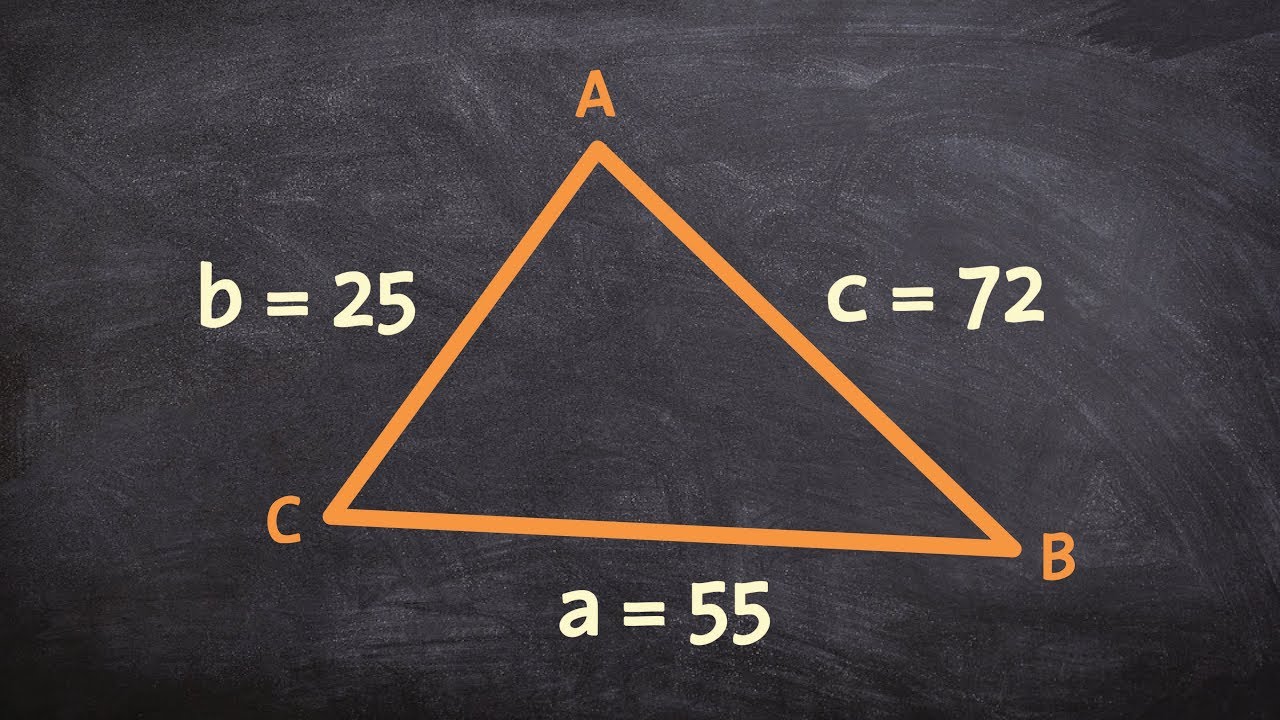
Learn how to solve for the lengths of the sides and the measures of the angles of a triangle using the law of cosines. The law of cosines is used in determining the lengths of the sides or the measures of the angles of a triangle when no angle measure and the length of the side opposite the angle are both known.
The law of cosines can be used ...