#geometry-and-trigonometry
1 messages · Page 16 of 1
 upper karma
 sick hemlock
now √9 = ?
upper karma
25-16=9
upper karma
sick hemlock
now √9 = ?
3
sick hemlock
do you understand how to apply Pythagoras theorem?
Like, say the sides are a, b and c where c is the hypotenuse
upper karma
sick hemlock
do you understand how to apply Pythagoras theorem?
Yes
 wild rivet
upper karma
3
wild rivet
upper karma
3
that's the answer of the sample question
upper karma
wild rivet
that's the answer of the sample question
I thought u meant what is the type
or sth
wild rivet
now apply it on the question we had. x^2=?
sick hemlock
can you see how you can find the third side in the triangle?
since you already know 2 sides
upper karma
wild rivet
now apply it on the question we had. x^2=?
yeah what is the x tho
wild rivet
we don't know, you have to find out
sick hemlock
alright lemme send the figure one sec
wild rivet
10^2-8^2=x^2
upper karma
wild rivet
10^2-8^2=x^2
solve this?
upper karma
(10-8)^2 = (10-8)(10-8) = 400-64 = 336
upper karma
wild rivet
10^2-8^2=x^2
this?
upper karma
wild rivet
10² - 8² = x²
or this?
wild rivet
upper karma
this?
this is
upper karma
i have to solve 2 things in the same time wait
wild rivet
upper karma
or this?
the same as this
wild rivet
wild rivet
this is
this is the same as
wild rivet
upper karma
or this?
this
sick hemlock
Find the side length AB@upper karma

You said you knew how to apply Pythagoras theorem
apply it and find AB
upper karma
sick hemlock
Find the side length AB<@456226577798135808>
AB = AG - BG = AB = 10 squared (100) - 8 squared (64) = 36
sick hemlock
Another thing to keep in mind is that a² - b² and (a-b)² are 2 different things
wild rivet
sick hemlock
Another thing to keep in mind is that a² - b² and (a-b)² are 2 different things
yeah
wild rivet
exactly
upper karma
so 6?
sick hemlock
Pythagoras Theorem says that AB² + BG² = AG²
upper karma
sick hemlock
Pythagoras Theorem says that AB² + BG² = AG²
ahh yeah
wild rivet
sick hemlock
Pythagoras Theorem says that AB² + BG² = AG²
but you can't use squares
you have to use square roots
upper karma
sick hemlock
you use square roots to go from AB² to AB
yeah
wild rivet
I mean that taryla is coming to an answer but not square rooting it
upper karma
u confused me
sick hemlock
I think he misremembered the Pythagoras theorem
wild rivet
whom?
sick hemlock
which is fair since he was probably taught it 3-4 years back
sick hemlock
wild rivet
whom?
taryla
wild rivet
sick hemlock
which is fair since he was probably taught it 3-4 years back
umm, you don't want to know about me. Can I talk to you on personal chat? You seem to be nice
sick hemlock
sure?
wild rivet
ok
upper karma
Goodbye guys
sick hemlock
upper karma
I forget what i was taught
you need to practise questions based on what you're taught
upper karma
thx for ur help ig
sick hemlock
maths in lower grades is basically formulae memorization
upper karma
Goodbye ❤️
 prisma salmon
 upper karma
prisma salmon
upper karma
prisma salmon
D
Since it does 8 revolutions, the total distance is 8*22,159km = 177,272km
 frozen ocean
Nope, I wasn't need help with this because I already know how
It's just an example on how we learned trig in canada
 dark sparrow
upper karma
D
dark sparrow
upper karma
D
!nosols
 lime crownBOT
upper karma
D
lime crownBOT
upper karma
D
As a helper, please do not give out answers that could be copied as a homework solution. Have the student work through the problem themselves and guide them along the way.
upper karma
dark sparrow
!nosols
mb
 violet robin
Helpppp

 knotty fjord
help...


 bleak blade
knotty fjord
help...
bleak blade
knotty fjord
help...
Should be just 1 cause all the numerators cancel out with denominators
 grave pond
knotty fjord
help...
grave pond
knotty fjord
help...
The first picture doesn't mean anything until you explicitly define it to mean some limit of finite calculations.
The details about how you choose to cut the infinite thing down to finite approximations you can calculate turn out to completely dominate which result (if any) you'll get.
 tepid hatch
https://imgur.com/a/KMiGhHX
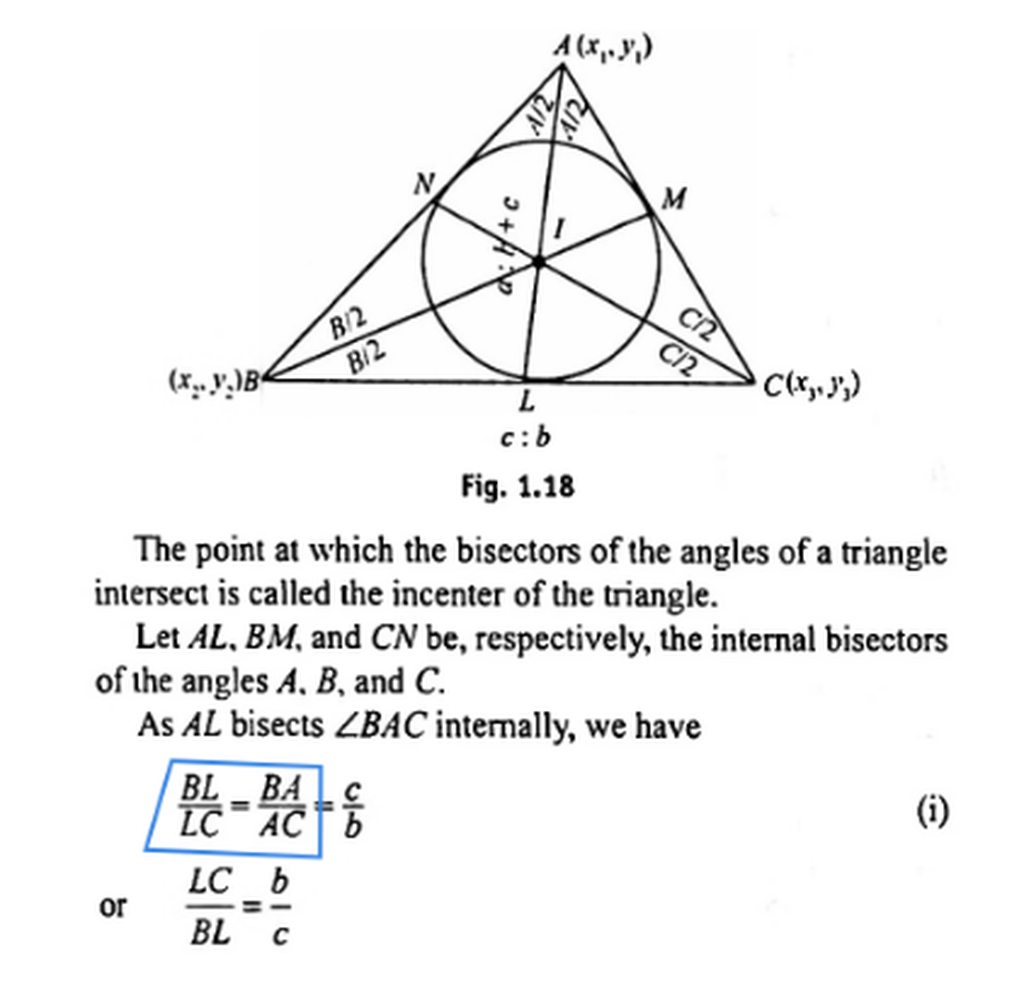
what witchcraft is this? does this come under similarity of triangles
 nocturne remnant
look up angle bisector theorem
tepid hatch
thanx
 zinc agate
knotty fjord
help...
zinc agate
knotty fjord
help...
The second is one satisfied for cos x = cos π
But both of them are just
The numerators and denominators cancelling each other out
grave pond
zinc agate
The second is one satisfied for cos x = cos π
The second one is satisfied by everything.
grave pond
For all we know he hasn't even been back since he asked.
zinc agate
Umm could u help with a problem
I opened a help channel but
Can't get anyone to help
@grave pond
grave pond
tepid hatch
https://imgur.com/a/KMiGhHX
what witchcraft is this? does this come under simila...
I'd file it under the law of sines. $$\frac{BL}{BA} = \frac{\sin\angle BAL}{\sin\angle BLA} = \frac{\sin\angle LAC}{\sin\angle ALC} = \frac{CL}{CA}$$ (where the denominators are equal because supplementary angles have the same sine).
 somber coyoteBOT
Troposphere
 grave pond
Triangles BAL and CAL are not similar, though .
grave pond
zinc agate
<@217922183169572864>
Don't ping specific people for help.
upper karma
help pls (traductor?)

 ember stratus
how to prove
 ember stratus
 eager ivy
are circles congruent?
eager ivy
are circles congruent?
yeah they're congruent
eager ivy
thanks, let me look through it
 hollow moth
GEOMETRY PROS I need help

 eager ivy
hollow moth
**GEOMETRY PROS** I need help
eager ivy
hollow moth
**GEOMETRY PROS** I need help
Hello, so you know that RS and RW are perpendicular bisectors of the chords
eager ivy
So then, you can use the fact that radii that intersect congruent chords are congruent
or not really radii, mor like segments where one endpoint is the center
basically, RS and RW are congruent
So then, you have to prove the triangles congruent
hollow moth
eager ivy
basically, RS and RW are congruent
do you mean SW
eager ivy
So we already have an angle(the right angles) and a side for both triangles
so we need to prove another pair of angles to prove the triangles congruent through SAA critetia
hollow moth
oh
eager ivy
So connect S and T
Then you get an isoceles triangle
And with base angles congruent
You can do the same for the other chord
And CPCTC proves STU and STW congruent angles
So we have another congruent angle pair
hollow moth
I see
eager ivy
So, with that, CPCTC proves that SW and SR are congruent and you can solve for x
Use x to find SR and pythag to find ST
SU*
(UW is 26 because it is half of the chord)
DOes that make sense, i tried to type fast and so it may be confusing
And on to the second problem
hollow moth
eager ivy
DOes that make sense, i tried to type fast and so it may be confusing
yeah no worries
eager ivy
Whenever a radii intersects a chord and it is perpendicular to it, the chord is bisected
That is a proven theorem
So PR = RQ = 16
And MN = 40, so LN = 20
So LP is 20 because all radii are equal in length
hollow moth
yes
eager ivy
And you can use pythag to solve for LR
We already have PR
And angle PLN is 80 degrees because central angles are always equal to the intercepted arc
So you have all 4 parts
Glad I could help
arcs*
hollow moth
Thank you bro
 viral patrol
howdo u get the surface area of a sphere ;-;
 near harness
viral patrol
howdo u get the surface area of a sphere ;-;
near harness
viral patrol
howdo u get the surface area of a sphere ;-;
Are you asking for the derivation?
The surface area is 4πr^2
dark sparrow
viral patrol
howdo u get the surface area of a sphere ;-;
do you just want us to act as your personal google or did you mean to ask "where did the sphere surface area formula come from"
viral patrol
whatever nonsense
dark sparrow
??
ember stratus
Hi dajiahao, how did they use the sine rule to calculate for the circumradius in:
https://artofproblemsolving.com/community/c6h1951086p13467971
 oak mural
how is the answer this? i dont get it

 outer sinew
oak mural
how is the answer this? i dont get it
outer sinew
oak mural
how is the answer this? i dont get it
$$\sqrt{2x^2} = 12$$
sick hemlock
Dude how did you get 45√2 💀
somber coyoteBOT
Kiameimon | Welt Rene
 oak mural
sick hemlock
Dude how did you get 45√2 💀
oak mural
sick hemlock
Dude how did you get 45√2 💀
bra ion kno this geomotry stuff lmaoo
sick hemlock
sin(45°) = x/12 = 1/√2
oak mural
what is sin
sick hemlock
since sine is opposite/hypotenuse
outer sinew
U don't even need that
sick hemlock
uh
outer sinew
U just need pythag theorem
 golden marten
oak mural
how is the answer this? i dont get it
golden marten
oak mural
how is the answer this? i dont get it
oh this is one of the identities no? or am i wrong
oak mural
sick hemlock
Dude how did you get 45√2 💀
ion kno i was going off of the last answer solutions
sick hemlock
outer sinew
U don't even need that
I mean, clearly the question was asking for trigonometry to be used since it specified the angle
golden marten
i dont know any of the identities but there was something with trianles oe something i forgor
outer sinew
sick hemlock
I mean, clearly the question was asking for trigonometry to be used since it spe...
Seeing how they don't know what sine is?
oak mural
outer sinew
U just need pythag theorem
ight bet im finna watch a yt vid on dis rn
outer sinew
oak mural
ight bet im finna watch a yt vid on dis rn
No need to
Just apply pythagorean theorem
sick hemlock
outer sinew
Seeing how they don't know what sine is?
and yet, what's the point to include the angle if it's not required
outer sinew
sick hemlock
and yet, what's the point to include the angle if it's not required
Ask the setter
golden marten
 outer sinew
Not me
sick hemlock
the question is ambiguous on what method it requires
oak mural
outer sinew
Just apply pythagorean theorem
i dont kno how to
outer sinew
sick hemlock
the question is ambiguous on what method it requires
... just go for the simpler method no?
outer sinew
oak mural
i dont kno how to
What does the pythagorean theorem tell us
sick hemlock
also for the record, I mentioned sine because you already mentioned Pythagorean theorem
outer sinew
In your case
outer sinew
outer sinew
What does the pythagorean theorem tell us
@oak mural
Do you know what it is?
golden marten
outer sinew
What does the pythagorean theorem tell us
||a^2 + b^2 = c^2||, no?
outer sinew
golden marten
||a^2 + b^2 = c^2||, no?
Yes
Wait lmao I pinged the wrong person
XD
In any case
So our c is 12
Wait
I pinged the right person

sick hemlock
uh, didn't you ping the right person
outer sinew
My brain
sick hemlock
lol
golden marten
lol
golden marten
outer sinew
So our c is 12
||wait so how do we solve for x tho||
golden marten
i should know this i went thru precal last year 
outer sinew
golden marten
||wait so how do we solve for x tho||
||\sqrt{2x^2} = 12||
Or if u wanna do it the other way, ||2x^2 = 144||
So ||x^2=72 and sqrt that to solve for x||
golden marten
sick hemlock
in this case what do you think sides a and b are?
wait its like ||5 12 13 right?||
sick hemlock
golden marten
wait its like ||5 12 13 right?||
Just stop looking at special triangles, simply think about the Pythagorean theorem
golden marten
like a ||5 12 13 triangle or something i forgor but there were things like 3 4 5 and all these traingle combinations||
golden marten
sick hemlock
Just stop looking at special triangles, simply think about the Pythagorean theor...
oh ok
golden marten
how do we know both sides can be solved with 2x tho what if they are different lengths
golden marten
sick hemlock
what do you think sides a and b are in the triangle?
leg
outer sinew
golden marten
how do we know both sides can be solved with 2x tho what if they are different l...
They are not different lengths tho
golden marten
opp and adj
golden marten
outer sinew
They are not different lengths tho
oh ok. how would we solve it if it was tho
outer sinew
golden marten
oh ok. how would we solve it if it was tho
We use sine/cosine
golden marten
ah i see. could you give an example n how to do dat?
outer sinew
Depending on which angle is given
oak mural
outer sinew
Do you know what it is?
no
outer sinew
oak mural
no
You shouldn't be doing this question then...
golden marten
oak mural
no
you dont know pythagroem therom? how does your tracher want you to solve it?
outer sinew
You need to learn the fundamental concepts of triangles
oak mural
golden marten
you dont know pythagroem therom? how does your tracher want you to solve it?
idk i barely go to school
golden marten
oak mural
idk i barely go to school
oh
golden marten
oak mural
idk i barely go to school
khan academy or youtube dawg just search somethig up you can learn anything if you want to
outer sinew
golden marten
ah i see. could you give an example n how to do dat?
Ok so let's just say we have a triangle which hypotenuse is 4 and the angle between the hypotenuse and length we wanna find is 30 degrees
So we just take 4×cos(30) since cos is adjacent over hypotenuse and the angle (30) is adjacent to the side we wanna find
golden marten
outer sinew
Ok so let's just say we have a triangle which hypotenuse is 4 and the angle betw...
ohhh i remeber dis
thank brodie!
oak mural
sick hemlock
It seems his question is already answered
i was asking how to get the soluation
cuz this geomotry shi to me jus looks like u get random letters nd numbers nd multiply them and get a random ah solution this shi dont make sense
sick hemlock
oak mural
i was asking how to get the soluation
Alright you need to learn Pythagorean theorem first
and by learn I mean actually dedicate time to it
If you don't go to school watch some videos online
khan academy vids or any other math ytuber
that question can not be solved without some basic understanding of geometry
 supple robin
guys, how can I prove that the central angle of a circumference has the same measure of its arc?
 sick hemlock
why...?
oak mural
sick hemlock
why...?
cuz its the right way to do it?
sick hemlock
it's really not
 raven sable
oak mural
I divided 18 by 2 then put the checkmark thingy
raven sable
oak mural
I divided 18 by 2 then put the checkmark thingy
by "checkmark thingy" do you mean the square root symbol?
oak mural
raven sable
by "checkmark thingy" do you mean the square root symbol?
ya i didnt know the name of it
sick hemlock
what you're doing is memorising a pattern between the solutions and question data, then applying the same pattern
If I gave you any other angle, your answer would be wrong, regardless of whatever you divide the hypotenuse with
that's why I'm suggesting you to learn Pythagorean theorem and then learn some basic trigonometry
oak mural
sick hemlock
If I gave you *any* other angle, your answer would be wrong, regardless of whate...
give me one i need practice
 oak mural
is there a shortcut
sick hemlock
it's a big jump to go from that to trigonometry, but if your only focus is solving those questions then that's my only suggestion
sick hemlock
oak mural
is there a shortcut
You must have time right? you don't have your school finals or anything rn probably
upper karma
Need help with this question
 oak mural
sick hemlock
You must have time right? you don't have your school finals or anything rn proba...
oak mural
sick hemlock
You must have time right? you don't have your school finals or anything rn proba...
naa
its like in 3 weeks
sick hemlock
upper karma
Need help with this question
what do you think the amplitude of y = sin(3x - π) is?
upper karma
4? @sick hemlock
sick hemlock
oak mural
naa
Then dedicate time to maths, build on your fundamentals like kiameimon mentioned
sick hemlock
upper karma
4? <@569845645599571970>
Why do you think it's 4?
oak mural
sick hemlock
Then dedicate time to maths, build on your fundamentals like kiameimon mentioned
im gettin money doe
sick hemlock
no, it wouldn't
upper karma
Sorry 2pi/3
sick hemlock
Alright, the trick here is remembering that 3x - π represent a number themselves
what do you think the amplitude of y = sin(t) is?
sick hemlock
where t represents angles
upper karma
4?
sick hemlock
do you know what an amplitude of a function is?
upper karma
No
sick hemlock
alright, have you seen the graph of sine function?
sick hemlock
It's something like this is it not?
 upper karma
Yes !
sick hemlock
Do you see that the maximum and minimum points on the graph are basically at equal distance from the x-axis?
@upper karma

Can you see that the lengths a and b are equal?
upper karma
One is higher and one is the lowest
sick hemlock
but the distance is the same right? In a way the x-axis divides the function into 2 parts which are equidistant from it
so we call the x-axis the midline of the function
Now the distance between the midline and the function's highest/lowest point is called the amplitude
so here the amplitude is a
oak mural
do i use patheg thereom for this
 upper karma
No
sick hemlock
You can't use Pythagorean theorem for that
raven sable
you'll need sohcahtoa
oak mural
raven sable
you'll need sohcahtoa
how do u even pronounce it lmaoo
upper karma
90+60
sick hemlock
anyways what are the minimum and maximum values of the sine function? @upper karma
upper karma
The highest point
 upper karma
Ye
raven sable
oak mural
how do u even pronounce it lmaoo
pronounce it how it looks basically. "soh" rhymes with "low", "cah" rhymes with "the", and "toa" has the "same" vowel sounds as those... if that makes sense
dark sparrow
oak mural
how do u even pronounce it lmaoo
/ˌsoʊ.kə.ˈtoʊə/
 worthy matrix
oak mural
do i use patheg thereom for this
worthy matrix
oak mural
do i use patheg thereom for this
you'll want to memorize your special right triangles
45-45-90 and 30-60-90
grave pond
You can perfectly well use Pythagoras for that problem. Mirror the ramp triangle in the ground; together with the original triangle it forms an equilateral triangle, so we know that the vertical side of the triangle must be 3 ft. That's enough to plug into the Pythagorean theorem to find the horizontal side.
 novel canopy
hi need help
grave pond
You need dollar signs around that to trigger the bot.
novel canopy
$\left[\tan \left(x\right)+\cot \left(x\right)\right]^2$
somber coyoteBOT
SLOWWWWWWWWWWW

 silent plank
soccer tower
grave pond
And what do you want to do with that expression?
novel canopy

 errant lake

 grave pond
novel canopy
grave pond
novel canopy
Interesting -- my simplification would have given 1/(sin²(x)cos²(x)), but that is the same as one of your options.
Write the tangent and cotangent in terms of sine and cosine. Them multiply out the square-of-a-sum. That gives you two copies of 1; add each of them to one of the remaining terms.
novel canopy
thx
grave pond
You can also just metagame it: you want something that explodes when x approaches 0° as well as when x approaches 90°, and only one of your four options do that.
 dense canyon
I need help in 4
 grave pond
Don't just solve people's homework for them please.
lime crownBOT
As a helper, please do not give out answers that could be copied as a homework solution. Have the student work through the problem themselves and guide them along the way.
 pine silo
oh ok
 burnt basalt
How do I memorize formulas easier
 wide valley
oak mural
how do u even pronounce it lmaoo
wide valley
oak mural
how do u even pronounce it lmaoo
"soh-ka-toe-uh"
wide valley
burnt basalt
How do I memorize formulas easier
- It is much easier to memorize a formula if you understand what it means and how it works
- Practice, Practice, Practice
- Use acronyms, mnemonics, or other memory aids to help you remember formulas. E.g. "Please Excuse My Dear Aunt Sally" = PEMDAS.
- Teach it to someone else.
wide valley
dense canyon
I need help in 4
Do you have an answer key for this?
wide valley
Can you share the solution?
dense canyon
sure
wide valley
It was an interesting problem
dense canyon
1899.45
wide valley
Thanks, do you have the solution written down too?
dense canyon
yea
wide valley
May I have a look?
 wide valley
So did you multiply π5^2 by 5 to get the total area of those circles with radii 5?
No sorry, there was only 1 circle with radius 5
But 5 circles with radius 2.5
Right?
dense canyon
yes
wide valley
,calc 5*19.625
somber coyoteBOT
Result:
98.125
 wide valley
Yes my bad
dense canyon
so i think 117.75 is right
wide valley
,calc 253.14 + (5/2)^2 * 3.14 + 6(2.5^2)3.14 + 4^2 * 3.14 + (2.5/2)^2 * 3.14 + 13.14
somber coyoteBOT
Result:
274.16125
Okay so that should cover all the circles
Now what about the greater quadrilateral polygon?
dense canyon
wait like the whole trapezoid?
wide valley
What was your approach to solving that
I'm talking about the quadrilateral polygon, so the figure with 4 sides
So the trapezoid
wide valley
dense canyon
oh i just did the formula for that so 1/2(50+41)48
What formula is this, heron's?
Does (50+41)/2 calculate the average of the lengths of the two parallel sides?
dense canyon
yes
dense canyon
wide valley
What formula is this, heron's?
I'll be honest I have no idea what that is
wide valley
Okay but could you tell me what formula this is 1/2(50+41)48
wide valley
Where h is 48, I assume
dense canyon
yes
wide valley
,calc 1/2 ( 50+41) 48
somber coyoteBOT
Result:
2184
Okay so you added that to 274.16125?
Or did you subtract 274.16125 from 2184?
,calc 2184-274.16125
somber coyoteBOT
Result:
1909.83875
You wrote 1899.45
I suppose you got a different answer than me for 274.16125
At any rate, good job solving the question, I learnt something new in the process 🙂
 grave zealot
Does anyone know what does "|||" symbol means when talking about triangles?
 opaque thunder
how
 upper karma
grave zealot
Does anyone know what does "|||" symbol means when talking about triangles?
upper karma
grave zealot
Does anyone know what does "|||" symbol means when talking about triangles?
similar?
i had a very old book that had that notation
 lucid breach
 outer sinew
Are there any pythagorean triplets where a²+b²=c² and a+b=c?
 vivid plinth
outer sinew
Are there any pythagorean triplets where a²+b²=c² and a+b=c?
vivid plinth
outer sinew
Are there any pythagorean triplets where a²+b²=c² and a+b=c?
No, because then $(a+b)^2=a^2+b^2$, which leads to $2ab=0$, which means that either a or b would have to equal 0 which is an impossible side length for a triangle.
somber coyoteBOT
Northstar
 outer sinew
Ah
outer sinew
vivid plinth
No, because then $(a+b)^2=a^2+b^2$, which leads to $2ab=0$, which means that eit...
How'd u come to the conclusion that this would imply that tho?
vivid plinth
outer sinew
How'd u come to the conclusion that this would imply that tho?
Wdym?
outer sinew
Like how'd u know that a²+b²=c² and a+b=c implies a²+b²=(a+b)²
Oh
...mb (Square the 2nd equation)
LMFAO
Tyty

vivid plinth
$a+b=c$ so $(a+b)^2=c^2$ so $(a+b)^2=a^2+b^2$
vivid plinth
outer sinew
...mb (Square the 2nd equation)
Np
somber coyoteBOT
Northstar
 vivid plinth
Ok that's better
outer sinew
vivid plinth
I'm gonna edit the message
Lmao did u try \implies or \to?
vivid plinth
outer sinew
Lmao did u try \implies or \to?
No I didn't lol
I haven't used latex before
outer sinew
vivid plinth
No I didn't lol
They look better
$a+b=c \to (a+b)^2=c^2 \to (a+b)^2=a^2+b^2$
vivid plinth
outer sinew
They look better
$a+b=c \to (a+b)^2=c^2 \to (a+b)^2=a^2+b^2$
Ya that's definitely better
somber coyoteBOT
Kiameimon | Welt Rene
 outer sinew
Usually it's used for stuff like summation notation but hey it works here fine too 
vivid plinth
I'm pretty active on the help forum but every now and then I find a situation where the latex bot would be helpful in explaining something or another.
outer sinew
Wait whaaaaaaaaaa
somber coyoteBOT
Northstar
 vivid plinth
Made a slight adjustment
somber coyoteBOT
Northstar
 vivid plinth
It works because when you rotate a line 90 degrees, its slope $x$ becomes $-\frac{1}{x}$, and $tan^{-1}(x)$ gives you the line's angular displacement off of the x axis, so $tan(tan^{-1}(x)\pm90)$ makes the two expressions equal (with a few conditions).
somber coyoteBOT
Northstar
 vivid plinth
Oops I made a small mistake earlier
I meant $x(tan(tan^{-1}(x)\pm90))=-1$ if x is not the tangent value of a multiple of $\pm90$ that is not a multiple of $\pm180$
somber coyoteBOT
Northstar
 vivid plinth
Ok ykw using latex is too much work I'll just let you figure out what I mean
vivid plinth
outer sinew
Wait whaaaaaaaaaa
The easiest way for me to describe this is with this graph:

The function equals -1 for most values of x...but not all. You can try it out and see for yourself.

The strange thing that I do not understand is that when you create an equality to -1, the graph of the intersection is unresolved...

 coarse lance
Given that a car is traveling at 30 miles per hour, and each wheel is spinning at 2000 rotations per minute, can you figure out the circumference of the wheel in inches?
dark sparrow
@coarse lance do you still need help w this
coarse lance
yeah
dark sparrow
any progress?
vivid plinth
coarse lance
Given that a car is traveling at 30 miles per hour, and each wheel is spinning a...
This looks like dimensional analysis to me. Do you know how to solve such problems?
coarse lance
not sure, I have not heard of dimensional analysis
vivid plinth
coarse lance
not sure, I have not heard of dimensional analysis
It's just a fancy term. Try to make the information given to you into two expressions, and then find a common denominator to equate them and solve.
dark sparrow
idt you need dimensional analysis as such
it's just unit conversion
within the same quantities
ish
@coarse lance you will need to know how many inches are in a mile and how many minutes are in an hour.
coarse lance
coarse lance
Given that a car is traveling at 30 miles per hour, and each wheel is spinning a...
63360 inches in a mile, 120000 rotations per hour
vivid plinth
dark sparrow
so how many inches does your car travel in 1 hour
Mb there's one more step
coarse lance
dark sparrow
so how many inches does your car travel in 1 hour
1,900,800
coarse lance
dark sparrow
that is 120,000 times the circumference of the wheels
Whoa
so the circumference of a wheel in inches equals inches per hour over rotations per hour
vivid plinth
coarse lance
so the circumference of a wheel in inches equals inches per hour over rotations ...
Yes
So what do you get if you use that ratio?
coarse lance
15.84 inches the the circumference
vivid plinth
To put this into perspective, $30$ miles per hour $\to 30\cdot5280$ feet per hour $\to 30\cdot5280\cdot12$ inches per hour, so the car is traveling $1,900,800$ inches per hour. With the rotational information, each wheel is spinning at $2000$ rotations per minute $\to 2000\cdot60 \to 120,000$ rotations per hour. Now we can equate the two expressions since they have a common denominator. $1,900,800$ inches = $120,000$ rotations, so the circumference of the wheel is 15.84 inches.
somber coyoteBOT
Northstar
 coarse lance
i am a bit confused on how distance traveled in one hour over rph gives the circumference
how do we know thats not giving the diamater or another measurement of the wheel?
vivid plinth
coarse lance
i am a bit confused on how distance traveled in one hour over rph gives the circ...
It's just in this case
vivid plinth
coarse lance
how do we know thats not giving the diamater or another measurement of the wheel...
The circumference of the wheel is what's touching the ground when it rotates
coarse lance
ohh right
well pretty cool math to know tbh
i wanna verify the accuracy with a test drive
dark sparrow
this is not math this is geometry
also if youre gonna do a test drive make sure you maintain a constant velocity throughout and measure exactly how long you maintain it for and your tachymeter reading
coarse lance
shouldn't it give the same result regardless? Assuming my tire doesn't pop and the circumference stays the same
dark sparrow
this scenario assumes you have a constant tachymeter reading and velocity for some length of time
 sour cedar
 rancid heart

 torn gazelle
Could someone help with this?

 obtuse patio
torn gazelle
Could someone help with this?
obtuse patio
torn gazelle
Could someone help with this?
!show
lime crownBOT
torn gazelle
Could someone help with this?
Show your work, and if possible, explain where you are stuck.
 queen trellis
Does anyone know the equation to this?
 outer sinew
complete the square
 edgy cradle
torn gazelle
obtuse patio
or use colored pen on top
edgy cradle
torn gazelle
obtuse patio
or use colored pen on top
For what?
I found out the area of the white circles, which is just pi, I’m stuck on what I do next…
 karmic path
obtuse patio
karmic path
obtuse patio
yeah but you didn’t understand why I said something
torn gazelle
It’s another problem
 torn gazelle
obtuse patio
cause you didn’t show any effort
torn gazelle
obtuse patio
cause you didn’t show any effort
I didn’t show any effor?
Cause I didn’t understand it…
obtuse patio
Show your attempt
And you didn’t explain what you don’t understand
We cant read your mind
torn gazelle
Ok I’ll show this

Is problem c correct?
In a 30-60-90 triangle this hypotenuse is double the short side, so is 1/2R double that?
 snow crystal
yeah that's right
snow crystal
but what is the lenght of the base
torn gazelle
r
snow crystal
no
base can't be as long as the hypotenuse
use the fact that it's a 30-60-90 triangle
torn gazelle
So AC is the base?
snow crystal
no, you're not multiplying by hypotenuse
what is the height of the triangle if AC is the base
snow crystal
what would the length be in terms of r
torn gazelle
Yeah
snow crystal
and now you have to multiply it by sqrt(3)
torn gazelle
And the longer leg is radical 3 times the short leg
snow crystal
 torn gazelle
snow crystal
and now you have to multiply it by sqrt(3)
torn gazelle
snow crystal
and now you have to multiply it by sqrt(3)
So then 1/2rsqrt3
torn gazelle
Ok
So then the area is 1/2(R)• radical3?
Cause the base is R
And the height is radical 3
torn gazelle
That’s the area?
torn gazelle
And the height is r right?
snow crystal
1/2 * base * height
snow crystal
torn gazelle
And the height is r right?
no, r is the hypotenuse
snow crystal
yup
 snow crystal
snow crystal
snow crystal
use this
snow crystal
rad3/8
torn gazelle
As the area
snow crystal
np
obtuse patio
torn gazelle
Find the area of the dodecagon in terms of r
try it out on your own first
you literally just finished part 1
 snow crystal
yeah that's right
torn gazelle
snow crystal
yeah that's right
Find the area of dodecagon in terms of r
So then what?
That’s one triangle and there are 12
snow crystal
but those triangles are different from the one which we just calculated
use the formula area = 1/2 * sin(of the angle between two sides) * the two sides that create the angle
I gotta go
 torn gazelle
snow crystal
you know something about trigonometry?
torn gazelle
snow crystal
you know something about trigonometry?
A little
torn gazelle
Area= what over 2?
snow crystal
1
torn gazelle
And the angle would be 360 divided by 12 right
snow crystal
bro you said it yourself that the angle is 30°
torn gazelle
/

So that’s what the formula is
Sin30 is .5
So 1/2 and .5 cancel
So then the area is equal to 12r^2?
@snow crystal
snow crystal
why would 1/2 * 1/2 cancel out
@torn gazelle
maybe at least I'll get the active role lol
snow crystal
ik it's kinda hard to make clear drawings in paint lol
snow crystal
torn gazelle
It would be 1r^2
whered you get that from
torn gazelle
.25*
snow crystal
so what is your final answer
torn gazelle
3r^2
torn gazelle
.25 times 12?
snow crystal
what is the area of a single triangle
torn gazelle
I’m confused
torn gazelle
I already used the formula
snow crystal
you used it wrong
snow crystal
yup you got it right
snow crystal
yeah!
snow crystal
you forgot about something
torn gazelle
3r^2
snow crystal
yes thats the right answer
snow crystal
thought you were talking about a single triangle
torn gazelle
Oh ok
snow crystal
either way you got the right answer
torn gazelle
Yes thank you
The final question says, Why is the formula for the area of a regular dodecagon so much like the formula for the area of a circle?
snow crystal
what's the formula for circle area
snow crystal
uhh, M?
 snow crystal
you said it's 3r^2
torn gazelle
PiR^2 and 3r^2
snow crystal
see any similarities yet?
torn gazelle
So it’s just .14159 off
snow crystal
yuh
torn gazelle
snow crystal
yuh
Awesome

For the true or false questions, do I have the correct answers?
For D I need to drawn it out
snow crystal
nah bro my head is falling off
 trail pebble
Idk what to do all of these look right

 proven zodiac
I need help with Cavalieri's Principle
When do I use V=w * h * l and V=3.14r^2h
also is there any yt vids for studying the EOC for Geometry?
 short echo
The first one V = whl is for the volume of a rectangular prism
And the second one is the equation for volume of a cylinder
 wheat crest
I need help on these questions.
 snow crystal
maybe draw them out first
torn gazelle
snow crystal
maybe draw them out first
Ayy could you help me real quick.

For this, the central angle is 40deg
So how would I find arc ab?
torn gazelle
If the central angle is 40deg, wouldn’t the arc be double so 80deg?
 dry current
Can someone give me the answer to this PELASE and explain I’m very confused
 snow crystal
torn gazelle
If the central angle is 40deg, wouldn’t the arc be double so 80deg?
snow crystal
torn gazelle
If the central angle is 40deg, wouldn’t the arc be double so 80deg?
what's the formula for the arc
torn gazelle
snow crystal
what's the formula for the arc
Idk
 mental bobcat
dry current
Can someone give me the answer to this PELASE and explain I’m very confused
mental bobcat
dry current
Can someone give me the answer to this PELASE and explain I’m very confused
AE = AD because tangents from the same external point are equal. You can do the same with CD. Then add AD and CD
snow crystal
torn gazelle
Idk
$$L\ =\ \frac{\theta}{360°}\cdot2\pi r$$
somber coyoteBOT
IamMax420

 outer sinew
Just take area of the circle minus the rectangle
 inner stag


 violet raft
inner stag
<:Jason_Dead:994430950631014480>
violet raft
inner stag
<:Jason_Dead:994430950631014480>
do you know sohcahtoa?
inner stag
violet raft
do you know sohcahtoa?
Nope not at all-
 dapper lodge
inner stag
<:Jason_Dead:994430950631014480>
dapper lodge
inner stag
<:Jason_Dead:994430950631014480>
i got you
dapper lodge
inner stag
Nope not at all-
shouldnt they teach u that if its a question 💀
inner stag
dapper lodge
shouldnt they teach u that if its a question 💀
My math teacher is the type of guy to give you the homework and not give any explaination
He gave us all our work for the quarter at the start and its our job to finish it all


 inner stag
Ty dawg 
inner stag
dapper lodge
i took a ton of notes on this lol, i didnt understand it at all either
Its kinda wack trynna understand this w no context of any work-
dapper lodge
my math grade dropped to a 29% once 💀 but i got it back up
dapper lodge
inner stag
Its kinda wack trynna understand this w no context of any work-
hold on im not done
inner stag
My teacher hasn't taught us anything throughout the year
dapper lodge
here's examples of sine, tangent, and cosine


 inner stag
Tysm
dapper lodge
inner stag
Tysm
do u have a scientific calculator?
inner stag
dapper lodge
do u have a scientific calculator?
Uhh i dont think so, i can try use one online
dapper lodge
oh yea you'll need one for sin, cos, and tan
look into buying one, or if ur teacher has some in class
or look it up but theres different ones idk how reliable itll be
but
 inner stag
dapper lodge
look into buying one, or if ur teacher has some in class
inner stag
dapper lodge
look into buying one, or if ur teacher has some in class
Ill look tmr
Ill try use one online today
dapper lodge
alr
im sure u can get it
do u have to learn about finding the angles of a right triangle with only side lengths too?
inner stag
dapper lodge
do u have to learn about finding the angles of a right triangle with only side l...
I think so?
dapper lodge
inner stag
I think so?
thats where the sin^-1 comes in

idk im sorry, i hope my notes helped, they helped me a lot but i cant teach you good over online
oh yea dont mind the mexican restaurant at the top of the page 😭
just remember
hypotenuse= across from 90 degrees
opposite= across from the given angle
adjacent= line between given angle and 90 degrees
the notes are a little messed up, where it says sin(ø)=opposite/hypotnenuse/adjacent
the adjacent isnt supposed to be there, its a label for the triangle
 dapper lodge
 raw forum
What theorem proves that triangle ABC is similar to triangle CEF
raw forum
What theorem proves that triangle ABC is similar to triangle CEF
sorry mate ik theyre similar but idk what can officially prove it
havent learned that
upper karma
just make up ur own name for it
il798li theorum
too late i already named it
exeterishere theorum
too bad now i get the credit
dapper lodge
whats the theorem tho 💀
upper karma
if a square is placed inside a right triangle, where the corners of the square are touching the hypotenus, opposite, and adjacent side of the triangle, the two triangle that are separated from said square are similar
best i could do
actually wait

ok one of the corners has to touch another corner of the triangle
raw forum
upper karma
if a square is placed inside a right triangle, where the corners of the square a...
but whats the name of the theorem
snow crystal
raw forum
They're similar bc their angles are the same
I don't think that it has its specific name
 undone moat
raw forum
but whats the name of the theorem
undone moat
raw forum
but whats the name of the theorem
The naming of the sides are part of the Pythagorean theorem.
 brazen veldt
raw forum
What theorem proves that triangle ABC is similar to triangle CEF
brazen veldt
raw forum
What theorem proves that triangle ABC is similar to triangle CEF
it is called the corresponding angle theorem. sorry if im too late i just joined the server and had to wait 10 mins to type. basically because BC and DF are parallel the left F corner on the side between the two parallels is just as big as the left C corner on the outside of the two parallels.
 zealous lotus
Anyone know?

 twin crag
 timber cargo
no
worthy matrix
zealous lotus
Anyone know?
power of a point
i've also heard that theorem called chord-chord/chord-secant/tangent-secant, etc
ember stratus
Points $A, B, C, D, E$ match the following.
$$AC = AE, \angle CAD = 2 \angle CBD, \angle BAE = 2 \angle BDE$$Find all values of $\frac{AB}{AD}$.
somber coyoteBOT
aSome1gussy

 twin jungle
yay i love trigonometry
 foggy parcel

<@&286206848099549185>
we have to get the area of the half circle
thought it in a multiple ways but still got stuck
getting the value of AB would help
 lucid jasper
If sin(6x)/sin(2x) = 5/2
The value of
cos(6x)/cos(2x) is ?
 foggy parcel
yea seems fine to me thanks dude
 prisma raft
you are welcome
frozen ocean

 shell vale
i am 14 can someone dedicate their time in helping me with geometry and trigonometry
 runic beacon
shell vale
i am 14 can someone dedicate their time in helping me with geometry and trigonom...
runic beacon
shell vale
i am 14 can someone dedicate their time in helping me with geometry and trigonom...
if you have any problems you are having trouble with, you can ask them here in the server, maybe in one of the available help channels. that way, if anyone is able and willing to help you out, they can do so
grave pond
"The area of axles in conus" doesn't make much immediate sense, even if "conus" is a typo for "cones". Can you try to state your question in different words?
 neat python
grave pond
"The area of axles in conus" doesn't make much immediate sense, even if "conus" ...
neat python
grave pond
"The area of axles in conus" doesn't make much immediate sense, even if "conus" ...
I don't know that word in English ah
What about shaft of S
Maybe it's correct word for it XD
grave pond
Sorry, still doesn't make sense. Are you willing to show your problem in the original language -- someone might know it?
neat python
grave pond
Sorry, still doesn't make sense. Are you willing to show your problem in the ori...
I don't think so if anyone there would know that language XD
neat python
grave pond
Sorry, still doesn't make sense. Are you willing to show your problem in the ori...
What about pivot of S

grave pond
What is S?
neat python
Area
grave pond
Huh. I'm completely lost, sorry.
neat python
I will tell evey area formulas and one won't be there XD
S base= πR^2
S lateral = πRl
S complete = πR(l+R)
And one left that I don't know
😀
@grave pond
Now?
Or still lost XD
grave pond
No, I have no idea what you're talking about.
 main grove
how to convert rect coord (0,-pi) to polar coord... always choose angle theta to be in interval (-pi,pi]
i got r but having problems with the angle part..
<@&286206848099549185>
would it be undefined?
main grove
omg nvm i am so dumb I got it
 somber bay
yo
need some help
You slide a 1 m wide table along the straight wall of a 2 m wide corridor, as in the figure below. How far from B, in meters, can you bring corner C of the table, so that you can still fully open the door [AB]?

 young violet
The diameter of a circle has endpoints P(-6,-11 ) and Q(4, 7).
Write an equation for the circle. Be sure to show and explain all work.
To write the equation of the circle, we need to find the center and the radius.
First, we can find the coordinates of the center of the circle by using the midpoint formula:
x-coordinate of center = (x-coordinate of P + x-coordinate of Q)/2 = (-6 + 4)/2 = -1
y-coordinate of center = (y-coordinate of P + y-coordinate of Q)/2 = (-11 + 7)/2 = -2
So, the center of the circle is (-1, -2).
Next, we can find the radius of the circle using the distance formula between the center and one of the endpoints of the diameter:
r = sqrt[(x2 - x1)^2 + (y2 - y1)^2] = sqrt[(-1 - (-6))^2 + (-2 - (-11))^2] = sqrt[49 + 81] = sqrt(130)
Therefore, the equation of the circle is:
(x + 1)^2 + (y + 2)^2 = 130
This is the standard form of the equation of a circle with center (-1, -2) and radius sqrt(130).
is this right?
 gilded rampart

What is the formal definition we need to prove?
Two vectors are parallel? How is that defined in vectors?
near harness
gilded rampart
What is the formal definition we need to prove?
You have to show that two opposite sides of the quadrilateral formed by joining all the midpoints are equal and parallel. Because if that is true, the shape formed will be a parallelogram
 fringe ridge
Someone please explain a segment to me
 umbral nymph
 digital knoll
hi
digital knoll
fringe ridge
Someone please explain a segment to me
a segment is just the area of a sector minus the area of the triangle that can be drawn from the three points of the sector
 tawny skiff
 flat pawn
(1/2)pi + (n*pi)
Isn't it better to make the connection using graphs?
Talking about segments. I still don't get why vertices aren't called edges. Also, why aren't edges called line segments?
 wary ember
someone can help me here

 slow merlin
hi, can someone please explain to me what dilations, transformations, and translations are? im p confused on it and i have state testing tomm so
thanks
frozen ocean
wary ember
someone can help me here
what have you tried so far?
hint: use reciprocal trig identities formula
wary ember
frozen ocean
what have you tried so far?
hi, ive done another problem but im struggled with this one
wary ember
frozen ocean
hint: use reciprocal trig identities formula
well, that's nothing
somber coyoteBOT
Akira
 frozen ocean
this is what I meant
wary ember
frozen ocean
this is what I meant
yeah of course i mean that´s too obvious
but forget it man
frozen ocean
what is the question asking you
obtuse patio
slow merlin
hi, can someone please explain to me what dilations, transformations, and transl...
Google it
wary ember
someone to help me to solve it, that´s it, is just a problem
no 2 or 3 or 4
just one, and im not gonna bother here anymore
frozen ocean
do you know how to prove the trig identities?
wary ember
frozen ocean
do you know how to prove the trig identities?
well
i already did this problem
this one
but this was 10x easier
frozen ocean
wary ember
i already did this problem
nice
 foggy parcel
Given Equilateral triangle and stacks of infinite number of semicircles inside. Solve for the total area of the semi circles.

Any hint would be appreciated
<@&286206848099549185>
 spare ore
 foggy parcel
in the 2nd pic is the triangle's upper two sides equal?
spare ore
foggy parcel
in the 2nd pic is the triangle's upper two sides equal?
i assume the secnod one is the top right one? dont really know what you're asking, but I assume ur talking about the two upper tangent lines? cause yes
 woven shoal
What is asked
spare ore
i need to find x y and z
woven shoal
What else is given?
spare ore
nothing
woven shoal
Okay what is x?
spare ore
idk
woven shoal
Is x, 42?
woven shoal
This data isnt enough.
Well wait
It is ig
I didn't see that the two angles with the horizontal were equal

Well, its enough for finding angles.
I just took x as 42 degrees
Otherwise there's no way you can find it
Arc length
??
woven shoal
spare ore
i need to find x y and z
...?
You can't find arc length using this data
Its insufficient
...
Radius!
Let's become radius people
 tiny oriole

 pliant tapir
yooo
who's the teacher here?
or anyone who knows trigonometry more?
ohh greatt
thankss
dark sparrow
pliant tapir
who's the teacher here?
no such position
the helpers on this server are volunteers
 alpine pagoda
 ancient ether
Please help
 snow crystal
first, evaluate the third angle
upper karma
ancient ether
Please help
use the law of sines to calculate the side lengths. Your second angle is 90 degrees and to evaluate the third angle, you have to add the corresponding angles and subtract them from 180.
ancient ether
Get a calculator?
upper karma
ancient ether
Get a calculator?
a calculator isnt necessary for most of it aside from evaluating the sides with the sine function
Law of sines: ((a)/(sin(A)))= ((b)/(sin(B)))= ((c)/(sin(C)))
a,b,c are the sides; A,B,C are the angles

 snow crystal
That monitor tho 💀
grave pond
I'm very skeptical that "stack as cubes" is literally what the author of that task imagined.
 rugged veldt
grave pond
I'm very skeptical that "stack as cubes" is literally what the author of that ta...
rugged veldt
grave pond
I'm very skeptical that "stack as cubes" is literally what the author of that ta...
My teacher said we can assume that
grave pond
Then it would be a lot more efficient to make the box rectangular with room for 2×3×2 of those cubes.
Note that two layers each of the arrangement
O O O
 O O
  O
would be too densely packed for cubes, so there would need to be a lot of rattle room if you expand your equilateral-triangle footprint enough to have room for cubes.
rugged veldt
Ok so let’s assume that they are spheres
I think the two layers in height means the distance between bases
 steady geyser
I need to understand the trigonometry part can someone help me?
I have no clue to be honest
Like this one from the middle how can i show that

 cyan wren
 digital knoll
a = 6/2
formula for apothem: a = Rcos(pi/n) where n is number of sides (in this case hexagon so 6)
3 = Rcos(pi/6)
rearrange: 3/R = (cos(pi/6))
3/R = (sqrt3/2)
R = 3/(sqrt3/2)
R = 6/(sqrt3)
then we have two sides of a right angled triangle, a is the apothem and R is side c
R^2 - a^2 = h^2 where h is the height of the triangle
(6/(sqrt3))^2 - 3^2 = 3
h = sqrt3
area of the triangle is 1/2 bh
1/2 * asqrt3 = (asqrt3)/2
height of the hexagon is 6 times a
6*3 = 18
therefore the volume of the hexagon is: 18 * ((asqrt3)/2)
= 18asqrt3/2
= 9asqrt3
idk if i did it right or if I even reached the right answer
 light sleet
 snow crystal
segment?
digital knoll
annular sector?
digital knoll
npp
 cursive sluice
does anyone know a good vid covering this topic

 iron pike
does anyone know how to find the square/rectangle inscribed in a parabola and (limited by the parabula and y=0) knowing the equation of the parabula
pls help
 willow patrol
iron pike
does anyone know how to find the square/rectangle inscribed in a parabola and (l...
willow patrol
iron pike
does anyone know how to find the square/rectangle inscribed in a parabola and (l...

not sure if that's what you mean
using this formula you can find the area inside the parabola
 last quiver
iron pike
does anyone know how to find the square/rectangle inscribed in a parabola and (l...
last quiver
iron pike
does anyone know how to find the square/rectangle inscribed in a parabola and (l...
do you mean something like this (area of square/rectangle "inscribed" in a parabola and "limited" by y = 0) , in such a case , ig knowing the coordinates of vertices can help (if the equation of parabola is known, just plug in the value of x in the eqn to get the height of your rectangle/square ) ,and it doesn't require definite integrals to compute the area.

 shadow plaza
hey there, im in 8th grade and just started geoamitry any tips
 blissful spire
can someone pls explain why the formula for the volume of a sphere is V=4/3 pi r^3
 cunning acorn
please help:
 worthy matrix
shadow plaza
hey there, im in 8th grade and just started geoamitry any tips
worthy matrix
shadow plaza
hey there, im in 8th grade and just started geoamitry any tips
just generally in math you shouldnt memorize formulas blindly and instead understand why they work (unless the proof requires some higher math to prove)
also proofs are important so learn them
worthy matrix
cunning acorn
please help:
you can find OP and from there OE since OEP is a right triangle, and with that angle EPO which is equal to angle BPC
 tight lion