#geometry-and-trigonometry
1 messages · Page 3 of 1
 hasty karma
 heavy shale
hasty karma
-+ and +- may confuse though
heavy shale
hasty karma
-+ and +- may confuse though
yea thats why i wrote it
 digital halo
Anyone has a lead?
 dim barn
hi im a newbie here and i wanna get help on my calculus subject
is the someone who knows about discontinuties?
 digital halo
dim barn
hi im a newbie here and i wanna get help on my calculus subject
digital halo
dim barn
hi im a newbie here and i wanna get help on my calculus subject
Go to help section.
 torpid kettle
Hello fellow mates, I’m back
I don’t seem to get what should I even begin with

If someone can help me understand such questions, I’ll be in debt forever to them
 finite cove
 supple kiln


 silent plank
what have you tried?
silent plank
do you have a compass and straight edge?
silent plank
(note that did not use ruler as you're not supposed to measure distance with that)
 upper karma
ofc ofc
silent plank
anyway start with a single point
upper karma
just make a single point?
silent plank
for now yes
silent plank
use the compass to copy the length of one of the long segments
silent plank
once you have the arms at the correct length, then you draw in your arc
centred at the point I initially told you to draw
silent plank
small indicator
upper karma
done
silent plank
clear enough to be seen and able to draw a line from your point to it
upper karma
ofc
silent plank
same idea of copying length to get point E
upper karma
arc on E?
silent plank
wdym
silent plank
you copy the appropriate length
make an arc that intersects with your first line and if you did that properly, the intersection will be E
 azure slate
How do you find out which points in a polygon (which points make the polygon concave)
upper karma
silent plank
you copy the appropriate length
make an arc that intersects with your first lin...
what
i started with A
found C
small arc on C
silent plank
yes
upper karma
 silent plank
how are you getting E over there
silent plank
E isn't just anywhere between A and C
upper karma
oh sorry
silent plank
it's at a specific location
upper karma
i'm using like a seperate piece of paper with different lines
silent plank
you have to copy the diagram exactly
upper karma
i just need to know how to like solve these things though
silent plank
so you E needs to be in the same relative position from the A and C in the original
you can't just place it anywhere you want
just like how you couldn't make AC any length you want
upper karma
i understand that
silent plank
and why I specifically told you to use the compass to copy length
copy the length AE
upper karma
upper karma
i'm using like a seperate piece of paper with different lines
tbf i also did say this and that my goal was figure out how to solve these
but i'll do it exactly sure
make it easier for both of us
silent plank
I'm giving relatively simple instructions
did you copy the length just like you did with AC earlier?
upper karma
 silent plank
tbf i also did say this and that my goal was figure out how to solve these
for this it's pretty much copying lengths and finding intersections
that looks a lot more reasonable
silent plank
now consider
AB and EB
copy the appropriate lengths, make two arcs and find where they intersect to get B
upper karma
how do i like get the proper angle though
upper karma
ab and eb are on different lines, but like how do i place B properly to get the same angle
silent plank
and not possible with the allowed tools
upper karma
i need to make a copy of the image with 5 arcs and 2 lines
upper karma
silent plank
and not possible with the allowed tools
i don’t think i said there were any tool restrictions
silent plank
compass and straight edge only is implied
silent plank
note that B is a certain distance from A, same idea for E
considering the distance from A to B
drawing an arc with that distance from A, gives the potential location of B
doing the same for E, and BE gives you another arc
the intersection of these two arcs will be the location of B
upper karma
full circle on A?
upper karma
 silent plank
yes
upper karma
and do i continue the arc from E to a full circle to find D?
silent plank
considering you know the general location of D, again full circle isn't needed
silent plank
measure ED, and a decent size arc at the top right is enough
you are not told whether EB is the same as ED nor should you assume that if that's what you were planning
upper karma
is this the final product
 silent plank
yeh
silent plank
well technically your line shouldnt extend past the arc at D
the arc is there to tell you where to stop
 upper karma
linear line?
 humble sphinx
ok thx so muchhhhhhh
upper karma
trigonometry? CRINGE draw me some axels brutha
 rain spire
upper karma
is this the final product
rain spire
upper karma
is this the final product
sheesh

 thorn iron
how would you write the answer to this question?

 gleaming blade
hey y’all I need help
 snow kite
thorn iron
how would you write the answer to this question?
snow kite
thorn iron
how would you write the answer to this question?
It depends on how you answered it. If you're asking how to solve it, then use the property that two parallel lines form the same angles when a 3rd line intersects them. And that sum of the angles formed is 180 degrees. What do you get when you sum m∠1 and m∠2?
 magic otter
Yep, sorry
magic otter
silent plank
first step would be to sub in the 60
Wdym sub in the 60?
silent plank
substitute
you're trying to find out what happens when theta is 60°
so it would make sense to replace those theta with 60°
silent plank
after subbing in 60 and doing a small step in simplification
 somber coyoteBOT
ℝamonov
 silent plank
similar idea for $cos^2(30\deg) = (\cos(30\deg))^2$
somber coyoteBOT
ℝamonov
 silent plank
yuo shouldn't be cubing or squaring 30 itself
magic otter
Oh okay
magic otter
silent plank
$\tan^3(30\deg)$ is convenient notation for $(\tan(30\deg))^3$
=0.19245009
=0.19245009*4
=0.769800359
=0.769800359/3
=0.25660012
silent plank
you should be working with exact values
magic otter
What's that supposed to mean?
silent plank
no decimal appriximations
silent plank
you dont
use a calculator
these are special angles and you should know the exact value of trig functions at these angles
magic otter
Sorry, I'm not quite getting you
silent plank
without using a calculator, tan(30°) = ?
magic otter
0.5 sum sum?
magic otter
Not sure if I was taught that yet 😅
 thick obsidian
Have you learned the unit circle @magic otter?
magic otter
Nope
thick obsidian
What do they expect from you? The answer simplified to cosine and sine? A decimal approximation? An exact result in radians?
silent plank
so yeh, exact values
magic otter
That's the answers from the textbook 🤷♂️
silent plank
look up special trig ratios
magic otter
Looking at it
Ohh I see!
It
It's getting late, I think I'm gonna head to bed
Thanks for the help!
 fierce shadow
Let α be an acute angle measured in radians. Prove the
inequality cos α > 1 − α
 nocturne remnant
fierce shadow
Let α be an acute angle measured in radians. Prove the
inequality cos α > 1 − α
nocturne remnant
fierce shadow
Let α be an acute angle measured in radians. Prove the
inequality cos α > 1 − α
A geometric proof:
 heavy shale
fierce shadow
Let α be an acute angle measured in radians. Prove the
inequality cos α > 1 − α
heavy shale
fierce shadow
Let α be an acute angle measured in radians. Prove the
inequality cos α > 1 − α
cos (-1 rad) = 0.54030230586 < 1 - (-1) = 2
ig its wrong
idk
heavy shale
 sinful remnant
Hey guys, does the drawn shape makes sense?

 heavy shale
sinful remnant
Hey guys, does the drawn shape makes sense?
heavy shale
sinful remnant
Hey guys, does the drawn shape makes sense?
i am not sure but i dont think a trapezium can have opposite angle 90
sinful remnant
heavy shale
i am not sure but i dont think a trapezium can have opposite angle 90
If anything, it should be a rectangle right? But the measures would be off
heavy shale
sinful remnant
If anything, it should be a rectangle right? But the measures would be off
yea
fierce shadow
heavy shale
cos (-1 rad) = 0.54030230586 < 1 - (-1) = 2
Let α be an acute angle measured in radians. Prove the
inequality cos α > 1 − α^2
i missed ^2
silent plank
If anything, it should be a rectangle right? But the measures would be off
refer to my less confusing diagram
its not supposed to be a rectangle
sinful remnant
silent plank
its not supposed to be a rectangle
So you suggest it is a trapezoid?
heavy shale
silent plank
where a pair of opposite angles are 90°
but opposite angle cant be 90 in a quadrilateral it has to be 90
silent plank
wdym
heavy shale
sinful remnant
Hey guys, does the drawn shape makes sense?
angle A = angle C =90
is that even possible
silent plank
its a better scale than the one provided
heavy shale
yea but is it possible
silent plank
and if you've done circle geo before, you'd know this is possible
heavy shale
isnt this the only kind of it possible
 silent plank
no
and if you've done circle geo before, you'd know this is possible
from thales theorem
heavy shale
do you have any article i can refer to
silent plank
thales circle theorem
heavy shale
silent plank
thales circle theorem
ok
thnx
oh thales circle theorem is one in which angle formed on one side of semi circle is 90
ik that
never thought it would apply here
thnx for telling
hasty karma
silent plank
the scale's just really bad
non linear 
upper karma
Anyone know how to apply to be a mod
upper karma
Alright
upper karma
upper karma
Anyone know how to apply to be a mod
help numerous of people in math (as much as subjects as possible) and then request for mod
or just dance in the air. LOAOOAOAOOAOAOAL
Haha
Well ask me for help if you need it then
upper karma
upper karma
help numerous of people in math (as much as subjects as possible) and then reque...
And thanks
 marsh gorge
hey y'all, just a dumb no math game dev over here. I'm trying to figure out how to get the arc of the circle that is inside of this triangle. I need the angle of the overlapping arc of the circle that's inside of the red circle in the illustration. Anyone got any ideas?
 upper karma
Only 5 periodic patterns right?
And they can be gotten from one side of platonic shapes right?
heavy shale
,w arcsin(1)
somber coyoteBOT


 Requested by NotMyself#5342
heavy shale
somber coyote
Requested by NotMyself#5342
heavy shale
somber coyote
why does this give 90 only
why not 450
or other angles with sin as 1
 dark sparrow
because arcsin(x) is the angle between -90° and 90° whose sine is x
such is its definition
heavy shale
dark sparrow
because arcsin(x) is the angle **between -90° and 90°** whose sine is x
thnx
 hollow onyx
how can I simplify $cos^{2} x$
somber coyoteBOT
mstf

 exotic yarrow
hollow onyx
how can I simplify $cos^{2} x$
exotic yarrow
hollow onyx
how can I simplify $cos^{2} x$
You can't rlly simplify it, but you can rewrite it in alternate forms such as $1-\sin^2 x$ and $\frac{\cos 2x+1}{2}$ if you want.
somber coyoteBOT
enclave wangedrocht
 hollow onyx
thanks
 eager quiver
have no idea what to do or where to start
 eager quiver
 paper spindle
first you would use pythagoras to calculate length of BC
paper spindle
first you would use pythagoras to calculate length of BC
im confused how to do that
how do i find BC
paper spindle
so since a^2 + b^2 = c^2, rearrange this to find length of BC and it becomes 11^2 - 8^2 = b^2
eager quiver
paper spindle
so since a^2 + b^2 = c^2, rearrange this to find length of BC and it becomes 11^...
ohh ok
eager quiver
paper spindle
so since a^2 + b^2 = c^2, rearrange this to find length of BC and it becomes 11^...
so then what do i do after that??
i got 57
but i dk what to do next
eager quiver
square root 57??
paper spindle
which rounds to 7.55
paper spindle
eager quiver
square root 57??
yes, √ this is the symbol for square root
paper spindle
have you learned sohcahtoa?
eager quiver
yeh
paper spindle
so which one do you think we should use, sin, cos, or tan?
with the length BC in our hands
eager quiver
tan maybe??
paper spindle
correct! good job
because you want to find BD which is adjacent, and tan is opposite over adjacent
so tan(28) = 7.55/BD
Rearange this to find length of BD
eager quiver
im stuck on the rearranging part 😭
eager quiver
paper spindle
Rearange this to find length of BD
i’m kinda getting it but i’m stuck how to do this
paper spindle
np!

 errant pulsar
eager quiver
any help on this?
errant pulsar
eager quiver
any help on this?
okay from pythagorean theorem we see that BC^2 = AC^2 - AB^2
so we have BC^2 = (11.2)^2-(8.7)^2
,w sqrt((11.2)^2 -(8.7)^2)
somber coyoteBOT

 Requested by Deep.#0001
errant pulsar
Requested by Deep.#0001
errant pulsar
so we get BC=7.05
eager quiver
tyy
errant pulsar
do you get it?
eager quiver
yh
errant pulsar
and next for angle we can use sin(x)=oppo/hypo
upper karma
hypotenuse is 3 the y angle is 65 the x angle is 25 i have no idea how to do this can someone teach me from beginning
 snow kite
upper karma
hypotenuse is 3 the y angle is 65 the x angle is 25 i have no idea how to do thi...
snow kite
upper karma
hypotenuse is 3 the y angle is 65 the x angle is 25 i have no idea how to do thi...
sin(25) = y/3
sin(65) = x/3
you're given a lot of information, so can do it a few ways. do you have the original problem?

 snow kite
well, do you know the trig identities?
upper karma
no
snow kite
you know what sin, cos, and tan represent on that triangle?
upper karma
tangent
is
both corners
sine is
bottom
and
cosine is top
right
or is it the other way around
snow kite
soh, cah, toa.
sine = opposite/hypotenuse
cosine = adjacent/hypotenuse
tangent = opposite/adjacent
upper karma
close
snow kite
the opposite is the side of the triangle that is 'opposite' the angle. it doesn't make an angle with it
upper karma
im very close
snow kite
do you know what to do now?
snow kite
@upper karma use sentences. you can use commas instead of new lines to represent pauses in speech
snow kite

the sine, cosine, and tangent represent different ratios of sides in a right angle triangle.
 upper karma
sine 25 /65 *3
snow kite
can you identify the opposite, adjacent, and hypotenuse in your triangle?
snow kite
upper karma
sine 25 /65 *3
sin(25) = opp/hyp
snow kite
do not confuse angles with sides
upper karma
yes
 ember monolith
Can someone help me?
snow kite
ember monolith
Can someone help me?
assume yes next time you ask, and just send the problem.
ember monolith
 snow kite
ember monolith
snow kite
ember monolith
they tell you that the sides AB and BC are the same length. this means that the triangle can be split into two equal right angle triangle. the symmetry of which gives you the angle BCA
 atomic tulip
Do you get how <BCA is 71 also
snow kite
from here, you should be able to get BCD by using one other property

 safe python
Is it possible to find the orange and yellow angle with the information given? Ive tried help with no luck someone suggested to try here.
 safe python
There is a help section above but ill give it my best college try.
 heavy shale
 ripe wharf
Add $2sin^2y$ to both sides to get: $cos^2y+sin^2y = 1$
somber coyoteBOT
NotMyself
 heavy shale
And thats an identity
ripe wharf
Thanksssssssss
 grave pond
safe python
Is it possible to find the orange and yellow angle with the information given? I...
grave pond
safe python
Is it possible to find the orange and yellow angle with the information given? I...
Consider the quadrilateral to the left of the red line with the orange angle.
The sum of the corner angles are (53°+53°)+(53°+53°)+orange+orange.
But the angle sum in a quadrilateral is always 360°, so you get an equation that you can solve for 'orange', getting 74°.
(concluding that the joint between the 76° and 80° angles will not be exactly parallel to the ends, but must be an aesthetic compromise between "bisect the overall angle" and "don't point too much forwards").
safe python
grave pond
Consider the quadrilateral to the left of the red line with the orange angle.
Th...
I dont know exactly what you said if there is something specific I could lookup to read so that going forward I could solve this myself I would appreciate it. If you know red that would also be awesome
grave pond
Hmm, the most general property I used was that the sum of the corner angles in an n-gon is (n-2)·180°.
That the two corner angles at the head end are 53°+53° each is something I concluded by looking at the drawing and wondering what exactly the 53° numbers referred to.
safe python
grave pond
Hmm, the most general property I used was that the sum of the corner angles in a...
So would yellow be 82? Meaning an 8 degree cut?
Or did I derp your math?
grave pond
Yes, I would get 82°. I'm not sure exactly what it is you would cut at 8°, though.
safe python
grave pond
Yes, I would get 82°. I'm not sure exactly what it is you would cut at 8°, thoug...
The end of the wood to fit in there as a shelf
grave pond
Ah, okay.
safe python
Cant tell you how big of a help that was
safe python
grave pond
Ah, okay.
So when I go make my cuts w.e length I want the shelf to be (depends on where inside I want them to fit) I know I have to cut the angles at the end to 16 for a top fit and 8 to fit in that bottom portion.
 grave pond
It might be easier in practice to measure the total length each side of the shelf, and transfer that to each side of the board, rather than measuring angles.
safe python
grave pond
It might be easier in practice to measure the total length each side of the shel...
Would that somehow help me get the angles faster/easier that I need so they drop in?
grave pond
If you're using a cutting tool that that you need a numeric angle to set to, then go on and start with the angles.
I was imagining you needed to draw a physical line on the board to cut along.
safe python
grave pond
If you're using a cutting tool that that you need a numeric angle to set to, the...
Yeah I need to set it at an angle for as flush of a fit as possible.
That might make a little more sense to you its a bit beyond me

Stuff like that. Just a hobby im getting into.
 worthy cliff
hi
upper karma
I love geometry 🥰
 dawn dirge
SOMEONE ON EARTH PLEASE SOLVE THIS PROBLEM
 dawn dirge
upper karma
I love geometry 🥰
dawn dirge
upper karma
I love geometry 🥰
if you love,you will try to solve this problem
upper karma
dawn dirge
if you love,you will try to solve this problem
I love geometry I’m not this good at it lol
dawn dirge
xD okay
upper karma
I would have to draw it out to even get a visual
What are you struggling with though
dawn dirge
upper karma
What are you struggling with though
everything
upper karma
Try drawing it
dawn dirge
upper karma
I would have to draw it out to even get a visual
just draw it and send me
😄 😄
upper karma
I can’t do all your work for you
dawn dirge
OKAY 🙂 😄
upper karma
Ok so im taking geometry in 8th grade and my teacher gave us extra credit that no one in my class can do, and my parents can’t either. Would someone pls be willing to try and help me
I’ve tried for hours to do it

Pls help
dawn dirge
upper karma
But I will draw to what I understand because it’s kind of interesting
have you drawn it?
upper karma
upper karma
Ooh this is fun it’s not geometry though it’s logic
upper karma
dawn dirge
have you drawn it?
I forgot will do it right now
I will try to do them both
I’ve drawn it but it is kind of complicated
Do you know what a circumcircle is? Try drawing it yourself and figuring it out
upper karma
upper karma
Working on this too. The hard part is that you have so much information you need to figure out a good way to visualize it
Yea
upper karma
It would take too much time I am not sure
I did a similar problem before but it was much easier this one has so much going on because it’s mostly about characteristics they don’t share instead of what they do share
Which means you have to use process of elimination
If you really want to solve it write out each of the 20 things with a massive amount of space
Then write out the other 19 things across from the one you already wrote
And draw the relationship between each
It takes up so much space and it would be really time consuming
upper karma
upper karma
It takes up so much space and it would be really time consuming
Ok thanks
It prob wouldn’t be longer then 6 hours lol
 trim gust
Im not really sure where to go with this but I need help with a vector problem
upper karma
upper karma
It prob wouldn’t be longer then 6 hours lol
Less than 2
Probably
Ok
I think it is the most certain method
grave pond
I have:
||James / Babalu / CONTROL / K.K.K.K.K||
||Mata / Hero / KAOS / I.I.I.I.I||
||Boris / Fox / Spies / C.C.C.C.||
||Matt / Dimples / Master Spies / S.S.S.S.||
||Natasha / Fearless / Intelligence / M.M.M.M.||
grave pond
I think that's enough now.
 main patrol
Ight
 quasi furnace
 upper karma
@quasi furnace do you still need help?
dawn dirge
upper karma
I forgot will do it right now
hi have you drawn problem?
upper karma
dawn dirge
hi have you drawn problem?
Yeah but I don’t think it will help you much

 bleak blade
 severe orbit
is there more context
at its current state
there are many solutions
oh wait
nvm
wait yeah
OH WAIT
i think it could be arcs
on a circle
other than that idk
severe orbit
Nope
severe orbit
Dude im a freshman and I dont know anything, a little help here??
severe orbit
lol alr
 dark sparrow
you know that the angles in a triangle add up to 180 degrees, yes?
heavy shale
 crimson hawk
Someone help please im so lost
crimson hawk
Someone help please im so lost
What is the question? Find x?
crimson hawk
dark sparrow
you know that the angles in a triangle **add up** to 180 degrees, yes?
yeah ik that but like-
dark sparrow
...yes? is there an issue?
crimson hawk
yeah idk how to put the equation correctly
dark sparrow
well what symbol do we use for addition?
heavy shale
crimson hawk
yeah idk how to put the equation correctly
add all the angles and equate them to 180
crimson hawk
ok so i have 2x - 5 degrees x+ 25 degrees and i have 2x -5 = 80 is that correct?
heavy shale
crimson hawk
ok so i have 2x - 5 degrees x+ 25 degrees and i have 2x -5 = 80 is that correct?
You missed the x and ur equation is wrong
there are 3 angles in triangle
Just add them
crimson hawk
dark sparrow
well what symbol do we use for addition?
crimson hawk
oh-
dark sparrow
sounds like you overthought things
crimson hawk
yeah im doing algebra 2 and gemetry at the same time so im getting confuesd

did i do it right this time
😭
dark sparrow
you're overthinking it again and also you're still missing the plus signs at the bottom and the =180 at the top
 dark sparrow
ok so you're asked to find the value of this given theta = 30°
magic otter
Mhm
dark sparrow
so $\frac{4}{5} \cos^3(60^\circ)$
somber coyoteBOT
Ann
 dark sparrow
assuming i've read your low-res screenshot correctly
dark sparrow
well do you know what cos(60°) is
magic otter
yea 1/2
dark sparrow
and can you tell me what (1/2)^3 is?
magic otter
0.125
dark sparrow
ew decimals
magic otter
1/8
dark sparrow
no you're overthinking this again
cos^3(x) just stands for [cos(x)]^3 !!
and you've already told me that cos^3(60°) = 1/8 !!!
you don't need to reintroduce another cos in there!
crimson hawk
dark sparrow
you're overthinking it again and also you're still missing the plus signs at the...
my equation was (6x+14) + (4x-8) + (2x+18) =180
dark sparrow
ok well you did not write it clearly in the pic :p
the equation as you wrote just now is correct
crimson hawk
dark sparrow
ok well you did not write it clearly in the pic :p
ok so when i do my test tmmr i should get the triangles right atleast
 fallen sleet
hello yes so i have two erroneous proofs for the volume of a cone, i would like to know where the mistakes in the proofs are, and how they are related to correct methods of volume finding
fallen sleet
fallen sleet
hello yes so i have two erroneous proofs for the volume of a cone, i would like ...
first proof: volume of cone is $\pi h r^2$: cone is just a bunch of right triangles whose right angle vertex is the center of the base of the cone, each of these right triangles have area $\frac{1}{2}hr$, the circumference of the base is $2 \pi r$, since there is one of these right triangles for each point on the circumference of the base, the volume of the cone is $\pi h r^2$
somber coyoteBOT
alshfik

 magic otter
nocturne remnant
Ok they deleted their message
magic otter
nocturne remnant
Ok they deleted their message
Someone else helped, so I deleted it! :D
magic otter
nocturne remnant
Ok they deleted their message

Could I get some help on this?
I got 1.7 repeating
somber coyoteBOT
NotMyself
 heavy shale
You just have to plug the value of theta and solve it
 bitter ocean
Hi I’m an artist learning how to do isometric/diametric pixel art. I have been struggling to understand how to make a perfect cube in this perspective though.
I was hoping someone could help me understand, or hand me an equation that can help me with this.
I need to be able to determine the width of the cube from a decided height and vice-versa.
Another artist tried to help me with an image and a short explanation but unfortunately I’m pretty bad at math and couldn’t figure it out. I can quote what they said if it helps explain what I’m trying to do.
Also I hope this is the right channel. Sorry if not ^^;

Here is what the other artist had to say “Here's a chart of a unit cube (i.e. a cube where all sides are 1 unit long) in common game projections, the last one on the bottom right is the relevant one here.
Notice how each side is 1/sqrt(2) or about 0.707 wide once projected, and the height is cos(arctan (1/2)) if you want strict pixel iso.
This means if your cube is 32px tall, each side should be about 25-26px wide. Or if you want each side to be 32px wide, then the cube should be about 39-40px tall. (The cube's height in this case is the height of the vertical edges of the cube, not the size of your image.)”
I’m not sure exactly how he uses the numbers to get the pixel counts
fallen sleet
fallen sleet
hello yes so i have two erroneous proofs for the volume of a cone, i would like ...
second proof: volume of cone is $\frac{1}{2} \pi h r^2$: make a cylinder with the same height as the cone and overlay them so their center lines are the same, now consider the intersection of some plane with the center line of the figures, the cross-section of the cylinder will be a rectangle and the cross-section of the cone will be a triangle which takes up one half of the square, since the formula for the volume of a cylinder is $\pi h r^2$, the volume of the cone is $\frac{1}{2} \pi h r^2$

 heavy shale
fallen sleet
first proof: volume of cone is $\pi h r^2$: cone is just a bunch of right triang...
heavy shale
fallen sleet
first proof: volume of cone is $\pi h r^2$: cone is just a bunch of right triang...
The same way volume of a cylinder isn't equal to $rh\cdot 2\pi r = 2\pi r^2$
somber coyoteBOT
NotMyself
 fallen sleet
heavy shale
https://www.quora.com/Why-doesnt-the-area-of-the-right-triangle-inside-the-cone-...
fallen sleet
heavy shale
https://www.quora.com/Why-doesnt-the-area-of-the-right-triangle-inside-the-cone-...
ty <3
what about the second nonproof?
heavy shale
fallen sleet
what about the second nonproof?
idk thats above my level
nocturne remnant
fallen sleet
what about the second nonproof?
a somewhat intuitive explanation would be that the outer regions of cross sections account for more of the volume than the inner ones
in fact, the proportion of the volume that the area accounts for is proportional to the distance of that area from the center line
 merry vine
Could some1 help me with this? It seems simple compared to the stuff that is asked here but I still need help, I know how the triangle looks + the angles but don't know how to solve it: A 100 meter high mast stands on the top of a mountain.
The base and the top of the mast are seen from a
observation point P of the valley at elevation angles α = 11.3° and β = 12.4°.
How high is the top of the mountain above the observation point?

Solution is: 996,88 m
heavy shale
merry vine
Could some1 help me with this? It seems simple compared to the stuff that is ask...
you would need calculator for this
since its right angle
nocturne remnant
merry vine
Could some1 help me with this? It seems simple compared to the stuff that is ask...
are you sure that β is the angle between the two diagonal lines?
From what I believe the elevation angle refers specifically to the angle from the horizontal (the ground)
merry vine
nocturne remnant
are you sure that β is the angle between the two diagonal lines?
From what I be...
I'm not sure tbh, I think you are right
fallen sleet
nocturne remnant
a somewhat intuitive explanation would be that the outer regions of cross sectio...
nice, is there an example with simpler figures that makes this effect obvious?
heavy shale
merry vine
I'm not sure tbh, I think you are right
yea ig they are right bcoz your question says angle of elevation beta
So first of all u should label the triangle so ts easy to calculate stuff
nocturne remnant
fallen sleet
nice, is there an example with simpler figures that makes this effect obvious?
I think I misread your message but I ended up drawing a scuffed figure

the cross sectional areas (as highlighted in orange) of the two rings are the same but it is visually clear that the bottom one has a larger volume
fallen sleet
ty <3
nocturne remnant
and since the cross sectional area of the cone is concentrated toward the center compared to the cylinder, you would rationally guess that the cone's colume is less than 1/2 of that of the cylinder (which is in fact true)
fallen sleet
the method used in the first nonproof only works if the circumference of the circle you want to multiply the area of the 2d figure by is intersecting the 2d figure at its center of mass?
nocturne remnant
wdym lol
fallen sleet
sorry for low hp image

that was from the quora link other dude sent
this smaller circle intersects the right triangle at its center of mass
nocturne remnant
woah :0
i never thought about it
fallen sleet
fallen sleet
this smaller circle intersects the right triangle at its center of mass
is this the key property that allows the calculation to work?
nocturne remnant
probably (and you can give a proof with calculus and whatnot)
fallen sleet
calculus isnt real 😤
nocturne remnant
merry vine
Could some1 help me with this? It seems simple compared to the stuff that is ask...
do you still need help with the problem?
merry vine
nocturne remnant
do you still need help with the problem?
sort of, idk how to solve it in the end
merry vine
yeea
nocturne remnant
ok so

i drew it again to make things a bit easier to look at
our goal is to find h
merry vine
yas
nocturne remnant
do you know about trigonometric ratios?
merry vine
yes
nocturne remnant
so basically the idea is to convert the angle information (you know the angles alpha and beta) into length information (you want to find out h and d)
so you should try to express the ratio of lengths in terms of trig functions (sin, cos, tan) of the angles given
merry vine
so tan alpha = h / d , then tan beta = h+100/d ?
merry vine
ye ye
nocturne remnant
with a calculator
heavy shale
oh
nocturne remnant
i dont think anyone is expected to do this without a calculator xd
heavy shale
you cant use a calculator for any exam in my school they just give us the values
nocturne remnant
oh thats weird
heavy shale
its common practice in my whole country lol
 nocturne remnant
nocturne remnant
nocturne remnant
so the two equations an actually be converted to a system of linear equations in d and h
merry vine
@nocturne remnant thank you btw
heavy shale
nocturne remnant
well certainly its not probable to compute tan 11.3 by hand😳
yea ig but you can make a right-angle triangle and then
@gilded thunder
merry vine
nocturne remnant
oh can you solve it now
eh might still need help after converting them lul
heavy shale
merry vine
eh might still need help after converting them lul
its just basic calculation after that
nocturne remnant
ok :3 so there is a general method when you have two linear equations and two unknowns (i underlined the unknowns in blue and the known constants in red*)
in this case you only want to solve for h so there are two steps
- write d in terms of h in one of the equations
- substitute that into the other equation (which converts it into a linear equation in h only)
 foggy furnace
How do you tell the difference between a sin and a cos function on a graph if they're shifted left/right? Couldn't it be either one?
silent plank
yes, it could be either
upper karma
Why is the area above the same size as the area below?
The red straight lines are parallel to each other, as are the green ones.
F and G are midpoints of the respective stretches.


Is there a name for this kind of pentagon?
The square and the triangle of this pentagon have the same size.
I know 3 is true but how do I explain it?
 dark sparrow
upper karma
I know 3 is true but how do I explain it?
dark sparrow
upper karma
I know 3 is true but how do I explain it?
when stating that two polygons are congruent, you list the vertices of each in such a way that they correspond to each other
e.g. in the statement as written you would expect angle A = angle P, angle B = angle Q, CD = RS, etc.
upper karma
Ty
bitter ocean
bitter ocean
Hi I’m an artist learning how to do isometric/diametric pixel art. I have been s...
Looks like this got ignored. Still need help if anyone is willing ^^;
grave pond
bitter ocean
Here is what the other artist had to say “Here's a chart of a unit cube (i.e. a ...
The diagram at the bottom is not a true isometric projection, but an approximation to it which works better with the classic "mode 13" aesthetic. The slanted lines have a slope of exactly 1:2 (two pixels out, one pixel up/down), which give them a slope of 26.6° to the horizontal, where exact isometric would have 30°.
The numbers basically say that the height of a one-unit vertical should be about 0.866/0.707 = 1.225 times the pixel distance between adjacent verticals.
This means if your cube is 32px tall, each side should be about 25-26px wide
Note that 32 is about 1.225 × 26
Or if you want each side to be 32px wide, then the cube should be about 39-40px tall
1.225 × 32 = 39.2
In fact, I'm not convinced by the calculations in the diagram -- it looks to me like they give too tall verticals for the slant angle.
bitter ocean
So far I have asked 3 different people and gotten 3 different answers. I’m super appreciative of the help though
Would it be correct if you swapped 0.866 for cos(arctan(1/2)) ?
grave pond
Hmm, cos(arctan ½) is 0.894, which would make the verticals even taller, so my gut says no. I haven't done my own calculations yet, though. Stand by.
bitter ocean
Alright thank you for your time ^^
 cedar plover
Troposphere do you only use this channel for Pre-University?
grave pond
I'm not sure I understand that question. Me personally or the general "you"?
cedar plover
I mean, can i only use this channel for pre university level
sorry my english isnt the best
nocturne remnant
Are you looking at a university-level geometry problem?
cedar plover
Nope
grave pond
Everything within the broad topic is good for the channel. The "pre-university" categorization is more an approximate help for finding the channel you want; it doesn't restrict what can be talked about in it.
cedar plover
oh ok thank you :)
I do need help on something though with Geometry

Im just confused on what i should put next for the rest of the lines
grave pond
This looks like the abomination the Americans call "high-school geometry" which would definitely be pre-university (that is, "earlier than the university level"). I don't know enough about its conventions to be of any help (but as far as I can even decode the problem, they must be looking for an acceptable way to say, "duh, the angles are equal because you just told me that each of them is 90°!").
exotic yarrow
grave pond
This looks like the abomination the Americans call "high-school geometry" which ...
prove the angles are right cause perpendicular lines then prove that the angles are congruent because all right angles are the same
grave pond
bitter ocean
Would it be correct if you swapped 0.866 for cos(arctan(1/2)) ?
After doing some diagrams of my own, I've concluded that I agree with the one you showed -- and in particular with the 0.866.
I think many games of the relevant era that tried to be isometric actually used a 1:1 ratio between horizontal and vertical (which squishes the picture vertically but on the other hand stays true to the property of true isometric that the far corner of the cube would be shown exactly behind the near one). So you may want to reduce the mathematically well motivated 1.225 ratio to something closer to 1, to stay closer to tradition -- but whether you do that, and by how much, will be an artistic choice, not a mathematical one.
bitter ocean
So even if it looks a bit odd the diagram is correct?
Thank you so much for all the help. I greatly appreciate it c:
grave pond
Yeah, it seems mathematically correct (except for the mislabeling as "isometric"; a true isometric projection would have α = arctan(1/sqrt2) = 35.3°, rather than the 30° that gives a nice 1:2 pixel slant).
Personally I'd shrink the verticals a bit and call it artistic freedom, but that's just me :-)
bitter ocean
There is a 1 pixel arbitrariness in the height because of the way it tiles, so I will make it 1 pixel short. Tysvm
 raw roost
Need some help w this plz

 tranquil talon
does anyone know what simplest exact form means by chance?
upper karma
raw roost
Need some help w this plz
Option D is correct because there are some property to prove congruency which are side angle side, angle side angle, side side side and if we choose option D, it is fulfilling the side angle side property and one side is common in both triangles
 sleek fog
can anypne help

 past geyser
sleek fog
can anypne help
past geyser
sleek fog
can anypne help
i don't think this is appropriate for #geometry-and-trigonometry
if you want i may be able to help in #proofs-and-logic
 exotic ravine
How to find the x using sin and cos theorema

 rigid gate
Can you guys give me some feedback on this solution of mine? Like how clear are the writing, the explanations, the English, the diagrams, anything really.
fallen sleet
two chords intersect in the interior of a circle such that the first chord is divided by the second into segments of length 8 and length 9 and the second chord is divided by the first into segments of length 3 and length x. find x
is there a non-analytic solution?
dark sparrow
got a diagram for that?
nocturne remnant
fallen sleet
is there a non-analytic solution?
What exactly you mean
 floral shale
exotic ravine
How to find the x using sin and cos theorema
floral shale
exotic ravine
How to find the x using sin and cos theorema
You can use isosceles trapezoid properties
More specifically, that isosceles trapezoids are made from two congruent triangles and a rectangle
exotic ravine
already solved
 upper quarry
bitter ocean
grave pond
After doing some diagrams of my own, I've concluded that I agree with the one yo...
upper quarry
bitter ocean
grave pond
After doing some diagrams of my own, I've concluded that I agree with the one yo...
Sorry to bug you again. But for. 1:1 isometric, when you say move 1.225 closer to 1. is the ratio exactly 1?
Being able to tell what is a cube in both perspectives will help me decide on how best to use artistic liberty
 tribal musk
 grave pond
bitter ocean
Sorry to bug you again. But for. 1:1 isometric, when you say move 1.225 closer t...
grave pond
bitter ocean
Sorry to bug you again. But for. 1:1 isometric, when you say move 1.225 closer t...
It's exactly 1, but we need to be clear on what it is that exact number achieves.
In this figure, B is a mathematically ideal isometric projection of a wireframe cube. Note that all edges are exactly equally long on the figure; the sloping lines are at a 30° angle to horizontal. The hallmark of an isometric projection is that we see the far corner of the cube exactly behind the near one. But the cost of that is that the 30° angle doesn't really make a pretty straight line when pixellated.
A and C are different strategies for making the lines slope at 26.6° instead, for a nice pixellated 2:1 slope.
Drawing C does the mathematically nice thing and "moves the camera closer to the ground", just enough that the bottom and top edges of the cube become a bit flatter. This is a geometrically exact ("orthographic") perspective, just with a different camera angle than the isometric one. It has a height:width ratio of 1.225.
Drawing A instead simply squishes the entire diagram from B vertically, to a height:width ratio of 1. This preserves the "far corner right behind the near one" property, but looks visibly distorted -- it is not the correct perspective from any viewpoint. Its main virtue is that it simplifies the coordinate calculations for games that need to represent a 3D game world using low-resolution 2D assets.

Then again, even though I know drawing C shows a correctly calculated perspective, my brain still thinks it shows a block that is slightly taller than it is wide. My reason for making the verticals a bit shorter would be to counter that illusion, but making them as short as A is definitely too much for my taste.
bitter ocean
Thank you c:
 smoky jetty
tribal musk
https://cdn.discordapp.com/attachments/941487256613552138/1025528873909243984/IM...
smoky jetty
tribal musk
https://cdn.discordapp.com/attachments/941487256613552138/1025528873909243984/IM...
use solution of a right triangle (when 1 side and 1 angle values are given) where cos theta = x/given side

 slow zodiac
How can I get coordinates out of wolfram? I'm trying to get the line "x=1-2r y=2+3r z=3-r"
dark sparrow
define "get coordinates"?
slow zodiac
Just draw the line on a coordinates map
 idle bronze
Hey I'm a highschool freshman and is going to take the SAT in my sophomore year. My school wont let me take trigonometry can anyone help me learn trig?
 midnight belfry
What's your rush?
smoky jetty
idle bronze
Hey I'm a highschool freshman and is going to take the SAT in my sophomore year....
khan acad
upper karma
 vernal cloak
where did you get this task from?
grave pond
It was posted in #competition-math earlier, but @vernal cloak didn't respond to the comments it got there.
vernal cloak
grave pond
It was posted in <#433980473367330826> earlier, but <@852470857569402900> didn't...
Maybe no one tagged me. Sorry about that i dont use discord at all, except using this server
vernal cloak
upper karma
where did you get this task from?
Some math channel on telegram
upper karma
 upper karma
idle bronze
Hey I'm a highschool freshman and is going to take the SAT in my sophomore year....
upper karma
idle bronze
Hey I'm a highschool freshman and is going to take the SAT in my sophomore year....
nice name
 delicate remnant

 delicate remnant
snow kite
use this
delicate remnant
snow kite
use this
yaya got it thanksss
smoky jetty
delicate remnant
The last time I've done Trigo identities was a few months ago, but I'd suggest getting the identity of the denominators and then adding till you get the simplified answer.
hope this makes sense
delicate remnant
smoky jetty
~~hope this makes sense~~
it does
 noble nova
Plz help me the solution is needed

 tight elm
 upper karma
tight elm
upper karma
tight elm
Hints Leading To Solutions To Each Question:
a) How many letters are there? Well, that is the amount of points.
b) What is a ray? Well, it has one starting point and it shoots out and does not end. It is like .---------------->
c) What is a line segment? Well, it starts and end, unlike a line. It is like .-------.
d) There is only one line the question. A line does not end and it goes in opposite directions infinitely. It is like <-------------> So, what are the ways to name a line?
Buddy, it is asked in this server that we provide steps leading to the answer and not the answer (depending on the situation or question).
 trail musk
vernal cloak
upper karma
trail musk
vernal cloak
upper karma
Ik about this
 red jetty
I came across an interesting problem that i was not able to solve analytically

find the area of the blue circle given that it is tangent to both axes and the graph
snow kite
upper karma
Buddy, it is asked in this server that we provide steps leading to the answer an...
convinced 90% are doing a last minute homework assignment
red jetty
red jetty
if anynoe is able to solve this analytically please tell me(well up to the point where you need to solve the disgusting system of equations that may arrive, then numerically apprxoiamte it ig)
 toxic knoll
delicate remnant
toxic knoll
delicate remnant
 snow kite
red jetty
if anynoe is able to solve this analytically please tell me(well up to the point...
snow kite
red jetty
if anynoe is able to solve this analytically please tell me(well up to the point...
yeah that variable for the circle really is something. at least x and y are both translated by the same
upper karma
snow kite
convinced 90% are doing a last minute homework assignment
yep
and in that case, there are numerous of help channels
for immediate help
red jetty
snow kite
yeah that variable for the circle really is something. at least x and y are both...
im not sure i get what you mean
snow kite
red jetty
im not sure i get what you mean
you defined the circle with an equation right?
to find an expression for the point, you can use that dy/dx = dx/dy at the point they intersect
send me the system of equations you got so we're on the same page
 pliant roost
you can implicitly differentiate the circle equation (actually only the sqrt(r - x^2) part) and the e^(-x)^2, and then find their intersection in a way, hm? though that's not precalculus, it's just calc
though probably there is a simpler way, just the first idea I've got
 stable cloud


 fiery socket
a bit late but for 17:
J, K, and L are points on the same segment
point K is between J & L
this means JK and KL are both within the line segment JL
so JL = JK + KL
try putting the equations together
 final cradle


 lapis flare
 foggy jacinth
for the first question
you know that angle NEC is 90 degrees as stated in the diagram
so 5x+1+3x+9=90
8x=80
x=10
foggy jacinth
THANK YOU
heavy shale
 distant crypt
(cos75-sin75)^2
distant crypt
(cos75-sin75)^2
can u use the values?
distant crypt
heavy shale
can u use the values?
wouldnt that just complicate things?
heavy shale
distant crypt
wouldnt that just complicate things?
first just use (a+b)^2 property and then use values
distant crypt
heavy shale
first just use (a+b)^2 property and then use values
yeah i tried that but couldnt get the right answer
nocturne remnant
distant crypt
(cos75-sin75)^2
try to convert sin75 into a cosine value then use sum-to-product
dark sparrow
y'all are overcomplicating this
heavy shale
distant crypt
yeah i tried that but couldnt get the right answer
what was your answer after using property?
distant crypt
dark sparrow
y'all are overcomplicating this
mind helping us 
nocturne remnant
oh wait now that i think of it, just expand and use pythagorean identity and sin2x identity
distant crypt
answer is 1/2 btw
distant crypt
you mean (a-b)^2?
dark sparrow
same formula from different angles, so to speak...
$\cos^2(75\dg) + \sin^2(75\dg) - 2 \sin(75\dg)\cos(75\dg)$
somber coyoteBOT
Ann
 distant crypt
got it
dark sparrow
something might just jump out at you
somber coyoteBOT
Ann
 distant crypt
hey this is a cool bot
heavy shale
whats the double angle formula?
distant crypt
somber coyote
**Ann**
my god yes this it it
i got -cos^2(75) in the first part
anyways thanks
heavy shale
heavy shale
whats the double angle formula?
??
distant crypt
sin2a=2sinacosa
heavy shale
distant crypt
sin2a=2sinacosa
ohk thnx
distant crypt
somber coyote
**Ann**
this bot is cool tho someone has to teach me how to use it 😂
dark sparrow
#resources has a cheat sheet
the markup language it uses is called LaTeX, for which you can find tutorials online
#latex-help exists here too
distant crypt
thats a game changer bot right there
dark sparrow
sure is
distant crypt
anyways thanks ann, saved me from worrying about this for next couple weeks
now it wont haunt me anymore 
 jagged coyote
Help please


 deft helm
How do you do this pls help
 dark sparrow
do you know how to move stuff around on a grid
deft helm
I do
silent plank
starting with the point the top right of your figure,
where will it end up after moving 1 unit to the right followed by 6 units down?
upper karma
jagged coyote
Help please
- x = 80 y = 70 if the two lines are parallel
- x = 70 y = 110
but my question is do you know the concept of parallel lines tho
i hope that isnt a test
goddamn thats easy tho
deft helm
This is prob the easiest geometry ever but its kinda hard for meh pls help.
 upper karma
deft helm
This is prob the easiest geometry ever but its kinda hard for meh pls help.
upper karma
deft helm
This is prob the easiest geometry ever but its kinda hard for meh pls help.
are u in the middle of a test
deft helm
it was for homework
upper karma
oh lol
we are gonna have this for the next grade but i think the portion is omitted
not really sure though
 stiff jasper
3D space angle/rotation . If I have only the first image(no rotation ) i have elevation angle =asin(width/length) and azimuth angle=acos(width/length). Can someone guide me on which angle(s) and how are they influenced by the rotation?


 jagged coyote
upper karma
i hope that isnt a test
jagged coyote
upper karma
i hope that isnt a test
Weekend hw on the day it was due
upper karma
deft helm
This is prob the easiest geometry ever but its kinda hard for meh pls help.
Is that...
DELTA MATH?!?
I just had to complete this painfully annoying assignment on delta math
deft helm
Can someone answer this simple question im confused ash
 grave pond
Depending on one's favorite definition of "intersect", one might possibly answer yes, but nobody would ever say "intersect" about two points.
deft helm
grave pond
Depending on one's favorite definition of "intersect", one might possibly answer...
This is the answer I wrote
 grave pond
But the question said nothing about lines.
If you're talking about something intersecting in two points, then that can definitely happen -- for example if the somethings are two circles.
deft helm
Ur right ima change the answer and thx for the help
grave pond
But then it's the circles that intersect, not the points.
upper karma
deft helm
This is the answer I wrote
Technically, you could say yes, as when, for example, 2 lines intersect, they share a point, so if 2 points were in the exact same location, they would share that point, but yeah, you wouldn't say intersect for 2 points.
 livid crag
if I have ||u|| and ||v|| can I do ||u||² = u² ||v||² = v² and then find ||u + v|| in vectors?
dark sparrow
what do you mean when you talk about squaring a vector as-is?
pliant roost
dark sparrow
what do you mean when you talk about squaring a vector as-is?
if his identities are true, then he is probably talking about inner space product, typically <v, v> = v². other operations don't fit for this channel, so I would assume that
pliant roost
livid crag
`if I have ||u|| and ||v|| can I do ||u||² = u² ||v||² = v² and then find ||u + ...
typically I don't think you can get what you want (there is no thing like ||u + v|| = ||u|| + ||v||) and you are recommended to just find the length as usual
you can use the cosine theorem, but I think it's better to just sum up the coordinates and find the length
 gusty kernel
jagged coyote
Help please
gusty kernel
jagged coyote
Help please
in 16, x=130 and y = 50
livid crag
pliant roost
typically I don't think you can get what you want (there is no thing like \||u +...
my point is

so I can use u . v = 1/2 (||u + v||² - ||u||² - ||v||²)
nocturne remnant
yes i believe so
pliant roost
oh, then sure
 icy elbow
anybody good at trig?
dark sparrow
@icy elbow you should just post your question
 flint wraith
What if, that is the question? 🤨
dark sparrow
they tried to DM me just now, but i could not DM them back.
flint wraith
Oh
toxic knoll
does anyone have all the trignometric formulas and identities
dark sparrow
@silent plank could you drop your \trigids thing here?
silent plank
those were rokabes, they should be pinned here
toxic knoll
thanks
 remote timber

 empty scarab
Bow do I find the area of a sphere? I wasn't paying attention to that lesson in class lat week
 south pawn
empty scarab
south pawn
empty scarab
The volume
empty scarab
Thanks

 jagged moon
does anyone know how to use the hint for this?
 dark sparrow
the sides of the triangle are in the ratio 1 : 2 : sqrt(5) by the pythagorean theorem @jagged moon
so this boils down to proving sqrt(5) is irrational
 tawny hatch

 grave pond
(2) in the first image is cursed. There's an angle labeled z² which makes no sense.
dark sparrow
grave pond
(2) in the first image is cursed. There's an _angle_ labeled z² which makes no s...
the angle measures are probably all given in degrees and z is supposed to be taken as dimensionless
grave pond
Yes, that's probably the most likely. I still submit there's no freaking situation where such a relation could possibly arise in a natural way, though.
dark sparrow
it's a quadratic equation dressed in a geometric fig leaf
 sudden lance
Can someone correct me where I went wrong? I need help please, thank you

This is geometric sequence/series btw
Whoops
jagged moon
dark sparrow
so this boils down to proving sqrt(5) is irrational
ok yeah I figured that too, thanks!
silent plank
wdym by whether its correct
the question is fine
have you done circle geometry yet?
there's a nice theorem for stuff like this
otherwise use properties of slopes of perpendicular lines to set up an equation
 coral timber
Hey -cosec will be +cosec in the 4th quadrant right ?
 sly raptor
The fourth and the third quadrant, yes
 sullen kettle
you want theta to equal 90, and by the inscribed angle theorem(prop 20 in Book3 of Euclid's Elements), you know that the central angle will be 2 theta = 180, and there's only one way for that to happen, which is if AB is the diameter of the circle. you conclude that P is just a point on a circle of radius AB/2 centered in the midpoint of AB. check here https://en.wikipedia.org/wiki/Inscribed_angle#Theorem
another way to do this is to use analytic geometry and Pythagora's theorem. just compute euclidean distances and write Pythagora's equation AP^2 + PB^2 = AB^2
however, when you expand you'll have to bring the quadric to its canonical form and classify it to determine that it's indeed a circle.
https://en.wikipedia.org/wiki/Conic_section#Discriminant
maybe there's a 3rd approach of using trigonometry, use the parametric equation of a circle but also say that sin/cos are unique
https://www.stumblingrobot.com/2015/10/30/prove-that-sin-and-cos-are-the-unique-functions-satisfying-given-properties/

Let be given functions with derivatives satisfying for all in some interval which contains 0. (Note: and satisfy all of these conditions.) Prove that these functions must satisfy the Pythagorean identity If and are any other pair of functions satisfying all of these conditions prove that What else can …

In geometry, an inscribed angle is the angle formed in the interior of a circle when two chords intersect on the circle. It can also be defined as the angle subtended at a point on the circle by two given points on the circle.
Equivalently, an inscribed angle is defined by two chords of the circle sharing an endpoint.
The inscribed angle theorem...

In mathematics, a conic section (or simply conic, sometimes called a quadratic curve) is a curve obtained as the intersection of the surface of a cone with a plane. The three types of conic section are the hyperbola, the parabola, and the ellipse; the circle is a special case of the ellipse, though historically it was sometimes called a fourth t...
sullen kettle
@sturdy trellis Sorry I mean general cartesian form(not canonical). After that, using the fact that discriminant <0 and A=C and B=0 is enough to identify it as a circle.
 green burrow
i still dont know how to do it..
 upper karma
phshs you forget it as soon as you finish it
 sullen kettle
 slate mauve
is this proof right?
slate mauve
is this proof right?
no a=d and b=c is wrong. that would only happen if PS || RQ (which is not the case).
instead, just use the fact that the sum of interior angles of a triangle always equals 180 and that triangle PTS has an angle with equal measure to an angle in triangle RTQ.
use vertical and adjacent angle pairs https://en.wikipedia.org/wiki/Angle#adjacent

In Euclidean geometry, an angle is the figure formed by two rays, called the sides of the angle, sharing a common endpoint, called the vertex of the angle.
Angles formed by two rays lie in the plane that contains the rays. Angles are also formed by the intersection of two planes. These are called dihedral angles. Two intersecting curves may also...
 zealous pivot
Let E be a point inside the square of consecutive vertices ABCD that is at a distance of 1 from A, at a distance of 2 from B and at a distance of 3 from C. Calculate the angle AEB.
Any help? No idea how to solve that lol.
sullen kettle
zealous pivot
Let E be a point inside the square of consecutive vertices ABCD that is at a dis...
I've read a proof of it here https://www.cut-the-knot.org/proofs/swivel.shtml
It requires copying the original figure, rotating it by 90 deg and attaching it to he original figure.
The cool part is this operation will create a new 90 degree angle.
From there Pythagora's theorem and its converse are used to acquire more information and eventually the angle AEB is computed.
slate mauve
sullen kettle
no a=d and b=c is wrong. that would only happen if PS || RQ (which is not the ca...
thanks
 teal dome
Having a hard time understanding geometry
 warped bear
can anybody help me with this question?


 hybrid lily
with what how to draw graph?
 hollow gazelle
ok thanks a lot bro i really wanna pass this
hollow gazelle
wait how are you solving it
hybrid lily
its 6
 warped bear
oh god
warped bear
hybrid lily
heres ur graph if u want it
how did u do that
hybrid lily
desmos
warped bear
??
warped bear
ohh
warped bear
warped bear
can anybody help me with this question?
can u help me with this?
man its sucking my head
@hybrid lily
warped bear
hybrid lily
wdym like
got it... its a graphing website
hollow gazelle
oof we need the whole how u did it thing
hybrid lily
can i send u a website with the answer or whati think is the answer
hybrid lily

Mathematics Stack Exchange
Prove that in a quadrilateral, the lines joining the midpoints of the opposite sides and the midpoints of the diagonals are concurrent.
We construct an arbitrary quadrilateral $ABCD$ with $E, F, ...
warped bear
man
hybrid lily
hollow gazelle
oof we need the whole how u did it thing
how to find y?
warped bear
@hybrid lily the answers are on ur tips
hollow gazelle
no i need the equation on how i got the answer
hybrid lily
lol im bad at geometry so i just googled it
hybrid lily
hollow gazelle
no i need the equation on how i got the answer
ur given the equation
warped bear
hybrid lily
lol im bad at geometry so i just googled it
lol
hybrid lily
x^2-4x+1
warped bear
yes in the table see it
hollow gazelle
hybrid lily
ur given the equation
ohh as you can see im very bad at math i didnt even know this xd
hybrid lily
oh lol no prob
hollow gazelle
i honestly still have no idea what to do
hybrid lily
ok u have x= (-1,0,1,2,3,4,5)
the equation is x^2-4x+1
so if u put for example 0 into the equation u get
(0)^2 -4(0) + 1 which = to 1
so the point is (0,1)
then u do that for all the x values to get y
hollow gazelle
yeah uh thanks for the effort but i don't know how to do any od that i was forced into thi class
hollow gazelle
hybrid lily
how to find y?
yes actually
warped bear
@hybrid lily hey
hybrid lily
hi
hollow gazelle
hybrid lily
heres ur graph if u want it
wait is this the graph for my thing
hybrid lily
ya
 maiden spire
so
I'm afraid I might have slipped up and misunderstood some steps to solve this this similar triangle with missing side problem

based on the formulas I know
I couldn't get the UT side length
since there isn't any KM side length either
am I supposed to solve for the KM side length first?
silent plank
was there additional stuff indicating which sides/angles were corresponding
$\triangle ??? \sim \triangle ???$
somber coyoteBOT
ℝamonov
 zealous pivot
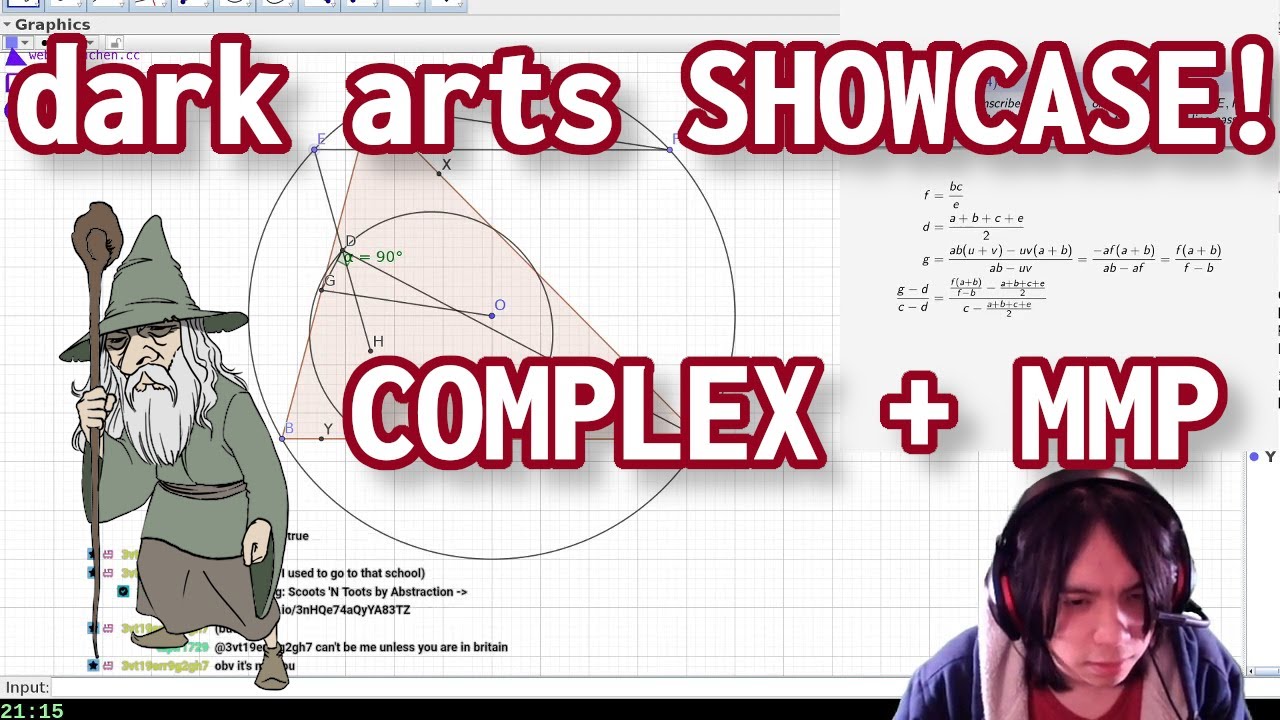
Why use synthetic methods when you can also solve the problem?
Broadcasted at https://www.twitch.tv/vEnhance (runs Fridays 8pm EST, schedule at https://web.evanchen.cc/videos.html).
Come join my students in watching me be dumb on camera, whether it's missing MathCounts questions, misreading shortlist geometry problems, forgetting a Spawning Poo...
What's that set up for geogebra? I don't have an input command line below like he does
wait got it
it was the classic version
The classic version is so much cooler
I'm gonna try hard at geometry, maybe I'll be around here often 🙂
maiden spire
silent plank
was there additional stuff indicating which sides/angles were corresponding
nope, that's all they gave me
silent plank
can you triple check.
90% of the time I ask this, some new piece of info pops up upon asking the third time
maiden spire
silent plank
can you triple check.
90% of the time I ask this, some new piece of info pops up...
that's all I got
 silent plank
i suppose you assume that the diagrams are reasonable scaled
 onyx cloud
i can't tell if lm coincides with tu or uv lol
silent plank
UV looks a bit longer than TU
onyx cloud
ah true


 maiden spire
I see
alright I'll try doing that
I'll ask my teacher for clarification as well
thanks for your help
zealous pivot
In geogebra, how can I hide the angle measurment of an angle
sullen kettle
zealous pivot
In geogebra, how can I hide the angle measurment of an angle
Right click on it and then settings and then find a checkbox called “show object”.
Also when you right click theres a menu and you can disable there
zealous pivot
I can check "show label". But I want that option disabled all the time by default, so I don't have to do it every time I draw an angle
sullen kettle
Geogebra can probably do that(it has a lot of features and docs and a forum) but I may lack this knowledge.
Sometimes I want to do custom or complicated things with it but I realize the time spent would lead to a marginal improvement so I try to focus instead and make compromises.
But if I find a way to do it, I’ll share it.
zealous pivot
In advanced settings, you can modify some aspects of angles (like change degrees to radians, etc). The option should be there I suppose, but didn't see it. I also tried googling, but couldn't find anything
smoky jetty
maiden spire
that's all I got
I'd assume they're right triangles, so, you'll find the value of side KM using the Pythagorean theorem, then, use the solution of a right triangle to find the angles. I've not really encountered such a problem before, but it's intriguing. Again, I'd assume after getting all the angles in Triangle KML, the values of the angles in Triangle VTU will be the same as in Triangle KML. Therefore, you'll have the appropriate values you'd require to find the other missing values of Triangle VTU (particularly the 2 sides)
take this with a grain of salt, as I relied on the word "similar triangles." Such a shame that I've not known the term when I self studied plane trigo, lmao
maiden spire
smoky jetty
I'd assume they're right triangles, so, you'll find the value of side KM using t...
Thank you very much
it's starting to click
like wow! I didn't know there was such a big gap between linear systems and trigo
maybe I just find trigo harder
silent plank
you shoulnd't be assuming right angles
you are not being asked for VT or KM
only TU
maiden spire
yes
smoky jetty
silent plank
you shoulnd't be assuming right angles
if thats the case, i honestly have no clue how to solve the upper triangle with only one given value, even if it's a right triangle
silent plank
the triangles were given to be similar
the issue was identifying which sides/angles were supposed to be corresponding
smoky jetty
but if they're right triangles and their angle values are similar, i think you'd need angles to find the value of side TU