#help-49
1 messages · Page 254 of 1
 midnight plankBOT
 last slate
anyone?
 fallow scarab
Read
midnight plankBOT
No need to ask “Can I ask…?” or “Does anyone know about…?”—it’s faster for everyone if you just ask your question!
last slate
must you reduce your matrix to REF in order to find the basis? Or can you just take the row vectors/column vectors as your basis?
 last slate
fallow scarab
Read
last slate
fallow scarab
Read
i know i went to screenshot the theorem
 blissful pier
as long as they are linearly independent
blissful pier
A = nxn matrix and you can rref to identity (which I assume is what you mean) then A is invertible and columns of A are linearly independent, so columns of A form a basis of Rn
last slate
blissful pier
A = nxn matrix and you can rref to identity (which I assume is what you mean) th...
so your safest bet is to do REF?
 gaunt imp
last slate
must you reduce your matrix to REF in order to find the basis? Or can you just t...
gaunt imp
last slate
must you reduce your matrix to REF in order to find the basis? Or can you just t...
The rows/columns of a matrix form a basis iff they're linearly independent
Which happens iff the determinant is non-zero
blissful pier
gaunt imp
The rows/columns of a matrix form a basis iff they're linearly independent
-# (and spans Rn)
gaunt imp
(if I remember correctly, this had to do with the definition of the determinant being a multilinear function with det(I)=1)
last slate
blissful pier
-# (and spans Rn)
you mean a subspace in R^n
gaunt imp
blissful pier
-# (and spans Rn)
Well, the guy was talking about an nxn matrix in R^n
If the rows/columns are linearly independent, they will always span R^n
gaunt imp
last slate
Btw im talking about any mxn matrices
Oh, that's different then
 gaunt imp
Well, if you have an mxk matrix within R^n, first, the rows/columns of the matrix won't be vectors of R^n
(unless you add 0s)
gaunt imp
last slate
Alright, I see now
Note that the dimension of your whole space changes depending on whether you take the row space or the column space to fit the choice of m/n
last slate
gaunt imp
Note that the dimension of your whole space changes depending on whether you tak...
yes
but now must you apply REF
to be safe
gaunt imp
last slate
must you reduce your matrix to REF in order to find the basis? Or can you just t...
And answering this directly, if your columns/rows are linearly independent, you can take them as they are
They will form a basis of the subspace regardless
When you need to apply REF is when they're not linearly independent
At least, if memory serves me right
last slate
gaunt imp
And answering this directly, if your columns/rows are linearly independent, you ...
Say i dont wanna spend time checking for linear dependency
can i just do REF for all cases
gaunt imp
last slate
can i just do REF for all cases
Fairly sure it would work, yeah
last slate
gaunt imp
Fairly sure it would work, yeah
i assume if there was dependency, ill have less rows/ columns after applying REF?
gaunt imp
last slate
i assume if there was dependency, ill have less rows/ columns after applying REF...
Iirc, you'd get a row/column of zeroes
last slate
gaunt imp
Iirc, you'd get a row/column of zeroes
yeah, but whys that?
what does REF do that’s special that reduces redundancy ?
gaunt imp
last slate
what does REF do that’s special that reduces redundancy ?
Because REF is essentially applying gaussian elimination
That is, it's trying to generate zeroes
last slate
gaunt imp
That is, it's *trying* to generate zeroes
yeah but
whats the relationship with linear independence
gaunt imp
last slate
whats the relationship with linear independence
If a set of vectors say V_k is linearly dependent then there exists some combination of coefficients such that the sum of all a_k(V_k)s is zero
This is an if and only if
Through REF, what you're trying to do is find as many zeroes as possible in the last row, if the biggest number of zeroes is all, that's what you'll get
midnight plankBOT
@last slate Has your question been resolved?
midnight plankBOT
Channel closed
Closed due to timeout
Use .reopen if this was a mistake.
 Available help channel!
Send your question here to claim the channel.
Remember:
• Ask your math question in a clear, concise manner.
• Show your work, and if possible, explain where you are stuck.
• Do not immediately ping people or roles. After 15 minutes, feel free to ping <@&286206848099549185> once.
• Type the command .close to free the channel when you're done.
• Be polite and have a nice day!
Read #❓how-to-get-help for further information on how to ask a good question, and about conduct in the question channels.
 twilit field
 midnight plankBOT
twilit field
twilit field
midnight plankBOT
twilit field
twilit field
$\mathcal{A}T=T^$. Let $v_1,v_2,\dots v_m$ be eigenvectors of $T^$ with $\lambda_1,\dots,\lambda_m$ being the corresponding eigenvalues.
\ Then $\mathcal{A} T(v_i)= \lambda_i v_i$.
 grand pondBOT
wai
 twilit field
I'm unsure if it's lambda_i or 1/lambda_i
 prime hornet
I'm not quite sure where you're going with this 
the eigenvalues of T* may have nothing to do with the eigenvalues of A at all
twilit field
mhm
prime hornet
you'll have better luck examining A on its own, without thinking of eigenvectors of T*
prime hornet
prime hornet
you'll have better luck examining A on its own, without thinking of eigenvectors...
(one word hint if you need it: ||composition||)
twilit field
prime hornet
(one word hint if you need it: ||composition||)
not sure how that helps
oh
prime hornet
twilit field
not sure how that helps
think about ||composing A with itself. what is this map?||
twilit field
prime hornet
think about ||composing A with itself. what is this map?||
A^*
prime hornet
twilit field
A^*
eh? how did you decide on that? 
twilit field
prime hornet
eh? how did you decide on that? <:kongouderp:483988392099446794>
oops
A^2
twilit field
I'm quite unsure
twilit field
$AT^=T^$
grand pondBOT
wai
 twilit field
it is just T*
twilit field
T

 twilit field
identity map
twilit field
prime hornet
can you take it from here?
all eigenvalues would be 1 , no( for A^2)
prime hornet
twilit field
all eigenvalues would be 1 , no( for A^2)
you're right, but we can use this to think about what the eigenvalues of A might be 
twilit field
1 again
prime hornet
hmm, 1 certainly works, but it's not gonna be the only possibility
if lambda's an eigenvalue for A and T is nonzero, we're gonna have AT = lambda T, and hence (spoilers ahead! don't click on it if you want to think about it more) ||A^2T = lambda^2 T. with T nonzero, we get lambda^2 = 1, so lambda = +- 1.||
twilit field
prime hornet
if lambda's an eigenvalue for A and T is nonzero, we're gonna have AT = lambda T...
Oops
Right
Got it
Thanks so. Much
prime hornet
ah, before you go
notice that I only gave a necessary condition on the eigenvalues of A
it's not necessarily the case that the eigenvalues are actually both values
A could have only one eigenvalue value, for example
but it does turn out that A has both; keywords: self-adjoint operator, skew-adjoint operator
midnight plankBOT
Channel closed
Closed by @twilit field
Use .reopen if this was a mistake.
prime hornet
midnight plankBOT
Available help channel!
Send your question here to claim the channel.
Remember:
• Ask your math question in a clear, concise manner.
• Show your work, and if possible, explain where you are stuck.
• Do not immediately ping people or roles. After 15 minutes, feel free to ping <@&286206848099549185> once.
• Type the command .close to free the channel when you're done.
• Be polite and have a nice day!
Read #❓how-to-get-help for further information on how to ask a good question, and about conduct in the question channels.
twilit field
 midnight plankBOT
twilit field
twilit field
midnight plankBOT
twilit field
twilit field
I think it is?
 solid iris
can u think of a very short proof?
twilit field
just chose eps=delta
 lavish venture
why even involve epsilons here
twilit field
🤦
lavish venture
do you know any theorems about continuous functions on compact sets?
lavish venture
ok but if it’s uni cts on [0, 1] and (0, 1) is a subset then surely this is fine?
 subtle blaze
Is this not even lipschitz continuous
twilit field
subtle blaze
Is this not even lipschitz continuous
no idea what that is
twilit field
lavish venture
ok but if it’s uni cts on [0, 1] and (0, 1) is a subset then surely this is fine...
yeah, silly me
subtle blaze
It bounds the derivative
twilit field
( We haven't done derivatives yet, so checks out)
solid iris
lavish venture
ok but if it’s uni cts on [0, 1] and (0, 1) is a subset then surely this is fine...
i was kinda hoping wai could say this instead
lavish venture
🤔
twilit field

I think this has the exact same answer
xsin(1/x) is cont on[0,1] and thus uniform cont too
twilit field
lavish venture
it’s not even defined at 0
you can define it to be 0.
the limit is def 0
lavish venture
ok but i don’t see h defining it to be 0
subtle blaze
twilit field
you can define it to be 0.
Just cos you can turn it into a continuous function doesn’t mean it is
Just cos I can turn ℚ into a complete field doesn’t mean ℚ is complete
solid iris
@lavish venture @subtle blaze try again
lavish venture
🤔
subtle blaze
Huh?
lavish venture
wut
mate it’s not even defined at 0
😭
i don’t see a piecewise definition here sir
solid iris
it has continuous extension as wai was probably thinking but didnt say fully
fallow scarab

Mathematics Stack Exchange
Prove $f(x)=x\sin(1/x)$ is uniformly continuous on $(0,1)$.
I have tried to use the definition to prove this. $|x-y|<\delta \Longrightarrow |f(x)-f(y)|<\epsilon $.
lavish venture
subtle blaze
0 isn’t even in the domain bro
no but wai asked if we can use the same argument?
lavish venture
twilit field
xsin(1/x) is cont on[0,1] and thus uniform cont too
^
fallow scarab
lavish venture
no but wai asked if we can use the same argument?
Oh yes the same argument doesn't work
subtle blaze
Ah
lavish venture
that’s what all of this was about lmao
fallow scarab
Only assuming the function is defined differently at 0
lavish venture
@solid iris try again
solid iris
so same solution except dont be scared of continuous extensions!
twilit field
solid iris
so same solution except dont be scared of continuous extensions!
lemme prove that result
if a continuous function can be continuously extended to a closed bounded interval it's uniformly continuous.
solid iris
its not a very deep statement
twilit field
yea, just give me ~2 minutes, a bit stressed rn
solid iris
upgrading continuity to uniform continuity comes for free on a compact set
fallow scarab
But I bet the proof is still tedious
solid iris
the other thing is uniform continuity on a set implies the same on any subset
midnight plankBOT
Channel closed
Closed by @twilit field
Use .reopen if this was a mistake.
solid iris
np!
midnight plankBOT
Available help channel!
Send your question here to claim the channel.
Remember:
• Ask your math question in a clear, concise manner.
• Show your work, and if possible, explain where you are stuck.
• Do not immediately ping people or roles. After 15 minutes, feel free to ping <@&286206848099549185> once.
• Type the command .close to free the channel when you're done.
• Be polite and have a nice day!
Read #❓how-to-get-help for further information on how to ask a good question, and about conduct in the question channels.
last slate
I need help
midnight plankBOT
last slate
I need help

 lyric charm
Nul(A) = Nul(B)
last slate
lyric charm
Nul(A) = Nul(B)
yeah idk how to get that
i dont even get the intuition its pissing me off i dont get what im doing with Ax=b
<@&286206848099549185>
 barren loom
https://en.wikipedia.org/wiki/Kernel_(linear_algebra)#Illustration has a worked example
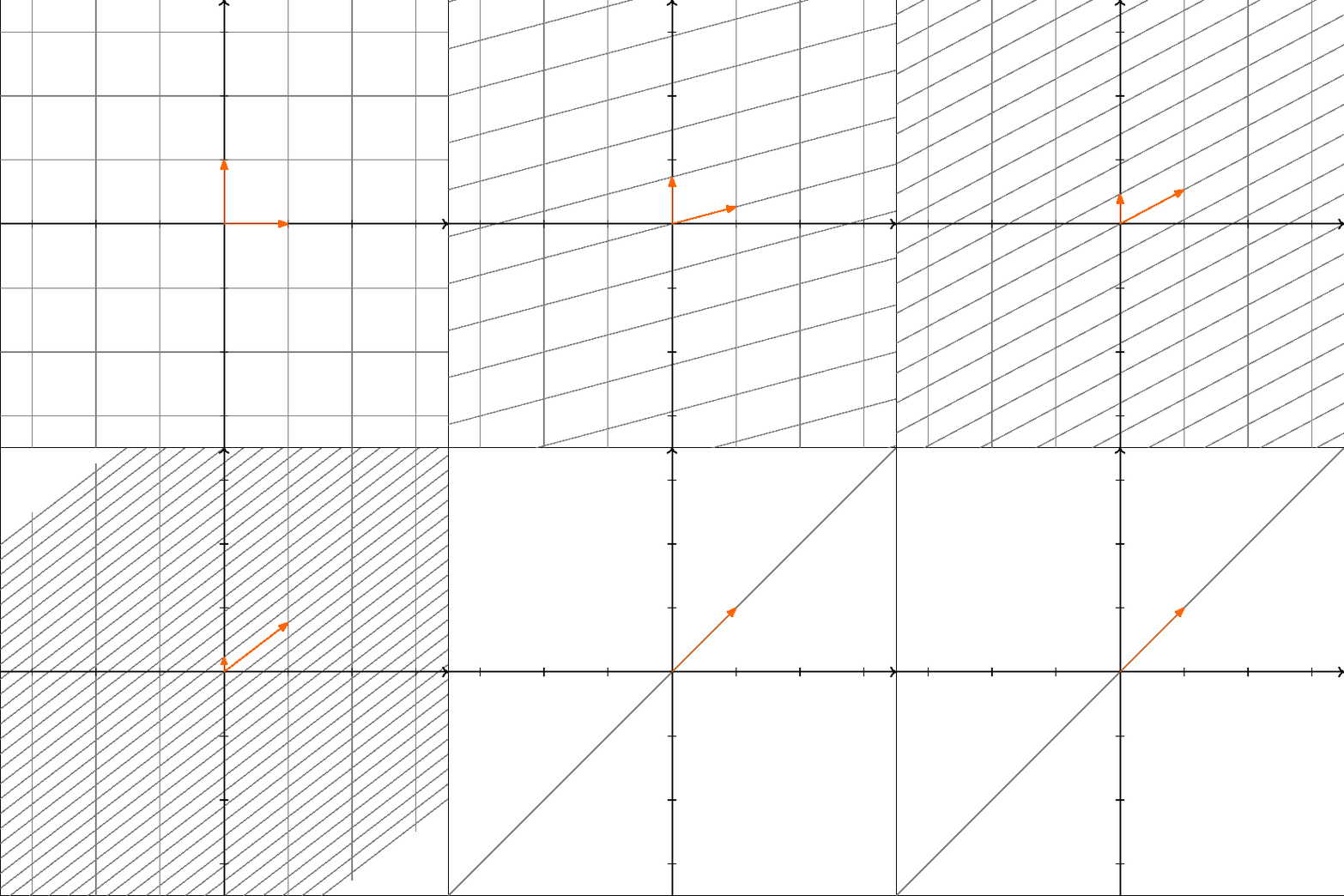
In mathematics, the kernel of a linear map, also known as the null space or nullspace, is the part of the domain which is mapped to the zero vector of the co-domain; the kernel is always a linear subspace of the domain. That is, given a linear map L : V → W between two vector spaces V and W, the kernel of L is the vector space of all elements ...
Here B has x=z, y=-z, so (1,-1,1)^t is in the null space as you can check by multiplying with A, col1-col2+col3=0
midnight plankBOT
@last slate Has your question been resolved?
midnight plankBOT
Channel closed
Closed due to timeout
Use .reopen if this was a mistake.
Available help channel!
Send your question here to claim the channel.
Remember:
• Ask your math question in a clear, concise manner.
• Show your work, and if possible, explain where you are stuck.
• Do not immediately ping people or roles. After 15 minutes, feel free to ping <@&286206848099549185> once.
• Type the command .close to free the channel when you're done.
• Be polite and have a nice day!
Read #❓how-to-get-help for further information on how to ask a good question, and about conduct in the question channels.
 shut canyon
 midnight plankBOT
shut canyon
shut canyon
midnight plankBOT
shut canyon
shut canyon

 proud violet
$T_2^n$ is composition n times right?
grand pondBOT
Beth
 proud violet
shut canyon
I think it is iteration, composition then
proud violet
shut canyon
I think it is iteration, composition then
You can do the first part right?
proud violet
shut canyon
f∘…∘f
Yes got it thanks
shut canyon
upside down parabola
proud violet
shut canyon
upside down parabola
Well,,, with a sharp point so kind of but not really
shut canyon
I'll try to draw it, I don't yet see what is going on
proud violet
When you apply the function twice it’s like making 2 tents across [0,1] and after that with another application 4 tents etc.
shut canyon
proud violet
When you apply the function twice it’s like making 2 tents across [0,1] and afte...

this is rx(1-x), r>4
I believe
so maybe similar?
proud violet
shut canyon
so maybe similar?
Ummm. It looks like a tent
This shape (of course with axes and that stuff)
 shut canyon
proud violet
This shape (of course with axes and that stuff)
shut canyon
proud violet
This shape (of course with axes and that stuff)

Thank you for your help @proud violet I'm grateful.
T^n can be drawn? infinite drawing?
proud violet
shut canyon
T^n can be drawn? infinite drawing?
Well, each T_2^n can be drawn as n is finite, but of course as n tends to infinity you can’t get an accuracy graph. I imagine it will look like a rectangle but still be a function
shut canyon
proud violet
Well, each T_2^n can be drawn as n is finite, but of course as n tends to infini...
Look, I visualise it like so
 shut canyon
proud violet
Well, each T_2^n can be drawn as n is finite, but of course as n tends to infini...
shut canyon
proud violet
Well, each T_2^n can be drawn as n is finite, but of course as n tends to infini...
do you know if phase portrait can show the periodic points? I don't yet know how to draw phase portrait
proud violet
shut canyon
do you know if phase portrait can show the periodic points? I don't yet know how...
I don’t know tbh
shut canyon
proud violet
I don’t know tbh
Use the graph of T^n to conclude T has exactly 2^n periodic points of period n.
I don't understand this just yet
proud violet
I’m sorry idk how to screenshot. But this is composing twice
shut canyon
how to conclude, with induction?
proud violet
shut canyon
Use the graph of T^n to conclude T has exactly 2^n periodic points of period n. ...
Try first to get a general expression for T_2^n (you can show it works by induction)
proud violet
shut canyon
how to conclude, with induction?
Yes
proud violet
shut canyon
But since it wants you to use the graph, you can also just use it
shut canyon
Oh, maybe not use the graph to conclude but reason algebraically also
proud violet
shut canyon
Oh, maybe not use the graph to conclude but reason algebraically also
It’s a good exercise to do this but it’s also a pain lol
There is lots of symmetry in the graph as you would expect
shut canyon
proud violet
There is lots of symmetry in the graph as you would expect
group theory?
it's like iterated reflection , mirror^n
proud violet
shut canyon
it's like iterated reflection , mirror^n
Yeah a little bit
I’m thinking that it’s taking the line [0, 1] and pitching a tent and is doing the same across split intervals with repeated application
shut canyon
proud violet
I’m thinking that it’s taking the line [0, 1] and pitching a tent and is doing t...
Nice analogy
⛺∘…∘⛺∘…∘⛺
⛺ : ⛺ + ⛺ ⟶ ⛺

 midnight plankBOT
@shut canyon Has your question been resolved?
shut canyon
let me try to write the proof
shut canyon
2-periodic means T₂(T₂(x)) = x and T₂(x) ≠ x.
x ≤ ½
→ T₂(x)=2·x
if 2x ≤ ½ → T₂(T₂(x))=4·x=x → x=0 ❌ (fixed)
- Case: x ≤ ½, so T₂(x) = 2·x
- Subcase: 2·x ≤ ½ → x ≤ ¼
- Then T₂(T₂(x)) = T₂(2·x) = 2·(2·x) = 4·x
- Solve 4·x = x → 4x - x = 0 → 3x = 0 → x = 0
T₂(0) = 0, it’s a fixed point, not 2-periodic.
if 2x > ½ → T₂(T₂(x))=2-4·x=x → 3x=2 → x=⅔ ✅
x > ½
→ T₂(x)=2-2·x
→ T₂(T₂(x))=x → x=⅓ ✅
2-periodic points = ⅓, ⅔
So the 2-cycle is x = 1/3 ↔ 2/3 🏓⛺
shut canyon
.close
midnight plankBOT
Channel closed
Closed by @shut canyon
Use .reopen if this was a mistake.
midnight plankBOT
Available help channel!
Send your question here to claim the channel.
Remember:
• Ask your math question in a clear, concise manner.
• Show your work, and if possible, explain where you are stuck.
• Do not immediately ping people or roles. After 15 minutes, feel free to ping <@&286206848099549185> once.
• Type the command .close to free the channel when you're done.
• Be polite and have a nice day!
Read #❓how-to-get-help for further information on how to ask a good question, and about conduct in the question channels.
 rough schooner
why you get squrt(10)/2?
 midnight plankBOT
rough schooner
why you get squrt(10)/2?
midnight plankBOT
rough schooner
why you get squrt(10)/2?
Please don't occupy multiple help channels.
 solar hearth
@rough schooner were you given cot A
solar hearth
rough schooner
why you get squrt(10)/2?
b=3a, so b^2=9a^2
a^2+b^2 = 10a^2=5^2=25
 grand flower
@rough schooner
 midnight plankBOT
@rough schooner Has your question been resolved?
 vagrant shoal
yo Can someone really cracked with maths and chill DM me please I need some help
midnight plankBOT
Channel closed
Closed due to timeout
Use .reopen if this was a mistake.
Available help channel!
Send your question here to claim the channel.
Remember:
• Ask your math question in a clear, concise manner.
• Show your work, and if possible, explain where you are stuck.
• Do not immediately ping people or roles. After 15 minutes, feel free to ping <@&286206848099549185> once.
• Type the command .close to free the channel when you're done.
• Be polite and have a nice day!
Read #❓how-to-get-help for further information on how to ask a good question, and about conduct in the question channels.
twilit field
show $\sqrt{x}$ is uniform continuous on $[0, \infty)$
grand pondBOT
wai
 midnight plankBOT
twilit field
show $\sqrt{x}$ is uniform continuous on $[0, \infty)$
twilit field
midnight plankBOT
twilit field
show $\sqrt{x}$ is uniform continuous on $[0, \infty)$
twilit field
so if eps is given we have $\frac{x-y}{\sqrt{x}+\sqrt{y}}< \varepsilon$
grand pondBOT
wai
 twilit field
the issue is x-y doesn't have to be less tha this , does it
 quiet hinge
I don't understand your concern
twilit field
quiet hinge
I don't understand your concern
my concern is , how does this allow me to chose delta
twilit field
how do I fix that
midnight plankBOT
@twilit field Has your question been resolved?
midnight plankBOT
Channel closed
Closed by @twilit field
Use .reopen if this was a mistake.
midnight plankBOT
Available help channel!
Send your question here to claim the channel.
Remember:
• Ask your math question in a clear, concise manner.
• Show your work, and if possible, explain where you are stuck.
• Do not immediately ping people or roles. After 15 minutes, feel free to ping <@&286206848099549185> once.
• Type the command .close to free the channel when you're done.
• Be polite and have a nice day!
Read #❓how-to-get-help for further information on how to ask a good question, and about conduct in the question channels.
 smoky briar
how do these type of functions usually work
 midnight plankBOT
smoky briar
how do these type of functions usually work
smoky briar
lyric charm
thats a piecewise function
midnight plankBOT
smoky briar
how do these type of functions usually work
smoky briar
lyric charm
thats a piecewise function
didn't know this existed in math? basically a small program lol
.solved
midnight plankBOT
Channel closed
Closed by @smoky briar
Use .reopen if this was a mistake.
midnight plankBOT
Available help channel!
Send your question here to claim the channel.
Remember:
• Ask your math question in a clear, concise manner.
• Show your work, and if possible, explain where you are stuck.
• Do not immediately ping people or roles. After 15 minutes, feel free to ping <@&286206848099549185> once.
• Type the command .close to free the channel when you're done.
• Be polite and have a nice day!
Read #❓how-to-get-help for further information on how to ask a good question, and about conduct in the question channels.
last slate
yo
midnight plankBOT
last slate
yo
last slate
whats a good way of figuring out how many vectors C) is

 sudden yacht
There are infinite vectors
 visual tiger
last slate
whats a good way of figuring out how many vectors C) is
visual tiger
last slate
whats a good way of figuring out how many vectors C) is
talking about dimension?
Dimension is the "degree of freedom" of a subspace
in how many independent directions can you go
Since you need two variables, s and t, to describe W, that should set you on the right track
To prove it more rigorously, you can rewrite W as Span(some list of vectors)
all you have to do is to check that the list you wrote is LI (linearly independent)
last slate
visual tiger
all you have to do is to check that the list you wrote is LI (linearly independe...
can you check for that intuitively
visual tiger
last slate
can you check for that intuitively
well, for example, t acts on the 2nd coordinate while s doesn't
so t is "independent" from s
in most cases, you'll have to check manually for linear independence
as soon as you get three variables to describe a subspace, it isn't as easy as "one isn't a multiple of the other"
last slate
visual tiger
well, for example, t acts on the 2nd coordinate while s doesn't
chat gpt split the coordinates into linear combination of 2 vectors is that a good way to do it?
visual tiger
last slate
chat gpt split the coordinates into linear combination of 2 vectors is that a go...
that's what I suggested
W = Span(......)
visual tiger
visual tiger
all you have to do is to check that the list you wrote is LI (linearly independe...
but then there's still this step
sudden yacht
Also, it might help writing that "general form" in the following fashion:
s(1, 0, 1, 2) + t(4, 1, 0, -1)
@last slate
This helps both find the generators and the dimension
last slate
sudden yacht
Also, it might help writing that "general form" in the following fashion:
s(1, ...
@visual tiger this is what you meant right
visual tiger
from this writing you can see W = Span((1,0,1,2), (4,1,0,-1))
last slate
visual tiger
from this writing you can see W = Span((1,0,1,2), (4,1,0,-1))
but by just looking at it is there a way to tell in which dimention the set is
 bold knoll
last slate
but by just looking at it is there a way to tell in which dimention the set is
bold knoll
last slate
but by just looking at it is there a way to tell in which dimention the set is
the dimension is the number of linearly independent vectors that span the set. You’ve found two linearly independent vectors that span the set, so the dimension is two
sudden yacht
last slate
but by just looking at it is there a way to tell in which dimention the set is
last slate
sudden yacht
https://discord.com/channels/268882317391429632/1018703621841494076/143751957162...
i mean is the whole idea how many variables there are?
can you not have 1 variable but have your set of vectors be linearly independent ?
fallow scarab
last slate
chat gpt split the coordinates into linear combination of 2 vectors is that a go...
Stop using chatgpt and read a real book
last slate
fallow scarab
Stop using chatgpt and read a real book
i am reading a real book 💀
just because i asked it for something once or twice doesnt mean im using it to learn
sudden yacht
last slate
can you not have 1 variable but have your set of vectors be linearly independent...
Sure, W = {(t, -2t, 3t, 0), for t real}
last slate
sudden yacht
Sure, W = {(t, -2t, 3t, 0), for t real}
yeah so it’s wrong to just see how many variables you have right?
im trying to imagine it geometrically
bold knoll
last slate
can you not have 1 variable but have your set of vectors be linearly independent...
What do you even mean by “variable” here?
sudden yacht
last slate
im trying to imagine it geometrically
You can't, because those vectors live in R⁴
last slate
sudden yacht
You can't, because those vectors live in R⁴
not this particularly
bold knoll
last slate
like t
No, it’s not sufficient to count the number of variables
sudden yacht
last slate
input
It's called parameter
bold knoll
You may miss linear dependence
of some of the vectors you find
you have to actually check that they are linearly independent
last slate
i mean in general, im trying to picture how the vectors would be graphed. It worked fine for me in part a
sudden yacht
sudden yacht
It's called parameter
I mean variable might be fine, bit honestly I never heard it in this context
last slate
bold knoll
No, it’s not sufficient to count the number of variables
I thought so too
bold knoll
last slate
i mean in general, im trying to picture how the vectors would be graphed. It wor...
You can’t picture 4 dimensional space, and you don’t need to. You just need to check the definition algebraically
last slate
the way im thinking of it is seeing how the vectors are drawn
last slate
bold knoll
You can’t picture 4 dimensional space, and you don’t need to. You just need to c...
yes but say its R^3
bold knoll
The human mind can only picture up to 3 spatial dimension, so you’re out of luck here
sudden yacht
last slate
yes but say its R^3
Then you're changing the exercise
last slate
sudden yacht
Then you're changing the exercise
im asking in general,
Is it better to imagine how the vectors are plotted then you would see in which span they live, or is it better to split it which I don’t fully understand
last slate
bold knoll
better to learn the general algebraic method
but I don’t fully understand how it relates to the original vector
sudden yacht
last slate
but I don’t fully understand how it relates to the original vector
Huh? Which original vector?
<@&268886789983436800>
last slate
sudden yacht
Huh? Which original vector?
like generally
the splitting part

can we do b
last slate
sudden yacht
t(5, -3, 1, 1)
But was t always meant to be a scalar?
or is it just the input like in (x,y)
thats what’s confusing me
is t the t axis or what
sudden yacht
last slate
But was t always meant to be a scalar?
Yeah of course. (It's also written in the definition of W)
sudden yacht
The same compared to what??
last slate
like when they say ℝ ^3 = { (x,y,z) : x,y,z ∈ ℝ }
see how similar it looks
x direction right, y direction left, and z up
you know
sudden yacht
Well, yeah, you can view it as 3 parameters giving you dimension 3
sudden yacht
Exactly
last slate
sudden yacht
Well, yeah, you can view it as 3 parameters giving you dimension 3
but x,y,z arent scalars right
sudden yacht
last slate
but x,y,z arent scalars right
Here #help-49 message you mean?
last slate
yes
they are just coordinates
right
isnt t also a coordinate like i dont get that
sudden yacht
last slate
but x,y,z arent scalars right
Of course they are, you've (correctly) written that x,y,z ∈ ℝ}
sudden yacht
last slate
isnt t also a coordinate like i dont get that
I don't know how you can visualise it as a coordinate
last slate
sudden yacht
I don't know how you can visualise it as a coordinate
can i restate my question?
say you have (x,y) you think of this as “go x a certain direction, then go y a certain direction “
similarly here i see the parameters as just going a certain direction

so I don’t understand the splitting part and treating t like its scaling some vector (5,-3,1,1)
get what i mean @sudden yacht
sudden yacht
last slate
get what i mean <@641337451826380809>
Yes and no 
sudden yacht
last slate
so I don’t understand the splitting part and treating t like its scaling some ve...
It's just to "extract" the said direction
Which is exactly the generator vector
last slate
sudden yacht
Yes and no <:cat_happycry:636407813144576010>
like how did you suddenly go from:
“Go 5t some direcrion, go -3t some direction, go t some direction, then t some other direction” to “thats just (5,-3,1,1) scaled by t
sudden yacht
Huh? I don't get your doubt
The direction is only one in this exercise!
And it's the vector (5, -3, 1, 1)
last slate
sudden yacht
The direction is only one in this exercise!
i think im over complicating it. For part C though, how do you know how to rewrite it
sudden yacht
Wdym how I know? 🤔 I just factor out the parameters, by using vector space properties
$$(s+4t,t,s,2s-t) = (s,0,s,2s) + (4t,t,0,-t) = s(1,0,1,2) + t(4, 1, 0, -1)$$
grand pondBOT
Alberto Z.
 lyric charm
last slate
chat gpt split the coordinates into linear combination of 2 vectors is that a go...
lyric charm
last slate
chat gpt split the coordinates into linear combination of 2 vectors is that a go...
!noai
midnight plankBOT
last slate
chat gpt split the coordinates into linear combination of 2 vectors is that a go...
Please do not trust ChatGPT or similar AI tools for mathematical tasks, as they often generate output which "sounds correct" but has numerous factual or logical errors. Use of these AI tools to answer other people's help questions is strictly against server rules (see #rules).
bold knoll
lyric charm
!noai
The fact this is so common that it needs its own dedicated shortcut to avoid having to write it every single time is very funny
midnight plankBOT
@last slate Has your question been resolved?
midnight plankBOT
Channel closed
Closed due to timeout
Use .reopen if this was a mistake.
midnight plankBOT
Available help channel!
Send your question here to claim the channel.
Remember:
• Ask your math question in a clear, concise manner.
• Show your work, and if possible, explain where you are stuck.
• Do not immediately ping people or roles. After 15 minutes, feel free to ping <@&286206848099549185> once.
• Type the command .close to free the channel when you're done.
• Be polite and have a nice day!
Read #❓how-to-get-help for further information on how to ask a good question, and about conduct in the question channels.
 small warren
Can I please get help with this question? I'm stuck at being unable to factor x^2+8x-593=16, I'm not sure how i got to 21 so i wasn't sure if i was right so i drew a diagram and multiplied and this is what i got.

 midnight plankBOT
small warren
Can I please get help with this question? I'm stuck at being unable to factor x^...
small warren
midnight plankBOT
small warren
Can I please get help with this question? I'm stuck at being unable to factor x^...
small warren
G is just a variable that i devised.
I think i'm supposed to solve this with the quadratic equation and take the positive value?
 fresh leaf
625 is the area of the painting right?
small warren
fresh leaf
625 is the area of the painting right?
Yes but that includes the frame
I believe the question is trying to find what value of x when multiplied by itself results in the length of the bare canvas.
fresh leaf
i hate worded questions ;d gimme a bit idm helping, but an official helper can take over not sure of the rules here
small warren
Ty same but i just watched a khan academy video that motivated me XD now i really enjoy questions like these
i hope i don't get spoiled the answer
Maybe with my own drawn diagram I can subtract 4 from each side to find just the x area? i don't know
The reason I added them both is because that is equivalent to the total area of the frame (625 cm^2)
i was thinking of then subtracting the area of the frame or something like that.
fresh leaf
so one side of the painting is (4+x+4)
small warren
Ignore everything other than the diagram and the stuff below it and on the top right, those are what i got, but the other stuff is doodles
small warren
fresh leaf
so one side of the painting is (4+x+4)
You're right!
I'm going to try that, 1 second
fresh leaf
so we have that one side is (x+8) that means the area will be (x+8)^2
small warren
fresh leaf
so we have that one side is (x+8) that means the area will be (x+8)^2
ooo
and square rooting both sides yields $(x+8)=+/-25$
grand pondBOT
🩷Aurora💜
 fresh leaf
im trying to find where you made the mistake
small warren
And we only care about the positive because it's a real life canvas
small warren
fresh leaf
im trying to find where you made the mistake
it's when i only added 4
instead of 4+4 to x
small warren
small warren
And we only care about the positive because it's a real life canvas
So the solution is -8 + 25
x=17?
fresh leaf
yes
small warren
Thanks!!! ❤️
can i get help with this too

apparently this is wrong
this is my work

 hallow mantle
small warren
can i get help with this too
hallow mantle
small warren
can i get help with this too
Did u complete the square
small warren
i'm so dumb i think it should be x-8 right?
small warren
hallow mantle
Did u complete the square
Yea i added half of b and squared it and added it to both sides, i think
hallow mantle
small warren
Yea i added half of b and squared it and added it to both sides, i think
Wait whats the question
Ill just do it
small warren
small warren
can i get help with this too
this
if i weren't lazy and wrote out my answer then i would've wrote x-8
because 64 squared is something totally different XD
i got 95%
 hallow mantle
Yep its 8
small warren
because of that silly mistake xd
small warren
hallow mantle
Yep its 8
Awesome
hallow mantle
 hallow mantle
small warren
i got 95%
hallow mantle
small warren
i got 95%
😭🙏
small warren
hallow mantle
😭🙏
is that good
hallow mantle
small warren
is that good
Its great
small warren
hallow mantle
Its great
Yayyy
small warren
hallow mantle
Cool!!
hallow mantle
What year are u in?
hallow mantle
I reccomend using a site called maths genie it has great exam questions
small warren
but im back in school
hallow mantle
small warren
i kinda dropped out
Rip
small warren
ye
small warren
hallow mantle
I reccomend using a site called maths genie it has great exam questions
Oooo so i can practice?
hallow mantle
hallow mantle
I reccomend using a site called maths genie it has great exam questions
Its got basic stuff like this + super hard question
small warren
hallow mantle
Its got basic stuff like this + super hard question
Oooooo
hallow mantle
small warren
Oooo so i can practice?
Yea they even have video tutorials
small warren
hallow mantle
Yea they even have video tutorials
Niceee
Thanks, maybe i'll remember it sometime
hallow mantle
Anyways cya
small warren
Cya thank u both for the help!!! ❤️
i wouldn't consider the earlier thing cheating because i just made a simple error in not adding another 4 to the quadratic equation
i was considering submitting the answer and if it were wrong and i wanted to know why i could try and examine
.close
midnight plankBOT
Channel closed
Closed by @small warren
Use .reopen if this was a mistake.
midnight plankBOT
Available help channel!
Send your question here to claim the channel.
Remember:
• Ask your math question in a clear, concise manner.
• Show your work, and if possible, explain where you are stuck.
• Do not immediately ping people or roles. After 15 minutes, feel free to ping <@&286206848099549185> once.
• Type the command .close to free the channel when you're done.
• Be polite and have a nice day!
Read #❓how-to-get-help for further information on how to ask a good question, and about conduct in the question channels.
 valid sinew
https://arxiv.org/pdf/2105.13098
Hi! I'm trying to undestand this algorithm
midnight plankBOT
valid sinew
https://arxiv.org/pdf/2105.13098
Hi! I'm trying to undestand this algorithm
valid sinew
On the 6th page, it explains the blocked part of the algorithm
 formal orchid
Bro is studying 50 years into the future 🙂↕️
valid sinew
 formal orchid
Let me take a look.
valid sinew
So I successfully wrote a non-blocked version of this algorithm which correctly tridiagonalizes the matrix:

However, right now I'm trying to write the blocked version, but I don't quite understand the mathematical notation used in the paper ...
So how are we supposed to combine multiple ak and ek vectors together and then multiply them? It's very confusing

Note: The same algorithm is also described here (perhaps simpler since it's the original): https://arxiv.org/pdf/1102.3440
So here for-example, I'm storing four rows ak and ek in separate matrices to perform operation on four rows/columns at once , what do I next? I'm also confused because in the non-blocked version we were doing the outer product of ak and ek vectors
 midnight plankBOT
@valid sinew Has your question been resolved?
midnight plankBOT
@valid sinew Has your question been resolved?
midnight plankBOT
@valid sinew Has your question been resolved?
midnight plankBOT
Channel closed
Closed due to timeout
Use .reopen if this was a mistake.
midnight plankBOT
Available help channel!
Send your question here to claim the channel.
Remember:
• Ask your math question in a clear, concise manner.
• Show your work, and if possible, explain where you are stuck.
• Do not immediately ping people or roles. After 15 minutes, feel free to ping <@&286206848099549185> once.
• Type the command .close to free the channel when you're done.
• Be polite and have a nice day!
Read #❓how-to-get-help for further information on how to ask a good question, and about conduct in the question channels.
 final wharf
What is derivative of complex number?
midnight plankBOT
final wharf
What is derivative of complex number?
 astral canyon
What's the derivative of a constant?
 orchid fossil
astral canyon
What's the derivative of a constant?
orchid fossil
astral canyon
What's the derivative of a constant?
0
astral canyon
Thank you mr/ms unrelated individual
midnight plankBOT
@final wharf Has your question been resolved?
midnight plankBOT
Channel closed
Closed due to timeout
Use .reopen if this was a mistake.
Available help channel!
Send your question here to claim the channel.
Remember:
• Ask your math question in a clear, concise manner.
• Show your work, and if possible, explain where you are stuck.
• Do not immediately ping people or roles. After 15 minutes, feel free to ping <@&286206848099549185> once.
• Type the command .close to free the channel when you're done.
• Be polite and have a nice day!
Read #❓how-to-get-help for further information on how to ask a good question, and about conduct in the question channels.
 severe grail
Hi, how is 7pi/6 not a solution?
 midnight plankBOT
severe grail
Hi, how is 7pi/6 not a solution?
midnight plankBOT
severe grail
Hi, how is 7pi/6 not a solution?
 toxic prism
severe grail
Hi, how is 7pi/6 not a solution?
toxic prism
severe grail
Hi, how is 7pi/6 not a solution?
pretty sure that's 1/sqrt(3)
midnight plankBOT
Channel closed
Closed by @severe grail
Use .reopen if this was a mistake.
midnight plankBOT
Available help channel!
Send your question here to claim the channel.
Remember:
• Ask your math question in a clear, concise manner.
• Show your work, and if possible, explain where you are stuck.
• Do not immediately ping people or roles. After 15 minutes, feel free to ping <@&286206848099549185> once.
• Type the command .close to free the channel when you're done.
• Be polite and have a nice day!
Read #❓how-to-get-help for further information on how to ask a good question, and about conduct in the question channels.
 inland patio
Consider a sequence of independent random variables with values in $[-\infty,\infty]$ and define $$Z:=\limsup_{n\to\infty}\frac1{n}(X_1+X_2+\cdots+X_n).$$Then this random variable is $\sigma(X_n:n\geq1)$-measurable. The claim is that also $$Z=\limsup_{n\to\infty}\frac1{n}(X_k+X_{k+1}+\cdots+X_n)$$for any $k\in\mathbb{N}$. Why is this true? First I would have said $$\frac{S_n^{(k)}}{n} = \frac{S_n - S_{k-1}}{n} = \frac{S_n}{n} - \frac{S_{k-1}}{n},$$ and $\frac{S_{k-1}}{n} \to 0$ as $n \to \infty$, so the limsups are equal. But I'm not sure about $\frac{S_{k-1}}{n} \to 0$.
midnight plankBOT
inland patio
Consider a sequence of independent random variables with values in $[-\infty,\in...
inland patio
.close
midnight plankBOT
Channel closed
Closed by @inland patio
Use .reopen if this was a mistake.
midnight plankBOT
Available help channel!
Send your question here to claim the channel.
Remember:
• Ask your math question in a clear, concise manner.
• Show your work, and if possible, explain where you are stuck.
• Do not immediately ping people or roles. After 15 minutes, feel free to ping <@&286206848099549185> once.
• Type the command .close to free the channel when you're done.
• Be polite and have a nice day!
Read #❓how-to-get-help for further information on how to ask a good question, and about conduct in the question channels.
 sinful torrent
Ok I feel stupid here
 midnight plankBOT
sinful torrent
Ok I feel stupid here
sinful torrent
midnight plankBOT
sinful torrent
Ok I feel stupid here
sinful torrent
IK the log is inverse to the normal equation
But I am unsure about how this relates to the gradiant
toxic prism
sinful torrent
IK the log is inverse to the normal equation
that's right
how does the transformation look like on a graph tho
sinful torrent
Ik what they are for a normal curve
+- b to move up and down
(x+-z) to move left or right
sinful torrent
Erm y = x is the diagonal the reflect
sinful torrent
I would suppose that they would have the same gradiant at the same x value?
toxic prism
not exactly
slopes at coresponding points are reciprocals
what I mean is, suppose f(x) has some point (x,y) on it with slope m
inverse f will have (y,x) on it with slope 1/m
sinful torrent
So slope of the inverse will be 1/m
toxic prism
on the corresponding point
sinful torrent
So if the rate of change at x is 2, the inverse will have 1/2 (at that specific point
toxic prism
sinful torrent
So if the rate of change at x is 2, the inverse will have 1/2 (at that specific ...
no, its not fixed based on x
sinful torrent
Its based off m, at x, no?
toxic prism
no
suppose f(x) has a point (x,y) on it, whats the reflection of that pt about the line y=x?
toxic prism
no
sinful torrent
1/xy?
sinful torrent
Well if its reflected on y = x, it would be shifted to the corresponsing coordinates on the other side of the divide
toxic prism
yes
and what would the coordinates be?
assume the blue one is (x,y), what's the coords on the black?
 toxic prism
yup
sinful torrent
If the orgigonal is at 8,12, the inverse would be at 12,8
toxic prism
for reflection abt y=x, yes
those kinda points are what I'm referring to as corresponding
so slope of f at x, will be equal to 1/(slope of f inverse at y)
sinful torrent
Ah, i see
toxic prism
you can prove this by taking $f[f^{-1}(x)]=x$ and differentiating using chain rule
grand pondBOT
donkey
 sinful torrent
So the tranformation is the switching of the x and y coordinates, and this allows us to find the gradient with 1/m
toxic prism
right
sinful torrent
and how can this transformation be used to find the
gradient of y = loge x at its x-intercept?
Well you derive it, no?
Itll be 1/x
What transformation maps y = lnx to y = ln(−x), and how can this transformation also be interpreted as a dilation?
Erm Well considering ln-x is just the negative of lnx
Its a simple flip
I dont see how that is a dilation
toxic prism
sinful torrent
and how can this transformation be used to find the
gradient of y = loge x at i...
you can find the differential of e^x at point (0,1) [because x intercept of lnx is (1,0)] and then take reciprocal
sinful torrent
sinful torrent
Itll be 1/x
.
toxic prism
sinful torrent
.
yeah that's how we usually do it
toxic prism
toxic prism
you can find the differential of e^x at point (0,1) [because x intercept of lnx ...
this one's js because they want you to use the transformation to find it
toxic prism
sinful torrent
I dont see how that is a dilation
scale factor -1
sinful torrent
Ah I see
toxic prism
I think we call those directed dilations
midnight plankBOT
Channel closed
Closed by @sinful torrent
Use .reopen if this was a mistake.
midnight plankBOT
Available help channel!
Send your question here to claim the channel.
Remember:
• Ask your math question in a clear, concise manner.
• Show your work, and if possible, explain where you are stuck.
• Do not immediately ping people or roles. After 15 minutes, feel free to ping <@&286206848099549185> once.
• Type the command .close to free the channel when you're done.
• Be polite and have a nice day!
Read #❓how-to-get-help for further information on how to ask a good question, and about conduct in the question channels.
shut canyon
What is the fixed point of cos(tan(x))=x?
midnight plankBOT
shut canyon
What is the fixed point of `cos(tan(x))=x`?
Please don't occupy multiple help channels.
shut canyon
.close
midnight plankBOT
Channel closed
Closed by @shut canyon
Use .reopen if this was a mistake.
midnight plankBOT
Available help channel!
Send your question here to claim the channel.
Remember:
• Ask your math question in a clear, concise manner.
• Show your work, and if possible, explain where you are stuck.
• Do not immediately ping people or roles. After 15 minutes, feel free to ping <@&286206848099549185> once.
• Type the command .close to free the channel when you're done.
• Be polite and have a nice day!
Read #❓how-to-get-help for further information on how to ask a good question, and about conduct in the question channels.
 ocean chasm
shut canyon
What is the fixed point of `cos(tan(x))=x`?
ocean chasm
shut canyon
What is the fixed point of `cos(tan(x))=x`?
well do u want the exact ans?
midnight plankBOT
ocean chasm
well do u want the exact ans?
ocean chasm
or the step to find the ans?
 runic hamlet
for most equations like this you will never be able to give an "exact" answer
ocean chasm
well i meant by the numerical approximate
runic hamlet
i.e. a "formula" maybe involving some roots and known constants
ocean chasm
.close
midnight plankBOT
Channel closed
Closed by @ocean chasm
Use .reopen if this was a mistake.
lyric charm
ocean chasm
well i meant by the numerical approximate
"approximate" and "exact" cannot coexist
ocean chasm
lyric charm
"approximate" and "exact" cannot coexist
ok
midnight plankBOT
Available help channel!
Send your question here to claim the channel.
Remember:
• Ask your math question in a clear, concise manner.
• Show your work, and if possible, explain where you are stuck.
• Do not immediately ping people or roles. After 15 minutes, feel free to ping <@&286206848099549185> once.
• Type the command .close to free the channel when you're done.
• Be polite and have a nice day!
Read #❓how-to-get-help for further information on how to ask a good question, and about conduct in the question channels.
 vernal field
how to find eqn of common transverse tangent between 2 circles which have a pt of contact
midnight plankBOT
vernal field
how to find eqn of common transverse tangent between 2 circles which have a pt o...
 gleaming latch
welp find the point of intersection first
vernal field
gleaming latch
welp find the point of intersection first
no there is some formula and it says S1-S2..
its in a video and its in ihindi
gleaming latch
!original
midnight plankBOT
Please show the original problem, exactly as it was stated to you, with the entire original context. A picture or screenshot is best. If the original problem is not in English, then post it anyway! The additional context might still be helpful. Do your best to provide a translation.
vernal field
gleaming latch
!original
can u understand hindi
gleaming latch
read bot
vernal field
@gleaming latch https://youtu.be/KEsOtGdiU88?si=Ob13LpYCBO7aIG8R 10:52.

𝐃𝐨𝐰𝐧𝐥𝐨𝐚𝐝 𝐀𝐓𝐏 𝐒𝐓𝐀𝗥 𝐀𝐩𝐩 𝐟𝐨𝐫 Unlimited free practice for IIT 𝐉𝐄𝐄
📱 𝐀𝐓𝐏 𝐒𝐓𝐀𝗥 𝗔𝗽𝗽 𝗗𝗼𝘄𝗻𝗹𝗼𝗮𝗱 𝗟𝗶𝗻𝗸: https://bit.ly/39GJeRi
📞𝐅𝐨𝐫 𝐂𝐨𝐦𝐩𝐥𝐞𝐭𝐞 𝐂𝐨𝐮𝐫𝐬𝐞𝐬, 𝐜𝐨...
gleaming latch
whats th emath problem
 modern sapphire
vernal field
<@508442553754845184> https://youtu.be/KEsOtGdiU88?si=Ob13LpYCBO7aIG8R 10:52.
modern sapphire
vernal field
<@508442553754845184> https://youtu.be/KEsOtGdiU88?si=Ob13LpYCBO7aIG8R 10:52.
the situation is like this
 vernal field
modern sapphire
the situation is like this
vernal field
modern sapphire
the situation is like this
yes
vernal field
what is S1 and S2
modern sapphire
those are the circles
vernal field
do we sub the common intersection points in eqn of circle 1 and 2
burh
ok then i got it
another doubt
modern sapphire
this expression is called s1

coz that is equal to 0 in the equation of the circle
vernal field
@10:57 he gives another eqn.. what is that for
vernal field
modern sapphire
this expression is called s1
ohhh we find out common pt
modern sapphire
vernal field
ohhh we find out common pt
what? no, you dont find anything
s1 is directly the equation of the circle taken as is
 zealous schooner
(with 1 as the coefficients for x^2 and y^2)
modern sapphire
your general form of equation is x^2 + y^2 - 2fx - 2gy + c = 0
then x^2 + y^2 - 2fx - 2gy + c this part is called S
modern sapphire
vernal field
@10:57 he gives another eqn.. what is that for
I think he is telling the condition for the circles to intersect. C1 and C2 seem to be the centers of the two circles, so C1C2 is the segment that connects them, and its used there as the length of that segment aka the distance between centers
Also, that seems to be a crashcourse
if you have no clue whats going on in there, thats a sign that you should take a full length course to understand the stuff
midnight plankBOT
@vernal field Has your question been resolved?
midnight plankBOT
Channel closed
Closed due to timeout
Use .reopen if this was a mistake.
Available help channel!
Send your question here to claim the channel.
Remember:
• Ask your math question in a clear, concise manner.
• Show your work, and if possible, explain where you are stuck.
• Do not immediately ping people or roles. After 15 minutes, feel free to ping <@&286206848099549185> once.
• Type the command .close to free the channel when you're done.
• Be polite and have a nice day!
Read #❓how-to-get-help for further information on how to ask a good question, and about conduct in the question channels.
vernal field
modern sapphire
if you have no clue whats going on in there, thats a sign that you should take a...
idk hindi ✅
but i do understand now
midnight plankBOT
vernal field
idk hindi ✅
but i do understand now
 dapper scarab
vernal field
idk hindi ✅
but i do understand now
dapper scarab
vernal field
idk hindi ✅
but i do understand now
would you mind .close
the channel opened because you responded lol
 rain wasp
vernal field
idk hindi ✅
but i do understand now
rain wasp
vernal field
idk hindi ✅
but i do understand now
do you have any further questions?
 pearl hull
.solved 👍
midnight plankBOT
Channel closed
Closed by @pearl hull
Use .reopen if this was a mistake.
pearl hull
vernal field
idk hindi ✅
but i do understand now
Have a good one 🧡
midnight plankBOT
Available help channel!
Send your question here to claim the channel.
Remember:
• Ask your math question in a clear, concise manner.
• Show your work, and if possible, explain where you are stuck.
• Do not immediately ping people or roles. After 15 minutes, feel free to ping <@&286206848099549185> once.
• Type the command .close to free the channel when you're done.
• Be polite and have a nice day!
Read #❓how-to-get-help for further information on how to ask a good question, and about conduct in the question channels.
twilit field
kind of confused here
 midnight plankBOT
twilit field
kind of confused here
midnight plankBOT
midnight plankBOT
twilit field
kind of confused here
midnight plankBOT
Channel closed
Closed by @twilit field
Use .reopen if this was a mistake.
Available help channel!
Send your question here to claim the channel.
Remember:
• Ask your math question in a clear, concise manner.
• Show your work, and if possible, explain where you are stuck.
• Do not immediately ping people or roles. After 15 minutes, feel free to ping <@&286206848099549185> once.
• Type the command .close to free the channel when you're done.
• Be polite and have a nice day!
Read #❓how-to-get-help for further information on how to ask a good question, and about conduct in the question channels.
 edgy crater
have i gone wrong somewhere, especially the last case where n = 2 (mod 3), since wouldn't i have to show that 4 divides n-1, which i dont think works? like if n was 11, n-1 is 10 which isnt divisible by 4
 midnight plankBOT
edgy crater
have i gone wrong somewhere, especially the last case where n = 2 (mod 3), since...
edgy crater
midnight plankBOT
edgy crater
have i gone wrong somewhere, especially the last case where n = 2 (mod 3), since...
edgy crater
question is show 12 | n^4 - n^2 for all positive integers n
fallow scarab
Factor n^4-n^2
edgy crater
n^2(n+1)(n-1)?
 naive bridge
why is n odd in the last case?
or does the problem arise when u consider the case that n is odd
edgy crater
i thought if something = 2 (mod 3) then its odd
naive bridge
however you still have to deal with this case
would you like a hint or you wanna try a little more
 midnight plankBOT
Channel closed
Closed by @edgy crater
Use .reopen if this was a mistake.
midnight plankBOT
Available help channel!
Send your question here to claim the channel.
Remember:
• Ask your math question in a clear, concise manner.
• Show your work, and if possible, explain where you are stuck.
• Do not immediately ping people or roles. After 15 minutes, feel free to ping <@&286206848099549185> once.
• Type the command .close to free the channel when you're done.
• Be polite and have a nice day!
Read #❓how-to-get-help for further information on how to ask a good question, and about conduct in the question channels.
 trim sun
What am i supposed to do if the second graph doesn’t have exact points

 near cliff
trim sun
What am i supposed to do if the second graph doesn’t have exact points
near cliff
trim sun
What am i supposed to do if the second graph doesn’t have exact points
quotient rule?
 graceful drum
take them as 0.5s
trim sun
I did that for h(3) but then how do i find the equation of the line to do the prime
Or slope or whatever
graceful drum
trim sun
I did that for h(3) but then how do i find the equation of the line to do the pr...
do you know the formula for slope of a line?
trim sun
Y=mx+b?
graceful drum
well i meant the formula from a slope using two points on the line
trim sun
Y-y1=m(x-x1)?
graceful drum
well thats the equation for a line given the slope and a point
trim sun
😭
graceful drum
i mean $m = \frac{y_2-y_1}{x_2-x_1}$
grand pondBOT
CherryMan
 trim sun
Ohhhh yeah
graceful drum
so we can calculate this from the graph right
trim sun
I just choose any 2 points right
trim sun
Ok
graceful drum
(btw the slope is only constant for a line)

 graceful drum
nice
trim sun
.close
midnight plankBOT
Channel closed
Closed by @trim sun
Use .reopen if this was a mistake.
midnight plankBOT
Available help channel!
Send your question here to claim the channel.
Remember:
• Ask your math question in a clear, concise manner.
• Show your work, and if possible, explain where you are stuck.
• Do not immediately ping people or roles. After 15 minutes, feel free to ping <@&286206848099549185> once.
• Type the command .close to free the channel when you're done.
• Be polite and have a nice day!
Read #❓how-to-get-help for further information on how to ask a good question, and about conduct in the question channels.
 lyric scroll
does anyone know what u type in ur calculator
 midnight plankBOT
lyric scroll
does anyone know what u type in ur calculator
midnight plankBOT
lyric scroll
does anyone know what u type in ur calculator
 umbral timber
that translates to : \ \
$\frac{50!}{(41!)\cdot((50-41))!}$
lyric scroll
like all u need is the 3 variables
grand pondBOT
T&C
 umbral timber
 lyric scroll
umbral timber
lyric scroll
umbral timber
yeah
also can u help with another thing
or should i create a new channel
umbral timber
i was told you should always create a new channel for a different problem
midnight plankBOT
Channel closed
Closed by @lyric scroll
Use .reopen if this was a mistake.
midnight plankBOT
Available help channel!
Send your question here to claim the channel.
Remember:
• Ask your math question in a clear, concise manner.
• Show your work, and if possible, explain where you are stuck.
• Do not immediately ping people or roles. After 15 minutes, feel free to ping <@&286206848099549185> once.
• Type the command .close to free the channel when you're done.
• Be polite and have a nice day!
Read #❓how-to-get-help for further information on how to ask a good question, and about conduct in the question channels.
 jaunty oriole
Hello , i want to start learning math olympiad problems solving and i have only med school experience , from where i can start and with what .
I am in 8th grade
Thanks.
midnight plankBOT
jaunty oriole
Hello , i want to start learning math olympiad problems solving and i have only ...
umbral timber
The book Mathematical Circles is a great start id say but these questions are better for #discussion #competition-math
jaunty oriole
umbral timber
The book Mathematical Circles is a great start id say but these questions are be...
Ok , thx
jaunty oriole
umbral timber
The book Mathematical Circles is a great start id say but these questions are be...
But i see that this book is a little bit hard to understand
Someone says igcse book , is it good.
 floral apex
@jaunty oriole always good to get exposure to problems
if you're just trying to get into competition math I'd suggest AOPS
they have courses and books, but their free resources are pretty helpful too if you're just getting started
jaunty oriole
floral apex
they have courses and books, but their free resources are pretty helpful too if ...
Ok , i will , thanks 🙏
Is igcse book good
Please
Please
midnight plankBOT
@jaunty oriole Has your question been resolved?
 fallen sparrow
jaunty oriole
Is igcse book good
fallen sparrow
jaunty oriole
Is igcse book good
Id say yes
But Igcse will only get you si far
Aops i think is a step further
Depending on how basic ur math is, i'd suggest starting with the igcse book
If you feel thats easy
You can move on with aops but start the questions order wise
Since the difficulty is aimed likewise
midnight plankBOT
@jaunty oriole Has your question been resolved?
 undone yacht
jaunty oriole
Is igcse book good
undone yacht
jaunty oriole
Is igcse book good
Yes
Its a good way to start also try looking for edexcel igcse , i recommend it more
Cambridge mostly starting to depend on non calculators exam
midnight plankBOT
Channel closed
Closed due to timeout
Use .reopen if this was a mistake.
midnight plankBOT
Available help channel!
Send your question here to claim the channel.
Remember:
• Ask your math question in a clear, concise manner.
• Show your work, and if possible, explain where you are stuck.
• Do not immediately ping people or roles. After 15 minutes, feel free to ping <@&286206848099549185> once.
• Type the command .close to free the channel when you're done.
• Be polite and have a nice day!
Read #❓how-to-get-help for further information on how to ask a good question, and about conduct in the question channels.
 onyx tide
Isn’t this perfect? 🤩
midnight plankBOT
onyx tide
Isn’t this perfect? 🤩
onyx tide
y = -x^2 + 4
 onyx tide
Just calculate everything
 junior wedge
onyx tide
Isn’t this perfect? 🤩
junior wedge
onyx tide
Isn’t this perfect? 🤩
also would be more perfect if there were dots at (-2, 0) and (2, 0)
midnight plankBOT
Channel closed
Closed by @onyx tide
Use .reopen if this was a mistake.
midnight plankBOT
Available help channel!
Send your question here to claim the channel.
Remember:
• Ask your math question in a clear, concise manner.
• Show your work, and if possible, explain where you are stuck.
• Do not immediately ping people or roles. After 15 minutes, feel free to ping <@&286206848099549185> once.
• Type the command .close to free the channel when you're done.
• Be polite and have a nice day!
Read #❓how-to-get-help for further information on how to ask a good question, and about conduct in the question channels.
onyx tide
Can i find x1 and x2 from f(x) = a(x-0p)^2?
midnight plankBOT
onyx tide
Can i find x1 and x2 from f(x) = a(x-0p)^2?
subtle blaze
Do you have more context
onyx tide
So I need to draw parabola from y = -2x^2 + 3x + 2
subtle blaze
And what have you tried
subtle blaze
Quadratic formula?
onyx tide
(x,x)
onyx tide
subtle blaze
Quadratic formula?
Yea but can i use something different
onyx tide
Can I use canonical form of quadratic formula?
subtle blaze
What’s that
onyx tide
subtle blaze
Wdym skipping d
I want to solve it
Without doing d
Is it possible
Like i need to find x1 and x2
So i know where the lines will cross on x-axis
midnight plankBOT
@onyx tide Has your question been resolved?
Channel closed
Closed by @onyx tide
Use .reopen if this was a mistake.
Available help channel!
Send your question here to claim the channel.
Remember:
• Ask your math question in a clear, concise manner.
• Show your work, and if possible, explain where you are stuck.
• Do not immediately ping people or roles. After 15 minutes, feel free to ping <@&286206848099549185> once.
• Type the command .close to free the channel when you're done.
• Be polite and have a nice day!
Read #❓how-to-get-help for further information on how to ask a good question, and about conduct in the question channels.
 tawdry slate
 midnight plankBOT
tawdry slate
tawdry slate
midnight plankBOT
tawdry slate
tawdry slate
Help pls
I don't know how you get the height of the triangle
or how to do the question in general
The answer
 midnight plankBOT
Channel closed
Closed by @tawdry slate
Use .reopen if this was a mistake.
tawdry slate
.reopen
midnight plankBOT
✅ Original question: #help-49 message
tawdry slate
sry mate
What were you going to say?
anyway I'll do a youtube in the mean time, if anyone can help me here I'll leave the channel open
tawdry slate
 strong leaf
How do u get the height
strong leaf
How do u get the height
I've got the same issue mate
I've got no clue on how you get the height
strong leaf
What class is this
tawdry slate
This is NZ level 3 statistics
strong leaf
Interesting
tawdry slate

Worked solutions for the Probability Distributions paper from 2020. This video was made before Mark Scheme was available, so if you find mistakes, leave a comment below and I will add edits to the video description with details of the corrections!
Corrections:
10:45 Q 2 b i error on calculator input, the answer should be 0.2365
Update: In some ...
I've found this, the question is at 16:34
strong leaf
Probably something related to being a cdf function
Oh idk bro I did not go this deep it into stats
strong leaf
Why 2 tho
tawdry slate
strong leaf
Why 2 tho
I dunno, its the done thing
the formula for working out the height
strong leaf
Shouldn’t the height just be .7
tawdry slate
I've worked it out, the answer is 1/3
 quaint creek
tawdry slate
The answer
quaint creek
tawdry slate
The answer
my initial instinct is that the area of the triangle should be 1 because that covers all of the probability
tawdry slate
tawdry slate
h = 2/b-a
this is the code to crack the question
quaint creek
I've never learned this stuff before sorry
tawdry slate
quaint creek
my initial instinct is that the area of the triangle should be 1 because that co...
that's correct
the whole thing is 1
quaint creek
ah oaky
so the base multiplied by the height
divided by 2
will be 1
and we know that it occurs most often at 130
so we figure out the height and draw it at 130
strong leaf
Yea that makes sense but the height weird
quaint creek
and then you calculate
wtv is to the left of 130
so its 10 x 0.6666 / 2
so like 33.3?
1/3 chance
strong leaf
Oh I get it
Area = 1/2 bh
H = 2* area/b
area/b = 1/30
@tawdry slate
Area is assumed to be 1
And the Base of the triangle is 150-120 =30
Plug it in and it gets height
midnight plankBOT
Channel closed
Closed by @tawdry slate
Use .reopen if this was a mistake.
midnight plankBOT
Available help channel!
Send your question here to claim the channel.
Remember:
• Ask your math question in a clear, concise manner.
• Show your work, and if possible, explain where you are stuck.
• Do not immediately ping people or roles. After 15 minutes, feel free to ping <@&286206848099549185> once.
• Type the command .close to free the channel when you're done.
• Be polite and have a nice day!
Read #❓how-to-get-help for further information on how to ask a good question, and about conduct in the question channels.
 narrow gull
 midnight plankBOT
narrow gull
quaint creek
midnight plankBOT
narrow gull
quaint creek
hey
narrow gull
hey wassup
narrow gull
I can zoom it in if that helps?
quaint creek
so we want to find the value of g(3) first dont we?
quaint creek
narrow gull
I can zoom it in if that helps?
no, its fine
narrow gull
quaint creek
no, its fine
you sure?
quaint creek
ye I can see it
narrow gull
quaint creek
so we want to find the value of g(3) first dont we?
yeah
quaint creek
dw
quaint creek
narrow gull
yeah
do you know how to find that
quaint creek
so
in this case, y = f(x)
since its a graph
so by plugging in x into the function f(x), you get a y value
so when we plug in the x-value 3 into the function g(x), what value of y do we obtain?
narrow gull
-1/2
quaint creek
when we zoom in

you can see that when the x-value is 3
or the third dashed line
the y value is the point on the third dashed line
so what's the y value, or the vertical value of that point
narrow gull
oh i though it was that because of the neg 2
 quaint creek
ye
but its clear it goes down in intervals of -0.5
so that point is gonna have a y value, or g(3) = -1.5
so now, we solved f(g(3)) into f(-1.5), since g(3) = -1.5
so now we solve f(-1.5)
quaint creek
yeh thats why the question is kinda ass
but -1.5 is in the middle of the two dashed lines, so

actually wait
notice that the blue line goes from -5 to 10

(1, -5) to (-2, 10)
narrow gull
oh so I would use the midpoint formula?
quaint creek
well yeah I guess
if you learned it
so we get 2.5 for the y value
so the first question f(g(3)) = 2.5
try the second one yourself lmk if any help needed
narrow gull
okay thanks!
quaint creek
should be alot more straightforward than this one
narrow gull
I got -1/2 but it is saying it is not right
narrow gull
I got 3
quaint creek
yes
quaint creek
narrow gull
I got 3
so since f(2) is 3, what is g(3)
(we already did this in the previous question)
 quaint creek
.
we did g(3) in the previous question
so basically what is the y-value of the dot

at an x-value of 3, so the third dashed line
narrow gull
0hh mbmb
quaint creek
yeh
narrow gull
-1 1/2
quaint creek
yeah, so simplified to -3/2
midnight plankBOT
Channel closed
Closed by @narrow gull
Use .reopen if this was a mistake.
quaint creek
you too
midnight plankBOT
Available help channel!
Send your question here to claim the channel.
Remember:
• Ask your math question in a clear, concise manner.
• Show your work, and if possible, explain where you are stuck.
• Do not immediately ping people or roles. After 15 minutes, feel free to ping <@&286206848099549185> once.
• Type the command .close to free the channel when you're done.
• Be polite and have a nice day!
Read #❓how-to-get-help for further information on how to ask a good question, and about conduct in the question channels.
 lone dock
my answer was (6 - root 3)/ 40
im not sure if it was correct tho...

 subtle zinc
eh
lone dock
i assumed a and all of those are squares
cant find the solution anywhere so super confused TwT
should i send what approach i used?
graceful drum
sure
astral canyon
Let the smallest square be of side length 1, then the side length of the medium square will be sqrt2 You now have a triangle with two known lengths (1 and sqrt2), and one known contained angle (135). That's how I would start.

 modern sapphire
I am getting a pretty nice answer ||1/10||
lone dock
modern sapphire
I am getting a pretty nice answer ||1/10||
can u please tell me ur approach?
modern sapphire
I made this figure from the two squares. Let the blue line to be 1

so small square has side sqrt2, middle one has side as 2
red side, which is side of big square is thus sqrt10
now area of the highlighted part of the figure would be 0.5 * sqrt2 * 2 * sin(135) = 1
so ratio 1/(sqrt10)^2 = 1/10
lone dock
modern sapphire
red side, which is side of big square is thus sqrt10
i didnt get this, how that sqrt 10?
 midnight plankBOT
Channel closed
Closed by @lone dock
Use .reopen if this was a mistake.
midnight plankBOT
Available help channel!
Send your question here to claim the channel.
Remember:
• Ask your math question in a clear, concise manner.
• Show your work, and if possible, explain where you are stuck.
• Do not immediately ping people or roles. After 15 minutes, feel free to ping <@&286206848099549185> once.
• Type the command .close to free the channel when you're done.
• Be polite and have a nice day!
Read #❓how-to-get-help for further information on how to ask a good question, and about conduct in the question channels.
edgy crater
bit stuck on part (iii), i tried using the recurrance relation at the start, asserting that x_n+2 = kx_n+1 (1-x_n+1), then subbing in x_n+1 in terms of x_n into the relation, then setting both x_n+2 and x_n as equal to a, but when i expand it out etc it does't match the "show that part"
 midnight plankBOT
edgy crater
bit stuck on part (iii), i tried using the recurrance relation at the start, ass...
midnight plankBOT
edgy crater
bit stuck on part (iii), i tried using the recurrance relation at the start, ass...
@edgy crater Has your question been resolved?
 frail carbon
edgy crater
bit stuck on part (iii), i tried using the recurrance relation at the start, ass...
frail carbon
edgy crater
bit stuck on part (iii), i tried using the recurrance relation at the start, ass...
show work
 latent wadi
 dense heart
I think I have solved the collatz conjecture
dense heart
I think I have solved the collatz conjecture
You can go to #math-discussion, this is a help channel
edgy crater
.close
midnight plankBOT
Channel closed
Closed by @edgy crater
Use .reopen if this was a mistake.
midnight plankBOT
Available help channel!
Send your question here to claim the channel.
Remember:
• Ask your math question in a clear, concise manner.
• Show your work, and if possible, explain where you are stuck.
• Do not immediately ping people or roles. After 15 minutes, feel free to ping <@&286206848099549185> once.
• Type the command .close to free the channel when you're done.
• Be polite and have a nice day!
Read #❓how-to-get-help for further information on how to ask a good question, and about conduct in the question channels.
small warren
Can I get help with this transformation question? these are the options, I chose option c because i know that when the value of the output is multiplied with a negative number that the graph is reflected over the x-axis, and that because it's multiplied by 2 that it's going to become closer to the y axis because each value will get bigger, I eliminated options B and A because their asymptotes don't match the expected inversion of the graph that should be at y=2.


 midnight plankBOT
small warren
Can I get help with this transformation question? these are the options, I chose...
midnight plankBOT
small warren
Can I get help with this transformation question? these are the options, I chose...
 thorn sorrel
the -2 just means that all the y values of the function will be muktipled by -2
what is one known y value on your original function
small warren
thorn sorrel
what is one known y value on your original function
0, -1
rain wasp
small warren
Can I get help with this transformation question? these are the options, I chose...
what c does is just moving everything rightwards
thorn sorrel
small warren
0, -1
so what will the transformed coordinates be
small warren
thorn sorrel
so what will the transformed coordinates be
0, 2?
small warren
rain wasp
what c does is just moving everything rightwards
i dont see that
small warren
Option b?
thorn sorrel
yup
small warren
i was under the impression that it wouldn't change the asymptote that much but just its values
the original asymptote approaches the value of -2
thanks a lot!!!!
.close
midnight plankBOT
Channel closed
Closed by @small warren
Use .reopen if this was a mistake.
midnight plankBOT
Available help channel!
Send your question here to claim the channel.
Remember:
• Ask your math question in a clear, concise manner.
• Show your work, and if possible, explain where you are stuck.
• Do not immediately ping people or roles. After 15 minutes, feel free to ping <@&286206848099549185> once.
• Type the command .close to free the channel when you're done.
• Be polite and have a nice day!
Read #❓how-to-get-help for further information on how to ask a good question, and about conduct in the question channels.
twilit field
 midnight plankBOT
twilit field
twilit field
midnight plankBOT
twilit field
twilit field
any element of order 9 in Z_9 must be co-prime to 9
so there are 6 such elements in Z_9
the element of Z_3 must have order 1 or 3
so 2
so 12 such elements exist
runic hamlet
which element of Z_3 does not work?
runic hamlet
twilit field
any element of order 9 in Z_9 must be co-prime to 9
why do you only care about those elements?
twilit field
runic hamlet
why do you only care about those elements?
I need the order ot be 9 or 3
runic hamlet
then why did you exclude 3?
twilit field
I didn't realise then