#internals-and-peps
1 messages · Page 157 of 1
 rose schooner
 raven ridge
Yes, but not just that. It contains details about how most of the major components of the interpreter work, because contributors need to know that before they can start making contributions that touch those components
https://devguide.python.org/garbage_collector/ gives more detail than you could ever want to know about how the garbage collector works, for instance
 fierce sleet
It's sad there are no lectures online that I could watch... In any case, thanks for the advice 🙂
 spark magnet
now I'm curious what kinds of questions wouldn't be appropriate in a public chat....
rose schooner
spark magnet
now I'm curious what kinds of questions wouldn't be appropriate in a public chat...
like asking for a copy of a paid book
spark magnet
i see....
fierce sleet
spark magnet
now I'm curious what kinds of questions wouldn't be appropriate in a public chat...

 surreal sun
rose schooner
like asking for a copy of a paid book
surreal sun
rose schooner
like asking for a copy of a paid book
i mean there's a shortened but still helpful realpython that pulls excerpts from the actual book
.realpython python internals
 neon troutBOT
Here are the top 5 results:
CPython Internals: Paperback Now Available!
CPython Internals Book
Memory Management in Python
Python Descriptors: An Introduction
Python Class Constructors: Control Your Object Instantiation
Click the links to go to the articles.
neon troutBOT
Here are the top 5 results:
Your Guide to the CPython Source Code
Socket Programming in Python (Guide)
Inheritance and Composition: A Python OOP Guide
Python Type Checking (Guide)
Build a Command-Line To-Do App With Python and Typer
Click the links to go to the articles.
surreal sun
The first one
 unkempt rock
>>> [hash(-i) for i in range(100)]
[0, -2, -2, -3, -4, -5, -6, -7, -8, -9, -10, -11, -12, -13, -14, -15, -16, -17, -18, -19, -20, -21, -22, -23, -24, -25, -26, -27, -28, -29, -30, -31, -32, -33, -34, -35, -36, -37, -38, -39, -40, -41, -42, -43, -44, -45, -46, -47, -48, -49, -50, -51, -52, -53, -54, -55, -56, -57, -58, -59, -60, -61, -62, -63, -64, -65, -66, -67, -68, -69, -70, -71, -72, -73, -74, -75, -76, -77, -78, -79, -80, -81, -82, -83, -84, -85, -86, -87, -88, -89, -90, -91, -92, -93, -94, -95, -96, -97, -98, -99]
why is the hash of -1 not identity?
 native flame
hash values of -1 are used to indicate errors
https://github.com/python/cpython/blob/main/Python/pyhash.c#L4
 fallen slateBOT
Python/pyhash.c line 4
All the utility functions (_Py_Hash*()) return "-1" to signify an error.``` sturdy timber
Anyone have opinions on this: https://peps.python.org/pep-0675/. It felt a bit weird to me as it's sort of different to what I'd usually expect a type checker to do, but I guess it makes sense. Are there other cases where type checking is used for things other than just checking types?
Python Enhancement Proposals (PEPs)
 grave jolt
sturdy timber
Anyone have opinions on this: https://peps.python.org/pep-0675/. It felt a bit w...
grave jolt
sturdy timber
Anyone have opinions on this: https://peps.python.org/pep-0675/. It felt a bit w...
Depends on what you mean by "type" 🙂
list[int] and list[str] surely refer to objects with the same class, for example.
Also, just Literal on its own.
Some things are used for control flow -- e.g. NoReturn
 paper echo
LiteralString just means that the data is never user-controlled right?
This seems like a funny thing to put in a type system, as interesting of an idea as it is
Literal is different because it is a refinement of the type
There are valid cases when you want to construct SQL strings
so this type seems like an arbitrary restriction for minimal or no benefit
the correct solution imo is to not accept strings, or to emit a warning for accepting strings, and instead require a SqlQuery object much like httpx.URL (and the yarl/hyperlink equivalents)
or to have a dsl query builder
sturdy timber
Yeah I think I agree
 radiant garden
LiteralString is also a refinement of str, it just propagates its type through some operations
It behaves much like a const modifier
grave jolt
paper echo
the correct solution imo is to *not* accept strings, or to emit a warning for ac...
Yeah I was really surprised that this was accepted
I guess one good but completely unrelated use case is when you want to bind a type variable to a literal string
Like, you want Route("foo", foo_h) to be inferred as Route[Literal["foo"]]
paper echo
I suppose it has a very narrow use case within an application to indicate that a particular variable must never be constructed from user provided input
But it seems like something you should never put into a library interface
And even within an application, the modest improvement in "injection safety" will probably just come back to bite you in the ass when you need to refactor
 clear coral
TIL type hints can be used as placeholders to do this kind of binding. Or is it a bug?
def test():
  i: int
  def test2():
    nonlocal i
    i = 1
  test2()
  print(i)
works with global too
 pliant tusk
thats clever. the i: int gets parsed into the AST (so the scoping rules apply to it) but it doesnt yield any bytecode
 vast saffron
sturdy timber
Anyone have opinions on this: https://peps.python.org/pep-0675/. It felt a bit w...
vast saffron
sturdy timber
Anyone have opinions on this: https://peps.python.org/pep-0675/. It felt a bit w...
tbh I couldn't figure out if:
1.) this will make us have to replace all str typehints
2.) this is somehow a replacement for Literal
or
3.) if the other do not apply, what the actual use/purpose is. The way this was presented in the mailing list, sounded like they just added a massive important feature that was missed in python to the stdlib.
From what I gather from the answers here, is this is a niche feature and most either never noticed they missed it or think the type system is the wrong place for it.
How is this different to about 50 other feature request that where rejected for only benefiting a small part of the user base?
grave jolt
vast saffron
tbh I couldn't figure out if:
1.) this will make us have to replace all `str` t...
I was surprised as well
but I guess it doesn't really require any changes to Python, only a new type-checking rule
1.) this will make us have to replace all str typehints
No. Where did you read that?
2.) this is somehow a replacement for Literal
not really, it's just a way to signal: "this has to be a string literal, not an arbitrary computed string"
 fossil blade
What's the difference between nonlocal and global
rose schooner
fossil blade
What's the difference between nonlocal and global
the first one needs to be from a local variable outside of a function/class inside another function/class and the second needs to be from a global variable
rose schooner
fossil blade
def foo
def bar
Like this?
yes
 quick snow
sturdy timber
Anyone have opinions on this: https://peps.python.org/pep-0675/. It felt a bit w...
quick snow
sturdy timber
Anyone have opinions on this: https://peps.python.org/pep-0675/. It felt a bit w...
I don't like it, but I also don't like type hints in general.
Until now, type hints told you what the function could work with, as in "I take a number as an argument". These claims might sometimes be wrong (e.g. a function thinks it can only accept integers when it also works with floats), but that's a different story.
This PEP introduces the concept of "the function will definitely work with this type, but wants to educate you", which makes me a bit uncomfortable. In the only example given (protecting against sql injections), there's legitimate usecases for using dynamic strings (when the dynamicness doesn't come from user data, but is more complex than just a concatenation of literals).
 next lion
I don't like it because it is arbitrarily specific, why not extend that to allow all literals to be expressed this way? I mean they mention why, I just disagree
Otherwise I feel like this should have been just a byproduct of having Literals in the first place, not a new feature
 inland acorn
I really hope type checkers add an option to ignore it, as pointed out there are many reasons to use dynamic strings, like one thing I can think of is data from an api, like there are many trusted sources of dynamic strings :p
radiant garden
Same as with any other type lol, either cast or type-ignore
I just realized, this would type check, right?
def to_literal(s: str) -> LiteralStr:
   """return original string untouched"""
   result = ""
   for c in s:
      if c == "\0":
        result += "\0"
      # ...
    return result
Lol
grave jolt
inland acorn
I really hope type checkers add an option to ignore it, as pointed out there are...
Data from a remote API run by someone else is definitely not a trusted source :)
But otherwise yes
For example, there isn't an idiomatic way of constructing HTTP paths without injection vulnerabilities
So I guess it's really just about SQL injection tho?
Also, what is the intersection of people who use type annotations and people who don't know what SQL injection is?
 sacred yew
grave jolt
Also, what is the intersection of people who use type annotations and people who...
sacred yew
grave jolt
Also, what is the intersection of people who use type annotations and people who...
given that automatic type checking is built-in to plenty of ides/extensions, a lot of people
inland acorn
grave jolt
Data from a remote API run by someone else is definitely not a trusted source :)
ofc, discord would 100% try and use their api to inject stuff into my db 🙃
grave jolt
inland acorn
ofc, discord would 100% try and use their api to inject stuff into my db 🙃
It doesn't have to be malicious. Maybe it's a bug, maybe just an unintentional change.
Or maybe the API is relaying user-influenced data, in which case it might be malicious, but the API is not at fault
inland acorn
grave jolt
It doesn't have to be malicious. Maybe it's a bug, maybe just an unintentional c...
fair, ofc if you know the results of the api are user-generated you should treat it as any other user input,
maybe an api was not the best example, but there are many other sources that you could consider to trust.
grave jolt
Yeah, stuff like whitelisted columns
Although an argument could be made that maybe you should consider a query builder if you are doing stuff like this
Well, nobody seems to bother with that with HTTP query paths
vast saffron
grave jolt
> 1.) this will make us have to replace all str typehints
No. Where did you read...
Read that no where, but these were my thoughts as I read the pep and tried to make sense of it in light of enthusiasmus of the mailing message that presented the pep.
Also the last message of that mailing list message sounded like it will break stuff at least for a few libraries.else i cant explain that obtuse last sentence.
Whole thing just confused me as, like many said, it has nothing to do with type checking, but is implemented via it.
Really careful question:
-Removed stupid speculation-
 stone field
Whole thing just confused me as, like many said, it has nothing to do with type checking, but is implemented via it.
Both the concept of a literal type (i.e. 'compile-time-compatible') and mutability are parts of the type system and something many other statically typed languages have, so I don't really see a way to agree with this. The way it has to be expressed in Python is albeit fairly strange, due to type hints being bolted onto the language 30 years in hindsight.
Could this have been a pet project of a current council member?
Lots of the changes into Python typing - maybe in general - tend to be
grave jolt
vast saffron
Read that no where, but these were my thoughts as I read the pep and tried to ma...
Maybe you could raise your concerns on the mailing list? I doubt anyone here can really answer you
stone field
Personally my only gripe with this PEP is that for some reason the author seems to have reached the conclusion that this is not widely usable enough to expand to all literals, and should only be available for string literals.
grave jolt
Actually there is a precedent for this feature - TypeScript lets you specify a type that only a literal string will satisfy. Although it is not a separate construct but a tricky combination of existing mechanics
vast saffron
Yeah your right, was stupid speculation
 boreal umbra
files: list[pathlib.Path]
for f in files:
    json.load(f.open())
does this leave every file handle open? if I remember correctly, it should get closed in the __del__ for whatever pathlib.Path.open returns, which should get called pretty quickly since a reference is never created for it in this scope.
paper echo
boreal umbra
```py
files: list[pathlib.Path]
for f in files:
json.load(f.open())
```
does...
in cpython yes, f.__del__ will be called when the reference count hits 0
in pypy, i dont think there are well-defined semantics
boreal umbra
I've never used not-cpython, so it's just as well.
 peak spoke
mind that you can use read_text and pass that to loads instead of the open
With read only operations I wouldn't really say it's horrible to not use the context manager, but then there's not much of a reason no to
pliant tusk
!d contextlib.ExitStack
fallen slateBOT
class contextlib.ExitStack```
A context manager that is designed to make it easy to programmatically combine other context managers and cleanup functions, especially those that are optional or otherwise driven by input data.

For example, a set of files may easily be handled in a single with statement as follows:

```py
with ExitStack() as stack:
    files = [stack.enter_context(open(fname)) for fname in filenames]
    # All opened files will automatically be closed at the end of
    # the with statement, even if attempts to open files later
    # in the list raise an exception
i think this would be the recommended way to solve that problem
peak spoke
why? You don't need multiple at the same time
pliant tusk
you could do ```py
with ExitStack() as stack:
for f in files:
json.load(stack.enter_context(open(f)))
well most of the time you can do this:
for f in files:
    with open(f) as fp:
        json.load(fp)
you only need the stack if you want them all concurrently open
pliant tusk
fair enough
paper echo
that's what numerlor was saying, i think
raven ridge
and there's an upper limit on the number of files that can be open concurrently. The ExitStack approach would most likely fail if there were more than 1024 file names in the list
 turbid basin
empty_list = []
for _ in empty_list:
    ...
# continues on after loop
...
Does Python short-circuit the iteration protocol when it sees the empty built-in, or does it call the iterator and catch StopIteration? There'd be arguably unecessary overhead from the exception system, but it would be more consistent.
raven ridge
It doesn't special case that.
!e ```py
import dis
dis.dis("""
empty_list = []
for _ in empty_list:
...
""")
@raven ridge :white_check_mark: Your eval job has completed with return code 0.
001 |   2           0 BUILD_LIST               0
002 |               2 STORE_NAME               0 (empty_list)
003 |
004 |   3           4 LOAD_NAME                0 (empty_list)
005 |               6 GET_ITER
006 |         >>    8 FOR_ITER                 2 (to 14)
007 |              10 STORE_NAME               1 (_)
008 |
009 |   4          12 JUMP_ABSOLUTE            4 (to 8)
010 |
011 |   3     >>   14 LOAD_CONST               0 (None)
... (truncated - too many lines)
Full output: https://paste.pythondiscord.com/jatofeliju.txt?noredirect
raven ridge
It unconditionally calls GET_ITER and FOR_ITER.
 elder blade
Anyone seen this? https://overreacted.io/algebraic-effects-for-the-rest-of-us/
They’re not burritos.
It soooooo cool!
Let me Tl;Dr it before you read the link:
Imagine reversible exceptions
So like- something went wrong and you're not sure how to handle it so you raise an exception. The user catches the exception and does something such that you can now continue running exactly where you were before!
You could have reconnection logic up to the user, for example instead of having a callback (un-pythonic because of Python not having multi-statement anonymous functions) passed in you can now use these and let the user determine whether to reconnect and when
grave jolt
elder blade
Let me Tl;Dr it before you read the link:
> Imagine reversible exceptions
So li...
ON ERROR RESUME NEXT
elder blade
YESS!!!
 astral gazelle
flashbacks
radiant garden
Yeah algebraic effects are really promising
surreal sun
where can you find examples of when a certain bytecode instruction is used
like where can I find where the bytecode op ROT_TWO would be used in real code
 median palm
Doesn't ROT_TWO swap the top two positions in the stack
From what I can find, it seems to be used when you swap values```py
a, b = b, a
@spice pecan :white_check_mark: Your eval job has completed with return code 0.
001 |   4           0 LOAD_FAST                0 (b)
002 |               2 LOAD_FAST                1 (a)
003 |               4 ROT_TWO
004 |               6 STORE_FAST               1 (a)
005 |               8 STORE_FAST               0 (b)
006 |              10 LOAD_CONST               0 (None)
007 |              12 RETURN_VALUE
 spice pecan
Two loads, rot two, two stores
native flame
interesting, didnt know this was special cased
doesnt happen for [a, b] = [b, a] though 
spice pecan
that's because you're making a list on rhs
I think it'd still work with just [a, b] on lhs
!e ```py
from dis import dis
dis('[a,b] = a,b') # I sure do hope I can pass strings
@spice pecan :white_check_mark: Your eval job has completed with return code 0.
001 |   1           0 LOAD_NAME                0 (a)
002 |               2 LOAD_NAME                1 (b)
003 |               4 ROT_TWO
004 |               6 STORE_NAME               0 (a)
005 |               8 STORE_NAME               1 (b)
006 |              10 LOAD_CONST               0 (None)
007 |              12 RETURN_VALUE
Yeah, it's because of the list. Would probably also fail if you did tuple((a, b)) on rhs
quick snow
elder blade
Anyone seen this? https://overreacted.io/algebraic-effects-for-the-rest-of-us/
Very interesting. When I have a bit of time again, I'll try to build a PoC in Python
native flame
spice pecan
Yeah, it's because of the list. Would probably also fail if you did `tuple((a, b...
there it would have to lookup the name "tuple" too tho
spice pecan
yeah, any deviation from tuple literal on rhs would probably break it
sturdy timber
surreal sun
where can you find examples of when a certain bytecode instruction is used
Could write something to look through a module's bytecode for a given instruction and then output the location in the source code
Not sure it would be massively helpful but would be an interesting exercise
surreal sun
median palm
From what I can find, it seems to be used when you swap values```py
a, b = b, a
...
ohh
surreal sun
sturdy timber
Not sure it would be massively helpful but would be an interesting exercise
it would be quite helpful for me, trying to write a bytecode guide but i can't think of examples for some of them :P
!e
import dis

dis.dis("a, b, c = c, b, a")
@surreal sun :white_check_mark: Your eval job has completed with return code 0.
001 |   1           0 LOAD_NAME                0 (c)
002 |               2 LOAD_NAME                1 (b)
003 |               4 LOAD_NAME                2 (a)
004 |               6 ROT_THREE
005 |               8 ROT_TWO
006 |              10 STORE_NAME               2 (a)
007 |              12 STORE_NAME               1 (b)
008 |              14 STORE_NAME               0 (c)
009 |              16 LOAD_CONST               0 (None)
010 |              18 RETURN_VALUE
i see
though in general i'm guessing there aren't places where you can find examples of all the bytecode instructions
sturdy timber
interestingly it seems the rot instructions are being replaced with a single swap instruction https://github.com/python/cpython/pull/30902 (ok maybe not interesting idk you decide)
surreal sun
that's nice to hear, the rot names were confusing too and there are three separate ones afaik
or maybe just two separate ones
sturdy timber
surreal sun
it would be quite helpful for me, trying to write a bytecode guide but i can't t...
I might give it a go at some point if someone else here doesn't first 😄, can't right now though.
surreal sun
yea it sounds like a great idea tbh, helpful for debugging certain parts too to some extent
paper echo
is this a bug in PDB? i'm so confused
(Pdb) !from bson import DBRef
(Pdb) p DBRef
<class 'bson.dbref.DBRef'>
(Pdb) !curs = coll.find({'subject': {'$in': [DBRef('group') for i in group_ids]}})
*** NameError: name 'DBRef' is not defined
kind of. it's because of the comprehension, which has its own scope
paper echo
quick snow
kind of. it's because of the comprehension, which has its own scope
what do you mean by that?
rose schooner
surreal sun
i see
though in general i'm guessing there aren't places where you can find exa...
a lot of bytecode changes are happening in CPython in python 3.11
for example the BINARY_* operators are being replaced with BINARY_OP
 rich cradle
elder blade
Anyone seen this? https://overreacted.io/algebraic-effects-for-the-rest-of-us/
rich cradle
elder blade
Anyone seen this? https://overreacted.io/algebraic-effects-for-the-rest-of-us/
Yeah, they seem to have a lot of potential
I don't know of any languages where they're used besides a few explicitly designed for experimenting with them though
I think Koka was one?
 verbal escarp
rich cradle
Yeah, they seem to have a lot of potential
verbal escarp
rich cradle
Yeah, they seem to have a lot of potential
the killer application i see is to streamline mixed async/sync code, but that's about it..
(which might be worth the trouble actually)
quick snow
paper echo
what do you mean by that?

Stack Overflow
In debugging my code, I want to use a list comprehension. However, it seems I cannot evaluate a list comprehension from the debugger when I'm inside a function.
I am using Python 3.4.
Script cont...
quick snow
result = raise Effect()
...
try:
    do_thing()
except Effect:
    continue with 42
Possible syntax without new keywords
next lion
continue with that is actually a really smart way of reusing the current keywords, it is like it was meant for this 😂
Although idk about reusing except since this would definitely be different then an exception
 flat gazelle
pretty much, it's also similar to CL conditions/restarts
next lion
grave jolt
Isn't this just a cursed version of goto? 🤔
I mean, it seems pretty structured to me, instead of propagating an exception you are propagating a something = yield x
flat gazelle
there are some interesting troubles with this, for example, say I have a finally block, and in the corresponding try: an Effect arises. The finally cannot run until the event is handled and we know whether it got restarted or the call was abandonned. It is probably fine to do it like that, but I can imagine a whole new class of counter-intuitive behaviours once flow gets more complex
 lethal magnet
!e ```py
from fishhook import hook
@hook(int)
def add(_, ):
print( ,_)
print((4) + (2))
@lethal magnet :x: Your eval job has completed with return code 1.
001 | 4 48
002 | Traceback (most recent call last):
003 |   File "<string>", line 4, in <module>
004 |   File "/snekbox/user_base/lib/python3.10/site-packages/fishhook/__init__.py", line 229, in pwrapper
005 |     hook_cls_from_cls(cls, type(f'<{itos(id(cls))}>', (P,), body), **kwargs)
006 |   File "/snekbox/user_base/lib/python3.10/site-packages/fishhook/__init__.py", line 186, in hook_cls_from_cls
007 |     update_subcls(subcls, pcls)
008 |   File "/snekbox/user_base/lib/python3.10/site-packages/fishhook/__init__.py", line 154, in update_subcls
009 |     hook(cls, is_base=False)(body=attributes)
010 |   File "/snekbox/user_base/lib/python3.10/site-packages/fishhook/__init__.py", line 229, in pwrapper
011 |     hook_cls_from_cls(cls, type(f'<{itos(id(cls))}>', (P,), body), **kwargs)
... (truncated - too many lines)
Full output: https://paste.pythondiscord.com/ewohuvedug.txt?noredirect
lethal magnet
whats wrong with that?
peak spoke
it returns none, breaking any integer addition
lethal magnet
!e ```py
from fishhook import hook
@hook(int)
def add(_, ):
print( ,_)
return _ + __
print((4) + (2))
@lethal magnet :x: Your eval job has completed with return code 1.
001 | 4 48
002 | 4 48
003 | 4 48
004 | 4 48
005 | 4 48
006 | 4 48
007 | 4 48
008 | 4 48
009 | 4 48
010 | 4 48
011 | 4 48
... (truncated - too many lines)
Full output: https://paste.pythondiscord.com/hebumizoda.txt?noredirect
lethal magnet
o.O
peak spoke
that's recursive
grave jolt
yeah you're calling the function itself
!e
from fishhook import hook

@hook(int)
def __add__(_, __):
  print(_ ,__)
  return _ - (-__)

print((4) + (2))
@grave jolt :white_check_mark: Your eval job has completed with return code 0.
001 | 6 48
002 | 9 48
003 | 8 48
004 | 6 48
005 | 7 48
006 | 5 48
007 | 3 48
008 | 2 48
009 | 9 48
010 | 0 48
011 | 2 48
... (truncated - too many lines)
Full output: https://paste.pythondiscord.com/diqatepati.txt?noredirect
lethal magnet
o.O
grave jolt
well.... integers are added a lot, I guess
lethal magnet
huh
!e ```py
from fishhook import hook
@hook(int)
def add(_, __):
return _ - __
print((4) + (2))
@lethal magnet :x: Your eval job has completed with return code 1.
001 | Traceback (most recent call last):
002 |   File "<string>", line 4, in <module>
003 |   File "/snekbox/user_base/lib/python3.10/site-packages/fishhook/__init__.py", line 229, in pwrapper
004 |     hook_cls_from_cls(cls, type(f'<{itos(id(cls))}>', (P,), body), **kwargs)
005 |   File "/snekbox/user_base/lib/python3.10/site-packages/fishhook/__init__.py", line 186, in hook_cls_from_cls
006 |     update_subcls(subcls, pcls)
007 |   File "/snekbox/user_base/lib/python3.10/site-packages/fishhook/__init__.py", line 154, in update_subcls
008 |     hook(cls, is_base=False)(body=attributes)
009 |   File "/snekbox/user_base/lib/python3.10/site-packages/fishhook/__init__.py", line 229, in pwrapper
010 |     hook_cls_from_cls(cls, type(f'<{itos(id(cls))}>', (P,), body), **kwargs)
011 |   File "/snekbox/user_base/lib/python3.10/site-packages/fishhook/__init__.py", line 24, in itos
... (truncated - too many lines)
Full output: https://paste.pythondiscord.com/poxoqexogi.txt?noredirect
paper echo
quick snow
```py
result = raise Effect()
...
try:
do_thing()
except Effect:
continu...
i like this
paper echo
grave jolt
Isn't this just a cursed version of goto? 🤔
pretty much all algebraic effects are, yes
it's still better than goto imo
it's still structured; it just makes implicit control flow of error handling explicit
...and then generalizes it, which is the part that might make some people uncomfortable
but much like with nonlocal, you can make a big fat mess with it, but you shouldn't and don't have to
verbal escarp
where do you see the most value of the construct?
paper echo
in a program with effect handlers, most continuations would be one-shot or zero-shot. heck, some implementations of algebraic effects don't even support multi-shot (but largely for performance reasons)
paper echo
verbal escarp
where do you see the most value of the construct?
it's a totally different way to write programs, especially in languages with strong static type systems that want to promote functional purity
it basically replaces monads
like you can still use monads of course, but monads have some serious deficiencies that effect handlers do not have
verbal escarp
so it lets python become more functional where it's beneficial
paper echo
in a dynamically typed language, it's still valuable because 1) you get the lisp condition system as a subset, "for free", which is great; and 2) you can write almost your entire program in a kind of sans-io style
the (2) is a kind of extreme case which you normally wouldn't do in a dynamic language
eg. i have seen examples of people using lisp conditions to parse lines of text, and i don't like it
so yeah the main benefit is much much greater control over "conditions" and implementing non-linear flow control in cases where such a thing would be valuable
personally i dont see much benefit in python specifically, although being able to re-execute a failed computation without writing a while loop would be quite nice
verbal escarp
paper echo
in a dynamically typed language, it's still valuable because 1) you get the lisp...
sans-io?
paper echo
the problem in a dynamic language is that if you use effects to write your entire program in sans-io fashion, there's no type system to guarantee that you actually even know the full list of effects that your program uses, nor that you are handling all effects at top-level
paper echo
verbal escarp
sans-io?
yeah, your program logic never does i/o
verbal escarp
ah
paper echo
instead, your program logic emits and receives a sequence of "events"
which are then handled by an outer layer
verbal escarp
okay
paper echo
so if you are writing a client library for some rest api, you could do it like this:
class ApiClient:
    def __init__(self, api_key):
        self.api_key = api_key

    def fetch_foo(self, foo_id) -> ApiRequest:
        return ApiRequest(
            HttpMethod.GET,
            f'https://api.example.net/foo/{foo_id}',
        )
which is totally i/o-less
you are then free to write wrappers for any i/o and concurrency paradigm
e.g. asyncio, threads, trio, etc.
in some cases, like parsing a binary protocol, you want to implement your class as a state machine + a kind of "event loop"
class CoolProtocolParser:
    def __init__(self):
        self.state = ProtocolState.START
    def handle_input(data):
        ...
where handle_input updates self.state as needed and emits requests for further i/o actions, e.g. "fetch the next 5 bytes"
grave jolt
ah I see, I misunderstood the thing
paper echo
so your code is a loop between
-
doing whatever i/o action the protocol parser requested,
-
and then kicking some data back to it in order to advance the state and get the next i/o event
grave jolt
yeah I've done this with generators
paper echo
yeah thats one way to do it
fwiw i have literally never found a good use case for generators that i couldn't refactor to use classes
i assume you are talking about "push-style" generators with .send
verbal escarp
hmm.. how would you implement an FSM with effects?
doesn't it lure you into writing spaghetti code?
paper echo
verbal escarp
doesn't it lure you into writing spaghetti code?
yeah you could write some pretty gnarly spaghetti code with this
on the other hand, it lets you separate the functionally pure state transitions from any actual i/o
verbal escarp
i'll trust you on that one ^^
grave jolt
paper echo
fwiw i have literally never found a good use case for generators that i couldn't...
    @do
    async def point() -> tuple[int, int]:
        await exact("(")
        x = await integer
        await exact(",")
        y = await integer
        await exact(")")
        return (x, y)

    assert point.parse("(3, -51)") == ("", (3, -51))
``` 🙂not quite the thing you're talking about, but yeah
paper echo
that's fun. what happens if you await integer and the next character isn't an integer?
is this something you made up, or an existing parsing library?
fallen slateBOT
tests/test_basic.py line 163
def test_point_with_do_notation():```both 🙂
grave jolt
paper echo
that's fun. what happens if you `await integer` and the next character isn't an ...
the control is just never returned to the function, and the underlying parser returns None
although I guess I could get some nice things if I threw an exception instead, like asyncio.CancelledError
paper echo
grave jolt
the control is just never returned to the function, and the underlying parser re...
that's wild
presumably you could have it return some kind of ParseFailure object instead, with a line/character number?
paper echo
but is it caught by the do wrapper? or is it exposed to the user?
grave jolt
paper echo
but is it caught by the `do` wrapper? or is it exposed to the user?
it is thrown from point.parse
but ideally, I think, it should be thrown on the await
(so that e.g. you can do backtracking)
paper echo
yeah that was what i had in mind
although backtracking is hard since you'd have to wrap it in a while loop or something
maybe you'd need a way to manually step backwards
   @do
    async def point() -> tuple[int, int]:
        await exact("(")
        try:
            x = await integer
        except InvalidInput:
            step(-2)
        ...
but then it's no longer "declarative"
grave jolt
@paper echo hmm yeah I haven't thought that through. But forward-tracking will work 😄
although hmm, you could add a contract-breaking parser like goback("old_input") that would add to the string, not subtract
elder blade
paper echo
the problem in a dynamic language is that if you use effects to write your entir...
I haven't read that deep, but I was imagining that if an effect is uncaught the call that generated can have have some default behaviour - for example raising an exception if it can't continue
paper echo
elder blade
I haven't read that deep, but I was imagining that if an effect is uncaught the ...
yeah, you can have a default handler for an effect
elder blade
Python could raise exceptions maybe?
try:
    result = raise Effect(...)
except UncaughtEffect:
    result = None
Definitely looks odd to someone not aware of it, same could be said about the match statement though (pattern matching can be pretty advanced)
stone field
What advantages would this algebraic effect system have over Python's yield statement?
elder blade
elder blade
```python
try:
result = raise Effect(...)
except UncaughtEffect:
result ...
This also means that if the user didn't handle the effect, and the author doesn't catch the exception, it would propagate upwards and exit 👌 (considered an error)
elder blade
stone field
What advantages would this algebraic effect system have over Python's `yield` st...
How would this be redone with yield?
grave jolt
try:
    result = yield Effect(...)
except UncaughtEffect:
    result = None
Now how would you propagate it up?
grave jolt
although yeah, it would require you to go yields all the way down
stone field
So the difference would be that it would jump down the call stack?
elder blade
Yup, you jump up without destroying the callstack and then jump down again
stone field
Exceptions for control flow already have a notorious reputation and this makes it two-way so I can't really fathom how this would work without being a massive mess
grave jolt
elder blade
Now how would you propagate it up?
Something like...
@effectful
def foo():
    try:
        result = yield Effect(...)
    except UncaughtEffect:
        result = None

def bar():
    try:
        foo()
    except Effect as ef:
        ef.resolve(42)
``` I guess? Not sure how you'd _catch_ the effect though. Since a function could throw several of them\Plus it seems like a very strange cousin of the actor model
native flame
that makes me squirm a bit, i think that'd make reasoning about how the code flows really hard
elder blade
I need this behaviour: ```python
class ShouldReconnect(Effect):
...
def handle_failed():
if (raise ShouldReconnect):
... # Reconnect
else:
raise ConnectionClosed()
def connect():
while True:
try:
...
except ConnectionFailed:
handle_failed()
def main():
    try:
        connect()
    except ShouldReconnect:
        continue with True
Yeah what if bar doesn't catch it, it should continue walking up the stack
elder blade
native flame
that makes me squirm a bit, i think that'd make reasoning about how the code flo...
What part of it? It's just an exception you can recover from (not, catch and retry, I mean catch and continue)
stone field
This seems like an absolute clusterfunk from a lifetime/ownership point of view
elder blade
Of say, context managers and finally?
native flame
i suppose its not too different from generators or coroutines
grave jolt
elder blade
What part of it? It's just an exception you can recover from (not, catch and ret...
Here:
def main():
try:
connect()
except ShouldReconnect:
continue with True
what if you need to run several consecutive effects on a single run? Like, what if connect() first raises Effect1, then later Effect2 etc.?
Or is there an implicit loop here?
stone field
Also your example is like the hallmark example of IOC
elder blade
grave jolt
Or is there an implicit loop here?
The loop is inside connect()
stone field
I don't think you need algebraic effects to solve it at all
elder blade
Let me add an else clause hold on
grave jolt
elder blade
The loop is inside `connect()`
Right but what if connect produces two effects?
elder blade
grave jolt
Right but what if `connect` produces two effects?
At the same time?
grave jolt
elder blade
At the same time?
no, after you've caught the first effect
it can ask for reconnection several times, right?
elder blade
Yeah, so my except ShouldReconnect can run multiple times, yes.
paper echo
stone field
Exceptions for control flow already have a notorious reputation and this makes i...
the idea is that you either keep the effect handlers reasonably "local" to avoid exactly this problem w/ two-way spaghetti logic, or you use them as "global" handlers in order to push side effects to the fringes of your application in a purely functional language. basically you don't really need them in a dynamically typed effectful language like python
grave jolt
elder blade
Yeah, so my `except ShouldReconnect` can run multiple times, yes.
then you can just replicate it like so: py def main(): connect_gen = connect() for effect in connect: if isinstance(effect, ShouldReconnect): effect.proceed_with(True) with a decorator to wrap the original connect
stone field
Is this something that plays really well with a strong type system so it's ideal in a pure FP language
paper echo
again, they were developed as a way to encode effects that doesn't use monads
yeah, exactly
stone field
Okay so it's probably incredibly unfit for Python, heh
paper echo
if you know what delimited continuations are, they are basically typed delimited continuations
for example multicore ocaml introduced algebraic effects into ocaml in order to implement its async concurrency stuff
stone field
Is that the same as partial continuation?
elder blade
grave jolt
then you can just replicate it like so: ```py
def main():
connect_gen = conn...
Yeah so I'd add the decorator all the way up the chain?
paper echo
stone field
Is that the same as partial continuation?
yes, i think so
stone field
Okay, I see
grave jolt
elder blade
Yeah so I'd add the decorator all the way up the chain?
you could apply it locally
def main():
    connect_gen = iterate_over_effects(connect())
    for effect in connect:
        if isinstance(effect, ShouldReconnect):
            effect.proceed_with(True)
and there are research languages like koka, eff, and effekt that explore the language design space around algebraic effect handlers. koka in particular looks like a language that real live humans might actually want to use at work
there are also implementations in haskell, notably alexis king has done a lot of work on modifying ghc itself (adding delimited continuations to its internals) to support better implementations of algebraic effects
its a really promising direction in PL design/research in my opinion
elder blade
grave jolt
you could apply it locally
```py
def main():
connect_gen = iterate_over_effe...
If I don't want to handle a particular effect (ignoring the fact that this is the main function) how would that look like?
paper echo
seems like it has the potential to make pure functional programming a lot easier to use, no fucking around with abstract category theory just to read from a file
grave jolt
elder blade
If I don't want to handle a particular effect (ignoring the fact that this is th...
Hmm... right, that doesn't seem possible without adding yield to every function
but, well, people somehow live with adding await to every function 🙂
verbal escarp
if this makes mixing async and sync code easier, i'm all for it, i don't care about purity
grave jolt
grave jolt
but, well, people somehow live with adding `await` to every function 🙂
I guess you could walk up the call stack (say hello to inspect), then find the next function ready to handle an effect
elder blade
grave jolt
Hmm... right, that doesn't seem possible without adding `yield` to every functio...
I get that, but with your proposal, how would I continue propagating it? Just yield it again?
grave jolt
grave jolt
I guess you could walk up the call stack (say hello to `inspect`), then find the...
...In fact, iterate_over_effects could itself note who is currently calling it, e.g. with ```py
def main():
with iterate_over_effects(connect()) as effects:
for effect in effects:
if isinstance(effect, ShouldReconnect):
effect.proceed_with(True)
If proceed_with is not called on an effect, it automatically propagates up the call stack
actually you might not even need inspect
iterate_over_effects could keep a stack of effect iterators. So when an effect is not handled, the previous iterator is chosen to handle this effect. and so on
like ```py
@contextmanager
def iterate_over_effects(ef):
thing = EffectThing(prev=global_stack[-1])
global_stack.append(thing)
try:
yield _actually_yield_events(ef, thing)
finally:
global_stack.pop()
def _actually_yield_events(ef, thing):
    while True:
        for effect in somehow_get_next_effects(ef, thing):
            yield effect
            if not effect.is_handled():
                thing.propagate(effect)
            ...
def somehow_get_next_effect(ef, thing):
    effects = []
    while True:
        while thing.propagated_events():
            yield from thing.propagated_events()
        effects.append(raw_get_next_effect(ef))
        if not thing.propagated_events():
            yield from effects
            break
``` something like this maybe?..Yeah I get what you mean, cool
quick snow
I am still not convinced it would be a good addition for Python, but I'd sure love to try it out
grave jolt
Yeah it's more of #esoteric-python territory tbh
Writing simple code is already hard enough
quick snow
It might be a good idea. That's my point: I really have no idea. Is this some (in Python) useless feature that will just complicate things, or is it something like the move from goto to proper loops, try-finally to context managers, ... . Would have to try out a bunch to see if you can make code better with it.
 lethal magnet
fossil blade
Why are badly designed libs getting used more than better designed libs?
lethal magnet
fossil blade
Why are badly designed libs getting used more than better designed libs?
care to name some examples?
 bot.run("token")
 sour thistle
fossil blade
<:lemon_clown:896150992557572207> bot.run("token")
sour thistle
fossil blade
<:lemon_clown:896150992557572207> bot.run("token")
they're changing that to in 2.0, but how is that bad? ```py
async def main():
async with bot:
await bot.start('token')
asyncio.run(main())
https://gist.github.com/wookie184/3050782b3502c2fd17491ecb00ab2177 Really dodgy but seems to just about work 😄
Takes a opcode to search for and an object to look through, and returns the shortest function(?) that uses that opcode
surreal sun
this looks awesome!
sturdy timber
I didn't really know what I was doing so it's probably quite fragile lol.
native flame
hmm is there anywhere i can find updates about the bpo to gh migration
 prime estuary
There's this GitHub repo with issues and a pile of links for organising the process: https://github.com/psf/gh-migration
rose schooner
does python have atomic groups or possessive quantifiers in the re module
quick snow
rose schooner
does python have atomic groups or possessive quantifiers in the `re` module
No, but there's a PEP for it
rose schooner
quick snow
No, but there's a PEP for it
eh what's this then https://github.com/python/cpython/commit/345b390ed69f36681dbc41187bc8f49cd9135b54

GitHub
…-31982)
- Atomic grouping: (?>...).
- Possessive quantifiers: x++, x*+, x?+, x{m,n}+.
Equivalent to (?>x+), (?>x*), (?>x?), (?>x{m,n}).
Co-authored-by: J...
Stack Overflow
Ruby's regular expressions have a feature called atomic grouping (?>regexp), described here, is there any equivalent in Python's re module?
quick snow
rose schooner
eh what's this then https://github.com/python/cpython/commit/345b390ed69f36681db...
The result of the accepted PEP, merged into 3.11.
quick snow
Oh, I guess there's wasn't a PEP. In any case: coming in 3.11
 elder portal
Hello friends I am beginner So How can I practice python
grave jolt
@edgy wagon this is definitely the wrong place to dump memes from r/shitposting
 edgy wagon
grave jolt
<@!262120465525506049> this is definitely the wrong place to dump memes from `r/...
edgy wagon
grave jolt
<@!262120465525506049> this is definitely the wrong place to dump memes from `r/...
wait did i accidentally
so sorry lol
boreal umbra
@opal zenith your question was off-topic for this channel; try again in #python-discussion
rose schooner
the first few instructions: ```py
x = 1:
4 0 LOAD_CONST 1 (1)
2 STORE_FAST 0 (x)
y = 2:
5 4 LOAD_CONST 2 (2)
6 STORE_FAST 1 (y)
i have no idea how the rest work
 ember sparrow
I don't understand, what is the error in this code?
from statistics import mean
notes = input("Entrez votre note (exemple 5,6,10...)").split(",")
print(notes)
notes_length = len(notes)
if notes_length <= 5:
print("Le trimestre n'est pas encore finit!")
else:
result = mean(notes)
print("Votre moyenne est de {}".format(result))
quick snow
ember sparrow
I don't understand, what is the error in this code?
from statistics import mea...
Not the right channel for this. See #❓|how-to-get-help
ember sparrow
quick snow
Not the right channel for this. See <#704250143020417084>
Ah okay sorry
 olive marsh
Which part of cpython code should I look to make changes in python REPL?
surreal sun
oops, the reaction earlier was accidental
but essentially,
  x = 1  / 4           0 LOAD_CONST               1 (1)
         \           2 STORE_FAST               0 (x)

 y = 2   / 5           4 LOAD_CONST               2 (2)
         \            6 STORE_FAST               1 (y)

 finally block <-- 6           8 SETUP_FINALLY            6 (to 22)
``` is the first part, the second part is a bit confusinglike the ROT_FOUR being there is odd but i didn't take a look at the whole step by step
native flame
olive marsh
Which part of cpython code should I look to make changes in python REPL?
Trail starts at https://github.com/python/cpython/blob/main/Modules/main.c#L508
fallen slateBOT
Modules/main.c line 508
pymain_repl(PyConfig *config, int *exitcode)```Thanks man
spark magnet
olive marsh
Which part of cpython code should I look to make changes in python REPL?
how do you want to change it?
 patent aspen
Hey! I was just in #help-croissant (check there for any additional info about my situation) and the person that was helping me there said i might want to hop over here. I am trying to implement my own repl and need to know how to both display the values of variables and (if possible) run functions. Specifically, i am looking for class object variables and functions, otherwise i'd just use print(globals()[command])
 hybrid relic
y'all is pythonw included in standard mac and linux installations
paper echo
hybrid relic
y'all is pythonw included in standard mac and linux installations
i think pythonw is a windows-specific thing
hybrid relic
doesn't seem like it to me though since the docs do mention mac too
paper echo
patent aspen
Hey! I was just in <#439702951246692352> (check there for any additional info ab...
for anyone reading: i think the challenge here is to resolve all currently-visible names, not just the current local and global scopes
hybrid relic
but they're really ambiguous on whether mac and linux actually have it
paper echo
i can look on my mac. i guess it makes sense that you'd want it on both systems
olive marsh
spark magnet
how do you want to change it?
I accidentally types ls clear and all in python REPL and it gives weird (only for me) parsing error. Maybe i will change the error msg according to my need.
 white nexus
olive marsh
I accidentally types ls clear and all in python REPL and it gives weird (only fo...
white nexus
olive marsh
I accidentally types ls clear and all in python REPL and it gives weird (only fo...
!d code
fallen slateBOT
Source code: Lib/code.py
The code module provides facilities to implement read-eval-print loops in Python. Two classes and convenience functions are included which can be used to build applications which provide an interactive interpreter prompt.
white nexus
repl is implemented within python afaik
olive marsh
white nexus
repl is implemented within python afaik
You are right as it gives TypeError when I type ls. I once encountered something which was using code.py but i forgot.
olive marsh
No it just emulates the behaviour of repl. I will explore more
fossil blade
Is multiple inheritance just like doing chained Inheritance?
Class Fish(Predator, Prey) == Class Fish(Class Predator(Prey))
grave jolt
well, Predator doesn't inherit from Prey
it's a bit complicated
maybe this can help: https://www.youtube.com/watch?v=EiOglTERPEo
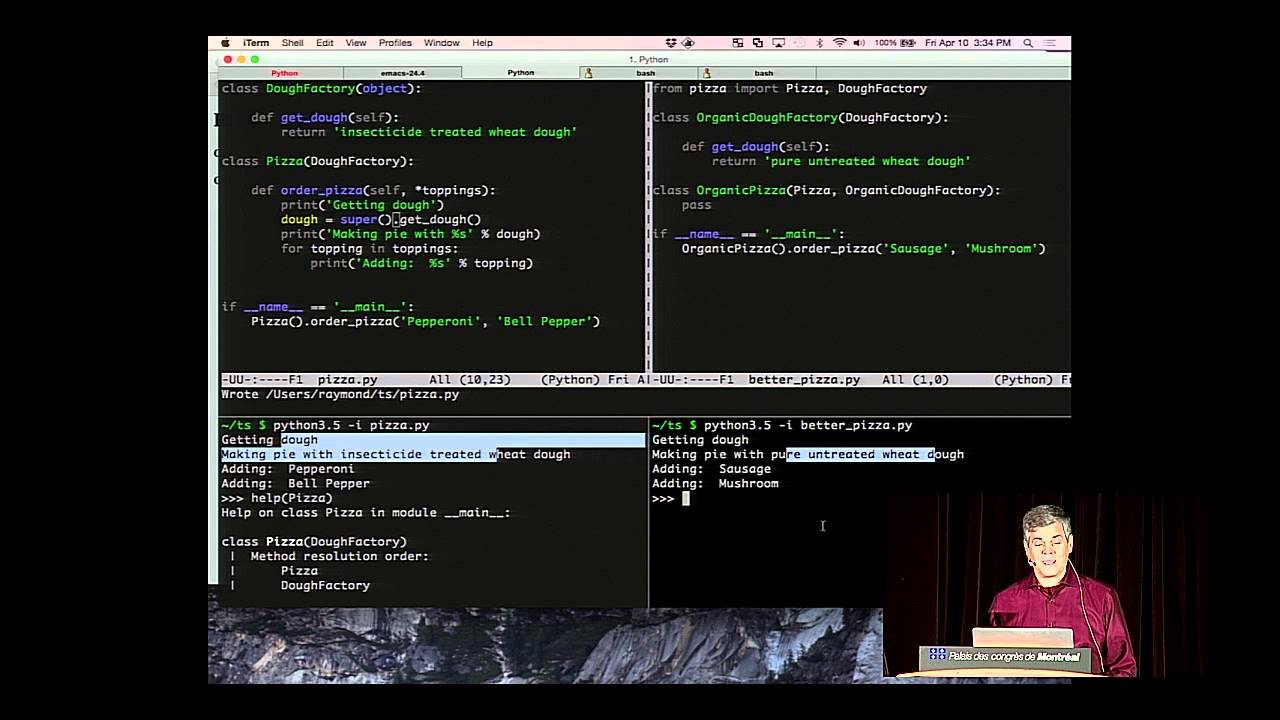
"Speaker: Raymond Hettinger
Python's super() is well-designed and powerful, but it can be tricky to use if you don't know all the moves.
This talk offers clear, practical advice with real-world use cases on how to use super() effectively and not get tripped-up by common mistakes.
Slides can be found at: https://speakerdeck.com/pycon2015 and ...
boreal umbra
yield from generator is roughly the same as
for item in generator:
    yield item
as for when you would want that, something like this:
def another_generator():
    yield first_value
    yield from iterable_or_whatever
    yield last_value
yes, thanks for clarifying this
boreal umbra
@unkempt rock your question is off-topic for this channel. Try asking in a help channel. See #❓|how-to-get-help
verbal escarp
i think i found a nice use case for js-like lambdas 🙂
class Foo:
    _x = 10
    x = property(self => self._x,
                (self, x) => self._x = x
              )
finally a way to write properties that doesn't suck 😄
rose schooner
verbal escarp
```py
class Foo:
_x = 10
x = property(self => self._x,
...
a statement in a lambda?
verbal escarp
rose schooner
a statement in a lambda?
yes?
also {} should work for multi-line (multi-statement)
property getter/setter/deleter are basically defined as throw-away functions, which exactly is the point about anonymous functions
spice pecan
setattr(self, "_x", x) :)
verbal escarp
spice pecan
`setattr(self, "_x", x)` :)
you know what properties are, right?
paper echo
verbal escarp
```py
class Foo:
_x = 10
x = property(self => self._x,
...
i know you're joking but i don't think this is any better than 2 defs, and still approximately as ugly/dense as lambda
i think stacking long blocks / anonymous functions on top of each other is visually impossible to read
!e ```python
class Foo:
_x = 10
x = property(lambda self: self._x)
x.setter(lambda self, x: self._x := x)
foo = Foo()
print(foo.x)
foo.x = 20
print(foo.x)
@paper echo :x: Your eval job has completed with return code 1.
001 |   File "<string>", line 4
002 |     x.setter(lambda self, x: self._x := x)
003 |              ^^^^^^^^^^^^^^^^^^^^^^^
004 | SyntaxError: cannot use assignment expressions with lambda
!e ```python
class Foo:
_x = 10
x = property(lambda self: self._x)
foo = Foo()
print(foo.x)
@paper echo :white_check_mark: Your eval job has completed with return code 0.
10
huh
verbal escarp
no assignments in lambdas
radiant garden
you need to parenthesize them
verbal escarp
paper echo
i know you're joking but i don't think this is any better than 2 `def`s, and sti...
i'm not joking. i hate the need to name throw-away functions. they're polluting the namespace and IDEs have a really hard time with the ```py
@x.setter
def x(..):
...
@x.getter
def x(...):
...
patternbut it's x already 🤔 (in this case)
and yes valid, it's obnoxious to give a name to every throwaway function
but in this particular case i don't see a problem. you can also do def _(...):
verbal escarp
paper echo
but in this particular case i don't see a problem. you can also do `def _(...):`
that's even worse. have 10 properties, all with def _(...) and your IDE will slowly choke you to death
there's no elegant solution with properties.. i really searched far and wide and all i found is sadness
pliant tusk
radiant garden
you need to parenthesize them
still couldnt set the attribute with an assignment expression
paper echo
answer: don't over-use properties
verbal escarp
paper echo
answer: don't over-use properties
that's not an answer, that's giving up 😦
paper echo
i have been working with some people who use async properties
i do not understand why you would do that
how is await self.current_user any better than await self.get_current_user()??
hint: it's not, it's just confusing
radiant garden
a great idea: some form of postfix await token, let's use 🎟️
foo🎟️
foo.🎟️bar
foo.bar()🎟️
1 +🎟️ 1
i'm fascinated and appalled at the same time
paper echo
verbal escarp
i'm fascinated and appalled at the same time
right? i didn't even know you could use @property with async def, apparently it works just fine
paper echo
radiant garden
a great idea: some form of postfix await token, let's use 🎟️
```
foo🎟️
foo.🎟...
(foo🎟️).bar
elder blade
paper echo
right? i didn't even know you could use `@property` with `async def`, apparently...
Yup because async functions are just functions that return coroutines. I've seen some cursed stuff
Like- async properties that actually have an effect
paper echo
elder blade
Yup because async functions are just functions that return coroutines. I've seen...
yeah it makes sense after i saw it... but. why.
elder blade
You can also use properties with generators
paper echo
elder blade
Like- async properties that actually have an effect
oh yeah this one does i/o. it looks for something in a local cache, and if it's not there then it fetches it from another service over the network
verbal escarp
yeah, it doesn't make really sense from a reader perspective
elder blade
paper echo
oh yeah this one does i/o. it looks for something in a local cache, and if it's ...
GET are supposed to be idempotent, this wasn't...
paper echo
elder blade
GET are supposed to be idempotent, this wasn't...
oh lol
verbal escarp
i mean, you're using a property to abstract away internal behaviour
but then you have to use await to ..
🤷
elder blade
Then use a method 😩
verbal escarp
exactly @paper echo 's point 😄
paper echo
verbal escarp
i mean, you're using a property to abstract away internal behaviour
literally the only benefit of properties is for compatibility with an interface or another class where something is expected to be an attribute, but for whatever reason your implementation requires some kind of computation
that's it
verbal escarp
my point was that there's no nice way to write properties at all - all cursed in one way or another (except the simplest of cases with @property decorator for getters)
paper echo
and i guess maybe certain cases where you really really want to make some attributes read-only
paper echo
verbal escarp
my point was that there's no nice way to write properties at all - all cursed in...
and my point is that maybe this isn't such a bad thing 🙂
verbal escarp
well, one time i wrote a class that was acting as a facade, mapping attributes to slices etc
it was a nice idea in principle, but writing those properties.. i was cursing all the way
another time i wrote a little wrapper class for an sqlite db, same problem
it's not an issue of over-using properties or making them too complicated - none of those examples really were complicated, just some mapping - it's just a pita to write them and an eyesore to read them
paper echo
i guess i don't mind them much, but i also don't use them to such an extent
paper echo
!e ```python
from enum import Enum
class Thing:
def init(self, x):
self.x = x
class SpecialThings2(Thing, Enum):
A = Thing(1)
B = Thing(2)
print(SpecialThings2.A.x)
i expected this to return `1`, not `Thing(1)`. what's happening here?@paper echo :white_check_mark: Your eval job has completed with return code 0.
<__main__.Thing object at 0x7f15c4c11c00>
Hm, maybe try doing SpecialThings.A.value.x?
grave jolt
radiant garden
a great idea: some form of postfix await token, let's use 🎟️
```
foo🎟️
foo.🎟...
You can already do this!
x = (
    foo(1, 2)(await ing)
    .bar()(await ing)
    .baz("hmm")(await ing)
)
although it does require specially crafting these methods
Basically, when a method is called, set up a global variable with some coroutine. Then ing will read that variable
paper echo
median palm
Hm, maybe try doing `SpecialThings.A.value.x`?
it seems to work for any attribute name though, which makes no sense. normally you access the underlying object in an enum member with _value_
!e ```python
from enum import Enum
class Thing:
def init(self, x):
self.x = x
class SpecialThings2(Thing, Enum):
A = Thing(1)
B = Thing(2)
print(SpecialThings2.A.x)
print(SpecialThings2.A.x.x)
print(SpecialThings2.A.asdfasdfds)
print(SpecialThings2.A.asdfasdfds.x)
@paper echo :x: Your eval job has completed with return code 1.
001 | <__main__.Thing object at 0x7f59af95e9e0>
002 | 1
003 | Traceback (most recent call last):
004 |   File "<string>", line 13, in <module>
005 | AttributeError: 'SpecialThings2' object has no attribute 'asdfasdfds'
Huh
spice pecan
verbal escarp
you know what properties are, right?
i do, and i don't see properties being a good case for multiline lambdas, or lambdas in general
verbal escarp
spice pecan
i do, and i don't see properties being a good case for multiline lambdas, or lam...
they have very little to do with setattr
spice pecan
you can implement a property with setattr
and that will allow you to use a lambda if you want that so much
verbal escarp
spice pecan
you can implement a property with setattr
the way you showed wasn't implementing a property though
spice pecan
!e ```py
class Example:
x = property(lambda s: s.x, lambda s, x: setattr(s, "_x", x))
e = Example()
e.x = 10
print(e.x)
@spice pecan :x: Your eval job has completed with return code 1.
001 | Traceback (most recent call last):
002 |   File "<string>", line 6, in <module>
003 |   File "<string>", line 2, in <lambda>
004 |   File "<string>", line 2, in <lambda>
005 |   File "<string>", line 2, in <lambda>
006 |   [Previous line repeated 996 more times]
007 | RecursionError: maximum recursion depth exceeded
not as easy as it looks like, is it
spice pecan
If only I remembered the semantics of setattr and had a pc at hand
verbal escarp
you're still using property and setattr is just a different way to say x = property(..), which is no different from what i wrote
spice pecan
I'm aware that I'm using property
The recursion issue is me returning x instead of _x
In the getter
!e ```py
class Example:
x = property(lambda s: s._x, lambda s, x: setattr(s, "_x", x))
e = Example()
e.x = 10
print(e.x) ```
fallen slateBOT
@spice pecan :white_check_mark: Your eval job has completed with return code 0.
10
Here, a working property with a setter and no statements in a lambda
verbal escarp
sure, that works
that would work around the assignment issue in lambdas, which is one issue
verbal escarp
 plucky night
how to follow automate the boring stuff using python
plucky night
how to follow automate the boring stuff using python
try asking in #python-discussion
spice pecan
Regarding setters that are more complicated, I'm firmly on the side that they should:
a) be a named method to not mislead the caller in terms of computational cost
b) if there is no significant cost overhead, but a setter needs multiple statements, there's is either little difference between a regular def with a decorator and a function style property with a ml lambda in terms of visual noise (arguably in favor of def)
c) if neither apply, reconsider if you need properties
furthermore, I think that in a lot of cases, properties should instead be replaced with custom descriptors, because a lot of common use cases are very similar and can be generalized to a good extent
So no, i don't see properties being a good use case for lambdas. There are other cases that would be valid, but not properties (at least not IMO)
I should note that I'm firmly in favor of named functions than ml lambdas in general, so I may be biased, but excluding a subset of callbacks and a few other cases where giving a sensible name to a function is not applicable, I don't see much use for them in a readable codebase
verbal escarp
spice pecan
I should note that I'm firmly in favor of named functions than ml lambdas in gen...
maybe that's because lambda isn't very readable to begin with
spice pecan
Not python lambdas specifically, ml lambdas in general
I don't dislike the python notation, and when passing a function to, say, reduce, simple lambdas are a very legitimate tool to use, be it python, c# or js
verbal escarp
i dislike the python notation and its limitations
spice pecan
key word being simple, most of the time (in my experience and the code I've seen) ml lambdas can be safely and beneficially replaced with a named function. There are a few exceptions that I've mentioned above, but other than that, js-esque callback spaghetti is not something I'd like to see spreading in python source code
verbal escarp
callback spaghetti is also very doable with named functions, just thinking of twisted
i don't think crippling lambdas makes a big difference in readability. instead of crippling them or having them js-free-style, code blocks could also be doable
i mean, there are many ways to produce unreadable code. arbitrarily limiting people by special-casing unnamed functions doesn't solve anything. having clear but still flexible guidelines on code layout like PEP8 does solve much more
paper echo
spice pecan
key word being simple, most of the time (in my experience and the code I've seen...
when i write code in ml/haskell-style languages, i tend to make lots of named local functions anyway
i have a really hard time reading through nests of anonymous -> functions in those languages
stone field
paper echo
!e ```python
from enum import Enum
class Thing:
def __init__(self, x):
...
Enum has weird behaviour with multiple inheritance, since you inherit from Thing it constructs a Thing for every member so what you're effectively doing is assigning A to Thing(Thing(1))
If you do A = 1; B = 2, etc. it will automatically construct Thing(...) with that value
Take a look at the docs https://docs.python.org/3/library/enum.html#timeperiod here, they demonstrate it.
Right above it is also the https://docs.python.org/3/library/enum.html#planet planet example, which might or might not also be applicable to your use case.
stone field
verbal escarp
i'm not joking. i hate the need to name throw-away functions. they're polluting ...
You could always write a descriptor manually instead of relying on the property syntactic sugar, though a Python IDE struggling with properties sounds mighty strange.
verbal escarp
stone field
You could always write a descriptor manually instead of relying on the `property...
yes, i know that.. what's your point? the problem with properties and IDEs is that using in a property named throw-away functions rapidly pollute the namespace and instead of 1 you have 4 things with the same or similar name. not the IDE is "struggling" but the programmer is "struggling"
paper echo
stone field
`Enum` has weird behaviour with multiple inheritance, since you inherit from `Th...
ahhhh, interesting
yes, i think the planet case is relevant. i remember reading this once before, but never "filed" it properly in my brain
@stone field it seems that they are removing this behavior in 3.11
Enummembers are instances of theirEnumclass, and are normally accessed asEnumClass.member. Under certain circumstances they can also be accessed asEnumClass.member.member, but you should never do this as that lookup may fail or, worse, return something besides theEnummember you are looking for (this is another good reason to use all-uppercase names for members):Note This behavior is deprecated and will be removed in 3.11.
so is there any way to write what i wrote? or do you have to first subclass Thing and override __new__ to be idempotent if you pass it a Thing in its first argument??
 winged yarrow
hello, do you think that in the future, it would be possible to (even uniefficiently) convert python bytecode to asm?
paper echo
winged yarrow
hello, do you think that in the future, it would be possible to (even uniefficie...
there have been attempts already to compile python to machine code, see e.g. the Nuitka project
and Numba, which actually does operate on python bytecode and JIT compiles to native machine code
(i think Nuitka operates on source code)
so yes, it exists
verbal escarp
winged yarrow
is it effiecient? (and works for all bytecode instructions)
numba is awesome
verbal escarp
you're looking for nuitka then
or pyinstaller
i haven't worked with nuitka before though, so i can't really tell how well it works
winged yarrow
so, instead of an EXE
just pure code?
meaning instead of giving some file, just prints out some assembly code
paper echo
winged yarrow
is it effiecient? (and works for all bytecode instructions)
no, numba only works for a limited subset of python, specifically designed for numerical programs
winged yarrow
example: ```py
def test():
return 5
nuitka supposedly does work on all or most python code
With the Python compiler Nuitka you create protected binaries out of your Python source code.
winged yarrow
could that return: test: mov rax, 5 ret
paper echo
i dont think its that good
verbal escarp
paper echo
i dont think its _that_ good
you mean nuitka or numba?
paper echo
verbal escarp
you mean nuitka or numba?
either / both
median palm
I believe nuitka loads stuff into a c level library
paper echo
is there a way to see the generated machine code in numba?
yeah nuitka might compile to C first, i dont remember. would have to check the website
paper echo
@winged yarrow remember that python "bytecode" is also specific to the standard implementation of python (called "cpython"). other implementations like pypy and graalpython exist and do not use the same bytecode at all
pyjion does actually operate on cpython bytecode right? it's like a plugin bytecode interpreter for cpython?
median palm
Yes
verbal escarp
paper echo
is there a way to see the generated machine code in numba?
numba's performance optimization is pretty significant for the area it's designed for
median palm
It compiles what it can and offloads the rest to the interpreter
paper echo
yeah pretty cool stuff. i wonder how it compares to pypy on "plain python" tasks (where pypy tends to kick cpython's butt)
paper echo
doesn't graalvm also support native ahead-of-time compilation?
@winged yarrow https://stackoverflow.com/a/61859833/2954547
Stack Overflow
In a bizarre turn of events, I've ended up in the following predicament where I'm using the following Python code to write the assembly generated by Numba to a file:
@jit(nopython=True, nogil=True...
median palm
I believe you can get the compiled il in Pyjion
winged yarrow
so i was thinking
why not, even if SUPER unefficient, to literally transpile cpython bytecode
for example it has 3 stacks (i think)
so instead of optimizing, literally: mov chosenreg, [stackregweuse] dec stackregweuse instead of pop chosenreg
nvm that's stupid
paper echo
winged yarrow
why not, even if SUPER unefficient, to literally transpile cpython bytecode
im pretty sure this is how numba works
cpython bytecode -> llvm
and thereon to machine code
stone field
paper echo
<@!763813702590922773> it seems that they are removing this behavior in 3.11
> `...
Interesting, as far as I can tell it seems to refer to this behaviour, where since instances by default are instances of the same underlying Enum type you could access the members through each other:
>>> class BareEnum(enum.Enum):
...     a = 10
...     b = 10
...
>>> BareEnum.a.b
<BareEnum.a: 10>
which in 3.11 has changed:
>>> BareEnum.a.b
Traceback (most recent call last):
  File "<stdin>", line 1, in <module>
  File "python3.11/enum.py", line 169, in __get__
    raise AttributeError(
    ^^^^^^^^^^^^^^^^^^^^^
AttributeError: <enum 'BareEnum'> member has no attribute 'b'
I can't find a BPO issue associated with this very quickly and it's not listed in the changelog either, but custom member types still seem to work as expected:
>>> from datetime import timedelta
>>>
>>> class Period(timedelta, enum.Enum):
...     day_0 = 0
...
>>> Period.day_0
<Period.day_0: datetime.timedelta(0)>
>>> Period.day_0.total_seconds()
0.0
>>> Period.day_0.days
0
Something has definitely changed, though I'm not exactly sure if this kind of name sharing was truly 'supported' behaviour in the past (as self is the member type):
>>> class Test:
...     def __init__(self, x):
...         self.x = x * 2
...
>>> class TestEnum(Test, enum.Enum):
...     x = 10
...     y = 20
...
>>> TestEnum.x
<TestEnum.x: 10>
>>> TestEnum.x.x
20
>>> TestEnum.y.x
40
vs 3.11 where it just fails as self.x is attempted to be set again:
>>> class TestEnum(Test, enum.Enum):
...     x = 10
...     y = 20
...
Traceback (most recent call last):
  File "<stdin>", line 1, in <module>
  File "/usr/lib64/python3.11/enum.py", line 484, in __new__
    raise exc
    ^^^^^^^^^
  File "/usr/lib64/python3.11/enum.py", line 237, in __set_name__
    enum_member.__init__(*args)
    ^^^^^^^^^^^^^^^^^^^^^^^^^^^
  File "<stdin>", line 3, in __init__
  File "/usr/lib64/python3.11/enum.py", line 177, in __set__
    raise AttributeError(
    ^^^^^^^^^^^^^^^^^^^^^
AttributeError: <enum 'TestEnum'> cannot set attribute 'x'
@stone field thanks for investigating. i don't think i've been this mystified about something since i started trying to learn about monad transformers
i guess it's too much to ask that enums be fully magical
it seems like Enum is really really complicated and maybe tries to do too much
stone field
The python enum module is fairly strange to be fair, in hindsight this feature could maybe have been achieved with something like this instead:
class MyEnum(Enum, member_type=T):
    ...
i had no idea enum was so cursed wth
paper echo
stone field
The python `enum` module is fairly strange to be fair, in hindsight this feature...
that's what i was thinking, or similar
alternatively enum members could be defined as a dict of values, or flagged with some wrapper function
or all class-level attributes are naively frozen as enum members 🤷♂️
i don't know why they did the _sunder_ thing
enum member could have just been its own type
stone field
That's what they changed it to in 3.11, by the looks of it
paper echo
from enum2 import Enum

class Status(Enum):
    ACTIVE = 1
    CANCELED = 2
    ON_HOLD = 3
    UNDER_REVIEW = 4

Status.ACTIVE  # instance of EnumMember
Status.ACTIVE.value == 1
seems like that would have been easy enough 🤷♂️ and just not support the Status(int, Enum) trickery at all
that, or, you just slap on all the associated methods and if there is a name clash then that's your fault 😛
i guess the sunder stuff was specifically added to support the Status(int, Enum) trickery?
stone field
In hindsight there's a lot the enum module could do but I imagine most of the weirdness is historical baggage
paper echo
i still don't know Status(SomethingComplicated, Enum) is even supported or not 🤔 i admittedly don't understand the TimePeriod example
paper echo
stone field
In hindsight there's a lot the `enum` module could do but I imagine most of the ...
as with most weirdness
i see how subclassing works with the tuple, but what a strange way to set things up
normally you would want to define your class and then set up an enum separately
stone field
For example, it wouldn't be too trivial to make Enum work like this by default:
class MyEnum(Enum):
    ACTIVE
    CANCELLED
    ON_HOLD
    UNDER_REVIEW
whereas currently this would be achieved with explicitly using auto()
paper echo
you could do it with variable annotation syntax!
but yeah i don't have any complaints against auto()
class MyEnum(Enum):
    ACTIVE: int
    CANCELLED: int
    ON_HOLD: int
    UNDER_REVIEW: int
Runtime annotations are just all around worse descriptors
paper echo
those are fighting words 😛
i agree, except that type checkers still don't know how to handle descriptors properly
at least mypy doesn't
i don't think pyright does either. there's some kind of special dataclass protocol now to work around this
also there's no reason why auto() even needs to be a descriptor. e.g. in the case of attrs, the attr.ib() things aren't descriptors, they are actually just dumb placeholders that get stripped off entirely when the class is created
the attrs decorator just iterates over class members, it doesn't leave any dynamic descriptors in place after the class is returned to the user
stone field
I'm not entirely sure auto() actually is a descriptor, but yeah it doesn't need to be
https://github.com/python/cpython/blob/main/Lib/enum.py#L143-L148 doesn't look like it is
paper echo
maybe as a concession to type checkers, attr.ib and enum.auto should be descriptors, with their __get__ method required to return the same type as the annotated instance/class attribute
fallen slateBOT
Lib/enum.py lines 143 to 148
_auto_null = object()
class auto:
    """
    Instances are replaced with an appropriate value in Enum class suites.
    """
value = _auto_null```The mypy Playground is a web service that receives a Python program with type hints, runs mypy inside a sandbox, then returns the output.
from __future__ import annotations
from pathlib import Path


class DirectorySize:
    def __get__(
        self,
        obj: Directory,
        objtype: None | type[Directory] = None
    ) -> int:
        return len(list(obj.path.iterdir()))


class Directory:
    path: Path
    size: int = DirectorySize()

    def __init__(self, path: Path) -> None:
        self.path = path
mypy --strict --show-error-codes --show-column-numbers
main.py:16:17: error: Incompatible types in assignment (expression has type "DirectorySize", variable has type "int")  [assignment]
Found 1 error in 1 file (checked 1 source file)
auto() is intercepted by the custom namespace class, and then swapped out as the class is built.
boreal umbra
Not a problem that I'm currently experiencing, but is there any support (native or otherwise) for circumstances where two dependencies themselves depend on irreconcilable versions of a shared dependency? is this something the core devs plan to address?
 strange wasp
hey, are all updates made in python basically PR's merged to the cpython repository after verification by core devs
olive marsh
When did python made writing super(clsname, self).__init__() optinal?
Can I get that pep or a stackflow answer when It is proposed?
fallen slateBOT

**PEP 3135 - New Super**
Status
Final
Python-Version
3.0
Created
28-Apr-2007
Type
Standards Track
elder blade
boreal umbra
Not a problem that I'm currently experiencing, but is there any support (native ...
I believe @verbal escarp worked on justuse for things like these issues
verbal escarp
elder blade
I believe <@500372058186842123> worked on `justuse` for things like these issues
meep?
oh, yeah
elder blade
I don't think I have heard anything about any plans to make it work. As in, from what I know there is no dedicsted effort.
verbal escarp
in justuse?
elder blade
It seems like a quite tricky problem, but with the complexity of the import system it has to be possible, surely 😅
verbal escarp
we released a new version few days ago
i also ran mass tests against all conda packages with 1148 of 1321 total successfully automatically installing without manual interference
although, working on the showcase gave me a little headache with some unexpected bugs showing their tails
so i wouldn't recommend it for production yet, but it's getting there
however, there's one problem i don't think i can solve without breaking too much
i wanted to not only make it possible to have different dependencies installed in parallel but also be able to load them into the same program
which would require dropping the import caching, which would work except for one crucial package - numpy is forcefully refusing to play along
and without numpy, much of the rest of the sci stack is useless
i mostly made peace with the import caching by now
white nexus
elder blade
It seems like a quite tricky problem, but with the complexity of the import syst...
yes
now let me read what the question was
oh, almost certainly
yeah that's not too hard to do imo
i've spent too much time with import hooks
verbal escarp
white nexus
yeah that's not too hard to do imo
what is?
white nexus
boreal umbra
Not a problem that I'm currently experiencing, but is there any support (native ...
.
that is definitely doable
verbal escarp
did you try it? 🙂
if you think you found a solution, make a POC for numpy and show me
white nexus
importhooks + custom finder and loader, getting the parent frame to see which module is trying to import the package, using importlib metadata to get the version it wants
verbal escarp
yeah, that's the easy part
white nexus
ye
verbal escarp
and now for the caching
white nexus
it would have to install the packages on first import and then cache it
verbal escarp
sys.modules would use the same name for both versions
elder blade
verbal escarp
which would require dropping the import caching, which would work except for one...
Odd,I thought numpy supported the new multi-stage init for extensions
white nexus
oh right... would need to solve the problems sys.modules...
verbal escarp
white nexus
oh right... would need to solve the problems `sys.modules`...
bingo.
i did play with custom shadowing of sys.modules and sys.paths to serve whatever each module is expecting, but that only gets you that far
white nexus
also the parent frames might not work due to importlib calling with frames removed
verbal escarp
elder blade
Odd,I thought numpy supported the new multi-stage init for extensions
don't know about that, also probably not related to this problem
numpy actively checks if it has already been loaded to actively prevent reloading
which includes loading of multiple versions
white nexus
verbal escarp
i did play with custom shadowing of sys.modules and sys.paths to serve whatever ...
why would that not work?
/pypi numpy
!pypi numpy
fallen slateBOT

NumPy is the fundamental package for array computing with Python.
verbal escarp
white nexus
why would that not work?
because there are packages that modify other packages which are looking them up in sys.modules etc
it's a bloody mess
white nexus
right
elder blade
verbal escarp
numpy actively checks if it has already been loaded to actively prevent reloadin...
Aah, right. Might be fixed when it realizes it has to support subinterpreters 🤷♂️
verbal escarp
the other possibly viable solution would be to modify the name dropped in sys.modules and keep track of the version that way, like (numpy, "1.21.0")
or somesuch
but even that is problematic because it would need extra lookup and in the scenario where one module is trying to find another, there's ambiguity
sigh
verbal escarp
elder blade
Aah, right. Might be fixed when it realizes it has to support subinterpreters 🤷...
i'm thinking the only actually viable solution is to work with software components à la jupyter
properly isolated sub-programs each with their own modules
communicating via msgpack or somesuch
at least in this case justuse does solve the "oh no we can't install different versions at the same time" problem
there's another problem i need to solve before justuse hits 1.0, which is "from which python version am i trying to load"
nvm. just rambling ^^
but i'm serious, if you do figure out a way to load different versions of numpy in the same program, i'd love to see it
i gave it a serious shot and couldn't make it work
boreal umbra
In an experiment I just did in 3.7.9, str.__str__ returned the same object in memory. Is this specified behavior?
rose schooner
boreal umbra
In an experiment I just did in 3.7.9, `str.__str__` returned the same object in ...
i mean shouldn't it do that just like how +int just returns the same object but incref'd
boreal umbra
rose schooner
i mean shouldn't it do that just like how `+int` just returns the same object bu...
for immutable types, it's ultimately inconsequential whether equivalent instances happen to be the same in memory, so they might have chosen not to specify that str.__str__ has to return itself.
raven ridge
boreal umbra
In an experiment I just did in 3.7.9, `str.__str__` returned the same object in ...
It's not required, but it's an obvious optimization.
 hasty scroll
kinda confused do i have to use my irl name in cla?
paper echo
hasty scroll
kinda confused do i have to use my irl name in cla?
i used mine
i would imagine that's the expectation
hasty scroll
like can i use my internet name instead (MaskDuck)
paper echo
i'm not sure how agreements like that work when people are using pseudonyms
it might depend on various local laws / legal precedents
maybe that's a good question for the mailing list or discourse forum
we don't have many users here who work on python in an official capacity
quick snow
hasty scroll
like can i use my internet name instead (MaskDuck)
IANAL, but I don't see how pseudonyms would be a problem: a CLA is supposed to stop you from suing the project later for using your code. As long as the code you contribute can be linked to the CLA (signed by the same user), I don't see how you would be able to sue successfully.
elder blade
hasty scroll
kinda confused do i have to use my irl name in cla?
I signed it with my alias, I reached out to them and they said it was fine.


 wheat jacinth
while type(obj).mro() is working, I wonder .mro() cannot be found in the dir(type(obj)). Why we can't find its method from dir(type(obj))?
class A:
  def method(self):
    print("A.method() called")

class B(A):
  def method(self):
    print("B.method() called")

b = B()
obj1 = dir(type(b))
print(obj1)
"""
['__class__', '__delattr__', '__dict__', '__dir__', '__doc__', '__eq__', '__format__', '__ge__',
'__getattribute__', '__gt__', '__hash__', '__init__', '__init_subclass__', '__le__', '__lt__',
'__module__', '__ne__', '__new__', '__reduce__', '__reduce_ex__', '__repr__', '__setattr__',
'__sizeof__', '__str__', '__subclasshook__', '__weakref__', 'method']
"""

obj3 = type(b).mro()
print(obj3)
"""
[<class '__main__.B'>, <class '__main__.A'>, <class 'object'>]
"""
you can find it in dir(type) though
also every type is an instance of type
fossil blade
Hi I want to implement something like sorted(obj) or len(obj)
Basically I want to be able to do run(obj) and the obj must have __run__ to run or smth should I just do
def run(obj, *args, **kwargs):
return obj.__run__(args, kwargs)``` ionic harbor
The PEP 8 song, but I kind of made it overly dramatic (hopefully this belongs here well enough)
elder blade
fossil blade
Hi I want to implement something like sorted(obj) or len(obj)
Basically I want ...
Yeah
elder blade
ionic harbor
The PEP 8 song, but I kind of made it overly dramatic (hopefully this belongs he...
I'd recommend #community-meta
 red solar
do i ask about MRO stuff here?
ok i'm gonna assume yes
can i use a type's MRO to check inheritance? like is MRO a version stable feature?
 feral island
you mean calling the .mro() method?
red solar
>>> mro = atomics.INT.mro()
>>> mro.index(atomics.INTEGRAL)
1
>>> mro.index(atomics.ANY)
2
i have this type
    ANY
    │
    └───BYTES
    │
    └───INTEGRAL
        │
        └───INT
        └───UINT
i want to check that it inherits like this
can i do this by checking that INTEGRAL and ANY appear in .mro(), with INTEGRAL being first, and also check that none of the other types appear in the mro?
would that be reasonable?
feral island
Seems easier to check __bases__ directly
red solar
oh no way
i had no idea that existed 🙂
should i be accessing it directly as __bases__ or is there an equivalent non-magic method?
hmm tbh i think i still want mro(), since you can hide stuff in __bases__ by inheriting indirectly
paper echo
i assume issubclass isn't appropriate because of __subclasshook__, right?
red solar
paper echo
i assume `issubclass` isn't appropriate because of `__subclasshook__`, right?
it's also quite verbose to do it that way (i tried in #unit-testing )
paper echo
ah i see
paper echo
grrr why is printf-style string interpolation documented in library/stdtypes.html but format-style string interpolation documented in library/string.html
i can never remember where to find these things
prime estuary
It's documented there since string.Formatter has an extensible version of the logic. But all three spots (str.format, string, f-string syntax) do link to each other at least...
boreal umbra
fossil blade
Does function have constructors
In [8]: from types import FunctionType

In [9]: FunctionType.__init__
Out[9]: <slot wrapper '__init__' of 'object' objects>

In [10]: FunctionType(5)
TypeError: function() missing required argument 'globals'
 quick snow
!e it's a bit tedious
from types import CodeType, FunctionType

new_fn = FunctionType(
    CodeType(1, 0, 0, 1, 8, 67, b"|\x00d\x01\x17\x00S\x00", (None, 1), (), ("n",), "", "foo", 1, b"\x00\x01"),
    {},
)

print(new_fn(41))
@quick snow :white_check_mark: Your eval job has completed with return code 0.
42
It's a bit less cryptic with kwargs
olive marsh
1Run python -W error test.py

6Traceback (most recent call last):

7 File "test.py", line 8, in <module>

8 import pandas as pd

9 File "/opt/hostedtoolcache/PyPy/3.9.10/x64/lib/pypy3.9/site-packages/pandas/__init__.py", line 11, in <module>

10 __import__(dependency)

11 File "/opt/hostedtoolcache/PyPy/3.9.10/x64/lib/pypy3.9/site-packages/numpy/__init__.py", line 155, in <module>

12 from . import random

13 File "/opt/hostedtoolcache/PyPy/3.9.10/x64/lib/pypy3.9/site-packages/numpy/random/__init__.py", line 180, in <module>

14 from . import _pickle

15 File "/opt/hostedtoolcache/PyPy/3.9.10/x64/lib/pypy3.9/site-packages/numpy/random/_pickle.py", line 1, in <module>

16 from .mtrand import RandomState

17 File "mtrand.pyx", line 19, in init numpy.random.mtrand

18ImportWarning: can't resolve package from __spec__ or __package__, falling back on __name__ and __path__
Getting this weird ImportWarning for PyPy
How can I fix this? I am getting the warning only in GitHub CI. This is working fine locally
 wind crypt
Does anyone here understand Pypy?
I don't quite understand the details of it. I get that there is an interpreter written in RPython. And that It is a tracing compiler, but apparently the tracing is done on the interpreter. So what is the difference between that and say writing an interpreter in a JIT runtime like Java? People talk about Pypy like it is special and unique but that conflicts with my current understanding.
native flame
hi, please ask your question in #type-hinting
wheat jacinth
Oh sorry
raven ridge
oh, but also what hsp says. 🙂
white nexus
hm, what do type checkers use internally?
raven ridge
moving my answer over there...
white nexus
raven ridge
moving my answer over there...
for future readers: #type-hinting message
what is a member_descriptor, there are no docs on this class whatsoever

so further investigation means that it is an instance of types.MemberDescriptorType
feral island
white nexus
some thing on builtins, let me try to find out exactly what
white nexus
The type of objects defined in extension modules with PyMemberDef, such as datetime.timedelta.days.
???
fallen slateBOT
Lib/datetime.py lines 593 to 597
# Read-only field accessors
@property
def days(self):
    """days"""
return self._days```that doesn't look like a member descriptor or all properties would return this type, no?
feral island
white nexus
that doesn't look like a member descriptor or all properties would return this t...
there's probably a separate C implementation
white nexus
then why am i getting this class for attributes defined in python?
feral island
white nexus
then why am i getting this class for attributes defined in python?
you aren't
white nexus
I am
feral island
can you give an example?
white nexus
lemme see if i can make a smaller example
feral island
fallen slateBOT
Modules/_datetimemodule.c line 2652
{"days", T_INT, OFFSET(days), READONLY,```There is also a Python implementation that gets used if the C implementation isn't available, but that's very rare (maybe pypy uses it?)
feral island
This isn't much to do with the Python-level __slots__ mechanism either
feral island
oh I see, yeah it makes sense that the __slots__ implementation would use this type
white nexus
!e ```py
import inspect, types
class Message:
slots = ['content',]
obj = getattr(Message, 'content')
print(type(obj))
print(inspect.ismemberdescriptor(obj))
print(isinstance(obj, types.MemberDescriptorType))
@white nexus :white_check_mark: Your eval job has completed with return code 0.
001 | <class 'member_descriptor'>
002 | True
003 | True
is it mis-documented?
feral island
I don't know, what documentation are you looking at ?
(Also sorry for not believing earlier that you'd see this type for Python-defined attributes)
white nexus
feral island
I don't know, what documentation are you looking at ?
types.MemberDescriptorType and inspect.ismemberdescriptor have the only docs about it
feral island
white nexus
types.MemberDescriptorType and inspect.ismemberdescriptor have the only docs abo...
Oh yeah, would be reasonable to mention there that it's also used for __slots__. Also, those two places in the docs should link to each other.
white nexus

feral island
please report a bugs.python.org bug 🙂
Also, those docs don't really say what the difference is between a GetSetDescriptorType and a MemberDescriptorType. Seems like it's that MemberDescriptor refers directly to an object stored on the underlying C structure, while GetSetDescriptorType has a getter (and optionally setter) function that computes the value. So __slots__ are MemberDescriptors, because the getter just returns the object at some fixed offset from the start of the instance definition, but int.real is a GetSetDescriptor, because it has a getter with some logic in it.
white nexus
!e print(type(int.real))
fallen slateBOT
@white nexus :white_check_mark: Your eval job has completed with return code 0.
<class 'getset_descriptor'>
is that possible now? new issues couldnt be opened because of the migration to gh issues
white nexus
!pep 588 still a draft ¯_(ツ)_/¯
fallen slateBOT
white nexus
This issue tracker will soon become read-only and move to GitHub.
feral island
native flame
is that possible now? new issues couldnt be opened because of the migration to g...
yeah the migration got delayed a few times
native flame
oh
feral island
the plan is now that it happens next weekend
white nexus
neat, i'll try to remember to make a issue
next lion
5 + 10 == add(5, 10)
0 + .1 == add(0, .1)

"foo" + "bar" == concat("foo", "bar")
[1, 2] + [3] == concat([1, 2], [3])

# Why not extend to...
range(5) + range(10) == chain(range(5), range(10))

# And perhaps as a default implementation
IteratorA + IteratorB == chain(IteratorA, IteratorB)
Isn't this what you would (perhaps naively) expect?
 deft pagoda
no, chain isn't a sequence -- you can't index it
that is, if i could add two range types, i'd probably expect a range type to come out, not a chain object
next lion
Humm, that's fair, you would need an intermediate object for that one so that you can keep __contains__ and __getitem__, but expecting range + range to just give you another range would be weirder since start end step would make no sense... At the same time, Idk if looking at typeshed is enough, but I did a search for __add__ and I could only find one example where adding two objects would give you a completely different object: xml.dom.minicompat.EmptyNodeList() + xml.dom.minicompat.EmptyNodeList() gives a xml.dom.minicompat.NodeList and that was it, so probably not the way to go
grave jolt
deft pagoda
that is, if i could add two range types, i'd probably expect a range type to com...
!e
that doesn't always hold for arithmetic operators
d = {"a": 1, "b": 2, "c": 3}
a = d.keys()
b = ["c", "d"]
print(type(a), type(b))
diff = a - b
print(diff)
print(type(diff))
@grave jolt :white_check_mark: Your eval job has completed with return code 0.
001 | <class 'dict_keys'> <class 'list'>
002 | {'a', 'b'}
003 | <class 'set'>
but yeah, it'd be a bit strange
next lion
If you chained two itertors though, you would still have an iterator, just not the same one x)
deft pagoda
i create a RangeSet when adding two Ranges in real_ranges -- for convenience
 candid grove
Is there a pythonic method to get many attribute from a list, ex:
x[1,4]
output: [2,5]```
numpy support list as index, ex:
```x[[1,4]]```
and if there isn't, is there any plan to have it in python?by "attribute", it sounds like you mean "element". "attribute" refers specifically to something else in Python.
There isn't a pythonic way to do that, unless it can be achieved via list slicing. I doubt there are plans to add it since it sounds like most of the use cases are scientific computing, in which case they'd use numpy anyway. It's an interesting idea though!
The best solution I can think of is [x[i] for i in [1, 4]]
candid grove
boreal umbra
by "attribute", it sounds like you mean "element". "attribute" refers specifical...
thank you
Can I follow this issue? and may be add it to source code of python?
boreal umbra
candid grove
thank you
Can I follow this issue? and may be add it to source code of python?
you would first have to suggest it on the python-ideas email list and see if there's any interest, and find a cpython core developer interested in sponsoring a PEP. my guess is that the idea wouldn't make it past the first stage, as the community is tending towards making fewer changes to the language going forward.
candid grove
That's ok
thank you
boreal umbra
I made a suggestion on python-ideas a few years ago and got a resounding rejection. I'm still emotionally damaged tbh
candid grove
I have experienced something like that in django community.
But I love community, It let others like me help the world and learn too much.
fossil blade
How does pypi and pip work?
I want to make a pypi but only good design codes are allowed
feral island
fossil blade
How does pypi and pip work?
I'd look into https://bandersnatch.readthedocs.io/en/latest/. There are also some PEPs about how PyPI works
grave jolt
fossil blade
I want to make a pypi but only good design codes are allowed
If you want to just host your own PyPI with a few hand-picked packages, there are existing solutions such as pypiserver and devpi
paper echo
!pypi pypiserver
fallen slateBOT
A minimal PyPI server for use with pip/easy_install.
paper echo
i didn't know about this one
the docs also show that you can use any file server with auto-indexing (eg twistd) but then you have to manage the file layout yourself
grave jolt
Note of caution: pypiserver proxies to global PyPI by default
I would personally announce it in a big red sign but I'm not a maintainer
paper echo
grave jolt
Note of caution: pypiserver proxies to global PyPI by default
does it cache locally at least? otherwise what's the point?
isn't one of the other ones also a locally-caching pypi mirror by default?
grave jolt
paper echo
does it cache locally at least? otherwise what's the point?
The point is that you can add your own packages
Or, well, disable the proxying
paper echo
i see. depends on your use case then
spice pecan
candid grove
Is there a pythonic method to get many attribute from a list, ex:
```x = [1,2,3,...
You can try using operator.itemgetter
!e ```py
from operator import itemgetter
getter = itemgetter(2, 3)
print(getter([1, 2, 3, 4, 5]))
@spice pecan :white_check_mark: Your eval job has completed with return code 0.
(3, 4)
 unreal parcel
!e 5 + 10
fallen slateBOT
@unreal parcel :warning: Your eval job has completed with return code 0.
[No output]
!e
import inspect, types
class Message:
slots = ['content',]
obj = getattr(Message, 'content')
print(type(obj))
print(inspect.ismemberdescriptor(obj))
print(isinstance(obj, types.MemberDescriptorType))
fallen slateBOT
@unreal parcel :white_check_mark: Your eval job has completed with return code 0.
001 | <class 'member_descriptor'>
002 | True
003 | True
@unreal parcel is there something you are attempting to demonstrate?
verbal escarp
boreal umbra
I made a suggestion on python-ideas a few years ago and got a resounding rejecti...
sometimes you need a good amount of defiance to keep going. when i suggested the idea for module reloading in justuse and justuse in general, the feedback was "that'll never work. other attempts by smarter people have failed, why do you think you could succeed?" or "why would you even WANT to do this?!"
it helped me to have figured out a good amount of stuff before approaching people about the idea, so i knew it was doable
but still, getting told by people you otherwise respect to give up is pretty heavy
apropos reloading. i think i have a feasible solution to the question of signature compatibility
assuming there's a hierarchy of generality for types - iterable > container > list, numerical tower etc
if one is trying to automatically update a module and want to programmatically determine if the incoming version is signature-compatible with the previous one, one could say that all parameters may become less general (previous signature said a: iterable, now a: list is okay, but not the other way round)
i'm thinking that once annotations are at struct-level you can't make compatible changes anymore without changing runtime behaviour
but this is where generics could make a difference and be quite useful
i was pondering whether only input parameters may become less general or it should be all parameters. for input parameters it's clear (thinking of numba or other trans/compilers that rely on specific types)
but if you're working with code that relies on specific types, it may break behaviour of the calling code if the return type becomes less specific
 ruby willow
verbal escarp
sometimes you need a good amount of defiance to keep going. when i suggested the...
ruby willow
verbal escarp
sometimes you need a good amount of defiance to keep going. when i suggested the...
When you get some defiance in some cases it may mean you are doing something major so yes I agree... Many good ideas do encounter resistance initially since people have their comfort zones and change esp major ones can be uncomfortable in the beginning but once you get over that you get the benefits of the changes
verbal escarp
ruby willow
When you get some defiance in some cases it may mean you are doing something maj...
it still hurts when you get blown off by people you like and respect
ruby willow
verbal escarp
it still hurts when you get blown off by people you like and respect
Yeah it does
verbal escarp
maybe it would be better if ideas could be discussed anonymously - then people wouldn't hold back with negative feedback, but it also would be easier to detach personal feelings
(of course trolling and insults would still need to be moderated)
ruby willow
I think so and unfiltered feedback is nice if constructive....I had worked with people who filter themselves excessively since they wanna be liked
ruby willow
verbal escarp
maybe it would be better if ideas could be discussed anonymously - then people w...
You can just make a rule to ignore ad hominem and filter it internally if somebody does that their arguements are logically weak and it is on them to be civil and logical.
verbal escarp
humans 😐 oh well.
ruby willow
Yeah why we like computers
verbal escarp
exactly 😄
grave jolt
Nobody insulted me worse than the Rust compiler tbh
verbal escarp
grave jolt
Nobody insulted me worse than the Rust compiler tbh
what did it say? ^^
 dusk comet
Bug in documentation: https://docs.python.org/3.11/c-api/memory.html#customize-memory-allocators
The description says that there are four fields, but in fact there are five of them.
 feral island
dusk comet
Bug in documentation: https://docs.python.org/3.11/c-api/memory.html#customize-m...
feral island
dusk comet
Bug in documentation: https://docs.python.org/3.11/c-api/memory.html#customize-m...
send a PR and I'll merge it 🙂
dusk comet
i am too lazy(
feral island
 verbal escarp
@feral island judging by your obvious fascination with type checking maybe you're the right person to ask
in justuse i'd like to realize a signature-compatibility check for reloading modules and automatic upgrading, so i'm thinking that stricter types (future version) are always compatible with more general types (past version)
now i figured i can use the numeric tower for this purpose, which at least cover the numbers, which is a big chunk
but i have no idea how to go about container types
feral island
Yes, sounds like you need the same kind of check that type checkers perform in subclassing. But you need it at runtime, so you need to implement the same kinds of compatibility checks with runtime type objects
There are libraries that provide something like that (I've heard of pytypes, pydantic, beartype; my own pyanalyze has it too), but not sure how well that will integrate with your library
It's definitely not a simple problem if you want to be fully general
verbal escarp
how would you go about list[float] => list[int]?
do you recursively unpack the types or is there a mechanism built in somewhere for this?
feral island
typing.get_args helps
But note that strictly those two types are not compatible, because list is invariant
verbal escarp
feral island
`typing.get_args` helps
that's undocumented o.O
verbal escarp
yeah, no text there
feral island
it's documented together with get_origin
verbal escarp
ohh, i see
feral island
admittedly that's confusing
verbal escarp
feral island
But note that strictly those two types are not compatible, because list is invar...
hm.. let's say we have ```py
def foo(X: list[float]):
return X
which becomes in the next version
```py
def foo(X: list[int]):
  return X
you would reject this change as incompatible?
feral island
verbal escarp
hm.. let's say we have ```py
def foo(X: list[float]):
return X
```
which becom...
yes, because if a user passed f([1.0]) that will now fail
verbal escarp
what about the other way round?
feral island
argument type compatibility should actually be checked the other way around: you can broaden but not narrow
though in the case of lists, because of invariance strictly you can't change it at all (https://mypy.readthedocs.io/en/stable/common_issues.html#invariance-vs-covariance)
verbal escarp
feral island
argument type compatibility should actually be checked the other way around: you...
well, there's a problem. if you're at the bottom of the typing and you're making the assumption that you can apply numba or cython, broadening would kill that assumption
feral island
verbal escarp
well, there's a problem. if you're at the bottom of the typing and you're making...
I don't understand that, maybe I don't understand your use case
my assumption would be that you want to be able to reload without breaking existing consumers. Then applying normal subtyping rules makes sense
verbal escarp
i think i'll take your advice and will special case a degradation from fully annotated to partial annotation, breaking the promise to numba
thanks 🙂
verbal escarp
@feral island is there something that can handle issubclass(Sequence, list)? this raises a TypeError: issubclass() arg 1 must be a class, but the other way round issubclass(list, Sequence) will return True
feral island
verbal escarp
<@783088578363523104> is there something that can handle `issubclass(Sequence, l...
try collections.abc.Sequence instead of typing.Sequence maybe
 lusty scroll
weird traceback
@verbal escarp , and whoever else is interested in the types of things and how they fit into the data model
my assumption had been that if I want to get the class name of some object (any legal python reference) 'o', I could do one of two things:
- if the object is an instance of
type, reado.__name__ - otherwise, read
type(o).__name__.
But this seems to not always work. consider this traceback:
.Traceback (most recent call last):
  File "<stdin>", line 1, in <module>
  File "<stdin>", line 1, in <listcomp>
  File "/tm/tmp_py_src_dm6qwlre.py", line 123, in printr
    val_type_name = class_name(val)
  File "/tm/tmp_py_src_dm6qwlre.py", line 28, in class_name
    name=getattr(ty, "__qualname__", ty.__name__)
AttributeError: 'SourceFileLoader' object has no attribute '__name__'```And I recall having to special case SourceFileLoader once when I wanted a similar string (in this case, "SourceFileLoader") and some extra care was required
so, am I crazy ?
I will give complete code if anyone is interested to see
rose schooner
lusty scroll
I will give complete code if anyone is interested to see
i wanna see
lusty scroll
ohnI think I figued out where the problem was
I was trying to do something besides just simply check if isinstance(o, type)
lusty scroll
rose schooner
i wanna see
now it works since I've reduced this function down to one line of code:
old code
def isinst_object(t):
  from types import WrapperDescriptorType
  return isinstance(t, type)
  try:
    return isinstance(
      object.__getattribute__(t, "__str__"), WrapperDescriptorType
    )
  except AttributeError:
    try:
      object.__getattribute__(t, "__mro__")
    except AttributeError:
      return True
    else:
      return not isinstance(t, type)
``` new code:
```py
def isinst_object(t):
  return not isinstance(t, type)
and this is where the exception was happening
  def get_class_or_module(t):
    return type(t) if isinst_object(t) else t

  def get_class_or_module_name(t):
    tym = get_class_or_module(t)
    return "{module}.{name}".format(
      module=tym.__module__,
      name=getattr(tym, "__qualname__", tym.__name__)
    ) if not inspect.ismodule(tym) else (
      tym.__name__
)```I had been assuming the logic in isinst_object lived up to its name
!e minimal reproducer:
import importlib.machinery as mod
o = mod.__loader__
print(o)
print(o.__name__)```@lusty scroll :x: Your eval job has completed with return code 1.
001 | <_frozen_importlib_external.SourceFileLoader object at 0x7f4d51ff59f0>
002 | Traceback (most recent call last):
003 |   File "<string>", line 4, in <module>
004 | AttributeError: 'SourceFileLoader' object has no attribute '__name__'. Did you mean: '__ne__'?
I swear there is something weird about one of those loader classes though
ah it was just that some __spec__s have a loader "type" instead of a loader "instance" in their __loader__ property
nevermind, nothing to see here
verbal escarp
>>> issubclass(list[int], Number)
Traceback (most recent call last):
  File "<pyshell>", line 1, in <module>
  File "G:\Python398\lib\abc.py", line 123, in __subclasscheck__
    return _abc_subclasscheck(cls, subclass)
TypeError: issubclass() arg 1 must be a class
kneejerk moment
>>> type(list[int])
<class 'types.GenericAlias'>
especially with this
does this qualify as a bug or..?
next lion
I dont think so, it doesn't make much sense to use issubclass with parameterised generics, it would be more appropriate for a issubtype but python has no constructions for this internally that would allow for this I think
verbal escarp
next lion
I dont think so, it doesn't make much sense to use `issubclass` with parameteris...
well, the answer for issubclass(list[int], Number) is clearly False, not an exception
next lion
but list[int] is not a class, it makes as much sense as issubclass(3, int)
verbal escarp
i would argue that it is a class in the sense that you can do ```py
listint
[1, 2, 3]
without problemsbut you could also do
>>> list[int](["foo","bar","baz"])
["foo","bar","baz"]
list[int] doesnt really mean much at runtime, so what would be the utility in allowed it as a first argument to issubcalss
verbal escarp
also, type() agrees with me
it clearly says "class"
if it's not a class, one of the above is clearly lying
next lion
Humm, that is a good point, I think it gets weird when talking about the types from types. ..., because in that case this is also a bug issubclass(lambda x: x, int)
wait, nvm lambda x: x would be an instance of lambdatype
next lion
verbal escarp
```py
>>> type(list[int])
<class 'types.GenericAlias'>
```
Wait no, that just means that list[int] is an instance of the class 'types.GenericAlias'
verbal escarp
i'm confused 😄
next lion
For X to be a class, type(X) should return type disregrading metaclasses
verbal escarp
what's the difference between class and type anyway?
i thought python3 got rid of the distinction?
next lion
In python, classes are instance of type, conceptually classes layout new types, but it is not the same kind of "type" per say
next lion
Conceptually yes, I think, but only classes are actual instances of type in python
list[int] is conceptually a type
verbal escarp
so basically it's the same issue with the numeric tower and the built in float/int types?
next lion
and "instances" or terms of it are stuff like [1, 2] [3, 4, 6]
verbal escarp
you can't check float vs int without mapping to numbers.Integral etc beforehand
you could also build something that's instantiable but that has no place in the type hierarchy because it isn't built by type?
next lion
verbal escarp
so basically it's the same issue with the numeric tower and the built in float/i...
Maybe? I think that issue is similar but parallel, but I dont know
verbal escarp
next lion
Maybe? I think that issue is similar but parallel, but I dont know
there's so much duplication and confusion 😐
next lion
Can you build something that is instanciable and inst a type? If so I wasnt aware xD
verbal escarp
typing.Sequence vs. collections.abc.Sequence is another instance
next lion
In the future typing.Sequence will be removed so there is at least that
verbal escarp
next lion
Can you build something that is instanciable and inst a type? If so I wasnt awar...
no clue. if so, i'd be looking at low-level wrappers like numpy
low-level wrappers lead to the most annoying and confusing things
 swift imp
verbal escarp
i would argue that it is a class in the sense that you can do ```py
>>> list[int...
swift imp
verbal escarp
i would argue that it is a class in the sense that you can do ```py
>>> list[int...
I think the type on generics implements __subclasscheck__ blocks issubclass just like isinstance is blocked
verbal escarp
well, i realized it now https://pastebin.com/rXfYn5KW via catching TypeError
Pastebin
Pastebin.com is the number one paste tool since 2002. Pastebin is a website where you can store text online for a set period of time.
but it's not as elegant as it could be
sorting kwargs is the last missing bit i think
native flame
are you trying to implement your own typechecker...?
verbal escarp
native flame
are you trying to implement your own typechecker...?
no, i'm implementing a compatibility checker for auto-reloading modules and auto-upgrading packages
type-checkers are more specific, also using icontract in conjunction would be beneficial
type compatibility is a rough test that suggests that there may be issues with a direct upgrade
native flame
why not use an existing typechecker for the type compatibility?
grave jolt
rather, why do you need a runtime type checker?
verbal escarp
because i need to compare the signatures of two different callables, any typechecker i know only compares the values that are passed into a single one
verbal escarp
grave jolt
rather, why do you need a _runtime_ type checker?
because i'm loading the module, then test for compatibility and throw away the module if it doesn't hold
grave jolt
if TYPE_CHECKING:
    Foo = ;"some complex alias"
else:
    Foo = Any
    # or:
    Foo = defaultdict(lambda: SomeType)  ;"SomeType is not subscriptable at runtime"
now your checker doesn't quite work
native flame
if you have
class A:
    def f(...) -> ...:
        ...
class B(A):
    def f(...) -> ...:
        ...
then the typechecker will verify whether the signature of B.f is compatible with A.f
verbal escarp
grave jolt
```py
if TYPE_CHECKING:
Foo = ;"some complex alias"
else:
Foo = Any
...
yes, you can shoot yourself in the foot if you really want to :p
native flame
isnt that what you're trying to reimplement 🤔
verbal escarp
not really..
grave jolt
verbal escarp
yes, you can shoot yourself in the foot if you really want to :p
Example: tkinter.Event is advertised as generic in the stubs but at runtime it's not generic. How else do you use it as a generic?
verbal escarp
grave jolt
Example: `tkinter.Event` is advertised as generic in the stubs but at runtime it...
my idea is 1) load the module 2) load the modified module 3) crawl both modules for callables and compare their signatures for compatibility
i don't check what's passed in, that's the job of beartype
grave jolt
right, but when you encounter something like ```py
v1
def foo(bar: Event[int]):
...
v2
def foo(bar: Event[str]):
...
i don't care about the instances
grave jolt
foo.__annotations__ will be the same in both versions, that's what I meant
or are you planning to crawl the AST?
verbal escarp
i haven't planned to, no
hmm.. at this point i'm not even sure if Event[int] and Event[str] would be different in my implementation
grave jolt
grave jolt
right, but when you encounter something like ```py
# v1
def foo(bar: Event[int])...
...you'd also need to know the variance of the generic to know if Some[Child] is a subtype of Some[Parent](or vice versa)
So you need stubs anyway, if e.g. the class is from a C extension
verbal escarp
because i only look at container types
native flame
i dont see why you cant use an existing type checker
checking whether one callable is a subtype of another is very much within their capabilities
grave jolt
yep
next lion
native flame
checking whether one callable is a subtype of another is very much within their ...
I wish that was exposed x)
grave jolt
next lion
I wish that was exposed x)
You can import mypy and just use its internals
although, granted, it's very hard to use
verbal escarp
native flame
checking whether one callable is a subtype of another is very much within their ...
i asked a couple times, nobody could give me a solution so i did it myself.. if you have a better solution, i'm all ears
next lion
grave jolt
You can import `mypy` and just use its internals
Is there an easy issubtype?
grave jolt
mypy is very stateful with lots of different objects, I haven't found an easy way
verbal escarp
i don't insist on my solution being the best, i just haven't seen any for exactly this problem
native flame
verbal escarp
i asked a couple times, nobody could give me a solution so i did it myself.. if ...
from mypy import api
inp = f"""
f1: Callable[[int, float], str]
f2: Callable[[float, float], str]

f1 = f2
"""
results = api.run(["-c", inp])
print(results)
would check whether f2 is at least as general as f1
verbal escarp
from mypy import api
from typing import Callable
inp = f"""
from typing import Callable, Any

f1: Callable[[bool], str]
f2: Callable[[Any], str]

f1 = f2
"""
results = api.run(["-c", inp])
this is a problem
native flame
isnt tho
verbal escarp
it is, because i want to forbid broadening
grave jolt
can't you just check if the signatures are equal?
native flame
yeah exactly
grave jolt
no narrowing, no broadening... means they're equal
verbal escarp
grave jolt
can't you just check if the signatures are equal?
signature equality is meh :p
grave jolt
grave jolt
no narrowing, no broadening... means they're equal
although you might want to allow new optional parameters, idk
verbal escarp
well, i think narrowing signatures is quite natural in python development and once very specific types are hit, it gets difficult to make compatible changes anyway
grave jolt
but narrowing is not backwards-compatible
grave jolt
I think I completely misunderstand what you're trying to do
verbal escarp
okay, let's say you're working on a jupyter notebook or you have a service running somewhere which is auto-reloading a functions-only module when you're modifying it (either by hand or via git commit)
ah, you mean backwards compatible with functions calling the new functions..
🤯
coding with the time dimension is tricky
swift imp
verbal escarp
okay, let's say you're working on a jupyter notebook or you have a service runni...
Ipython has functionality to auto reload imported code upon change on lfs
verbal escarp
maybe callbacks from the future? 😆
verbal escarp
swift imp
Ipython has functionality to auto reload imported code upon change on lfs
i know
swift imp
Ok
I use it a lot for development, vim/ipython/pdb life
I work on remote systems, very rarely do I have access to an ide
verbal escarp
yeah, i like working with jupyter too, but i'm also thinking of standalone services like servers or bots
think of a discord bot that would auto-reload when you're pushing a commit
paper echo
verbal escarp
think of a discord bot that would auto-reload when you're pushing a commit
tornado has this option
it's very useful if you are developing in a docker container because you can bind mount your code and don't have to restart the container, which can be slow
verbal escarp
how does it work with changing signatures?
paper echo
i don't think it works in a repl
it literally restarts a running server if it detects file changes
verbal escarp
easy way out then ^^
paper echo
GitHub
Tornado is a Python web framework and asynchronous networking library, originally developed at FriendFeed. - tornado/autoreload.py at stable · tornadoweb/tornado
as for ipython, i eyeballed the code a while ago, and it does not follow aliased names
so it's still limited
verbal escarp
coming from my experience with an MMORPG, restarting the server always took very long and nobody was really happy when it happened
it would've been nice to only reload the game logic, for example
outside of splitting everything up into microservices of sorts, i don't see a viable alternative there
that's why i'm a bit obsessed with this problem ^^
but i also see the issues about "backwards compatibility" and it's giving me a headache
verbal escarp
maybe it could be feasible to check for compatibility breaks this way and then register wrappers of some sort either for warning the user or type conversion
so the user would first get NotCompatibleWarning and it would fall back to the previous version, then they could explicitely enable a type converter
 naive adder
whats the spec of hash? (side topic, where do i find those specs) is it just to return a unique number like id?