#esoteric-python
1 messages · Page 91 of 1
 grizzled cloak
 half sigil
hello, i wanted to know if i can shorten my solution for the knapsnacklight problem in any way (currently 64 chars)
solution=lambda a,b,c,d,e:max(a*b<=e,c*d<=e,(a+c)*b+d<=e)
 stark fable
solution=lambda a,b,c,d,e:min(a*b,c*d,(a+c)*b+d)<=e```? proper vault
solution=lambda a,b,c,d,e:not(a+c)*b+d>e<a*b>e<c*d
not 100% this works, but in theory it should
hypothesis did not find an error, so I guess it works
 rare yarrow
ok this is going to be a very strange question
but is there a variable or something set by the interpreter that tells if you are in a loop?
i.e. py print("Yes" if __IN_LOOP__ else "No") should print "No" butpy for i in range(1): print("Yes" if __IN_LOOP__ else "No") should print "Yes"?
I know this is quite strange
so I figured #esoteric-python is the place to ask
(also I may be able to modify the for loop if necessary)
 hard spoke
hmm, the call stack probably doesn't have it, but still inspect is probably the way
rare yarrow
I've never used inspect before, how would I go about doing this?
hard spoke
I meant "if anything has it, probably inspect"
but I look at the docs and don't see it.
rare yarrow
ah ok
hmm
not very familiar with python internals, what exactly would "current indentation level" be called? scope? block?
 modest glade
I don't think there is a general name for it
modest glade
not scope for sure, because thats not how python scopes work
modest glade
if its in a loop, its called the loop body
hard spoke
I mean, inside a lot of other things too, lol
modest glade
I would say indentation level is the general name for it
hard spoke
hmmm, actually...
rare yarrow
that's true, but behaviour in those other edge cases shouldn't matter to me @hard spoke
hard spoke
you can maybe retrieve the function's source code with inspect
and parse it with ast if needed
and detect for/while loops.
hard spoke
yeah
rare yarrow
I was kinda hoping for a one-or-two-liner 🙂
welp, time to dig into the AST module!
I guess I'll learn some more about how python works today
 formal sandal
!e
def null(generator_function):
    def new_generator_function(*args, **kwargs):
        generator = generator_function(*args, **kwargs)
        state = generator.send(None)
        while state is not None:
            try:
                state = generator.send(state)
            except StopIteration as e:
                return e.value
        return None
    return new_generator_function

def sqrt(x):
    if x < 0: return None
    return x**0.5

def inverse(x):
    if x == 0: return None
    return 1/x

@null
def inverse_sqrt(x):
    inv = yield inverse(x)
    sq = yield sqrt(inv)
    return sq + 5

print(inverse_sqrt(2))
print(inverse_sqrt(-5))
print(inverse_sqrt(0))
 night quarryBOT
@formal sandal :white_check_mark: Your eval job has completed with return code 0.
001 | 5.707106781186548
002 | None
003 | None
I am a big fan of do notation
 remote widget
I am a big fan
 zealous widget
why all the return Nones
 snow beacon
It's more explicit than return on its own.
zealous widget
but why even
snow beacon
I feel like monads for python would be a fun esoteric project.
zealous widget
def sqrt(x):
    if x >= 0:
        return x**0.5
It's because the returning is actually very important to the control flow of other functions, so it's best to be explicit. It's zenlike, too.
zealous widget
i can't tell if you're trolling
snow beacon
The 'zenlike' bit is 'explicit is better than implicit' in the Zen of Python.
zealous widget
don't vomit koans -- there's also simple is better than complex and there should be one obvious way
snow beacon
I personally think that one way should be monads...
My point was that return None draws attention to the returning of None, which is something you'd want to keep track of.
I think there's something in a PEP about it too...
 tribal moon
I've been doing it wrong my whole life
formal sandal
seriously though, I think a missing return indicates that a function is either just for the side effect or that it's never supposed to return normally (e.g. it has an infinite loop)
tribal moon
wait but I never put an else statement
def foo(x):
    if x >= 0
      return math.sqrt(x)
return None```c
formal sandal
or maybe not backwards
I generally prefer explicit elses because it makes control flow more explicit in most cases (unless the if just leads to an exception branch)
zealous widget
i hate it
 high garnet
what about an if expression?
formal sandal
def sqrt(x):
    return [lambda: None, lambda: x**0.5][x > 0]()
sqrt = lambda x: [lambda: None, lambda: x**0.5][x > 0]()
true  = lambda x: lambda y: x
false = lambda x: lambda y: y
sqrt = lambda x: [false, true][x>0](lambda: x**0.5)(lambda x: None)()
!zen only one
night quarryBOT
The Zen of Python (line 12):
There should be one-- and preferably only one --obvious way to do it.
night quarryBOT
The Zen of Python (line 13):
Although that way may not be obvious at first unless you're Dutch.
 proper frigate
that "Dutch" part I never really understood :D
Why "Dutch" especially, and not "German" or "Chinese" ? Is there a specific joke beheind it ?
snow beacon
Guido Van Rossum is Dutch, I believe.
formal sandal
yes, and he is the ultimate source of what to consider obvious
proper frigate
oooooooooooooookay ! 🤣
 sick hound
esoteric python, whilst beautiful, makes me want to punch a child
it is extremely scary
 dusty mulch
for s in[*open(0)][1:]:print(sum(sorted(map(len,s[:-1].split('0')))[-1::-2]))
hi can someone tell how input is taken here
hard spoke
looks like open(0) opens stdin
then, of course, [*open(0)] is equivalent to list(open(0)) (list of lines)
the rest is pretty clear
for s in [*open(0)][1:]:
    print(sum(sorted(map(len,s[:-1].split('0')))[-1::-2]))
hmm
one thing tho
input is this
5
01111001
0000
111111
101010101
011011110111
output i need is
4
0
6
3
6
how it's taking care of new lines
and where next input starts
all that magic is builtin ?
hard spoke
how it's taking care of new lines
and where next input starts
When working with a file, you can do
f = open(filename)
for line in f:
and the lines will be handled for you. This is no different.
 hard pivot
hello
i want to run this code
from tkinter import*
import tkinter.messagebox as box
window = Tk()
window.title('Message Box Example')
def dialog():
var=box.askyesno('Message Box','Proceed?')
if var == ,1:
box.showinfo('Yes Box', 'Proceeding...')
else:
box.showwarning('No Box', 'Cancelling...')
btn=Button(window, text='Click',command=dialog)
btn.pack(padx=150, pady=50)
window.mainloop()
hard spoke
What's esoteric about this? 
hard pivot
but i get an error message
File "tk_message.py", line 6
var=box.askyesno('Message Box','Proceed?')
^
IndentationError: expected an indented block
i don't understand what it means
night quarryBOT
@frank jacinth :x: Your eval job has completed with return code 1.
001 |   File "<string>", line 1
002 |     (lambda x: x**3(3)
003 |                      ^
004 | SyntaxError: unexpected EOF while parsing
 frank jacinth
!e
(lambda x: x**3)(3)
night quarryBOT
@frank jacinth :warning: Your eval job has completed with return code 0.
[No output]
 steep plover
!eval print('hi')
night quarryBOT
@steep plover :white_check_mark: Your eval job has completed with return code 0.
hi
 woeful flicker
Why is this being used as bot commands channel
 grand tree
whats the longest way someone can express 1 + 1 = 2
proper vault
(-~int.__call__()).__class__.__dict__.__getitem__.__call__('__add__').__call__(-~int.__call__(), -~int.__call__()).__eq__(-~-~int.__call__()) is as long as I am willing to type it, but you can obviously nest the __call__ infinitely
could also replace int.__call__ with ''.__class__.__call__().__len__.__call__()
snow beacon
(((1 + 1 == 2) == True) == True) == True...
hard spoke
candidate for longest-to-calculate:
import numpy as np
mat = np.random.randint(0,127,(1024,1024),dtype=np.uint8)
(mat @ mat == np.linalg.matrix_power(mat,2)).all()
the integer powers of a matrix are, after all, a ring much like the integers themselves 😛
to prolong, increase the size.
proper vault
also, -~ could be .__invert__.__call__().__neg__.__call__()
 idle lynx
I think I have finally found my chat... sorry I'm not too advanced but I found this hilarious:
funcs = [lambda: print("Why am I doing this?")]

for i in range(5):
    funcs.append(lambda i=i: funcs[i])

funcs[5]()()()()()()```gonna repost it here
!e
def trampoline(f):
    def new_function(*args, **kwargs):
        f(*args, **kwargs)
        return new_function
    return new_function

@trampoline
def useful_function():
    print("why")

useful_function()()()()
@formal sandal :white_check_mark: Your eval job has completed with return code 0.
001 | why
002 | why
003 | why
004 | why
!e
class Phoenix:
    def __repr__(self):
        return f"<Phoenix {id(self)}>"

    def __del__(self):
        print("You cannot kill me!")
        birds.append(self)

birds = [Phoenix()]

birds.pop()

print(birds)
@formal sandal :white_check_mark: Your eval job has completed with return code 0.
001 | You cannot kill me!
002 | [<Phoenix 140578748385744>]
Lol
remote widget
Nice, I love it
 rugged sparrow
@formal sandal you might be able to get its original refer using inspect to make it work anywhere
 prisma lynx
Hey, I was wondering if anyone has a way to get into esoteric python.
Ping me please, I might not respond if you don't
 midnight bane
Is that possible? Use inspect to get a reference to the list containing an instance of the object from within the object?
maybe with gc.get_referrers?
midnight bane
wut
 obtuse lagoon
huh
midnight bane
I just ran it in idle
tribal moon
I get a typeerror in idle
midnight bane
ast is so weird
welp I was able to get this to work on python 3.8.2 and within an actual file```python
import ast
import inspect
class Phoenix:
def repr(self):
return f"<Phoenix {id(self)}>"
def __init__(self):
    frame = inspect.stack()[1]
    st = ast.parse(frame.code_context[0].strip())
    stmt = st.body[0]
    target = stmt.targets[0]

    self.container = target.id

def __del__(self):
    globals()[self.container].append(self)
    print("I cannot be killed!")
birds = [Phoenix()]
birds.pop()
print(birds)
more_birds = [Phoenix()]
more_birds.pop()
print(more_birds)``` Its my first time using ast like this so im sure it can be improved
rugged sparrow
!e ```py
import sys
import gc
class Phoenix:
def init(self):
self.containers = []
def trace_func(frame, event, arg):
for referr in gc.get_referrers(self):
if isinstance(referr, list):
idx = referr.index(self)
if idx != -1:
self.containers.append([referr, idx])
elif isinstance(referr, dict):
for key,val in referr.items():
if val is self:
self.containers.append([referr, key])
sys.settrace(None)
sys.settrace(trace_func)
def __repr__(self):
    return f'<{type(self).__name__} {id(self)}>'

def __del__(self):
    print(f'{self!r} is Reborn!')
    for container, key in self.containers:
        if isinstance(container, list):
            container.insert(key, self)
        elif isinstance(container, dict):
            container[key] = self
bird = Phoenix()
print(bird)
del bird
gc.collect()
print(bird)
birds = [Phoenix(), Phoenix()]
print(birds)
birds.pop()
gc.collect()
print(birds)
@rugged sparrow :white_check_mark: Your eval job has completed with return code 0.
001 | <Phoenix 140307448084944>
002 | <Phoenix 140307448084944> is Reborn!
003 | <Phoenix 140307448084944>
004 | [<Phoenix 140307447980624>, <Phoenix 140307447654144>]
005 | <Phoenix 140307447654144> is Reborn!
006 | [<Phoenix 140307447980624>, <Phoenix 140307447654144>]
007 | <Phoenix 140307447980624> is Reborn!
gc.collect() is needed to ensure Phoenix.__del__ is called to restore the object
@formal sandal i may have gone a bit far ^
tribal moon
Make a hydra with it
midnight bane
!e python print(....__class__)
night quarryBOT
@midnight bane :white_check_mark: Your eval job has completed with return code 0.
<class 'ellipsis'>
its weird how ellipsis is an object
 plain moon
Pretty normal imo though the notation seems like magic
midnight bane
Is it only used as a special case for stuff like numpy and fastAPI?
or does it actually serve a purpose in the standard lib?
plain moon
I believe it's also used for typing
night quarryBOT
 :ok_hand: applied mute to @tribal moon until 2020-08-16 07:07 (9 minutes and 59 seconds) (reason:
 chars rule: sent 3466 characters in 5s).
 buoyant agate
!unmute 400096873978789888
night quarryBOT
:incoming_envelope: :ok_hand: pardoned infraction mute for @tribal moon.
tribal moon
Yeah I was dming modmail lol
buoyant agate
Going a bit crazy there
buoyant agate
Yea we get pinged on auto mod actions by @night quarry and log it so we can check it
tribal moon
I made a 2nd hello world script
don't wanna trigger the bot again
here's my IDLE pic
 raw night
https://circuitpython.readthedocs.io/projects/adxl34x/en/latest/examples.html#motion-detection
how can i know what is the min Thershold and max thershold for motion detection??
thanks
 thin trout
Hmhm that's pretty simple to read actually
 brisk zenith
!e print(bytes([(True << (True ^ True << True) ^ True << (True << True ^ True << (True << True))), (True ^ True << (True << True) ^ True << (True ^ True << (True << True)) ^ True << (True << True ^ True << (True << True))), (True << (True << True) ^ True << (True ^ True << True) ^ True << (True ^ True << (True << True)) ^ True << (True << True ^ True << (True << True))), (True << (True << True) ^ True << (True ^ True << True) ^ True << (True ^ True << (True << True)) ^ True << (True << True ^ True << (True << True))), (True ^ True << True ^ True << (True << True) ^ True << (True ^ True << True) ^ True << (True ^ True << (True << True)) ^ True << (True << True ^ True << (True << True))), (True << (True << True) ^ True << (True ^ True << True) ^ True << (True ^ True << (True << True))), (True << (True ^ True << (True << True))), (True ^ True << True ^ True << (True << True) ^ True << (True << (True << True)) ^ True << (True ^ True << (True << True)) ^ True << (True << True ^ True << (True << True))), (True ^ True << True ^ True << (True << True) ^ True << (True ^ True << True) ^ True << (True ^ True << (True << True)) ^ True << (True << True ^ True << (True << True))), (True << True ^ True << (True << (True << True)) ^ True << (True ^ True << (True << True)) ^ True << (True << True ^ True << (True << True))), (True << (True << True) ^ True << (True ^ True << True) ^ True << (True ^ True << (True << True)) ^ True << (True << True ^ True << (True << True))), (True << (True << True) ^ True << (True ^ True << (True << True)) ^ True << (True << True ^ True << (True << True))), (True ^ True << (True ^ True << (True << True)))]).decode())
night quarryBOT
@brisk zenith :white_check_mark: Your eval job has completed with return code 0.
Hello, world!
i appreciate anybody who remembers when i made this a couple years back haha
brisk zenith
i did! hang on
def true_shift(value):
    code = ""
    count = 0

    if value == 0:
        return
    elif value == 1:
        return 'True'

    while value != 0:

        if value % 2 == 1:

            if count != 0:
                code += "True << {} ^ ".format(true_shift(count))
            else:
                code += "True ^ "

        count += 1
        value >>= 1

    return '({})'.format(code.strip(" ^ "))


while True:
    print(true_shift(int(input("number: "))))
this is used to generate the code for a specific integer, so the code above uses this with the ASCII codes of the letters. code was written for 3.6 iirc
snow beacon
Neat.
snow beacon
Is that not 0?
hard spoke
it returns None 🙂
snow beacon
Oh, I see.
formal sandal
brisk zenith
i fucking love that
 analog dust
😳 how do you guys think this stuff up
formal sandal
i have no idea
Sometimes I start a new project, and it somehow gets an esoteric spin onto itself
analog dust
lmao im mindblown by the stuff here
how did all that Trues and Falses turn into a Hello World 
formal sandal
well, True can be used as 1 in numeric contexts.
You can create a bytes object from a list of integers [0..255].
Then you can decode that bytes object into a str
analog dust
huh makes sense. thanks for explaining your mysterious ways! 😄
 pastel grail
interesting
thin trout
I just had an idea, what if we use this to reconstruct the bytecode of a python script? 
That'd be a cool obfuscation method
pastel grail
hmm
 cursive plover
that is very cool @brisk zenith,
if value % 2 == 1:
    if count != 0:
        code += "True << {} ^ ".format(true_shift(count))
    else:
        code += "True ^ "
I'm curious, did you derive that formula out yourself? What's the idea here
snow beacon
Using XOR to toggle the bits in an integer, I believe. You get a number e.g. 10000 by shifting 1 leftwards four places, then xor it with e.g. 1111 to get 11111.
brisk zenith
yeah, i did figure that out myself, and @snow beacon has the right idea
to make the number 3 (binary 11) it must do (1 << 1) ^ 1
actually, better example
to make the number 4 (binary 100), it must do 1 << 2
but 2 can't be represented by a single True or anything
so we have to use the function recursively to find the representation that 2 should take
which is 1 << 1
so the final result for 4 is (1 << 2), or (1 << (1 << 1)) which is perfect
cursive plover
well why do you have the code.strip(" ^ ") part at the end then
midnight bane
Because with code += "True ^ " it would be possible for the code to end with ^ which is invalid
cursive plover
this is some really magical code
night quarryBOT
Hey @tribal moon!
Uh-oh! It looks like your message got zapped by our spam filter. We currently don't allow .txt attachments, so here are some tips to help you travel safely:
• If you attempted to send a message longer than 2000 characters, try shortening your message to fit within the character limit or use a pasting service (see below)
• If you tried to show someone your code, you can use codeblocks
(run !code-blocks in #bot-commands for more information) or use a pasting service like:
tribal moon
ye
hard spoke
About "fastest segfault": I've discovered a nice way 😅
import pygame
pygame.segfault()
this method does exactly what it says.
rugged sparrow
__import__('ctypes').string_at(0)
 spring fractal
*iter(lambda:0,1),
that might give a segfault about OOM before crashing your computer
same with while 1:()
 edgy kelp
why would the loop segfault?
snow beacon
It's not storing the intermediate values...
 twilit grotto
why do you need a segfault function
snow beacon
If you're meaning why do we need one, it's because of the channel we're in. If you mean why pygame does, maybe to help people debug the memory of their programs.
twilit grotto
I mean, is there a good reason to cause a segfault
brisk zenith
i wonder if pygame's segfault function actually performs an access violation, or if it just sends a SIGSEGV signal to its own process.
formal sandal
volatile int p = *((int*)NULL) I guess
or something
I ran valgrind. Yep, it is dereferencing a pointer with the address 0x1.
valgrind python3.6 -c "import pygame; pygame.segfault()"
Also, why do I get so many errors when running valgrind on python?
so many invalid reads
brisk zenith
weird that it goes for 0x1 and not 0x0. i guess it might be to differentiate it from an actual null pointer segfault or something
formal sandal
maybe
thin trout

Mmhh the implementation is kinda janky
Is it dereferencing 0x0?
string_at(0) is doing the same thing right?
brisk zenith
pretty much, yeah
formal sandal
oh, you don't even need a C extension.
 formal sandal
!e
def f():
    pass

f.__code__ = f.__code__.replace(co_consts=())

f()
@formal sandal :warning: Your eval job has completed with return code 139 (SIGSEGV).
[No output]
don't even need custom bytecode 🙂
proper frigate
can you just explain to me how that one works ? I don't get it right now...
formal sandal
!e
import dis

def f():
    pass

dis.dis(f)
@formal sandal :white_check_mark: Your eval job has completed with return code 0.
001 |   4           0 LOAD_CONST               0 (None)
002 |               2 RETURN_VALUE
None is stored as a constant
so when you empty the list (tuple) of constants, it will get a segfault when trying to fetch the constant at index 0.
brisk zenith
haha that's pretty smart
proper frigate
hmm, ok,nice !
Thanks for explaining
 modest sphinx
print(*[x%3//2*'Fizz'+x%5//4*'Buzz'or x+1 for x in range(100)])
I wanna make it shorter
sick hound
Shortened by 1 char
[print(x%3//2*'Fizz'+x%5//4*'Buzz'or x+1) for x in range(100)]
Ah, very good
night quarryBOT
@modest sphinx :white_check_mark: Your eval job has completed with return code 0.
001 | 1
002 | 2
003 | Fizz
004 | 4
005 | Buzz
006 | Fizz
007 | 7
008 | 8
009 | Fizz
010 | Buzz
011 | 11
... (truncated - too many lines)
Full output: https://paste.pythondiscord.com/inupamoxej
modest sphinx
!e
print(len("[print(x%3//2*'Fizz'+x%5//4*'Buzz'or x+1)for x in range(100)]"))
@modest sphinx :white_check_mark: Your eval job has completed with return code 0.
61
 young zealot
question what are you doing
sick hound
Question is why the list comp: ```py
for x in range(100):print(x%3//2*'Fizz'+x%5//4*'Buzz'or x+1)
1 char shorter
!e ```py
print(len("for x in range(100):print(x%3//2*'Fizz'+x%5//4*'Buzz'or x+1)"))
@sick hound :white_check_mark: Your eval job has completed with return code 0.
60
FizzBuzz as short as possible @young zealot
modest sphinx
!e
for x in range(100):print(x%3//2*'Fizz'+x%5//4*'Buzz'or x+1)
@modest sphinx :white_check_mark: Your eval job has completed with return code 0.
001 | 1
002 | 2
003 | Fizz
004 | 4
005 | Buzz
006 | Fizz
007 | 7
008 | 8
009 | Fizz
010 | Buzz
011 | 11
... (truncated - too many lines)
Full output: https://paste.pythondiscord.com/oxukutuhog
sick hound
Technically not smaller, but with a mini x ```py
for ₓ in range(100):print(ₓ%3//2*'Fizz'+ₓ%5//4*'Buzz'or ₓ+1)
Online unicode tables
night quarryBOT
@modest sphinx :white_check_mark: Your eval job has completed with return code 0.
001 | 1
002 | 2
003 | Fizz
004 | 4
005 | Buzz
006 | Fizz
007 | 7
008 | 8
009 | Fizz
010 | Buzz
011 | 11
... (truncated - too many lines)
Full output: https://paste.pythondiscord.com/ehuqunejez
sick hound
ofc
modest sphinx
can we make code short
sick hound
Already tried some things, it'll be pretty difficult to make it even shorter 😄
modest sphinx
lets take it as a challenge
i saw somewhere it is possible in 56chars
also i saw fix errors type
sick hound
I tried with recursion but that didn't work out, it's way too long: ```py
def f(ₓ):
print(ₓ%3//2*'Fizz'+ₓ%5//4*'Buzz'or ₓ+1)
if ₓ<99:f(ₓ+1)
f(0)
hahaha
Much better ```py
for 𒐫 in range(100):print(𒐫%3//2*'Fizz'+𒐫%5//4*'Buzz'or 𒐫+1)
Maybe we can use a PyPi package https://github.com/Paradoxis/Fizz-Buzz

GitHub
Ace that job interview with minimal effort, good developers write clean code, master developers don't write any at all. - Paradoxis/Fizz-Buzz
night quarryBOT
@modest sphinx :x: Your eval job has completed with return code 1.
001 | Traceback (most recent call last):
002 |   File "<string>", line 1, in <module>
003 | ModuleNotFoundError: No module named 'fizzbuzz'
Local install only ofc
modest sphinx
lol
but thts cheating
for 𒐫 in range(100):print(𒐫%3//2*'Fizz'+𒐫%5//4*'Buzz'or 𒐫+1)
this is shortest
maybe the x one is shorter coz u know the pun
sick hound
Maybe we should tackle something else
modest sphinx
short code is directly proportional to less reaability
sick hound
A while ago I made this tictactoe game: ```py
w=[0]16;a=[['']*3for _ in[0]*3];p=1;c=int;v={1:'X',-2:'O'};P=print;W={0:147,1:15,2:168,10:24,11:2578,12:26,20:348,21:35,22:376}
while not 3 in w:
for n in a:P(n)
n=c(input());a[c(n/10)][n%10]=v[p];n=list(str(W[n]));p=~p
for N in n:w[(abs(p)-1)*8+(c(N)-1)]+=1
P(f"{v[~p]} won")
Are you familiar with minimax?
sick hound
It's an algorithm for perfect game playing
formal sandal
list(x) -> [*x] 
snow beacon
Or even *x,.
proper vault
v could be ' OX ''OX'
stark fable
...yeah, it could
wait hang on
no, you'd want just 'OX'
>>> 'OX'[1] # X
'X'
>>> 'OX'[-2] # O
'O'```good point
stark fable
P(*a,sep='\n') is one shorter than for n in a:P(n)
half sigil
@sick hound will this work
fizz_buzz=lambda x:"fizz"*(x%3<1)+"buzz"*(x%5<1)or x
I have a version with all those shorter forms mentioned above somewhere
remote widget
@sick hound Maximizing the minimum case?
In tic tac toe that would mean making sure you never lose
sick hound
Ohh, that is actually a good one
Don't think I have that implemented, thanks 😄
But would it still print the board?
 static holly
Yeah it does the exact same thing
Except it technically returns a bunch of None that get discarded
static holly
Oh, it doesn't, the more you know
stark fable
*map(P,a), is even shorter :P
 twilit grotto
I think that's the point
stark fable
if it didn't then it would be normal python and not esoteric python
 rapid flame
A while ago I made this tictactoe game: ```py
w=[0]16;a=[['']*3for _ in[0]*3];p=1;c=int;v={1:'X',-2:'O'};P=print;W={0:147,1:15,2:168,10:24,11:2578,12:26,20:348,21:35,22:376}
while not 3 in w:
for n in a:P(n)
n=c(input());a[c(n/10)][n%10]=v[p];n=list(str(W[n]));p=~p
for N in n:w[(abs(p)-1)*8+(c(N)-1)]+=1
P(f"{v[~p]} won")
@sick hound plz have direction in the code lmao
formal sandal
there's a certain kind of pleasure in figuring out how an esoteric piece of code works
it's like a sadomasochistic puzzle
remote widget
I won't kinkshame
 worthy socket
Hey! I am writing a small script to fetch some values and set callbacks based on the time retrieved from the database column. The code is along the lines of ```
class Scheduler:
def init(self):
self.jobs = []
def add_job(self, job):
    self.jobs.append(job)

def start(self):
    for job in self.jobs:
        job()
scheduler = Scheduler()
for i in range(3):
scheduler.add_job(lambda: print(i))
scheduler.start()
The problem is this code outputs: ```
2
2
2
How can I make the code output: ```
0
1
2
for i in range(3):
    scheduler.add_job(lambda i=i: print(i))
Thanks @proper vault
 steep crest
 regal osprey
 ```py
```py
import functools
class Pausable:
def init(self, func):
self._gen = func
self._inst = None
def __call__(self, *args, **kwargs):
    if self._inst is None:
        self._inst = self._gen(*args, **kwargs)
    return next(self._inst)

def __get__(self, instance, cls):
    if instance is not None:
        return functools.partial(self, instance)  # "Freeze" the object instance as first argument (aka self)
    return self
@Pausable
def d_act():
while True:
yield None
...
self.act = behavior if behavior is not None else d_act()
 ```py
import functools
class Pausable:
def __init__(self, func):
self._gen = func
self._inst = None
def __call__(self, *args, **kwargs):
if self._inst is None:
self._inst = self._gen(*args, **kwargs)
return next(self._inst)
def __get__(self, instance, cls):
if instance is not None:
return functools.partial(self, instance) # "Freeze" the object instance as first argument (aka self)
return self
...
self.act = behavior if behavior is not None else Pausable(lambda: (yield None) and (True, self.act()))
actually it doesn't work
why tho
shouldn't a = lambda: expr() and (cond(),a()) act as a while loop?
formal sandal
a = lambda: ((expr() and 0) or cond()) and a()
this is a do-while loop
!e
i = [0]
cond = lambda: i[0] < 5
expr = lambda: (print(i[0]), i.__setitem__(0, i[0]+1))
a = lambda: ((expr() and 0) or cond()) and a()
a()
@formal sandal :white_check_mark: Your eval job has completed with return code 0.
001 | 0
002 | 1
003 | 2
004 | 3
005 | 4
@formal sandal so in my case :
formal sandal
well, uh, you can't put yield in a lambda
regal osprey
!e
act = lambda: ((yield None) and 0) and act()
@regal osprey :warning: Your eval job has completed with return code 0.
[No output]
huh?
regal osprey
yes i can
thin trout
Lol
formal sandal
I see, you might be confused by generators
act is a function that returns a generator.
regal osprey
!e
import functools


class Pausable:
    def __init__(self, func):
        self._gen = func
        self._inst = None

    def __call__(self, *args, **kwargs):
        if self._inst is None:
            self._inst = self._gen(*args, **kwargs)
        return next(self._inst)

    def __get__(self, instance, cls):
        if instance is not None:
            return functools.partial(self, instance)  # "Freeze" the object instance as first argument (aka self)
        return self

act = Pausable(lambda: ((yield None) and 0) and act())
If you want to yield everything from a generator, you need to use yield from
regal osprey
nah i know @formal sandal, i just forgot that pausable class
formal sandal
oh
regal osprey
!e
import functools


class Pausable:
    def __init__(self, func):
        self._gen = func
        self._inst = None

    def __call__(self, *args, **kwargs):
        if self._inst is None:
            self._inst = self._gen(*args, **kwargs)
        return next(self._inst)

    def __get__(self, instance, cls):
        if instance is not None:
            return functools.partial(self, instance)  # "Freeze" the object instance as first argument (aka self)
        return self

act = Pausable(lambda: (((yield None) and 0) or True) and act()
for i in range(5):
  act()
@regal osprey :x: Your eval job has completed with return code 1.
001 | Traceback (most recent call last):
002 |   File "<string>", line 21, in <module>
003 |   File "<string>", line 12, in __call__
004 | StopIteration
hm...
i had found this WHILE = lambda:e() and (f(),WHILE()) on this website http://p-nand-q.com/python/lambda.html @formal sandal, you got any idea why it seems not to work with the (yield None). normally it shouldn't matter wether or not this is a generator, while is while
!e
import functools


class Pausable:
    def __init__(self, func):
        self._gen = func
        self._inst = None

    def __call__(self, *args, **kwargs):
        if self._inst is None:
            self._inst = self._gen(*args, **kwargs)
        return next(self._inst)

    def __get__(self, instance, cls):
        if instance is not None:
            return functools.partial(self, instance)  # "Freeze" the object instance as first argument (aka self)
        return self

@Pausable
def act():
  yield None
  act()
for i in range(5):
  act()
@regal osprey :x: Your eval job has completed with return code 1.
001 | Traceback (most recent call last):
002 |   File "<string>", line 24, in <module>
003 |   File "<string>", line 12, in __call__
004 |   File "<string>", line 22, in act
005 |   File "<string>", line 12, in __call__
006 | ValueError: generator already executing
hmm....
stark fable
@regal osprey it's because it's a generator
that's only designed for when the function isn't a generator
it's actually recursion and not a proper loop
functions that contain yield don't actually do anything when you call them, they just construct a generator object and return that
regal osprey
yeah ik but i can't seem to find a way to do recursion with a generator
stark fable
you need to use yield from
regal osprey
tried
stark fable
act = Pausable(lambda: (((yield None) and 0) or True) and (yield from act())```so as i was saying :
def act():
  while True:
    yield None
for i in range(5):
  print(next(act))

act = lambda: (((yield 1) and 0) or True) and (yield from act())
gen = act()
for i in range(5):
  print(next(gen))
oh wait even worse :
!e
act = (lambda: (((yield 1) and 0) or True) and (yield from act()))()
for i in range(5):
print(next(act))
night quarryBOT
@regal osprey :x: Your eval job has completed with return code 1.
001 | 1
002 | Traceback (most recent call last):
003 |   File "<string>", line 3, in <module>
004 |   File "<string>", line 1, in <lambda>
005 | TypeError: 'generator' object is not callable
ok nvm
i'd need Pausable for that
ah, @stark fable, look at what we made.... nightmares in packs of 6
!e
act = (gen := lambda: (((yield None) and 0) or True) and (yield from gen()))()
[print(next(act)) for i in range(5)]
night quarryBOT
@regal osprey :white_check_mark: Your eval job has completed with return code 0.
001 | None
002 | None
003 | None
004 | None
005 | None
lmao
!e
[print(next((gen := lambda: (((yield 1) and 0) or True) and (yield from gen()))())) for i in range(5)]
night quarryBOT
@regal osprey :white_check_mark: Your eval job has completed with return code 0.
001 | 1
002 | 1
003 | 1
004 | 1
005 | 1
oh my
thin trout
With a codeblock it would be even more perfect :P
regal osprey
[print(next((gen := lambda: (((yield 1) and 0) or True) and (yield from gen()))())) for i in range(5)]
mhm, looking juicy
this is the new zen of python
i can't even imagine it with more complex paterns than just returning 1 x times
sick hound
    var1 = False
    var2 = True
    var3 = True

    state1, state2, state3 = "🟩" if var1, var2, var3 else "🟥"

    # state1 = "🟩" if var1 else "🟥"
    # state2 = "🟩" if var2 else "🟥"
    # state3 = "🟩" if var3 else "🟥"
``` I wish this was possible.. or am I doing something wrong here?it's then-expression if condition else else-expression
what are you trying to do?
also, this is not a help channel
 vestal solstice
@sick hound ```py
state1, state2, state3 = ("🟥🟩"[var] for var in (var1, var2, var3))
Thank you
twilit grotto
more esoteric
formal sandal
state1,state2,state3=map("🟥🟩".__getitem__,(var1, var2, var3))
🤔
formal sandal
Migrated from #internals-and-peps
!e
import re


def ensnake(attrmapping):
    class _SnakeCaseProxy:
        def __getattr__(self, attr: str):
            try:
                return getattr(attrmapping, attr)
            except AttributeError:
                snake_case_attr = attr
                camel_case_attr = re.sub(r"_(.)", lambda m: m[1].upper(), snake_case_attr)
                return getattr(attrmapping, camel_case_attr)
    _SnakeCaseProxy.__name__ = _SnakeCaseProxy.__qualname__ =\
        f"_SnakeCaseProxy<{getattr(attrmapping, '__name__', repr(attrmapping))}>"
    return _SnakeCaseProxy()


###

import logging

class IReallyLoveJava:
    def helloWorld(self):
        return "C#"
javaLover = IReallyLoveJava()
java_lover = ensnake(javaLover)

snake_logging = ensnake(logging)

print(java_lover.hello_world())
print(snake_logging.get_logger())
@formal sandal :white_check_mark: Your eval job has completed with return code 0.
001 | C#
002 | <RootLogger root (WARNING)>
 flat notch
Use list unpacking
vars = [False, True, True]
state1, state2, state3 = ["🟩" if i else "🟥" for i in vars]```oh it's already solved 🤔
thin trout
That's really cool fix
raw night
what kind of arcitechture is being used with this protocol?(Python-Socketio)
https://python-socketio.readthedocs.io/en/latest/intro.html
proper vault
https://socket.io/ uses websockets internally IIRC
raw night
@proper vault can u explain..i didnt understand ur answer...
 slate wasp
The second line is a fun way to write y = x
x = 5
from __main__ import x as y
print(x, y)
What if the current file isn't main?
 clear flume
formal sandal
clear flume
formal sandal
Challenge: implement FizzBuzz using at most 5 vowels. (Using exec or eval is cheating!)
proper vault
def f(n): #1
  (n - 100
    and #2
    (print( #3
      n%3//2*'Fizz'+ #4
      n%5//4*'Buzz'+ #5
      str(n+1)*(n%5//4==0==n%3//2)
     )
    ,f(n+1)))
f(0)
```loops are overratedactually,
def f(n): #1
  if n - 100 != 0: #2
      print( #3
          n%3//2*'Fizz'+ #4
          n%5//4*'Buzz'+ #5
          str(n+1)*(n%5//4==0==n%3//2)
      )
      f(n+1)
f(0)
``` is much cleanerstr(n+1)*(n%5//4==0==n%3//2)
How is that clean ? 😉
proper vault
I mean, it is pretty obvious in purpose, even if a bit chaotic
it has this cool almost symetry
proper frigate
it's clever, sure
I'd have put a bit more parentheses, though, if I didn't know every character counted here ^^
slate wasp
Challenge: implement FizzBuzz using at most 5 vowels. (Using
execorevalis cheating!)
@formal sandal I'm thinking of using some different character encoding, but that may not be valid ahahah
formal sandal
Well, at least 3 vowel are necessary for def and return
def fjzzbvzz(n):
    return(n%3<1)*("F"+chr(105)+"zz")+(n%5<1)*("B"+chr(117)+"zz")or str(n)
a function version of fizzbuzz is possible with 4 vowels
[print((n%3<1)*("F"+chr(105)+"zz")+(n%5<1)*("B"+chr(117)+"zz")or str(n))for n in range(100)]
6 vowels
uhh, doesn't work properly for some reason fixed
slate wasp
Does this one work?
def fjzzbvzz(n):
    return(n%3<1)*("F"+chr(105)+"zz")+(n%5<1)*("B"+chr(117)+"zz")or str(n)
yes
slate wasp
Awesome that you solved the chr(105) things. I was thinking about doing the same
formal sandal
!e
_=[print((n%3<1)*("F"+chr(105)+"zz")+(n%5<1)*("B"+chr(117)+"zz") + str(n)*((n%5>0)*(n%3>0)))for n in range(1,101)]
now it works
night quarryBOT
@formal sandal :white_check_mark: Your eval job has completed with return code 0.
001 | 1
002 | 2
003 | Fizz
004 | 4
005 | Buzz
006 | Fizz
007 | 7
008 | 8
009 | Fizz
010 | Buzz
011 | 11
... (truncated - too many lines)
Full output: https://paste.pythondiscord.com/culafiguga
formal sandal
Well, one obvious improvement
!e
r=[1, 2, 3, 4, 5, 6, 7, 8, 9, 10, 11, 12, 13, 14, 15, 16, 17, 18, 19, 20, 21, 22, 23, 24, 25, 26, 27, 28, 29, 30, 31, 32, 33, 34, 35, 36, 37, 38, 39, 40, 41, 42, 43, 44, 45, 46, 47, 48, 49, 50, 51, 52, 53, 54, 55, 56, 57, 58, 59, 60, 61, 62, 63, 64, 65, 66, 67, 68, 69, 70, 71, 72, 73, 74, 75, 76, 77, 78, 79, 80, 81, 82, 83, 84, 85, 86, 87, 88, 89, 90, 91, 92, 93, 94, 95, 96, 97, 98, 99, 100]
_=[print((n%3<1)*("F"+chr(105)+"zz")+(n%5<1)*("B"+chr(117)+"zz") + str(n)*((n%5>0)*(n%3>0)))for n in r]
@formal sandal :white_check_mark: Your eval job has completed with return code 0.
001 | 1
002 | 2
003 | Fizz
004 | 4
005 | Buzz
006 | Fizz
007 | 7
008 | 8
009 | Fizz
010 | Buzz
011 | 11
... (truncated - too many lines)
Full output: https://paste.pythondiscord.com/ugayogofux
slate wasp
😆
formal sandal
!e
_=[print((n%3<1)*("F"+chr(105)+"zz")+(n%5<1)*("B"+chr(117)+"zz") + str(n)*((n%5>0)*(n%3>0)))for m in '\1\2\3\4\5\6\7\10\11\12\13\14\15\16\17\20\21\22\23\24\25\26\27\30\31\32\33\34\35\36\37\40\41\42\43\44\45\46\47\50\51\52\53\54\55\56\57\60\61\62\63\64\65\66\67\70\71\72\73\74\75\76\77\100\101\102\103\104\105\106\107\110\111\112\113\114\115\116\117\120\121\122\123\124\125\126\127\130\131\132\133\134\135\136\137\140\141\142\143\144' if (n:=ord(m))]
@formal sandal :white_check_mark: Your eval job has completed with return code 0.
001 | 1
002 | 2
003 | Fizz
004 | 4
005 | Buzz
006 | Fizz
007 | 7
008 | 8
009 | Fizz
010 | Buzz
011 | 11
... (truncated - too many lines)
Full output: https://paste.pythondiscord.com/kujilubuxi
formal sandal
[yes, I don't count y as a vowel]
oh shit, there are a and e in hex
fixed*
unfortunately, ord adds one vowel
so maybe just go with a list
slate wasp
This modified version of @proper vault solution is only 3 vovels:
def f(n): #1
  if n - 100 != 0: #2
      print( #3
          n%3//2*('F'+chr(105)+'zz')+
          n%5//4*('B'+chr(117)+'zz')+
          str(n+1)*(n%5//4==0==n%3//2)
      )
      f(n+1)
f(0)
I accidentally pasted his/her original answer instad
I suppose that print will always be necessary
slate wasp
Yeah. maybe we can remove the def as well
formal sandal
huh?
slate wasp
Not sure
formal sandal
!e
def f(n): #1
  n<100 and (
      print( #3
          n%3//2*('F'+chr(105)+'zz')+
          n%5//4*('B'+chr(117)+'zz')+
          str(n+1)*(n%5//4==0==n%3//2)
      ),
      f(n+1)
  )
f(0)
@formal sandal :white_check_mark: Your eval job has completed with return code 0.
001 | 1
002 | 2
003 | Fizz
004 | 4
005 | Buzz
006 | Fizz
007 | 7
008 | 8
009 | Fizz
010 | Buzz
011 | 11
... (truncated - too many lines)
Full output: https://paste.pythondiscord.com/gipehahiqu
formal sandal
got rid of the if, but and has a vowel as well : - (
I don't think there's a python keyword without vowels
slate wasp
That's just too bad
formal sandal
no, there isn't
slate wasp
This is another 3 vowel solution
!e
r = [0, 1, 2, 3, 4, 5, 6, 7, 8, 9, 10, 11, 12, 13, 14, 15, 16, 17, 18, 19, 20, 21, 22, 23, 24, 25, 26, 27, 28, 29, 30, 31, 32, 33, 34, 35, 36, 37, 38, 39, 40, 41, 42, 43, 44, 45, 46, 47, 48, 49, 50, 51, 52, 53, 54, 55, 56, 57, 58, 59, 60, 61, 62, 63, 64, 65, 66, 67, 68, 69, 70, 71, 72, 73, 74, 75, 76, 77, 78, 79, 80, 81, 82, 83, 84, 85, 86, 87, 88, 89, 90, 91, 92, 93, 94, 95, 96, 97, 98, 99, 100]
[print(n % 3//2*('F'+chr(105)+'zz')+n % 5//4*('B'+chr(117)+'zz') + str(n+1)*(n % 5//4 == 0 == n % 3//2)) for n in r]
@slate wasp :white_check_mark: Your eval job has completed with return code 0.
001 | 1
002 | 2
003 | Fizz
004 | 4
005 | Buzz
006 | Fizz
007 | 7
008 | 8
009 | Fizz
010 | Buzz
011 | 11
... (truncated - too many lines)
Full output: https://paste.pythondiscord.com/icatopupib
slate wasp
I'm not sure if we can get much lower than 3 @formal sandal
Considering python's vowel keywords
snow beacon
One vowel: python print('1\n2\nF\151zz\n4\nB\165zz\nF\151zz\n7\n8\nF\151zz\nB\165zz\n11\nF\151zz\n13\n14\nF\151zzB\165zz\n16\n17\nF\151zz\n19\nB\165zz\nF\151zz\n22\n23\nF\151zz\nB\165zz\n26\nF\151zz\n28\n29\nF\151zzB\165zz\n31\n32\nF\151zz\n34\nB\165zz\nF\151zz\n37\n38\nF\151zz\nB\165zz\n41\nF\151zz\n43\n44\nF\151zzB\165zz\n46\n47\nF\151zz\n49\nB\165zz\nF\151zz\n52\n53\nF\151zz\nB\165zz\n56\nF\151zz\n58\n59\nF\151zzB\165zz\n61\n62\nF\151zz\n64\nB\165zz\nF\151zz\n67\n68\nF\151zz\nB\165zz\n71\nF\151zz\n73\n74\nF\151zzB\165zz\n76\n77\nF\151zz\n79\nB\165zz\nF\151zz\n82\n83\nF\151zz\nB\165zz\n86\nF\151zz\n88\n89\nF\151zzB\165zz\n91\n92\nF\151zz\n94\nB\165zz\nF\151zz\n97\n98\nF\151zz\nB\165zz\n')
sick hound
!e ```py
a = 1
a᠋ = 2
a᠋᠋ = 3
print(a, a᠋, a᠋᠋)
@sick hound :white_check_mark: Your eval job has completed with return code 0.
1 2 3
Unicode as? 
sick hound
Haha
thin trout
!charinfo a a᠋ a᠋᠋
night quarryBOT
You are not allowed to use that command here. Please use the #bot-commands channel instead.
sick hound
Same character that makes this message unquoteable:
hello world!
 echo warren
sick hound
echo warren
sick hound
Zero length continuation character
thin trout
https://www.compart.com/en/unicode/U+180B
U+180B is the unicode hex value of the character Mongolian Free Variation Selector One (FVS1). Char U+180B, Encodings, HTML Entitys:᠋,᠋, UTF-8 (hex), UTF-16 (hex), UTF-32 (hex)
Ah, so the whole token is a + the zero space char(s), gotcha
sick hound
I think that has a lot of obfuscation potential
thin trout
That make sense actually
sick hound
at least visually
sick hound
This is beautiful: ```py
_᠋=[0]16;_᠋᠋=[['']*3for _ in[0]*3];_᠋᠋᠋=1;_᠋᠋᠋=int;_᠋᠋᠋='OX';_᠋᠋᠋=print;_᠋᠋᠋={0:147,1:15,2:168,10:24,11:2578,12:26,20:348,21:35,22:376}
while not 3in _᠋:
*map(_᠋᠋᠋,_᠋᠋),;_᠋᠋᠋=_᠋᠋᠋(input());_᠋᠋[_᠋᠋᠋(_᠋᠋᠋/10)][_᠋᠋᠋%10]=_᠋᠋᠋[_᠋᠋᠋];_᠋᠋᠋=*str(_᠋᠋᠋[_᠋᠋᠋]),;_᠋᠋᠋=~_᠋᠋᠋
for _᠋᠋᠋ in _᠋᠋᠋:_᠋[(abs(_᠋᠋᠋)-1)*8+(_᠋᠋᠋(_᠋᠋᠋)-1)]+=1
_᠋᠋᠋(f"{_᠋᠋᠋[~_᠋᠋᠋]} won")

slate wasp
!e ```py
_᠋=[0]16;_᠋᠋=[['']*3for _ in[0]*3];_᠋᠋᠋=1;_᠋᠋᠋=int;_᠋᠋᠋='OX';_᠋᠋᠋=print;_᠋᠋᠋={0:147,1:15,2:168,10:24,11:2578,12:26,20:348,21:35,22:376}
while not 3in _᠋:
*map(_᠋᠋᠋,_᠋᠋),;_᠋᠋᠋=_᠋᠋᠋(input());_᠋᠋[_᠋᠋᠋(_᠋᠋᠋/10)][_᠋᠋᠋%10]=_᠋᠋᠋[_᠋᠋᠋];_᠋᠋᠋=*str(_᠋᠋᠋[_᠋᠋᠋]),;_᠋᠋᠋=~_᠋᠋᠋
for _᠋᠋᠋ in _᠋᠋᠋:_᠋[(abs(_᠋᠋᠋)-1)*8+(_᠋᠋᠋(_᠋᠋᠋)-1)]+=1
_᠋᠋᠋(f"{_᠋᠋᠋[~_᠋᠋᠋]} won")
@slate wasp :x: Your eval job has completed with return code 1.
001 | Traceback (most recent call last):
002 |   File "<string>", line 3, in <module>
003 | TypeError: 'dict' object is not callable
i fear no man, but that thing as a beginner it scares me..
plain moon
!charinfo a a᠋ a᠋᠋
night quarryBOT
Character Info
\u0061 : LATIN SMALL LETTER A - a
\u0020 : SPACE -
\u0061 : LATIN SMALL LETTER A - a
\u180b : MONGOLIAN FREE VARIATION SELECTOR ONE - ᠋
\u0020 : SPACE -
\u0061 : LATIN SMALL LETTER A - a
\u180b : MONGOLIAN FREE VARIATION SELECTOR ONE - ᠋
\u180b : MONGOLIAN FREE VARIATION SELECTOR ONE - ᠋
Full Raw Text
\u0061\u0020\u0061\u180b\u0020\u0061\u180b\u180b
plain moon
Unicode smh
slate wasp
Mongolian free variation selector one?
sick hound
@slate wasp Weird, it works in my VSC
!e
_᠋=[0]*16;_᠋᠋=[['*']*3for _ in[0]*3];_᠋᠋᠋=1;_᠋᠋᠋=int;_᠋᠋᠋='OX';_᠋᠋᠋=print;_᠋᠋᠋={0:147,1:15,2:168,10:24,11:2578,12:26,20:348,21:35,22:376}
while not 3in _᠋:
    *map(_᠋᠋᠋,_᠋᠋),;_᠋᠋᠋=_᠋᠋᠋(input());_᠋᠋[_᠋᠋᠋(_᠋᠋᠋/10)][_᠋᠋᠋%10]=_᠋᠋᠋[_᠋᠋᠋];_᠋᠋᠋=*str(_᠋᠋᠋[_᠋᠋᠋]),;_᠋᠋᠋=~_᠋᠋᠋
    for _᠋᠋᠋ in _᠋᠋᠋:_᠋[(abs(_᠋᠋᠋)-1)*8+(_᠋᠋᠋(_᠋᠋᠋)-1)]+=1
_᠋᠋᠋(f"{_᠋᠋᠋[~_᠋᠋᠋]} won")
?!
slate wasp
Doesn't seems to work in my terminal either
slate wasp
Really strange
It is really the same code
But VSC autopep8 formats it slightly different
Either way, that game is just madness
It looks like a much of hieroglyphs, but works like a charm
sick hound
Haha 😄
sick hound
Input it as matrix coordinates
brisk zenith
with sheer willpower- yeah that
 night rapids
ah
got a bug
['X', 'X', 'O']
['O', 'O', 'X']
['X', '*', 'O']
21
['X', 'X', 'O']
['O', 'O', 'X']
['X', 'X', 'O']
2
O won
>>>
need draw condition
@sick hound
sick hound
Ooo, right
 fallen roost
does anyone have a idea how can i write this in dict comprehension?
for j in liste:
data[j] = etüt(data[j])
 still lily
data = {item: func(item) for item in some_list}?
thin trout
Yeah, it is pretty good as is IMO
still lily
oh wait, right, it's using data[j] as the argument
data.update({item: func(data[item]) for item in some_list}) should be it, but I do agree that it's fine as it is and should probably be kept that way
fallen roost
thanks bro it works fine
formal sandal
!e
import pprint
import json
import re


TOKEN_RE = r"\s*" + "|".join([
    r"(?P<LPAR>\()",
    r"(?P<RPAR>\))",
    r"(?P<INTEGER>\d+)",
    r"(?P<NAME>[a-zA-Z][-_a-zA-Z0-9]*)",
    r'(?P<STRING>"(?=[^"]|\\.)*")'
])

s = """
(sequence
    (move 1 2)
    (repeat
        (move 23 4) 3)
    (repeat
        (shoot) 2)
    (parallel
        (repeat (shoot) 3)
        (repeat (move 8 9) 2)))
"""

stack = []
current_sexpr = []

for m in re.finditer(TOKEN_RE, s):
    tokens = {k: v for (k, v) in m.groupdict().items() if v is not None}
    name, content = tokens.popitem()
    if name == "LPAR":
        stack.append(current_sexpr)
        current_sexpr = []
    elif name == "RPAR":
        stack[-1].append(current_sexpr)
        current_sexpr = stack.pop()
    elif name == "INTEGER":
        expr = int(content)
        current_sexpr.append(expr)
    elif name == "STRING":
        expr = json.loads(content)
        current_sexpr.append(expr)
    else:
        expr = "$" + content
        current_sexpr.append(expr)

pprint.pprint(current_sexpr)
@formal sandal :white_check_mark: Your eval job has completed with return code 0.
001 | [['$sequence',
002 |   ['$move', 1, 2],
003 |   ['$repeat', ['$move', 23, 4], 3],
004 |   ['$repeat', ['$shoot'], 2],
005 |   ['$parallel', ['$repeat', ['$shoot'], 3], ['$repeat', ['$move', 8, 9], 2]]]]
let's golf it
half sigil
datecard=lambda n:[[28,30,n],[31]][n<31]
is there a way to make this shorter?
vestal solstice
datecard=lambda n:n//31*[28,30,n]or[31]
 rugged wharf
half sigil
rugged wharf
half sigil
thanks guys, appreciate it
 cursive pine
So esoteric python is python with all readability out the window?
hard spoke
Well, I'd say this https://github.com/EnterpriseQualityCoding/FizzBuzzEnterpriseEdition qualifies as esoteric-Java, so I'd say a code can be readable but still esoteric. Basically, it's code that you shouldn't actually use in production 🙂
cursive pine
I remember FizzBuzzEnterprizeEdition 😛
It would almost be hard to make something like that in python
Java breeds that kind of code, but python is a lot shorter to write
cursive pine
I wrote a generateor for fizzbuzz, but I feel it get's worse than that ```python
class Fizzgen():
def init(self, n):
self.n = n
self.last = 0
def __next__(self):
    return self.next()

def check(self, x):
    return self.last % x

def next(self):
    if self.last == self.n:
        raise StopIteration

    self.last += 1
    ret = self.last

    if self.check(3):
        ret = 'Fizz'

    if self.check(5):
        ret = 'Buzz'
        if self.check(3):
            ret = 'FizzBuzz'

    return ret
g = Fizzgen(100)
while True:
try:
print(next(g))
except StopIteration:
break
Forgot to obfuscate all of it 😛
 fiery hare
@hard spoke I would argue that all Java is esoteric
cursive pine
I support that theory
hard spoke
heh, and I thought it was just me who felt like Java programming is a massive pain after using it for more than a year
cursive pine
I used it for a day before uninstalling it
formal sandal
found this on reddit (similar idea, different language):
zealous widget
i did this with meta classes
class FizzBuzzMeta(type):
    def __call__(cls, n):
        return ' '.join(''.join(word for word, value in cls.__annotations__.items() if i % value == 0) or str(i) for i in range(1, n + 1))

class FizzBuzz(metaclass=FizzBuzzMeta):
    Fizz: 3
    Buzz: 5

print(FizzBuzz(15))
I was wondering about a legit use of a meta class. I just learned about them
hard spoke
typing uses metaclasses to allow subscriptable types, I believe. Like, List[int] isn't possible with a normal class.
zealous widget
it's fun to define things quickly:
In [2]: class FooBarBaz(metaclass=FizzBuzzMeta):
   ...:     Foo: 3
   ...:     Bar: 4
   ...:     Baz: 7
   ...:

In [3]: print(FooBarBaz(21))
1 2 Foo Bar 5 Foo Baz Bar Foo 10 11 FooBar 13 Baz Foo Bar 17 Foo 19 Bar FooBaz
!e
def accumulate(label: str, modulo: int):
    def decorator(f):
        def new_fn(x):
            n, acc = f(x)
            return (n, label + acc if n % modulo == 0 else acc)
        return new_fn
    return decorator


def seal(f):
    def new_fn(x):
        n, acc = f(x)
        return acc or str(n)
    return new_fn


@seal
@accumulate("Fizz", 3)
@accumulate("Buzz", 5)
@accumulate("Bar", 2)
@accumulate("Hello", 4)
def fizz_buzz_bar_hello(n):
    return (n, "")


for i in range(1, 101):
    print(fizz_buzz_bar_hello(i), end=" ")
print()
@formal sandal :white_check_mark: Your eval job has completed with return code 0.
1 Bar Fizz BarHello Buzz FizzBar 7 BarHello Fizz BuzzBar 11 FizzBarHello 13 Bar FizzBuzz BarHello 17 FizzBar 19 BuzzBarHello Fizz Bar 23 FizzBarHello Buzz Bar Fizz BarHello 29 FizzBuzzBar 31 BarHello Fizz Bar Buzz FizzBarHello 37 Bar Fizz BuzzBarHello 41 FizzBar 43 BarHello FizzBuzz Bar 47 FizzBarHello 49 BuzzBar Fizz BarHello 53 FizzBar Buzz BarHello Fizz Bar 59 FizzBuzzBarHello 61 Bar Fizz BarHello Buzz FizzBar 67 BarHello Fizz BuzzBar 71 FizzBarHello 73 Bar FizzBuzz BarHello 77 FizzBar 79 BuzzBarHello Fizz Bar 83 FizzBarHello Buzz Bar Fizz BarHello 89 FizzBuzzBar 91 BarHello Fizz Bar Buzz FizzBarHello 97 Bar Fizz BuzzBarHello
well, a metaclass solution is better, of course
@cursive pine You can also look at this: https://gist.github.com/decorator-factory/b2fd85ef8248c9230835461c1ec24597, here I use both metaclasses and metametaclasses.
In [8]: class MaybeInt(SumType):
   ...:     Just.of(int)
   ...:     Nothing.of(())
   ...:

In [9]: x = MaybeInt.Just(42)

In [10]: x
Out[10]: 42

In [11]: type(x)
Out[11]: embellished('Just', <class 'int'>)

In [12]: y = MaybeInt.Nothing(())

In [13]: y
Out[13]: ()

In [14]: type(y)
Out[14]: embellished('Nothing', ())
found this on reddit (similar idea, different language):
!e
import asyncio

async def sort(iterable):
    output = []
    await asyncio.gather(
        *(sort_one(item, output) for item in iterable)
    )
    return output

async def sort_one(item, output):
    await asyncio.sleep(item/10)
    output.append(item)

async def main():
    my_list = [5, 2, 6, 1, 8, 9, 3, 4, 7]
    print(await sort(my_list))

asyncio.run(main())
@formal sandal :white_check_mark: Your eval job has completed with return code 0.
[1, 2, 3, 4, 5, 6, 7, 8, 9]
ah, the sleep sort?
hard spoke
lol
sick hound
saw that but in JS on r/shittyprogramming yesterday
sick hound
from operator import truediv,mul,add,sub; from functools import reduce
calc = {('d',op.__name__[0])[op.__name__!='truediv']:lambda *args:reduce(lambda x,y: op(x,y),args) for op in [truediv,mul,add,sub]}
print(calc[input('d,m,a,s: ')](*map(int,input('nums (space separated): ').split())))
Was trying to make a calculator
With dictionaries + lambda
But when you pick an operation (d for division) and type in numbers, it subtracts them for some reason
To debug, this is what I did
from operator import truediv,mul,add,sub; from functools import reduce
calc = {('d',op.__name__[0])[op.__name__!='truediv']:lambda *args:reduce(lambda x,y: op(x,y),args) for op in [truediv,mul,add,sub]}

for name, func in calc.items():
    print(name, func(1, 2, 3))
d -4
m -4
a -4
s -4
And this is what I got
Anyone know how to fix this?
Let me try making a clean version of this and see if it works there
!e
from operator import truediv, mul, sub, add
from functools import reduce

operation_dict = dict()
operations = [truediv, mul, sub, add]

for operation in operations:
    operation_dict[('d', operation.__name__[0])[operation.__name__ != 'truediv']] = lambda *args: reduce(lambda x, y: operation(x, y), args)

for name, func in operation_dict.items():
    print(name, func(1, 2, 3))
@sick hound :white_check_mark: Your eval job has completed with return code 0.
001 | d 6
002 | m 6
003 | s 6
004 | a 6
It doesn't work in normal code either. Hm
It's adding for all of the inputs this time
!e
from operator import truediv, mul, sub, add
from functools import reduce

operation_dict = dict()
operations = [mul, sub, add, truediv]

for operation in operations:
    func = lambda *args: reduce(lambda x, y: operation(x, y), args)
    print(operation.__name__, func(1, 2, 3))
@sick hound :white_check_mark: Your eval job has completed with return code 0.
001 | mul 6
002 | sub -4
003 | add 6
004 | truediv 0.16666666666666666
This outputs it fine
Hm
Wait
No way
Ok, somehow got it working
!e
from operator import truediv,mul,sub,add;from functools import reduce;a=input();b=map(int,input().split())
print(reduce(lambda x, y: {('d',op.__name__[0])[op.__name__!='truediv']: op for op in [truediv,mul,sub,add]}[a](x,y), b))
@sick hound :x: Your eval job has completed with return code 1.
001 | Traceback (most recent call last):
002 |   File "<string>", line 1, in <module>
003 | EOFError: EOF when reading a line
Ah, can't input here
from operator import truediv,mul,sub,add;from functools import reduce;a=input();b=map(int,input().split())
print(reduce(lambda x, y: {('d',op.__name__[0])[op.__name__!='truediv']: op for op in [truediv,mul,sub,add]}[a](x,y), b))
2 line calculator that supports division, multiplication, subtraction and addition on any number of arguments

First line is the operation's starting character, for example, m for multiplication, a for addition and so on
2nd line is any number of arguments
Still wondering why the old code didn't work
stark fable
for the same reason that this happens ```py
funcs = [lambda: x for x in range(5)]
funcs0
4```
 sick hound
Holy
I was just trying to find a way to fix the thing as @stark fable mentioned
I see
I never knew about this
Is this a book? @hard spoke
hard spoke
nope, just a small site
proper vault
you can fix it with funcs = [lambda x=x: x for x in range(5)]
sick hound
Yeah, thanks, just also figured it out
hard spoke
oh wow, that's an interesting one
stark fable
yep, default arguments are evaluated when the function is created and then they're stored on the function object
hard spoke
yeah. I've never actually seen default arguments on lambdas before 🙂
stark fable
>>> (lambda x=4: x).__defaults__
(4,)```still prefer functools.partial though
stark fable
yeah but :<functools.partial is 17 characters
formal sandal
default arguments in lambdas are used to avoid the closure gotcha
!e
fns = []
for i in range(5):
    fns.append(lambda x: x + i)

for fn in fns:
    print(fn(100))
@formal sandal :white_check_mark: Your eval job has completed with return code 0.
001 | 104
002 | 104
003 | 104
004 | 104
005 | 104
!e
fns = []
for i in range(5):
    fns.append(lambda x, i=i: x + i)

for fn in fns:
    print(fn(100))
@formal sandal :white_check_mark: Your eval job has completed with return code 0.
001 | 100
002 | 101
003 | 102
004 | 103
005 | 104
^ solution
cursive pine
Can you put conditionals in lambdas?
proper vault
you can use if expression a if cond else b
cursive pine
ohh so list comprehension not a general if statement?
proper vault
you cannot put a statement into a lambda, but that is not comprehension
cursive pine
I meant the same format as conditionals in a list comprehension
Ok sorry I meant PEP 308: Conditional Expressions 😛
sick hound
Could you give an example? One way you can do it is
(if statement is false, if statement is true)[condition]
This is more like the C++ approach
proper vault
that is the terser option
sick hound
Yeah
proper vault
but you cannot use it for recursion and things with side effects
sick hound
Yeah, and python ternary equivalent is: (x, 50)[x > 50]
proper vault
and the sane way to do that is min(50, x)
stark fable
x ? y : z -> y if x else z
(y, z)[x] isn't quite "equivalent"
it's similar but try putting a call to print in one of them and you'll notice it always executes
i'm pretty sure ?: doesn't do that
proper vault
it doesn't
cursive pine
!e python x = 100;print([a if a % 3 == 1 or a % 5 == 1 else 'FizzBuzz' if not a % 15 else 'Fizz' if not a % 3 else 'Buzz' for a in range(x)])
night quarryBOT
@cursive pine :white_check_mark: Your eval job has completed with return code 0.
['FizzBuzz', 1, 'Buzz', 'Fizz', 4, 'Buzz', 6, 7, 'Buzz', 'Fizz', 10, 11, 'Fizz', 13, 'Buzz', 'FizzBuzz', 16, 'Buzz', 'Fizz', 19, 'Buzz', 21, 22, 'Buzz', 'Fizz', 25, 26, 'Fizz', 28, 'Buzz', 'FizzBuzz', 31, 'Buzz', 'Fizz', 34, 'Buzz', 36, 37, 'Buzz', 'Fizz', 40, 41, 'Fizz', 43, 'Buzz', 'FizzBuzz', 46, 'Buzz', 'Fizz', 49, 'Buzz', 51, 52, 'Buzz', 'Fizz', 55, 56, 'Fizz', 58, 'Buzz', 'FizzBuzz', 61, 'Buzz', 'Fizz', 64, 'Buzz', 66, 67, 'Buzz', 'Fizz', 70, 71, 'Fizz', 73, 'Buzz', 'FizzBuzz', 76, 'Buzz', 'Fizz', 79, 'Buzz', 81, 82, 'Buzz', 'Fizz', 85, 86, 'Fizz', 88, 'Buzz', 'FizzBuzz', 91, 'Buzz', 'Fizz', 94, 'Buzz', 96, 97, 'Buzz', 'Fizz']
it somewhat works
cursive pine
Wait that's super broken
sick hound
It’s only good for assignment and stuff
@sick hound Yeah, I figured that out the hard way. I thought you could run functions like this. There was an error in my code and I spent around an hour trying to fix it. Ended up finding out that python ternary operators execute both expressions
proper vault
do note that that is not a ternary. It is literally just a tuple that you index into with a boolean value
stark fable
python ternary operators execute the condition and then only one expression
(y, z)[x] is not a ternary operator
it's indexing a tuple
sick hound
Ah, so, (0, 1)[True] will return 1?
Oh wait, True is 1
So it indexes it
I see, makes sense
cursive pine
What does ? do?
sick hound
That’s C/C++
cursive pine
ohh lol
😛
ok how does or work when saying python [a if not a % 3 or a % 5 else 'Yay' for a in range(x)]
hard spoke
[(a if ((not a % 3) or a % 5) else 'Yay') for a in range(x)]
not has a higher priority than or
cursive pine
Python's parser is even smarter than I realised
!e ```python
print(*[a if not a % 3 or not a % 5 else 'Yay' for a in range(100)][1:])
@cursive pine :white_check_mark: Your eval job has completed with return code 0.
Yay Yay 3 Yay 5 6 Yay Yay 9 10 Yay 12 Yay Yay 15 Yay Yay 18 Yay 20 21 Yay Yay 24 25 Yay 27 Yay Yay 30 Yay Yay 33 Yay 35 36 Yay Yay 39 40 Yay 42 Yay Yay 45 Yay Yay 48 Yay 50 51 Yay Yay 54 55 Yay 57 Yay Yay 60 Yay Yay 63 Yay 65 66 Yay Yay 69 70 Yay 72 Yay Yay 75 Yay Yay 78 Yay 80 81 Yay Yay 84 85 Yay 87 Yay Yay 90 Yay Yay 93 Yay 95 96 Yay Yay 99
That is the exact oppisite of what I want
But if I remove the nots it gives me
!e python print(*[a if a % 3 or a % 5 else 'Yay' for a in range(100)][1:])
night quarryBOT
@cursive pine :white_check_mark: Your eval job has completed with return code 0.
1 2 3 4 5 6 7 8 9 10 11 12 13 14 Yay 16 17 18 19 20 21 22 23 24 25 26 27 28 29 Yay 31 32 33 34 35 36 37 38 39 40 41 42 43 44 Yay 46 47 48 49 50 51 52 53 54 55 56 57 58 59 Yay 61 62 63 64 65 66 67 68 69 70 71 72 73 74 Yay 76 77 78 79 80 81 82 83 84 85 86 87 88 89 Yay 91 92 93 94 95 96 97 98 99
Which I'm confused by
proper vault
anything nonzero is true
cursive pine
yes up top. But anything 0 should be true on the bottom right? It seems the or is working like an and
Wait an And works fine there it makes it work. I'm so confused
proper vault
a if a % 3 or a % 5 else 'Yay' is equivalent to a if ((a % 3 != 0) or (a % 5 != 0)) else 'Yay'
stark fable
!e py print(*[a if a % 3 and a % 5 else 'Yay' for a in range(100)][1:])
night quarryBOT
@stark fable :white_check_mark: Your eval job has completed with return code 0.
1 2 Yay 4 Yay Yay 7 8 Yay Yay 11 Yay 13 14 Yay 16 17 Yay 19 Yay Yay 22 23 Yay Yay 26 Yay 28 29 Yay 31 32 Yay 34 Yay Yay 37 38 Yay Yay 41 Yay 43 44 Yay 46 47 Yay 49 Yay Yay 52 53 Yay Yay 56 Yay 58 59 Yay 61 62 Yay 64 Yay Yay 67 68 Yay Yay 71 Yay 73 74 Yay 76 77 Yay 79 Yay Yay 82 83 Yay Yay 86 Yay 88 89 Yay 91 92 Yay 94 Yay Yay 97 98 Yay
Slotting that in this works now
!e python print(*[a if a % 3 and a % 5 else 'FizzBuzz' if not a % 15 else 'Fizz' if a % 3 else 'Buzz' for a in range(100)][1:])
night quarryBOT
@cursive pine :white_check_mark: Your eval job has completed with return code 0.
1 2 Buzz 4 Fizz Buzz 7 8 Buzz Fizz 11 Buzz 13 14 FizzBuzz 16 17 Buzz 19 Fizz Buzz 22 23 Buzz Fizz 26 Buzz 28 29 FizzBuzz 31 32 Buzz 34 Fizz Buzz 37 38 Buzz Fizz 41 Buzz 43 44 FizzBuzz 46 47 Buzz 49 Fizz Buzz 52 53 Buzz Fizz 56 Buzz 58 59 FizzBuzz 61 62 Buzz 64 Fizz Buzz 67 68 Buzz Fizz 71 Buzz 73 74 FizzBuzz 76 77 Buzz 79 Fizz Buzz 82 83 Buzz Fizz 86 Buzz 88 89 FizzBuzz 91 92 Buzz 94 Fizz Buzz 97 98 Buzz
i think you got it the wrong way round
cursive pine
fizz and buzz are backwords lol
Missing a not
print(*[a if a % 3 and a % 5 else 'FizzBuzz' if not a % 15 else 'Fizz' if not a % 3 else 'Buzz' for a in range(100)][1:])
Done
I found this one online, but have no clue how it works
["Fizz"*(1-x%3)+"Buzz"*(1-x%5)or str(x)for x in range(1,100)]```now how does that or there work?
cursive pine
@sick hound That explains why my Or statement was not working but And did. Thx
stark fable
@sick hound that's not specific to list comprehensions
@cursive pine no it doesn't
your or wasn't working because not (not x or not y) is not x or y, it's x and y
cursive pine
ok
stark fable
always
>>> False or 4
4```it literally never casts one of the values to a bool and gives you that
if the first value is true it gives you the first value, otherwise it gives you the second value
>>> dis.dis('x or y')
  1           0 LOAD_NAME                0 (x)
              2 JUMP_IF_TRUE_OR_POP      6
              4 LOAD_NAME                1 (y)
>> 6 RETURN_VALUE```load x, if x is true then jump to RETURN_VALUE and return that, otherwise pop it, load y, and return that
 gentle pagoda
tiny recursive descent calculator, supports + - * / % () and whitespace py import operator z={a:getattr(operator,b)for a,b in zip("+-*/%",["add","sub","mul","truediv","mod"])} b=lambda i:i<len(s) def o(o,n): def p(i): l,i=n(i) if b(i)and s[i]in o:r,j=p(i+1);return int(z[s[i]](l,r)),j return l,i return p def a(i): a="" while b(i)and"/"<s[i]<":":a+=s[i];i+=1 return int(a),i def g(i): if s[i]=="(":x,j=t(i+1);return x,j+1 return a(i) t=o("+-",o("*/%",g)) s=input().replace(" ","") print(t(0)[0])
could probably be a lot shorter with shunting yard though
 trim sierra
whats esoteric?
twilit grotto
trim sierra
oh
cursive pine
What do you guys think of this? https://www.youtube.com/watch?v=sbIzdpQdaYs
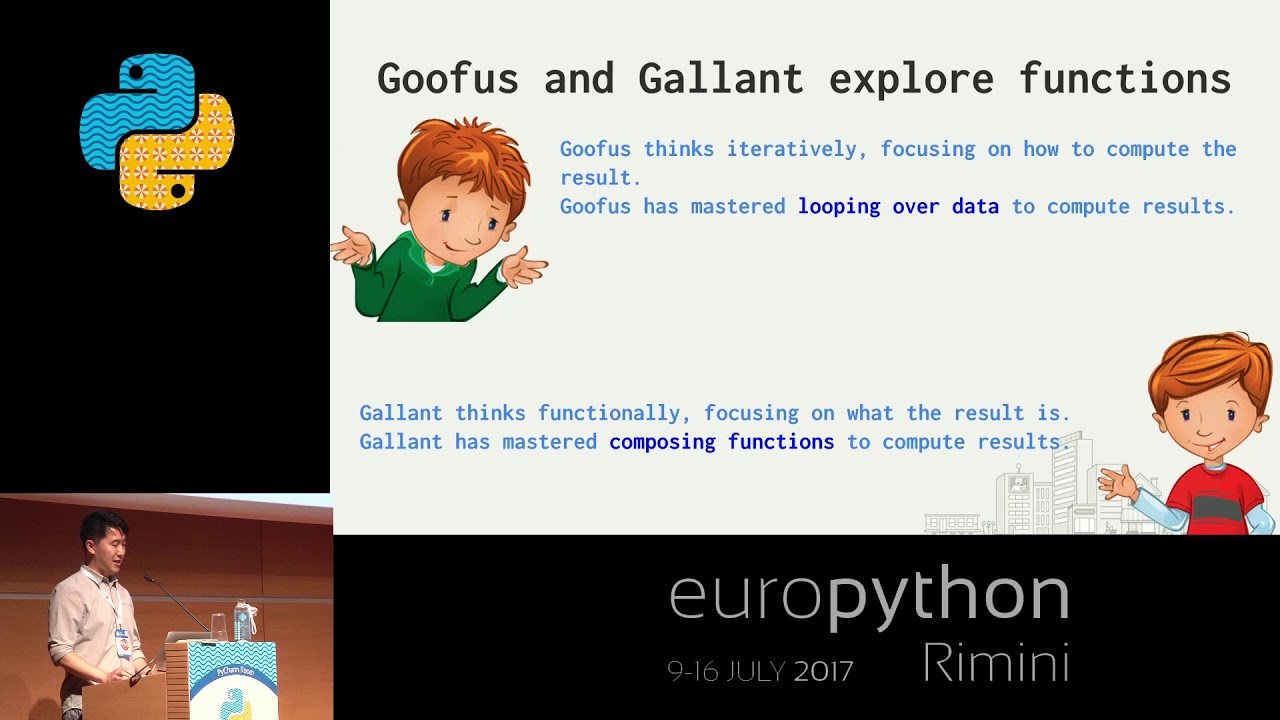
"Teeing up Python: Code Golf
[EuroPython 2017 - Talk - 2017-07-12 - PyCharm Room]
[Rimini, Italy]
Code golfing is an interesting heuristic dedicated to minimizing the overall length of code to produce the same functionality. The result doesn’t have to be incomprehensible, and...
night rapids
can @night quarry !e command import modules?
sick hound
Was just experimenting on python so there's no actual use for this, but I was wondering if there's a way to call dictionaries who have lambdas/functions as their key
This is all I was able to think of
d = {
    lambda x: x < 15: 'a',
    lambda x: 30 > x > 15: 'b',
    lambda x: x > 30: 'c',
}

for func, string in d.items():
    print(string if func(70) else '')
[val for func, val in d.items() if func(70)] is pretty similar, but makes a list of all matches.
 steady cape
!e
print("test")
night quarryBOT
@steady cape :white_check_mark: Your eval job has completed with return code 0.
test
coolö
hard spoke
something like
import itertools,collections
# recipe from itertools docs
def consume(iterator, n=None):
    "Advance the iterator n-steps ahead. If n is None, consume entirely."
    # Use functions that consume iterators at C speed.
    if n is None:
        # feed the entire iterator into a zero-length deque
        collections.deque(iterator, maxlen=0)
    else:
        # advance to the empty slice starting at position n
        next(itertools.islice(iterator, n, n), None)

consume(1 for func, val in d.items() if func(70))
would be as fast (or a bit faster) without creating a list of results.
sick hound
prob not the right channel but:
var = [(i.name, i.id) for i in ctx.guild.members]
# gives
[('Buster', 272699141358878720), ('Coppen', 444901560544264212), ('Testing Bot', 730739952391946252)]
How can I join this list of tuples?
I tried: ```py
print([' '.join(t) for t in var])
gives
TypeError: sequence item 1: expected str instance, int found
you want a list of strings?
var = [(i.name, str(i.id)) for i in ctx.guild.members]
if they were strings, it would just work
sick hound
In the end I want the result to be like
Buster - 272699141358878720
Coppen - 444901560544264212
...
right
Yes
    m_list = []

    for member in ctx.guild.members:
        m_list.append(f"{member.name} - {member.id}")
is what I had before
or is what I have
vestal solstice
cool
proper vault
[f'{i.name} - {i.id}' for i in ctx.guild.members]
This works
    var = [(i.name, '-', str(i.id)) for i in ctx.guild.members]
    res = [' '.join(t) for t in var]
    print('\n'.join(res))
[f'{i.name} - {i.id}' for i in ctx.guild.members]
@proper vault Yeah this is the most logical and best choice, thought I'd try it another way
apparently not the answer for everything haha
 hybrid hornet
Golf - lowest score wins right
Code Golf - fewest characters to get the solution wins
 river idol
If you want to try out golfing they've got some fun challenges at https://www.codingame.com

CodinGame
CodinGame is a challenge-based training platform for programmers where you can improve your coding skills with fun exercises (25+ languages supported)
@proud glade
 proud glade
ohkk
river idol
And there's also a whole Stack Exchange dedicated to the art https://codegolf.stackexchange.com

Code Golf Stack Exchange
Q&A for programming puzzle enthusiasts and code golfers
But most of the stuff there goes way over my head.
proud glade
ohll
hybrid hornet
And there's also a whole Stack Exchange dedicated to the art https://codegolf.stackexchange.com
@river idol Just threw up in my mouth at some of the threads on there
Code Golf Stack Exchange
Q&A for programming puzzle enthusiasts and code golfers
river idol
Yeah, people have written whole programming languages just for golfing 🙄
formal sandal
that's lame IMO
"hey look, it takes 1 character in this language, I've put so much creative effort into that"
brisk zenith
there's a golfing-focused derivative of python called "pyth" that takes an integer input, calulates the prime factors of said input, then prints it out as a list, with just one character.
P
i think the input and output is done implicitly at the start and end of the program and P is just the factorising function
thin trout
That kinda breaks the challenge lol
hard spoke
using unicode identifiers, one symbol is probably enough to encode the common codegolf programs
the only way to beat that is to design a language for each codegolf problem, in which case you can solve them in 0 symbols 🙂
brisk zenith
yup, code golf is more interesting in general-purpose languages anyways
sick hound
!e
int = str
print(isinstance('test', int))
@sick hound :white_check_mark: Your eval job has completed with return code 0.
True
!e
float = str
print(isinstance(3.4, float))
print(isinstance('3.4', float))
@sick hound :white_check_mark: Your eval job has completed with return code 0.
001 | False
002 | True
 fringe shell
Hello, I have a question.
If we have 'something.py' in our 'dir' directory we can import it with import dir.something. My question is that how can I import it, if the filename starts with a dot ('.') for example 'dir/.something.py' . If I'm using the wrong channel, tell me.
sick hound
Have a good day.
I have a problem in my code and I want to ask several questions.
X = "abcdefgğhıijklmnoöprsştuüvyzw"
#User must put a number between 1-10.
zeka = input("Zeka seviyenizi 1-10 arası bir sayı ile tanımlayınız:")
if zeka <= int(3):
    print(X[-9]+X[4]+X[15]+X[10]+X[15]+" "+X[-9]+X[16]+X[19]+X[-6]+X[15]+X[-6]+
          X[15]+" "+X[15]+X[4]+" "+X[1]+X[-6]+X[15]+X[3]+X[0]+X[15]+
          " "+X[3]+X[0]+X[8]+X[0]+" "+X[10]+X[-3]+X[10]+X[-9]+X[10]+X[15])
#I want to put >3 but <6 how can I do that?
elif zeka >(3):
    print(X[12]+X[4]+X[15]+X[3]+X[10]+X[15]+X[10]+" "+X[1]+X[10]+X[19]+X[0]
          +X[3]+X[0]+X[8]+X[0]+" "+X[6]+X[4]+X[13]+X[10]+X[-8]+X[-7]
          +X[10]+X[19])
#Here is the error when I test the error;
if zeka <= int(3):
TypeError: '<=' not supported between instances of 'str' and 'int'```
Thanks for help! <3Btw I am new python programmer so I don't know too much.
snow beacon
Maybe other channels would be better place to look for help. This channel is about making code as atrociously as possible.
sick hound
I'd argue it's beautiful, not atrocious
Oh thanks for info dude.
though I understand your view 😂
I am fetishizing the code.
And also which channel I may ask for help?
twilit grotto
!e
int, str = str, int

print(isinstance(10, str))
print(isinstance("10", str))
@twilit grotto :white_check_mark: Your eval job has completed with return code 0.
001 | True
002 | False
@fringe shell check out __import__
fringe shell
@static holly I did check it out. I learned that when using import xyz it is done with the __import__. But still ,if I want to use it, I need to something like that __import__('dir..something') to do it, which, by the way tries to import dir. for some reason. So I tried from dir import .something setup with __import__ , here is what I did : __import__('dir', globals(), locals(), ['.something']), but sadly it tried to import dir..something anyways. So still no solution.
And something interesting I noticed: if I try __import__('dir..something') it will say that there isn't a dir. directory, but if I rename dir to dir. it will say that there isn't a dir directory. Weird
fallen roost
how can i override serializer = AttendanceSerializer(y) this method anyone have idea?
proper vault
that calls __call__, which calls __new__ and __init__
static holly
I am pretty sure __call__ is for a call on the instance of the class
And when you do Class() it calls __new__
midnight bane
Yeah ^
New is for when the class is created
Init is when it's initialized
And call is for when you actually call the instance
 alpine flower
!e
import random
def rnd():
    return random.randint(0,2)
for i in range(0,5):
    lst = ["float", "int", "str"]
    statement = "{}={}".format(lst[rnd()],lst[rnd()])
    exec(statement)
    print("float={}".format(float))
    print("int={}".format(int))
    print("str={}".format(str), "{}".format(statement))
@alpine flower :white_check_mark: Your eval job has completed with return code 0.
001 | float=<class 'float'>
002 | int=<class 'int'>
003 | str=<class 'int'> str=int
004 | float=<class 'float'>
005 | int=<class 'int'>
006 | str=<class 'int'> str=int
007 | float=<class 'int'>
008 | int=<class 'int'>
009 | str=<class 'int'> float=str
010 | float=<class 'int'>
011 | int=<class 'int'>
... (truncated - too many lines)
Full output: https://paste.pythondiscord.com/ebewidofep
formal sandal
@alpine flower Shell game? 🙂
alpine flower
Shell game to make debugging harder
formal sandal
!e
import asyncio

# Library code:

async def run(generator, afn):
    try:
        resp = None
        while True:
            query = generator.send(resp)
            resp = await afn(query)
    except StopIteration as e:
        return e.value

# Third-party API that provides some sort of filesystem

def xpath(coll, path):
    acc = coll
    for key in path:
        acc = acc[key]
    return acc

DATABASE = {"$index": [("folder", "scripts"),("file", "hello_world"),("file", "aaa"),],"$store": {"scripts": {"$index": [("file", "a.py"),("file", "b.py"),],"$store": {"a.py": "# a.py","b.py": "# b.py",},},"hello_world": "HELLO!!!","aaa": "bbb"},}

async def api(path):
    await asyncio.sleep(len(path) * 0.05 + 0.05)
    try:
        data = ("ok", xpath(DATABASE, path))
    except KeyError:
        data = ("error", path)
    # print(f"got {data}")
    await asyncio.sleep(0.05)
    return data

# Application logic (walking the tree):

def walk(root, callback):
    (status, nodes) = yield (root + ["$index"])
    for (node_type, name) in nodes:
        if node_type == "file":
            yield from callback(root + ["$store", name])
        if node_type == "folder":
            yield from walk(root + ["$store", name], callback)

def recursive_walker():
    files = []

    def add_file(path):
        data = yield path
        print(f"path:{path} -> data:{data}")
        files.append( (path, data) )

    yield from walk([], callback=add_file)
    return files

# Running the app:

async def main():
    import pprint
    files = await run(recursive_walker(), api)
    pprint.pprint(files)

asyncio.run(main())
@formal sandal :white_check_mark: Your eval job has completed with return code 0.
001 | path:['$store', 'scripts', '$store', 'a.py'] -> data:('ok', '# a.py')
002 | path:['$store', 'scripts', '$store', 'b.py'] -> data:('ok', '# b.py')
003 | path:['$store', 'hello_world'] -> data:('ok', 'HELLO!!!')
004 | path:['$store', 'aaa'] -> data:('ok', 'bbb')
005 | [(['$store', 'scripts', '$store', 'a.py'], ('ok', '# a.py')),
006 |  (['$store', 'scripts', '$store', 'b.py'], ('ok', '# b.py')),
007 |  (['$store', 'hello_world'], ('ok', 'HELLO!!!')),
008 |  (['$store', 'aaa'], ('ok', 'bbb'))]
Inversion of control using generators! 
I think it's called dependency inversion or something like that
My business logic (walking the file tree) does not depend on the API, but can still perform powerful operation. That is, the request can depend on the API response.
This also allows for interactive development: you can pretend to be the API and interactively respond to your app's requests.
 snow geyser
!resources
night quarryBOT
Resources
The Resources page on our website contains a list of hand-selected learning resources that we regularly recommend to both beginners and experts.
https://pythondiscord.com/pages/resources
half sigil
the code works in rafea.py but doesn't in another.py
idk why
i'm using python version 3.7.9 and i'm using Windows 10 1909 if that matters
sorry abt the variable names
lmao, i just realized i should put this in #python-discussion
sorry you lot
grizzled cloak
@half sigil add a __init__.py file to your main dir
then it will be marked as a package
not sure if you ended up getting this answered in #python-discussion
sick hound
Can anyone make a code smaller than this but it shud wrk the same
b=lambda a,m:max({1:x}.get(a*x%m,1) for x in range(m))
it shud return the mod inverse of 2 numbers
(Ping me)
stark fable
b=lambda a,m:max({1:x}.get(a*x%m,1)for x in range(m))``` @sick hound :Paside from that i don't really know how to make it shorter, it's already pretty short
sick hound
Yeah lol
half sigil
@sick hound wdym mod inverse?
i might not be any help cuz i don't even know what mod inverse is
lmao
snow beacon
According to google, it's a number y such that (x*y)%m = 1, for a given input x and a modulo m.
hard spoke
It's the multiplicative inverse in the ring of remainders under division by m :P
snow beacon
There's a short version that unfortunately raises an exception when the answer is one:python b=lambda a,m:pow(a,-1,m)
stark fable
!e print(pow(1,-1,5))
...?
night quarryBOT
@stark fable :white_check_mark: Your eval job has completed with return code 0.
1
Oh, I guess it just raises it when the two numbers are coprime.
Aren't coprime? I don't know my modulo very well.
formal sandal
!e
print(pow(3, -1, 2))
@formal sandal :white_check_mark: Your eval job has completed with return code 0.
1
!e python print(pow(4,-1,2))
night quarryBOT
@snow beacon :x: Your eval job has completed with return code 1.
001 | Traceback (most recent call last):
002 |   File "<string>", line 1, in <module>
003 | ValueError: base is not invertible for the given modulus
There we go.
stark fable
alternatively you could write that as pow(0,-1,2)
formal sandal
Well, 4 % 2 == 0, and there's no such c that (4 * c) % 2 == 1
snow beacon
But to avoid changing the behaviour there, it should return 1.
formal sandal
oh, hm, right
snow beacon
Importing math for gcd is expensive, and it doesn't even give you the condition cheaply.
try/except is a lot of characters because you can't do it in a lambda. And you need two returns.
If only there were an inline try/except.
formal sandal
def b(a,m):
 try:return pow(a,-1,m)
 except:return 1
this is 52 characters long
the last golfed version seems to be 53 characters long
snow beacon
Oh, that's good.
snow beacon
def b(a,m,x=1):
 try:x=pow(a,-1,m)
finally:return x```This is probably similar length.
stark fable
it's exactly the same length
snow beacon
def b(a,m):
 try:x=pow(a,-1,m)
 except:x=1
return x```This is the same length too, I believe.yep
sick hound
def b(a,m,x=1):
 try:x=pow(a,-1,m)
 finally:return x```
@snow beacon Oh wow this is cool
but its not a 1 liner
sick hound
Wow @stark fable With a slight modification its very short now
b=lambda a,m:pow(a,-1,m) if a%m else 1
!e
b=lambda a,m:pow(a,-1,m) if a%m else 1
print(b(300,232))
print(b(4,2))
@sick hound :x: Your eval job has completed with return code 1.
001 | Traceback (most recent call last):
002 |   File "<string>", line 2, in <module>
003 |   File "<string>", line 1, in <lambda>
004 | ValueError: base is not invertible for the given modulus
It's whether they are co-prime, not whether one is a multiple of the other.
sick hound
aah yes
river idol
Anyone a fan of functional programming?
hard spoke
I am :P
import math
sin = MyFunction(math.sin)
X = np.linspace(0,4*math.pi,10000)
Y1 = sin@(lambda x:x**2)@X
Y2 = (lambda x:x**2)@sin@X

plt.close()
plt.figure()
plt.plot(X,Y1)
plt.plot(X,Y2)
plt.show()
!eval ```python
from functools import reduce
from operator import add, mul
def compose(*functions):
return reduce(
lambda f, g: lambda x: g(f(x)),
functions,
lambda x: x,
)
def curry(function):
return lambda first: lambda *rest: function(first, *rest)
CtoF = compose(curry(mul)(9/5), curry(add)(32))
FtoC = compose(curry(add)(-32), curry(mul)(5/9))
print(f"{'°C':>10}{'°F':>10}")
for temp in range(-30, 50, 5):
print(f"{temp:>10}{CtoF(temp):>10}")
@river idol :white_check_mark: Your eval job has completed with return code 0.
001 |         °C        °F
002 |        -30     -22.0
003 |        -25     -13.0
004 |        -20      -4.0
005 |        -15       5.0
006 |        -10      14.0
007 |         -5      23.0
008 |          0      32.0
009 |          5      41.0
010 |         10      50.0
011 |         15      59.0
... (truncated - too many lines)
Full output: https://paste.pythondiscord.com/siziyohawu
river idol
ohh, interesting
hard spoke
https://paste.pythondiscord.com/goquhojuje.rb here's the definition of the wrapper
river idol
Do you like my curry function?
hard spoke
supports functional powers too: sin**4@x is sin(sin(sin(sin(x))))
river idol
Hmm, I want to find some more interesting higher-order functions to implement.
river idol
It probably should have been this instead:
def curry(function):
    return lambda *rest: lambda last: function(*rest, last)
Then currys can be chained together with compose
Like compose(curry, curry, curry)(max)(1)(2)(3)(4)
thin trout
Hey, would you guys know how to make that shorter?
lambda t:''.join('||'+f+'||'for f in t)
Mhh an f-string should already be shorter, wouldn't it?
lambda t:''.join(f'||{f}||'for f in t)```lambda t:f'||{"||||".join(t)}||'
lambda t:''.join(f'||{f}||'for f in t)
thin trout
 smart Boi
cursive pine
have I hit #esoteric-python territory yet. 😛 I was just trying to do a simple pandas DF searchpython data_search = [data[data[x].str.contains(y, na=False, case=False)] for x in ('Title', 'description') for y in ('Covid', 'corona')]
formal sandal
nah, I can even read it
 outer glen
yaaa, me too, I came here yesterday, this is amazing
sick hound
What have I stumbled upon?
 ivory parcel
also some pretty great python here try running this code:
from datetime import timedelta
print(timedelta(seconds=-1))
!eval
from datetime import timedelta
print(timedelta(seconds=-1))
@ivory parcel :white_check_mark: Your eval job has completed with return code 0.
-1 day, 23:59:59
 calm rampart
there really need to be better ways to format time deltas
proper vault
probably makes it easier to implement
 quartz ore
@dense umbra Hey! I was in awe as well...this is a great community
 dense umbra
It is, is't it?
quartz ore
currently coding up a program to check if the servers are online in my organization and having a rough time getting this auto email part working 😦
snow beacon
I expect there are a lot of other channels that can help with that on the server.
hard spoke
Functions with arbitrary numbers of arguments
Wrong way:
def my_sum(*args):
    return sum(args)
Right way:
def my_sum_factory(n):
    argslist = [f"v{i}" for i in range(n)]
    s = f"""global _temp_fun
def _temp_fun({" = 0, ".join(argslist) + " = 0"}):
    return {" + ".join(argslist)}"""
    #print(s)
    exec(s,globals(),locals())
    return _temp_fun

my_sum = my_sum_factory(2**32-1)
really though, at n=2**14 it gets a RecursionError: maximum recursion depth exceeded during compilation on exec, and on higher n the Python interpreter crashes.
8192 arguments is perfectly fine, though.
 barren cairn
 proper vault
you can press ctrl+k
outer glen
What do you find annoying about tkinter, pls answer my question at #help-croissant
proper vault
# a is not in namespace
(a:=6) + a # works

a(a:=print) # NameError, a does not get set

a = str
a(a:=int) # "<class 'int'>"
a() # 0

a = 6
a(a:=8) # TypeError, a does get set
```interesting that calls first resolve name, then evaluate arguments, then check whether the lhs is callable and call itwonder if there is anything that resolves names not directly before acting upon their values.
huh, this seems := specific
snow beacon
I think of foo(bar) as an operation on foo. It makes sense that foo would need to be evaluated first.
rugged sparrow
!e ```py
(p:=print)(p)
@rugged sparrow :white_check_mark: Your eval job has completed with return code 0.
<built-in function print>
!e ```py
(a:=[]).append(a)
print(a)
@rugged sparrow :white_check_mark: Your eval job has completed with return code 0.
[[...]]
!e
a = (lambda: (a:=[]).append(a))()
print(a)
@fiery hare :white_check_mark: Your eval job has completed with return code 0.
None
!e py (lambda: (a:=[]).append(a))() print(a)
night quarryBOT
@rugged sparrow :x: Your eval job has completed with return code 1.
001 | Traceback (most recent call last):
002 |   File "<string>", line 2, in <module>
003 | NameError: name 'a' is not defined
wait is a placed in a local scope?
edgy kelp
Well it is a function, scope and all
half sigil
hmm, how would i be able to make this shorter?
def solution(a):e,w,n,s=map(a.count,"ewns");return(b==c)*(d==e)*11>len(a)
it needs to return true if e == w n == s and the length of a is shorter than 11
vestal solstice
e==w<len(a)<11>n==s
calm rampart
ughhhh