#esoteric-python
1 messages · Page 89 of 1
 proper vault
 sick hound
Ah yeah, since it's only needed in one place now
proper vault
aren't z and i always the same thing?
sick hound
Hmm, they could be the same thing
sick hound
Yeah, they are unrelated but can be the same with no problem^^
z used to be the iteration depth
x=y=0;i=50;q=print
while y<i:
 c=p=0;x=-~x%i
 if x==1:q();y+=1
 while p<i and abs(c:=c*c+complex(y/i-.8,x/i-.5)*2.2)<2:p+=1
 q(" #"[p==i],end=' ')
141 chars now
 snow beacon
You don't need to assign to o. It's only used once.
Oh, maybe you do.
For sequencing, that is.
proper vault
seems to work fine
sick hound
True, o is never changed therefore the assignment is unnecessary
proper vault
if will sometimes get different y value though
snow beacon
Could you do something like while abs(c:=c*c+o)<2:p+=p<i? Or might that loop forever?
Can o be 0?
And you still don't need indents that big.
One space is sufficient.
sick hound
Yeah, my editor forces me to write them
snow beacon
If o can be zero, you could do while(abs(c:=c*c+o)<2)*o:p+=p<i so it doesn't get stuck in a loop.
Wait, no, that's different logic.
Oh, right, o is gone.
 stark fable
is it possible for p to end up being bigger than i?
sick hound
Yes
snow beacon
Not with the current loop condition?
sick hound
Well, no
There needs to be some mechanism in place, so that the loop doesn't loop forever, and p does that.
stark fable
"# "[p<i] is one character shorter than " #"[p==i]
stark fable
if you flip around both the string and the p<i/p==i then it won't be inverted
snow beacon
Do you need to call complex(a,b)? Can't you do a+b*1j?
Oh, brackets around b.
Still shorter, I believe.
stark fable
abs(c:=c*c+complex(y/i-.8,x/i-.5)*2.2)
abs(c:=c*c+(y/i-.8+(x/i-.5)*1j)*2.2)```2 characters shorter
sick hound
Works
stark fable
possibly better if someone figures out how to get rid of some of those brackets
sick hound
Is this notation a shorthand for complex numbers in Python?
stark fable
>>> complex(0,1)
1j
>>> 1j
1j```Ahh okay
stark fable
abs(c:=c*c+complex(y/i-.8,x/i-.5)*2.2)
abs(c:=c*c+(y/i-.8+(x/i-.5)*1j)*2.2)
abs(c:=c*c+(y/i-.8+x/i*1j-.5j)*2.2)```good spot
that should work
i think
snow beacon
and abs(...)<2 -> and-2<(...)<2
proper vault
that abs is of a complex number
snow beacon
Oh, curse my assumptions.
 harsh canopy
Excuse the vulgarity of the source, I'm working with a library called "fuckitpy"
https://hastebin.com/guloxanoge.py
I'm trying to implement a custom codec, and I'm having trouble with what I think is the incremental decoder. The final parameter should be true on the very last call to the incremental decoder's decode method, however it seems to be stuck in a loop calling this method with the final parameter set to true with no data being passed. The codec registers and all the source of the file being run is passed to the decode function, but once it reaches the end of the file it passes nothing forever.
Anyone have any idea how I can sort this out?
This is the example I'm working with https://github.com/aroberge/ideas/blob/master/ideas/encoding.py

GitHub
Easy creation of custom import hooks to experiment on alternatives to Python's syntax; see https://aroberge.github.io/ideas/docs/html/ - aroberge/ideas
 formal sandal
Is it the https://github.com/ajalt/fuckitpy ?

GitHub
The Python error steamroller. Contribute to ajalt/fuckitpy development by creating an account on GitHub.
sick hound
x=y=0;i=50;q=print
while y<i:
 c=p=0;x=-~x%i
 if x==1:q();y+=1
 while p<i and abs(c:=c*c+complex(y/i-.8,x/i-.5)*2.2)<2:p+=1
 q(" #"[p==i],end=' ')
141 chars now
@sick hound what the fuck
 limpid crest
@sick hound this is the esoteric python channel, what did you expect? lol
 tribal moon
I made the fake windows blue screen more realistic
it makes the cursor invisible as well as restarts the computer
formal sandal
Could you also make it work for Linux? :D
snow beacon
Is this shorter? It has slightly different behaviour because it doesn't print a trailing space before newlines.python x=y=0;i=50 while y<i: c=p=0;x=-~x%i;v=x==1;y+=v while p<i and abs(c:=c*c+(y/i-.8+x/i*1j-.5j)*2.2)<2:p+=1 print(" #"[p==i],end=' \n'[v])
Looks about 6 shorter.
If you want the trailing spaces, though, you can add two characters: end=' \n'[v] -> end=' '+'\n'*v
tribal moon
I can make it work for linux
but I've never used Linux before
so I need to know how it looks like when it has an error
What does a Linux version of a BSoD look like?
snow beacon
Try these. https://askubuntu.com/questions/561224/what-is-the-equivalent-of-blue-screen-of-death-in-linux

Ask Ubuntu
Will the computer just freeze or will it display a error message like BSoD?
tribal moon
Yeah
I don't know if anyone knows this, but what is the font in the error terminal thing
 modest glade
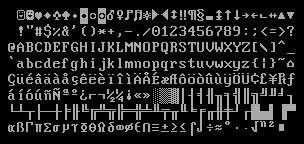
Code page 437 (CCSID 437) is the character set of the original IBM PC (personal computer). It is also known as CP437, OEM-US, OEM 437, PC-8, or DOS Latin US. The set includes all printable ASCII characters, extended codes for accented letters (diacritics), some Greek letters, ...
tribal moon
wow.
Thanks
Well I think I can do it
But I don't think I have the time for it
maybe I can do it
just not in one line
and I also can't disguise it as something else
I could if I wanted too
 hollow patrol
Idea: A program that converts python code to much uglier versions
if True:
  print(3)
to
while True:
  print(3)
  break
and works in multiple steps
so you can convert it to one form, then do it again until it's maximum ugly
 proper frigate
It would be horrible to use, but fun to do lmao
 vague hearth
i think it should conver to this instead py for _ in range(True): print(3) continue
 vestal solstice
print(end = '3\n')
 thin trout
sys.stdout.write('3\n')
sick hound
sys.stdout.write("".join([chr(n) for n in [13, 51]]))
thin trout
Oh nice one
formal sandal
I am deeply confused
thin trout
That's the point :D
thin trout
What's the difference?
formal sandal
!e
import sys
sys.stdout.write("".join([chr(n) for n in [13, 52]]))
 night quarryBOT
@formal sandal :white_check_mark: Your eval job has completed with return code 0.
001 |
002 | 4
Hmm
formal sandal
?!??!?!?!?
 gaunt panther
is python effecient in small(est sometimes?) bytes for any particular program?
formal sandal
what the steaming fuck
thin trout
Different encoding perhaps?
night quarryBOT
@formal sandal :white_check_mark: Your eval job has completed with return code 0.
<_io.TextIOWrapper name='<stdout>' mode='w' encoding='utf-8'>
same
thin trout
!e
print(ord('4'), ord('2'))
night quarryBOT
@thin trout :white_check_mark: Your eval job has completed with return code 0.
52 50
like you know jelly, it takes very less space to execute something
sso how good is python in those cases
 spark dock
what about me
thin trout
sys.stdout.write("".join([chr(n) for n in [int(i, base=2) for i in [1101, 110100]]]))```you can throw some binary in there tooYou could do a PyVM eso language lol
formal sandal
Syntax error
thin trout
I'm missing a ]
gaunt panther
why am i asking here........ how do I install jelly?
formal sandal
I've been working a bit on a stack-based language, now I'm writing a VM in C for it, and it's still gonna have a Python frontend (bytecode compiler, maybe REPL)
thin trout
If you are going this way, I'd really recommend you to read "the dragon book", it is a book about compiler techniques and stuff, the original python parser (< 3.8) follow this exact implementation
It is really technical, but it is great
@grizzled folio you should take a look at #❓|how-to-get-help, this isn't an help channel :D
gaunt panther
i wasn't able to find his mention lol
formal sandal
Thanks @thin trout , I'll check it out
vestal solstice
@gaunt panther ```
$ git clone -q https://github.com/DennisMitchell/jellylanguage.git
$ cd jellylanguage
$ pip3 install --upgrade --user .
wai wha? jelly is writtin in python?
gaunt panther
but how will i type in jelly
vestal solstice
I don't actually know how people do that heh
I mean you can copy paste by character
gaunt panther
yeah, if only I can i can understand jelly, bye, imma take its tutorial
 limber orchid
I guess this is a 'code golf'-ish question.
Is it possible to go from:
a = some_fun(x)
b = some_fun(y)
to
a, b = some_fun(x,y)
``` in some way?a, b = map(some_fun, [x, y])
Perfect, I forgot about that, thanks.
 marsh void
a, b = map(some_fun, (x, y))``` don't waste memory 👀!e
import sys
sys.stdout.write("".join([chr(n) for n in [13, 52]]))
@formal sandal excuse me why does that not work
night quarryBOT
@marsh void :white_check_mark: Your eval job has completed with return code 0.
001 |
002 | 4
h u h
sick hound
that should be 52, 13 but yea
marsh void
ah
marsh void
!e python import sys sys.stdout.write("".join(map(chr, (52, 13))))
night quarryBOT
@marsh void :white_check_mark: Your eval job has completed with return code 0.
4
hm
sick hound
!e print(chr(52))
night quarryBOT
@sick hound :white_check_mark: Your eval job has completed with return code 0.
4
some control character magic?
sick hound
!e print(chr(0x52))
night quarryBOT
@sick hound :white_check_mark: Your eval job has completed with return code 0.
R
thats.. supposed to say 3
i think it should conver to this instead
py for _ in range(True): print(3) continue
@vague hearth
!eval
import sys
sys.stdout.write("".join([chr(n) for n in [51, 13]]))
@sick hound :white_check_mark: Your eval job has completed with return code 0.
3
writing to stdin?
sick hound

 topaz anchor
oh
that took some time
but I just managed to figure out what was happening
so chr(13) is the \r character, and sys.stdout.write returns the amount of chars written
which is why in the terminal/shell you see the 4-2; the 4 is from chr(51) while 2 is from the sys.stdout.write call
tribal moon
import sys;sys.stdin.write("".join(map(chr,(51,13))))```
why use semicolons?
sick hound
cuz minified
tribal moon
do it in one line without semicolons
tribal moon
use import
night quarryBOT
@sick hound :white_check_mark: Your eval job has completed with return code 0.
<module 'sys' (built-in)>
OH
tribal moon
__import__('sys').stdin.write("".join(map(chr,(51,13))))```well I'm not the one who wrote it
when I do this kind of stuff
I usually prefer to put it in lambda functions
so instead of py __import__('sys').stdout.write("".join(map(chr,(51,13))))
I do py (lambda sys: sys.stdout.write("".join(map(chr,(51,13)))))(__import__('sys'))
sick hound
asdsd
OH OOPS
!e
(lambda ch: list(filter(lambda x: x[0] == ch(str(7772697465)),(lambda y: y.__dict__[ch("6765746d656d62657273")]((lambda x: x.__dict__[ch("7374646f7574")])(__import__(ch(str(737973))))))(__import__(ch("696e7370656374")))))[0][1](ch("68656c6c6f20776f726c642121")))(lambda s: "".join(map(lambda a: chr(int(a, 16)), [s[i * 2:(i + 1) * 2] for i in range((len(s) + 1) // 2)])))
@sick hound :white_check_mark: Your eval job has completed with return code 0.
hello world!!
:D
 neat otter
haha nice

 stone bane
There was a time when I thought hello world was the simplest program in any programming language, it was supposed to be what you started with.
No longer. I am now a changed man, my eyes have been opened.
goes to find bleach
limpid crest
how do I get started on this hell
sick hound
oh im not done yet
i just discovered you can use builtins with lambdas
!e
a = "123"
print(list((lambda x: x(int, a))(map)))
@sick hound :white_check_mark: Your eval job has completed with return code 0.
[1, 2, 3]
and i figured, since i use inspect.getmembers in the code to get write(), why not get __dict__ too
how do I get started on this hell
@limpid crest
basically did
list(filter(lambda x: x == "write", inspect.getmembers(sys.stdout)))[0][1]("hello world!!")
?
sick hound
you asked how to get started, i assumed you meant reading it
sick hound
ohhh, you want to make hellish code?
limpid crest
I wanna get started
And idk where to go
I'm an intermediate python programmer
Or that's how I consider myself
sick hound
i mean i just abuse lambda and map
limpid crest
okay
sick hound
moogs inspired me
limpid crest
I can't wait to be able to do this
(lambda ch: list(filter(lambda x: x[0] == ch(str(7772697465)),(lambda y: y.__dict__[ch("6765746d656d62657273")]((lambda x: x.__dict__[ch("7374646f7574")])(__import__(ch(str(737973))))))(__import__(ch("696e7370656374")))))[0][1](ch("68656c6c6f20776f726c642121")))(lambda s: "".join(map(lambda a: chr(int(a, 16)), [s[i * 2:(i + 1) * 2] for i in range((len(s) + 1) // 2)]))) ```:>
limpid crest
:^)
sick hound
just a piece at a time
limpid crest
To be honest I have no idea what's going on in that code
I just know it prints hello world
sick hound
import sys
sys.stdout.write("hello!")

__import__("sys").stdout.write("hello!")

(lambda x: x.stdout.write("hello!"))(__import__("sys"))
thats evolution ^^^
the random character strings/numbers area the hex representations of sys, stdout.. etc
ch() converts them to strings
limpid crest
okay?
 rugged sparrow
!e ```py
import('ctypes').py_object.from_address(id(1)+8).value=type('', (int,), {'repr':lambda a: 'hello world'})
print(1)
print(1 .repr())```
night quarryBOT
@rugged sparrow :x: Your eval job has completed with return code 1.
001 | Traceback (most recent call last):
002 |   File "<string>", line 1, in <module>
003 | NameError: name 'py' is not defined
Ugh mobile
!e ```
import('ctypes').py_object.from_address(id(1)+8).value=type('', (int,), {'repr':lambda a: 'hello world'})
print(1)
print(1 .repr())```
night quarryBOT
@rugged sparrow :x: Your eval job has completed with return code 139 (SIGSEGV).
hello world
segfaults
rugged sparrow
Eh it worked mostly
I'm replacing the base class of 1 with a custom class
!e ```
import('ctypes').py_object.from_address(id(1)+8).value=type('', (int,), {'repr':lambda a: 'hello world'})
print(1)```
night quarryBOT
@rugged sparrow :white_check_mark: Your eval job has completed with return code 0.
hello world
I guess it doesn't like when you access repr directly
limpid crest
How do you cause a segfault in python lmao
rugged sparrow
Mess with the internals
stark fable
!e py __import__('ctypes').string_at(4)
night quarryBOT
@stark fable :warning: Your eval job has completed with return code 139 (SIGSEGV).
[No output]
you can also just do that
tribal moon
one line it
hollow patrol
someone needs to make a program that makes python longer
if True:
  print(3)
to
for _ in range(bool(True)):
    print(3)
to
iterable = iter(range(bool(True)))
try:
    while True:
        _ = next(iterable)
        print(3)
except StopIteration:
    pass
and
def func(x):
  print(x)
  return x + 1
a = func(1)
b = func(2)
to
print(1)
a = 1 + 1
print(2)
b = 2 + 1
 dapper parrot
my dad wrote a program that did something like that in the 80s
tribal moon
Someone made a program that makes scripts in one line
for python
I can actually make a script to generate one line code with that website
in one line too
hollow patrol
@tribal moon That's for Python 2
Someone else made it
I'm making a Python 3 version
 frigid wharf
!e ```py
add = lambda x,y:(lambda v:v(x,'add'))(lambda m,l:(list(filter(lambda z:z[0]==l,import('inspect').getmembers(import('ctypes').cast(id(m),import('ctypes').py_object).value)))[0][1]))(y)
print(add(2,7))
print(add(3.2,2.7))
@frigid wharf :white_check_mark: Your eval job has completed with return code 0.
001 | 9
002 | 5.9
@func_def(kernel32.OpenProcess)
def open_process(
    access: wintypes.DWORD, inherit_handle: wintypes.BOOL, process_id: wintypes.DWORD
) -> wintypes.HANDLE:
    pass

handle = open_process(access=PROCESS_ALL_ACCESS, inherit_handle=False, process_id=...)
``` improved func_def once again!all these weird positional arguments can now be easily read without opening docs!
https://paste.pythondiscord.com/iqekenozaw.py here's the code
tribal moon
@hollow patrol That's very impressive! Notify me when you finish
tribal moon
I've made the Py2 version so far
(lambda requests, code: print(requests.get("http://www.onelinerizer.com/onelineit/", params={'code': code}).content.replace(b'__builtin__', b'builtins')))(__import__('requests'), open(input('Name of python file to oneline: '), 'r+').read())```But I really want to try your Py3 version
it uses http://www.onelinerizer.com/ to do it
Convert any Python 2 script into a single line. No newlines allowed. No semicolons, either. No silly file I/O tricks, or eval or exec. Just good, old-fashioned lambda.
It works for some Python 3 code, because in Python 2, you weren't able to do this py (lambda: print('something'))(), it would give a syntax error, so instead, they did this py (lambda _print: _print('hi'))(__import__('__builtin__').__dict__['print']), but in Python 3, __builtin__ module was renamed to builtins, so this code replaces that with the newer version, so it can work better
(lambda _print: _print('hi'))(__import__('builtins').__dict__['print'])```I mean with the site or the code
you can potentially one line almost anything
(lambda __g: (lambda __mod: [[[(app.run('127.0.0.1', port=80), None)[1] for __g['hello'] in [(app.route('/')([__func for __func, __func.__name__ in [(lambda : __import__('requests').get('https://www.stackoverflow.com').content, 'hello')]][0]))]][0] for __g['app'] in [(Flask(__name__))]][0] for __g['Flask'] in [(__mod.Flask)]][0])(__import__('flask', __g, __g, ('Flask',), 0)))(globals())
``` like this Flask app that recreates stack overflow frozen holly
im not very good at alot of esoteric stuff, but replace the default sorting algorithm with somthing stupid like bogo sort
tribal moon
(lambda random: random.randint(*sorted([random.randint(*sorted([random.randint(*sorted([random.randint(*sorted([random.randint(*sorted([random.randint(1, 1000), random.randint(1, 1000)])), random.randint(*sorted([random.randint(1, 1000), random.randint(1, 1000)]))])), random.randint(*sorted([random.randint(*sorted([random.randint(1, 1000), random.randint(1, 1000)])), random.randint(*sorted([random.randint(1, 1000), random.randint(1, 1000)]))]))])), random.randint(*sorted([random.randint(*sorted([random.randint(*sorted([random.randint(1, 1000), random.randint(1, 1000)])), random.randint(*sorted([random.randint(1, 1000), random.randint(1, 1000)]))])), random.randint(*sorted([random.randint(*sorted([random.randint(1, 1000), random.randint(1, 1000)])), random.randint(*sorted([random.randint(1, 1000), random.randint(1, 1000)]))]))]))])), random.randint(*sorted([random.randint(*sorted([random.randint(*sorted([random.randint(1, 1000), random.randint(1, 1000)])), random.randint(*sorted([random.randint(*sorted([random.randint(1, 1000), random.randint(1, 1000)])), random.randint(*sorted([random.randint(1, 1000), random.randint(1, 1000)]))]))])), random.randint(*sorted([random.randint(*sorted([random.randint(1, 1000), random.randint(1, 1000)])), random.randint(*sorted([random.randint(*sorted([random.randint(1, 1000), random.randint(1, 1000)])), random.randint(*sorted([random.randint(1, 1000), random.randint(1, 1000)]))]))]))]))])))(__import__('random'))``` Super random@tribal moon It doesn't work for all cases
tribal moon
Your version?
hollow patrol
Yep
Notable failures: return, try, continue, break, yield
global, local, nonlocal
tribal moon
Do you know what contextlib is?
hollow patrol
And I can't add in return, continue, or break without try either
Yep
But contextlib won't work in cases where I need access to the outer scope
Like setting a variable in the try and except bodies
tribal moon
can onelinerizer do that?
hollow patrol
yeah, it might be able to
hollow patrol
I'm not sure, it's not my main priority
So not for a bit
But when I pick it back up I'll work on a scoping generator
Which uses dictionaries over :=
tribal moon
Well you can use onelinerizer to make onelined code
hollow patrol
for python 2
tribal moon
It's meant for python 2 code
hollow patrol
python 2 is deprecated
hollow patrol
not all of it
tribal moon
well yeah
hollow patrol
try using yield in it
hollow patrol
see?
that's the problem
anyways I'm not working on this for some time
I have other projects
dapper parrot
you can also one-line anything by just having it get run from a string
sick hound
thats cheating
 earnest wing
Manually forming and compiling an AST? :^)
dapper parrot
exec(__import__("zlib").decompress(b"x\x9c]\x8d1\x12\xc3 \x0c\x04{^\xa1P\x99\xb4\xee\xf2\x82< \x1f`la\x98\x01\x89\x91D\x91\xdf\x07'\xaer\xe5\xde\xed\\\x97B\xb6\xf8'\xd6\xca7x\xe5\xa2\xd0\x85\x0f\x89\r\x86\xa2B\x1a\xb4YaR\x88\xb4\x83\xa0\r!P\x8b\x86\r\xc9~\x94-\xa3\xc0\xc6\\g3R\xf2\xc1\xed\x98\xa0\xbdOy\x89r\x84\x87\x83\x99\xcb\x9e\xe0\xbe:\xd7\xbf\xcf\xd7\xc8\xe7\xe2C\xf8\x83\xebI>!\xec6}"))```
(lambda __g: (lambda __mod: [[[(app.run('127.0.0.1', port=80), None)[1] for __g['hello'] in [(app.route('/')([__func for __func, __func.__name__ in [(lambda : __import__('requests').get('https://www.stackoverflow.com').content, 'hello')]][0]))]][0] for __g['app'] in [(Flask(__name__))]][0] for __g['Flask'] in [(__mod.Flask)]][0])(__import__('flask', __g, __g, ('Flask',), 0)))(globals())
``` like this Flask app that recreates stack overflow
things like this are pretty tho
hollow patrol
@dapper parrot @earnest wing Both of those are cheating.
dapper parrot
yeah sure
earnest wing
Hence the :^)
tribal moon
I think when it comes to one liners, exec and ; would be considered cheating
 amber ermine
How can I make a keyword? Like, what if I wanted to do print "Hello" in Python 3, how would I make that keyword?
 vague gust
Hey all, I've just merged a load of pull requests from https://github.com/python-discord/esoteric-python-challenges and I think it'd be really fun to get it started again (this is the 6th most active topical channel so I think there would be some interest)

GitHub
Contribute to python-discord/esoteric-python-challenges development by creating an account on GitHub.
If anyone wants to suggest challenges feel free to PR them to the challenges directory and if we get an interest I could look into setting up an announcement role for new challenges or something
There is a challenge generator in the tools directory for those looking to add challenges
 analog dust
hey, why do i get a "File not found error" even though the file im trying to open is in the same folder?
 whole kiln
You should claim a help channel to ask that #❓|how-to-get-help
analog dust
oh okay alright
proper vault
@amber ermine you can use #coding: printkw by adding a custom codec
amber ermine
@amber ermine you can use
#coding: printkwby adding a custom codec
@proper vault Thanks :D I'll look into that
 vague gust
heh
marsh void
I legit forgot I participated in one
now that I know much more python than I did back then, time to make more funky stuff :p
import ctypes is always a solid start
vague gust
lul
sick hound
Eval's are stackable: ```py
double_stack = eval('eval("1+1")')
triple_stack = eval('eval("eval(\"1+1\")")')
Is this possible for stacks with more than three evals? I have tried
```py
quadruple_stack = eval('eval(\"eval(\\"eval(\\\"1+1\\\")\\")\")')
```and ```py
quadruple_stack = eval('eval(\"eval(\\"eval(\\\\"1+1\\\\")\\")\")')
But both of them throw a syntax error. it's really hard to get what's going on with so many strings being parsed.
proper vault
In [89]: quadruple_stack = eval(r'eval("eval(\"eval(\\\"1+1\\\")\")")')
```this worksOoh, I haven't thought of using raw strings that way
Alright, so this works for a stack of five:
quintuple_stack = eval(r'eval("eval(\"eval(\\\"eval(\\\\\\\"1+1\\\\\\\")\\\")\")")')
and this for a stack of six hehehe ```py
sextuple_stack = r'eval("eval("eval(\"eval(\\\"eval(\\\\\\\"1+1\\\\\\\")\\\")\")")")'
And here's the whole thing done 12 times
proper vault
made a 20 stack, but paste sites keep crashing
proper vault
the file I wrote it is 2MB
30 stack was 2G, and I think that was some hard limit rather than the actual size
sick hound
Yeah, this is how I stack them ```py
def stack_evals(expression, n=10):
slashes = 0
add = 1
s = r""

for _ in range(n):
    s += (r'eval(' + "\\" * slashes) + '"'
    slashes += add
    add *= 2

s += expression

for _ in range(n):
    add //= 2
    slashes -= add
    s += ("\\" * slashes) + '")'


return s
so 2G may actually be accurate, as it is 1024 times more than 2M
ah, I just did
base, res = 'eval({!r})','1+1'
for _ in range(20):
    res = base.format(res)
Oh, this is good
proper vault
could also do
res = '1+1'
for _ in range(20):
    res = f'eval({res!r})'
```to possibly be faster!r forces it to be formatted as a raw string by adding escapes?
proper vault
it means it uses repr(res) rather than str(res)
sick hound
This is how long the execution takes with different stack depths
The program is just a simple hello world
sick hound
how do you write python that is esoteric
like the stuff filled with lambdas, etc
is there a guide anywhere?
 brisk zenith
not really. the best thing to do is to take a very simple program and break it down piece by piece until you can write it all as one line for example
that's what i did to make this single-expression guessing game: https://discordapp.com/channels/267624335836053506/470884583684964352/488095199575277578
dapper parrot
does eso include underhanded
snow beacon
Certainly.
dapper parrot
noice
stark fable
this is a function to compute the string 'getattr'
proper vault
Where do s,k come from?
stark fable
s=lambda a:lambda b:lambda c:a(c)(b(c))
k=lambda a:lambda b:a```the function is also called with the arguments 0, 1, lambda a:lambda b:a+b, and chr
proper vault
Interesting
 true mortar
Has anyone here made a pip package before?
snow beacon
forbiddenfruit is up there. Was it made by one of us?
brisk zenith
nope :D
 wraith galleon
I am trying out cython
sick hound
OH NO
What did I write?
def add(numbers):
    a = ""
    b = "0"
    c = "number"
    d = "1"
    total = []
    while True:
        e = len(numbers)
        number = numbers[len(a)]
        numbers = numbers[len(b):e]
        while True:
            total.append(c)
            number = number - (int(b) + 1)
            if number == int(b):
                break
        if len(numbers) == len([] * int(b)):
            break
    result = (len(str(total))) / int(d + b)
    print(result)
And how does it work?
stone bane
What's numbers. Datatype. Also this feels like the wrong room for this, you should take up a help channel instead
snow beacon
This https://www.python.org/dev/peps/pep-0622/ has the potential to open up a lot of diabolical possibilities for esoterica.

Python.org
The official home of the Python Programming Language
 teal monolith
It looks interesting but also confusing as hell
I can't wrap my head around it fully
snow beacon
If you've played around with it in another language it's easier to grok.
Although all of the stuff about __match__ is indeed incomprehensible.
 umbral night
Anyone here be able to help me a bit with programmatic access to a decorator that takes parameters?
Basically this:
import argparse
from cmd2 import Cmd, with_argparser


p = argparse.ArgumentParser()
p.add_argument('filename')

class TestApp(Cmd):

    def __init__(self, *args, **kwargs):
        super().__init__(*args, **kwargs)
        self.do_example = with_argparser(p)(self.do_example)


    def do_example(self, args) -> None:
        self.poutput(f"Argument is: {args.filename}")

    @with_argparser(p)
    def do_example2(self, args) -> None:
        self.poutput(f"Argument is: {args.filename}")

if __name__ == '__main__':
    import sys
    app = TestApp()
sys.exit(app.cmdloop())```The normal usage is as seen with do_example2. What I'd like is to apply the decorator programmatically as seen in __init__ (as for why, presume I do not have an XY problem 🙂 )
What I get is:
Traceback (most recent call last):
  File "/home/epoulsen/.local/lib/python3.8/site-packages/cmd2/cmd2.py", line 1646, in onecmd_plus_hooks
    stop = self.onecmd(statement, add_to_history=add_to_history)
  File "/home/epoulsen/.local/lib/python3.8/site-packages/cmd2/cmd2.py", line 2075, in onecmd
    stop = func(statement)
TypeError: cmd_wrapper() missing 1 required positional argument: 'statement'
EXCEPTION of type 'TypeError' occurred with message: 'cmd_wrapper() missing 1 required positional argument: 'statement''```The odd part is that example2 is a bound method, as you'd expect, while example is not, so I tried binding it using types.MethodType, but that would yield: EXCEPTION of type 'TypeError' occurred with message: 'do_example() takes 2 positional arguments but 3 were given'
snow beacon
Consider looking into MethodType in types.
umbral night
👍
Dunno if you read my last message, but I had already tried that.
In any case the problem is that do_example is a bound method before doing the decorator in __init__. The solution was to declare do_example as a static method, then using types.MethodType after doing the decoration.
snow beacon
Well I thought I had, but apparently not.
 hallow hinge
One liner for a noughts and crosses game. I found out that list comprehensions are good for replacing while loops as well since you can change the iterator from within. It does pretty much everything you'd expect except win detection.
formal sandal
!e
from functools import partial


class InstanceDecorator:
    def __init__(self, wrapper, **kwargs):
        self.wrapper = wrapper
        self.kwargs = kwargs
        self.arg = None

    def __call__(self, fn):
        self.arg = fn
        return self


_BAR_METHODS = []
def bar():
    for method in _BAR_METHODS: method("Bar")


def process_instance_decorators(cls):
    class _Wrapper(cls):
        def __init__(self, *args, **kwargs):
            cls.__init__(self, *args, **kwargs)
            self._apply_instance_decorators()

        def _apply_instance_decorators(self):
            for attr_name in dir(self):
                attribute = getattr(self, attr_name)
                if isinstance(attribute, InstanceDecorator):
                    instance_decorator = attribute
                    instance_decorator.wrapper(partial(instance_decorator.arg, self), **instance_decorator.kwargs)
    _Wrapper.__name__ = cls.__name__
    _Wrapper.__qualname__ = cls.__qualname__
    return _Wrapper


@process_instance_decorators
class Foo:
    @InstanceDecorator(_BAR_METHODS.append)
    def hello(self, phrase): print("Foo", phrase)


@process_instance_decorators
class LeftRightPrinter:
    def __init__(self, left): self.left = left

    @InstanceDecorator(_BAR_METHODS.append)
    def world(self, right):
        for i in range(50):
            buf = ""
            if i % 3 == 0: buf += self.left
            if i % 5 == 0: buf += right
            if buf == "": buf += str(i)
            print(buf, end=" ")
        print()

f = Foo()
bar()
g = LeftRightPrinter("Fizz")
bar()
@formal sandal :white_check_mark: Your eval job has completed with return code 0.
001 | Foo Bar
002 | Foo Bar
003 | FizzBar 1 2 Fizz 4 Bar Fizz 7 8 Fizz Bar 11 Fizz 13 14 FizzBar 16 17 Fizz 19 Bar Fizz 22 23 Fizz Bar 26 Fizz 28 29 FizzBar 31 32 Fizz 34 Bar Fizz 37 38 Fizz Bar 41 Fizz 43 44 FizzBar 46 47 Fizz 49
Problem statement: make a generator run on each instance creation and accept a bound (instance) method instead of running once on a plain function.
Is there a better/more flexible/more ugly way of doing this?
 eager pond
#help-pineapple for posterity
formal sandal
Last time you used that word I had to google it
Well, I subscribed to a word-of-the-day service, so my vocabulary will double in 10 years
eager pond
hmm what would the metaclass approach look liike
formal sandal
Well, that kind of answers Is there a <...> more ugly way of doing this?
eager pond
@messenger.event_class
class MessageHandling(BaseService):

    def __init__(self):
        pass
        messenger.subscribe(Events.on_message_recieved, self.on_message_recieved)

    @messenger.EventInstance(messenger.Set(Events.on_message_recieved))
    async def on_message_recieved(self, message) -> None:
        await MessageRepository().add_message(message)
def event_class(cls):
    class _Wrapper(cls):
        def __init__(self, *args, **kwargs):
            cls.__init__(self, *args, **kwargs)
            self._apply_instance_decorators()

        def _apply_instance_decorators(self):
            for attr_name in dir(self):
                attribute = getattr(self, attr_name)
                if isinstance(attribute, EventInstance):
                    instance_decorator = attribute
                    instance_decorator.wrapper(partial(instance_decorator.arg, self), **instance_decorator.kwargs)
    _Wrapper.__name__ = cls.__name__
    _Wrapper.__qualname__ = cls.__qualname__
    return _Wrapper

class EventInstance:
    def __init__(self, wrapper, **kwargs):
        self.wrapper = wrapper
        self.kwargs = kwargs
        self.arg = None

    def __call__(self, fn):
        self.arg = fn
        return self

class Set():
    def __init__(self, arg):
        self.decor_arg = arg

    def __call__(self, func):
        subscribe(self.decor_arg, func)

        async def wrapper(*args, **kwargs):
            await func(*args, **kwargs)
        return wrapper
the init is never run in the event_class decorator
formal sandal
How do you instantiate MessageHandling?
and why is the messenger.subscribe(Events.on_message_recieved, self.on_message_recieved) in __init__? pass is a no-op, it's not return
eager pond
    def load_services(self) -> None:
        log.info('Loading Services')
        #self.load_extension("Cogs.manage_classes")
        for m in ClemBot.walk_modules('services', services):
            for c in ClemBot.walk_types(m, services.base_service.BaseService):
                log.info(f'Loading service: {c.__module__}')
self.active_services.append(c())```the c()
formal sandal
Hm... that's kind of complicated. Is it a private project, or can you share the code?
Have you tried stepping in with a debugger?
eager pond
i can share ya

GitHub
Contribute to ClemsonCPSC-Discord/ClemBot development by creating an account on GitHub.
dynamic cog and service loading in bot/clem_bot.py
eager pond
lol
formal sandal
wait, but you commited 6 days ago
eager pond
i havent commited the new stuff cuz it doenst work
i can commit this stuff on afeauture real fast
formal sandal
Well, I can add it if you tell me where to
formal sandal
By the way, in the later versions of Python you don't need __init__ AFAIK
but check the docs on that
eager pond
the __init__ pass part?
ohh the package modules
i was gettign import errors without them
eager pond
3.7.6 i believe
its no problem if you dont wanna deal with getting it up, its not hard to set up but it does take a few mins
if you cant tell i have a habit of uhh overengineering 😁
eager pond
well the process of creating a bot token takes like 2 mins
yee
docker is just for prod
i wrote it for beginners to be able to set up easily so its only a few steps
GitHub
Contribute to ClemsonCPSC-Discord/ClemBot development by creating an account on GitHub.
you prob dont need to add it to a discord server tbh
formal sandal
Well, the invite is invalid anyway
eager pond
ohh is it?
ohh
lol
any server will do
thats just one i set up to be used by newbies
formal sandal
(venv) decorator-factory@df-laptop:~/Python/ClemBot$ python -m bot
2020-06-28 03:52:28,398 INFO Attempting to load BotSecrets.json from /home/decorator-factory/Python/ClemBot
2020-06-28 03:52:28,399 ERROR [Errno 2] No such file or directory: 'BotSecrets.json': The bot could not find your BotSecrets Json File
Do i rename that JSON?
formal sandal
yep, works
formal sandal
Set constructor is ON!
I'm gonna create an EventInstance with args: <bot.messaging.messenger.Set object at 0x7f863e06ec70> {}
Calling <bot.messaging.messenger.EventInstance object at 0x7f863e06ee80> with fn = <function MessageHandling.on_message_recieved at 0x7f863e071f70>
Let's apply `event_class` to <class 'bot.services.message_handling.MessageHandling'>
🤷
eager pond
it worked?
formal sandal
hmmm
eager pond
ill try printing
formal sandal
for me neither
wtf
We should really move to a help channel
I mean, debugging with prints only is kind of esoteric, but you just used breakpoints and ruined everything
eager pond
🤣
 sharp night
Is that sublime text editor?
formal sandal
ye
formal sandal
yes
And, well, I'm not using it anymore.
I think using it for writing commercial software actually breaches the argeement.
I use VSCode now, and for shorter stuff I use vim or gedit.
 somber zodiac
fair enough
the license is like $100 australian
i don't write anything commercial, tho
 somber zodiac
lmao
 proper vault
Doom emacs is also nice
formal sandal
I started exploring clojure a little bit, and I tried out emacs. It really is nice
brisk zenith
no you're really nice
brisk zenith
:(
formal sandal
You don't like being nice?
brisk zenith
hm ok u got me there
formal sandal
Well, you're going to the Pylag now
brisk zenith
oh really? i didn't realise haha
 distant wave
This syntax looks really strange:
>>> a = [((1,),)]
>>> for (i,), in a:
...     print(i)
1
1 long tuples are a problem with no nice solution
snow beacon
There is always the option of pretending that anything that isn't a tuple is a length 1 tuple. (1) is a length 1 tuple, and also equal to 1.
proper vault
how do you make ((1,2),) then
snow beacon
You would have to ban nesting.
proper vault
what about ([1, 2],)[0], if you treat any value as a tuple, what should tuple operations on it do
snow beacon
I think you'd not be able to put lists or tuples inside tuples.
proper vault
how about custom objects that have __getitem__
hell, literally every sequence method would have this problem. What if I have an object with an index method that does something unrelated to tuple.index, what should happen?
snow beacon
It would be easier in a strictly typed language, where people would have no hopes that they can use the same indexing method for tuples as for iterables.
tribal moon
useless script asks for a message and prints it out
(
    lambda __hash__, _str_, __range__, __print__, __input__, __iter__, __next__, __0__, __1__, __self__, __builtins__, __ttp__: (
        lambda int, __main_vars__, ____strings____: __main_vars__[__0__]
        .__getattribute__.__call__(____strings____[__0__])
        .__dict__[__main_vars__[__1__].__qualname__]
        .__call__(
            __import__.__call__(____strings____[__1__])
            .__dict__[__main_vars__[__0__].__name__.__str__.__call__()]
            .__getattribute__.__call__(____strings____[__0__])
            .__dict__[__main_vars__[__1__].__qualname__]
            .__call__(
                int.__call__(
                    __main_vars__[__0__]
                    .__getattribute__.__call__(____strings____[__0__])
                    .__dict__[__main_vars__[(__1__).__add__(__1__)].__qualname__]
                    .__call__(____strings____[(__1__).__add__(__1__)])
                )
            )
        )
).__call__(``` __hash__.__getattribute__.__call__(__self__).__dict__[_str_.__qualname__],
(
lambda __keywords__: [
__import__.__call__(__builtins__).__dict__[
__hash__.__getattribute__.__call__(__self__)
.__dict__[__next__.__qualname__]
.__call__(__keywords__)
.__qualname__
]
for _ in __hash__.__getattribute__.__call__(__self__)
.__dict__[__range__.__qualname__]
.__call__((__1__).__rmul__((__1__).__add__(__1__).__add__(__1__)))
]
)(
__hash__.__getattribute__.__call__(__self__)
.__dict__[__iter__.__qualname__]
.__call__([__hash__, __print__, __input__])
),
(
            lambda __strings__: [
                __hash__.__getattribute__.__call__(__self__)
                .__dict__[__next__.__qualname__]
                .__call__(__strings__)
                for _ in __hash__.__getattribute__.__call__(__self__)
                .__dict__[__range__.__qualname__]
                .__call__(((__1__).__rmul__((__1__).__add__((__1__)).__add__((__1__)))))
            ]
        ).__call__(
            __hash__.__getattribute__.__call__(__self__)
            .__dict__[__iter__.__qualname__]
            .__call__([__self__, __builtins__, __ttp__])
        ),
    )
)(
    hash,
    str,
    range,
    print,
    input,
    iter,
    next,
    0,
    1,
    "__self__",
    "builtins",
    "Thing to print: ",
)```obfuscated as much
formal sandal
You can replace f() with f.__call__(), .__call__ with .__call__.__call__() and so on by induction.
This can improve the unreadability.
earnest wing
I like the generous sprinkling of extra underscores on your dunder names.
 steep mural
what the shit is
__1__?!
Lol
formal sandal
How to transform
@do(T)
def function():
    a = some_expression1
    b = some_expression2
    some_expression3
    some_expression4
into
@do(T)
def function():
    return Monad[T].bind(some_expression1, lambda a: Monad[T].bind(some_expression2,  lambda b: Monad[T].shove(some_expression3, some_expression4))
?
Maybe there's some nice way of manipulating the AST?
Basically,
var_name = expression
<rest of the code>
should become:
Monad[T].bind(expression, lambda var_name: <rest of the code transformed>)
And
expr1
expr2
<rest of the code>
should become:
Monad[T].shove(expr1, Monad[T].shove(expr2, <rest of the code transformed>)
or, if it's any easier:
Monad[T].shove_many(expr1, expr2, <rest of the code transformed>)
@formal sandal you would probably need to manipulate the code obj
Easiest thing would be to loop thru the code obj, extract opcodes and args and build either AST or a source code string then pass that into compile and replace the functions code obj then return it
tribal moon
script that generates a random string
with your choice of length
(
    lambda _, __, ___, ____, _____, ______, _______, ________, _________, __________, ___________: __________.join(
        [
            __.__getattribute__.__call__(______)
            .__dict__[_______]
            .__call__(________)
            .choice(
                __.__getattribute__.__call__(______)
                .__dict__[_____.__qualname__]
                .__call__(
                    [
                        *__.__getattribute__.__call__(______)
                        .__dict__[_______]
                        .__call__(_________)
                        .ascii_letters.__add__(
                            __.__getattribute__.__call__(______)
                            .__dict__[_______]
                            .__call__(_________)
                            .digits
                        )
                    ]
                )
            )
            for ____________ in __.__getattribute__.__call__(______)
            .__dict__[_.__qualname__]
            .__call__(
                __.__getattribute__.__call__(______)
                .__dict__[____.__qualname__]
                .__call__(
                    __.__getattribute__.__call__(______)
                    .__dict__[___.__qualname__]
                    .__call__(___________)
                )
            )
        ]
    )
)(
    range,
    hash,
    input,
    int,
    list,
    "__self__",
    "__import__",
    "random",
    "string",
    "",
    "Length of random string: ",
)
now minify it 
formal sandal
Does anyone remember the sum types library I posted here before?
Just imagine how nicely it will fit with structural pattern matching!
proper vault
ye, it will be quite wonderful for those kinds of things
though due to the lack of typing you can just decide to accept multiple types of objects without a common supertype
formal sandal
I hope there'll be no lack of typing 👀
 halcyon dirge
Guys, what are some ways to insanely obfuscate my program, without cutting on speed
proper vault
pyarmor I would think
 gilded orchid
what program would you use for obfuscating without caring about the speed?
thin trout
what program would you use for obfuscating without caring about the speed?
I'd use this channel for sure haha
stark fable
i just created a version of factorial that only works with numbers up to 5
>>> s=lambda a:lambda b:lambda c:a(c)(b(c));k=lambda a:lambda b:a;factorial=lambda a:s(s(s(s(k)(k))(k(s(s(k(s(s(k(s))(s(k(k))(s(k(s))(s(k(s(s(k)(k))))(k)))))(k(k))))(s(s(k(s(s(k(s))(s(s(k(s))(k))(k(s(s(k)(k))(k(s(s(k(s))(s(k(s(k(s))))(s(k(k)))))(k(s(k)(k)))))))))(k(k(k(s(k)(k)))))))(s(s(k)(k))(k(k))))(s(s(k)(k))(k(k(s(k)(k)))))))(s(k(s(s(k(s))(s(k(s(k(s))))(s(k(k)))))(k(s(k)(k)))))(s(s(k)(k))(k(k(s(k)(k)))))))))(k(s(s(s(k)(k))(k(s(k)(k))))(k(s(k)(k))))))(k(k))((lambda a:a(a))(lambda a:lambda b:(lambda c:lambda d:a(a)(b-1)(c)(c(d)))if b else lambda a:lambda a:a)(a))(lambda a:a+1)(0)
>>> factorial(1)
1
>>> factorial(2)
2
>>> factorial(3)
6
>>> factorial(4)
24
>>> factorial(5)
120
>>> factorial(6)
Traceback (most recent call last):
  File "<stdin>", line 1, in <module>
  File "<stdin>", line 1, in <lambda>
  File "<stdin>", line 1, in <lambda>
  File "<stdin>", line 1, in <lambda>
  [Previous line repeated 995 more times]
RecursionError: maximum recursion depth exceeded```nice
stark fable
s(s(s(s(k)(k))(k(s(s(k(s(s(k(s))(s(k(k))(s(k(s))(s(k(s(s(k)(k))))(k)))))(k(k))))(s(s(k(s(s(k(s))(s(s(k(s))(k))(k(s(s(k)(k))(k(s(s(k(s))(s(k(s(k(s))))(s(k(k)))))(k(s(k)(k)))))))))(k(k(k(s(k)(k)))))))(s(s(k)(k))(k(k))))(s(s(k)(k))(k(k(s(k)(k)))))))(s(k(s(s(k(s))(s(k(s(k(s))))(s(k(k)))))(k(s(k)(k)))))(s(s(k)(k))(k(k(s(k)(k)))))))))(k(s(s(s(k)(k))(k(s(k)(k))))(k(s(k)(k))))))(k(k)) is the main factorial bit, the rest is conversion to/from church numerals that i couldn't be bothered to SK-ify
 rare yarrow
Is there a difference between running import os.path and from os import path?
I know both do (essentially) the same thing
since path is a module we can either import it as a module or a member of os
but is there something one will do and not the other?
stone bane
No. No diff. Also wrong room
formal sandal
got it to work with 6 using sys.setrecursionlimit, but no further
 hardy falcon
Consider implementing tail recursion, and then tail recursion optimization
@formal sandal
snow beacon
Consider also rewriting in Continuation-Passing Style and adding a trampoline at the top level. You might still run out of memory (and it doesn't seem like the easiest thing to rewrite) but that way you wouldn't be using the Python call stack, just storing that information in the continuations.
 elfin jungle
Can I run python scripts on/with my GPU instead of cpu
snow beacon
You might want to ask in a different channel, say #c-extensions or one of the help channels.
modest glade
GPUs and CPUs do different things
You can use a library like tensorflow to have the GPU do certain tasks, but your program will still run using the CPU
stark fable
yep ^
if you ran the entire program on the GPU without doing anything else to make it better, it would probably run slower
the cases where you can use a GPU to make things faster are rather specific cases and in those cases you'd need special code
formal sandal
lark-parser now has templates in grammar!
thin trout
Ooh EBNF parsers 
snow beacon
Ironically the grammar library has a spelling error.
brisk zenith
haha it does.
formal sandal
I'm officially an open-source contributor! 8)
marsh void
oh yes
proper frigate
That's my only contribution as well :D
I found an English typo while translating the docs, so I fixed it.
stark fable
!e py import __main__ class MyClass: pass a = MyClass() b = MyClass() print(sum(isinstance(getattr(__main__,x),MyClass) for x in dir()))
night quarryBOT
@stark fable :white_check_mark: Your eval job has completed with return code 0.
2
 hard spoke
nice, though I think it will fail if loaded as a module
stark fable
good point
!e py class MyClass: pass a = MyClass() b = MyClass() print(sum(isinstance(getattr(__import__(__name__),x),MyClass) for x in dir()))
night quarryBOT
@stark fable :white_check_mark: Your eval job has completed with return code 0.
2
much better
hard spoke
...though you can always use eval(__name__) instead of __main__ 😄
stark fable
!e py print(eval(__name__))
night quarryBOT
@stark fable :x: Your eval job has completed with return code 1.
001 | Traceback (most recent call last):
002 |   File "<string>", line 1, in <module>
003 |   File "<string>", line 1, in <module>
004 | NameError: name '__main__' is not defined

stark fable
!e py print(__main__)
night quarryBOT
@stark fable :x: Your eval job has completed with return code 1.
001 | Traceback (most recent call last):
002 |   File "<string>", line 1, in <module>
003 | NameError: name '__main__' is not defined
!e py import __main__ print(__main__)
night quarryBOT
@stark fable :white_check_mark: Your eval job has completed with return code 0.
<module '__main__' (built-in)>
i imported it
hard spoke
oh, I see
stark fable
__import__(__name__) works though
distant wave
!e ```py
class A:
pass
a = A()
b = A()
import gc
print(gc.get_referrers(A))
@distant wave :white_check_mark: Your eval job has completed with return code 0.
[<attribute '__dict__' of 'A' objects>, <attribute '__weakref__' of 'A' objects>, (<class '__main__.A'>, <class 'object'>), <__main__.A object at 0x7fe7da4339d0>, <__main__.A object at 0x7fe7da4090a0>, {'__name__': '__main__', '__doc__': None, '__package__': None, '__loader__': <class '_frozen_importlib.BuiltinImporter'>, '__spec__': None, '__annotations__': {}, '__builtins__': <module 'builtins' (built-in)>, 'A': <class '__main__.A'>, 'a': <__main__.A object at 0x7fe7da4339d0>, 'b': <__main__.A object at 0x7fe7da4090a0>, 'gc': <module 'gc' (built-in)>}]
oh, nice, that's like half the way to a custom garbage collector
stark fable
!e ```py
class A:
pass
a = A()
b = A()
import gc
print([x for x in gc.get_objects() if isinstance(x, A)])```
night quarryBOT
@stark fable :white_check_mark: Your eval job has completed with return code 0.
[<__main__.A object at 0x7f70fdcef9d0>, <__main__.A object at 0x7f70fdcc50a0>]
 vestal hornet
Who would've thought my horrible idea would lead to this. Now check if it works across files
distant wave
gc.garbage might be interesting too
hard spoke
just need to run a thread that does for A in map(eval,dir()):gc.get_referrers(A)
and then, uhh
clears the memory somehow if there's not any referrers
night quarryBOT
@stark fable :white_check_mark: Your eval job has completed with return code 0.
None
yeah, eval of course
stark fable
._.
distant wave
The only time pythons gc doesn't clear memory is if two things are the case
A: there's a reference cycle
and B: The objects have an__del__ method
From the docs:
Objects that have __del__() methods and are part of a reference cycle cause the entire reference cycle to be uncollectable, including objects not necessarily in the cycle but reachable only from it. Python doesn’t collect such cycles automatically because, in general, it isn’t possible for Python to guess a safe order in which to run the __del__() methods.
 verbal bane
Do any of you know of a keybind that comments out the selected lines?
distant wave
You can use DEBUG_SAVEALL to have everything end up in gc.garbage rather than uncollectables, then I guess run your own gc algorithm
CTRL-/
usually
verbal bane
thanks
hard spoke
!e
import gc
lst1 = []
lst2 = [lst1]
lst1.append(lst2)
print(gc.get_objects())
del lst1
del lst2
gc.collect()
print(gc.get_objects())
@hard spoke :white_check_mark: Your eval job has completed with return code 0.
001 | [{<weakref at 0x7fabeccf9bd0; to 'type' at 0x7fabed53cd80 (frozenset)>}, <weakref at 0x7fabeccf9b80; to 'set' at 0x7fabeccff120>, <built-in method _destroy of weakref object at 0x7fabeccf9b80>, <weakref at 0x7fabeccf9bd0; to 'type' at 0x7fabed53cd80 (frozenset)>, {<weakref at 0x7fabeccf9c70; to 'type' at 0x7fabed53cd80 (frozenset)>}, <weakref at 0x7fabeccf9c20; to 'set' at 0x7fabeccff200>, <built-in method _destroy of weakref object at 0x7fabeccf9c20>, <weakref at 0x7fabeccf9c70; to 'type' at 0x7fabed53cd80 (frozenset)>, (<class 'collections.abc.Set'>,), <function MutableSet.add at 0x7fabeccfaca0>, <function MutableSet.discard at 0x7fabeccfad30>, <function MutableSet.remove at 0x7fabeccfadc0>, <function MutableSet.pop at 0x7fabeccfae50>, <function MutableSet.clear at 0x7fabeccfaee0>, <function MutableSet.__ior__ at 0x7fabeccfaf70>, <function MutableSet.__iand__ at 0x7fabecd01040>, <function MutableSet.__ixor__ at 0x7fabecd010d0>, <function MutableSet.__isub__ at 0x7fabecd01160>,
... (truncated - too long, too many lines)
Full output: too long to upload
stark fable
!e py import gc print(len(gc.get_objects()))
night quarryBOT
@stark fable :white_check_mark: Your eval job has completed with return code 0.
4572
!e py import gc x = gc.get_objects() y = gc.get_objects() print(len(x)) print(len(y))
night quarryBOT
@stark fable :white_check_mark: Your eval job has completed with return code 0.
001 | 4572
002 | 4573
LOL
!e py import gc x = gc.get_objects() y = gc.get_objects() print(len(x)) print(len(y)) print(x in x) print(y in y) print(x in y) print(y in x)
night quarryBOT
@stark fable :white_check_mark: Your eval job has completed with return code 0.
001 | 4572
002 | 4573
003 | False
004 | False
005 | True
006 | False
as expected
hard spoke
!e
import gc
lst1 = []
lst2 = [lst1]
lst1.append(lst2)
print(list(filter(lambda x:isinstance(x,list),gc.get_objects())))
del lst1
del lst2
gc.collect()
print(list(filter(lambda x:isinstance(x,list),gc.get_objects())))
the number of objects increases because now there's a reference to a gc.get_objects() result
night quarryBOT
@hard spoke :white_check_mark: Your eval job has completed with return code 0.
001 | [['/usr/local', '/usr/local'], [], [], ['/usr/local/lib/python3.8/../LICENSE.txt', '/usr/local/lib/python3.8/../LICENSE', '/usr/local/lib/python3.8/LICENSE.txt', '/usr/local/lib/python3.8/LICENSE', './LICENSE.txt', './LICENSE'], [('.cpython-38-x86_64-linux-gnu.so', <class '_frozen_importlib_external.ExtensionFileLoader'>), ('.abi3.so', <class '_frozen_importlib_external.ExtensionFileLoader'>), ('.so', <class '_frozen_importlib_external.ExtensionFileLoader'>), ('.py', <class '_frozen_importlib_external.SourceFileLoader'>), ('.pyc', <class '_frozen_importlib_external.SourcelessFileLoader'>)], [('.cpython-38-x86_64-linux-gnu.so', <class '_frozen_importlib_external.ExtensionFileLoader'>), ('.abi3.so', <class '_frozen_importlib_external.ExtensionFileLoader'>), ('.so', <class '_frozen_importlib_external.ExtensionFileLoader'>), ('.py', <class '_frozen_importlib_external.SourceFileLoader'>), ('.pyc', <class '_frozen_importlib_external.SourcelessFileLoader'>)], ['gc', 'lst1', 'lst2', 'lst
... (truncated - too long)
Full output: too long to upload
hard spoke
!e
import gc
lst1 = []
lst2 = [lst1]
lst1.append(lst2)
print(list(filter(lambda x:"lst" in str(x),gc.get_objects())))
del lst1
del lst2
gc.collect()
print(list(filter(lambda x:"lst" in str(x),gc.get_objects())))
@hard spoke :white_check_mark: Your eval job has completed with return code 0.
001 | [['gc', 'lst1', 'lst2', 'lst1', 'lst1', 'append', 'lst2', 'print', 'list', 'filter', 'x', 'str', 'x', 'lst', 'gc', 'get_objects', 'lst1', 'lst2', 'gc', 'collect', 'print', 'list', 'filter', 'x', 'str', 'x', 'lst', 'gc', 'get_objects'], (None, 'lst'), ('gc', 'lst1', 'lst2', 'append', 'print', 'list', 'filter', 'get_objects', 'collect'), {'__repr__': <slot wrapper '__repr__' of 'bytearray' objects>, '__str__': <slot wrapper '__str__' of 'bytearray' objects>, '__getattribute__': <slot wrapper '__getattribute__' of 'bytearray' objects>, '__lt__': <slot wrapper '__lt__' of 'bytearray' objects>, '__le__': <slot wrapper '__le__' of 'bytearray' objects>, '__eq__': <slot wrapper '__eq__' of 'bytearray' objects>, '__ne__': <slot wrapper '__ne__' of 'bytearray' objects>, '__gt__': <slot wrapper '__gt__' of 'bytearray' objects>, '__ge__': <slot wrapper '__ge__' of 'bytearray' objects>, '__iter__': <slot wrapper '__iter__' of 'bytearray' objects>, '__init__': <slot wrapper '__init__' of 'byte
... (truncated - too long, too many lines)
Full output: too long to upload
hard spoke
far, far too many objects
stark fable
!e py import gc lst1 = [] print(str(lst1)) print('lst' in str(lst1))
night quarryBOT
@stark fable :white_check_mark: Your eval job has completed with return code 0.
001 | []
002 | False
._.
distant wave
!e ```py
import gc
lst1 = []
print(repr(lst1))
print('lst' in repr(lst1))
@distant wave :white_check_mark: Your eval job has completed with return code 0.
001 | []
002 | False
sure, but when printing the output of gc.get_objects(), they do have variable names
night quarryBOT
@stark fable :white_check_mark: Your eval job has completed with return code 0.
True
the list is in gc.get_objects()
!e py import gc print(type(gc.get_objects())) print(type(gc.get_objects()) is list)
night quarryBOT
@stark fable :white_check_mark: Your eval job has completed with return code 0.
001 | <class 'list'>
002 | True
So why do I get results when I filter for "lst" in str(x)?
stark fable
as you can see gc.get_objects() is just a normal list
you get results because some of the objects that the GC is tracking are tuples or lists that contain the word lst
lst1 does not contain lst but something like __main__.__dict__ does
!e py import __main__ lst1 = [] print(__main__.__dict__)
night quarryBOT
@stark fable :white_check_mark: Your eval job has completed with return code 0.
{'__name__': '__main__', '__doc__': None, '__package__': None, '__loader__': <class '_frozen_importlib.BuiltinImporter'>, '__spec__': None, '__annotations__': {}, '__builtins__': <module 'builtins' (built-in)>, '__main__': <module '__main__' (built-in)>, 'lst1': []}
sure, and since I want to check if there are still references to it, it works
stark fable
!e py import __main__ import gc lst1 = [] print('lst' in str(__main__.__dict__)) print(__main__.__dict__ in gc.get_objects())
night quarryBOT
@stark fable :white_check_mark: Your eval job has completed with return code 0.
001 | True
002 | True
ok the issue with doing that is
!e py import gc x = ['lst'] print(x in gc.get_objects()) print('lst' in str(x))
night quarryBOT
@stark fable :white_check_mark: Your eval job has completed with return code 0.
001 | True
002 | True
hmm
vestal hornet
If eval gets disabled again, I'm blaming you lot 😛
stark fable
well this isn't an actual security vulnerability in the bot
it's just messing with python
i don't see why they would disable eval just because of some people doing weird stuff in the weird stuff channel
hard spoke
!e
import gc
lst1 = []
lst2 = [lst1]
lst1.append(lst2)
res1 = gc.get_objects()
del lst1
del lst2
gc.collect()
res2 = gc.get_objects()
print("New:",[x for x in res2 if x not in res1])
print("Deleted:",[x for x in res1 if x not in res2])
@hard spoke :x: Your eval job has completed with return code 1.
001 | Traceback (most recent call last):
002 |   File "<string>", line 10, in <module>
003 |   File "<string>", line 10, in <listcomp>
004 | RecursionError: maximum recursion depth exceeded in comparison
!e py lst = [] lst.append(lst) print(lst == lst)
night quarryBOT
@stark fable :white_check_mark: Your eval job has completed with return code 0.
True
@stark fable :x: Your eval job has completed with return code 1.
001 | Traceback (most recent call last):
002 |   File "<string>", line 5, in <module>
003 | RecursionError: maximum recursion depth exceeded in comparison
@hard spoke there ^
vestal hornet
It was a bit of a joke 😄
hard spoke
wow, that's a lot of things one can break with a simple pointer loop
so I can't even compare that list to itself
yikes
...can I calculate its hash?
vestal hornet
Someone wanna explain what happened there?
stark fable
x and y are two lists and they both have one element
so to determine if they're equal, you look at whether the elements are equal
so you compare x[0] (x) and y[0] (y)
so now, 1 level of recursion deeper, you're checking if x and y are equal
hard spoke
!e
lst1 = []
lst2 = (lst1,)
lst1.append(lst2)
#print(lst1==lst2)
print(hash(lst2))
this continues until it goes too far and you get an exception
hard spoke
right...
vestal hornet
Ahh
night quarryBOT
@hard spoke :x: Your eval job has completed with return code 1.
001 | Traceback (most recent call last):
002 |   File "<string>", line 5, in <module>
003 | TypeError: unhashable type: 'list'
What if you make a copy instead?
hard spoke
argh, won't work with tuples, and lists aren't hashable anyway
stark fable
something to do with is/id might work
since that doesn't require actual comparison
hang on a second
res1 = gc.get_objects()
del lst1
del lst2
gc.collect()
res2 = gc.get_objects()
print("New:",[x for x in res2 if x not in res1])
print("Deleted:",[x for x in res1 if x not in res2])```how can res1 contain anything that res2 doesn't
res1 holds references to all of those things
hard spoke
ooh
rugged sparrow
you could force an object to be collected if you really want to
stark fable
!e py import gc x = [] y = [x] del x gc.collect() lst = gc.get_objects() x = y[0] print(x in lst)
night quarryBOT
@stark fable :white_check_mark: Your eval job has completed with return code 0.
True
!e
import gc
lst1 = []
lst2 = [lst1]
lst1.append(lst2)
res1 = [str(x) for x in gc.get_objects()]
del lst1
del lst2
gc.collect()
res2 = [str(x) for x in gc.get_objects()]
print("New:",[x for x in res2 if x not in res1])
print("Deleted:",[x for x in res1 if x not in res2])
@hard spoke :white_check_mark: Your eval job has completed with return code 0.
001 | New: ['<function <listcomp> at 0x7fbe18179d30>', "{'Py_Repr': [{...}, [...]]}", "{'__name__': '_locale', '__doc__': 'Support for POSIX locales.', '__package__': None, '__loader__': None, '__spec__': None, 'setlocale': <built-in function setlocale>, 'localeconv': <built-in function localeconv>, 'strcoll': <built-in function strcoll>, 'strxfrm': <built-in function strxfrm>, 'nl_langinfo': <built-in function nl_langinfo>, 'gettext': <built-in function gettext>, 'dgettext': <built-in function dgettext>, 'dcgettext': <built-in function dcgettext>, 'textdomain': <built-in function textdomain>, 'bindtextdomain': <built-in function bindtextdomain>, 'bind_textdomain_codeset': <built-in function bind_textdomain_codeset>, 'LC_CTYPE': 0, 'LC_TIME': 2, 'LC_COLLATE': 3, 'LC_MONETARY': 4, 'LC_MESSAGES': 5, 'LC_NUMERIC': 1, 'LC_ALL': 6, 'CHAR_MAX': 127, 'Error': <class 'locale.Error'>, 'DAY_1': 131079, 'DAY_2': 131080, 'DAY_3': 131081, 'DAY_4': 131082, 'DAY_5': 131083, 'DAY_6': 131084, 'DAY_7':
... (truncated - too long)
Full output: too long to upload
hard spoke
hmm, interesting
!e
import gc
lst1 = []
lst2 = [lst1]
lst1.append(lst2)
res1 = [str(x) for x in gc.get_objects()]
del lst1
del lst2
gc.collect()
res2 = [str(x) for x in gc.get_objects()]
#print("New:",[x for x in res2 if x not in res1])
print("Deleted:",[x for x in res1 if x not in res2])
@hard spoke :white_check_mark: Your eval job has completed with return code 0.
Deleted: ["('_mapping',)", '(<object object at 0x7f5132f65150>,)', "(<class 'object'>,)", '(None,)', "('name', 'eof')", "('self', 'name', 'eof')", "(None, 'Use %s() or %s to exit')", "('self',)", "('sys', 'stdin', 'close', 'SystemExit')", "('self', 'code')", '(None,)', '(None, 0, <code object <listcomp> at 0x7f5132f20ea0, file "/usr/local/lib/python3.8/_sitebuiltins.py", line 40>, \'_Printer.__init__.<locals>.<listcomp>\')', "('path', 'join')", "('.0', 'dir', 'filename')", "('files', 'os')", "('os', '_Printer__name', '_Printer__data', '_Printer__lines', '_Printer__filenames')", "('self', 'name', 'data', 'files', 'dirs')", "(None, 'r', '\\n')", "('_Printer__lines', '_Printer__filenames', 'open', 'read', 'OSError', '_Printer__data', 'split', 'len', '_Printer__linecnt')", "('self', 'data', 'filename', 'fp')", "(None, '\\n', 'Type %s() to see the full %s text', 2)", "('_Printer__setup', 'len', '_Printer__lines', 'MAXLINES', 'join', '_Printer__name')", "('', 'q')", "('_Printer__setup', 'ran
... (truncated - too long)
Full output: too long to upload
hard spoke
...and if I run gc.collect() immediately on start?..
!e
import gc
gc.collect()
lst1 = []
lst2 = [lst1]
lst1.append(lst2)
res1 = [str(x) for x in gc.get_objects()]
del lst1
del lst2
gc.collect()
res2 = [str(x) for x in gc.get_objects()]
#print("New:",[x for x in res2 if x not in res1])
print("Deleted:",[x for x in res1 if x not in res2])
@hard spoke :white_check_mark: Your eval job has completed with return code 0.
Deleted: ['[[[...]]]', '[[[...]]]', "(None, 'Hit Return for more, or q (and Return) to quit: ', 0, ('', 'q'), 'q')", "{139752179003424: <weakref at 0x7f1a9688bdb0; to 'type' at 0x7f1a96fc7020 (TypeError)>, 139752179002976: <weakref at 0x7f1a9688bef0; to 'type' at 0x7f1a96fc6e60 (StopAsyncIteration)>, 139752179002464: <weakref at 0x7f1a9688d040; to 'type' at 0x7f1a96fc6c60 (StopIteration)>, 139752179000384: <weakref at 0x7f1a9688d4f0; to 'type' at 0x7f1a96fc6440 (ImportError)>, 139752178999136: <weakref at 0x7f1a9688d860; to 'type' at 0x7f1a96fc5f60 (OSError)>, 139752178991968: <weakref at 0x7f1a9688d9f0; to 'type' at 0x7f1a96fc4360 (EOFError)>, 139752178991520: <weakref at 0x7f1a9688db80; to 'type' at 0x7f1a96fc41a0 (RuntimeError)>, 139752178990176: <weakref at 0x7f1a96890040; to 'type' at 0x7f1a96fc3c60 (NameError)>, 139752178989280: <weakref at 0x7f1a96890310; to 'type' at 0x7f1a96fc38e0 (AttributeError)>, 139752178988576: <weakref at 0x7f1a968904a0; to 'type' at 0x7f1a96fc3620 (Synt
... (truncated - too long)
Full output: too long to upload
hard spoke
that's a lot of weird stuff
stark fable
a lot of seemingly random things are going to change just because the interpreter is running
those are probably all either internal interpreter things or parts of the program you don't recognize
hard spoke
(None, 'Hit Return for more, or q (and Return) to quit: ', 0, ('', 'q'), 'q')
I wonder what that tuple is 😄
and why is it only collected on the second collect
stark fable
idk
hard spoke
!e
import gc
gc.collect()
lst1 = []
lst2 = [lst1]
lst1.append(lst2)
res1 = [str(x) for x in gc.get_objects()]
gc.collect()
del lst1
del lst2
gc.collect()
res2 = [str(x) for x in gc.get_objects()]
#print("New:",[x for x in res2 if x not in res1])
print("Deleted:",str([x for x in res1 if x not in res2])[:1000])
@hard spoke :white_check_mark: Your eval job has completed with return code 0.
Deleted: ['[[[...]]]', '[[[...]]]', "(None, 'Hit Return for more, or q (and Return) to quit: ', 0, ('', 'q'), 'q')", "{140590596575264: <weakref at 0x7fddcc1d9db0; to 'type' at 0x7fddcc915020 (TypeError)>, 140590596574816: <weakref at 0x7fddcc1d9ef0; to 'type' at 0x7fddcc914e60 (StopAsyncIteration)>, 140590596574304: <weakref at 0x7fddcc1db040; to 'type' at 0x7fddcc914c60 (StopIteration)>, 140590596572224: <weakref at 0x7fddcc1db4f0; to 'type' at 0x7fddcc914440 (ImportError)>, 140590596570976: <weakref at 0x7fddcc1db860; to 'type' at 0x7fddcc913f60 (OSError)>, 140590596563808: <weakref at 0x7fddcc1db9f0; to 'type' at 0x7fddcc912360 (EOFError)>, 140590596563360: <weakref at 0x7fddcc1dbb80; to 'type' at 0x7fddcc9121a0 (RuntimeError)>, 140590596562016: <weakref at 0x7fddcc1de040; to 'type' at 0x7fddcc911c60 (NameError)>, 140590596561120: <weakref at 0x7fddcc1de310; to 'type' at 0x7fddcc9118e0 (AttributeError)>, 140590596560416: <weakref at 0x7fddcc1de4a0; to 'type' at 0x7fddcc911620 (Synt
... (truncated - too long)
Full output: too long to upload
stark fable
maybe somewhere between 500 and 1000 is something ridiculously long
hard spoke
nah, I'm truncating the string, not the list
hard spoke
so the reason is probably that it's limited by lines and by symbols
normally "too big to show" outputs have far less chars per line than this 😛
 fiery hare
Can one manually change the class that an instance belongs to?
I want to do a terrible thing
fiery hare
I thought that was protected
brisk zenith
for builtin types, yeah
fiery hare
!e
class A: pass
class B: pass

a = A()
a.__class__ = B
print(a)
@fiery hare :white_check_mark: Your eval job has completed with return code 0.
<__main__.B object at 0x7f5e19f549d0>
:D
fiery hare
:O
brisk zenith
it's actually given as a note on some page of the fluent python book
fiery hare
I'm trying to manually change the type of a function though.
proper vault
You just cannot do a.__class__ = int
brisk zenith
it says it's a horrible idea but technically possible
fiery hare
That might be documented on our github. It's called snekbot or something
 livid gorge
ah
fiery hare
Skekbox?
proper vault
Snekbox iirc
fiery hare
Yeeeee
proper vault
You cannot assign class on instances of builtins afaik
fiery hare
Anyway I'm trying to implement function composition for the lulz
It should be doable with lambdas if you can subclass the function class and make instances of it. But I can't find a way to do that.
livid gorge
I wrote something kinda similar but instead of sending a script it's like an interactive console
fiery hare
I'm not sure how that could be similar
livid gorge
oh sorry, I meant similar to snekbox 😄
fiery hare
This would be (range @ len)(8) being equivalent to range(len(8))
Which is a terrible thing because range len is virtually always wrong.
Also doesn't make sense because 8 doesn't have a len.
livid gorge
I clarified
proper vault
I think you would need to forbiddenfruit matmul of function
fiery hare
What's that?
 fiery hare
That's cool, I'll have to see how they did it.
 proper vault
 lone granite
Would implementing a ReusedIteratorError exception break functions that expect iterators and don't do weird things?
Say I make an iterator that raises StopIteration the first time you call next on it, but the second time it raises ReusedIteratorError
I find myself fixing errors related to reusing iterators quite often
hmmm
I think I could even wrap iterators with something that does that
Hmm
This might break things like queue iterators
or async stuff
lone granite
oh interesting
generators are assumed to never be called again after StopIteration from what I can see
lone granite
#!/usr/bin/env python3.8
from typing import TypeVar, Iterator

class IteratorExhaustedError(Exception):
    """Exception raised when exhausted iterators are ``next``d"""

T = TypeVar("T")
class reuse_guard(Iterator[T]):
    """
    Wraps an iterator so that StopIteration is only raised once,
    after that, ``IteratorExhaustedError`` will be raised to detect
    fixed-size iterator misuses
    """
    def __init__(self, iterator: Iterator[T]):
        self._iterated: bool = False
        self._iterator = iterator

    def __next__(self) -> T:
        try:
            return next(self._iterator)
        except StopIteration as e:
            if self._iterated:
                raise IteratorExhaustedError(
                    "This iterator has already reached its end")
            self._iterated = True
            raise e

    def __iter__(self) -> Iterator[T]:
        return self
👌
https://stackoverflow.com/questions/39622288/why-exhausted-generators-raise-stopiteration-more-than-once this exists

Stack Overflow
Why is it that when an exhausted generator is called several times, StopIteration is raised every time, rather than just on the first attempt? Aren't subsequent calls meaningless, and indicate a li...
 bleak quest
Hi everyone. For the project that I'm working on I need to use a bulk email verifier. do you know any python libraries than can do that? I looked for some projects on github but wasn't able to get them to work.
 viscid tulip
 grim geyser
@bleak quest what do you mean by email verifier, specifically?
I would say that it's off topic but, heck, emails are esoteric things so why not
are you verifying the email addresses specifically? because if so there's no real good pattern
bleak quest
so the process is like this
I have names of people and their domain
I would create a list of common possible emails such as: firstname.lastname@<theirdomain> lastname.firstname@<theirdomain> and etc.
this part is not a problem
grim geyser
mm
bleak quest
then I have to use a tool to verify these one by one
grim geyser
not-- necessarily the best idea always btw
if you're making new email accounts that is
bleak quest
this is how email guesser/finders usually work
bleak quest
so the last step is a tricky one. since verification process requires SMTP handshake
it for sure takes time to code it
grim geyser
okay that might be vaguely unethical so I feel iffy :p
but yes
you have to connect; there's no way about detecting account existence
it's entirely internal
what specifically are you verifying, with a SMTP handshake?
bleak quest
If the email account is working
grim geyser
ahh I think I see
proper frigate
there are websites out there doing that, so it must be guaranteed by SMTP
grim geyser
not entirely familiar with SMTP myself but I imagine #networks might have a bit more general knowledge for APIs to that
bleak quest
the point is I need this tool to be integrated in my software
the websites are usually premium
grim geyser
let me check if smtplib will cover this
bleak quest
not entirely familiar with SMTP myself but I imagine #networks might have a bit more general knowledge for APIs to that
@grim geyser awesome
I will message there
let me check if
smtplibwill cover this
@grim geyser Thnx
grim geyser
ah ah @bleak quest - https://docs.python.org/3.8/library/smtplib.html#smtplib.SMTP.helo
that miight help
grim geyser
ehhh, I'm not familiar with SMTP but it's mostly just basic words
HELO seems like a, well, "hello"
there's also EHLO so something's funky, though :p
bleak quest
that's interesting
limpid crest
how to clear the terminal screen in a chad way
(lambda __m, __s: __import__.__call__.__call__.__call__(__m).system.__call__.__call__.__call__(__s))("os", "cls" if __import__("sys").platform == "win32" else "clear")```made by me :p
brisk zenith
__call__.__call__.__call__ is a little too redundant haha
why not do "win32".__str__() while you're at it? :^)
hard spoke
exec("".join(['(lambda __m, __s: __import__'] + ['.__call__']*100 + '(__m).system' + ['.__call__']*100 + '(__s))("os", "cls" if __import__("sys").platform == "win32" else "clear")'))
🙂
snow beacon
You could put all the letters you need into a single string and index it to make your strings.
hard spoke
If you do it, you can then use a genetic algorithm or some other metaheuritic to figure out a way to clear the terminal or some other task in the shortest possible way 🙂
stark fable
import os;os.system(['clear','cls'][os.sys.platform=='win32']) is pretty short
grim geyser
why not
make the AST of the code first
then pickle and unpickle it
and then run it to clear the screen
stark fable
...can you unpickle ast?
stark fable
checks it works
stark fable
>>> import ast
>>> import pickle
>>> ast.parse('import os; print("hello world!")')
<_ast.Module object at 0x0000011C8544CB00>
>>> pickle.dumps(_)
b'\x80\x03c_ast\nModule\nq\x00)Rq\x01}q\x02X\x04\x00\x00\x00bodyq\x03]q\x04(c_ast\nImport\nq\x05)Rq\x06}q\x07(X\x05\x00\x00\x00namesq\x08]q\tc_ast\nalias\nq\n)Rq\x0b}q\x0c(X\x04\x00\x00\x00nameq\rX\x02\x00\x00\x00osq\x0eX\x06\x00\x00\x00asnameq\x0fNubaX\x06\x00\x00\x00linenoq\x10K\x01X\n\x00\x00\x00col_offsetq\x11K\x00ubc_ast\nExpr\nq\x12)Rq\x13}q\x14(X\x05\x00\x00\x00valueq\x15c_ast\nCall\nq\x16)Rq\x17}q\x18(X\x04\x00\x00\x00funcq\x19c_ast\nName\nq\x1a)Rq\x1b}q\x1c(X\x02\x00\x00\x00idq\x1dX\x05\x00\x00\x00printq\x1eX\x03\x00\x00\x00ctxq\x1fc_ast\nLoad\nq )Rq!}q"bh\x10K\x01h\x11K\x0bubX\x04\x00\x00\x00argsq#]q$c_ast\nStr\nq%)Rq&}q\'(X\x01\x00\x00\x00sq(X\x0c\x00\x00\x00hello world!q)h\x10K\x01h\x11K\x11ubaX\x08\x00\x00\x00keywordsq*]q+h\x10K\x01h\x11K\x0bubh\x10K\x01h\x11K\x0bubesb.'
>>> pickle.loads(_)
<_ast.Module object at 0x0000011C8544CB00>
>>> compile(_, '<idk>', 'exec')
<code object <module> at 0x0000011C85429420, file "<idk>", line 1>
>>> exec(_)
hello world!``` dusty haven
You can also use marshal to serialize and deserialize the code object itself
Bypassing the need for an AST object anywhere
s(s(s(s(k)(k))(k(s(s(k(s(s(k(s))(s(k(k))(s(k(s))(s(k(s(s(k)(k))))(k)))))(k(k))))(s(s(k(s(s(k(s))(s(s(k(s))(k))(k(s(s(k)(k))(k(s(s(k(s))(s(k(s(k(s))))(s(k(k)))))(k(s(k)(k)))))))))(k(k(k(s(k)(k)))))))(s(s(k)(k))(k(k))))(s(s(k)(k))(k(k(s(k)(k)))))))(s(k(s(s(k(s))(s(k(s(k(s))))(s(k(k)))))(k(s(k)(k)))))(s(s(k)(k))(k(k(s(k)(k)))))))))(k(s(s(s(k)(k))(k(s(k)(k))))(k(s(k)(k))))))(k(k))is the main factorial bit, the rest is conversion to/from church numerals that i couldn't be bothered to SK-ify
Beautiful, love the SKI calculus.
stark fable
technically that's just the SK calculus
instead of I i used s(k)(k)
they're equivalent (SKKx = Kx(Kx) = x = Ix, therefore SKK = I)
halcyon dirge
Guys, I had a doubt
I made a PyGtk Calculator at

GitHub
This is a great calculator frame which you can embed in your application - secretgithubuser/gtk_calculator
Can we obfuscate it
Without impacting the speed ?
😃
 quasi geyser
given it's just doing basic operations, rendering the elements is the bulk of the performance hit
halcyon dirge
Yes.............But its the only way I found
It uses like 26mb ram
from terminal
|| Gnome-calculator uses 22 mb ram + thousands of more features ||
Can anyone help ?
The entrie source code is about 187 lines including comments and newlines and about 150 with just real code
If I post that much here, It will get too long
night quarryBOT
Hey @halcyon dirge!
It looks like you tried to attach a Python file - please use a code-pasting service such as https://paste.pythondiscord.com
halcyon dirge
dusty haven
technically that's just the SK calculus
Well yes, but for some reason most sites list it as SKI
I don't think there's actually any combinator calculus or lambda calculus at all (typed or untyped) where you have a non-functionally complete subset of operators that becomes functionally complete iff identity is added
halcyon dirge
what do you mean by obfuscating it
@quasi geyser I meant the source code.
quasi geyser
i guees you could base64 it, but that won't really fool anyone
don't know why you would want to obfuscate this
proper vault
pyArmor can be used to obfuscate python source
 haughty halo
@lofty prawn your spotify playlist isn't something for this channel
halcyon dirge
[ Linux ] When ever you guys need to shut your system down, just do it
python -c "(lambda x: __import__.__call__.__call__.call__.__call__(x))('os').system.__call__.__call__('shutdown ' + str(__import__.__call__('math').sqrt(4) - 2))"```LOL
||You might also be able to further obfuscate the 0 with some mixed-boolean arithmetic or similar bitwise meet||
sick hound
[ Linux ] When ever you guys need to shut your system down, just do it
@halcyon dirge
For windows
exec(''.join(chr(x) for x in [105, 109, 112, 111, 114, 116, 32, 111, 115, 59, 32, 111, 115, 46, 115, 121, 115, 116, 101, 109, 40, 39, 115, 104, 117, 116, 100, 111, 119, 110, 32, 47, 115, 39, 41]))
Well to be fair, it is pretty easy to un-obfuscate
We hosted a little obfuscation challenge in here, maybe you should steal some ideas  https://github.com/python-discord/esoteric-python-challenges/tree/master/challenges/10-code-obfuscator
GitHub
Contribute to python-discord/esoteric-python-challenges development by creating an account on GitHub.
halcyon dirge
[ Very hysterical laughter ]
halcyon dirge
I have a venigere cipher module ( Which i made on my own ) and I will cipher my string format of the code using that and then execute it in a exec.
 neat holly
Speaking of those challenges
Ive done that repl one lol
tho i still need todo the auto fill
 whole light
Hello! I'm working with a Settings class, where there is a default template that firstly exists in a json file, which is then loaded into memory (a dict) once the program starts. This data will then be thrown into the Settings every time an object is created.
This is only the default, so it also checks in redis if there has been any manual changes (all manual setting changes will be accessible from redis).
If it finds a value that has been change, I simply overwrite said dictionary key with a new value in the same Settings object.
I've just now realized that since I first retrieve the "default settings", I just pass a reference to those default settings to the Settings object, so whenever I overwrite it with the manually changed settings, the "default settings" changes too.
What I want I assume is a copy of the "default settings" dict instead, or is there any other preferred method?
Any tips are appreciated
modest glade
settings = default.copy()
Or settings = dict(default)
If you have mutable objects in the dict though then you need a deep copy
import copy
settings = copy.deepcopy(default)
.copy() will be faster though
It is just a memcopy while dict() will create a new object and populate it
 sage oxide
i was looking at the esoteric challenges, they looked really fun, alhough quite confidential
snow beacon
Confidential?
sage oxide
given the number of answers out of the number of members, even at the time, yes I think it can be qualified as confidential
snow beacon
Perhaps a better word is 'esoteric'.
sage oxide
I meant confidential in popularity
snow beacon
I've never heard the word used that way.
But yes, we don't get many 'round these parts.
sick hound
#discord-bots for navigation
 zenith hare
Let's say that you have a variable a = list() and b = dict() and you want to store both of them inside a class. How many of you would inherit from dict or list and store the other one as self.a = list() self.b = dict() ?
I think this is idiotic and leads to complex code, any hot takes?
 grizzled cloak
Inheriting is when you want the behavior of the parent class, no reason to do it here
As far as I can see
brisk zenith
yeah that example makes very little sense to me, at least without some context to possibly justify that haha
amber ermine
How do I do what I am trying to do ( )?
)?
f'Shortened word: {ip[:minimum_value(len(word) - 1, 4)] + '...' if minimum_value(len(word) - 1, 4) != len(word) - 1 else word}?'
If it is longer than 5 characters it should add ..., if it is five or less characters it should show just the word
hard spoke
!e
word = "stratification"
MAX_WORD_LEN = 5
res = f"Shortened word: {word if len(word)<=MAX_WORD_LEN else word[:MAX_WORD_LEN]+'...'}"
print(res)
Like this?
night quarryBOT
@hard spoke :white_check_mark: Your eval job has completed with return code 0.
Shortened word: strat...
you're doing far too much weird stuff with mins, unless that's intentionally esoteric 😛
amber ermine
Haha, no I tried to make it normally but kept having to redo it until it became esoteric. Thanks for the help lol
hard spoke
👌
amber ermine
Welp, also just learned that my original was messed up because I did ' instead of "
hard spoke
oh, I knew someone would come to make this more channel-fitting 😛
formal sandal
If you 'shorten' a word with 6 or 7 letters this way, you'll end up with a longer word
hard spoke
ah, fair enough
 steep crest
i wrote a word lenghtner confused reptile
hard spoke
!e
word = "apeiron"
MAX_WORD_LEN = 5
res = f"Shortened word: {word if len(word)<=MAX_WORD_LEN+2 else word[:MAX_WORD_LEN]+'...'}"
print(res)
@hard spoke :white_check_mark: Your eval job has completed with return code 0.
Shortened word: apeiron
i didnt read properly
 upbeat lynx
formal sandal
upbeat lynx
formal sandal
@DarshWins404#4786 please check out #❓|how-to-get-help