#web-development
2 messages · Page 44 of 1
 toxic marten
I was just curious. If its private, no problem👍
 rustic pebble
It is kind of an account shop but not exactly
 vagrant adder
i only used xd
 rigid laurel
It is free. But I had issues downloading it
toxic marten
Xd is used only for quick propotype right?
rustic pebble
@native tide Adobe XD u mean?
@toxic marten Not really, you can export HQ SVGs from there
toxic marten
So u mean i can create front end using a drop&drop
rustic pebble
Not entirely
But basically yea
You then have to find a way to make it work backend-ly
But I wouldn't suggest using sich software, building a website with bootstrap is easier sometimes than getting in the process of making it on adobe
toxic marten
I downloaded it because one day i think it could be useful, for prototyping
Yes me too
Coding is better
I use bootstrap for front end
rustic pebble
I dont rly do frotnend
rustic pebble
Although I am surprisingly good at it
toxic marten
Do someone know some software for front-end prototyping?
 native tide
i am currently getting good at frontend
yes i mean adobe xd
having a lot of issues downloading it
toxic marten
I downloaded it but i never used at the moment. I use bootstrap, but when i have to think about the project (how to set the website) i use paper and pen
nooo it crash😫
rustic pebble
Does anyone know how to add link to local element
toxic marten
What do you mean
rustic pebble
sec
vagrant adder
@native tide yes it is free, downloading wasn't a problem at all
rustic pebble
I have made this that scrolls you backup when you are at the end
Is there a way I can do that for an element with smooth scorlling
scrolling
Basically user clicks a button called login and it scrolls him down to the login form
native tide
i think with javascript yeh
while true (window.fullheight) -=1;
idk😅
with an ease-in-out animation added
native tide
very nice
toxic marten
@native tide im reading what is adobe xd on adobes website. I dont understand if it produced with the idea of do prototype or do real website
native tide
heh
what did you think though
it's for prototypes
and i think it works better than pen and paper. I've tried using pen and paper before

you can add animations and such
toxic marten
👍
 onyx crane
hey guys, is someone here who can help me with picking a webframework :) / helping me choose if to use a web framework or a game building framework
native tide
What are you trying to accomplish?
In any case
I also have a question.
In Django, I have used user.is_authenticated to remove and show the register/login links based on a login session. But a user can still manually enter those urls and bring up the forms while logged in. I am familiar with the login_required decorator but im wondering if there is an option for opposite
I could have a conditional display of content on the templates for login/register and a redirect or something.
But I imagine someone has thought of a better way
 vestal hound
@native tide check if user is not authenticated
I do that too, but with DRF
so I have a permission that checks if the user is not logged in
native tide
I'm not really familiar with what DRF is. In fact the first time I heard of it and searched was earlier today. I only sort of know what REST means. My impression is that it has something to do with the idea that... front end rendering takes a load off the server or some nonsense? Am I way offbase because I am just guessing.
I know how to do an {% if not user.is_authenticated %} but thats not the same as the @login_required decorator which just makes it impossible to open the page until you login.
Let me look at what happens on other websites if I try to do this.
It would be cool if there was a similar decorator to just redirect away from that page if logged in.
But you know I could put the condition directly in the view as opposed to the template
that would make a lot more sense lol
ty
vestal hound
okay, basically
by default, with templates and stuff, you can theoretically render (generate) a full page in Django and send that to the user
all of that runs on your server.
another way to do it is to have a backend in Django with DRF (Django REST Framework) that runs on your server, and a frontend in some form of JS that runs on the user's computer.
so (simplifying) the frontend sends certain requests to the backend, gets data needed to render the page, and then renders it for the user
this separates the rendering (frontend) from the data access (backend)
in this case, the frontend checks if the user is logged in and, if so, redirects an attempt to visit the login page to the homepage.
and on the backend there's a separate check that prevents logging in again if the user's already logged in.
 final citrus
In Django
Where should I store my own .py files within my project
I have a large method that needs to be called during user creation
this method is stored in its own file where it calls other methods in that file
where should I put this and how should I import it
native tide
@vestal hound that's pretty close to what I imagined. I thought that was called AJAX. Or, thats the JavaScript that contacts what in this case would be DRF?
I don't know enough JavaScript to really do that. I think that unless your app really needs that JavaScript... that that is wasteful.
But for example... I have imagined web games I could create that would be difficult to do without a lot of JS.
So in those cases I could see justifying it
final citrus
In Django what is the model field that will hold an instance of a class?
I know that you can use models.ForeignKey to point to a model, but what about a class?
 valid cypress
How to use in Django function that fetch fixtures.
vestal hound
that question doesn't really make sense...
(part of) the point of Django is to map Python objects (classes and builtin types) to database primitives
so a class should be represented by a model.
valid cypress
I want to have default rows that is in DB, but function should fetch these.
rustic pebble
@valid cypress give an example
valid cypress
I have JSON files in server with Dynamic IP, and API with static IP that return Dynamic IP. This function get dynamic ip and do request for JSON, that this add to db by model. This should be done only on first startup.
@rustic pebble
valid cypress
On first application startup @rustic pebble
rustic pebble
You could have a seperate script that you only run once, there is not reason to implement this into the main app since it is only used once
rustic pebble
I am having a problem redirecting the user after payment. Basically when he pays a function on my server is triggered through js. Everything works, user gets registered and redirected but it does not set the token
Here is my code:
@app.route('/createuser', methods=['POST'])
def createuserfromregister():
    reply = request.json
    plan = returnid(createorder())
    res = make_response("")
    if plan:
        firstname = reply['fullname'].split(" ")[0]
        lastname = reply['fullname'].split(" ")[1]
        newUser = User(username=reply['username'], password=reply['password'], firstname=firstname, lastname=lastname,
                       plan=plan, premium="no", about="You haven't added an about section yet",
                       joindate=time.now().isoformat(), accountscreated=0, email=reply['email'])
        register = registerhandler(newUser)
        print(register)
        print(style.CYAN(
            '''
                                        [NEW PAYMENT]
            ''')+ style.GREEN(
                                        """
                                        [USERNAME] :    {}
                                        [FULL NAME]:    {}
                                        [ORDER AMOUNT]: {}
                                        [ORDER ID]:     {}
                                        """.format(style.GREEN(reply['username']), style.GREEN(reply['fullname']), style.GREEN(reply['price']), style.GREEN(reply['orderID']))))
        return loginhandler(newUser)
This is the loginhandler.
def loginhandler(LogUser):
    headers = {'alg': 'RS256'}
    key = read_file('privateKey.pem')
    objectuser = session.query(User).filter_by(username=LogUser.username).first()
    res = make_response("")
    starters = objectuser.firstname[:1] + objectuser.lastname[:1]
    print(starters)
    payload = {'username': str(LogUser.username), 'firstname':LogUser.firstname, 'lastname':LogUser.lastname,'starters':starters, 'aboutme': objectuser.about , 'iat': time.now()}
    print(check_password_hash(objectuser.password, LogUser.password))
    try:
        if objectuser.username == LogUser.username and not(check_password_hash(objectuser.password, LogUser.password)):
            print('Wrong credentials')
            return None
        else:
            print('User {} has been found'.format(objectuser.username))
            token = jwt.encode(headers, payload, key).decode('utf-8')
            res.set_cookie("jwt", jwt, 60 * 60 * 24)
            res.headers['location'] = url_for('login')
            print(token)
            return res, 302
    except:
       print("Wrong credentials")
       return None
 frigid egret
Hi all. Is it a good time to as a question here regarding Django?
frigid egret
Ye, that's why I'm hesitant
frigid egret
I'm making a pretty simple web store.
Here's my code:
    def total_price(self):
        return sum([item.price for item in self.orderitem_set.all()])

    print(total_price())
The error is:
TypeError: total_price() missing 1 required positional argument: 'self'
I get total price in admin panel, cause it's being red like a model field. But not when I want to get it separately.
 bleak bobcat
Is it a class method ?
bleak bobcat
Then you can't call it directly. You need to call it from an instance of your class
frigid egret
I am calling it from the instance in post_save
bleak bobcat
That's not what I see on the code you posted print(total_price())
frigid egret
Oke, 1 second. I was trying to simplify it here
def bp_redirect(sender, instance, **kwargs):
    print("INSTANCE", instance.total_price())
Like that? Gives me the same error
It's outside the class, being called like this:
post_save.connect(bp_redirect, sender=Order)
bleak bobcat
Just to be sure, the error you get is pointing to that exact line ?
frigid egret
Yes
bleak bobcat
try adding weak=False to connect
frigid egret
Oh, hold on a sec. If I do it exactly like that, it prints total_price as 0
Although in admin panel I can see a proper value in total_price field, so I know the sum method works
try adding weak=False to connect
@bleak bobcat Nope, still having 0 fortotal_price. And it's supposed to be 33
So I thought maybe I could transform this function into a variable inside the class? Or is it the wrong way to approach the issue?
 tranquil robin
I am trying to build a Dashboard like page that will show charts and stuff, and I am using Django.
I want the page to be dynamic, so I will have to call for the data depending on what I click or choose on the front-end.
Now my question is, should I used normal django views or DRF? and why ?
frigid egret
@tranquil robin What do you mean by dynamic? Can you give me a specific example? I don't quite see how you can apply DRF outside of making your own admin panel (or view) rather than built it Django admin view. But in that case using Django is a bit redundant in the first place
tranquil robin
well, if a chart is showing the data for 2019, and I click on a button and choose 2018, I need to fetch and display that data, without refreshing the page
PS: its not the admin dashboard of django
rigid laurel
What you're looking for is AJAX
frigid egret
Ok, so you're using template view?
rigid laurel
And AJAX necessitates JavaScript
tranquil robin
@rigid laurel yes, but with AJAX i will need to "GET" a url, and that URL can be in a "Django View" or "Django Rest API"
frigid egret
Can it get data from your database without loading a page, technically?
tranquil robin
yes it can
rigid laurel
I don't even know which of you needs help. If you're already getting help, thats fine. But I can walk you through what is required to set up the dynamic graph or whatever if you'd like
tranquil robin
@rigid laurel I am the one asking for help regarding that topic
frigid egret
then you don't need to use DRF necessarily, although that's definitely an option. AJAX looks like a good idea but I can't 100% confirm cause I've never used it. I use JSON, which works pretty well with JS
tranquil robin
this is the original question
I am trying to build a Dashboard like page that will show charts and stuff, and I am using Django.
I want the page to be dynamic, so I will have to call for the data depending on what I click or choose on the front-end.
Now my question is, should I used normal django views or DRF? and why ?
frigid egret
Yea, you can make JS call Django using JSON or AJAX to get the data it needs to draw
rigid laurel
From a high level overview, what you need to do is:
- Set up a Django view/url/endpoint that returns the information you want to show in the JSON format
- Write some JS that sends a GET/POST request to that endpoint
- Load that data into a graph using JS
I'm guessing you haven't done step 1 yet?
tranquil robin
I understand and know how to do all 3 steps
frigid egret
☝️ I was just gonna say that. It's the way to do it, what Charlie said
tranquil robin
but my point is that in step 1 , I can create an endpoint using normal "Django View" or "Django Rest API".
Which one is better and why, is my question 🙂
rigid laurel
ah alright. If you're building your site with something like React or Vue, then you'd want to use a framework oriented around Rest APIs like Django-Rest, or FastAPI. If you're only having a few JSON endpoints, the rest HTML, then normal Django is fine
If I were designing a dashboard. I'd use FastAPI on the backend, and React on the front end
FastAPI could be replaced by Django-Rest or by Flask
frigid egret
Any will do. But you shouldn't mix them. It's best if you either use only views or DRF. Otherwise it will get more frustrating the bigger your project gets
rigid laurel
You don't want to mix the frameworks. But you can serve normal JSON perfectly fine from within Django
But it depends how much you're relying on JSON
frigid egret
@rigid laurel You seem to know your way around Django. Can you help me solve my current problem perhaps?..
tranquil robin
oki will try that out, thanks guys 🙂
frigid egret
yw 🙂
rigid laurel
I haven't actually used Django in a fair while. Recently I've only used Flask and FastAPI, but those are pretty similar to Django. I might be able to help, if I can't someone else in the channel probably will be able to
frigid egret
I hope so, posted it a while ago and didn't get an answer
rigid laurel
Probably best to post it again
frigid egret
So, I have a pretty simple online store.
In Order object I have method for calculating total price:
    def total_price(self):
        #...calculations...
        return final_price
I get that final price in admin panel, it works fine there.
rigid laurel
I saw this earlier actually, I don't think I can help, but someone else migth be able to
frigid egret
For online payment I'm trying to use post_save method, and it looks like that:
def bp_redirect(sender, instance, **kwargs):
    tp = instance.total_price()
    print("INSTANCE", instance.payment, tp)
So far, it's only to get the total price, not even doing anything with that value.
But that method gets 0 as total_price, not the actual value
Hope someone else can help me solve it. Should be pretty simple in theory
native tide
I'm also having trouble with something involving post_save if anyone notices a problem with this code... I don't really understand it yet. I'm using an example to learn it but its giving me a 502 Bad Gateway
woot@wsi:~/project/users$ cat signals.py
from django.db.modlels.signals import post_save
from django.contrib.auth.models import User
from django.dispatch import receiver
from .models import Profile

@receiver(post_save, sender=User)
def create_profile(sender, instance, created, **kwargs):
    if created:
        Profile.objects.create(user=instance)

@receiver(post_save, sender=User)
def save_profile(sender, instance, **kwargs):
    instance.profile.save()
woot@wsi:~/project/users$ cat apps.py
from django.apps import AppConfig


class UsersConfig(AppConfig):
    name = 'users'

#    def ready(self):
#        import users.signals
I have the portions of apps.py commented out which stops the Bad Gateway error.
To be honest I don't understand what is going on with those decorators enough to even begin to diagnose the problem with this code. So I might just backtrack from using this and read the signals docs.
frigid egret
First, you don't need if created, it's post_save, so it does that anyway.
uh... I don't quite get the purpose of this code. What are you trying to achieve?
@native tide
native tide
So... at this point I'm following along with Corey Shafer's django blog tutorial to kind of learn the different features of Django a little better. This is supposed to make it such that any time user registers an account, that it automatically provides them with a profile which otherwise has to be created in the admin page.
the code being used in the guide is here if that helps clarify what is in other files https://github.com/CoreyMSchafer/code_snippets/tree/master/Django_Blog/08-Profile-And-Images/django_project/users

GitHub
Contribute to CoreyMSchafer/code_snippets development by creating an account on GitHub.
But yeah this signals thing is the first thing he has done where I really dont understand what is going on it the code at all.
I may have to do some research on decorator syntax before it will make sense to me
frigid egret
Ok, so that's a useless example as in, it doesn't have to use signals at all.
But I'll try to explain.
native tide
I find that tutorial examples sometimes are that way. Thanks.
frigid egret
You have a model, say a User
class User(models.Model):
  # User variables...
Then if you want some other action to be done, let's say a notification, you add this below:
post_save.connect(to_do, sender=User)
And then you add a method that makes that notification:
def to_do(sender, instance, **kwargs):
  # notification mechanism
Hope that helps 🙂
native tide
yes that is more something I can work with to make sense of this at least.
So that receiver decorator isnt necessary?
Its just an overcomplication?
frigid egret
Nope, I suggest you start like that, later you can experiment with decorators if you want. I usually write those methods like that first to ensure they work, and then I change them with decorators when optimizing code
frigid egret
But then again, I can't say I've alot of experience with Django
native tide
the example post_save.connect()
I think I can work with this without the decorator more easily.
I'll try it out and see what happens
frigid egret
Yep, because it's how program knows where to look
native tide
Also...
frigid egret
on post_save it tries to find to_do method and executes it. And to_do method on its side takes sender and/or instance from post_save parameters
native tide
The way he has us doing this
#    def ready(self):
#        import users.signals
whats up with that
obviously not commented out
Is that to avoid circular imports or something
frigid egret
Again, the way he does it doesn't make much sense to me =/
native tide
Right on haha. He couldnt explain it very well either.
Which is weird because thats what he excels at usually
frigid egret
It's working code, just probably a bad example to use on
native tide
right
Well it breaks for me.
I get a 502 bad gateway
its hard for me diagnose those.
frigid egret
I've learned first when was sending users e-mails on registration. A very practical example and there are alot of tutorials online
native tide
Ah that was one of the things i wanted to do soon
frigid egret
Look in Terminal, it'll tell you what's the problem
native tide
So... I have this running on a pretend production server.
I'm not sure how to get those same messages you get from the runserver command in nginx
im new to server admin as well
ill look into it though
ty
frigid egret
yw. Don't know how to help you here, I'm using PyCharm. You might want to use it as well, and then upload your latest code to the server
native tide
yeah, that is definitely what I should start doing. When I first started out with server side code I didnt really understand how to effeciently move files to the right place so I started deverloping in vim in ssh because I didnt know what else to do.
But now I know about rsync and all these other tools
And I probably should start doing that.
The whole idea of the pretend production server is to know how it works.
Dont want to have a habit of editing stuff in vim on production server haha
native tide
So.. the main reason why I can't develop on my client machine in PyCharm is because..
I cannot figure out how to get postgres to accept a conncetion from client. I remember thats why I started developing in vim on the server.
I can change it to maybe a sqlite3 on my desktop but it will just be a mess as the data isnt the same.
I basically gave up on trying to get it to connect to get postgres server to accept connection from client and I really have no interest in going back to trying to figure it out. I would rather just develop on vim.
I spend probably two weeks reading docs and trying postgres config and django configs to do it.
And Im just done haha
frigid egret
@native tide Did you use pgAdmin?
 tired root
@native tide You need to allow the connection in pg_hba.conf
For my network, the entry looks like this: host all all 10.10.10.0/24 md5
the file is in /etc/postgresql/%version%/main/
 lofty matrix
In Django's admin, you can use autocomplete_fields = ("field1, "field2") to get the Select2 dropdown for a ForeignKey field. Is there any way to get this widget for a TextField with choices? This would just be a normal dropdown of text options rather than a dropdown of other model instances, but with the search box
rustic pebble
Can anyone give me an idea on how I can do that with flask?
I mean the easy way, not coding related to db
These numbers are just mock ones
I used
tired root
count sessions
before_request and after are your friends
rest is just database
same goes for accounts created. fill the db with a number everytime someone creates an account, count one up
rustic pebble
I have thought of that, but I really believed there was a flask way of doing that
tired root
CREATE TABLE t_accounts_daily ( id INTEGER PRIMARY KEY, number INTEGER, day datetime)
tired root
sorry for helping
toxic marten
Bootstrap documentation suggest to do this with btn-group nesting:
                    <button class="btn btn-secondary">A</button>
                    <button class="btn btn-secondary">B</button>
                    <div class="btn-group">
                        <button class="btn btn-secondary dropdown-toggle" data-toggle="dropdown">C+</button>
                        <div class="dropdown-menu">
                            <a href="" class="dropdown-item">C</a>
                            <a href="" class="dropdown-item">D</a>
                            <a href="" class="dropdown-item">E</a>
                        </div>
                    </div>
</div>```But can i do also that: (?)
<div class="btn-group">
                    <button class="btn btn-secondary">1</button>
                    <button class="btn btn-secondary">2</button>
                    <button class="btn btn-secondary dropdown-toggle" data-toggle="dropdown">3+</button>
                    <div class="dropdown-menu">
                        <a href="" class="dropdown-item">3</a>
                        <a href="" class="dropdown-item">4</a>
                        <a href="" class="dropdown-item">5</a>
                    </div>
                </div>
difference is that first one is nested into another btn-group
And aria-labelledby attribute is important for some reason or its just used for screen reader?
native tide
@frigid egret no, I use the Django ORM and to some extent PSQL to do my database, again from the server.
@tired root it sounds like you know what you're talking about because that is definitely the file that I was led to. I could never get a config to make it work though. I will try again when I wake up a little bit more. I understand a bit more about client server relations than I did when I started this so maybe I can get it to work.
As for the problem I was having yesterday, I found it just by pulling down the code to my PC and opening it up in PyCharm
from django.db.modlels.signals import post_save
That was the problem
So maybe it is worth figuring out how to get that client connection
@toxic marten don't suggest that accessibility is not important to webdevs. They will tear your head off 😛
 gritty carbon
Hey guys can you help me with django not displaying my images on test server?
what i have in template :
{% load static %}
...
 <img src="{% static 'logo.png' %}" height=30 width=30 class="d-inline-block align-top" />
STATIC_URL = '/static/'
LOGIN_URL = '/accounts/login'
LOGIN_REDIRECT_URL = '/'
AUTH_USER_MODEL = 'localusers.LocalUser'
EMAIL_BACKEND = 'django.core.mail.backends.console.EmailBackend'
FORM_RENDERER = 'django.forms.renderers.TemplatesSetting'
STATIC_ROOT = os.path.join(BASE_DIR, 'static')
MEDIA_ROOT = os.path.join(BASE_DIR, 'media')
MEDIA_URL = '/media/'
error from server
[06/Mar/2020 11:04:08] "GET /static/logo.png HTTP/1.1" 404 1650
 jagged lark
Have you ran manage.py collectstatic
native tide
Did that solve it?
native tide
So... on a production server you use gunicorn to proxy pass. On a test development server people often add something to their project url conf
Did you do that?
Let me find an example of such
Do you have something like this
GitHub
Contribute to CoreyMSchafer/code_snippets development by creating an account on GitHub.
in your project urls conf? Look at last line
gritty carbon
nope
toxic marten
@toxic marten don't suggest that accessibility is not important to webdevs. They will tear your head off 😛
@native tide sorry i dont understand (in english) what do you mean? Do you say that accessiblity (screen reader) is important or not?
gritty carbon
so according to that code i have provided where logo.png should be on my project file structure?
native tide
I'm not sure I can explain it as well as this https://docs.djangoproject.com/en/3.0/howto/static-files/
All I know is that Django cant find anything that isnt in your urls conf.
There is a complicated way of doing in production.
But that shows the development server way
@toxic marten Yes, most developers will consider the screen reader stuff important. Im not sure if the culture is the same where you live, but in my country, its often required to do it.
@tired root I'm going to try this. The 192... represents my entire local network. (I think)
I'm going to kick the server over before I test it.
fun times
is it possible that that is the wrong range?
192.168.1.66 ---> 192.168.1.254 should be what it is
I used ipcalc to get that range
● postgresql@10-main.service loaded failed failed PostgreSQL Cluster 10-m
Damn, I hate editing server files. Now I cant get postgresql to start even when I edit the file back sigh
This is why I gave up before though
One day I will remember to snapshot servers before I edit their files.
native tide
after editing that file I was only able to get my server starting postgres again by backing up my django app, reloading a snapshot of server, and pulling the django app back down.
So... I'll try it again if you have some advice on what to do differently next time.
 iron sage
could someone help me with CSS
tired root
@native tide 192.168.1.66 to 254 is impossible, but if your router is 254, then /24 should be correct. You can get your subnet by typing ipconfig -all or ip a . If it is 255.255.255.0 it is /24. 8 bytes for each octet, so 8*3=24.
native tide
Yeah the router is 254
tired root
What distribution are you running?
Maybe SELinux is acting up?
Do you have firewall-cmd?
native tide
I actually had to pull the snapshot back of my postgresql server failing to start because in the old snapshot my django app is too outdated. So I tried to pull it down from git but it 502 Gateway Errors. It only works the old version of the app. Its been so long since I have snapshotted that I would rather try to fix postgresql than revert. The 502 gateway errors are impossible for me to fix because they dont give me a reason. Its usually some random syntax error in my django app that causes them.
I use ufw
its ubuntu 18
tired root
Have a look cat /etc/selinux/config and see if it is either permissive or disabled
native tide
woot@wsi:/etc/selinux$ cat /etc/selinux/config
cat: /etc/selinux/config: No such file or directory
woot@wsi:/etc/selinux$ ls
semanage.conf
Security Enhanced Linux
native tide
But somehow I have to figure out what broke psql when I edited the file.
tired root
something akin to Windows group policies
tired root
putting what back?
native tide
So when I edited the pg_hba.cong file and turned the server off... ever since it refused to start postgres on startup
I changed the file back and restarted again
And it still wont
native tide
woot@wsi:/etc/selinux$ sudo systemctl start postgresql
[sudo] password for woot:
woot@wsi:/etc/selinux$ sudo systemctl status postgresql
● postgresql.service - PostgreSQL RDBMS
   Loaded: loaded (/lib/systemd/system/postgresql.service; enabled; vendor preset: enabled)
   Active: active (exited) since Fri 2020-03-06 12:55:10 UTC; 11min ago
  Process: 1252 ExecStart=/bin/true (code=exited, status=0/SUCCESS)
 Main PID: 1252 (code=exited, status=0/SUCCESS)

Mar 06 12:55:10 wsi systemd[1]: Starting PostgreSQL RDBMS...
Mar 06 12:55:10 wsi systemd[1]: Started PostgreSQL RDBMS.
woot@wsi:/etc/selinux$
okay
tired root
it started
native tide
that app is still giving me this
tired root
type nmap serverip to check if 5432 is open
native tide
ok
native tide
wow
PORT     STATE  SERVICE
22/tcp   open   ssh
80/tcp   open   http
443/tcp  closed https
5432/tcp closed postgresql
it was totally open
ive been using it everyday
tired root
did you permanent the firewallcommand?
native tide
woot@wsi:/etc/selinux$ sudo ufw status
Status: active

To                         Action      From
--                         ------      ----
OpenSSH                    ALLOW       Anywhere
5432                       ALLOW       Anywhere
Nginx Full                 ALLOW       Anywhere
OpenSSH (v6)               ALLOW       Anywhere (v6)
5432 (v6)                  ALLOW       Anywhere (v6)
Nginx Full (v6)            ALLOW       Anywhere (v6)
I am not sure about ufw, but in firewall-cmd you have to type --permanent when adding, so it sticks over restarts
native tide
I turn it on and off all the time.
And the firewalls says its open
it must be closed to this IP
hold on let me nmap on server
tired root
yeah you need to nmap on the server
client is irrelevant
outgoing connections are always allowed until explicitly forbidden
native tide
yeah im having trouble installing it because of bs give me a second
Now im getting 404 on trying to install packages...
native tide
ok
Man I dont when I will learn not to edit a system file on a server without making a snapshot.
I cant imagine what people do on real servers where that isnt possible
native tide
ok
tired root
Scroll down a bit, what does it say in listen_addresses ?
native tide
woot@wsi:/etc/postgresql/10/main$ cat postgresql.conf | grep "listen_address"
###listen_addresses = '*'               # what IP address(es) to listen on;
yeah let me look at the entire file
tired root
it only listens on 127.1
uncomment it and enter your network there
I am not 100%, but it should accept the network id
192.168.1.0
native tide
I really dont know how that happened
Even if I get this to work to where I can connect it from a client... I dont understand how I broke everything by editing that file and editing it back. It must have been something that changed in the system coming down and going back up
tired root
I can't tell you that either from here 😄
tired root
that is the whole network
native tide
oh
tired root
first IP is always the network id
since you have a /24, your network goes from 192.168.1.0 to 255
But 0 and 255 are not usable, because the first is the ID and the last one the broadcast address
native tide
Right.
Well... shit
I really cant even concern myself with trying to connect to my database from my client anymore
because the more problematic problem
tired root
ok but you said you couldn't get any packages with apt either?
native tide
let me try again
woot@wsi:/etc/postgresql/10/main$ sudo apt install nmap
Reading package lists... Done
Building dependency tree
Reading state information... Done
The following additional packages will be installed:
  libblas3 liblinear3 liblua5.3-0
Suggested packages:
  liblinear-tools liblinear-dev ndiff
The following NEW packages will be installed:
  libblas3 liblinear3 liblua5.3-0 nmap
0 upgraded, 4 newly installed, 0 to remove and 86 not upgraded.
Need to get 255 kB/5,468 kB of archives.
After this operation, 25.0 MB of additional disk space will be used.
Do you want to continue? [Y/n] Y
Err:1 http://archive.ubuntu.com/ubuntu cosmic/main amd64 libblas3 amd64 3.8.0-1build1
  404  Not Found [IP: 2001:67c:1360:8001::21 80]
Ign:2 http://archive.ubuntu.com/ubuntu cosmic-updates/main amd64 liblua5.3-0 amd64 5.3.3-1ubuntu0.18.10.1
Err:2 http://archive.ubuntu.com/ubuntu cosmic-updates/main amd64 liblua5.3-0 amd64 5.3.3-1ubuntu0.18.10.1
  404  Not Found [IP: 2001:67c:1360:8001::21 80]
E: Failed to fetch http://archive.ubuntu.com/ubuntu/pool/main/l/lapack/libblas3_3.8.0-1build1_amd64.deb  404  Not Found [IP: 2001:67c:1360:8001::21 80]
E: Failed to fetch http://archive.ubuntu.com/ubuntu/pool/main/l/lua5.3/liblua5.3-0_5.3.3-1ubuntu0.18.10.1_amd64.deb  404  Not Found [IP: 2001:67c:1360:8001::21 80]
E: Unable to fetch some archives, maybe run apt-get update or try with --fix-missing?
yes
native tide
yes
tired root
then probably the archive down
native tide
I saw some people were uninstall postgres and reinstalling it
would that destroy the data?
Its all test data at this point but
tired root
you still have that entry in pg_hba.conf, right?
native tide
# IPv4 local connections:
host    all             all             127.0.0.1/32            md5
host    all             all             192.168.1.0/24          md5
# IPv6 local connections:
host    all             all             ::1/128                 md5
I thought one was commented out!
tired root
hold on
change host to hostnossl
and restart, try again
another method we could try is to change md5 to trust, but that is iffy
native tide
right.
tired root
Does the app you use do the md5 hashing?
There are all methods listed,check what that program needs
native tide
When youy say the app I use, which do you mean?
native tide
md5 was working several hours ago. with only this at least from my server host all all 127.0.0.1/32
yeah thats the django app
native tide
I cant even load my normal app. But the weirdest ass hell thing is when I reload and oldsnapshot it will suddenly work with files that are as far as i can tell the same as the files i am looking at now.
Nah not familiar
tired root
is your client on Windows or Linux?
native tide
Both are linux
tired root
https://dbeaver.io/download/ you could try and connect with this
Maybe it is the django app, idk
networking wise I've tried everything
last shot: /etc/hosts.deny
but I doubt it
native tide
I am pretty close to just loading the old snapshot, cutting my losses, and remebering to never in my life again touch my server without making a snapshot first.
ok
its a file where everything is commented out.
tired root
oh ok
was about to smash my head on the table
because I've been only looking at private IP
does the network bridge work?
can you ping it from your host machine?
native tide
let's try. I mean it was a few hours ago, which I cant let go of. haha
So I can ping the virutal host from my actual PC, but if I try to ping my actual pc from my virtual host, nothing
I think my server isnt getting internet
native tide
I pinged google.
native tide
192.168.1.197 -- virtual host,
192.168.1.152 -- client
tired root
what does it say in virtual box in the network config?
which options?
we should change that to a nat'd network
native tide
it is able to because i can ping 8.8.8.8 from it.
It just weirdly cant do a lot of things
native tide
not sure. But I able to ping my client again. Maybe I entered a typo before.
tired root
ok, but your issue is not getting in
it's the replies getting out
so, you need to look at how to make your vbox able to talk to your pc
native tide
I see
tired root
Django cannot establish a connection because it is not getting an answer
native tide
I could try to study the differences between this snap and the snap where the django app will work
Thats really all I can think to try
tired root
that was pointless, there is not much of a config when using bridged
native tide
yeah i saw that
Im loading the old snapshot and going to try to see what is different about it.
To be honest
The amount of work that would go into redoing the things to my django project that I would lost is starting to become an amount of time less than figuring this out
Which is frustrating
Because I want to know
But it is what it is
native tide
I appreciate you trying to help me. And actually, that makes sense. I think what I do want to do is go back to the old snapshot... I will have to rebuild some parts of the app, but before I do that.. I might try to see if I can play with the settings to get the database to connect.
Because being able to develop in PyCharm would be great
tired root
take an other snapshop before doing that
native tide
And if I have a snapshot i can always revert
Right
I will literally never touch my system files again without making one
bleak bobcat
Ever heard of docker @native tide ?
native tide
I have and I should probably learn to use it.
What did people do before virtual servers?
Did they just regularly destroy everything on accident?
And nothing they could do about it?
bleak bobcat
They either knew what they were doing (because they destroyed everything by accident plenty of times in the past) or had a sysadmin there to do that for them
native tide
Right.
Well, I follow several people on social media who are sysadmins and pentesters and they run services that I use and we use together
And they tell me the same thing
That they only are good at it because they have broken a million servers
toxic marten
@toxic marten Yes, most developers will consider the screen reader stuff important. Im not sure if the culture is the same where you live, but in my country, its often required to do it.
@native tide Thank you, can you recommend me some cheat sheet for screen reader html attribute? Its simple, but it's easy to forget about someone. So i just need a list
bleak bobcat
And they'll still break some in the future, you never stop learning
native tide
This is my first server ever. So. Ive been learning a lot from it.
Also, I dont really know @toxic marten sorry. Someone probably does though.
toxic marten
@native tide 👍
native tide
Still have to wonder
How you explain this
client, server
its an nmap of the server
But yeah, like I said when I originally described this problem
I tried to do this before.
I gave up. This would be the second time I give up on this problem.
And just go back to vim developing.
shrug. My command line skills are improving haha
I'm gonna take a break, thanks for trying to help it taught me a few things.
I actually might try to learn how to make a docker image and just do that.
@tired root I got nmap on my machine with snap.
PORT   STATE SERVICE
22/tcp open  ssh
80/tcp open  http
The rest are closed
bleak bobcat
Do you have a remote repo for your project somewhere ?
native tide
yeah. Its acutally just a practice project, its not even my own design. Its just me going over a tutorial. But I still have it up for backup purposes.
bleak bobcat
k, can you send me the repo in PM ? And give me access to it if needed ? I'll make you a docker branch
native tide
Is that a hard thing to do? I can probably learn to do it.
here, I have it on a privately hosted gitea install that my friend runs and you wont be able to be added to it. Let me open one on github
I could make it public probably
there is nothing sensitive in it
But you wouldnt be able to pull request there
tired root
ufw allow from 192.168.1.0/24 to any port 5432
ufw allow from 192.168.1.151/32 to any port 5432 only from your host machine
native tide
by host you mean the vhost or the actual computer? Sorry the terminology confuses me still haha
tired root
host is the real one, guest is the vbox
this lets the host access the vbox
first one allows the whole network
native tide
okay let me see if i can get this right haha
Man, I would have gotten so much done today if not for this problem. I guess thats life.
To be honest I have still learned a lot of things from this.
I just wish I didnt have to have learned this way haha
from host, still 5432/tcp closed postgresql
It doesnt care about the firewall rules
native tide
wellll
Look what I found
postgres@wsi:~$ /usr/bin/pg_lsclusters
Ver Cluster Port Status Owner    Data directory              Log file
10  main    5432 down   postgres /var/lib/postgresql/10/main /var/log/postgresql/postgresql-10-main.log
its this exact problem https://dba.stackexchange.com/questions/154252/psql-could-not-connnect-to-the-server-no-such-file-or-directory

Database Administrators Stack Exchange
I know that this is a question that has been posted repeatedly, but I have not been able to find an answer that suits me.
PostgreSQL 9.5 was running fine, someone decided we needed to edit the pg_...
I believe I will figure it out, ill let you guys know when I do. You put a lot of effort into helping me and i appreciate it
OMG
its the permissions of the file that changed.
native tide
@tired root since you spent so much time trying to help me with this I though I would show you
2020-03-06 12:55:09.956 UTC [1238] LOG:  listening on Unix socket "/var/run/postgresql/.s.PGSQL.5432"
2020-03-06 12:55:09.994 UTC [1238] LOG:  specifying both host name and CIDR mask is invalid: ":::q:1/128"
2020-03-06 12:55:09.994 UTC [1238] CONTEXT:  line 100 of configuration file "/etc/postgresql/10/main/pg_hba.conf"
2020-03-06 12:55:09.994 UTC [1238] FATAL:  could not load pg_hba.conf
2020-03-06 12:55:09.995 UTC [1238] LOG:  database system is shut down
the q isn't supposed to be there
should say ::1/128
unless that is something I don't know about
but ::1/128 means localhost and only this address
native tide
it looks like I added some random thing to my file I didnt know about while editing it
Im such an idiot
haha
but yeah
So the take away from this though
Is check the log file
native tide
I also fixed the thing where it wouldnt download by writing a new source list file.
Its all fixed!
native tide
Not only did I fix it. But I am now connecting to the database from my client.
 amber furnace
I really hope that's not a browser client
 stark yarrow
Hey. I dont know if this is the correct place to do ask it.
I have an Django app running in the local network that has a view that generates a PDF with a model data.
The user opens the link, the view generates the PDF, save a copy to a local shared folder and returns the PDF in the view as content-type pdf.
The file is saved correctly at the local folder but the client doesn't always receive the PDF in the browser. It throws a TimeoutError.
There are only one person using the app at the moment.
Sometimes it goes super fast and works flawlessly, but most of the times it timesout.
I thought that the issue was because it was saving the PDF first, but I removed it temporarily and the timeout still occurs.
What could the issue be? The file is ~3.8MB.
I don't have any issue opening the pdfs on the computer that is running the server. We are on Wifi but we are not having any connection issues.
jagged lark
Your connection is probably to blame
Can you try to generate a very little file and do some tests, to see if the issue still occurs?
stark yarrow
How little? few kbs?
jagged lark
Yes
stark yarrow
smaller files has no issue.. im pinging my computer from hers
jagged lark
Well, that's probably the fault of the network
stark yarrow
thats weird... ok well, thanks
rustic pebble
@jagged lark timeout errors probably mean that the file took too much time to upload
native tide
if settings.DEBUG:
    for each in [static(settings.STATIC_URL, document_root=settings.STATIC_ROOT),
                 static(settings.MEDIA_URL, document_root=settings.MEDIA_ROOT)]:
        urlpatterns += each
is this ugly?
rustic pebble
I suggest you renting a server for like 2euro and have an ftp service running on it to do such tests, I have experienced same problems are urs
@native tide it is :/
jagged lark
That's not really pythonic
rustic pebble
replace document root with sth
maybe just leave the param as is since you arent using the kwargs in the other param
That's django?
native tide
yes. You basically add those to the end of you url config if you're in development server only.
I knew it was ugly, that was why I asked.
rustic pebble
I always wanted to develop on django but I have found flask very very fast and efficient
jagged lark
And why not urlpattern.extend([...])
jagged lark
Yep it is
native tide
thats the biggest thing about Django
rustic pebble
something like '@debug` and it will automatically render debugs
native tide
It big
rustic pebble
I do like:
@authenticated and add everything I want under there
it really helps break down your code into parts and saves you from rewriting codes
native tide
I'm not super good with decorators yet. The only one I understand in Django that I have used so far are @login_required on views that need user login for them display.
rustic pebble
I always use a signed JWT to prevent logout even on browser close, and in order to see if a user is signed in or out I have a jwtdecoder and jwtchecker which need to be called upon every time
native tide
I should probably review basics on decorators
jagged lark
No it isn't
native tide
Im not the best person to ask very specific Django questions as Ive only just started myself.
rustic pebble
Oqh
okay
Does anyone know if there are any async frameworks for backend dev?
I really love async and I want to prevent the usage of docker
jagged lark
aiohttp have support for creating a server, although it is probably very limited
rustic pebble
Yea it is
jagged lark
Django apparently have an experimental support of asyncio https://docs.djangoproject.com/en/3.0/topics/async/
rustic pebble
It is used for socketing
native tide
Im having trouble finding docs on the extend you speak of.
rustic pebble
haha
rustic pebble
Flask seemed very easy at start butnow that I am looking django
it looks even easier
wtf
jagged lark
All the functions other than sort are listed here
Flask is way easier than django for sure
But it is also way more limited
rustic pebble
I dont really mind limitations
For example apparently django has a security feature that I would never use
and make my own version instead
When security is considered I usually go with whats better not whats easier
and that is why I always build very very strong infrastructures
rustic pebble
sort?
native tide
I get it
extend
dev_server_urls = [static(settings.STATIC_URL, document_root=settings.STATIC_ROOT),
                   static(settings.MEDIA_URL, document_root=settings.MEDIA_ROOT)]

if settings.DEBUG:
    for static_url in dev_server_urls:
        urlpatterns += static_url
Is this more pythonic?
It looks terrible because of how long it is
But thats what the kwarg is
rustic pebble
that more pythonic
jagged lark
Yes it is more pythonic for sure
rustic pebble
I am not sure if that is a thing on python but can you like include classes so instead of having to write settings.STATIC_ROOT you would just do STATIC_ROOT
native tide
I could save space by only importing the settings i am using.
rustic pebble
wait you are importing them from a different file?
native tide
yes
Django is a million different files. Im not sure if Flask is the same way
Its organized chaos
rustic pebble
you could just do:
from (filename).settings import STATIC_ROOT, MEDIA_ROOT```right
rustic pebble
Flask is only your files nothing more
but my structure is kind of weird
haha
I have more javascript on my files than python
native tide
I eventually need to get to the JavaScript parts of my project but one thing at a time.
I am curious though...
native tide
Can you access info in your database from JavaScript? Like, can I use the Django ORM to organize data that I will access from a JS script?
jquery
fun times
rustic pebble
That isnt wise since javascript same as html and css is viewable by the end client
native tide
Right.
jagged lark
You can also create a public view using the rest API
rustic pebble
I use queries to my db to access data
Let me give you an example
This requests my server and my server request my db for a limit, then the limit is given back and then it gets set in an element
      async function getlimit() {
        const url = '/limit'
        const response = await fetch(url, {
            method: 'GET',
            mode: 'cors',
            cache: 'no-cache',
            credentials: 'same-origin',
            headers: {
                'Content-Type': 'application/json'
            },
            redirect: 'follow',
            referrerPolicy: 'no-referrer',
        });
        dtresponse = await response.json();
        console.log(dtresponse['User Limit']);
        document.getElementById('accnumberrender').innerHTML = limit;
        return dtresponse['User limit'];
    }
    function setlimit(limit){
      document.getElementById('accnumberrender').innerHTML = limit;
      console.log(limit)
    }
Like, for a merchant website, you can use some AJAX for the front end that access a public rest endpoint to query objects form the article table
rustic pebble
setlimit is smth very very bad i did
it was for testing purposes
And like this is how it looks on the python part
@app.route('/limit', methods=['GET'])
def sendlimit():
    data=jwtdecoder()
    username = data['username']
    user = session.query(User).filter_by(username=username).first()
    limit = user.dailylimit
    print(limit)
    return {'User Limit':str(limit)}
and this how I communicate with my db on python and js
native tide
It looks like flask fits into one function with a decorator what django spreads out across at least two/three files. lol
rustic pebble
Yea flask is very good at keeping things straight
native tide
Well, Django is good at keeping things... modular.
rustic pebble
but when it comes to more advanced things, it is a nightmare
jagged lark
The rest API is also really good for this sort of thing
rustic pebble
I break everything in my code into functions so I dont get confused
on my main.py which is where everything gets called and use
it has around 400 functions
rigid laurel
It looks like flask fits into one function with a decorator what django spreads out across at least two/three files. lol
@native tide
what do you mean by that?
jagged lark
400 function in one file?
rustic pebble
named exactly what I use, it actually is quite handy because I can correct something from the function not from the main one it gets called
@jagged lark I have not implemented them all on there
native tide
it has the url conf on the view.
jagged lark
I mean, you'll be better creating a module instead
rigid laurel
Oh sure. But for anything complex, the flask way gets annoying quickly
rustic pebble
Each website is different though
rigid laurel
and blueprints are much worse than the Django way
jagged lark
Or your file will be impossible to navigate
rustic pebble
@rigid laurel not really
rigid laurel
I dislike blueprints
rustic pebble
@jagged lark exactly why I break everything into functions so I can both navigate and tinker anything I want easily
rigid laurel
I feel like the Django way leads to generally tidier URL naming
rustic pebble
Can you elaborate on that?
native tide
I cant comment since I havent tried both yet. I had trouble understanding why django seemed so complicated at first. But its actually genius when you realize how you can plug and play various parts of your project into any other project.
rigid laurel
The Django way means your URLs are much more condensed into one place, not just above random functions
native tide
To be fair, you urls in Django can be spread out over multiple url confs which at first seems confusing as shit
rigid laurel
I dunno. I really feel like Django gives you much nicer tools to structure your URLs https://docs.djangoproject.com/en/3.0/topics/http/urls/
rigid laurel
I have
rustic pebble
I mean use use not simple things
rustic pebble
I find it very convenient if you want to make fast asf websites without the django overhead
rigid laurel
I'm not disagreeing there
rustic pebble
But to be honest both are shity
rigid laurel
I'm just saying, I prefer the tools Django offers for managing URLs
rigid laurel
Overall, I feel like for me FastAPI is gonna kill any use I'd have of Flask
native tide
I don't know. All I think when I do Django is, "Wow, this is taking care of so many things in the background for me." That I dont think of it as overhead. I think of it is saving a massive amount of time overall.
rustic pebble
I have heard that fastapi is increasing in popularity
native tide
what is REST API?
rustic pebble
Well with node you can do the following:
Develop a very very good SYNC website and then use docker spam 15 instances and have instant response
rigid laurel
where you serve JSON instead of html @native tide
native tide
mmm. Ive seen sites do that.
rigid laurel
The modern web architecture is React/Vue/Angular on the front end talking to a RestAPI on the backend
very little actual HTML
rustic pebble
React is backend as well
rigid laurel
no it isn't
native tide
I hate JavaScript. I would prefer to have a backend of Python.
 dusk torrent
Hey
rustic pebble
I got confused
native tide
I know that I have to use JavaScript sometimes.
dusk torrent
whats up
native tide
But I would prefer not to if I dont have to
rustic pebble
@native tide you will eventually have to use it in your projects
valid cypress
How to make that Django rest api model have reference id to other model and this model in view return it's own content and also second model info (from ref. Id) inside it?
native tide
Of course
dusk torrent
so, guys can we possibly display a image using Python?
rustic pebble
I learned it the hard way
@dusk torrent not on console
I had a deadline which I needed to use javascript to implement updates on an element
and I had to learn. js in 12 hours
dusk torrent
So, like see if we have a Python Program that can take numbers from the user and then display the image according to the "if" statement in the program?
rustic pebble
and implement a socket connection without async in 3 hours
jagged lark
@valid cypress you could use a foreign key
native tide
Im okay with JS. Im not practiced with it and it frustrates me because similarly to you I didnt take the time to study it thoroughly. I just kind of slammed it together.
dusk torrent
Is this possible?
rustic pebble
I might sound ridiculous right now, but vanila javascript is quite easy
it is very similar to python
valid cypress
Ok, thanks
native tide
It is but it throws different errors.
rustic pebble
and it helps you implement the features you can
native tide
And its weird.
dusk torrent
Anyone?
rustic pebble
If you have the logic of what you want to do
You can do it easily
@dusk torrent on native window or browser?
from IPython.display import display, Image
display(Image(filename='path/to/image.jpg'))
this is for native
rigid laurel
I learned JS pretty much via google and w3schools, I'm quite a fan
dusk torrent
So, i should use this command?
rustic pebble
it is not a command haha
dusk torrent
then?
native tide
I know from experience with my mind that when I start something new that is slightly different from what I prefer, I find every reason to complain about it. But over time.. I open my eyes to realizing it was all me.
So knowing that about me...
rustic pebble
But to be honest this is not for webdev so you might as well ask in one of the #help channels
native tide
I think I will get used to in time.
rustic pebble
@native tide btw learing js doubles down as c# as well kinda
it is exactly same syntax
except linq
native tide
yeah the syntax I more or less get. Es6 stuff still blows my mind sometimes and makes me have to reference.
rustic pebble
fucking microsoft dude
native tide
But regular old JS I know the syntax of fine
Im just not practiced in building anything big
rustic pebble
Nah me neither but I am looking of doing electron-react for my next project
native tide
I just want to continue using Django for my backend and somehow still be able to have interactive experiences in JS.
rustic pebble
You will have to do that
native tide
But I haven't got that far yet. Im still learning Django
rustic pebble
if you really want dynamic websites
native tide
I just dont want a backend of JavaScript though at all.
rigid laurel
IMO, as soon as you're doing AJAX, you probably should just shift towards using React or Vue for the entire frontend
native tide
I am fine with it on front end
rigid laurel
You still use the fetch api in React
just updating things is much easier
with props and state variables
native tide
I'm really not sure what JS frontend framework to look at when I get there
rustic pebble
I really need to get done with my website
native tide
They seem to fall out of favor so quickly
rustic pebble
and I am talking here god damn it
native tide
I do that all the time
rustic pebble
This channel is addicting
rigid laurel
I'd say React
rustic pebble
I'd say React
@rigid laurel me too
rigid laurel
also, the only one that I know of thats fallen out of favour is Angular
native tide
I have heard many people express disgust with angular
I'll look at react when Im ready to
rustic pebble
haters of js
rigid laurel
I've used angular a tiny bit, and it seemed about as good as react; but I havent used angular enough to say
main reason I'd go for react is that its the most popular - so if you want to get employed or work with others, its good to know
rustic pebble
Just learn eveything
native tide
I mean, over time I probably will. This is what I do for fun. lol
rustic pebble
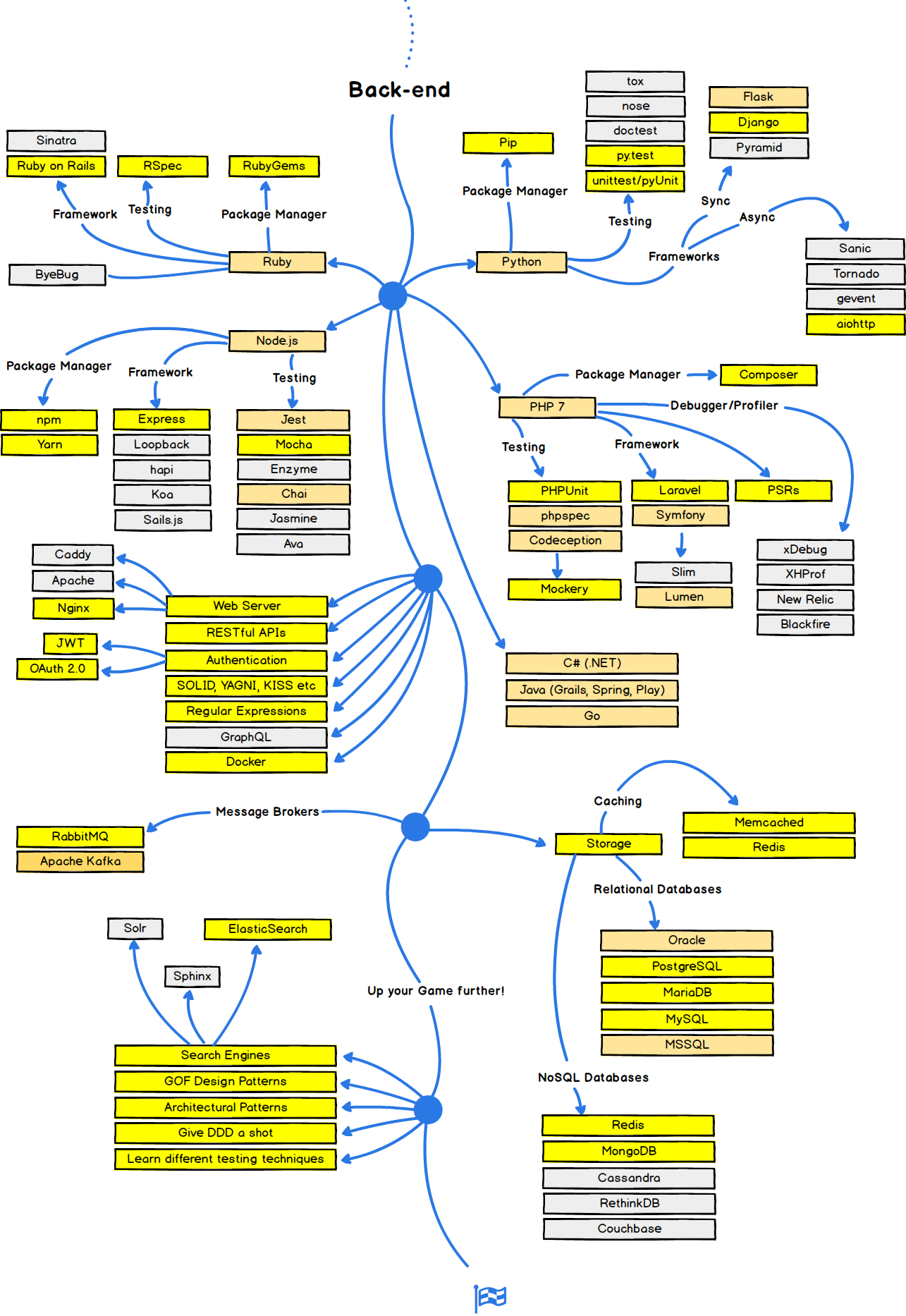
This is kinda what I follow for backend
native tide
Its just that ive only just started
rustic pebble

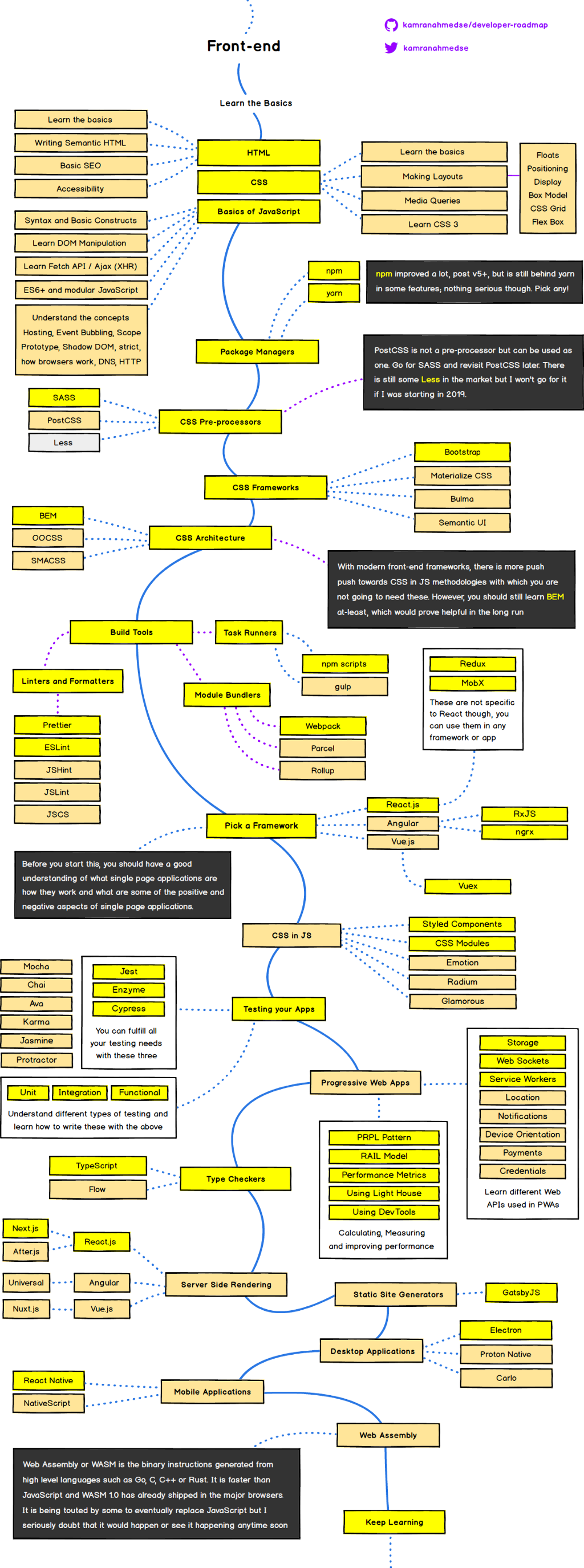
And this is what I follow for front end

It really narrows down what you can choose
and helps you build with the tools you need
rigid laurel
You definitely don't need to learn a lot of this
rustic pebble
yea
rigid laurel
but its a pretty good overview
rustic pebble
only what you need
I need to change to nosql dbs
But sql is also addicitng
I am a web addict
native tide
Going over that frontend progression
native tide
I definite got stuck trying to use packages in my project from npm that use webpack because i did not understand webpack. I had trouble with cors, too.
native tide
But... I didn't read books thoroughly about these things the way I did with Python.
I just kind of threw myself at it.
rustic pebble
I learned python when I was 15
by trying to hack Hahaha
But then I thought that if I was to hack I would need to first get good at the language
and so forth here I am now
native tide
It happens.
rustic pebble
Never done anything bad in my life
I have built many websites never have I done something smelly
native tide
Now if you want to be a 1337 hax0r you just install kali and use someone elses python tools haha
rustic pebble
I had made some tools tbh
never used them
I was thinking of going back to cracking game accounts and was planning to build software for that
but as I said
web dev is addicting and couldnt do it
native tide
I have friends who are pentesters who want me to play CTF with them, but I tell them that Im just more interested in development.
They dont do anything bad but they are definitely hackers.
rustic pebble
Where I am from ctfs and generally coding contests are not a thing
and it is quite disappointing
In the capital they hold web dev contests and I am planning to go in one though
one man team, I can build a super complete website in 2 days max
for sure
native tide
Okay so... what was said earlier about REST being serving JSON... This got me to thinking.
I can dump data that I want to use on front end to a json from the database, using python. This data isnt sensitive data about users. Its just that its easier for me to organzie certain things using the ORM in Python.
Does that make sense?
Basically Im wanting to make a webgame. It's fairly RPG like and based on text based games played in console, only its on the web in a fake JavaScript console.
I somehow need to get game mechanics from the back end to the front end because I would rather not program it in JavaScript.
Just the interface in JS
for example, this is a basic example to make sense of what im saying
Say you have character with your logged in account. That character has three items and the ability to cast magic missile. Just for examples sake.
That's information in the database I need to relate to the JavaScript frontend to display it
Because the interface is a fake JavaScript terminal
it's actually a cyberpunk themed game so its made to seem like you're a console cowboy from something like neuromancer
rustic pebble
@native tide yea thats good
Question: I am refreshing an element with javascript when user clicks submit. The data gets updated and everything but the element value doesnt change
 mild merlin
@rustic pebble what's the code?
rustic pebble
backend or frontend?
rustic pebble
this is what I am using rn
      async function getlimit() {
        const url = '/limit';
        const response = await fetch(url, {
            method: 'GET',
            mode: 'cors',
            cache: 'no-cache',
            credentials: 'same-origin',
            headers: {
                'Content-Type': 'application/json'
            },
            redirect: 'follow',
            referrerPolicy: 'no-referrer',
        });
        dtresponse = await response.json();
        console.log(dtresponse['Limit']);
        limit = document.getElementById('accnumberrender').innerHTML;
        limit = dtresponse['Limit'];
        return document.getElementById('accnumberrender').innerHTML = limit;
So every time getlimit gets called
it should ideally refresh the value of accnumberrender
mild merlin
right
rustic pebble
It works once
but then it just resets to what it was in the start
even though the database gets updated
mild merlin
limit gets set to the content of accnumberrender first, and then it gets overwritten with the value of dtresponse['Limit']
hmm idk
rustic pebble
oh right
not I can do that
let me try doing this:
document.getElementById('accnumberrender').innerHTML = dtresponse['Limit'];
yeah that might work
rustic pebble
I should set it as var
maybe
Because I want limit to be the elements value so I can set it
For some reason it breaks
when I do that
native tide
{% if (g.permissions & 0x20) == 0x20 %} this throws a syntax error
Anyone know how to do a bitwise operation in a flask if statement
 native root
@native tide flask uses the jinja2 templating engine, which only supports a limited amount of syntax. See here for details: https://jinja.palletsprojects.com/en/2.9.x/templates/#logic
Bitwise operators are not on the list
native tide
Do you know a way to do bitwise at all in flask @native root
native root
👍
in the future, there's a method to define functions you can access in your templates, so you could do {% if permissions(0x20) %} or w/e
native tide
alright thanks

 native tide
Well i figured that much lmfao
rustic pebble
Getting KeyError: <Response streamed [200 OK]> when trying to upload a file using flask
any ideas?
Full traceback ^^^
rustic pebble
Yeah but in my defense
This is all the code I have upload = send_from_directory(app.config['UPLOAD_FOLDER'], 'accounts.txt',)
tired root
there is a comma to much at the end
rustic pebble
still same error tho
rustic pebble
Let me send you the whole function I have
but this is the part that generates the code because before I added that
it worked just fine
tired root
yeah well now it does not
rustic pebble
@app.route('/accrequest', methods=['POST'])
def accrequest():
    session.flush()
    data = request.json
    print('Text Data = ' + str(data['txt']))
    send_text = data['txt']
    clientaccnumber = data['accountnumber']
    upload = None
    try:
        dt = jwtdecoder()
        user = session.query(User).filter_by(username=dt['username']).first()
        print(user.dailylimit > clientaccnumber)
        if user.dailylimit > clientaccnumber:
            try:
                if clientaccnumber < plangrabber():
                    server = data['server']
                    print(server, clientaccnumber)
                    response = accountextractor(server, clientaccnumber)
                    addaccountstodb(clientaccnumber, user)
                    if send_text:
                        accountstotext(response)
                        try:
                            upload = send_from_directory(app.config['UPLOAD_FOLDER'], 'accounts.txt')
                        except Exception as e:
                            print(str(e))
                        print('---Upload added---')
                else:
                    response = {'accountnumber': -1, 'error': 'Exceeded account maximum'}
            except:
                response = {'accountnumber': 0, 'error': 'Please enter the correct details.'}
            print(response)
        else:
            response = {'error':'account limit has been exceeded'}
    except:
        session.rollback()
        response = {'error': 'An unknown database error has occured.'}
    return response, upload
I don't think you can return a tuple there
rustic pebble
hmm
Thing is that Ii want to get both the response as I utilize it on the frontend
and the .txt
rustic pebble
Damn
rustic pebble
Because I have two options
tired root
{'error': 'An unknown database error has occured.', file: "answer.txt"}
rustic pebble
Blue means enabled
So if a user has clicked export in .txt
I want the data to be upload by the server and downloaded by the client
while also being added to a table I have
rustic pebble
This is a website
tired root
no shit
rustic pebble
the user based on criteria makes a search
the search returns some shit
The shit is displayed as an html board
which is made by js
tired root
So you mean you send the search query to the server?
rustic pebble
Yup
tired root
Ok, that isn't an upload
rustic pebble
No no
When the user clicks submit a query is made and the response is posted back to the user
I have added the export in .txt functionality which means that the user will both get the table with the data and download the file
tired root
Then why not just return a template with a download link?
rustic pebble
Hmm
tired root
But anyway, just put the download link in the json and let js display it
if you are doing the js route
Bottom line: you cannot return a tuple
rustic pebble
So there isnt a way to do this: user clicks submit => file starts downloading
rustic pebble
upload = send_from_directory(app.config['UPLOAD_FOLDER'], 'accounts.txt')
thats what I am using
I will figure it out
maybe I will just add two js requests
one after th eother
tired root
yes, but it needs to be a response
tired root
send_from_directory must be returned from the function
Do you understand how http works?
You cannot just start a download in the middle of your code
you need to tell it to the browser
rustic pebble
I know I use them all over my code
tired root
the browser only does something if it gets data from you
so, to start a download you need to make a response
rustic pebble
Hmm