#web-development
2 messages · Page 2 of 1
 brittle copper
If somehow you are interested that takes the strings in two backticks() and returns it as <a href="two_backticks">two backticks</a>`
Oh god
 deep cave
@register.filter(name="replacer")
def messagetolink(text):
    split = text.split('`')
    even, odd = split[0::2], split[1::2]
    return format_html_join('', '{}<a href="' + site_name + '{}">{}</a>', ((a, ("_".join(b.split())), b) for a, b in itertools.zip_longest(even, odd, fillvalue='')))

# let's first clean up the function name.
def message_to_link(text):

# now let's rip that generator out of the return statement and put it on a line of its own
gen = ((a, ("_".join(b.split())), b) for a, b in itertools.zip_longest(even, odd, fillvalue=''))

# that's a bit better already, let's see how that looks
@register.filter(name="replacer")
def message_to_link(text):
    split = text.split('`')
    even, odd = split[0::2], split[1::2]
    gen = ((a, ("_".join(b.split())), b) for a, b in itertools.zip_longest(even, odd, fillvalue=''))
    return format_html_join('', '{}<a href="' + site_name + '{}">{}</a>', gen)
it's still hideous though.
brittle copper
I'm so irritated by this that I'm not even trying to add any more this kind of functionality, if I were able to do this I was planning on letting users share links to other websites too
But it is so damn incredibly hard for some reason
deep cave
I wish we could use an f string for the second argument in format_html_join, but because django is hijacking the {}, we can't do that.
brittle copper
I wish it was possible to just mark_safe_permanantly(string)
deep cave
# something like this
return format_html_join('', f'{}<a href="{site_name}{}">{}</a>', gen)

# would result in
SyntaxError: f-string: empty expression not allowed
so you'd need to escape them
and that's just even uglier
brittle copper
Anyway, for now I'm happy that I can let users toggle their posts' visibility
deep cave
If somehow you are interested that takes the strings in two backticks() and returns it as<a href="two_backticks">two backticks</a>
wait, give me an example of that
input and output data
and on discord backticks are special characters so if you're gonna type them, escape them with backslash
brittle copper
I couldn't escape them, I tried, struggled just couple mins ago so I'm just gonna use | instead of backtick :D
deep cave
`````
brittle copper
this is an example where |this part of the string| and |this part of the string| is converted to local links.
this is an example where <a href="http://127.0.0.1:8000/this_part_of_the_string">this part of the string</a> and <a href="http://127.0.0.1:8000/this_part_of_the_string">this part of the string</a> is converted to local links.<a href="http://127.0.0.1:8000/"></a>
While you are at it you can add a little feature like if a string is in between two *, the functions returns them as outside links :D
But that is purely optional :D
deep cave
while I'm at it? I never said I was gonna do this :D
brittle copper
Oh, alright, I thought you wanted to try to rewrite that hideous function :D
 signal karma
Can someone assure me that using flask.g is request specific? If I use it to store user information on a request (to be able to identify who is making the request, before it happens(in a decorator)), is it ever going to collide if there are two request by two different users at the same time?
I'm not 100% sure from the doc
And it's application critical if it collides
deep cave
it used to be. but isnt in the latest version. they changed it in like 0.10 or something
but whether things will collide or not is still an interesting question
g is in the application context in the latest version - but should still theoretically be wiped for every new request.
but the advantage of having it belong to the application context is that you can access it before the request is made. like in the before_request function if you're doing that. which used to be impossible.
so to answer your question - it should theoretically be safe from collision, and wiped for every request cycle. though I have never done any kind of extensive testing to that end.
I probably would do some tests before relying on it if it was "application critical"
signal karma
okok thanks
 brave mantle
I think it's a threadlocal
So it shouldn't conflict as long as everything is on the same thread
Python 3.7 will add tasklocals to asyncio which is gonna be awesome
signal karma
On the following code:
@staticmethod
@namespace.marshal_list_with(article_full, envelope='articles')
def get():
    return Article.query.all()
I want to return a filtered(reduced) relationship of Article, should I go for something like: Article.query.join(ArticlePrice).filter(ArticlePrice.location_id=req_location).all()?
brittle copper

I'm trying to sort a query set by its foreign key's number of objects that has been created in the last 7 days.
As in if there are three titles like:
Title one --> total entry: 100, entries i...
signal karma
Does anyone have an idea how I am supposed to use this undocumented thing? http://docs.sqlalchemy.org/en/latest/orm/query.html#sqlalchemy.orm.query.Query.add_columns
I don't know what it is expecting as parameter since it is not detailed 🙂
@namespace.marshal_list_with(local_article_full, envelope='articles')
def get(self, location):
    return Article.query\
        .filter(Article.prices.any(active=True), Article.prices.any(location_id=location))\
        .add_columns('price', Article.prices.price)\
        .all()
I'd like to get ALL Articles from the provided location, that are active=True and add a column to add its local price(add column 'price' equals to Article.prices.price where Article.prices.location_id equals to parameter location).
If that makes sense🤐
Note: The provided code is not working obviously
signal karma
Basically, I want that in Flask-SQLAlchemy:
SELECT a.*, ap.price
FROM article a
INNER JOIN article_prices ap ON a.id = ap.article_id
WHERE ap.location_id = %location%
AND ap.active = true
@deep cave Do you have any tips on that? (sorry for pinging 😕 )
brave mantle
@signal karma What you want is a relationship
Check the sqlalchemy docs on relationships, there are specific ways to define them
brave mantle
What's wrong with that?
signal karma
I want only the value ap.price WHERE ap.location_id = %location%
brave mantle
Realistically that's down to how your models are defined
signal karma
seems like not since SQL can get it, and I can't figure out using SQLAlchemy
syntax problem
brave mantle
It sounds like it's possible that there could be more than one result for that, as far as SQLA understands
Or it's just that your relationship is defined incorrectly
The relationships page gives you a set of different types of relationship
It sounds like you need one-to-one or many-to-one but you're using one-to-many or many-to-many
You should also make sure your model enforces whatever relationship that you pick
Application logic isn't enough
signal karma
@brave mantle sorry delay, I was on the SO 2018 survey 😛
I think you're missing the point. The SQL request I sent above is giving me the correct result, why should I change my models if SQL can get me the right result? I just want to port this SQL request to a Flask-SQLAlchemy syntax.
brave mantle
What's the point of having an ORM if you don't use it?
Use the ORM, it saves a lot of time
brave mantle
No, you don't get it
That isn't using the ORM
The method is undocumented because it's used internally, you're not supposed to use it yourself
signal karma
I know what you mean. But my model should be fine, I just need to know what syntax I should use to get it right.
hm
but then maybe I should not use this one add_columns, but there should be a way to translate this sql into flask-sa
brave mantle
Define the relationship properly and use that
signal karma
it is
I get an array of prices
I want to get only one out
how am I supposed to change my model for that?
brave mantle
Then it's not defined correctly
I'm cooking atm, I'll get you an example when I can
signal karma
but, an Article has multiple Prices. Just when a user request the list of Artciles for a specific location, I want to return just the price of this location, not the array of prices.
alright 😉 🍳
brave mantle
Well, I think the array is still an SQLA object, you should be able to filter on it
An alternative would be to take the approach you need for many-to-many and make a separate relationships table you can join
brave mantle
Wait, you said that locations have a price already
Can't you just get the price from the location then?
signal karma
class Article(db.Model):
    id = db.Column(db.Integer, primary_key=True)
    title = db.Column(db.String(255), nullable=False)
    description = db.Column(db.Text)
    image = db.Column(db.String(255))
    brand = db.Column(db.String(255), nullable=False)
    category_id = db.Column(db.Integer, db.ForeignKey("category.id"), nullable=False)
    prices = relationship("ArticlePrice", cascade="all, delete-orphan")
class ArticlePrice(db.Model):
    article_id = db.Column(db.Integer, db.ForeignKey("article.id"), primary_key=True)
    location_id = db.Column(db.Integer, db.ForeignKey("location.id"), primary_key=True)
    price = db.Column(db.Float, nullable=False)
    active = db.Column(db.Boolean, nullable=False)
    location = relationship('Location')
If that help =x
And this is not working
def get(self, location_id):
    return Article.query\
        .filter(Article.prices.any(active=True), Article.prices.any(location_id=location_id))\
        .all()
Eh? I've never seen .any() used
signal karma
ah
Stackoverflow
but I am sure I can't make it work because I don't know the verbs
brave mantle
If you can gimme like half an hour or three quarters of an hour I should be able to show you what I mean
It you can't wait, head to github, GlowstoneMC/Site
We used it there
signal karma
I am trying this for days, I think I can wait 😃
brave mantle
Haha, okay
brave mantle
@signal karma right, okay
Say we have a news post

News posts belong to single users
user = relationship("User", back_populates="news_posts")
And if we have users... https://github.com/GlowstoneMC/Site/blob/master/ultros_site/database/schema/user.py
They own multiple news posts
news_posts = relationship("NewsPost", back_populates="user", cascade="all, delete, delete-orphan")
The important thing here is back_populates="user"
Each post will have a single user association
but to complete that, you need to store the ID in the post, obviously
signal karma
ok, fine so far
brave mantle
user_id = Column(Integer, ForeignKey("user.id"))
Alright, so if we want to get our latest three news posts
we might do
news_posts = db_session.query(NewsPost).filter_by(published=True).order_by(NewsPost.posted.desc())[0:3]
now what if you want to return the whole user information with a key last_post?
brave mantle
and our User object will be available at post.user
OK, so you take your NewsPost query
filter by the user
so eg filter_by(user=User(whatever))
and order_by descending
and .one() it
then you'll get their latest news post, with the user object attached
If all you have is the user ID, you can filter_by(user_id=whatever) as well
an example of using .one():
try:
    news_post = db_session.query(NewsPost).filter_by(id=post_id, published=True).one()
except NoResultFound:
    raise HTTPNotFound()
I will try something
@brave mantle How do you get the user information while requesting NewsPosts?
no join?
signal karma
ah because of the backref?
brave mantle
It does the join for you
signal karma
is it the backref?
brave mantle
The backref helps, yeah
signal karma
ha, new one, how would you get the User with last_posted_date?
brave mantle
Find the relevant news post
grab the .user from it
You'd have to do that in my model
But if you actually wanted a last post date for users, you should have that on the user object and update it when they post
brave mantle
Why not?
signal karma
because it has multiple prices at the same time depending on the location, there is no one more relevant than another.
to be stored in articles
The thing is that in your example, you're gonna get the NewsPost and the user in news_post.user, right? What if you need all informations mixed at the root?
brave mantle
what? "all informations mixed at root"?
signal karma
It's a bit stupid in your example, but it'd look like:
news_posts = db_session.query(NewsPost).filter_by(published=True).order_by(NewsPost.posted.desc())[0:3]
print(news_posts[0].username)
The answer is, well, you don't
signal karma
instead of print(news_posts[0].user.username)
brave mantle
that'd be news_posts[0].user.username
signal karma
right
signal karma
okok
brave mantle
Ok, look at it this way
you have a set of tables
each table should represent one particular thing
and everything that belongs to that thing
When you're writing SQL yourself and doing joins yourself, you get mixed data from each table you joined, but that's messy and doesn't actually represent the structure of your database
Under the hood, SQLA still does those joins for you
But they're abstracted away, so you have something that actually looks and behaves like regular Python objects
that's the point of an ORM
Keeping your data compartmentalised like that is important for maintaining a piece of software that is clean and easy to work with
signal karma
Sure, but I don't think what I am asking is irrelevant, just it doesn't match 100% your use case
brave mantle
You're conflating direct DB access with using an ORM
If you want direct DB access, SQLA provides a lower-level API for that purpose
but chances are you don't, and the ORM is designed so that you don't have to write or generate a single line of SQL yourself
When you have well-defined models like I showed you, you basically have a schema of the attributes to expect on that object
That's why your use-case doesn't actually make sense
You'd be adding attributes that aren't actually present in your definition
signal karma
So how would you design an article table that has multiple prices depending on a location?
brave mantle
You would probably need a relationship table
signal karma
I do
brave mantle
article ID and location ID mapping to price IDs
signal karma
hm I don't have a price id...
brave mantle
every table should have an ID column
your SQL server uses it for indexing
usually, you want that to be some numerical ID primary key
signal karma
I am closed to this model: http://docs.sqlalchemy.org/en/latest/orm/basic_relationships.html#association-object
brave mantle
Essentially what you have is a table with a primary key (ID) and a bunch of foreign keys
then you provide it in your relationship using the secondary param
branches = relationship("ProductBranch", secondary="product_branch_association")
if you don't need the backref, don't make it
otherwise, if you have extra data in your association, you map it directly
It's just like any other relationship, just with a table in the middle
so you'd end up with something like article.article_price_assoc.price
you could put a property on the model if you wanted it to be just price but you wouldn't be able to set it with .price unless you define a setter
signal karma
@brave mantle solution: https://stackoverflow.com/questions/48219143/how-to-translate-sql-into-sqlalchemy-shaping-output-model-differently-from-the
I have the following SQL request that is giving me the result I want, but I can't succeed to make it work in SQLAlchemy.
DB Models
from flask_sqlalchemy import SQLAlchemy
from sqlalchemy.orm import
FYI, if you are interested 😛
brave mantle
Intredasting
 compact pelican
for anyone familiar with knockout, how would i go about moving the results from one table to another when clicked on? i currently have it so when you click on a result it redirects you and instead generates a report based on params associated with the selected result however i would like to move it instead to a new "queue" table where when i click a button all results in the "queue" table get generated at the same time
signal karma
@compact pelican what you're asking is very unclear to me..
compact pelican
@signal karma ive since fixed the issue i needed to point my nested databind to the parent forgot to do that
compact pelican
is anyone in this channel any good with knockout.js? if so could you please DM me? been having some issues with a multi-select report generation page and cannot figure out the multi-select. I have the generation working and it works with just one but i cannot for the life of me figure out how to get multiple pages to generate. Id explain more in this channel but i would just be blowing it up
brittle copper
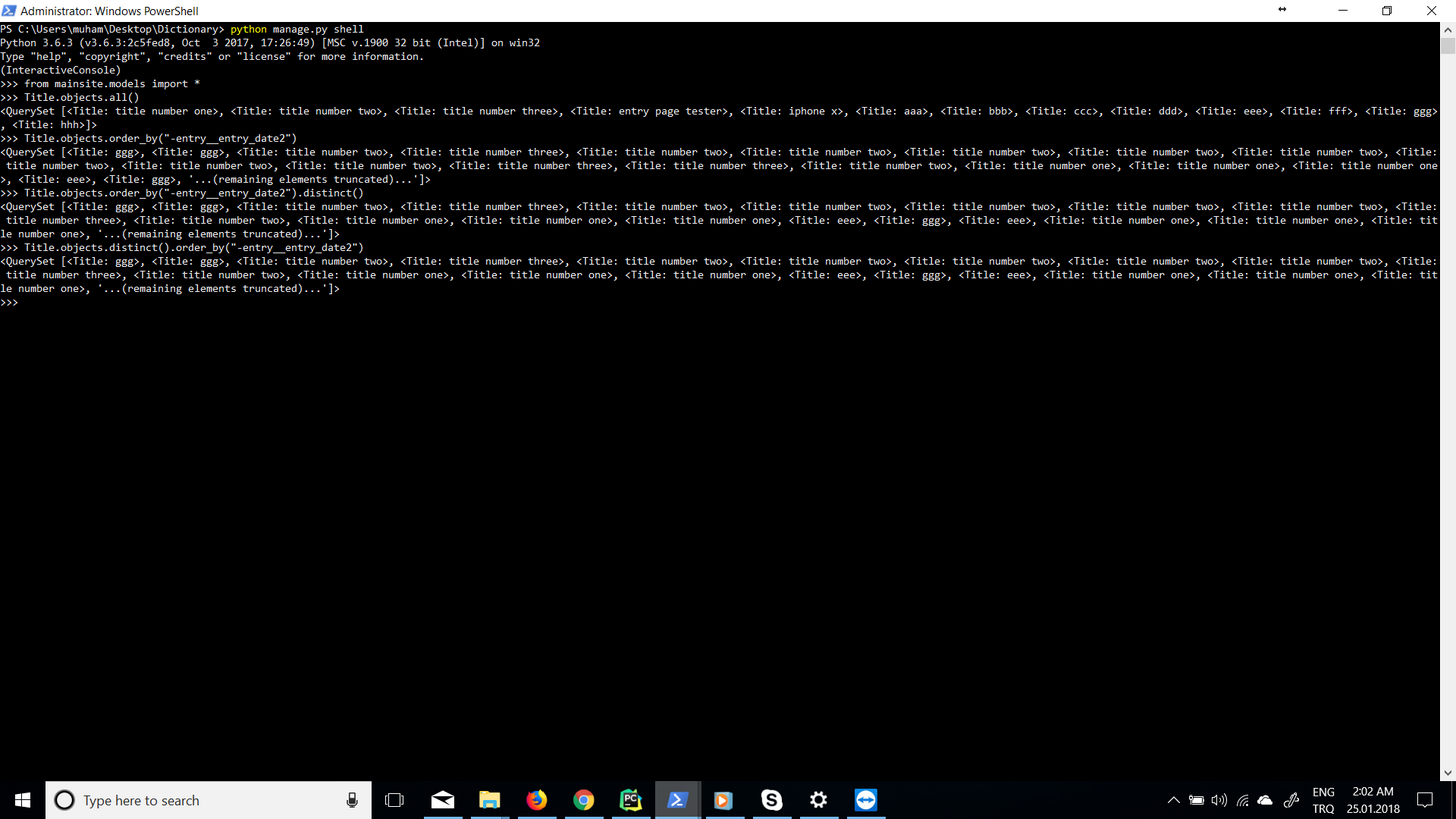
Oh god I can't seem to find a solution to this
Title.objects.order_by("-entry__entry_date2").distinct()```
.distinct() simply doesn't work, apparently it is somehow related to me using order_by and distinct in the same queryset concurrentlyhalp me
brave mantle
need more context
brittle copper
django
Entry class has a foreign_key with Title, and I'm trying to sort Title objects with their entry dates
brave mantle
but why distinct?
brittle copper
When an entry is entered to a Title,
Otherwise if users enter entries to the same Title over and over again my index would show only the same Title after a while
brave mantle
surely your application should not be inserting duplicates?
brittle copper
So if even though the last 2 entry is entered to the Title x, I only want one title x in my query set
Uhm, what? :3
Pardon my weak English :8
brittle copper
I am not, the ordey_by does it
brave mantle
If you weren't inserting duplicates, there would be no duplicates
brittle copper

 limber adder
i dont know if this is relevant, but in sql distinct comes before order by
brittle copper
Tried that too, still the same
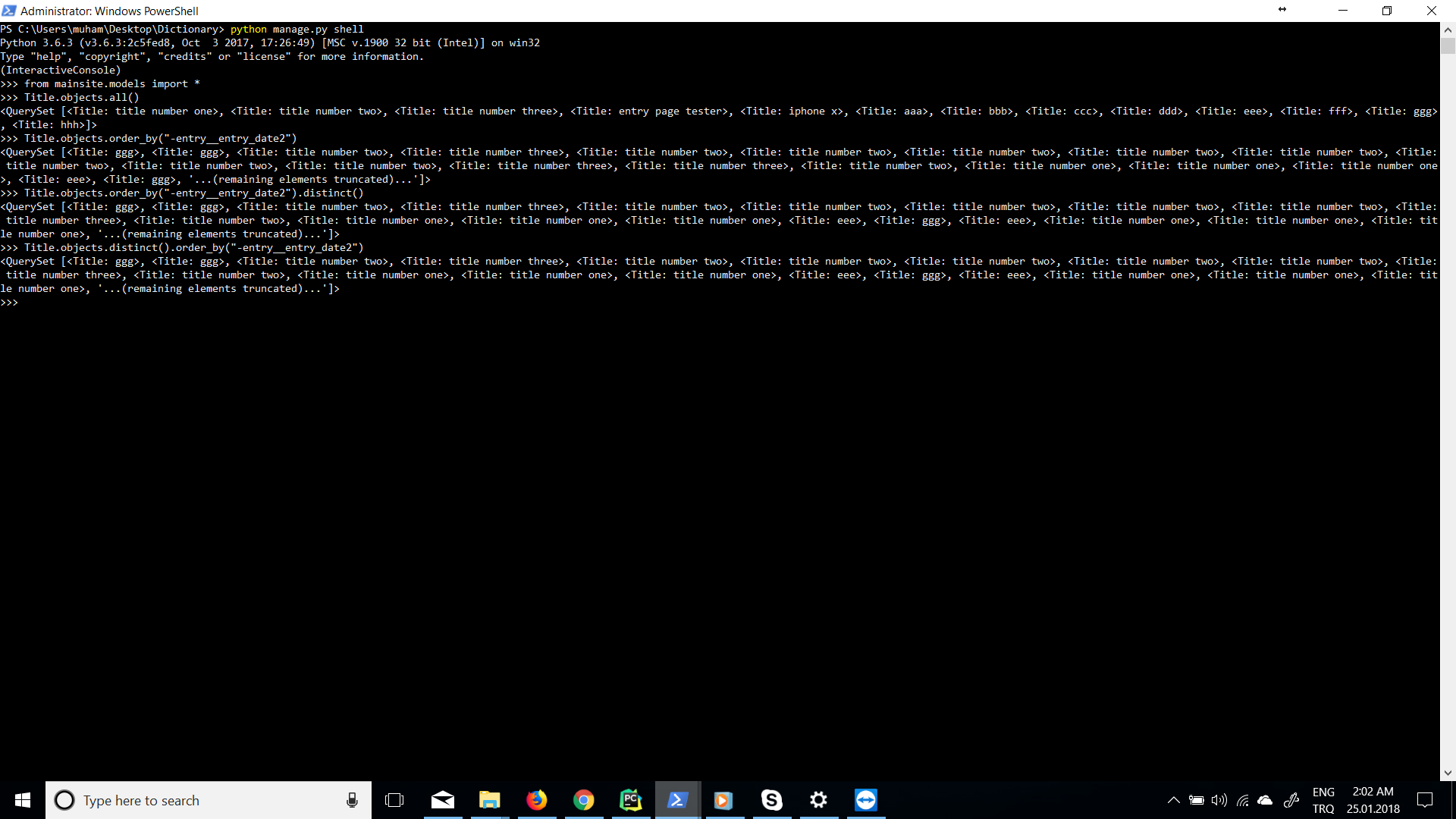
Help me or I'll suicide by drinking 50 more cups of coffee
 deep cave
distinct takes an optional arg of what col to filter distinct by
make sure it is using the col you expect it to by manually specifying it.
oh shit was scrolled up
brittle copper
from mainsite.customcustom import EMAIL_USE_TLS, EMAIL_HOST, EMAIL_HOST_USER, EMAIL_HOST_PASSWORD, EMAIL_PORT

EMAIL_USE_TLS = EMAIL_USE_TLS
EMAIL_HOST = EMAIL_HOST
EMAIL_HOST_USER = EMAIL_HOST_USER
EMAIL_HOST_PASSWORD = EMAIL_HOST_PASSWORD
EMAIL_PORT = EMAIL_PORT
As soon as I add the above code to my settings.py I get this beautiful error
django.core.exceptions.AppRegistryNotReady: Apps aren't loaded yet.```halp
Okay, fixed it, I'm a moron
 stone pelican
Same
deep cave
the fuck. why would you possibly do x = x
brittle copper
It was from a tutorial, thought it was a django thing
 void summit
deep cave
void summit
deep cave
what a tutorial.
 whole smelt
That is next level programming
brittle copper
def changestyle(request):
    if request.user.is_authenticated():
        userstyleconfig = UserStyle.objects.get(user_name=User.objects.get(username=request.user.get_username()))
        referer = request.META.get('HTTP_REFERER')
        if userstyleconfig.user_style == "standard":
            userstyleconfig.user_style = "darkorange"
            userstyleconfig.save()
        else:
            userstyleconfig.user_style = "standard"
            userstyleconfig.save()
        if referer == f"{URL}change/changestyle/" or None:
            return HttpResponseRedirect(URL)
        return HttpResponseRedirect(referer)
    else:
return HttpResponseRedirect(URL)```ERR_TOO_MANY_REDIRECTS
halp
Okay, I'm a moron, nevermind
 pastel hinge
hello guys plse can someone refer me to a book on python web development
intermediate level
 frosty star
I am working with django atm, i have a problem with moving the templates folder from app to project folder can someone help me?
brittle copper
Hmm, getting closer to the end I have a question if I did something uhm, incorrectly
My like, dislike and favorite functions are simply called with the posts id like www.wb.com/like/15/
brave mantle
GET requests?
brittle copper
Uhm, what exactly do you mean
I was gonna ask if I should make the functions in a form and the view called from just www.wb.com/like/ and with a post request
No idea how to do it with a get
brave mantle
Yeah, that's what I'd recommend doing
If you're using JS it doesn't actually have to be a form, but
You can just do an xmlhttprequest, which is a bit of a mouthful
we call them XHRs for short
brittle copper
How am I gonna know the post id if I don't do a form :3
brave mantle
Depends how your posts are defined
Here's an example XHR from one of my other projects
brittle copper
<span class="rate-options"><a data-href="http://127.0.0.1:8000/like/454/" class="like" title="şükela!">
                                    <svg class="dic" id="svg-chevron-up">
                                        <use xmlns:xlink="http://www.w3.org/1999/xlink" xlink:href="#dic-chevron-up-thick"></use>
                                    </svg></a><a data-href="http://127.0.0.1:8000/dislike/454/" class="dislike" title="çok kötü"><svg class="dic" id="svg-chevron-down">
                                        <use xmlns:xlink="http://www.w3.org/1999/xlink" xlink:href="#dic-chevron-down-thick"></use>
                                    </svg></a>
</span>``` let oReq = new XMLHttpRequest();
oReq.addEventListener("load", req_listener);
oReq.open("POST", "/add_object");
oReq.setRequestHeader("Content-type", "application/json");
oReq.send(JSON.stringify({"type": type, data: obj, layer: layer}));
hmm
brittle copper
data-id and then post it with js
brave mantle
data-post-id="whatever" yeah
brittle copper
Oh I see
One last question
Normally I do <form method="POST"> and in django request.POST.get(name)
Oh fuck
Okay I'm an idiot, nvm :D
Thank you :D
brave mantle
:>
brittle copper
Damn :(
brave mantle
?
brittle copper
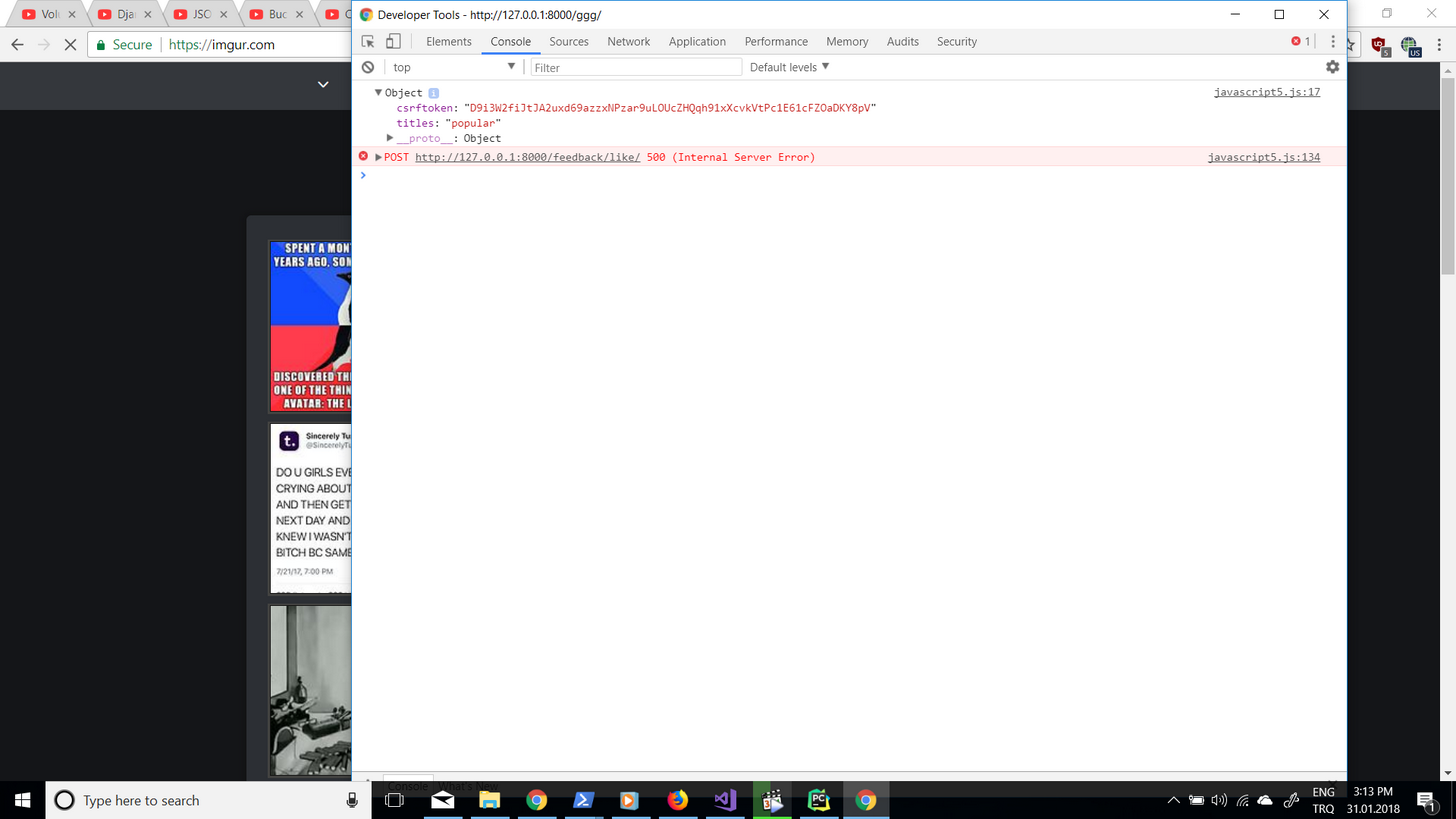 brittle copper
what
brave mantle
xD
deep cave
check your logs
brittle copper
good idea
deep cave
internal server error always means "check your logs"
brave mantle
Yup
deep cave
in fact, most of the time you should just have a tail -f running to the relevant logs while doing webdev
brave mantle
a 500 is the webserver going "something broke  "
"
deep cave
I basically have a monitor dedicated to that :P
brittle copper
Uhm, should I return something if I only do some logic
deep cave
you don't have to return anything.
brittle copper
def like(request):
    userchoice = UserStyle.objects.get(user_name=User.objects.get(username=request.user.get_username()))
    entry_pk = request.POST.get("getnew", 246)
    entry = Entry.objects.get(pk=entry_pk)
    if entry in userchoice.user_dislike.all():
        userchoice.user_dislike.remove(Entry.objects.get(pk=entry_pk))
        userchoice.user_like.add(Entry.objects.get(pk=entry_pk))
    elif entry in userchoice.user_like.all():
        userchoice.user_like.remove(Entry.objects.get(pk=entry_pk))
    elif entry not in userchoice.user_like.all() or userchoice.user_dislike.all():
        userchoice.user_like.add(Entry.objects.get(pk=entry_pk))
    entry.entry_points = len(entry.user_like.all()) - len(entry.user_dislike.all())
entry.save()```Python functions return None implicitly
brave mantle
:>
brittle copper
ValueError: The view mainsite.views.like didn't return an HttpResponse object. It returned None instead.
brave mantle
Ah, yeah, return a response then
deep cave
well that's Django telling you it has special rules. :D
deep cave
strider?
brave mantle
I keep thinking of that GDQ run
"We went down this pipe and now we're in africa. Strider."
brave mantle
Yeah, :P
brittle copper
request.POST.get("getnew", 246) just to see if it works I have this and it toggles post with id 246
My post part may be a little fucked up hang on
brave mantle
Since I imagine you could probably just POST like
brittle copper
function ajaxfeedbackhelper(x,y,z) {
    x[z].children[0].addEventListener("click", function () {
        var getnew = new XMLHttpRequest();
        if (x[z].classList.contains("like")) {
            getnew.open("POST", sitename + "feedback/like/");
            getnew.setRequestHeader('X-CSRFToken', cookies['csrftoken']);
        } else if (x[z].classList.contains("dislike")) {
            getnew.open("POST", sitename + "feedback/dislike/");
            getnew.setRequestHeader('X-CSRFToken', cookies['csrftoken']);
        }
        getnew.onload = function () {
            if (x[z].classList.contains("voted")) {
                x[z].classList.remove("voted")
            } else {
                if (y[z].classList.contains("voted")) {
                    x[z].classList.add("voted");
                    y[z].classList.remove("voted")
                } else {
                    x[z].classList.add("voted")
                }
            }
        };
        getnew.send(x[z].getAttribute("data-id"))
    });
}

function ajaxfeedback(feedback, affected) {
    for (var i=0; i<feedback.length; i++) {
        ajaxfeedbackhelper(feedback, affected, i)
    }
}

ajaxfeedback(ajaxlike, ajaxdislike);
ajaxfeedback(ajaxdislike, ajaxlike);```"post=x"
ah you're literally just posting the ID
well in that case there's nothing to parse and you want the request body
brittle copper
sooo, request.POST ?
brave mantle
that's a multidict if I'm not mistaken
that won't be populated
you probably just want request.body
brittle copper
oh
brave mantle
why don't you print it?
brittle copper
how :o
brave mantle
print(request.body)?
brittle copper
I feel like I'm stupid I'm sorry but where do I do that exactly :( in shell?!
brave mantle
in your function
brittle copper
I'm lost, where would it print it
brave mantle
You know what print does, right?
brittle copper
Okay prints to the console, I'm sorry just didn't think it would print it there for some reason :(
Although, this does it :D
brave mantle
Good stuff
brittle copper
Fixes my problem :D
brave mantle
\o/
brittle copper
Thank you, gimme a hug 🤗
brave mantle
Bruh 
brittle copper
Oh yours cuter :3
brave mantle


 native tide
hey, like in Flask, return puts a string to a HTML document in function ?
brittle copper
You have to put it in one of the render functions before in django
 grand badge
im using django 2.0 and want a button on my website to delete all objects of the specified model, how will i go about doing that?
pls @ me when u gat answer
brave mantle
@grand badge Please ask a better question
The question you asked appears to be asking for someone to write it for you
I could give an overview if you want though
grand badge
yes i would like that
brave mantle
More or less, you'll need a form with a button in it, or just a button that will submit using Javascript
grand badge
oookaaay
brave mantle
You'll need a route that will be submitted to
grand badge
okay
brave mantle
That route will then need to run the delete operation on your database, having done whatever authorization checks you need
grand badge
soooo i need to make a model form right?
brave mantle
As I don't use Django I can't give that many specifics, but I don't think you need anything special
Just a single form with a button in your HTML should be fine
grand badge
okay thx
brave mantle
That sounds inefficient, wouldn't you do that on the database?
They want to delete all the objects in the table
brittle copper
Okay, isn't it just Modelname.objects.all().delete()
grand badge
i tried that, but it never worked unfortunately
brittle copper
Then put it in a for loop
Anyway GDUDE, while I have you here
I was turning all my hardcoded urls to template url patterns with {%url "urlname" regex_group = somevariable%}, how do I do this for GET requests?
My pagers are hardcoded rn
Like {%url "urlname" regex_group = somevariable%}?page={{next_page}}
deep cave
what do you mean "how do I do this for GET requests"
brittle copper
url(r'^(?P<title_text>[a-zA-Z0-9_]+)/$', views.title_page, name="titlepage") this is one of my url patterns
I'm using this as {%url "urlname" title_text=title.title_url%} in html
Everything is fine so far, but to add a paginator to titlepage
I need something like ?page=pagenumber
brave mantle
Django has a pagination system? That's kind of neat
brittle copper
Which I can't find a solution except hardcoding it into html
brave mantle
I've always done it myself
brittle copper
Yeah it is pretty easy :D
deep cave
hm, I see.
I have never actually done this but let me fetch a django book from my bookshelf and see if I can figure it out.
brittle copper
Oh, thank you :D
@brave mantle
instance = Paginator(list, item_per_page)
page_item_list = instance(page)```This is pretty much it
deep cave
I'm thinking maybe you just make a second url pattern which includes the ?page=<page_number> in the expression
and then you call that one instead
is that an option?
@brittle copper
brittle copper
Hmm, I can always try
deep cave
might be a better way but I'm not finding it in my django books
brittle copper
Well, this works and if I don't want to use hard coded urls this is what I have to use for now, thanks :D
deep cave
yeah.. I think you're stuck with that.
but at least it works
btw this book is excellent
brittle copper
Too bad I have to restructure all the views again
 brittle copper
This is my life now, I try to fix something and all the sudden I have to do 10 hours of manual labour :D
Alrighty, will look at it when come across another problem
deep cave
it's not online or anything, you'd have to actually buy it
but it's not really for solving problems, rather for learning best practices and methodology
but it's really well written
brittle copper
Just clicked at link, yeah; probably can't afford it rn :D
deep cave
yeah, that's fair enough
just figured I'd mention it just in case you want a django book in the future.
brittle copper
Although, bookmarked it
brave mantle
Aren't we at Django 2.x though? :P
deep cave
django 2 exists, but I think 1.11 is still LTS
brittle copper
deep cave
oh wait, no look at that.
yeah actually the book I have is for django 1.8
I guess maybe there's no two scoops for django 2 yet.
brittle copper
Just found it, django itself too is saying "fuck you your urls have to be ugly"
 raw rapids
how do i use requests to inject js into pages
 frigid hamlet
you mean response?
forgot how, but you can work with static files@raw rapids
may be js script can be added to page as static object
but it headpain, before cofigure once
@raw rapids try just use "safe" flag in template variable, may be it will be enought, if js was generated on server side
inside django template html file variable syntax
if i right remember it something like html {safe|myvar}
where myvar is html <script>...</script> js code
brittle copper
How is that even related to requests library @frigid hamlet
frigid hamlet
may be i wrong translate... for me this text look like request info about ways to using django webframework that inject js code in response html page.@brittle copper
frigid hamlet
like python server generate jscode and then transport this code use response into html.... yes , this text
i use this once... in django project..., that inject threejs 3d model js code into js template inside html, but forgot how :|
and lazy to search and read code again
brittle copper
You can just use javascript files in static folder and reference them from your template html
 neat nest
if he's talking about actual "JS injection" then I think he's hard pressed to do such a thing with a library that doesn't execute JavaScript
brave mantle

Google today announced the third step in its browser's war on HTTP sites. Starting in July 2018, Chrome will mark all HTTP as not secure right in its address bar.
 kind steppe
good
brave mantle
Yep
 cyan pilot
agreed
 verbal chasm
amazing to finally see this!
 ripe grotto
What would you consider when making an API: Django or Flask?
Or maybe another toolset?
neat nest
Flask is a pretty standard choice
I don't know that I've ever seen Django pulled in exclusively for use as an API
ripe grotto
Yeah it's just that I'm more comfortable with Django right now as I'm still learning
But flask seems very simple and easier than Django actually
neat nest
it's pretty lightweight and generally used for beginners and simple tasks
I haven't used it in... maybe 3 years
my last opinion on it was that the way I was taught to use it was not terribly pythonic, but when used in a more reasonable fashion it actually starts to look and feel a bit more like django
(I might also just be inventing memories, take it for what it's worth)
ripe grotto
3 years? That's a lot, what's your framework or library of preference?
neat nest
haven't been writing web apps in Python in 3 years! :P
Flask is probably the one I've had the most experience with, so I'd probably default to it unless I had time to research alternatives
ripe grotto
Oh, you don't do webapps then? Or maybe in another language?
neat nest
last web application I wrote was a quick PHP prototype, I think
toying with converting some network storage into web accessible cloud storage for the sysadmin team I was with
but in general, yeah, not working with webapps
ripe grotto
Like an OwnCloud sort of app?
deep cave
owncloud is pretty damn good.
and yeah, I'd like to second the suggestion that flask is a better choice than django for a restful api.
styled is right that django and flask can be made to look similar, if you use class-based views and an ORM database with flask and split the codebase over lots of files and folders. but with Flask you have the option of writing your restful api in a single file with decorated function-based views. you can use a lightweight NoSQL database. it's all very self-contained.
in a word, Flask is less opinionated than Django.
solve the problem with however much complexity you require.
 meager anchor
on the topic of Django, is there a way to call a template filter after rendering the template somehow?
specifically I have a blog which uses Markdown to render the posts, and would like to add a live preview to the admin
the markdown gets rendered through a template filter, or template tag, I forgot the exact naming
would I have to set up an endpoint on my site that does nothing but render the markdown given to it, and then call that endpoint from the admin?
god i have no idea of web dev  I think I need to do that though, judging from the responses on SO at least
deep cave
well, you could probably solve it with a bit of javascript
and have the preview be truly live.
I think that's what I would do.
without javascript, you will have to call some endpoint, yes.
I mean you could probably roll this preview stuff into the same endpoint you're already on at that point by spitting in an optional arg or something, but I'm not sure it'd be better.
meager anchor
"solve it with a bit of javascript" as in parsing the markdown in JS?
deep cave
that's one option
you could also have javascript dynamically load in whatever you're using for markdown already
as a daft example, javascript might make an ajax call and fetch the html from an endpoint you made to do this, and then just stick it on the page.
although it might be faster to just have a js markdown library handle it
(I'm sure there are a bunch)
I mean, there's probably a hundred ways to solve this with js. I'm not sure what the best method would be for your project, you'll probably have to do some research for that.
but for this kind of thing - a post preview - it's probably the way to go.
you don't wanna be reloading the page every time the preview is gonna change.
meager anchor
yeah
i'll probably go with fetching it from an endpoint, since I don't want to get into any weird issues because of library differences
thanks!
meager anchor
will do 👍
 mental chasm
@meager anchor When you say you are using an endpoint, are you re-rendering the markdown everytime they type a character??
meager anchor
uh
😃 I'll have to think of something smart
probably something along the lines of "if nothing was entered within the past x seconds, submit a request to grab the rendered output"
mental chasm
A lot of people use Showdown

If its on the client it means you arent having to send a HTTP request for every character
meager anchor
Yeah
Hm, maybe the whole "render the markdown on the server" approach is a bit stupid in the first place when i could just render it on the client
mental chasm
Yea
brittle copper
Isn't there any easy way to share stuff on facebook?
Facebook sharer requires an app id
My twitter sharer looks like this for reference
def sharetwitter(self):
    entry_title = self.entry_title.title_text.replace(' ','+')
    url = URL.replace(':','%3a').replace('/','%2f')
    pk = self.pk
    hashtags = ','.join(str(i) for i in self.entry_title.title_channels.all())
return f"https://twitter.com/intent/tweet?text={entry_title}%3a+{url}entry%2f{pk}%2f&hashtags={hashtags}"```pretty sure there's functions in the standard library to do the URL encoding
meager anchor
800 lines 
brittle copper
This is twitter though
mental chasm
Thats twitter
brittle copper
Can't do the facebook one :(
meager anchor
ahh
meager anchor
Trying to get client-side markdown rendering with highlighting working reminds me why I rendered it on the server in the first place
either I don't get any exception and it doesnt work, an exception that doesnt make sense, or something else  oh well, back to server side rendering..
mental chasm
:(
neat nest
rendering on the server with AJAX calls?
meager anchor
yeah but, i, uh, changed my mind again
the only issue I have now is code highlighting, which .. should work at some point
mental chasm
lol
mental chasm
huh?
meager anchor
you don't know fcc?
mental chasm
no
meager anchor
not this again
I tried to paste it but Discord apparently maintains its own clipboard again. anyways - https://freecodecamp.org
mental chasm
Oh I see
 strange thorn
at which point would you say does caching make sense?
mental chasm
If the endpoint puts either a lot of heavy load, or gets hit a lot
Quite a vague answer I understand
neat nest
vague questions get vague answers
mental chasm
True
strange thorn
hmm
raw rapids
does anyone know how to add a proxy to scrapy?
kind steppe
essentially, setting the HTTP proxy environment variable will allow scrapy to use it
raw rapids
i understand you have to set it so its active but where do i add it when rnning the crawler
 kind steppe
on mac or linux, you can run the export command before running your scraper
you're using Terminal to run?
kind steppe
export https_proxy=<proxy>
python3 scraper.py
i set the value of it to 1 right
kind steppe
no
raw rapids
'scrapy.downloadermiddlewares.httpproxy.HttpProxyMiddleware' : 1,
No
You type that into your terminal and then run the scraper
like in the command I sent
export https_proxy=<proxy>
python3 scraper.py
but does it set the variable for the whole system
kind steppe
No, is that what you intend for it to do?
kind steppe
Then it won't most likely
raw rapids
scrapy crawl <spider name>
raw rapids
how will i know if its working
kind steppe
I've never used scrapy, I wouldn't know, I'm just going by what the docs say on using a proxy
meager anchor
Alright, I've integrated a live markdown preview into the Django Admin with some help of @mental chasm since i'm horrible with JS  - this is what it looks like:
it might possibly be nicer to have the preview to the right of the content but i have no idea how to do that without grabbing yet another css framework think it's okay like this
mental chasm
Looks good
deep cave
I think that looks pretty good.
meager anchor
Thanks!
 long swan
<div class='container'> <div class='row'> <div class='large-6'>Code content</div> <div class='large-6'>Preview Content</div> </div> </div>
If you are using bootstrap, maybe you could get markdown to implement this ¯_(ツ)_/¯
meager anchor
i'm not, it's the default django css, but thanks
brave mantle
You can ask your question in #help-coconut, #help-grapes or #help-falafel
native tide
hey guys
my code works but it's not getting all the fields I want.. I think it has something to do with the source code in html..
span or something.. so it's missing out certain fields
# LIST OF FIELDS TO SCRAPE
list_of_fields = ['Market Cap', 'Enterprise Value', 'Trailing P/E', 'Forward P/E', 'PEG Ratio', 'Price/Sales', 'Price/Book', 'Enterprise Value/Revenue', 'Enterprise Value/EBITDA', 'Fiscal Year Ends', 'Most Recent Quarter', 'Profit Margin', 'Operating Margin', 'Return on Assets', 'Return on Equity', 'Revenue', 'Revenue Per Share', 'Quarterly Revenue Growth', 'Gross Profit', 'EBITDA', 'Net Income Avi to Common', 'Diluted EPS', 'Quarterly Earnings Growth', 'Total Cash', 'Total Cash Per Share', 'Total Debt', 'Total Debt/Equity', 'Current Ratio', 'Book Value Per Share', 'Operating Cash Flow', 'Levered Free Cash Flow', 'Beta', '52-Week Change', 'S&P500 52-Week Change', '52 Week High', '52 Week Low', '50-Day Moving Average', '200-Day Moving Average', 'Avg Vol (3 month)', 'Avg Vol (10 day)', 'Shares Outstanding', 'Float', '% Held by Insiders', '% Held by Institutions', 'Shares Short', 'Short Ratio', 'Short % of Float', 'Shares Short (prior month)', 'Forward Annual Dividend Rate', 'Forward Annual Dividend Yield', 'Trailing Annual Dividend Rate', 'Trailing Annual Dividend Yield', '5 Year Average Dividend Yield', 'Payout Ratio', 'Dividend Date', 'Ex-Dividend Date', 'Last Split Factor', 'Last Split Date']

#stock_ticket = 'TEF.MC'
sourceCode = str(urllib.request.urlopen('https://finance.yahoo.com/quote/TEF.MC/key-statistics?p=TEF.MC').read())
for field in list_of_fields:
    if(list_of_fields!=""):
        ScrapedValue = sourceCode.split('>' + field)[1].split('</td></tr>')[0].split('>')[-1]
print ("field=",field, " / scraped valued= ", ScrapedValue) ```for example.. fields like Fiscal year ends.... and Dividend date. .. are not being printed.. I think it's because it's in date format.. but I'm not sure how to correct it :< please help
 deep prism
It's because a 'normal' field that you can parse looks like
<td class="Fz(s) Fw(500) Ta(end)" data-reactid="75">5.37</td>
And the fields you can't parse like Fiscal years looks like
<td class="Fz(s) Fw(500) Ta(end)" data-reactid="90"><span data-reactid="91">Dec 31, 2016</span></td>
Your code can't handle the extra <span> element.
@native tide
meager anchor
Not 100% sure if this is the right channel, but I'll ask anyway..
I have a Discord / Reddit / Twitch Bot for subscribing / unsubscribing to Twitch stream events through commands. Twitch handles this by sending callbacks to my site, which has to respond accordingly.
If they send me an event, e.g. "stream x went online", I need to access the database of the Bot to find out which guilds and which subreddits are following the stream for events and then do either
- send the update to a webhook on discord
- update the sidebar of a subreddit
Now to my question, in django, is there a way to access a database from another project like that, or am I taking the wrong approach? I mean, I could also justimport sqliteand then do the querying myself, but this all seems like bad practice. Would be happy for any suggestions
brave mantle
@meager anchor First of all: Don't use sqlite
Second of all, the database should be on the site - the bot should access it via a HTTP API
brave mantle
poor concurrency and speed
meager anchor
I only have like 2 guilds actively using this
brave mantle
Your site isn't going to be so forgiving
meager anchor
🤔
brave mantle
meager anchor
🤔
brave mantle
sqlite is only good for testing
meager anchor
I think I'll just go with the hacky import-sqlite-way
brave mantle
You're going to actually break it if you do that
meager anchor
Why
brave mantle
You've got a file-based DB and more than one process accessing it
you're gonna corrupt it
meager anchor
goddamnit
"Multiple processes can have the same database open at the same time. Multiple processes can be doing a SELECT at the same time. But only one process can be making changes to the database at any moment in time, however."
the site doesnt make changes
brave mantle
Yeah, but you can't guarantee that the reads will be atomic
sqlite isn't writing as soon as you make a change, and you could be reading during a write as well
meager anchor
if it breaks I'll learn from it, and if not I'll save a couple hours of rewriting half my bot and my website to have an API 
brave mantle
the couple hours is worth it when you're learning to do things the right way :P
meager anchor
i've had to rewrite half my bot twice already because twitch moved to their new and amazing API, and all for the one guild that uses it
brave mantle
Sounds like you could use some modularity, but yeah, that happens
meager anchor
probably
deep cave
it'a pretty quick to switch out your sqlite for postgres or something.
which is easy to make available to all your services.
meager anchor
yeah
well, I just figured out that twitch doesn't send the stream name / game name anymore, just IDs, so half of this is broken anyways
deep cave
you interact with both databases in almost exactly the same way, usually.
at least if you're just sending sql queries to sqllite with execute or something. psycopg2 will be identical.
just gotta change the import.
and a remotely accessible db is a nice thing to have. for future projects.
meager anchor
i'm using Django ORM in my web app and SQLite ORM in my bot, so its no issue at all
probably just changing a connection string
deep cave
right right.
yeah that should be pretty simple
so I think gdude is right, you should just get a database that supports this.
meager anchor
yeah
well I need to integrate the twitch app into my django web app somehow now, so I'll have it in two projects...
I think I'll just go with adding an API to my site
mental chasm
@brave mantle
🅶🅳🆄🅳🅴 - Yesterday at 11:15
sqlite is only good for testing```Well that just isnt true
brave mantle
Oh, well sure, if you're making a small application that you're only ever gonna use yourself, or you're locking yourself into a model with no concurrency, sure
brittle copper
I'm high but continue
cyan pilot
what's wrong with sqlite for small-scale stuff?
mental chasm
Nothing at all
brittle copper
What's wrong with sqlite for bigger stuff?
I'm not kidding around I really don't know :(
mental chasm
Only one write can happen at one time
So you would need to implement some sort of queue system
Which if you have a high volume of requests, may not be what you want
brave mantle
file-based sqlite is known to be pretty slow, as well
mental chasm
Slow compared to what?
brave mantle
slow compared to most anything with its own daemon, really
in-memory sqlite is okay I guess, but I'm not sure of the use-cases of that
mental chasm
That is a pretty bold claim
Considering SQLite doesnt have the network overhead i doubt there is much truth in that
cyan pilot
I was going to use sqlite for trading card thing, but decided against it due to not really feeling like writing a parser for moving things into a dict
mental chasm
What?
cyan pilot
unrelated
mental chasm
But i still dont understand the last part
mental chasm
Do you mean because SQLite returns a tuple?
cyan pilot
the dicts I'm using are nested, pickle is just more convenient.
Regardless, I will try to make it work later when I finish up the actual content of the project.
mental chasm
Ok
cyan pilot
My fault for derailing an argument on the practicality of sqlite3
but really it boils down to how frequently the database is accessed
Running a bot for a personal server would be fine, but a multi-server bot like tatsumaki might need something better
(just adding a tl;dr for anyone who doesn't care to scroll up)
 nocturne plover
It's sqlite is probably not going to be your bottleneck for a discord bot of any size.
brave mantle
Once you get past 1000 servers, it'll be unusable unless you're using a beefy enough rig for d.py's AutoShardedBot
at 1k servers, Discord forces you to shard
The "correct" way to do it is to split off into multiple processes, but asyncio is generally pretty fast
nocturne plover
oh, for multiple instances? You have to implement c/s for the bot anyway.
No reason to compare them at that point if you have to stand up a server anyway.
brave mantle
c/s?
nocturne plover
client/server
brave mantle
Oh, if you've got more than one instance, yeah, for sure
unless you wanted to be silly and make like
an sqlite server daemon
which I'm sure exists, tbh
brave mantle
lol
nocturne plover
(No really that's the solution for some software that I deploy at an event each year.)
(These motherfuckers all access a single database file on a network share using a lock file.)
(homemade format database*)
brave mantle
Yikes
nocturne plover
Used samba one year to do it so I could script inotify to make a copy after each write mtime change just in case
Was scary D:
Also, bananas are a neat fruit
brave mantle
At least they weren't using shelve, I suppose :P
nocturne plover
I'm going to assume that not having heard of shelve is a good thing ;p
brave mantle
It's one of those python modules you only see beginners using
It's a key value store that is serialised with pickle and has no querying aside from the keys
Single file of course
brave mantle
:P
native tide
lmfao
 opal coral
ok so, i have no clue what to use as a backend for my nonexistant website
strange thorn
flask flask flask
opal coral
but google told me that its single-threaded
strange thorn
but you can do wsgi with gunicorn or some other webserver OR enable the multi threading option?
opal coral
ok so google tells me theres single threaded, but not that theres a multithreading option?
how did i not know about this
strange thorn
huh
i read about a multi threading option
and flask is made for wsgi anyways
google gunicorn with flask
opal coral
im gonna be honest with you i have no idea what wsgi or gunicorn is
all i want is like a do this and this when someone goes to /home and give them this page
so like flask, but not one thread
brave mantle
wsgi is inherently not compatible with asynchronous programming
however
what you usually do is use a worker manager, like gunicorn
so you're actually running like 24 copies of your flask app
and it dispatches requests to whichever ones aren't busy
opal coral
ah ok gunicorn sounds useful
can you make it dynamically spin up more workers if the load increases (though i doubt my website will get that much attention)
brave mantle
I think so, but you probably don't need it
With flask, you can combine it with gevent as well, which is what we're doing with the python discord site
and gunicorn will handle most of that as well
opal coral
so we're using gevent, gunicorn, and flask?
brave mantle
Yep
brittle copper
Just use Django like a real man
nocturne plover
Flask love
strange thorn
^
kind steppe
flask + gunicorn + nginx + gevent best
strange thorn
^^^^^^^^^^^^^^^^^^^^^^^^^^^^^^^^^^^^^^^
now we just need some nice db
and its perfect
kind steppe
- Cassandra

kind steppe
I prefer cassandra
kind steppe
I mean it's only for larger scale stuff lmao
strange thorn
you can just keep adding and adding and dding nodes
kind steppe
running it for anything smaller is overkill
yeah
However the issue is
"While Cassandra can be made to run on small servers for testing or development environments (including Raspberry Pis), a minimal production server requires at least 2 cores, and at least 8GB of RAM. Typical production servers have 8 or more cores and at least 32GB of RAM."
I have none of those
so when I want to mess around with cassandra
I have to fire up a cassandra node at my work
and start messing with it from home
which is slow
strange thorn
dafuq
kind steppe
ikr
strange thorn
we are allowed to get jobs with 14 and then just like minimal paid jobs
so we are again back to
I NEED TO AGE FASTER
kind steppe
cyan pilot
i ceo i 12
kind steppe
henlo am 2 years of age i am ceo of my friends minecraft server
strange thorn
😃
cyan pilot
😄
kind steppe
when a linux install loads dll's onto your machine
strange thorn
when we are 16 we may accept jobs full time and work for four weeks a year
(if we are still in school during that you CAN leave school with 15 and work 8 hours a day)
and how much may you work?
@kind steppe
kind steppe
I work 4h on weekends
kind steppe
lmao
strange thorn
(for kids)
strange thorn
could get interesting
kind steppe
okay so
the command to start it told me it took too long to start
and to check the status
the status check command timed out and told me it may not be started
cassandra are you lying
strange thorn
no cassandra is always saying the truth
kind steppe
o
kind steppe
yes
lmao what
it started but then exited a few seconds later
and then the log dir is empty
nevermind cassandra got pissy at java
strange thorn
😄
kind steppe
this was a bad move
strange thorn
what happened?
kind steppe
laptop ram spiked to 100 and laptop froze
strange thorn
🤣
strange thorn
did even the ttys freeze
kind steppe
not when you have 100% RAM & CPU usage
Datacenter: datacenter1
=======================
Status=Up/Down
|/ State=Normal/Leaving/Joining/Moving
--  Address    Load       Tokens       Owns (effective)  Host ID                               Rack
UN  127.0.0.1  103.69 KiB  256          100.0%            a922cfab-b51e-4462-ac9a-79ab236d56fa  rack1
huh okay
it's still running
wat
strange thorn
Datacenter: datacenter1
??
kind steppe
yeah i'm using the default install stuff
it auto assigns a datacenter and rack
in prod I could say "oh yeah it's in us-west and on rack 12
so if there was an issue with it
I could go fix that node
cqlsh> SELECT key, broadcast_address, rack, cql_version FROM system.local;

 key   | broadcast_address | rack  | cql_version
-------+-------------------+-------+-------------
 local |         127.0.0.1 | rack1 |       3.4.4

(1 rows)
lmao what
kind steppe
startup of cassandra i'd assume
a nice feature of CQLSH is that you can open up doc links from inside the interface
help INSERT_JSON opens up the inserting json docs
only issue is it links to 404 documents lmao
luckily the directory is indexable so you can find things in the end
this is nice tho
INSERT INTO mytable JSON '{"\"myKey\"": 0, "value": 0}'
json inserting
for some reason this is working
so from some quick benchmarks everything seems good
jus a high cpu usage lol
i never knew about the json insert so i was messing with it kek
stone pelican
Does anyone have any idea, how flask's Request object, changes, depending on what function it's in? For example, if I register a callback for /home/, how can the Request object change, depending on the request for /home/ that was made?
stone pelican
If anyone knows what I mean by that :p
stone pelican
Alrighty
 indigo holly
Looking for some help on a project, I'm new to python for WD and was given some JS and CSS by work to design a site.
I'm using Flask. I don't have any HTML or JS background so I'm looking for a second set of eyes to see if there's something basic I'm mixing up.
My issue is the flask site is supposed to pull information from csv files and display them as a graph, however I get the GET 404 error of the csv file when I try. Here is some of the code:
brittle copper
@indigo holly Your .csv file in not in your static dir
indigo holly
Wow, such a silly mistake. Thanks
brittle copper
Anytime :D
 formal junco
Hey guys, I'm new and learning Python. Kinda stuck, have learned the basics and not sure where to go next. I'm interested in learning some web dev stuff, any recommendations? I feel like I have a good grasp of how to structure functions and code, but have no idea about how to arrange files or develop a website.
neat nest
the almost universal recommendation for beginner web frameworks in Python is Flask http://flask.pocoo.org/
small, simple, extremely common and well-documented
formal junco
Cool, thanks. Do you think Flask is a better start than Django?
stone pelican
yep
neat nest
if you're just getting out of the basics and haven't touched web dev before? absolutely
formal junco
Will check it out
 rose quest
I've generally seen django espoused as the more powerful option but
Generally beginners won't need the shiniest chrome and biggest engine and raddest rides
formal junco
I gotcha.
deep cave
I actually don't subscribe to the point of view that django is more powerful.
it's just more opinionated.
formal junco
the gist I seem to get from others is that django makes more executive decisions whereas flask gives more freedom
not that I know too much about any of this
deep cave
yeah, that's what I mean by opinionated
you can use a document-oriented database like mongo or rethinkdb with django if you absolutely want to
but it sure doesn't make it easy for you
it reaaally wants you to use a SQL database.
flask, on the other hand, let's you choose freely and has no bias towards one or the other.
and this is a recurring theme when comparing the two.
rose quest
@deep cave I am by no means a webdev so I don't have any strong opinions one way or the other
deep cave
that's okay, you're entirely correct of course that django is espoused as the powerful option.
I acknowledge that it is. but as someone who works with python and web, I don't subscribe to that point of view. just figured I'd put that out there. :)
formal junco
flask seems to be a lot simpler also
deep cave
it can be. a single file is all you need.
django requires a whole hierarchy of files.
but, to be clear, it can also be just as complex as django.
depends what you're doing.
ripe grotto
Hello, I know this is a very newbie question but, are patch, delete and put relevant HTTP methods?
I know get, head and post are, but I haven't seen real world examples with patch, put or delete
deep cave
PUT and DELETE are valid HTTP methods
I've never actually heard of PATCH being one.. ?
pretty sure it isn't
ripe grotto
Yeah, they are, I now put and delete are http methods, but my question is: are they relevant methods in real world escenarios?
neat nest
there's actually a number that don't bump around much anymore https://developer.mozilla.org/en-US/docs/Web/HTTP/Methods

MDN Web Docs
HTTP defines a set of request methods to indicate the desired action to be performed for a given resource. Although they can also be nouns, these request methods are sometimes referred to as HTTP verbs. Each of them implements a different semantic, but some common features are shared by a group of them: e.g. a request method can be safe, idempotent, or cacheable.
deep cave
I think DELETE is useful.
I use it when I write restful API's that interact with databases to handle removing stuff.
I use PUT for like.. uploading files and the likes.
you could technically just use POST for that too, but it feels wrong.
I mean, you could use POST for everything, but the point is to have some seperation
none of them are strictly speaking useful in the sense of "do you absolutely need to use this because it has a special feature"
I will say that I very rarely use OPTIONS, though.
ripe grotto
Oh, ok so: POST, PUT, GET and DELETE are the most used methods then?
deep cave
and yeah, it seems PATCH is a thing
yep, without a doubt.
those are all fairly common to see.
PUT a little less so than the others.
POST and GET extremely common.
ripe grotto
gotcha, thanks @deep cave 👌🏻
brittle copper
I only use POST and GET
I don't know what the others are and whether if they can do things that POST can't do
Since after POST you can pretty much do anything with that info at the backend
 tough raptor
You can accept whatever you want. You should consider accepting others, as they can be used to convey the semantics of your api
That's espe true if you're making an api. Not so much if you're making a site
ripe grotto
But be aware, that PUT is highly exploitable, so be sure to add a good authentication method before working with PUT
tough raptor
In what way is PUT more exploitable than other methods?
ripe grotto
PUT can directly mess with local files, someone can write, lets say, a PHP file in your server and enable code execution
uploading a web shell, etc.
tough raptor
Only if you have a server with that set up
ripe grotto
Yeah, good practices mitigate a lot of vulnerabilities like this, if your server is correctly configured, and has a good authentication system then it won't be vulnerable
tough raptor
Just don't have put write local files at all
If you're building a web backend you're in control of that
It's not like adding a put endpoint in flask suddenly enables people to write local files
ripe grotto
I know, but a lot of sysadmins and web developers are just lazy, leave services with their default settings and believe me, there are a LOT of http services with PUT enabled to everyone 🤣
tough raptor
Ok, your experience is different to mine. I've never worked with a server where there was a PUT endpoint, enabled or not, that just wrote local files
ripe grotto
Congratulations
neat nest
I have a feeling Daniel Greenfeld was doing something horribly wrong
cyan pilot
He might not have written the original code.
cyan pilot
OOP
brittle copper
Do you write python code to turn your code into c then compiles it which then open a python terminal and does the necessary 10 lines of code?
Even that wouldn't be 1200
cyan pilot
He never really spcified what it was
 west glen
This talk https://www.youtube.com/watch?v=o9pEzgHorH0 covers how Jack Diederich went from 660 to 5, same order of reduction
brittle copper
Is that even real
I'm trying to imagine what one may have wrote in those 600 lines
native tide
it's quite easy to do actually
especially if you follow OOP standards hard
you kinda have to step back and look at how people want to use your library and what you're actually providing
and always think about the cost of fracturing your code
cyan pilot
It's official, I can now use requests pretty okay
but I can't show what I did with it
ripe grotto
Why not?
brave mantle
NDA probably
ripe grotto
National defense academy?
brave mantle
non-disclosure agreement
 brave mantle
Lots of contracts require signing one of those these days, especially in IT
ripe grotto

DigitalOcean
This tutorial will go over how to work with the Requests and Beautiful Soup Python packages in order to make use of data from web pages.
 mild bridge


 cyan pilot
actually I can't show what I did because it's lewd
 olive oxide
owo?
cyan pilot
but if you really want to see you can dm me
olive oxide
depends on the type of lood we're taaaalkin
olive oxide
oh fooey that's hardly lood
cyan pilot
