#data-science-and-ml
1 messages · Page 328 of 1
 wispy wolf
 desert oar
I am on mobile right now but i can try another time
wispy wolf
No worries!
I've just realised I never write my own pandas, I always refactor working pandas
 mint palm
Doubt regarding MobilNet:
So i am referring the mobilNet which has resisual connection and a bottleneck layer(consisting of expansion, depthwise conv and projection)
My question :
Why does this NN architecture apart from being memory and computation efficient gives advantage of learning more complex and richer function?
I think, it is due to multiple conv and filters that the function is prevented from overfitting and features that are actually to be learned are more pronounced after application of filters in bottleneck.
 hoary wigeon
Anyone to help me with multi colinearity ?

Multi co linearity (TotalBsmtSF, GarageArea) >> SalePrice
desert oar
I wouldn't worry about it unless you are fitting with OLS and you see high VIFs
 chilly geyser
From the corr diagram all the areas are heavily related, and house ages are also related. (for hopefully obvious reasons)
While I wouldn't worry about it, I think using just 1 of both groups would predict SalePrice uses data most efficiently
Given n=9 I would run automated AIC-based exhaustive subset selection on it - it should terminate within reasonable time
hoary wigeon
cool then
hoary wigeon
chilly geyser
From the corr diagram all the areas are heavily related, and house ages are also...
how to perform automated?
chilly geyser
Just search for lowest(or highest if that's what your system uses) AIC
Typical modern computer should be able to do 2^9 fits without issues
 solid kindle
Jupyter lab 3.0.16 sometimes jumps the position of the code cell on the screen when clicking on it (autoscroll a few lines), it often happens when I click on the output, then on the code, it's pretty annoying, is there a setting to change that, or it is a bug that I should feel on Jupyter GitHub?
 glacial sparrow
when training and evaluating Isolation Forest on a labelled dataset i.e. 95% inliers 5% outliers, the minority class percentage should be the contamination ratio right?
 robust snow
What's the recommended FPS, video resolution, & video size for video input for OpenCV's VideoCapture?
I'm right now trying a vehicle tracking program using my own video file (1080p, 30 FPS), but it stutter so much and the centroid is all over the place.
 opaque stratus
Basically, I am using various BERT models to classify a certain section of patient's medical documents (electronic health records) -- however, much of the valuable information is written in a sort of 'note' format, and less so refined English.
BERT is extremely good at understanding a language, however, I can't help but think this task relies heavily on a set of key words rather than a complex understanding of the clinical language
This can be highlighted by the fact that
while the various BERT models I implement do indeed perform very well (high f1 scores across the board), there is not much different between them -- even though some have been pretrained on entirely different material
and some even employ different pretraining techniques
Does anyone know any NLP models that would be better suited for this? -- please @ me if so ! ty
 deft harbor
@opaque stratus have you tried fine tuning your Bert model?
opaque stratus
deft harbor
<@600913914049331212> have you tried fine tuning your Bert model?
ye ofc
all fine-tuned on the downstream task i mentioned above
 cerulean stream
hi
so Im using matplotlib in different areas of 1 program and my issue is that the plots interfere with each other e.g.
after one plot is saved and the plots that are made after it uses the previous plot for the background 
any idea how I would fix that
opaque stratus
cerulean stream
hi
so Im using matplotlib in different areas of 1 program and my issue is that t...
delete this message, go to another channel, thank you
cerulean stream
 but matplotlib is in the channel description so
opaque stratus
oh
thought this was a help channel
my bad
but now nobody will see my message above =[
deft harbor
Have you tried gpt2
I've seen some people have success adding gnns to document based problems, but I'm not sure how to set that up without working through the specific data
 tepid cobalt
Hi i have a question... can someone help me?
I want to create a ML Learning Curve... so ive create and trained my model (a rock, paper, scissor recognition).... but i dont have any idea how to create the learning curve....
link to colab google = https://colab.research.google.com/drive/1qwaWc4sz-6WkJVCHoJaPgOUnNwE4Hhov?usp=sharing

 lapis sequoia
How to see neural network properties from pickle open ? Like features used, number of layers, etc
 quasi sparrow
def classifier_data(data,time_horizon):
    lagged_features=data.shift(time_horizon, axis = 0)
    data=data.add_suffix('_target')
    data_formatted = pd.concat([lagged_features,data], axis=1)
    data_formatted.dropna(axis='columns')
    return(data_formatted)
How can I drop the first of last rows of my dataframe?
The code works but it's not efficient because on dropna, it iterates over all rows to find a row with NAN but I already now where the NAN are.
 vague stratus
quasi sparrow
```py
def classifier_data(data,time_horizon):
lagged_features=data.shift(tim...
vague stratus
quasi sparrow
```py
def classifier_data(data,time_horizon):
lagged_features=data.shift(tim...
You can use data_formatted.drop(axis=[<axis numbers (0 corresponds to index)>], inplace=True)
 inland zephyr
i need help about Tensorflow things. I successfuly run this model with keras tuner
def GetModel(hp):
    f_choice = hp.Choice('num_filters',values=[16,32, 64, 128,512],default=16)
    k_size = hp.Choice('kernelsize',values=[3,7,11,13,15],default = 3)
    max_k_size = hp.Choice('pool_kernelsize',values=[2,3,5,7,11],default = 2)
    dropouts = hp.Choice('dropout',values=[0.2,0.3,0.5,0.7,0.8],default=0.3)
    model = Sequential()
    model.add(InputLayer(input_shape=(15360,1)))
    model.add(Convolution1D(filters= f_choice,kernel_size=    k_size ,activation=tf.nn.leaky_relu,strides=1))
    model.add(Convolution1D(filters= f_choice,kernel_size=    k_size ,activation=tf.nn.leaky_relu,strides=1))
    model.add(Dropout(rate=dropouts))
    model.add(MaxPooling1D(pool_size=max_k_size,strides =2))
    model.add(Convolution1D(filters= f_choice,kernel_size=    k_size ,activation=tf.nn.leaky_relu,strides=1))
    model.add(Dropout(rate=dropouts ))
    model.add(MaxPooling1D(pool_size=max_k_size,strides = 2))
    model.add(Flatten())
    model.add(Dense(64,activation=tf.nn.leaky_relu))
    model.add(Dense(2,activation='softmax'))
    model.compile(loss = 'sparse_categorical_crossentropy',optimizer='Adam', metrics=["accuracy"])
    return model
and get the params from the hyperband which is 128 for filter lenght, 3 for kernelsize , 2 for pooling and 0.3 for dropouts. But with the same model in different function, i have error TypeError: unsupported operand type(s) for %: 'ListWrapper' and 'int'
i have run the same process before (i using google colab free tier for this) and using tf 2.5.0. This is the hyperband process:
def hyperband_test(trainX, trainY,order):
    print(order)
    seeds = 20
    stop_early = tf.keras.callbacks.EarlyStopping(monitor='val_accuracy', patience=10,mode='max')
    model = GetModel
    tuner = Hyperband(model,max_epochs=55,objective='val_accuracy',seed=seeds,executions_per_trial=2,factor=5,hyperband_iterations=1,directory='DIR')
    print(tuner.search_space_summary())
    tuner.search(trainX,trainY, epochs=50, validation_split=0.4,callbacks=[stop_early])
    best_hps=tuner.get_best_hyperparameters()[0]
    print(best_hps.get('num_filters'),
              best_hps.get('kernelsize'),
              best_hps.get('pool_kernelsize'),
              best_hps.get('dropout'))
    filter = best_hps.get('num_filters')
    kernel = best_hps.get('kernelsize')
    pooling = best_hps.get('pool_kernelsize')
    dropouts = best_hps.get('dropout')
    return filter,kernel,pooling,dropouts
That worked. Thanks
inland zephyr
inland zephyr
i have run the same process before (i using google colab free tier for this) and...
nvm
i found it and it silly problem
the variable for filter is confused with list type with same name
 hexed walrus
inland zephyr
nvm
i found it and it silly problem
the variable for filter is confused with lis...
hexed walrus
inland zephyr
nvm
i found it and it silly problem
the variable for filter is confused with lis...
So, we must define hp.Choice for each filters?
 cedar bluff
How to unite different queries results?

 serene scaffold
cedar bluff
How to unite different queries results?
serene scaffold
cedar bluff
How to unite different queries results?
you can concatenate them together
!docs pandas.concat
 arctic wedgeBOT
pandas.concat(objs, axis=0, join='outer', ignore_index=False, keys=None, levels=None, names=None, verify_integrity=False, sort=False, copy=True)```
Concatenate pandas objects along a particular axis with optional set logic along the other axes.

Can also add a layer of hierarchical indexing on the concatenation axis, which may be useful if the labels are the same (or overlapping) on the passed axis number.
Similar names: pandas.pandas.concat
inland zephyr
hexed walrus
So, we must define `hp.Choice` for each filters?
umm its also choice depends on your outcome
in my case i want to check what best value to fill each parameters.
cedar bluff
serene scaffold
!docs pandas.concat
concat(a, b, c, d)?
It doesn't work, I don't know why exactly
What does concat return?
serene scaffold
cedar bluff
concat(a, b, c, d)?
pd.concat([a, b, c, d])
inland zephyr
inland zephyr
umm its also choice depends on your outcome
in my case i want to check what best...
but choice is pretty bad since hyperparams only have chance to choose what value from the list. There are some suggestion by using minimum maximum number as threshold and find what best number for fill the parameters.
serene scaffold
cedar bluff
It doesn't work, I don't know why exactly
What does concat return?
a dataframe
cedar bluff
Hmm
hexed walrus
inland zephyr
umm its also choice depends on your outcome
in my case i want to check what best...
Would you mind to share the working code, please?
 waxen veldt
pandas help
 serene scaffold
waxen veldt
pandas help
serene scaffold
waxen veldt
pandas help
what do you need help with?
waxen veldt
I have a categorical column mostly filled with integers with occasional lettering. I want to encode this data for my ML algorithm but don't know if I should use Label Encoding Or One-Hot Encoding.
If I use One Hot Encoding, I will get way too many columns since I have so many distinct labels. And if I do label encoding, I will run into the problem of ML algo considering some of the tickets hierarchal
which one would be best to use?
Or better question, how should I encode this categorical column
serene scaffold
waxen veldt
I have a categorical column mostly filled with integers with occasional letterin...
do these numbers mean anything mathematically? do they measure an amount of something?
waxen veldt
mm not really
waxen veldt
they are just identifiers
serene scaffold
what algorithm do you plan to use? because that's a lot of classes.
waxen veldt
actually since this is the titanic dataset from kaggle, the letter probably represents the floor level
serene scaffold
what are you trying to predict?
waxen veldt
serene scaffold
what are you trying to predict?
predicting who dies in titanic
serene scaffold
waxen veldt
predicting who dies in titanic
you don't need to encode their ticket number for that, since the ticket number is fundamentally arbitrary
waxen veldt
here is more info
 serene scaffold
you want to select features that are relevant to who lived or died.
waxen veldt
serene scaffold
you want to select features that are relevant to who lived or died.
wouldn't the floor matter?
and that floor is implict in the ticket values
waxen veldt
serene scaffold
you want to select features that are relevant to who lived or died.
how would you check the correlation? p-value?
serene scaffold
waxen veldt
and that floor is implict in the ticket values
you can get information about their financial status from their passenger class.
waxen veldt
im a bit new sorry
i see.
if i were to check the correlation between a column and my y-labels, whats the best way to do that?
serene scaffold
if there's a way you can parse what deck their cabin was on out of another column, you can add that as a new column.
actually their cabin number is given, but it's missing for most rows. So you probably can't use that.
waxen veldt
serene scaffold
actually their cabin number is given, but it's missing for most rows. So you pro...
exactly
i dropped that column
i dropped name and cabin
columns
serene scaffold
Yeah, you don't want to use their name as a feature, either.
waxen veldt
my intuition is that sex won't matter either.
but like what if there is some weird correlation?
serene scaffold
waxen veldt
my intuition is that sex won't matter either.
Women and children first, remember?
men were a lower priority for the life boats. I would definitely keep that feature.
waxen veldt
serene scaffold
men were a lower priority for the life boats. I would definitely keep that featu...
interesting
so you basically have to know past data to decided which features are relevant
so if you were to get a new dataset, you would proceed to research about the topic at hand?
serene scaffold
waxen veldt
so if you were to get a new dataset, you would proceed to research about the top...
yes, you should always get some level of understanding about the problem at hand. In one of my courses, the instructor had to make a model to predict some weird DNA thing that none of us understand, and we all did terribly.
waxen veldt
serene scaffold
yes, you should always get some level of understanding about the problem at hand...
haha i see
do you think i should just drop the tickets column and see how the model performs?
serene scaffold
waxen veldt
do you think i should just drop the tickets column and see how the model perform...
instead of thinking about this in terms of dropping columns, think of it in terms of selecting columns.
waxen veldt
hmm
okay so pclass, sex, age, sibsp, parch, fare, and embarked are the columns i would select
i don't even think i need the id column
serene scaffold
waxen veldt
i don't even think i need the id column
the id column should be the index, which pandas uses to align rows from different dataframes
but it shouldn't be a feature for sure 😄
waxen veldt
but the dataframe is already an index no?
so its basically double counting
like when you do pd.read_csv() it automatically creates an index for all of the rows
serene scaffold
waxen veldt
but the dataframe is already an index no?
a dataframe is not an index, no. each row in a dataframe has an index
waxen veldt
serene scaffold
a dataframe is not an index, no. each row in a dataframe has an index
thats what i meant
serene scaffold
an index is assigned automatically, but you can instead pick a column that you want to use to index.
 proud oasis
@serene scaffold has all I want to say so I don't have more input, Tawsif 🙂
waxen veldt
proud oasis
<@!253696366952316929> has all I want to say so I don't have more input, Tawsif ...
bet bet thanks
proud oasis
Maybe you can search how the ticket numbers work and get the deck information from that or something, you can't really use those ticket numbers in raw format
waxen veldt
proud oasis
Maybe you can search how the ticket numbers work and get the deck information fr...
do you know of any resources that talk about dealing with categorical columns that have a lot of labels?
proud oasis
eh not really, I learned this stuff in school
 acoustic halo
Just use one-hot
serene scaffold
or, don't encode them at all
waxen veldt
acoustic halo
Just use one-hot
this gonna create like a 1000 columns
acoustic halo
label encoding assumes all the categories exist on a scale so thats out
Thats fine
serene scaffold
if there's a category with way too many possible values, the model isn't going to learn anything
waxen veldt
serene scaffold
or, don't encode them at all
and it still works?
serene scaffold
just skip that feature
proud oasis
you don't have to use all data, if you use too much data maybe it's prone to overfitting
serene scaffold
waxen veldt
and it still works?
you don't have to use the data from every column.
acoustic halo
1000 features is not really that many in the grand scheme of things
waxen veldt
serene scaffold
you don't have to use the data from every column.
i'm just confused as to how to check correlation
serene scaffold
waxen veldt
i'm just confused as to how to check correlation
correlation of what?
waxen veldt
between the feature and your y_label
serene scaffold
acoustic halo
1000 features is not really that many in the grand scheme of things
if each ticket number only appears once, it's just going to add noise.
serene scaffold
waxen veldt
between the feature and your y_label
you can make a matrix of what class instances with that feature belong to.
waxen veldt
serene scaffold
you can make a matrix of what class instances with that feature belong to.
okayy i see. and then do some sort of visualizaiton?
serene scaffold
waxen veldt
okayy i see. and then do some sort of visualizaiton?
you can just look at the matrix
     lived  died
1    20     5
2    10     10
3    3      15
It would look like that
acoustic halo
Is the 1000 features actually just the unique id?
waxen veldt
i got more questions but ill hold off, ill try it out thanks for the help.
serene scaffold
acoustic halo
Is the 1000 features actually just the unique id?
yes, they were wanting to encode the ticket number, which is unique to each passenger. So, it wouldn't help at all.
waxen veldt
when you are doing one hot encoding, is it good to call drop_first=True for the pd.get_dummies column? I get that it reduces the number of columns you have, but doesn't it also lose info about the columns?
I.e if you call drop_first=True for the Sex column (pretending you didn't know the other sex), you would have no idea that "male" exists
acoustic halo
But you would have the second column still
So if a person is not female in the remaining column, you would know they are male
vague stratus
waxen veldt
wouldn't the floor matter?
If it mattered it prolly can extrapolated from the fare too
waxen veldt
acoustic halo
So if a person is not female in the remaining column, you would know they are ma...
so it doesn't matter about the column name?
acoustic halo
You're trying to one-hot encode the sex right?
Theres not really any difference between using one-hot and label encoding when there are only two options, except that label means one less input
waxen veldt
acoustic halo
Theres not really any difference between using one-hot and label encoding when t...
what if there are like 5 options
acoustic halo
If they exist on a scale, label encoding
Otherwise one hot with 4 or 5 columns
where with 4 columns 0,0,0,0 would be the fifth category
 rich fox
what part of openai playground homepage would redirect to a page that looks like this
 acoustic halo
@waxen veldt So if you have 3 categories for instance you could use this:
goat [0, 1, 0]
pig  [0, 0, 1]```
or
```cow  [1, 0]
goat [0, 1]
pig  [0, 0]
I prefer the first option for more than 2 categories, but ultimately it's personal preference
 remote fossil
 waxen veldt
acoustic halo
<@!638191955242909742> So if you have 3 categories for instance you could use th...
waxen veldt
acoustic halo
<@!638191955242909742> So if you have 3 categories for instance you could use th...
ah i see interesting
waxen veldt
acoustic halo
where with 4 columns 0,0,0,0 would be the fifth category
if you were to do this, does it not matter what the column name is? since you are essentially dropping the column name
remote fossil
How do you read the 3d dimensions? E.g. 4x4x512, Im guessing last is neurons in layer
acoustic halo
waxen veldt
if you were to do this, does it not matter what the column name is? since you ar...
It doesn't matter specifically which column you drop, or what their names are, ultimately you don't pass the actual column names into a ML model anyway. The only time you need to save the name of the column being deleted is if you plan on convering the one-hot encoding back to the category name
waxen veldt
acoustic halo
It doesn't matter specifically which column you drop, or what their names are, u...
makes sense
lapis sequoia
idky as soon as i imported pynput.keyboard and run i get this error
 acoustic halo
waxen veldt
makes sense
acoustic halo
waxen veldt
makes sense
This is why I prefer using all the categories in one-hot, for your sex column, you could use your drop first and rename the column something like isMale or isFemale depending on which you drop
lapis sequoia
lapis sequoia
idky as soon as i imported pynput.keyboard and run i get this error
someone help pweeez
serene scaffold
lapis sequoia
idky as soon as i imported pynput.keyboard and run i get this error
it's a lot easier if you provide text as actual text. Whatever mouse is, it doesn't have a click method, so you may have created the wrong type of object.
acoustic halo
You have doubly imported controller, one from pynput.mouse then again from keyboard
It's trying to use the keyboard Controller
lapis sequoia
serene scaffold
it's a lot easier if you provide text as actual text. Whatever `mouse` is, it do...
but it worked before
lapis sequoia
acoustic halo
You have doubly imported controller, one from pynput.mouse then again from keybo...
ohhhhhhhh
i see
serene scaffold
@lapis sequoia you could do import ... as ... to give them different names. Like MouseController

 acoustic halo
Now your keyboard controller will use the mouse
serene scaffold
btw, I'm not sure that this is on-topic
acoustic halo
Yeah definitely not
lapis sequoia
serene scaffold
btw, I'm not sure that this is on-topic
this is ai right?
acoustic halo
Moving a mouse is not ai
serene scaffold
lapis sequoia
this is ai right?
no, it's GUI automation.
serene scaffold
you can just open a regular help channel. See #❓|how-to-get-help
lapis sequoia
ok thank you
 grave frost
opaque stratus
Basically, I am using various BERT models to classify a certain section of patie...
grave frost
opaque stratus
Basically, I am using various BERT models to classify a certain section of patie...
why the hell does that matter, as long as the model works?
plus LM's usually pick up a lot of things like medical stuff too
acoustic halo
grave frost
why the hell does that matter, as long as the model works?
What the hell does what matter? The fact that different BERT models did consistently well?
@opaque stratus If you think it is more reliant on keywords, just try an n-gram based model, it can outperform bert in a lot of cases where there is no structured language
grave frost
acoustic halo
What the hell does what matter? The fact that different BERT models did consiste...
yes
even if its keyword based, BERT still manages to do it - hence "what does it matter"
acoustic halo
But he's asking if there is a model better suited for unstructured language
grave frost
hmmm....you seem familiar 
grave frost
acoustic halo
But he's asking if there is a model better suited for unstructured language
if something gets good accuracy, then what would be your reasons for changing the model?
acoustic halo
Better accuracy? What else lol
grave frost
well, @opaque stratus you can use something like this https://huggingface.co/fspanda/Medical-Bio-BERT2 but it won't give you much of a boost
 flat hollow
Hi there, look for some help with the function scipy.stats.ttest_rel and my data. I have a dataframe with 4 columns and 2064 rows. The rows are separated into chunks of 86, so there is a TON of categories (see the screenshot to get an idea). I would like to find the ttest value between the group and individual columns for v_p and k_trans, but each input to ttest_rel should only contain the rows for each category (86 at a time). I could do this by for-looping over all the different categories in the multiindex, but I was hoping there would be a vectorised way of achieving the same thing. Any ideas of how to proceed?

 nova tapir
can someone explain?
 flat hollow
quasi sparrow
4 columns and 2064 rows times 86?
flat hollow
quasi sparrow
4 columns and 2064 rows times 86?
actually I realised its 72 different row-categories with each category having 28,66... values on average because patient_catg has variable number of rows per label, if I ignore that one then it's 24 different row-categories with 86 rows per category
2064 is the total number of rows
flat hollow
nova tapir
can someone explain?
isn't it just plugging numbers into a calculator? like if you do J(theta + epsilon) = 1,01^3 and J(theta - epsilon) = 0,99^3 you just get the answer as 3,0001
and derivative of J(theta) = theta^3 is 3*theta^2, with theta = 1 that's equal to 3 trivially
quasi sparrow
I'm not sure. Sorry I can't be of more help but I don't understand the dataset
I have a question too.
I'm training a regressor, the dataset is a combination of 4 systems that produce the same data output. I concatenated the 4 datasets to have more samples.Can I train a model without testing data and only using training and validation data?
Would it be a good practice to use only 3 systems to train data and then test the model with data coming from the fourth system just to test transfer learning?
Should I test the data using cross-validation?
 potent cobalt
does anyone have a book they can recommend about time series forecasting with NNs?
serene scaffold
quasi sparrow
I have a question too.
I'm training a regressor, the dataset is a combination o...
It might be interesting to do four-fold cross validation and use each dataset as a fold.
 undone vigil
Hello, I'm new to machine learning and I'm creating a crawler and it should classify if a given URL is an article link or section link. My use cases are to determine if a web page is an article link is based on the structure of Document Object Model(DOM), because an article link would always have a title and content, and for the section link it is the opposite of the structure of article link's DOM structure.
I'm not yet sure if I should use random forest algorithm to classify a web page or other algorithm to perform a DOM analysis to classify if its an article link or section link. Any thoughts?
serene scaffold
undone vigil
Hello, I'm new to machine learning and I'm creating a crawler and it should clas...
because an article link would always have a title and content, and for the section link it is the opposite of the structure of article link's DOM structure.
Doesn't this mean that you can classify the two deterministically?
undone vigil
serene scaffold
> because an article link would always have a title and content, and for the sec...
Yes, It should classify the two deterministically, but I try to focus more on classifying if its an article link. That's why I'm figuring out on what should I use as an algorithm.
serene scaffold
undone vigil
Yes, It should classify the two deterministically, but I try to focus more on cl...
don't links to sections within a page have a # or something?
undone vigil
Some links have # and others don't have #. That's why I try not to based on links.
Also when I collect relative links I clean all the links such as replacing from https to http, and disallowing fragments(#) to avoid duplicate links.
serene scaffold
undone vigil
Some links have # and others don't have #. That's why I try not to based on link...
suppose you download whatever the link goes to. What about that document determines if it's an article or not?
undone vigil
An article would always have a title and content.

Sometimes section link does look like an article link, because even google news tagged this an article link https://tribune.net.ph/index.php/tag/flash/ even though it is a section link.
That's why I'm not yet sure on what algorithm should I use for this web page classification.
serene scaffold
undone vigil
An article would always have a title and content.
again, I feel like you should be able to decide this deterministically just by looking at the HTML
 twin token
quasi sparrow
I have a question too.
I'm training a regressor, the dataset is a combination o...
twin token
quasi sparrow
I have a question too.
I'm training a regressor, the dataset is a combination o...
Well technical you can but it is much better having that third hold out test set to test your model. Remember the model will optimize on your validation set and might overfit on the specific data. Therefore the test set is your way of simulating how it would perform and thus generalize in a real world setting (and avoid overfitting). What you can do however is do the three splits and when you find the best model then do a final model on all data but that only makes sense if the model is to be deployed in a production environment. If it is for a paper it is not an option I guess.
Regards your second question: it depends on your case and data but In general I would say no. I would rather just split your data into train, test and validation based on random sampling. Random split should avoid any systematic bias that might occur e.g. between the systems. Is there any particular reason you wanna use one system output data as a test set?
twin token
quasi sparrow
I have a question too.
I'm training a regressor, the dataset is a combination o...
Oh and regards the third Q: cross-validation is for the training process . It is irrelevant when testing the final model on out of sample data. BTW for clarification - ppl and fields use test set and validation set differently. In my previous answer the test set is the out of sample data
 willow gull
Serious question: Is it possible to code an AI capable of sentience in python? if so, I'd like to try
also where would i get started neural networking
it all looks really cool
idk
serene scaffold
@willow gull this is a philosophical question about what counts as sentience, but lots of cutting edge AI is written in python, so it's just a matter of your answer to that question.
willow gull
yeh
arctic wedgeBOT
4. Use English to the best of your ability. Be polite if someone speaks English imperfectly.
 hoary spear
 mystic harbor
hey <@!799540243673382952> , please speak try to speak in English 😅
mystic harbor
hey <@!799540243673382952> , please speak try to speak in English 😅
Sorry
He is my friend
My friend ask me
Something
mystic harbor
@hoary spear You are also off-topic for this channel. If you need help with python, you can ask in #python-discussion or claim a help channel ( #❓|how-to-get-help )
mystic harbor
No worries 👍
 iron basalt
willow gull
Serious question: Is it possible to code an AI capable of sentience in python? i...
iron basalt
willow gull
Serious question: Is it possible to code an AI capable of sentience in python? i...
Not the right place to ask, but I recommend first thinking about what sentience is before trying to ask whether something can be sentient (Can you define it? Do others share that definition (what have they pondered on this)? Can it even be defined?).
acoustic halo
Surely this is the right place to ask AI related questions considering we don't have a philosophy channel
And @willow gull, what you are thinking of is called a general artificial intelligence, and no, making one wouldn't be feasible without a supercomputer that far outperforms anything that currently exists and decades of research
iron basalt
acoustic halo
And <@547941645304201247>, what you are thinking of is called a general artifici...
Is a human as fast as "a supercomputer that far outperforms anything that currently exists"?
I'm strongly of the opinion that we have more than enough compute power (way more than enough). We are just doing it wrong.
acoustic halo
I would say a brain does outperform a supercomputer, yes
iron basalt
Based on much simpler life having complex behavior that we fail to replicate.
acoustic halo
And that creating a human-like general AI would require the simulation of a brain, which is currently impossible
 dire echo
Yeah
It will be around for 20-30 years later by predictions
And ASI will come in ???
iron basalt
I believe the biggest problem is not compute power, but rather that we are trying to catch up with millions or years of evolution (so much data and iterations (and reality is much more complex than any simulation)).
In many ways, we are data bound.
dire echo
Also how do we make the AI think like human
Human thinking is so complex
Thanks to God, we can think better
iron basalt
dire echo
Also how do we make the AI think like human
This implies that an AGI must think like a human to do any human task, which could easily not be the case.
dire echo
What beyond ASI 
iron basalt
ASI implies that it surpasses humans, but it does not need to surpass humans to do any human task.
dire echo
Imagine when AI can think sooooo fast that i run out of "o"
iron basalt
Also it's very hard to tell what it even means to "surpass" at that point.
dire echo
Like it can learn a entire new galaxy on 1 sec
iron basalt
It can't do physically impossible things.
dire echo
dire echo
Like it can learn a entire new galaxy on 1 sec
If my pc run that task then ill make sure we have a double sun
dire echo
iron basalt
It can't do physically impossible things.
They can find a way to go through atom
Maybe
iron basalt
So you can assume it will find something like that, but based on what? How is that better than the prediction that it can't do things that seem very physically impossible?
dire echo
or instead learning what have learned they just... learn new things that human have wall to reach
Like when space become big so the expanding speed goes vroom vroom then humans will probaly stuck
iron basalt
ASI will know things humans can't understand, but all because a worm can't understand calculus does not mean that we can do physically impossible things.
dire echo
iron basalt
ASI will know things humans can't understand, but all because a worm can't under...
What if they learn us that us dont know 
iron basalt
(just based on what we know, which is all we can go off of, everything else is just hopeful fantasy)
nova tapir

does anyone know, why the code is not working? it gives "error: I: conversion of 1.0001 to octave_idx_type value failed" error
grave frost
acoustic halo
I would say a brain does outperform a supercomputer, yes
how?
grave frost
iron basalt
In many ways, we are data bound.
I wouldn't see it too much of an issue; seeing that even if we have an intelligence that can demonstrate near-human thinking capability virtually, why it won't be able to learn as a robot from our surroundings too
acoustic halo
grave frost
how?
Well, it's hard to make any real direct comparison, because a brain is so vastly different to the Von Neuman architechture that a computer uses, you can't really say the brain is better in terms of computing performance since they work so differently, so my claim that it does outperform is dubious. That said, at being a human brain, the human brain does indeed outperform any supercomputer, unless said supercomputer is capable of perfectly emulating a brain (which currently hasn't happened)
TL;DR You can't really compare a computer to a brain, only to an emulation of a brain running on a supercomputer, and we can't do that.
 tender hearth
iron basalt
In many ways, we are data bound.
tender hearth
iron basalt
In many ways, we are data bound.
if we could figure out how reasoning in the brain works we wouldn't be so data bound. trained ML models are just software encoded instincts, and instincts develop with experience thus the need for data
 untold night
Hi, I am working on a time series model which should predict after how many days or months vaccination will be complete in India. I am applying Neural Prophet Model. I am able to predict vaccination dose for future but I am bit confused that how can predict days or months on which vaccination will be completed Acc. to population in India. Here is my notebook:- https://colab.research.google.com/drive/1DOaNNunweNo_GDs6GU6fQuaZCCTdbXmK?usp=sharing please help me how should I proceed further and does my approach is correct.
grave frost
acoustic halo
Well, it's hard to make any real direct comparison, because a brain is so vastly...
according to neuroscience, the most processes of a neuron are for its life-support capabilities since they are few of the most valuable cell types in the body. for the 150k cortical columns, even replicating 10x the amount would be doable on a supercomputer due to its sparse nature which makes computations a piece of cake. the real problem is processing the SDR's (basically Sparse matrices) but we don't even need FPGA's for that - current CPUs are really efficient for sparse ops.
overall, its more towards the understanding and the need of a universal frameworks that accounts for the processes in our brain like an equivalent to the 3 laws of newton for physics. previous attempts at making a framework were not very good but newer attempts lie HTM and SNNs are good for a start
previous attempts tried to explain the data for their experiments which has been conncluded to be not the best approach for complex systems - as demonstrated by General relativity.
 lavish tundra
guys, i have two columns on a Dataframe where the cells of the columns are lists []
and i need to get the index and the name of the column where has one value, like the img bellow
i tried: db[['wts_id', 'wtb_id']].apply(lambda x: x.map(set(['123456']).issubset)) to get this img but idk how i can get the index and the column where the True is and how to do a If statement to check if has any True on this Dataframe, i'm kinda bad using apply and map =/

 spiral ridge
 lapis sequoia
Hi, what's the best way to make a shelve file into a pandas df?
The shelve file is in the form
key:dict
and i want the df to be made of the keys and values from the dict.
here's what i am using now but it's very very slow
import shelve
import tqdm

with shelve.open('dbfile') as db:
    for key in tqdm.tqdm(keys):
        df = df.append(db[key],ignore_index=True)
 woeful estuary
hello, can someone help me with darknet yolov4 on google colab?
i'm getting an error and it makes the kernel crash,
ping me if anybody can help
serene scaffold
woeful estuary
i'm getting an error and it makes the kernel crash,
You should post the error message so that people can see if they can help.
woeful estuary
alr
this is what happen

give me a sec, ill put in the code cell that i run when this happen
# import darknet functions to perform object detections
from darknet import *
# load in our YOLOv4 architecture network
network, class_names, class_colors = load_network("cfg/yolov4-obj.cfg", "data/obj.data", "mydrive/yolov4/backup/yolov4-obj_1000.weights")
width = network_width(network)
height = network_height(network)

# darknet helper function to run detection on image
def darknet_helper(img, width, height):
  darknet_image = make_image(width, height, 3)
  img_rgb = cv2.cvtColor(img, cv2.COLOR_BGR2RGB)
  img_resized = cv2.resize(img_rgb, (width, height),
                              interpolation=cv2.INTER_LINEAR)

  # get image ratios to convert bounding boxes to proper size
  img_height, img_width, _ = img.shape
  width_ratio = img_width/width
  height_ratio = img_height/height

  # run model on darknet style image to get detections
  copy_image_from_bytes(darknet_image, img_resized.tobytes())
  detections = detect_image(network, class_names, darknet_image)
  free_image(darknet_image)
  return detections, width_ratio, height_ratio
i re run it again but still end up with the error
 deft harbor
OOM?
Seems to crash when trying to load the weights, if I'm reading the order of events correctly
woeful estuary
i found a github issues and it says it can come from ipython
but i tried the solution and it didn't work
here is the page: https://github.com/googlecolab/colabtools/issues/513

GitHub
Bug report for Colab: http://colab.research.google.com/. - Describe the current behavior: Session crashes, then restarts and then crashes again for an unknown reason every time I try to run any cel...
 tacit wigeon
ill drop my question in here as its less of a direct question and more of a small discussion of my options in my situation:
im writing a script that takes 16-bit grayscale .tiff images as input and is supposed to run some analysis on them
the images contain a bright spot and some background noise which should be relatively weak, compared to the spot
i want to do cross sections that go through the brightest area, plot these and display a colourmapped version of the image, where i drew in straight lines of where the cross section is happening
i already have all of that up and running but the code is in desparate need of optimization
if the intensity is just a little on the lower end, the algorithm is no longer capable of finding the brightest area and places the cross section in the weirdes places
and if rhe intensity is just a bit too high, the spot in the colourmapped image will no longer have a clearly visible maximum, but just a big yellow smudge at the center (making it hard for me to estimate how good the algorithm nailed the brightest area)
this is the section of my code that looks for the brightest area
i didnt just go ahead and look for the maximum as the background noise can create random "hot pixels" where a single pixel has a peak value that i dont want the script to bother with

so i went with averaging areas of high intensity (the algorithm would fail if multiple spots were present but there is only ever one to be analyzed)
imgarray is a 2D numpy array that came from the .tiff and can have values from 0 to 65k (all int)
and this is my colourmapping which could use some improvements too

btw i for the threshold i tried any values between 70% and 99% and no value was good for all input images
though 70% and 80% usually yield the best results if the intensity is sufficiently high
is there an efficient algorithm or function that lets me search for the square shaped area in an image of a given size, that contains the highest overall intensity?
 viral moat
Hey guys anyone active here ?
acoustic halo
tacit wigeon
ill drop my question in here as its less of a direct question and more of a smal...
I can think of a brute force approach that could probably be optimised with a bit of clever thinking, though this isn't really an AI approach
tacit wigeon
yeah i could also think of brute forcing it but it would slow down the code significantly
and idk if i have much to gain from it
acoustic halo
If you just start with a square the size of the image and slowly decrease it until you reach peak brightness
It shoould end up with the optimum solution
unless you do have two large blobs
 stray mortar
What is “Letter Distribution” and what is “Word Distribution” in NLP dataset while preforming Exploratory data analysis(EDA)?
stray mortar
can you tell me how to perform it i am new to data analysis and this dataset is my first nlp dataset
acoustic halo
i mean it depends on what you are trying to do but effectively its counting the frequency of each letter/word
stray mortar
if i will share my dataset can u help me just like an example on cloumn 2 ,index 0
because i am stuck on this issue from 2 days

 acoustic halo
tacit wigeon
yeah i could also think of brute forcing it but it would slow down the code sign...
acoustic halo
tacit wigeon
yeah i could also think of brute forcing it but it would slow down the code sign...
Another think you could try is filtering out the noise
tacit wigeon
acoustic halo
Another think you could try is filtering out the noise
it is already being filtered out, some noise seems to remain
particularly these annoying hot pixels
acoustic halo
tacit wigeon
it is already being filtered out, some noise seems to remain
How large are these hot spots of noise? if they are 1x1, they can easily be filtered out
tacit wigeon
usually 1x1
acoustic halo
just check the pixels left and right , above and below
if >2 are dark then its noise
tacit wigeon
good idea! ty!
acoustic halo
stray mortar
and this is the task
You could literally just count the occurence of each word/letter for each tweet, and figure out whether they mostly occur in negative or positive tweets
You'd likely be better off using words
stray mortar
acoustic halo
You'd likely be better off using words
meaning (i didnt get what u mean about"better off using words")
acoustic halo
Letters on their own probably wont reveal much insight, for example does the letter "e" have a positive or negative sentiment?
What about the word "bad", that generally is used in negative sentiments
stray mortar
acoustic halo
Have you ever made a machine learning model before?
no i havent done it before
acoustic halo
then you should probably start by looking at an NLP basics course
 cold sequoia
would suggest you go through a bit of supervised learning before you go through NLP and sentiment analysis
 grave breach
stray mortar
this is the dataset
grave breach
stray mortar
this is the dataset
Worked with a similar dataset before
Remember to threat the special chars right
quasi sparrow
Anyone familiar with XGBoost?
 candid wraith
Good resources for building a dahsboard ?
quasi sparrow
stray mortar
no i havent done it before
Start with the book "deep learning with python", there is a good example on NLP.
quasi sparrow
stray mortar
this is the dataset
Send me a DM if you decide to use BERT. I did a project on bert and it took me 2 weeks to figure it out, lol.
Maybe I can save you some headaches.
twin token
quasi sparrow
Anyone familiar with XGBoost?
Yup
 undone holly
twin token
Yup
undone holly
twin token
Yup
what is it?
 junior matrix
I am getting Linear regression accuracy as 100 percent...is that possible? Or maybe I messed up with data sets?
twin token
undone holly
what is it?
An efficient implementation of gradient boosting. Here is a fine article about it https://towardsdatascience.com/https-medium-com-vishalmorde-xgboost-algorithm-long-she-may-rein-edd9f99be63d

Medium
The new queen of Machine Learning algorithms taking over the world…
undone holly
oooooo
twin token
junior matrix
I am getting Linear regression accuracy as 100 percent...is that possible? Or ma...
In theory it is possible but I wouldn't have confidence in that performance (without knowing anything about your project)
 uncut orbit
junior matrix
I am getting Linear regression accuracy as 100 percent...is that possible? Or ma...
uncut orbit
junior matrix
I am getting Linear regression accuracy as 100 percent...is that possible? Or ma...
Try running your model again. If it's an outlier, it'll show.
junior matrix
I had done a dumb mistake... figured it out 🙂...now it's showing around 90 percent accuracy
quasi sparrow
twin token
Yup
Thanks for the link!
When using XGBoost for regression, do you process the data as lagged features? Or do you just slice the columns out of the dataset and set it to the target
It's confusing because some tutorials are shifting data into lagged features and other just separate dataset into features and targets and train the model directly
twin token
quasi sparrow
It's confusing because some tutorials are shifting data into lagged features and...
It depends on your regression problem. Is it time series data? And by lagged features do you then mean making a sliding window? So that features from time t is predicting a target from t+1? (Which is one time unit into the future) . Maybe a short description of what you are working on and trying to predict would be helpful
quasi sparrow
Yes, it is a time series problem.
The model is a wind turbine and I have temperature, wind speed, power generated, position of vane, etc. I want to build a regression model to predict power output with a time horizon of 12 hours.
I did this, I have a function that shifts the data and concatenates the two dataframe on axis one.
So I end up with Dataframe ( [Features (not shifted),Targets(Features but shifted)])
All the sample code I found online are toy codes predicting boston housing prices but they don't do sliding window to preprocess data, which is confusing.
willow gull
where can I get started making AI?
twin token
quasi sparrow
So I end up with Dataframe ( [Features (not shifted),Targets(Features but shifte...
Then the Boston demo project probably isn't a time series problem? And therefore they don't need to do sliding windows
willow gull
ok then
quasi sparrow
twin token
Then the Boston demo project probably isn't a time series problem? And therefore...
So, for a time series problem using XGBoost I would need to slice the target data out of the features dataframe and do sliding window only on the target data pull out of the dataframe and use my target data unshifted?
iron basalt
grave frost
I wouldn't see it too much of an issue; seeing that even if we have an intellige...
Yes a robot should be able to, which is kind of the point. How many people are working on online learning with a real physical robot? Not many compared to the gigantic amount of people just doing say, deep learning (which can't do online learning, too slow, needs too many iterations, and i.i.d. stuff).
iron basalt
tender hearth
if we could figure out how reasoning in the brain works we wouldn't be so data b...
Also correct, with good priors we can reduce the total amount of data needed. But the question is how to encode those without something like an genetic algorithm finding them. Some have spent decades trying to hard code in all human logic only to give up in the end.
iron basalt
Basically, learning to learn is very important step for the robot which is still unsolved.
willow gull
speak english please i just woke up 
grave breach
iron basalt
Also correct, with good priors we can reduce the total amount of data needed. Bu...
Informations, logic, it all comes after
Wen we start living we don't learn by looking at data
We learn by interacting
Doing so we learn how to learn
For example, reading and understanding
willow gull
heh
iron basalt
grave breach
We learn by interacting
That is data, but yes, there is a feedback loop not present in the type of machine learning most are used to working with which makes it a very different problem (and much more difficult).
willow gull
this whole conversation is confusing ngl imma just sit back and eat my grapes
grave breach
iron basalt
That is data, but yes, there is a feedback loop not present in the type of machi...
Sorry, I know that is data, I meant, we don't learn by reciving data and analyzing
grave breach
iron basalt
That is data, but yes, there is a feedback loop not present in the type of machi...
I agree
To start overcoming this I had to design a whole new algorithm
willow gull
so about how accurate can an AI be?
iron basalt
grave breach
Sorry, I know that is data, I meant, we don't learn by reciving data and analyzi...
It's unconscious yeah. We go backwards, reach reasons from conclusions. The conclusions are already present unconsciously. Consciously is when we go the other way around, reasons to conclusions. And for some reason we are self aware of that part of the process.
grave breach
iron basalt
It's unconscious yeah. We go backwards, reach reasons from conclusions. The conc...
Reasoning is still to ahead
That's not the first thing to do
Reasoning is a skill
willow gull
i just wanted some resources 
grave breach
willow gull
i just wanted some resources <:PepeCry:832455492605313024>
Shh we're in the middle of a philosopical AI conversation!
By the way
What kind of resources you need?
willow gull
something just to start making an AI
i learn quick so that should be all I need
grave breach
willow gull
something just to start making an AI
i learn quick so that should be all I need
fastAI
willow gull
k ill look it up rq
https://docs.fast.ai/
this one right?
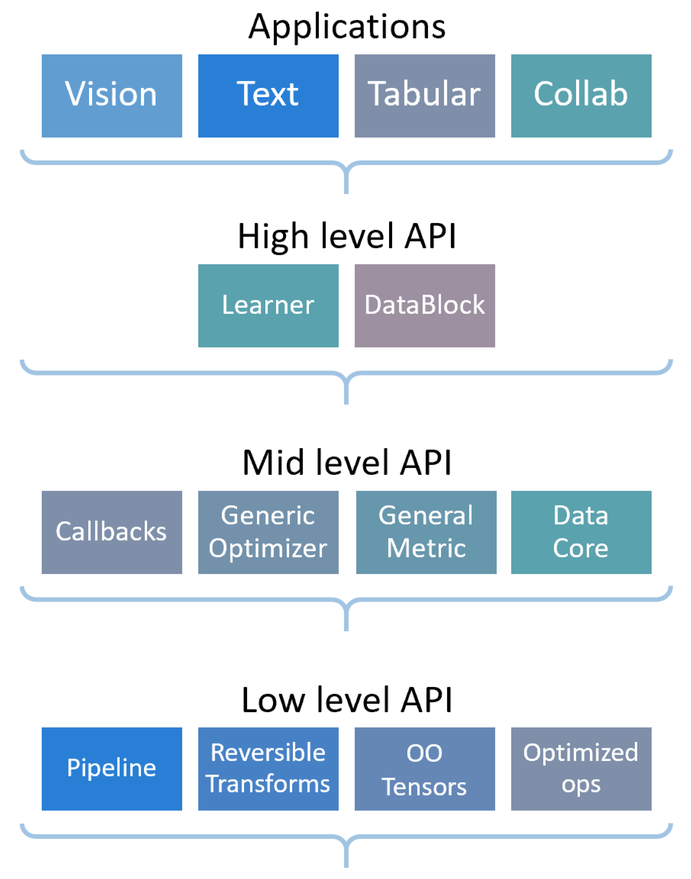
fastai simplifies training fast and accurate neural nets using modern best practices
grave breach
Yes
willow gull
mk
iron basalt
grave breach
That's not the first thing to do
Yeah, first comes something more like RL or UBL. Then reasoning somehow intermingles with that later and in different ways in different organisms (or not at all).
grave breach
iron basalt
Yeah, first comes something more like RL or UBL. Then reasoning somehow intermin...
RL is just a building block
Alone cannot lead to something "cool"
iron basalt
grave breach
Alone cannot lead to something "cool"
Yeah which is where something like a genetic algorithm comes into play or UBL.
Entropy maximization, etc
grave breach
iron basalt
Yeah which is where something like a genetic algorithm comes into play or UBL.
In my experience genetic algorithms were pretty much useless
iron basalt
grave breach
In my experience genetic algorithms were pretty much useless
In my experience, since we are here, they created something interesting. But we can't employ one in reality without well, letting it do its thing for a couple of million years and that would require at least robots that can sustain themselves.
grave breach
My problem was, that don't were flexible enough
Running a "search" for everything is "expensive"
I designed something that could adapt in a couple of frames
(if the task is simple)
And, if there are not too many layers to handle
iron basalt
Have you done such a task in real life on a real robot? There is this funny thing where ML algorithms that work in simulations do not translate at all to reality even in a very simple setup (by that I mean, untrained, learning only from reality).
grave breach
iron basalt
Have you done such a task in real life on a real robot? There is this funny thin...
Not yet, working on Gym
Some days I "ship" multiple version of the algorithm
I'm working really fast in this stage
iron basalt
grave breach
Not yet, working on Gym
Cool, yeah, if it does not even work in simulation then it won't IRL, so make sure it works there first, not waste time with a physical robot yet.
(And setup)
grave breach
iron basalt
Cool, yeah, if it does not even work in simulation then it won't IRL, so make su...
It works
But there's currently an annoyng bug
Have to rething a function
What kind of "experiments" have you been doing?
@iron basalt
Or, are you just trying to figure out where to start?
iron basalt
grave breach
What kind of "experiments" have you been doing?
In behavioral science, a T-maze (or the variant Y-maze) is a simple maze used in animal cognition experiments. It is shaped like the letter T (or Y), providing the subject, typically a rodent, with a straightforward choice.
T-mazes are used to study how the rodents function with memory and spatial learning through applying various stimuli. Start...
grave breach
Cool
iron basalt
All the gym stuff, but those are much easier than real life stuff like that (but a good sanity check on a new algorithm).
grave breach
I agree
I have a couple of bots
It would be fun mounting the algorithm on them
I'll do it
iron basalt
We also specialize in machine learning that is very fast and needs little memory, while still out performing other much most costly algorithms.
So we run our algorithms on stuff like the pi zero.
grave breach
What do you mean by "we" are you part of a research team or something?
grave breach
iron basalt
So we run our algorithms on stuff like the pi zero.
I think that my algorithm would work there
iron basalt
Yes, but I don't feel like revealing identity at this time.
iron basalt
grave breach
I think that my algorithm would work there
Yea, actually some of the main things to overcome in terms of speed is just being able to process the camera data at all.
Gotta use the little integrated GPU to at least downscale.
grave breach
iron basalt
Yea, actually some of the main things to overcome in terms of speed is just bein...
Oh that would be painful I think...
(I mean, making a learning algorithm work with images on a pi zero)
quasi sparrow
iron basalt
Have you done such a task in real life on a real robot? There is this funny thin...
Yeah, some of the models don't perform well. I am working on a transfer learning problem and I will "enhance" the model with a mathematical model to see how it works.
iron basalt
Yea ours does online learning on a pi zero at about 70 fps. It required not using the python pi camera library because it was too slow (made our own).
But the model is of course very small. Which kind of helps us push the algorithm forward though. Do more with less.
While also still running it on a big beefy machine to see how it scales.
grave breach
I wish you best luck
If you have something cool to say send me a dm, always open to learn something cool
grave frost
iron basalt
Yes a robot should be able to, which is kind of the point. How many people are w...
if we do develop a close enough simulation of a brain - what's stopping it from doing online learning provided the robot is connected to the servers?
grave breach
@grave frost By the way, I think that this might interest you: https://www.epfl.ch/research/domains/bluebrain/
EPFL’s Blue Brain Project is a Swiss brain research Initiative led by Founder and Director Professor Henry Markram. The aim of Blue Brain is to establish simulation neuroscience as a complementary approach alongside experimental, theoretical and clinical neuroscience to understanding the brain, by building the world’s first biologically detailed...
It aims to recreate a virtual "biological" brain
It is something big
grave frost
grave breach
<@!738058085083381760> By the way, I think that this might interest you: https:/...
looks good on the POC part
grave breach
grave frost
looks good on the POC part
I know
grave frost
it really doesn't matter what theory we take for WBE - its just different paths for the same goal
iron basalt
grave frost
if we do develop a close enough simulation of a brain - what's stopping it from ...
So you know how a biological organism must obtain food to stay alive? All interesting behavior comes as the result of that need. A robot has no such need by default so one would need to craft such a need that would lead to something interesting. Which is not very easy to do. But other than that, yeah sure. But I don't think we need tons of compute power to even do this. We don't need to simulate it at such a fine detail level. We only need the motifs (and maybe a few details like micro columns, grid cells, etc).
grave frost
the more important thing is to keep the funding flowing 🤣
grave frost
iron basalt
So you know how a biological organism must obtain food to stay alive? All intere...
hm. we could easily "replicate" this need by knowledge. i.e the more objects in the world it can predict exponentially more the reward
basically how humans do it
iron basalt
grave frost
hm. we could easily "replicate" this need by knowledge. i.e the more objects in ...
Not sure how easy that would actually be to implement, nor if it would give the type of behavior desired (on its own).
But if you think it can work, please try it.
(And maybe write something about how it went, and if you think you just did it wrong, or the idea was wrong)
(Or maybe it needs a little something more)
 potent ember
hello guys , need a little help , anyone here know about datasets in h5 files , need to finnish a project and dont have much time , a little help is appreciated
grave frost
iron basalt
Not sure how easy that would actually be to implement, nor if it would give the ...
basically how DL's probablity distribution represents the "confidence" of predictions? A reward for creating a model of the world (like how balls bounce, how carpets roll, how the sun appears from a certain point, how the notes in a music piece change etc.) and predicting it reasonably correctly & confidently would give it a positive reward and would endow human like behavior.
That is, if its brain is reasonably complex to atleast match human level abilities
grave frost
iron basalt
But if you think it can work, please try it.
like I am in much of a position to do that lol 😁
iron basalt
grave frost
basically how DL's probablity distribution represents the "confidence" of predic...
So you are rewarding it for having a good world model. We already have a pretty good world model in our algorithm (dare I say beyond SOTA), but it's just that, a world model. There is still missing the part where it learns to use that model for something interesting.
Hence stuff like the T-maze. Can it use the world model to navigate the maze?
I currently believe that anything that forces the robot to switch locations will result in interesting behavior simply because getting from A to B is difficult in a real world environment, especially a dynamically changing one.
(And will make it use its world model)
grave frost
iron basalt
So you are rewarding it for having a good world model. We already have a pretty ...
I believe complicating it would yield more complex behaviors; A reward for learning the model of the world + a reward for meeting basic requirements (surviving, obeying human implemented instructions etc.) + ...
the more we add, the closer we simulate a human being in a hope that it would gain that much intelligence atleast, if not ASI
iron basalt
grave frost
I believe complicating it would yield more complex behaviors; A reward for learn...
Yea, there is the possibility that it's just a ton of different things in a giant mix. Our current robot learns the world model, and also gets a reward for finding the cheese (T maze), and also for finding unique states.
Well we have multiple versions, thats the RL one.
grave frost
iron basalt
Yea, there is the possibility that it's just a ton of different things in a gian...
gridworld?
iron basalt
grave frost
gridworld?
No, real life T maze. https://en.wikipedia.org/wiki/T-maze
In behavioral science, a T-maze (or the variant Y-maze) is a simple maze used in animal cognition experiments. It is shaped like the letter T (or Y), providing the subject, typically a rodent, with a straightforward choice.
T-mazes are used to study how the rodents function with memory and spatial learning through applying various stimuli. Start...
grave frost
does sound like a great test for a POC
iron basalt
(and more complex mazes too)
grave frost
what fundamental theory are you using for the "brain"?
grave frost
iron basalt
Jeff Hawking
grave frost
something proprietary/new?
iron basalt
It's new and proprietary yes
grave frost
well, do send us a paper here!
iron basalt
When it does that maze like it's nothing I will def. send you something to look at.
Until then, we change stuff so rapidly (daily), that it would be a bit of a waste of time to write a long thing about it (since it can become completely outclassed the next day).
grave frost
but the basics are near/like HTM? so what would be different?
iron basalt
It's more like Jeff newer stuff. Or actually we bounce off of each other*
We cite each other*
grave frost
ooh, sounds pretty interesting 😉 now I am curious about your real identity, but that's for another time ig 🙂
note to self: check Jeff's citations for patterns
anyways, do update us on any new progress 
 tranquil yarrow
Does anyone know how I might utilize my GPU to train tensorflow models and speed up the training process?
vague stratus
tranquil yarrow
Does anyone know how I might utilize my GPU to train tensorflow models and speed...
are you using colab or your own local system?
tranquil yarrow
vague stratus
are you using colab or your own local system?
IDLE locally
REPL
Just training on those MNIST images. First time doing this.
vague stratus
tranquil yarrow
IDLE locally
You need to install Cuda toolkit, Cudnn and tensorRT for faster inference
tranquil yarrow
is that available via pip?
vague stratus
Also first of all you need to install NVIDIA drivers
tranquil yarrow
Just latest drivers or drivers specifically for ML?
vague stratus
tranquil yarrow
is that available via pip?
no
you need to install them from official nvidia website
vague stratus
tranquil yarrow
Just latest drivers or drivers specifically for ML?
just latest drivers
https://www.tensorflow.org/install/gpu
steps are well described here

TensorFlow
 austere swift
tranquil yarrow
Just latest drivers or drivers specifically for ML?
austere swift
tranquil yarrow
Just latest drivers or drivers specifically for ML?
you also need cuda and cudnn
tranquil yarrow
austere swift
you also need cuda and cudnn
Yeah, thanks, it's all at that GPU support link
austere swift
tranquil yarrow
Yeah, thanks, it's all at that GPU support link
yeah sorry i was scrolled up and didnt notice they sent the link yet lol
tranquil yarrow
Now if this gosh darn training would stop running on my CPU so I can test my GPU!
I didn't realize 5 epochs would take so long.
tranquil yarrow
austere swift
why don't you cancel the training?
Just close IDLE you say?
austere swift
tranquil yarrow
Just close IDLE you say?
you can use ctrl c to cancel it
tranquil yarrow
hmmmm....
austere swift
thats the standard keyboard interrupt key for cancelling any python programs
tranquil yarrow
Not a bad idea
austere swift
and even most non-python programs as well
tranquil yarrow
austere swift
and even most non-python programs as well
In Linux I'm familiar with this but am on Windows rn and that hasn't always been the case. Will try it, though.
tranquil yarrow
austere swift
ctrl c to cancel whatever's running
Do I need to specify the GPU when I re-run it, or will it default to the GPU if it's available for use?
austere swift
it should default to gpu
tranquil yarrow
okay thanks
austere swift
i wouldn't recommend using IDLE for advanced stuff btw
it would be better to switch to a proper editor/ide like vscode or pycharm or something
tranquil yarrow
austere swift
i wouldn't recommend using IDLE for advanced stuff btw
Thanks, but I'm aware. Just trying to get comfortable with the basics of setting up a DL model. I'm also working in Windows atm when I normally do work in Linux.
setting up / training a DL model
austere swift
yeah linux is much better for that stuff imo
tranquil yarrow
Yeah, I'm being a little stupid right now.
 solar rock
I am using Pandas to pump data into a csv. Is it at all possible to format a column in the dataframe using split? What do I need to Google by chance?
I think this will do it. Thanks. https://stackoverflow.com/questions/14745022/how-to-split-a-dataframe-string-column-into-two-columns
tranquil yarrow
@austere swift Do you know how long it should take to train this MNIST dataset with 5 epochs using something like an RTX 3080?
austere swift
tranquil yarrow
<@!494466018245345282> Do you know how long it should take to train this MNIST d...
depends on model size
tranquil yarrow
This is going to take a while. I did not expect it to take this long.
It's just the basic tensorflow tutorial.
austere swift
on my A6000 (which is about equivalent to a 3090 in terms of compute speed but double the vram) takes like 4s per epoch
thats on a basic dense model though
tranquil yarrow
Then it seems like there's something wrong then.
austere swift
how long is it taking?
tranquil yarrow
This will take over an hour at this rate.
austere swift
how big is the model
also check task manager and see if your gpu memory is being filled
tranquil yarrow
It does appear that the GPU is using almost all 10GB of memory
tranquil yarrow
It's this model below. I'm not sure. I think it's like 128 images or something.
https://colab.research.google.com/github/tensorflow/docs/blob/master/site/en/tutorials/quickstart/beginner.ipynb#scrollTo=DUNzJc4jTj6G
But it's those low-res MNIST images.
austere swift
that should not take that long
thats smaller than the one i was saying took 4s per epoch
tranquil yarrow
yeah, and a 3080 isn't that much less performant than a 3090
austere swift
tranquil yarrow
It's this model below. I'm not sure. I think it's like 128 images or something...
let me test this code on my 2080 super and see how long it takes
tranquil yarrow
austere swift
let me test this code on my 2080 super and see how long it takes
Okay, thanks.
austere swift
4s
per epoch
so it should be 4s on your 3080
are you running the code exactly how it is?
tranquil yarrow
Wait, why does it say "Utilization: 0%", but then the graph shows it almost full?
 tranquil yarrow
austere swift
are you running the code exactly how it is?
tranquil yarrow
austere swift
are you running the code exactly how it is?
Yeah, character for character
austere swift
windows shows utilization for different gpu "engines"
the cuda engine isnt on there
in most cases
so it wont show it
tranquil yarrow
oh okay
Well, I know my GPU can handle some massive 3D files, so I don't think it's a GPU hardware issue.
austere swift
what cuda and cudnn versions
tranquil yarrow
11.4.0
austere swift
use 11.2
austere swift
tranquil yarrow
11.4.0
oh i didnt even know 11.4 came out
austere swift
tranquil yarrow
wtf
its in the https://www.tensorflow.org/install/gpu
tranquil yarrow
It came out in june
austere swift
TensorFlow supports CUDA 11.2 (TensorFlow >= 2.5.0)
tranquil yarrow
austere swift
> TensorFlow supports CUDA 11.2 (TensorFlow >= 2.5.0)
Doggamnit
okay
does it matter which version of 11.2 I use?
tranquil yarrow
okay
austere swift
like 11.2 vs 11.2.1 doesnt make a difference
tranquil yarrow
Okay I'll just download latest 11.2 then
austere swift
yep
tranquil yarrow
I did install / re-install the latest drivers AFTER installing CUDA. Would this wipe out the CUDA installation?
tranquil yarrow
okay
tranquil yarrow
austere swift
cuda is separate
Does it matter if the cuDNN version is newer than that specified on that GPU support page?
tranquil yarrow
the problem is the link takes me to the latest version
tranquil yarrow
yeah okay i found it
@austere swift Do you know if it's going to be a problem if there is an 11.4 folder in addition to the 11.2 folder inside the CUDA directory?
austere swift
there shouldnt be
tranquil yarrow
okay
austere swift
i personally have 4 cuda installs
tranquil yarrow
So tf should just get the proper version?
austere swift
yes
tranquil yarrow
okay
alright, let's test this bad boy out
Okay, well, I guess we'll see if everything is hunky dory in a moment.
austere swift
the epochs should take like less than 10s
tranquil yarrow
austere swift
the epochs should take like less than 10s
So, this seems kind of weird to me:
The loss function for the untrained model has returned different numbers every time.
Should I be concerned?
austere swift
no that's normal
tranquil yarrow
okay
grave frost
@iron basalt a gedankenexperiment - suppose you put a healthy human baby in a building full of insane people and suppose it's brought up completely by them. do you think despite being normal and having no defects, the baby would still be like them and act like them?
if you think from a human perspective, it seems the only reward we got early on was replication. if we learnt to say something the way parents say then the baby would usually get a human equivalent of reward.
We have knowledge distillation for approximating algos. It seems that suppose your model can 'learn' enough from it's 'parent' in a compute efficient manner (just like knowledge distillation). Thus, supposing a parent to be a sufficiently intellgent algo say a GA. then on simulating the movement of the GA with the least tries would be deserving of a huge reward.
it kind of feels like cheating, but suppose it sees enough amount of mazes and learns to replicate its so-called smart parent enough. Wouldn't it generalize pretty well to the mazes - hopefully enough to do online learning and understand enough about maze topology to atleast solve it at a PoC level?
tbh it depends on the algo you would end-up using. but I think the idea of a having a critic/parent would be a simple idea to perform this computationally effectively while having it evolve complex policies from its parent to be rewarded upon succesfully mimicing a parent enough to navigate the maze and get the cheese.
I would think dervivatives of this raw approach might serve you well for having a simple model that can learn with a simple reward that basically defines "intelligent" atleast at a naive level.
BTW sorry for the long wall of text 😅 just had a suggestion that might be helpful
tranquil yarrow
@austere swift Still not done with first epoch yet.
Steps get progressively slower
on step 1291 out of 1875
austere swift
What other specs of your system?
tranquil yarrow
Ryzen 7 5800X CPU, RTX 3080, 32 MB DDR4 3200 RAM. nvme 1TB SSD
Python version 3.9
 royal crest
32 MiB 
tranquil yarrow
royal crest
32 MiB <:sweatDuck:785412893855580160>
A lot or not enough?
austere swift
tranquil yarrow
Ryzen 7 5800X CPU, RTX 3080, 32 MB DDR4 3200 RAM. nvme 1TB SSD
32 mb ram
tranquil yarrow
yeah, 32 mb ram
royal crest
32 mb
austere swift
I’m pretty sure you have that wrong lol
tranquil yarrow
megabytes
austere swift
are you sure
royal crest
tranquil yarrow
100% sure, yes
austere swift
Lol yeah
tranquil yarrow
gigabytes my bad
austere swift
Anyways that should run fine
tranquil yarrow
Yeah, I don't know what the effing problem is.
It runs AAA games at ultra settings perfectly fine
austere swift
I was just double checking it wasn’t like a 10 year old dell optiplex or something stupid like that
tranquil yarrow
lol no
I've got like 15-20 tabs open in Edge, but that shouldn't be the issue.
It's only using 10.3 GB of system ram atm
royal crest
jesus
tranquil yarrow
royal crest
jesus
That does seem like a lot doesn't it?
royal crest
okay i've scrolled up to read the fullest of the context
i think nvidia-smi is the only way to know for sure if your model is indeed using your GPU
royal crest
hmm so it is being used
royal crest
real solution: use linux
tranquil yarrow
I could switch over to Linux. I'm thinking of trying that. I have Ubuntu installed on this machine.
I'd have to download all the drivers again, though.
tranquil yarrow
Okay, eff Windows. I'm going to get onto Ubuntu.
Windows should still be able to run this, though.
I don't like not being able to do this in Windows also.
royal crest
it's just a matter of how much hassle you're willing to go through to get it working on 🪟
tranquil yarrow
royal crest
it's just a matter of how much hassle you're willing to go through to get it wor...
Wow, got onto Linux and now my display settings are effed up. WTF!!!
royal crest

tranquil yarrow
It doesn't even recognize my main monitor
royal crest
Anyways i think we are getting off-topic to this channel here
for linux related stuff #unix exists!
my favourite channel
tender hearth
tranquil yarrow
It's this model below. I'm not sure. I think it's like 128 images or something...
I've no idea if you fixed this already but you're doing something wrong because I was able to train on mnist with my laptop CPU in no time
tranquil yarrow
tender hearth
I've no idea if you fixed this already but you're doing something wrong because ...
I'm just entering the code as it shows up in that tutorial
into the Python REPL
Python 3.9
I have not fixed it yet. I'm installing CUDA drivers in Linux right now.
tranquil yarrow
tender hearth
I've no idea if you fixed this already but you're doing something wrong because ...
@austere swift Runs all 5 epochs in about 10s in Ubuntu first try
austere swift
tranquil yarrow
<@!494466018245345282> Runs all 5 epochs in about 10s in Ubuntu first try
windows is shit
:)
 austere swift
yeah linux is much better for that stuff imo
austere swift
austere swift
yeah linux is much better for that stuff imo
.
i've had a ton of random bugs in windows that just were gone in linux
tranquil yarrow
It would probably still be running in Windows if I hadn't stopped it.
 minor flax

Medium
Money-free make your home more secure just using your pc
royal crest
tranquil yarrow
<@!494466018245345282> Runs all 5 epochs in about 10s in Ubuntu first try


 drifting ermine

“Data Analysis with Python: Zero to Pandas” is a practical, beginner-friendly and coding-focused introduction to data analysis covering the basics of Python, Numpy, Pandas, data visualization and exploratory data analysis. You can earn a verified certificate of accomplishment by completing assignments and doing a course project.
inland zephyr
i want to ask about Earlystopping strategy. Some people said that put val_accuracy with max objective and some using val_loss with minimum objective. In hyperband original paper, they using val_loss as earlystopping objective. But most tutorial around web using val_accuracy as objective. What is the drawbacks and your suggestion about the strategy? I using val_loss to follow the original implementation with 10 patience.
 real perch
there won't be a big difference in using val loss or val accuracy as the early-stopping metric
the thing is, they are kind of loosely correlated, and mostly whenever val loss increased, accuracy decreases (not a hard rule, but most of the time this happens)
inland zephyr
but as far as i know, the loss can be bigger than 1 but cannot be 0 and accuracy must lie between 0 to 1. There's some test i done using both, and val_accuracy have tendency to give higher outcome in accuracy and F1 compare with val_loss.
real perch
then ig you can go with val-accuracy. a lot depends on the nature of the dataset for these kinds of things, so...
inland zephyr
i'm lack of scientific reference for this...
and also about usage Batch Normalization instead dropout
 fathom slate
Can a fresher with intermediate python along with average-level dsa get a job as a data engineer? given that all the backend stuff will be learned. what are the projects that one have to do, I mean whether python projs or projects with backend stuff like that in kaggle.com. please share your opinion
serene scaffold
@fathom slate what is a fresher?
 eager imp
hey, i need some pointers for a keras model i've build that i want to train with a generator
i'm using tf.keras.utils.Sequence for the generator
class DataGenerator(Sequence):
    def __init__(self, data:np.array, batch_size:int=1):
        data = scaler.fit_transform(data)
        #sample = data[np.random.choice(data.shape[0])].astype('float32').reshape(-1, 1)
        self.data = data
        self.labels = labels
    def __len__(self):
        return 7
    def __getitem__(self, idx):
        #  yield [imgs, cols], targets
        return np.array(self.data[idx:idx+2]), np.array([1,1])
for now it should just return two samples with a single label to make it work
the issue i run in is ValueError: Input 0 of layer sequential is incompatible with the layer: : expected min_ndim=3, found ndim=2. Full shape received: (None, None)
what's happening here?
fathom slate
serene scaffold
<@811915961060950087> what is a fresher?
a person looking for job without any experience. atleast, that's what they call in my country.
serene scaffold
fathom slate
a person looking for job without any experience. atleast, that's what they call ...
I don't think it's likely that you could get a job as a data engineer without a degree.
serene scaffold
 proven sigil
anyone here use dask?
proven sigil
anyone here use dask?
Go ahead and ask your question. Even if there's someone here who knows dask, they shouldn't need to interview you to get to the question.
fathom slate
I think you got me wrong here. I like to restate that "a gradute who's just completed his/her bachelor's programme applying for their first job would be considered as a fresher."
grave frost
ay, that's an indian term
yea, kaggle would serve you well even if you can't score well in the comps
 velvet thorn
indeed it is
serene scaffold
fathom slate
I think you got me wrong here. I like to restate that "a gradute who's just comp...
Restate? I don't recall you saying that earlier. Anyway, I can't comment on the job market in India.
grave frost
you would need to be quite competitive if you areindeed in India, due to the low demand for indian jobs and high supply - especially in DS which almost everyone i s doing
fathom slate
Thank you for A2A
grave frost
fathom slate
Can a fresher with intermediate python along with average-level dsa get a job as...
keep in mind tho that kaggle doesn't have "backend stuff". kaggle is purely DS/ML which may perhaps not be much of an achievement because 1. its not widely recognized among indian HR 2. it doesn't gurantee knowledge in managing databses, sql etc. which are often crucial skills.
proven sigil
fathom slate
Can a fresher with intermediate python along with average-level dsa get a job as...
Yes, you can. Focus on learning about DB systems, SQL, python, Scala, functional programming, etc. Kaggle is not a necessity for data engineering.
lapis sequoia
why using a cnn instead of a capsnet?
 grim oar
guys i get this error
Unable to allocate 288. MiB for an array with shape (23, 1640597) and data type int64
What can i do
All i did was try to upload a dataset to pandas
 void anvil
Hey guys, say I have a table of people with multiple datapoints such as their hobbies, favorite store, and favorite car. What algorithm is the best to rank the closest matching people to any record in the table
 undone flare
grim oar
guys i get this error
```Unable to allocate 288. MiB for an array with shape (...
undone flare
grim oar
guys i get this error
```Unable to allocate 288. MiB for an array with shape (...
what os
grim oar
Windows
This only happens with pycharm
When I do it with Jupyter lab I don't get any errors but the program just crashes
undone flare
what python version 32 bit or 64 bit?
undone flare
can you try changing the dtype to uint8 or would that mess up some data
grim oar
Let me see if they will work
How do you general work with large data sets
The one I am working with is around 4gb
undone flare
let me see if I get this
np.zeros((156816, 36, 53806), dtype='uint8')

-------------------------------------------------------------------
MemoryError                       Traceback (most recent call last)
<ipython-input-26-9392083af14d> in <module>
----> 1 np.zeros((156816, 36, 53806), dtype='uint8')

MemoryError: Unable to allocate 283. GiB for an array with shape (156816, 36, 53806) and data type uint8
hmm
let me try something
undone flare
works now

:)
I changed it to always overcommit mode
idk how to do that on windows tho
on linux it's echo 1 > /proc/sys/vm/overcommit_memory
undone flare
grim oar
what would happen if i run out of memory?
no idea
grim oar
is there any way to change it in windows?
undone flare
that so post should have for windows
undone flare
I don't think making it uint8 would do anything tho u can try
grim oar
I was trying to follow the method, but it doesnt give me the option run as admin
undone flare
um if you right click does it not show Run as Administrator?
grim oar
But it works normally
So I'll try it with that
Yeah it doesn't give me the option when I right click
undone flare
¯_(ツ)_/¯
grim oar
maybe i can break the data down into smaller chunks
thank you for your help @undone flare I really appreciate it. I am not very at tech haha
undone flare
grim oar
maybe i can break the data down into smaller chunks
hmm yea maybe
or you can remove something which won't help you much in data analysis
grim oar
right I am just using a corelation matrix and removing all the attributes that dont make much sense
grave frost
 round mango
u can ask me anything
round mango
u can ask me anything
when are you joining google brain? ( ͡° ͜ʖ ͡°) ||/j||
quasi sparrow
Guys, I have a question, I seem to have the concepts mixed.
When talking about regression, regression estimates based on the correlation of the features while time-series estimates based on extrapolation, correct?
Then, if regression uses correlation, why it is considered in machine learning a "regression" problem and not a classification problem.
I know it's super basic but I'm a little bit rusty.
is this why when training LSTM networks, 2D data must be converted into a 3D dataframe? To work the problem as regression in one time step and as a time-series problem in multiple time steps?
lapis sequoia
hey guys
in my jupyter notebook
it's not showing gpu
i already downloaded nividia cuda
also tensorlfow
show gpu - 0
i have RTX gpu
pls treat as urgnet
@bitter kayak no one is replying : (
it's urgent please
i also have lot's of work today
i'm in stress
uncut orbit
 grave frost
lapis sequoia
i already downloaded nividia cuda
grave frost
lapis sequoia
i already downloaded nividia cuda
cuda errors are the worst lol
use colab my dude
lapis sequoia
grave frost
cuda errors are the worst lol
what
lapis sequoia
grave frost
use colab my dude
i already have my own gpu
lapis sequoia
uncut orbit
?
 bronze skiff
lapis sequoia
pls treat as urgnet
bronze skiff
lapis sequoia
pls treat as urgnet
if it's urgent hire someone, this is a discord
try pytorch-- it comes with its own cuda binaries so it should work even without you installing cudatoolkit
unless of course you are missing drivers for the card itself-- at which point, download the drivers
tranquil yarrow
austere swift
windows is shit
Ubuntu wouldn't boot today after installing the CUDA drivers. Managed to get it resolved (at least for now), but it seems like the common thread here is Nvidia. The immortal words of Linus Torvalds never rang truer than now.
 lapis sequoia
bronze skiff
unless of course you are missing drivers for the card itself-- at which point, d...
lapis sequoia
bronze skiff
unless of course you are missing drivers for the card itself-- at which point, d...
ah drivers already downloaded
 tepid rapids
im working on a project involving using reinforcement learning on battlegrounds with hearthstone. im trying to code an environment for it in openai gym but i cant figure out how to deal with mouse control. anyone got any advice?
lapis sequoia
bronze skiff
if it's urgent hire someone, this is a discord
any video?
you'll recommend
tranquil yarrow
tepid rapids
im working on a project involving using reinforcement learning on battlegrounds ...
Sounds like you're coding game hacks.
tepid rapids
it's a masters project that i have no intention of releasing to the public. would this be a problem? i never considered the ethical issues...
tranquil yarrow
If it breaks terms of service, it's not really something people are supposed to be chatting about in here.
tranquil yarrow
Maybe you should consider a project that can't be so readily used for unethical purposes.
tranquil yarrow
I'm just saying your project may have more future value if it had some market potential. I know people make money off game hacks, but it's not really something you can talk about out in the open in a lot of places.
tepid rapids
well my other idea involved detecting network intrusions using a system log. This seemed like it had already been done numerous times though
 cold mantle
Can someone help me in #help-pineapple, just me being a idiot, but i dont know how to fix
 elfin trellis
need some advice for object detection modeling. Which is better for large datasets: Gluoncv, pytorch, or tensorflow?
 civic summit
i wanted to build a ordinal log regression model but i cant find a working guide. i tried using from statsmodels.miscmodels.ordinal_model import OrderedModel for statsmodel but it seems like it is no longer supported. Anyone know how i can run a ordinal log reg in python?
civic summit
even from mord import LogisticAT doesnt work
lapis sequoia
anyone here know how to write good airflow pipelines? do you have a repo you can share? thanks!
royal crest
lapis sequoia
show gpu - 0
0 indexing mate
i have 2 GPUs they show up as gpu0 and gpu1
royal crest
tranquil yarrow
If it breaks terms of service, it's not really something people are supposed to ...
well no, there's tools that predict % of winning a battle that hearthstone-sponsored streamers use
with an in-game overlay
Blizzard doesn't consider that cheating
lapis sequoia
royal crest
i have 2 GPUs they show up as gpu0 and gpu1
how can i solve then?
royal crest
solve what
if you're using tf try tf.config.list_physical_devices('GPU')
if they show you anything but False then you're good to go
and ensure that your tf is built with cuda
check this by doing tf.test.is_built_with_cuda
lapis sequoia
royal crest
solve what
0 gpu found error
royal crest
have you checked if your tf is built with cuda?
 gloomy crater
Does anyone have experience with Apache spark (Pyspark). Have some small general doubt
Or if anyone is currently working as a Data Scientist or for a company that's into retail analysis ?
lapis sequoia
royal crest
have you checked if your tf is built with cuda?
i don't how can i ?
i am new to ML
pls help
royal crest
What would you like us to do?
 mystic edge
Hey guys, I am using Gekko to try to solve a Mixed Integer Optimisation problem for a hobby of mine and it is worked somewhat well I think, as in the answer is at least reasonable but when I try to read the debug... Well because I only learned it a surface level I am not sure how to read it and some things seems weird? That is mostly when I increase the domain the optimisation has to go over but regardless, does anyone has like a solid article that would point me in the right direction for understanding well the results bellow?
And the weird things are for example:

It is a maximisation problem, why is Iter 2's obj lower (less negative) then the first one
and also, if I set one of the equations which just says a couple of variables have to be lower then X, where if those variable's are higher then X it has no change in the answer, to a very high number... Say from 100 to 100000, the obj gets even lower. Still the solver only shows me 2 iters
But then if I increase the Max_Iter option to 1000000, it goes back to giving me the previous answer, although still only showing 2 iters and with the first iter having a higher (more negative) obj then the second one
 short heart
Anybody encountered this?
NotImplementedError: Layer ModuleWrapper has arguments in `__init__` and therefore must override `get_config`.```

From what Ive read it can pop up if theres a custom layer, but I dont think Im using any

```py
model=Sequential()
model.add(Conv2D(128, 3, activation='relu', kernel_initializer='he_uniform', input_shape=(256,256, 1)))
model.add(MaxPooling2D())
model.add(Conv2D(64, 3, activation='relu', kernel_initializer='he_uniform'))
model.add(Conv2D(32, 3, activation='relu', kernel_initializer='he_uniform'))
#model.add(MaxPooling2D())
model.add(GlobalAveragePooling2D())
model.add(Dense(1,activation='sigmoid'))
model.compile(optimizer=
                  Adam(learning_rate=0.01),#,momentum=0.9, clipvalue=0.5),
                  loss='binary_crossentropy',
metrics=['accuracy'])```I found that the problem is in GlobalAveragePooling, but i dont see how its a custom layer
Solved: mixing up layer and model from keras and tf.keras
solar rock
Anyone have any good resources on formatting a column in a Pandas data frame? I have a column where each row is a list and I was to extract a value from each list item.
lavish tundra
guys i have a img like this and i'm trying to make it be clear and easy to be read by tesseract to convert it to a string text, i tried to resize it, but looks like what could help it be better is about to change the dpi, but i cant find someone using PIL or opencv to change the dpi of one image, someone can help me with that?

i tried to use opencv to do some things with this image, but nothing works
 grand breach
How do i resolve conflicts between pip and conda?
This is usually due to pip uninstalling or clobbering conda managed files,
resulting in an inconsistent environment. Please check your environment for
conda/pip conflicts using conda list, and fix the environment by ensuring
only one version of each package is installed (conda preferred)
royal crest
grand breach
How do i resolve conflicts between pip and conda?
This is usually due to `pip` ...
is the conflict arising from a venv that was created via conda?
grand breach
i'm in the base env
royal crest
or are we talking system's pip and conda clashing
grand breach
and trying to run conda pack
grand breach
royal crest
or are we talking system's pip and conda clashing
this
i'm trying to pack base env
basically trying to move my conda installation to a different drive
@royal crest how do i fix this? update the two conflicting pkgs via conda?
this github issue here (https://github.com/conda/conda-pack/issues/98) says: " the package cache no longer has a copy of the packages in the environment. So unfortunately, the same mechanism conda requires to clone an environment is needed be conda-pack to turn it into an archive"
 lean pebble
Who can help with yolov3. I need to check coordinate of middle of pickture what that found. Idk how to teach ai but I need teach and download ai to my pc and use in my bot
waxen veldt
what is the point of factorplots when you can individually call violinplot, barplot, boxplot, etc
and all of them have the hue argument right? so what would be the point
short heart
Is it better to fit small chunks of data with higher batch size or bigger chunks of data with small batch size for gpu
real perch
short heart
Is it better to fit small chunks of data with higher batch size or bigger chunks...
wdym "chunks"of data
short heart
I wont be able to just fit 560000 images instantly, so I only fit 10k and move on to next 10k and so on
lean pebble
lean pebble
Who can help with yolov3. I need to check coordinate of middle of pickture what ...
Pls help
I have all picture what is need
grave breach
lean pebble
Who can help with yolov3. I need to check coordinate of middle of pickture what ...
Wait, I didn't got it
Could you explain better?
 nova cliff
Am i alloweed to ask questions in here
grave breach
Yes
nova cliff
Ok
I am trying to scrape data off of a website
im using bs4,requests,beautiful soup and im getting cloudflare errors when sending the request
Tried having my useragent set to chrome, any thoughts?
grave breach
I don't think that's the right channel
nova cliff
Oh> sry
 misty flint
has anyone worked with FHIR
lean pebble
grave breach
Could you explain better?
Now I'm doing a system of automatic closure of advertising and I need to train artificial intelligence to find a cross and then click in the middle. Please help make ai and download to your computer and use it.
How i can teach bot and download and use on my pc
grave breach
Wait, I think that using ai could cause problems
Crosses aren't just used for ads, even for general purpose UI
It's better to download the image of commonly used crosses in ad
(like the one in youtube)
and use them as masks in OpenCV
But it could be better to handle the thing by manipulating the page's source
@lean pebble
opaque stratus
Hello! I am trying to find the optimal language model for a document classification task. These documents are long, however, the important sentiment is just a few sentences or less. I tried 6 BERT models, and all showed similar high F1 scores, which implies that the domain-specific pretraining of these models did not affect performance. This tells me that the optimal model would be able to really understand a small set of key words and phrases rather than need a complex understanding of the domain-specific language. Anyone have any suggestions or ideas of where to find this model? please @ me if so, thank you
 late shell
Hello, I am just getting started with NN, and wanted to code up a simple NN with just using numpy. The network architecture looks like the below picture. But I'm stuck at the updating the parameters in the gradient descent part. i.e :
W1 = W1 - alpha * dC_dW1
b1 = b1 - alpha * dC_db1
W2 = W2 - alpha * dC_dW2
b2 = b2 - alpha * dC_db2
# Where W1 & b1 represents the matrix of weights and biases in layer 1 respectively,
# W2 & b2 represents the matrix of weights and bias in layer 2 respectively.
```Since there are 9 weights and 4 biases, do I have to calculate the equation for derivative of cost function with respect to each of those 9 weights and 4 biases, and then vectorize them? That's 13 equations to code up, is this really how it's done if you want to code it from scratch? grave breach
opaque stratus
Hello! I am **trying to find the optimal language model for a document classific...
grave breach
opaque stratus
Hello! I am **trying to find the optimal language model for a document classific...
Don't know what kind of documents you're dealing with, so I'll suggest you a general-purpose language model
opaque stratus
grave breach
Don't know what kind of documents you're dealing with, so I'll suggest you a gen...
clinical documents
clinical notes
opaque stratus
grave breach
Don't know what kind of documents you're dealing with, so I'll suggest you a gen...
but the point is is that it doesnt matter how well the models understand the grand schem,e of the documents
it is just all coming down to a few sentences of information in them
like
general BERT trained on general english text outperforms BERT trained on clinical documents
serene scaffold
opaque stratus
Hello! I am **trying to find the optimal language model for a document classific...
Look into LDA for document classification.
opaque stratus
serene scaffold
Look into LDA for document classification.
yes Mister Stelercus
thank you
 rigid zodiac
Dumb question, if we have a small data like 15 of them, and we feed it to the ML algorithm. The accuracy will be like 100%? or else
opaque stratus
rigid zodiac
Dumb question, if we have a small data like 15 of them, and we feed it to the ML...
yeah may overfit, or it could do horribly lol
15 samples is not enough for a model to learn
even if you doubled that you could see a huge improvement!
rigid zodiac
that's what I afraid so far lol. For categorical variable, what ML model do you recommend?
tranquil yarrow
royal crest
well no, there's tools that predict % of winning a battle that hearthstone-spons...
Is machine learning really used for this sort of thing? Does it yield better results than more classical methods of odds prediction?
I guess it makes sense that there would be "intangibles" that wouldn't be captured so readily by more classical methods. Interesting. Looks like I'm going to move to Vegas and become a bookie!
arctic wedgeBOT
:incoming_envelope: :ok_hand: applied mute to @magic dune until <t:1627066391:f> (9 minutes and 59 seconds) (reason: newlines rule: sent 114 newlines in 10s).
 atomic tide
!unmute 555944200047296513
arctic wedgeBOT
:incoming_envelope: :ok_hand: pardoned infraction mute for @magic dune.
:x: There's no active mute infraction for user @magic dune.
arctic wedgeBOT
Pasting large amounts of code
If your code is too long to fit in a codeblock in discord, you can paste your code here:
https://paste.pydis.com/
After pasting your code, save it by clicking the floppy disk icon in the top right, or by typing ctrl + S. After doing that, the URL should change. Copy the URL and post it here so others can see it.
 magic dune
atomic tide
Please use this service to paste large amounts of code:
magic dune
atomic tide
Please use this service to paste large amounts of code:
Alright thx
Won't happen again
 noble sand
How would you resize Matplotlib.pyplot figures? I've been looking at this forum: https://stackoverflow.com/questions/332289/how-do-you-change-the-size-of-figures-drawn-with-matplotlib, and tried out the solution but my figure plots don't get sized appropriately 😦

Stack Overflow
How do you change the size of figure drawn with Matplotlib?
magic dune
I am currently making a k means cluster code which is only using numpy and matplotlib I want to color code the clusters can someone tell me how to do this
austere swift
noble sand
How would you resize `Matplotlib.pyplot` figures? I've been looking at this foru...
what's your code?
 umbral ferry
when ever I use df.describe() and specify the percentiles, it always includes the 50th percentile. I don't want it to include that, how do I make it not?
austere swift
so what do you mean by your figures dont get sized appropriately
noble sand
austere swift
so what do you mean by your figures dont get sized appropriately
Well the figure doesn't get scaled with size 800px in height by 800px in width hence why I wrote this: py fig, ax = plt.subplots(figsize=(8, 8), constrained_layout=True, dpi=100)
magic dune
I am currently making a k means cluster code which is only using numpy and matplotlib I want to color code the clusters can someone tell me how to do this?
help pls
austere swift
noble sand
Well the figure doesn't get scaled with size 800px in height by 800px in width h...
what size does it get scaled to
noble sand
austere swift
what size does it get scaled to
when I display it on the web browser, it's sized at about 100px x 100px

 steel ravine
magic dune
I am currently making a k means cluster code which is only using numpy and matp...
steel ravine
magic dune
I am currently making a k means cluster code which is only using numpy and matp...
Try one of the help channels
magic dune
steel ravine
Try one of the help channels
I did #help-pineapple
noble sand
austere swift
what size does it get scaled to
But when I check it out in my project file directory, it's sized at 800px x 800px...
 magic dune
but this guy just a question in the channel
steel ravine
Ok
umbral ferry
which scoring function should I use with SelectKBest when I have categorical input and numerical output?
mint palm
Why do we use resisual nets in NN ...it doesnt make sense to me in how the improve NN if ur just teleporting data so as to skip some layers?
bronze skiff
gradients like teleports tho
 edgy hull
Is there a great book related to machine learning as pdf form or anything?
magic dune
I am currently making a k means cluster code which is only using numpy and matplotlib I want to color code the clusters can someone tell me how to do this
My code:https://paste.pythondiscord.com/gabaporile.apache
pls help me
 finite leaf
Hi Everyone - I'm new to python and am tinkering with pandas. I have a two datasets with a primary key - foreign key relationship
On the dataset with the foreign key, I want to lookup data in the linked table and do a calculation
And then add that as a column in the original dataset
 ripe forge
finite leaf
ripe forge
finite leaf
ok
I'll look up those docs
thanks!
A follow on question - my keys are named dissimilarly
it looks like merge takes a single key, finds that on both tables, and joins on that
 unborn glacier
edgy hull
Is there a great book related to machine learning as pdf form or anything?
unborn glacier
edgy hull
Is there a great book related to machine learning as pdf form or anything?
This is my fave: https://www.amazon.com/Hands-Machine-Learning-Scikit-Learn-TensorFlow/dp/1492032646
Looks like it was free as a pdf at some point but not anymore
unborn glacier
finite leaf
A follow on question - my keys are named dissimilarly
Then how do you know how to pair them up??
edgy hull
unborn glacier
This is my fave: https://www.amazon.com/Hands-Machine-Learning-Scikit-Learn-Tens...
Will have a look at it ty!
finite leaf
If I were doing SQL you can say something like INNER JOIN Foo ON Bar.ID=Foo.BarID
unborn glacier
Ohhh you mean the column containing keys has a different name
finite leaf
yes 🙂
unborn glacier
Lol I thought your actual keys were different haha
mint palm
bronze skiff
gradients like teleports tho
??
unborn glacier
I think the right on / left on params do that
pd.merge(df1, df2, left_on='UserName', right_on='UserID')
 timber skiff
unborn glacier
I *think* the right on / left on params do that
pd.merge(df1, df2, left_on='User...
timber skiff
unborn glacier
I *think* the right on / left on params do that
pd.merge(df1, df2, left_on='User...
That's some good advice, i was renaming my columns like a plebian haha
serene scaffold
timber skiff
That's some good advice, i was renaming my columns like a plebian haha
for your reference, pd.merge has a how keyword argument where you can pick between inner, outer, right, etc., but "inner" is the default. DataFrames also have a join method, but that's only for joining on the index for some reason.
timber skiff
serene scaffold
for your reference, `pd.merge` has a `how` keyword argument where you can pick b...
Thank you, i did find that argument super useful. I usually just do an outter merge and filter/subset afterwards because they're small reports
While it's on my mind, do you know the best way to make a helper column that checks for nan in a different column, and fills in based off whether or not it's occupied?
serene scaffold
timber skiff
While it's on my mind, do you know the best way to make a helper column that che...
you just do df['column_name'].isna() and that gives you a boolean series.
timber skiff
My case is the large set is production data, the medium set is shipment data, and the small set is consumption data. I'd like a column called "stage" with the value produced, shipped, or consumed based off whether it shows up
serene scaffold
In [4]: df
Out[4]:
          0         1         2
0  0.471273  0.800411  0.899211
1  0.214583  0.581962  0.752713
2  0.611297  0.909228  0.658377
3  0.512379  0.329779  0.843706
4  0.323153  0.020822  0.234330

In [5]: df[0].isna()
Out[5]:
0    False
1    False
2    False
3    False
4    False
Name: 0, dtype: bool
 frank flare
I'm a noob. Idk how to code properly and definitely dunno about NN. Is there any online server or something where I could just add my dataset and it will be able to make predictions ?
serene scaffold
frank flare
I'm a noob. Idk how to code properly and definitely dunno about NN. Is there any...
I'm not sure, but you'd at least need to know enough about AI to effectively select what kind of model is appropriate for your data and the intended use case.
velvet thorn
timber skiff
While it's on my mind, do you know the best way to make a helper column that che...
if you want to identify null values, .isna(). if you want to fill them, .fillna().
timber skiff
if column A is 20 rows, B is 15, and C is 10.....
whats the best way to create a column D that has 3 possible values, "A is present", "A and B are present", "All are present"
velvet thorn
I suppose
that means that for all rows for which B and C are present, A is present
and for all rows for which C is present, B is present
timber skiff
exactly
velvet thorn
okay then
timber skiff
it steps down
velvet thorn
(df['A'] * 4 + df['B'] * 2 + df['C']).map({7: 'all', 6: 'A and B', 4: 'A'}) should work
wait hold up
velvet thorn
timber skiff
if column A is 20 rows, B is 15, and C is 10.....
what do you mean by this
how can they have different sizes
timber skiff
in an outter merge
timber skiff
where the presence of data indicates its stage
and i want a label for stage. Maybe df["all"] = df[df["C"].notna()]
then df["all"] = "all" .... then i'll append them ill play around
serene scaffold
timber skiff
and i want a label for stage. Maybe df["all"] = df[df["C"].notna()]
I don't think this would work because df[df["C"].notna()] is going to be selecting a subset of rows
 warm swallow
maybe this will work for you:
def is_present(a,b,c):
  if not math.isnan(b) and not math.isnan(c):
    return "all are present"
  elif not math.isnan(b) and math.isnan(c):
    return "a and b are present"
  else:
    return "a is present"

df['D'] = df.apply(lambda x: is_present(x['A'], x['B'], x['C']), axis=1)
ofc! i love lambda functions.