
#data-science-and-ml
1 messages · Page 146 of 1
 rich moth
 unkempt wigeon
the gyms?
rich moth
Theres so links at the bottom training agents

A standard API for reinforcement learning and a diverse set of reference environments (formerly Gym)
unkempt wigeon
What a mathematical formula do I use to get from -1 to 0 to 1?
 violet gull
hyperbolic tangent
 main fox
violet gull
hyperbolic tangent
main fox
violet gull
hyperbolic tangent
Asymptotic
unkempt wigeon
thank you
unkempt wigeon
violet gull
hyperbolic tangent
Thank you
unkempt wigeon
violet gull
hyperbolic tangent
I would not be subtracting the weights and biasis?
violet gull
?
unkempt wigeon
Ticket when I need for the function my apologies

import numpy as np
X = np.array([[1,2,3,4,5,6,7,8,9,10,])
W = weights
B = bias

output0 = (X,W) + B

def Exponential_definition(output):
output1 = output0**1 / output0** -1


Exponential_definition()


print(ouput1)
 desert oar
unkempt wigeon
What a mathematical formula do I use to get from -1 to 0 to 1?
desert oar
unkempt wigeon
What a mathematical formula do I use to get from -1 to 0 to 1?
there's also the logistic function https://en.wikipedia.org/wiki/Logistic_function

A logistic function or logistic curve is a common S-shaped curve (sigmoid curve) with the equation
    f
    (
    x
    )
    =


        L

          1
          +

            e

              −
              k
         ...
thankyou
But I think not going with something like a hyperbolic tangent may possibly work because I'm trying to measure the output for where a bomb may be using a kernel and then getting the values for that and crunching them and based on whether where the data is going a positive one will go up and negative one would go down on the y-axis my apologies
unkempt wigeon
desert oar
there's also the logistic function https://en.wikipedia.org/wiki/Logistic_functi...
I managed to get such a function to work working my apologies
rich moth
you can see how the generated captions are starting to match the processed ones. well the first one, but im starting to see paterns like that. still hammering down the hyperparameters but i think the sweet spot area seems to be 5e-5 for the the weight decayy I got to play with more.
 rich moth
unkempt wigeon
I managed to get such a function to work working my apologies
rich moth
unkempt wigeon
I managed to get such a function to work working my apologies
hows your project going?
unkempt wigeon
rich moth
hows your project going?
I managed to figure out what mathematical formula I need to make it so that it can go up and down or just stay in the area that it needs to other than that nothing now I don't know if I should make a for a loop for every 5 seconds take a screenshot in the game or take one every two seconds so that I can learn fast from the images giving it computer vision almost sorry
rich moth
probably the latter. guess it depends what exactly you want to achieve.
rich moth
DND? lol
unkempt wigeon
hyperbolic tangent that's why I need because a negative number to the neural network when men going down well I would mean going up and zero and mean stay where it is sorry
unkempt wigeon
rich moth
DND? lol
I thought I copied the formula I needed to explain my apologies
rich moth
i see it
unkempt wigeon
Now I have to make some statements and have to figure out what I need to do to give it a crude form of computer vision taking quick screenshots converting them into arrays then quickly jump to the next one a second later my apologies
rich moth
i was wondering what kind of game it was or if it was for a pre exisiting game you wanted it to learn from?
unkempt wigeon
rich moth
i see it
What I need an if max argument an a min argument to adjust the AI_paddles position
unkempt wigeon
rich moth
i was wondering what kind of game it was or if it was for a pre exisiting game y...
Pong I made from a tutorial
rich moth
unkempt wigeon
Pong I made from a tutorial
nice
unkempt wigeon
I have to figure out how to get the network up and running and want to use a pre-trained model but that feels like I'm cheating plus I don't get any understanding out of it sorry
unkempt wigeon
rich moth
nice
Any ideas of how I can make it so that can go up and down with the paddle with if statements sorry
rich moth
unkempt wigeon
Any ideas of how I can make it so that can go up and down with the paddle with i...
maybe try rephrasing what you want to say using AI first and paste it, its hard to make out what you want exactly.
 unkempt apex
YUP!
unkempt apex
unkempt wigeon
Pong I made from a tutorial
u wanna see my Pong game?
I made that with custom environment to train
not the one that Gym provides
rich moth
unkempt apex
u wanna see my Pong game?
i wanna see it.
I made one for assault game, though it didnt run very well as it was going through cpu.
rich moth
lol they got ya. nice man. Ive been messing around with that CTF game, its almost done. but I wanted to try something else.
rich moth
unkempt apex
after 320k episodes
320k episodes. How long did that take?
unkempt apex
rich moth
320k episodes. How long did that take?
bruhh, that's fairytale now
you have good GPU come on, you don't have to worry about this
rich moth
unkempt apex
bruhh, that's fairytale now
I still do. lol
 unkempt apex
which GPU u have?
rich moth
4090
rich moth
what have you been working on lately?
unkempt apex
rich moth
what have you been working on lately?
was studying about GAN
rich moth
unkempt apex
was studying about GAN
i want to make an AI driven MUD game, where AI acts as a dynamic dungeon master controlling the world, creating real-time interactions, and generating ASCII art for environments and characters. I think with all the tools and content already out there you can probably use a lot of templates or make the art using a GAN or something. seems like a lot of work though lol
 past bramble
does anyone know when I "Run & Save All" in kaggle, and my GPU time exceeds, are my output files that I created till then still saved?
 uneven jewel
Guys after finishing my Bachelor's degree,what should I pursue ,MS or Mtech in data science?
Someone help me
 wooden sail
uneven jewel
Guys after finishing my Bachelor's degree,what should I pursue ,MS or Mtech in d...
wooden sail
uneven jewel
Guys after finishing my Bachelor's degree,what should I pursue ,MS or Mtech in d...
what do you wanna do after and what kind of job are you aiming for? the main difference is usually that an msc is more theory and research based
uneven jewel
wooden sail
what do you wanna do after and what kind of job are you aiming for? the main dif...
I'm aiming to become a data scientist or an AI ML Engineer
wooden sail
but doing research and developing your own methods, or applying what's out there?
uneven jewel
wooden sail
but doing research and developing your own methods, or applying what's out there...
Idk honestly 😐
But yeah I'll try to develop my new methods
wooden sail
you're gonna have to figure that out, since that's the key difference
unkempt apex
past bramble
does anyone know when I "Run & Save All" in kaggle, and my GPU time exceeds, are...
it only saves for session I guess!
 lapis sequoia
HI
unkempt wigeon
rich moth
maybe try rephrasing what you want to say using AI first and paste it, its hard ...
I'm working on the AI threshold to signal where to move when it detects in the ball or the players movement and take track of its own movement too sorry
 ionic valley
need some help loading AWS S3 into a notebook environment for an ML project https://discord.com/channels/267624335836053506/1284184828379533444
 scarlet anchor
For extracting information from images, is resnet a good choice
unkempt apex
scarlet anchor
For extracting information from images, is resnet a good choice
what info u need??, text ?? pixels like CNN do??
scarlet anchor
unkempt apex
what info u need??, text ?? pixels like CNN do??
not quite, need to extract some text written on the image
 unkempt wigeon
unkempt apex
u wanna see my Pong game?
unkempt wigeon
unkempt apex
u wanna see my Pong game?
Yes sorry fell asleep
scarlet anchor
unkempt apex
https://huggingface.co/models?pipeline_tag=image-to-text
nah, i cannot use these models, i want traditional ML model
 serene scaffold
scarlet anchor
nah, i cannot use these models, i want traditional ML model
serene scaffold
scarlet anchor
nah, i cannot use these models, i want traditional ML model
what would you consider "traditional" ML?
 sonic remnant
Does anyone know anything about OCR for batches of webtoon images for each episode using tesseract. I already have a python script that runs fine but nothing is produced in terms of text extraction.
Idk where to ask this problem of mine.
 storm valve
sonic remnant
Does anyone know anything about OCR for batches of webtoon images for each episo...
sonic remnant
storm valve
sonic remnant
Does anyone know anything about OCR for batches of webtoon images for each episo...
sonic remnant
Damn
scarlet anchor
serene scaffold
what would you consider "traditional" ML?
something like basic models i mean
storm valve
scarlet anchor
something like basic models i mean
and why cant huggingface models be basic?
scarlet anchor
storm valve
and why cant huggingface models be basic?
it sure can be, but I am not allowed to use, as per competition rules. I am doing this task as part of a competition
unkempt wigeon
How would I implement a function that test if there's a negative number a positive number and a neutral number like zero sorry
storm valve
scarlet anchor
it sure can be, but I am not allowed to use, as per competition rules. I am doin...
ah, that explains it
rich moth
i just got a good idea. I can use the sentence transformer to create new captions from the orginal captions right? Im thinking I can double my training data for the captions that way. What do you guys think?
Mayybe not, could not align with the pictures as much, but its worth testing
rich moth
well,I started training after adding the CNN. So it turns the text embeddings into a pseudo-image like structure. This gets tied into the manifold autoencoder, creating a shared space between text and images. The CNN output is projected into the manifold then heads over to the attention module which refines that connection by focusing on the important parts.. hopefully this works out ill report back. i had to make a bunch of changes though
 gusty silo
Ay is there anyone here who likes cryptography?
 jaunty helm
gusty silo
Ay is there anyone here who likes cryptography?
jaunty helm
gusty silo
Ay is there anyone here who likes cryptography?
well this is the data sci channel, maybe more luck in #cybersecurity ?
 river cape
Hi guys]
I have cnn model which augments the data
It is a cat -dog classifer
I have around 2002 images in train and 1000 images in validation
and the image data generator has a batch_size of 16
and when I train model
model.fit(train_generator,steps_per_epoch=125,epochs=4,validation_data=validation_generator,validation_steps=66)
Your input ran out of data; interrupting training. Make sure that your dataset or generator can generate at least steps_per_epoch * epochs batches. You may need to use the .repeat() function when building your dataset.
self.gen.throw(typ, value, traceback)
It gives me this error
 small wedge
river cape
and the image data generator has a batch_size of 16
small wedge
river cape
and the image data generator has a batch_size of 16
okay well if you have 2002 images in your training set and 16 images per batch, you can make 2002/16 == 125 batches. 125 steps per epoch * 4 is 500 batches you would need
weird that it wants steps * epoch though, you should be running through all the batches each epoch generally
river cape
small wedge
weird that it wants steps * epoch though, you should be running through all the ...
Yea when i configured the steps to 30 and epochs as 4 , it gives the right output
30*4 is 120 batches for each iteration
Which is less than 125 batches as per 2002/16

 umbral olive
I've been training ML models with my laptop GPU RTX 3050, I've been thinking if I wanna learn and solve any problems, is 1 hour training is enough before fine tune it or is there any aspects that I need to look out?
it would waste my time cuz I need to wait for 1 hour only then I can have some progress cuz I can't use my laptop since 100% GPU is in training
jaunty helm
umbral olive
I've been training ML models with my laptop GPU RTX 3050, I've been thinking if ...
I wanna learn and solve any problems
what does that mean
is 1 hour training is enough before fine tune
training what, fine tuning what
 proper crag
anyone here like do the study in deep regarding kernel trick?
if does , i wan to know the resources you're using
storm valve
https://paste.pythondiscord.com/YMHA
this is something basic i've come up with
needs some cleanup i guess but it's a start
desert oar
discuss.python.org and #python on Libera
and of course a certain Discord server but we aren't allowed to discuss techniques for constructing that dataset 😉
 hushed drift
desert oar
and of course a certain Discord server but we aren't allowed to discuss techniqu...
hushed drift
desert oar
and of course a certain Discord server but we aren't allowed to discuss techniqu...
Can you tell md the discord server name in private?
serene scaffold
hushed drift
Can you tell md the discord server name in private?
||it's this one||
unkempt wigeon
May I ask a question
jaunty helm
unkempt wigeon
May I ask a question
Nope.
(jokes aside, you don't need to ask for permission to ask a question)
unkempt wigeon
Is it possible to get screenshots from pie game to put into on your own network so that I can try to teach my neural network sorry
jaunty helm
unkempt wigeon
Is it possible to get screenshots from pie game to put into on your own network ...
teach your network to do what exactly
also I'm not sure what pie game is
unkempt wigeon
jaunty helm
also I'm not sure what pie game is
Pygame and to play pong
Sorry stt never works
 dusty lodge
Hello, im implementing Attention Is All You Need paper with pytorch from scratch. And i would like to test it by training it using multi30k dataset. The model is training (the loss decrease) but when comes to inference it just repeating the same word
If you mind you can see my implementation here. I also try to use the transformer class from pytorch to compare it. And it acts like my own implementation https://colab.research.google.com/drive/1DOGUufRoZjynd2Te2tc7R1_qBBrOCn_v?usp=sharing
 storm valve
desert oar
and of course a certain Discord server but we aren't allowed to discuss techniqu...
storm valve
desert oar
and of course a certain Discord server but we aren't allowed to discuss techniqu...
wait we aren't? why?
rich moth
desert oar
discuss.python.org and #python on Libera
is there some type of competition going on?
 drowsy ice
from gym.wrappers import GrayScaleObservation
# Import Vectorization Wrappers
from stable_baselines3.common.vec_env import VecFrameStack, DummyVecEnv
# Import Matplotlib to show the impact of frame stacking
from matplotlib import pyplot as plt
# 1. Create the base environment
env = gym_super_mario_bros.make('SuperMarioBros-v0')

# 2. Simplify the controls
env = JoypadSpace(env, SIMPLE_MOVEMENT)

# 3. Grayscale
env = GrayScaleObservation(env, keep_dim=True)

# 4. Wrap inside the Dummy Environment
env = DummyVecEnv([lambda: env])

# 5. Stack the frames
env = VecFrameStack(env, 4, channels_order='last')

JoypadSpace.reset = lambda self, **kwargs: self.env.reset(**kwargs)

# Reset the environment to get the initial state
state = env.reset()

# Take a step in the environment (action 5)
state, reward, done, info = env.step([5])

# Plot the state (4 stacked grayscale frames)
plt.figure(figsize=(20, 16))
for idx in range(state.shape[3]):
    plt.subplot(1, 4, idx + 1)
    plt.imshow(state[0][:, :, idx], cmap='gray')
plt.show() ``` The joypad wasn't resetting so I put that one liner of joypad reset now it has too many values to unpackI found this.
 rich moth
Ok , i tested it, i think the latest version of gym returns obs, info from the env.rest()
drowsy ice
rich moth
Ok , i tested it, i think the latest version of gym returns obs, info from the e...
TypeError: JoypadSpace.reset() got an unexpected keyword argument 'seed'
So what do you think I should do?
downgrade versions?
Is aw that line too but idk where to put it
going to try uninstalling
rich moth
drowsy ice
TypeError: JoypadSpace.reset() got an unexpected keyword argument 'seed'
from nes_py.wrappers import JoypadSpace
import gym_super_mario_bros
from gym_super_mario_bros.actions import SIMPLE_MOVEMENT
from gym.wrappers import GrayScaleObservation, FrameStack
import numpy as np
import matplotlib.pyplot as plt
Ensure gym_super_mario_bros is imported before creating the environment
import gym_super_mario_bros
1. Create the base environment
env = gym_super_mario_bros.make('SuperMarioBros-v0')
2. Simplify the controls
env = JoypadSpace(env, SIMPLE_MOVEMENT)
3. Grayscale
env = GrayScaleObservation(env, keep_dim=True)
4. Stack the frames
env = FrameStack(env, 4)
JoypadSpace.reset = lambda self, **kwargs: self.env.reset(**kwargs)
Reset the environment to get the initial state
state = env.reset()
Take a step in the environment (action 5)
state, reward, done, info = env.step(5)
Convert LazyFrames to numpy array
state_array = np.array(state)
Print the shape of the state array
print("State array shape:", state_array.shape)
Plot the state (4 stacked grayscale frames)
plt.figure(figsize=(20, 16))
for idx in range(state_array.shape[0]): # Changed from state_array.shape[2]
plt.subplot(1, 4, idx + 1)
plt.imshow(state_array[idx], cmap='gray')
plt.title(f"Frame {idx+1}")
plt.axis('off')
plt.tight_layout()
plt.show()
Close the environment
env.close()
i installed this pip install gymnasium gym-super-mario-bros stable-baselines3[extra] shimmy seems like it working now. i think it was a verison error.
desert oar
storm valve
wait we aren't? why?
Just about any reasonable technique for assembling a corpus of data from this server would probably violate server rules to discuss in detail
small wedge
I mean you can say self botting without explaining how to and it's fine right
storm valve
desert oar
Just about any reasonable technique for assembling a corpus of data from this se...
this is a very specific corpus of data which should be able to be gathered within server rules as the entire thing is open source i'd think
drowsy ice
rich moth
from nes_py.wrappers import JoypadSpace
import gym_super_mario_bros
from gym_sup...
Ty
I will try it when I get back home
drowsy ice
rich moth
from nes_py.wrappers import JoypadSpace
import gym_super_mario_bros
from gym_sup...
Getting requirements to build wheel ... error
error: subprocess-exited-with-error
unkempt wigeon
But how can I make it work on our own network thinks of its panel being in the right space or not in the right space how can I implemented going up and down or staying the same sorry
rich moth
drowsy ice
Getting requirements to build wheel ... error
error: subprocess-exited-with-er...
what was the error?
rich moth
drowsy ice
when its installing build dependancies
did it say what packages are holding the install up?
drowsy ice
C:\Users\AppData\Local\Temp\pip-build-env-1x9xfcg4\overlay\Lib\site-packages\setuptools
_distutils\dist.py:261: UserWarning: Unknown distribution option: 'tests_require'
rich moth
maybe try python -m pip install --upgrade pip setuptools
you might need to try to build a new env? i got it working using python 3.11
unkempt apex
why env?? on windows?
rich moth
ohh haha i didnt notice that
drowsy ice
yea its ok guys I'm going to work on somthing else I'm losing my mind on it lol
drowsy ice
rich moth
did it say what packages are holding the install up?
advice if I want to do this without using a tutorial?
because these tutorials are making me lose my mind
rich moth
dude this generated caption cracked me up Generated Output IDs Shape: torch.Size([1, 17]) Decoded Caption: ["a polar bear is seen in this image taken from nasa's curiosity spacecraft"]
rich moth
drowsy ice
advice if I want to do this without using a tutorial?
ya the tutorrial wasnt very helpful. i got it workingn with those packages on python 3.11. I'd try to make a new env with 3.11 and install what i pasted above try again
 drowsy ice
python 3.11 got it
I'm getting more erroes now
OverflowError: Python integer 1024 out of bounds for uint8
serene scaffold
drowsy ice
OverflowError: Python integer 1024 out of bounds for uint8
Do you know what the error message means
drowsy ice
I'm assuming that the integer is to large for something
I' don't really under stand though
# Import the game
import gym_super_mario_bros
# Import the Joypad wrapper
from nes_py.wrappers import JoypadSpace
# Import the SIMPLIFIED controls
from gym_super_mario_bros.actions import SIMPLE_MOVEMENT

env = gym_super_mario_bros.make('SuperMarioBros-v0')
the only change was python version
I see the problem incompatible libraries
rich moth
drowsy ice
```
# Import the game
import gym_super_mario_bros
# Import the Joypad wrapper
f...
you got it working? cool beans
drowsy ice
rich moth
you got it working? cool beans
OverflowError: Python integer 1024 out of bounds for uint8
ML/RL is my nemesis
It works when I switch python versions
rich moth
i thought as much
drowsy ice
you're a genius plunder, I cry when I think about how muych time I've spent just trying to ge through tutorials and falling into a myriad of problems
rich moth
drowsy ice
you're a genius plunder, I cry when I think about how muych time I've spent just...
no worries man! i know the feeling
drowsy ice
should |I keep changing python versions?
rich moth
ive been pretty happy with 3.11 i cant remember why i switched to it, i found it really compatible though
drowsy ice
so you don't know how to fix "Python integer 1024 out of bounds for uint8"
rich moth
uint8 only hold 0 to 255 1024 is too large for it.
im looking on stackoverflow, but thats what It seems like
try uint16?
drowsy ice
It's ok I'm just going to give up on coding
It always makes me mad and I end up wasting hours trying to fix a problem
Just going to focus on the coding that I absolutely need
 tranquil mist
man, polars is just insane, im seeing 10x to 20x improvements in some dags just by rewriting the pandas part in polars
and the api is so well written
rich moth
tranquil mist
man, polars is just insane, im seeing 10x to 20x improvements in some dags just ...
I had to google it never even heard of it. https://pola.rs/

DataFrames for the new era
small wedge
tranquil mist
man, polars is just insane, im seeing 10x to 20x improvements in some dags just ...
do you have the old pandas code and the polars you wrote to replace it so we could see the difference? I'm interested
tranquil mist
small wedge
do you have the old pandas code and the polars you wrote to replace it so we cou...
all work stuff so not really, but there's this snippet where im consolidating and unpivotring around 7k csv files into a single dataframe
Pandas takes around 25mins, polars takes 2mins flat
rich moth
small wedge
do you have the old pandas code and the polars you wrote to replace it so we cou...
I found this,. https://www.linkedin.com/pulse/polars-vs-pandas-benchmarking-performances-beyond-l6svf

by Arlind Avdullahi Introduction If you have ever done any kind of experimenting in data science, you must have heard of Pandas. To quote the corresponding Github documentation, Pandas is a “Flexible and powerful data analysis / manipulation library for Python, providing labeled data structures simi
tranquil mist
keep in mind polars has a purpose built method for bulk csv reading while pandas doesnt (u have to iterate over the files)
but other methods are still way ahead, the unpivot method on lazyframes is just unbeatable
 left tartan
This benchmark misses the point about Pandas having an arrow backend option. I'd be curious how these results would compare when using the arrow backend to pandas, such as https://pandas.pydata.org/docs/user_guide/pyarrow.html#i-o-reading
desert oar
left tartan
This benchmark misses the point about Pandas having an arrow backend option. I'd...
My expectations of a library performance benchmark posted on LinkedIn are not high
 spare forum
tranquil mist
man, polars is just insane, im seeing 10x to 20x improvements in some dags just ...
spare forum
tranquil mist
man, polars is just insane, im seeing 10x to 20x improvements in some dags just ...
Because it use all your pc cores
Pandas use one core max
Pandas is fast considering this and written in C, polars is written in Rust, note that you can use similar to pandas syntax and use more ressources with dask, also pyspark but not the same syntax and not the same setup
 iron basalt
spare forum
Because it use all your pc cores
iron basalt
spare forum
Because it use all your pc cores
The performance gain is for other reasons too. It creates a compute graph that it executes in one go. Unlike Numpy where you need to do one operation on the whole array, then the next (looping over it all multiple times). There is no performance difference between C and Rust, when they are both compiling with LLVM (LLVM with different makeup on).
serene scaffold
spare forum
Pandas use one core max
are you talking about pandas for string operations, or pandas in general?
spare forum
iron basalt
The performance gain is for other reasons too. It creates a compute graph that i...
It also can use more than one cpu core lol
spare forum
serene scaffold
are you talking about pandas for string operations, or pandas in general?
general
serene scaffold
spare forum
general
that's not true. pandas wraps numpy for numeric computations.
spare forum
And?
serene scaffold
so it's using more than one core for those computations.
spare forum
No.
serene scaffold
source?
spare forum
There are litteraly libraries built to reuse pandas syntax but using multiple cores, man idk 2s google search it's like that
serene scaffold
In [1]: a, b = np.random.random((10_000, 10_000)), np.random.random((10_000, 10_000))

In [7]: %timeit a + b
215 ms ± 6.49 ms per loop (mean ± std. dev. of 7 runs, 1 loop each)

In [8]: d1, d2 = pd.DataFrame(a), pd.DataFrame(b)

In [9]: %timeit d1 + d2
214 ms ± 1.85 ms per loop (mean ± std. dev. of 7 runs, 1 loop each)
One does not :simply use Google 
rich moth
man this thing is really coming together. I just started training and its learning quickly. i got the learning rate pegged down but the number of beams and the temperature of the captions needs fine tuning
 spare forum
 faint quail
whats the point of pandas
faint quail
whats the point of pandas
Data processing/operations
faint quail
spare forum
Data processing/operations
just use numpy
serene scaffold
faint quail
just use numpy
numpy is specifically for math, whereas numpy is for tabular data manipulation in general.
faint quail
oh ok
spare forum
it's less practical for dataframes
rich moth
who knew applying convolution layers to token embeddings would work lol
iron basalt
spare forum
It also can use more than one cpu core lol
Numpy can use more than one thread in its linear algebra library used, but it may require some configuration and depends on which build of numpy you have installed.
But this is not an optimal way to do threading, still better than no threads in many cases.
rich moth
so far so good, the rogue score should start going up with more training. i feel like this is the one ! its kinda dark the reconstruction but it should lighten up and fill in next few epochs.

 iron basalt
serene scaffold
```ipython
In [1]: a, b = np.random.random((10_000, 10_000)), np.random.random((...
iron basalt
serene scaffold
```ipython
In [1]: a, b = np.random.random((10_000, 10_000)), np.random.random((...
Not sure what your machine is, but this is about single threaded performance on mine. Can you try messing around with the thread count?
There is very little on documentation on how to make Numpy do this.
But you can try: https://github.com/joblib/threadpoolctl
GitHub
Python helpers to limit the number of threads used in native libraries that handle their own internal threadpool (BLAS and OpenMP implementations) - joblib/threadpoolctl
python -m threadpoolctl -i numpy should tell you what you need to know about which version of Numpy you have.
rich moth
https://docs.python.org/3/library/concurrent.futures.html
could that work?

Python documentation
Source code: Lib/concurrent/futures/thread.py and Lib/concurrent/futures/process.py The concurrent.futures module provides a high-level interface for asynchronously executing callables. The asynchr...
iron basalt
left tartan
This benchmark misses the point about Pandas having an arrow backend option. I'd...
I would like to see this too, my guess is that arrow does threading by default more so than Numpy.
rich moth
well I just googled the first benchmark i saw, you guys can dig deeper into it
iron basalt
rich moth
well I just googled the first benchmark i saw, you guys can dig deeper into it
I know that it's faster although the way it's advertised is nonsense, such as: "Compared to pandas, it can achieve more than 30x performance gains."
Like 30x is pretty specific and yeah, I can get 1000x or more with enough threads vs single threaded. Thats how adding more threads works.
What you really want here is information how well it makes use of the threads.
(Also it being in Rust is irrelevant, but Rust people have to mention it)
rich moth
iron basalt
I know that it's faster although the way it's advertised is nonsense, such as: "...
Right.. I did see that it is abit misleading. I've never even heard of it until today. I do see people throw it around a lot for its performance.
iron basalt
rich moth
Right.. I did see that it is abit misleading. I've never even heard of it until...
Not just throwing something like "30x" out there makes it a hard sell, which is why they do it.
 wanton trellis
does the most recent pandas version have multi-threading?
iron basalt
wanton trellis
does the most recent pandas version have multi-threading?
Numpy and such always did, but with configuration / and depends on which backend your Numpy is using. It's also not an optimal approach to multithreading.
Arrow backend seems to as well, but it seems easier to configure.
wanton trellis
if they are using an arrow backend now, it should be, I think
pandas didn't come with an out-of-box multithreading config, though
I don't think it's entirely misleading making the comparison if, by default, most people use pandas as single-threaded, it's on the pandas team to make multithreading happen
that being said, I think that the advantages of polars are much more concentrated on the lazyframes
iron basalt
wanton trellis
I don't think it's entirely misleading making the comparison if, by default, mos...
The issue is a specific number, like 30x.
wanton trellis
yeah, if they don't give you the machine that they have used for the benchmarks, it's problematic
iron basalt
If it's the world greatest super computer, 30x would be pretty bad.
wanton trellis
yup
iron basalt
A scaling graph with a specific CPU and the thread count would be more interesting.
Can even config pandas to multithread to give it a more fair chance.
wanton trellis
it would be a more honest benchmark
that being said, I still think polars would beat pandas
iron basalt
Probably, yeah.
wanton trellis
it's hard to beat their lazyframe implementation, since it can optimize the whole chain of operations
iron basalt
Yes, that is one of the main differences. Numpy can only multithread within an operation.
It can't combine them into one.
Even without mutliple threads, this means Numpy has a larger constant factor.
a + b + c with 3 vectors can be done in a single loop, but Numpy needs to do 2 loops over the whole thing.
Each operation is indepedent.
rich moth
this one seems interesting too

Dask is a flexible open-source Python library for parallel computing maintained by OSS contributors across dozens of companies including Anaconda, Coiled, SaturnCloud, and nvidia.
unkempt wigeon
How can I get an output like -1, 1 and 0, from my network network sorry
small wedge
unkempt wigeon
How can I get an output like -1, 1 and 0, from my network network sorry
tanh activation
that will bound it between -1 and 1
if you need it to be exactly one of those 3 you can just round outputs or something
unkempt wigeon
small wedge
if you need it to be exactly one of those 3 you can just round outputs or someth...
thank you
Sorry speech to text never works how I needed to
Is there a way in quickly capturing and image turning it into an array then dropping that image
Into the network and delete the screenshot sorry
small wedge
I'm not sure what you mean by turning it into an eye
 verbal venture
does anyone know how I'd make an in-depth book summarizer
unkempt wigeon
small wedge
I'm not sure what you mean by turning it into an eye
Taking a screenshot on the game itself then converting it into an array then taking that away putting it through output then putting it through the tahan definition thinking the output of tahan definition to see if it gets on 1, 0 -1
small wedge
verbal venture
does anyone know how I'd make an in-depth book summarizer
You'd probably use an RAG for this, depends on exactly what your goals and resources looked like
small wedge
well sure but maybe you want to prioritize the speed of semantic search in the text embeddings because you want the user to ask specific questions about the book live. Or maybe you don't care because you will archive the outputs of the model and basically use it to create sparknotes pages idk.
verbal venture
hmm what I was thinking was there is a built-in (generic) summarizer: say gets the 5 most important ideas from each chapter. But then the user can ask it specific questions too (interact with it)
small wedge
yeah a general RAG with a regular old dense KNN search algorithm would work for something like that
verbal venture
small wedge
yeah a general RAG with a regular old dense KNN search algorithm would work for ...
Can you expand
Agentic rag, regular rag, etc. and why not just feed it into long context windowv
small wedge
because a model with a large context window would probably be a lot more compute to use, and be more likely to hallucinate or become incoherent. Plus an RAG doesn't have a theoretical context limit for having relevant information in the context unlike the other option, so if a person was asking questions to the model there would be no point where the model can't reference the source material anymore.
but those are pretty minor reasons in the scope of things, if you have the resources to try both and you're doing this to make a product or something you should definitely try both
I haven't heard of agentic rag I just meant a regular one 
verbal venture
small wedge
because a model with a large context window would probably be a lot more compute...
Ok my concern is accuracy in terms of rag vs long context window
small wedge
An RAG is more likely to be accurate assuming it has a good search algorithm, because it will be fed less information at a time which is more relevant to the prompt, making it easier to accurately use relevant vocabulary and stay on topic. https://arxiv.org/pdf/2403.10446
Our research underscores the efficacy of leverag-
ing RAG systems and curated datasets to mitigate
the limitations of LLMs, particularly in terms of
factual accuracy and hallucination. The ablation
studies also indicate the necessity of finetuning the
embedding model, and the limitations of finetuning
the large generative model with small and biased
datasets
rich moth
you can make something for the memory, I made custom classes for mine, but there are some already out there
this is what i use ```class ConversationMemory:
def init(self):
self.memory_store = {}
def load(self, user_id):
    return self.memory_store.get(user_id, {"context": [], "documents": [], "query": ""})

def save(self, user_id, context, documents=None, query=None):
    self.memory_store[user_id] = {
        "context": context,
        "documents": documents if documents else [],
        "query": query if query else ""
    }
class ConversationSummaryMemory:
def init(
self,
prompt_node: PromptNode,
document_store: ElasticsearchDocumentStore,
retriever: MultiModalRetriever,
max_summary_length: int = 200,
):
self.prompt_node = prompt_node
self.document_store = document_store
self.retriever = retriever
self.conversation_summaries = {}
self.max_summary_length = max_summary_length
def load(self, user_id):
    summary = self.conversation_summaries.get(user_id)
    return copy.deepcopy(summary) if summary else {"history": [], "summary": "", "documents": [], "query": ""}

def save(self, user_id, context, documents, query):
    if not isinstance(context, list) or not all(isinstance(exchange, dict) for exchange in context):
        logging.error(f"Invalid context format for user_id {user_id}")
        return

    self.conversation_summaries[user_id] = {
        "history": context,
        "documents": documents,
        "query": query,
    }
    self._update_summary(user_id, context)

def _update_summary(self, user_id, context):
    transcript = "\n".join(f"{exchange['role']}: {exchange['content']}" for exchange in context)
    summary = self._generate_summary(transcript)
    self.conversation_summaries[user_id]["summary"] = summary

def _generate_summary(self, transcript):
    if not transcript.strip():
        return "No summary available."

    try:
        # Generate summary using the prompt node
        prompt_template_text = "Summarize the following conversation:\n\n{transcript}\n\nSummary:"
        prompt_template = PromptTemplate(prompt_text=prompt_template_text)
        prompt = prompt_template.fill(transcript=transcript)

        result, _ = self.prompt_node.run(prompt=prompt)
        if result and 'documents' in result and result['documents']:
            return result['documents'][0].content
        else:
            logging.warning("Unexpected response format from PromptNode.")
            return "Summary generation failed."

    except Exception as e:
        logging.error(f"Error generating summary: {e}")
        return "Summary generation failed."```
I had to build the conversationDB, but i just built it straight into elasticsearch
i recommened haystack and elasticsearch, they got really well made docs
verbal venture
Elastic search is for hybrid retrieval and haystack is for?
verbal venture
Will check it out ty 🙂
rich moth
ya no worries, i just started messing around with mine again today. i built a front end for it with flask but it looks like crap i need html with latex rendering
What do you guys think so far?

 small wedge
that's the best output I've seen you post so far nice
what's the goal for your autoencoder(?)
rich moth
small wedge
what's the goal for your autoencoder(?)
honestly, i havent thought to much about it but i feel like can open some doors though. image compression. I spent so much time getting it to work i really havent given it much thought
rich moth
small wedge
nice
somewhere around 294
rich moth
512 is the lowest i can really go on latent space, i mean without sacrificing the quality from the clip model
 steel temple
i'm looking for a dataset of basketball ball to recognozite it (in hand)
spare forum
iron basalt
Not just throwing something like "30x" out there makes it a hard sell, which is ...
also what can be problematic is that polars use all available cores by default, you can set POLARS_MAX_THREADS env variable but not recommanded
small wedge
one million threads 
spare forum
used smthing like 32 threads in my internship company 
tranquil mist
spare forum
Because it use all your pc cores
Not just that, pandas doesn’t not have a bulk csv reading method, it can’t easily push operations to the reading operation, it also executes everything eagerly so no query optimization
As you said it’s technically fast, but to me polars is superior for many reasons, one of them being its speed but also the clarity of the api
I have a pipeline that takes around 7k csv files and consolidates and unpivots them into a data frame, polars does it in 2 mins while pandas takes around 20 mins (both tests on my local machine)
spare forum
polars syntax is kinda cool too
desert oar
spare forum
polars syntax is kinda cool too
It comes from pyspark and spark
spare forum
when it can be too verbose with pandas
desert oar
Pandas can be less verbose at times, depends on what the task is. Although Polars does a nice job with the syntax overall and I think it's very popular with people who come from a "programming" background rather than a "stats" background. Pandas by contrast is inspired by R data frames.
tranquil mist
Problem is that spark is kinda overkill for many applications, while you technically don’t need a cluster to run spark jobs, the overhead of spinning up spark on a single machine outweighs the speed improvements over pandas by a lot
desert oar
Right, Spark also has a lot of other problems. Dask is more like "Spark but less complicated" if you want that, but faster core libraries like Polars and Duckdb make that less necessary
 verbal oar
I'm looking for association rules lib in python mlextend or other, is there some arules eqivalent from R?
lapis sequoia
desert oar
Pandas can be less verbose at times, depends on what the task is. Although Polar...
Polars is also much faster but likely not very significant for most use cases
tranquil mist
desert oar
Right, Spark also has a lot of other problems. Dask is more like "Spark but less...
I’ve never tried duckdb, how is it ? How is it different than pandas
lapis sequoia
fwiw, I do enjoy how R handles tabular data.
tranquil mist
lapis sequoia
Polars is also much faster but likely not very significant for most use cases
Yea tbf some of our pipelines could literally take hours instead of minutes and we wouldn’t really care
Maintainability is a lot more important
 manic sparrow
Which open source ML model works best for logo detection?. It'd be great if it can detect the brand archetype
 marble cloak
manic sparrow
Which open source ML model works best for logo detection?. It'd be great if it c...
marble cloak
manic sparrow
Which open source ML model works best for logo detection?. It'd be great if it c...
YOLO , but I think it cannot detect brand archetype.
desert oar
tranquil mist
I’ve never tried duckdb, how is it ? How is it different than pandas
It's more like sqlite: it uses a database file (or an in-memory database), and the interface is SQL
 silent flare
Hi everyone, I already tried everywhere but apparently i have no luck. I started with algo trading and crypto a few years ago, now I moved on the stock market. i am using backtrader as core library to build a backtesting system. Has to be said, im not a developer but i have python rudimentals. Now i implemented a basic genetic algorithm for hyperoptimization of parameters and I'm looking for fellow students/practitioners that have a similar goal so we can join forces, exchange ideas, help each other and collaborate. Whoever is interest let me know.
river cape

Hi guys I am trying the image data generator concept here
Could anyone explain as to why is the epoch 2 trained at 2secs?
while epoch 1 and 3 are trained at 36 secs
 scenic parcel
anyone know how to display plotly charts in pycharm
serene scaffold
scenic parcel
anyone know how to display plotly charts in pycharm
how are you trying to do it currently?
it looks like you just need to set the renderer to svg

Stack Overflow
I see the following renderers are available:
Default renderer: 'browser'
Available renderers:
['plotly_mimetype', 'jupyterlab', 'nteract', 'vscode',
'notebook', 'notebook_conne...
 steep cypress
hello everyone need some advice!
We are trying to build a real-time time series anomaly detection system. We receive sensor data via postgres sampled at 50ms (20 samples / sec). We fetch the data every 15s (300rows) and apply model inference on it using Netflix's Metaflow. Eventually the system becomes slow and the inference gets delayed (maybe due to metaflow artifact saving on disk etc..).
Wanted to know how the everyone approaches real-time time series data processing and inference, and what stack y'all use.
What we use: data ingestion: postgres, inference (15 small models parallel): metaflow, influxDB: time series storage.
The models we use: PCA, LSTM (seq_len=300)
libraries: numpy, pandas, sklearn, torch
scenic parcel
serene scaffold
how are you trying to do it currently?
it looks like you just need to set the re...
I was trying to do it for visualizing optuna but turns out optuna has its own dedicated dashboard. which is incredible
desert oar
steep cypress
hello everyone need some advice!
We are trying to build a real-time time series ...
What kind of model are you using? It sounds like like your time budget is on the order of a few seconds, that should be plenty for any any traditional statistics/forecasting algorithm + fastapi or some other simple web framework
I don't have experience with Metaflow though, I assume it offers more functionality than you could reasonably build and maintain DIY
steep cypress
desert oar
What kind of model are you using? It sounds like like your time budget is on the...
We aren't forecasting, we just use PCA and LSTM as autoencoders for anomaly detection.
desert oar
steep cypress
We aren't forecasting, we just use PCA and LSTM as autoencoders for anomaly dete...
And have you actually benchmarked your pipeline to see where the slow parts are? Do you have some kind of observability tool, or at least log for each step with timestamps?
Are you unable to reproduce the performance degradation running locally or in a staging env with simulated load/data?
steep cypress
desert oar
And have you actually benchmarked your pipeline to see where the slow parts are?...
We did, all seems fine and expected at the start but eventually slows down. Need to check which part slows down eventually
steep cypress
desert oar
Are you unable to reproduce the performance degradation running locally or in a ...
We'd be able to reproduce that yes during development
desert oar
Ok, so it seems like a Metaflow problem specifically then? Maybe you can turn on detailed logs for Metaflow and see what's happening
steep cypress
desert oar
Ok, so it seems like a Metaflow problem specifically then? Maybe you can turn on...
Yes seems so. Metaflow saves artifact for every run it creates. We delete them every 15mins and yet it seems that it's unable to keep up
desert oar
steep cypress
Yes seems so. Metaflow saves artifact for every run it creates. We delete them e...
Yeah but why would saving artifacts cause progressive slowdown? Seems suspicious unless Metaflow is doing something very odd
Where are you saving them? Is it a rapid dropoff in performance or a gradual decline? How bad does it get? What fixes it?
What are the artifacts -- model predictions?
steep cypress
desert oar
Yeah but why would saving artifacts cause progressive slowdown? Seems suspicious...
Not really sure. Earlier we had same issue when data was at 1s sample rate. We started deleting the artifacts and the problem was solved
 wicked ruin
hello not sure if this is Right place to ask this, there's a lot of channels , but
i have been looking for some kind of low overhead language model that I can give my own dataset to, or just any kind of text transformer, anything that is trained on dataset and can then give a text response to text
i Found one named textgenrnn but it seems to be outdated enough to be Kinda broken, and so far I can't seem to find any alternatives for some reason
Thanks in advance !
steep cypress
desert oar
What are the artifacts -- model predictions?
Any parameters assigned with self keyword in the run gets saved per step includes the dataframe as well
desert oar
wicked ruin
hello not sure if this is Right place to ask this, there's a lot of channels , b...
Google's language model apparently has a huge context window, big enough for multiple books I think. Or are you asking about fine-tuning a model?
desert oar
steep cypress
Any parameters assigned with self keyword in the run gets saved per step include...
Is that Metaflow functionality or your custom code?
steep cypress
desert oar
Is that Metaflow functionality or your custom code?
Metaflow's functionality and can't turn it off
desert oar
Are those instance attributes themselves increasingly large? Eg if it's saving its own run history somehow
steep cypress
Honestly for our use case python's standard 'multiprocessing/concurrent.futures' seems good enough (15 parallel model inferences)
steep cypress
desert oar
Are those instance attributes themselves increasingly large? Eg if it's saving i...
No they're individual
desert oar
How does this work? You write a class describing how to run the model, and the Metaflow runtime runs it? Are you self hosting or using a hosted service?
Can you reproduce with a dummy class that always outputs the same prediction?
wicked ruin
desert oar
Google's language model apparently has a huge context window, big enough for mul...
i should have mentioned that I wanted it to be local, all of google's appear to be cloud-based only
steep cypress
desert oar
How does this work? You write a class describing how to run the model, and the M...
We fetch 15s data from postgres. Save it to disk. Invoke metaflow on that file and it runs the inference. Repeat.
Metaflow code needs to be separate file so we either use subprocess / metaflow runner to do it
desert oar
steep cypress
We fetch 15s data from postgres. Save it to disk. Invoke metaflow on that file a...
I see. You're going to have to do some debugging and trying to rule out components
left tartan
steep cypress
hello everyone need some advice!
We are trying to build a real-time time series ...
Memray might be worth using to take a look at runtime memory behavior, as would pystack. I'd be curious what a profile shows between the degrading runs and the non degrading runs you mention later.
 vocal zealot
If anyone wants an ai that plays snake game super well then here is the code for that, just run it and the ai will play the snake game for itself:
and does anyone know any ways to make the snake "smarter"
rich moth
woops wrong message.
 odd stratus
https://eval.ai/web/challenges/challenge-page/2347/evaluation
i feel like the assignment university gave us for an intorductory a.i. course is a little difficult

EvalAI
EvalAI is an open-source web platform for organizing and participating in challenges to push the state of the art on AI tasks.
rich moth
this is the lowest loss ive gotten so far. I feel like somethings wrong lol
 iron basalt
steep cypress
Honestly for our use case python's standard 'multiprocessing/concurrent.futures'...
iron basalt
steep cypress
Honestly for our use case python's standard 'multiprocessing/concurrent.futures'...
If you can easily swap it out with something a lot more simple, I would try that. If the problem is gone then you know at least which part is causing the issue. I would also stick to the simple solution (if it's working) until you need something more complex.
Otherwise it's like premature optimization, except in this case premature scaling.
rich moth
i was thinking of creating a memory module for the vqvae so it could store and recall patterns or embeddings over time. i was thinking of like a memory bank that stores the latent embeddings after quantization and occasionally update them based on similarity or something. also after each caption generation, i can feed them back into the model with the image and have the system try to adjust the embeddings or the projection layers based on those divergence between the captions and orginal image
 hard fern
rich moth
this is the lowest loss ive gotten so far. I feel like somethings wrong lol
hard fern
rich moth
this is the lowest loss ive gotten so far. I feel like somethings wrong lol
If it ain’t broke 🤷
 mighty finch
https://discord.com/channels/267624335836053506/1284056857346048020 can someone help me..
I’m trying to clean a data but I end up getting a 1406 error “data too long for column”
Does anyone know how can I fix this?
Btw I already tried few solutions which is switching my sqlmode to not use strict
Also tried changing varchar to Text and even longtext but I still get the same error.
Any idea how can I fix this?
unkempt wigeon
May I ask a question on an experiment people have probably tried sorry
rich moth
unkempt wigeon
May I ask a question on an experiment people have probably tried sorry
just shoot it from the hip, you don't need to ask permission or apologize. whats the question?
unkempt wigeon
Has anyone tried making networks that can talk to other networks trained on different data to see if there's any differences and how they treat each other in a way
And talk about the ideas or the data that they were trained on ethics one trained on. Good ethics and one trained on poor ethics to see if they can come to agreement because people train their networks in 3D simulations how to fight walk etc but have we ever thought of making no one that works that can debate against each other on which data is more accurate sorry
My apologies
Append words to a document and 'talk' back and forth
 spring field
unkempt wigeon
And talk about the ideas or the data that they were trained on ethics one traine...
spring field
unkempt wigeon
And talk about the ideas or the data that they were trained on ethics one traine...
of course people have made models and put them against each other for a conversation/discussion
There really isn't that much to it, you initiate a conversation and then just put the output of one model as the input to the other model and then get its output and feed it back to the first and so on and so forth
I suppose so, but GANs sort of do it as part of a training process
 severe hare
Transformers and Multimodal networks can be CNN architecture that causes two 'conversations' or lines of thought that will then be decided between for optimal output.
There's also Dual-Channel CNNs, so if you specifically want that self-arugementative architecture there are 5 base models of CNNs that you could use.
unkempt wigeon
I was wondering because there's many different types of neural networks I was wondering sorry
severe hare
Don't be sorry. It's good to ask questions.
This is a very rough and lengthy explanation of a Dual-Channel CNN, but essentially it functions as described.
spring field
severe hare
Don't be sorry. It's good to ask questions.
they just do be like that, dw
unkempt wigeon
For those people who've made a game playing ai's what do I need to do to get it so that my neural network can start sorry
severe hare
You want to begin work on a neural network- you need to decide what you want it to do. It's formulation will follow its' function. Essentially follow instructions until you cen debug it enough to train it, then when it's trained up, you double check that it does the thing you want it to do. You want the time and energy and freedom to break your code many times in a row.
Does that answer your question? If you're asking about designing a game engine maybe this isn't the best server to ask
unkempt wigeon
No getting it to see the game screen and making a guess my apologies
severe hare
Oh ok
so making an AI trained on a game- like they have with YOLO cv trained on GTA, stuff like that?
I have no experience with that; it looks cool
unkempt wigeon
Pong I made
unkempt wigeon
I'm trying to get it so that I can capture the screen so that it can make a guess sorry
severe hare
I would think it would be easier to get outputs directly from the game engine by modding something like Unity- than it would to train an AI based on what's going on, on your screen.... but I really don't know
I tried to look it up, but there isn't much there and screen-capturing tons of gameplay footage would just overload your HD before you could train on it
so Idk. Sorry
Probably it's done at large universities or studios where they have money for dedicated hardware. Would be my guess
But I'm not sure exactly what kinds
stationary camera perhaps
unkempt wigeon
rich moth
just shoot it from the hip, you don't need to ask permission or apologize. what...
I'm sorry how did you get your AI to play in capture the flag my apologies @rich moth
im sorry newswsanky
I'm sorry
I'm sorry
rich moth
hard fern
If it ain’t broke 🤷
Your not wrong!! But I like to experiment. I got the hierarchical memory and vq with caption learning now running now, the train time shot up like 2 hours but lets see what happens.
 unkempt wigeon
#===[imports]===#
import numpy as np
import matplotlib as MPL
from PIL import Image
#===============#


#
# grabs data to turn into an array
Image = mygrab

image_array = np.array()


X = image_array

W =#values list of lists

B = # data list
output = np.dot(X,W) + B

def move_paddle(output):

prediction = np.tanh(output)


move_paddle()

print(prediction)
am i on a good value my apoliges
rich moth
unkempt wigeon
I'm sorry how did you get your AI to play in capture the flag my apologies <@204...
its a multi agent system i made in pygame . im using RL and a Q-network with an attention mechanism
severe hare
interesting.
severe hare
Reinforcement Learning
unkempt wigeon
sorry
severe hare
It's okay 🙂
Now; it's important to remember reinforcement learning is always Supervised or Unsupervised- meaning someone watches it
unkempt wigeon
what moduals would i need to create a RlQ-network?
severe hare
in this case it would be supervised
unkempt wigeon
im sorry
severe hare
unkempt wigeon
what moduals would i need to create a RlQ-network?
for STP? Pytorch should be sufficient,,
unkempt wigeon
im using numpy for this
unkempt wigeon
I'm trying to make a neural network that I can use reinforcement learning in the beginning let's say a hundred games in the beginning but then I can switch it into automatic which it takes what rounds I played against it and then puts anything that could see into the network itself sorry @severe hare
left tartan
unkempt wigeon
my apoliges
Please knock this off. The bot you're using is very annoying. You've been warned before.
rich moth
hmm.. what kind of bot? im just curious. hes using a chat bot or something?
unkempt wigeon
What bot?
unkempt apex
why the hell you are saying "I am sorry" always??
don't mind of normal things first of all
rich moth
so far so good! if you compare to the ones above it seems to be working well. im super excited about this verison. i almost lost my mind trying to get the shapes to match up.
 unkempt wigeon
unkempt apex
why the hell you are saying "I am sorry" always??
unkempt wigeon
unkempt apex
why the hell you are saying "I am sorry" always??
I don't know who I might take off and I don't want I want to be ticked off
unkempt apex
unkempt wigeon
I don't know who I might take off and I don't want I want to be ticked off
I guess, few weeks ago also you were doing this , saying weird things recurrently
like wrong spelling of apologies and sending recurrently
left tartan
unkempt wigeon
I don't know who I might take off and I don't want I want to be ticked off
Whatever your intent, it has the opposite effect. It's not genuine since it's repeated often with no appropriate message, and is spammy, and makes it harder to engage with you. I assume it's a bot, but if it's genuine, just stop and engage normally.
unkempt wigeon
Okay I'm sorry if it sounds this disgenuine it is genuine and just afraid that whenever I say might tick somebody off and I don't know I'm trying to minimize that type of loss
How can I get the image so that I can teach my network
rich moth
unkempt wigeon
Okay I'm sorry if it sounds this disgenuine it is genuine and just afraid that ...
these are perfect questions for like claude or chatgpt. use the free verison and tell them what you want to learn ask it to be your professor. you can gain lots of knowledge there and also watch some youtube videos on the matter. decided what you want to use and build the conceptual idea then start to write it. you need to google some resources for Reinforcement learning and other techniques
unkempt wigeon
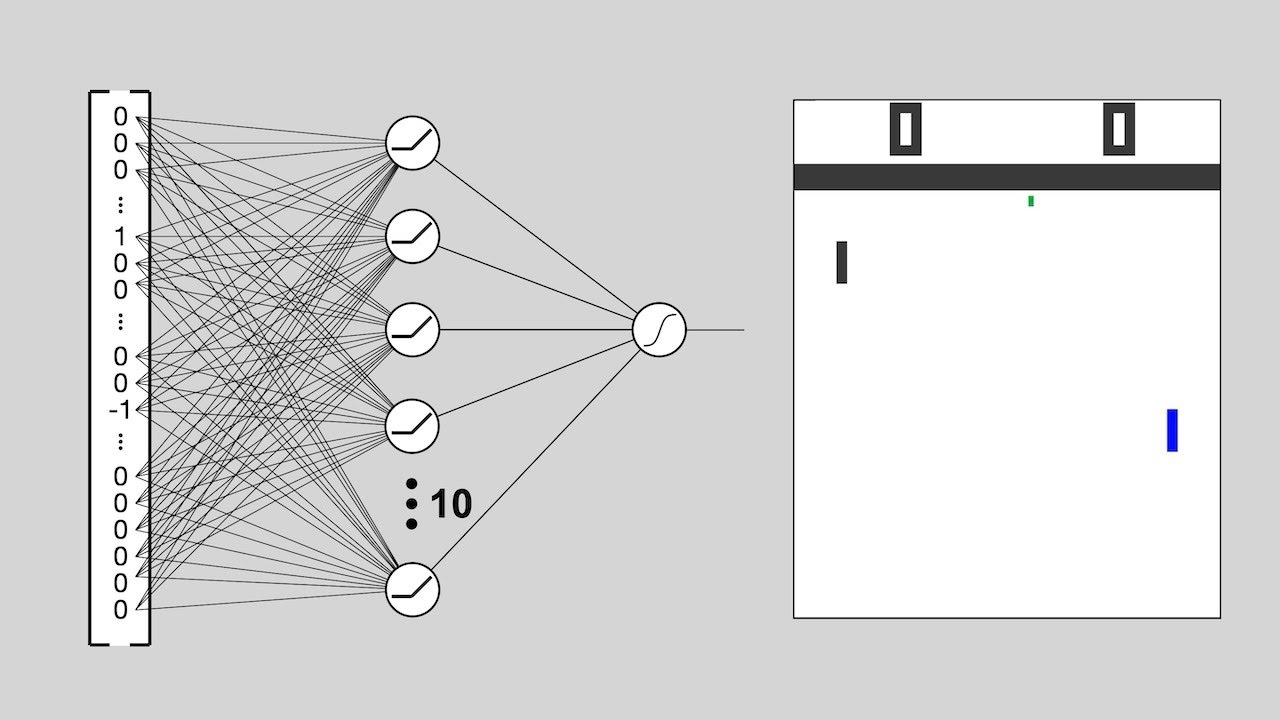
How does Reinforcement Learning work? A short cartoon that intuitively explains this amazing machine learning approach, and how it was used in AlphaGo and ChatGPT.
Part 1 of 3.
0:00 - intro
0:13 - pong
0:28 - the policy
0:51 - policy as neural network
1:32 - supervised learning
2:51 - reinforcement learning using policy gradient
4:24 - minimiz...
    prediction = np.tanh(output)

move_paddle()

how do i call the def for the output
left tartan
You have to 'return' prediction from the function
unkempt wigeon
Thank you
I'm trying to get an image from the game subtract it from the previous image and then figure out where it is on the grid for the game now which is raking my brain
left tartan
unkempt wigeon
I'm trying to get an image from the game subtract it from the previous image and...
Could you open a. Help thread? #❓|how-to-get-help share your code
unkempt wigeon
Done
 stone coral
I’m new to machine learning. I’m struggling on how to go about this project I’ve started. I collect NHL players stats of games for example a players shots. My question is how can I predict his next game how many shots he will take?
Is logistic regression a good idea to start with?
left tartan
stone coral
I’m new to machine learning. I’m struggling on how to go about this project I’ve...
Before asking the question of which model... one thing to consider is: How would you evaluate if you have a good model or not?
stone coral
left tartan
Before asking the question of which model... one thing to consider is: How would...
What so you mean by a good model? As in do I have enough data? To be honest it’s not easy to predict the players next game due to a bunch of factors but also just the way they feel like playing that day. But from looking over my data someplayers have consistent shots while others don’t
left tartan
stone coral
What so you mean by a good model? As in do I have enough data? To be honest it’s...
let say you and I both trained models to predict # of shots per game. How would you decide which model is better?
If you're unfamiliar with this topic, I'd suggest going through this first: https://www.kaggle.com/learn/intro-to-machine-learning . It's short.
stone coral
left tartan
If you're unfamiliar with this topic, I'd suggest going through this first: <htt...
Sorry computer died. But will do!
hard fern
stone coral
I’m new to machine learning. I’m struggling on how to go about this project I’ve...
fellow NHL fan here!
rich moth
The captions keep repeating something to the effect of "a picture on a computer screen with shapes or something similar, which is technically not wrong, but the quality of the reconstructions really affect the quality of captions. However I let it go for a bit and the losses were decrasesing and the captions were changing slighty. I changed the learning rate gonna restart it again hopefully this corrects the image

 rich moth
see thats what they look like.
 rich moth
heres the captions of the 2nd epoch, lol

 glacial ledge
Hi!, I'm looking for a framework or library for information retrieval tasks that provides a dashboard. I want to process some URLs and I want something where I can paste an URL and then it adds it to a processing queue. Then, for each item, it performs some crawling, extracting and processing tasks, and displays the "documents" and its status in a web dashboard. Previously I've only used notebooks, is there any library to do all of these things (except the "processing" part, which I can do on my own), or do I have to combine multiple libraries? In that case, what would you recommend to the "queueing" and "storing" part?
 noble robin
Hey guys, I am trying to start my first ML project and I have NO IDEA where to start, does anyone have something like a youtube playlist or some sources I can look it to start getting a grip?
jaunty helm
noble robin
Hey guys, I am trying to start my first ML project and I have NO IDEA where to s...
there's kaggle
spare forum
noble robin
Hey guys, I am trying to start my first ML project and I have NO IDEA where to s...
Titanic, iris, house prices, car prices
Email spamm detection
hard fern
Yea kaggle is great for beginner model building projects, try the titanic competition
Also has a rich library of datasets
left tartan
noble robin
Hey guys, I am trying to start my first ML project and I have NO IDEA where to s...
 rugged stream
when trying to scrape data from excel spreadsheets will macOS run into any complications that would not occur on windowsOS?
serene scaffold
rugged stream
when trying to scrape data from excel spreadsheets will macOS run into any compl...
you don't really "scrape" from excel, since the data is already structured and on your computer.
you can open xlsx files with Python on either OS.
rugged stream
serene scaffold
you don't really "scrape" from excel, since the data is already structured and o...
you know what that makes a lot more sense ty
unkempt wigeon
Can I python neural network learn how to read and write in a way if you gave it your own made up language couldn't kind of emulate what I need a speaker at that language would write let's say left to right and right to left up to down
left tartan
serene scaffold
you don't really "scrape" from excel, since the data is already structured and o...
Well, I dunno... you don't see the Excel files I see... there's definitely a lot of scraping involved with the way they're formatted. 😢
serene scaffold
left tartan
Well, I dunno... you don't see the Excel files *I* see... there's definitely a l...
oh. you're right, I treat excel files as CSVs with pages.
people who make "pretty" spreadsheets must suffer.
 obsidian talon
hii guys, do you guys help with R here?
serene scaffold
obsidian talon
hii guys, do you guys help with R here?
We do not help with R here.
 wet mortar
has anyone here have good experience with multivariate timeseries?
left tartan
wet mortar
has anyone here have good experience with multivariate timeseries?
I've had lots of bad experiences :)... just ask the question plz
wet mortar
left tartan
I've had lots of bad experiences :)... just ask the question plz
wondering what model I should use
for a project
where I have eegs
and I and doing mtsc
left tartan
wet mortar
wondering what model I should use
Maybe explain what you know, what you have, and what you're trying to do?
left tartan
wet mortar
wondering what model I should use
I don't deal with medical data, but I know other ppl here have.
wet mortar
left tartan
Maybe explain what you know, what you have, and what you're trying to do?
from your experience what models
have worked best
left tartan
wet mortar
have worked best
I deal with financial data, and I'm more on the "data" side than "science" side.
wet mortar
left tartan
I deal with financial data, and I'm more on the "data" side than "science" side.
ya just wondering in general
I hear rocket
is good
and also hivecotev2
and inception time needs a lot of data and time to be good
left tartan
wet mortar
ya just wondering in general
I don't think there's good general answers to questions like these. You mentioned EEGs: there's many papers talking about ML and EEGs. For instance (at random): https://pubmed.ncbi.nlm.nih.gov/32011262/. I'd start by looking at these to see what techniques have been used.
wet mortar
left tartan
I don't think there's good general answers to questions like these. You mentione...
thx
 timid ledge
working on implementing the random forest model to be trained with the nsl-kdd dataset -- any recommendations for resources/tutorials?
rich moth
!paste
 arctic wedgeBOT
Pasting large amounts of code
If your code is too long to fit in a codeblock in Discord, you can paste your code here:
https://paste.pythondiscord.com/
After pasting your code, save it by clicking the Paste! button in the bottom left, or by pressing CTRL + S. After doing that, you will be navigated to the new paste's page. Copy the URL and post it here so others can see it.
rich moth
Im working on my chat bot system and I'm trying to fine tune the module responsible for processing & embedding the data into the elasticsearch server. im trying to "clone" the datasets directly. if you guys wouldnt mind taking a look at it, let me know if you have any suggestions https://paste.pythondiscord.com/LWTQ
wet mortar
left tartan
I don't think there's good general answers to questions like these. You mentione...
are there any general ideas I should know for time series?
 hidden ferry
is anyone is working on computer vision specifically on Video Inpainting and Object Removal?
i have a few questions
I am working on some projects to remove some captions and emojis.
i have some used some pretrained for removing captions but after removing it theres still some glitchy frames on it
anyone?
 fossil sierra
Hi, any ideas about deep learning models for language classification? Data is of 5-6 words, words are connected thematically, like below. I've experimented with classical models like rf, lr, etc. have given me around ~88% accuracy. When I tried out LSTM/bi-LSTM it only returned a ~30% accuracy, looking for direction/recommendations
 desert oar
wet mortar
are there any general ideas I should know for time series?
desert oar
wet mortar
are there any general ideas I should know for time series?
- simpler is better
- traditional methods still work
- carefully consider your validation/testing procedure when forecasting
otherwise you pretty much need to figure out what works for your specific task
what is MTSC?
 elder pilot
Hi guys, pls i need resource recommendations for Machine Learning
proper crag
how does model learn from continuous value ?
i mean from what i can say regardless of what is the continuous value is there's must be smt like kind of pattern which caus of it
so bcuz of that im asking how does model learn from continuous value bcuz i thot that model perhaps learn another factor beyond than just a pattern
 lapis sequoia
proper crag
how does model learn from continuous value ?
i mean from what i can say regardle...
lapis sequoia
proper crag
how does model learn from continuous value ?
i mean from what i can say regardle...
Well, are you sure you understand the math behind the model? Say our model is using gradient descent to find a minimum - you can imagine it as trying to find a minimum on a curve created by the loss and defined by our weights.
 red dust
These are the two techniques you should be the most familiar with in order to be
successful in applied machine learning today: gradient boosting machines, for shallow-
learning problems; and deep learning, for perceptual problems. In technical terms,
this means you’ll need to be familiar with XGBoost and Keras—the two libraries that
currently dominate Kaggle competitions.
Is it still true?
spring field
XGBoost is definitely up there, sure
don't know about Keras, but nowadays pytorch is the go-to library for deep learning pretty much
rich moth
Polars inntergrated with Nvidia Rapids now. https://pola.rs/posts/gpu-engine-release/
DataFrames for the new era
wet mortar
desert oar
what is MTSC?
Multivariate time series classification
left tartan
rich moth
Polars inntergrated with Nvidia Rapids now. https://pola.rs/posts/gpu-engine-rel...
Huh, interesting. Practically speaking, I'm curious what kind of queries this would actually be useful for. Will be interesting to experiment with
desert oar
wet mortar
Multivariate time series classification
for classification you really just need a way to reduce each time series to a vector embedding that you can dump into a classifier. there's probably a lot of literature on state-of-the-art ways to do this, but i'd be skeptical of things like pre-trained sequence models. that's very new tech and results seem mixed.
wet mortar
desert oar
for _classification_ you really just need a way to reduce each time series to a ...
mhm I have gotten intresting reults from rocket based models
and also inceptiontime is another option
also this project is really for fun so I am fine with experimental methods
desert oar
yeah, someting CNN based seems intuitive for "retroactively" classifying time series
i just looked up rocket, it seems like a nice methodology
random convolutional kernels are an interesting idea
wet mortar
desert oar
yeah, someting CNN based seems intuitive for "retroactively" classifying time se...
ya I heard tcnn are good for these types of problems
wet mortar
desert oar
_random_ convolutional kernels are an interesting idea
is convolutional based
!pip aeon
arctic wedgeBOT

A toolkit for machine learning from time series
Released on <t:1725732865:D>.
wet mortar
^
cool toolkit I have been using to simple test models
on my data
it is like scikitlearn
but for time series
aeon
binder Time Series Classification (TSC) involves training a model from a collection of time series (real valued, ordered, data) in order to predict a target variable. For example, we might want to ...
desert oar
you might want to also look into Darts and Tslearn -- very similar ideas ("sklearn but for time series")
although Darts is much more about forecasting
wet mortar
desert oar
you might want to also look into Darts and Tslearn -- very similar ideas ("sklea...
ya aeon is a fork of sklearrn
with bangal
desert oar
it doesn't look like a fork to me 🤔
wet mortar
because some political drama happened
wet mortar
desert oar
it doesn't look like a fork to me 🤔
aeon
Roles: The roles are described in aeon ’s governance document. A list of all contributors can be found here. Code of Conduct Workgroup: The code of conduct workgroup maintains the code of conduct a...
It is maintained by Tony Bagnall Matthew Middlehurst
who are apparently big names in this type of research
wet mortar
desert oar
although Darts is much more about forecasting
I have more of classification problem on my hand
I also have spectogram
data so might work with that
and make an ensemble
1 model for eeg
and 1 for spectogram

@desert oar just wondering what are your experiences been like with time series?
desert oar
wet mortar
<@389497659087650836> just wondering what are your experiences been like with ti...
I haven't done time series classification since before deep learning was common for time series classification, so my experience is mostly "out of date"
wet mortar
ya the best deep learning option rn is inception time
desert oar
if I had to do it now, I'd try something without deep learning as a baseline, then work up from there
wet mortar
but as with deep learning model it didn't perform that well on tiny data and had a kinda high training time
cnn based solutions
are really the forfront of ts
 untold fable
is deep learning quite of machine learning insprire from human brain rather than statictcal tool
desert oar
untold fable
is deep learning quite of machine learning insprire from human brain rather than...
no
left tartan
wet mortar
because some political drama happened
Oh boy, at least they didn't name it -ce
untold fable
The how to define deep learning
arctic wedgeBOT
Python Game Development
Released on <t:1723463460:D>.
wet mortar
😭
 lavish kraken
Hi guys! I want to simply ask if anyone here had example of what I am about to post here below
I have a project to execute and I want to seek for your review below
 agile cobalt
!rule 6 9
arctic wedgeBOT
6. Do not post unapproved advertising.
9. Do not offer or ask for paid work of any kind.
rich moth
Im training a new custom model that combines BERT embeddings with a Tabtransformer for handling structured data . Im also using BYOL for self supervisted pre training. After the pre training im going fine tune it for classifcation on the AG news dataset using mixup and cutmix for regularzation . wish me luck!
 left tartan
As noted above, recruiting is not allowed on this server. Your post has been removed.
lavish kraken
Okay
I am not recruiting . I was just randomly asking people's opinion if anyone has done stuff like this
left tartan
lavish kraken
I am not recruiting . I was just randomly asking people's opinion if anyone has ...
Can you ask the question differently then? The last post was the job descriptions
lavish kraken
left tartan
Can you ask the question differently then? The last post was the job description...
Yeah, so a friend of mine who's running His PHD In Machine learning on Explainable AI in UK recommended me to his friend who needed help for his project
That's because I help my friend did the project In python last 6months ago.so he decided to bring this project for me if I can do it
You understand me now?
left tartan
lavish kraken
You understand me now?
But what's your question?
lavish kraken
Have done a lot with python including Federated Machine learning but I Judy felt like this project seems like a relatively new to me hence my asking of anyone here has done something similar based on the message iSent earlier
lavish kraken
left tartan
But what's your question?
In summary, has anyone here done something like this before?
left tartan
lavish kraken
In summary, has anyone here done something like this before?
I'm not trying to be difficult but: Your question has no details. It's basically: "Has anyone done machine learning before?"
 scarlet owl
Which library should I use for making a chat-bot?
serene scaffold
scarlet owl
Which library should I use for making a chat-bot?
Depends on how sophisticated you want it to be and how much compute power you have.
scarlet owl
serene scaffold
Depends on how sophisticated you want it to be and how much compute power you ha...
It is for support and simple tasks only
serene scaffold
scarlet owl
It is for support and simple tasks only
what kind of tasks?
scarlet owl
serene scaffold
what kind of tasks?
Like generating password and converting files etc.
So what library should I use?
jaunty helm
scarlet owl
Like generating password and converting files etc.
you shouldn't need a chatbot for that
scarlet owl
jaunty helm
you shouldn't need a chatbot for that
Then?
 tribal meteor
Does anyone know the best way to train a model / construct a model? I want to build an image model of trading cards for a sorting algorithm / machine I’m building. I plan to use a web cam that takes images from a fixed distance and I want my machine to be able to recognize the cards name and then use an api I have to get the rest of its data.
 rich moth
 spice ravine
Everyday I fear gpt replaces humanity
spice ravine
Everyday I fear gpt replaces humanity
Have you tried it? The new version? I have the preview for it, but you can only use it like 5 times every couple days. I was stunned.
 serene grail
spice ravine
It's funny though how it sucks at English
serene grail
spice ravine
It's funny though how it sucks at English
English in this context often involves proper reasoning right? Like making an essay and being able to provide arguments for your position
Currently GPT is not good at reasoning and it's not good at being consistent, so it probably fails on that account
I haven't kept up with the recent developments though, don't know how good o1 is
spice ravine
I haven’t tried the o1-preview yet but from what I heard they’re going to charge the o1 regular version 2000$ a month 💀
rich moth
spice ravine
I haven’t tried the o1-preview yet but from what I heard they’re going to charge...
good luck with that lol
serene grail
It uses chain-of-thought prompting from what I've heard, so it probably makes sense. You have to make many prompts for a single resulting prompt from what I understand
Probably very expensive to run
spice ravine
That’s like a month’s worth of rent
rich moth
well, if it can get a job and pay some bills ill consider it
serene grail
spice ravine
That’s like a month’s worth of rent
I don't think that's intended to be used by individuals at that pricepoint, it's intended to be used by businesses
serene grail
rich moth
Well, thats why competition is good.
Yeah I'm hoping this means there's more cool open source stuff coming out too. And people will probably focus more on making these models cheaper to run
wet mortar
spice ravine
It's funny though how it sucks at English
relatable
spice ravine
I would think that it’ll be better at English since English is just well supporting your ideas with evidence and what not. Pretty simple stuff rather than physics and math which can be very difficult subjects.
 limber token
How long should a "fast" fine-tuned mini BERT-like zero shot classification model take to label ~20k items?
serene scaffold
limber token
How long should a "fast" fine-tuned mini BERT-like zero shot classification mode...
is this on a GPU and what's the largest batch size you can do on that GPU
 brave barn
Anyone here who can give guidance and help in dsa
serene scaffold
brave barn
Anyone here who can give guidance and help in dsa
you're looking for #algos-and-data-structs. but remember to always ask your actual question--never ask if someone can answer a question that you haven't asked.
 final cobalt
Hey everyone! I'm trying to get this simple - though large - VAE up and running. I've got the basics down I think, but obviously something is going wrong.
A few notes: the model is quite large - it's a work in progress but I've got big plans. Also, I know I've got an odd coding style, but I like it. Third, everything I know about ML I learned from ChatGTP and only over the last few weeks. Like I said, work in progress.
The problem: well, there's a few.
First, the model is running on my Macbook, but I'm getting a Cuda OOM error when trying to run on an A100 in the cloud (Colab).
Second, on the mac with a batch size of 2, the output images I'm generating have identical outputs for both images. Unless I'm pasting the images wrong, this means the model is outputting the same data for both images in the batch. I'm leaning towards the second because pasting an image isn't complicated, but also the outputs from the next batch are nearly identical. Slight variations off the batch previous. Correct me if I'm wrong but even an untrained, clogged and inefficient network should produce random outputs for random inputs, no?
I'm guessing the two problems are related somehow.
https://github.com/lucaswalkeryoung/multiencoded-latent-diffusion
GitHub
Contribute to lucaswalkeryoung/multiencoded-latent-diffusion development by creating an account on GitHub.
final cobalt
Halp Q.Q
rich moth
Ahhh!! I did ! I finally got this thing running.

 indigo moth
Hello guys !
I have 3 days to prepare for an interview, it will mostly be around Pandas and Numpy. I didn't use these two for like two years. If you were me, how would you train for these?
I thought about watching a big tutorial to refresh my memory, and then find some uni problems online and solve a bunch of them to practice, and then solve some more tricky problems on leetcode to avoid trap questions as much as I can (it's for a junior python dev position)
any other suggestions?
rich moth
wow.. these are the best results I've got so far with all this experimenting

 rich moth
i added a mutli head latent attention to it and it increased the training of each epoch by 4 hours gotta love attention 😂 even without it like above in the images it seemed to be working really well, and much faster. ill let it run for awhile and see how it pans out. hopefully ill have some more results in the morning and nothing goes haywire. ive noticed with ther attention the captions are already getting better. Caption update - similarity: 0.19261378049850464 (below threshold).
final cobalt
Hey all!
I'm trying to get this very simple VAE online. It runs, but won't converge.
I'm doing this right, right? The problem is just hyperparameters?
Hastebin is a free web-based pastebin service for storing and sharing text and code snippets with anyone. Get started now.
 pearl parrot
What should I learn after OOP?
serene scaffold
pearl parrot
What should I learn after OOP?
this is the data science channel; try asking in #python-discussion
rich moth
Anyone got any ideas how to fix this? I made it through the training and eval phases but it failed the reconstructions. Also if you compare this one to the above you can see how the attention seems to really help the reconstructions of everything!


im super jazzed,
serene scaffold
@rich moth it's easier for people to help you if you give all text as actual text. not as screenshots.
rich moth
sounds good,, ill have to organize it a bit when i get back. maybe you guys can help
 tepid tartan
@spare forum Khan is a good source material for learning statistics?
spare forum
I learned stats through college, idk
tepid tartan
spare forum
I learned stats through college, idk
I did too but the class I took rely on calculator too much
I'm going to relearn it for a bit today and move on sql Tomorrow
spare forum
I learned good old theory with good old pen and paper + practical work with R, python and SAS (Eww), don't know about the stats part of khan or something, I didn't search more on stats outside courses, what I searched outside college was more python, ml related
scarlet anchor
Hey, for an LSTM network,
- every node is for every independent feature/variable
2)every node has 3 gates- forget, input,output
3)with every input it computes the state, gets an output and feeds it back for the next input computation
is this correct?
unkempt wigeon
Is there an important I need to separate sound into its basic components to be calculated sorry
 dire jungle
what are the best free AI's now? I use llama
agile cobalt
dire jungle
what are the best free AI's now? I use llama
Llama 3.1 (or models fine tuned from it) are amongst the best open weights models for most tasks. What exactly are you looking for?
https://lmarena.ai/?leaderboard ranks a lot of models, both closed and open weights
tbh the only reason I can imagine not to use Llama at this point in time would be if you want a model smaller than their minimum size
rich moth
dire jungle
what are the best free AI's now? I use llama
have you checked out huggingface?
you guys wanna hear me new idea?
serene grail
Sure, I like new ideas
rich moth
a multimodal transformer that can handle text, image, video and continuous data , at the same time.
contrastive multimodal with modality dropout and crossmodality fusion
rich moth
Im building the auto videoprocessor since i cant find a transformers one
agile cobalt
rich moth
a multimodal transformer that can handle text, image, video and continuous data ...
have you seen https://github.com/apple/ml-4m and https://github.com/lyuchenyang/Macaw-LLM ?
GitHub
4M: Massively Multimodal Masked Modeling. Contribute to apple/ml-4m development by creating an account on GitHub.
GitHub
Macaw-LLM: Multi-Modal Language Modeling with Image, Video, Audio, and Text Integration - lyuchenyang/Macaw-LLM
rich moth
agile cobalt
have you seen https://github.com/apple/ml-4m and https://github.com/lyuchenyang/...
no, those look interesting. thanks ill check it out.
I thinnk Im gonna use a video autoencoder with the contrastive learning setup. Im gonna try out the polars and rapids intergration for the dataframes and preprocessing and the modality dropout.
rich moth
agile cobalt
have you seen https://github.com/apple/ml-4m and https://github.com/lyuchenyang/...
Have you tried them at all or heard anything?
agile cobalt
haven't tried myself
their readmes + the resources linked from there contain everything I remember hearing about them and more
jaunty helm
dire jungle
what are the best free AI's now? I use llama
tbh I didn't see people have great sentiments about L3.1
in fact the more common opinion I see on it is it feels dumber than L3 and is harder to tune (maybe wait a couple o' months then it'll change)
on the other side, mistral models seem to have better community feedback
e.g. nemo 12b's very good, mistral large 123b can beat L3.1 405b, the recent mistral small 22b is apparently nice as well
oh and all recent models boast ridiculous context sizes, when the RULER benchmark disagrees with most of them

GitHub
This repo contains the source code for RULER: What’s the Real Context Size of Your Long-Context Language Models? - hsiehjackson/RULER
 fickle shale
Hii Bro! Love to hear about operations research as a field/job opportunity!
 past meteor
fickle shale
Hii Bro! Love to hear about operations research as a field/job opportunity!
past meteor
fickle shale
Hii Bro! Love to hear about operations research as a field/job opportunity!
Can’t tell you much about it. Check out LinkedIn
We have a few companies doing typical problems in my country and those around
fickle shale
past meteor
Can’t tell you much about it. Check out LinkedIn
Well I am pursuing master in operation research! i am from cs background!
 odd meteor
fickle shale
Well I am pursuing master in operation research! i am from cs background!
odd meteor
fickle shale
Well I am pursuing master in operation research! i am from cs background!
Hmmm that's interesting given you're coming from CS background. Do you mind sharing what interests you in pursuing your graduate studies in operation research?
Idk much about the field myself. Usually it's only a few of friend with Maths, and Economics major that I've seen pursuing masters in Operation Research. I have another friend doing a dual program in Msc Collective Intelligence & Operation Research.
 eager sundial
Hello, I was wondering why when I fit the MultiModalAutoEncoder implemented here https://hastebin.com/share/ocalenawix.python, the loss is the sum of the losses of the AutoEncoders instead of the average
past meteor
fickle shale
Well I am pursuing master in operation research! i am from cs background!
The way the OR scene is here is that you have people working on the tools/products, both open source and closed source, and another group of people working with existing tools to solve problems for businesses.
I think you're a good fit for the former group, especially since you have a CS background. The solvers have tons of tricks to make them fast
The last OR course I did was in C++ and it was a nice mix of CS fundamentals and actual OR theory to implement the solvers. The very first course I did was the exact opposite. It was more about modelling the problems, the math (doing simplex and whatnot by hand). If we solved problems we ran them with Lindo. There was no coding 🙂
 full furnace
Anyone don't have Nvidia GPU? I'm making a gan and it's slow,any fix for this
past meteor
full furnace
Anyone don't have Nvidia GPU? I'm making a gan and it's slow,any fix for this
If you don't have a GPU you can try with Google colab and when your credits are finished you can move to Kaggle
full furnace
Zestar u have tried kaggle
past meteor
Training nets with CPU is so slow it's never worth it
past meteor
full furnace
Zestar u have tried kaggle
yes, why?
full furnace
Ikr right so slow using CPU rn I'm tryna use kaggle we just need to change the accelerator right to GPU Nvidia t4 x2
But when I run in the top there's like a CPU bar and it's hot red and there 2 more GPU bar but it doesn't really use it it's like white not even green maybe I did something wrong?
past meteor
Are you using Pytorch or Keras/Tensorflow?
full furnace
Tf keras
past meteor
Hmmm, it's been ages since I used that but the idea is the same. You need to ensure your tensors are on the GPU
past meteor
So, you can check .device to see where that tensor (or your model) lives
Can you do that for a second?
full furnace
Holon I'm bouta turn my PC on again
past meteor
I assume you have a variable like model that is your GAN?
full furnace
Cuz I alr spent like 40 mins
full furnace
Wait
Oh dang it I just remember I deleted the whole code bruh
But what do we expect it to return?
past meteor
It'll tell you if it's on /device:CPU or /device:GPU
past meteor
Did you do it already?
past meteor
Why is it slow? Are you training your model
full furnace
Na it gave me an error
past meteor
Just initialize it and do .device
full furnace
Dang it bruh I delete my last code
past meteor
model = Model()
model.device
Just this 🙂
full furnace
Oh aight
Name error model is not defined
I think I need to make the gan model first no
past meteor
I have no idea how your code etc. looks like
but in general, I think it's good to look at a basic keras tutorial because they'll cover this stuff and it won't take you longer than an hour or three
and it'll save you a lot of time in the long run
full furnace
The .device part?
past meteor
Everything
full furnace
What are we expecting tho from it the amount of GPUs
past meteor
full furnace
What are we expecting tho from it the amount of GPUs
Whether or not the tensor (or your model in general) is residing on CPU or GPU
And if what I said doesn't make sense, that reinforces the fact you probably need to read the docs a little bit. I could teach you, but me teaching you step by step isn't efficient for you or me 😄
full furnace
I think ur correct
past meteor
Also, it seems you're also not deep into Keras yet. I'd advise you to also just switch to Pytorch
past meteor
Pytorch is way more used nowadays
full furnace
Really
past meteor
Aside from maintaining old things I don't think anyone is on Keras or Tensorflow nowadays
full furnace
U use tf or pytorch
past meteor
Tensorflow is where I started and I moved as well to Pytorch
So, that should be proof enough as well 😄
full furnace
U work as a data seicentist
past meteor
full furnace
U work as a data seicentist
Yes, why?
Here's the Pytorch docs https://pytorch.org/tutorials/beginner/basics/intro.html
full furnace
I see how u land a job do u extend ur intern
past meteor
what do you mean?
full furnace
Like how do u land a job is it from internship and then u got return offer or u just apply and do u put ur kaggle or just ur project when u apply for a position
past meteor
full furnace
Like how do u land a job is it from internship and then u got return offer or u ...
I got my previous job by applying on LinkedIn. I got my current job because I did an internship there 3-4 years ago and I sent a messgae on LinkedIn asking them to hire me
final cobalt
Hastebin is a free web-based pastebin service for storing and sharing text and code snippets with anyone. Get started now.
I can't get this model to converge. I've tried everything I can think of. It can isolate the numbers fine, but can't seem to figure out the backgrounds. I've tried every combo of hyperparameters I can think of
And the model is pretty big compared to the scope of the task. I must be doing something wrong
final cobalt
MNIST
Yeah. And I apply both random horizonal and vertical flips just to keep things flexible
And - I'm doing it in RGB. This is a warmup exercise to get my sea-legs before moving on to more complex reconstruction
 west wing
The following packages are causing the inconsistency:

  - defaults/win-64::curl==8.7.1=he2ea4bf_0
  - defaults/noarch::itemloaders==1.0.4=pyhd3eb1b0_1
  - defaults/win-64::libxslt==1.1.37=h2bbff1b_1
  - defaults/win-64::lxml==4.9.3=py311h09808a7_0
  - defaults/win-64::parsel==1.6.0=py311haa95532_0
  - defaults/noarch::pyls-spyder==0.4.0=pyhd3eb1b0_0
  - defaults/win-64::python-lsp-black==1.2.1=py311haa95532_0
  - defaults/win-64::python-lsp-server==1.7.2=py311haa95532_0
  - defaults/win-64::qtwebkit==5.212=h2bbfb41_5
  - defaults/win-64::s3fs==2023.4.0=py311haa95532_0
  - defaults/win-64::scrapy==2.8.0=py311haa95532_0
  - defaults/win-64::spyder==5.4.3=py311haa95532_1```
anyone faced this issue, how to resolve thisi was trying to update conda
desert oar
final cobalt
I can't get this model to converge. I've tried everything I can think of. It can...
Are you saying that subjectively the backgrounds in the autoencoder reconstruction don't look right? Or something else?
desert oar
west wing
```The environment is inconsistent, please check the package plan carefully
The ...
The error message says the problem: you have package conflicts. try listing all packages in an environment yaml file and recreating the environment from that
final cobalt
desert oar
Are you saying that subjectively the backgrounds in the autoencoder reconstructi...
Yes? The system correctly recreates the digits as well as a small black border around it, but the rest of whatever isn't occupied by the number is just noise. It's like all the features/expressiveness the model has access to is being devoted to better expressing the digits, and the backgrounds are being ignored.
I tried switching up the loss to favor dark pixels, and that worked like you'd expect. It did start focusing more on the backgrounds, but at the cost of the digits which receded to indistinct clouds of grey.
I'm going to add an adversarial component. I'm expecting it will contribute the refocusing pressure that's required
final cobalt
 serene grail
Woah the one on the right is weird but cool
rich moth
rich moth
Anyone got any ideas how to fix this? I made it through the training and eval p...
I figured it out. I was using view instead of reshape lol
rich moth
geez the size of the model increased by 1.65GB. think i need to play with the learning rate a bit but let me train, that was on a batch of 8. im trying 16 now


im trying to hammer everything out before enabling the latent memory. i ran some test with and without the memory and it was worth keeping it, but its very computational as most is.
i wonder how much the quadratic complexities will add to the size of the file when I enable the memory 🤔
fickle shale
odd meteor
Hmmm that's interesting given you're coming from CS background. Do you mind shar...
Yeah Mostly student here is also from math/stats background I like the curiculum and found this course pretty interesting and it's also related to data field. And i really enjoy this course!
final cobalt
Hastebin is a free web-based pastebin service for storing and sharing text and code snippets with anyone. Get started now.
I'm getting a vanishing gradient, pretty much right after the last few layers
It's a fairly deep network, compared to the problem anyway. I've initialized the weights using a smart initializer, but after the first epoch it always dies out. Any thoughts?
rich moth
dang i just started the training Training Epoch 0/20: 24%|███▎ | 369/1551 [45:08<2:35:15, 7.88s/it, Loss=3.1, PSNR=16.1, SSIM=0.469, Epoch Progress=0/20] seems pretty high for just starting lol
rich moth
final cobalt
https://hastebin.com/share/ejalovoxec.py
try AdamW for the heck of it
rich moth
You guys ever hear of a cross modal dynamic fusion transformer?
final cobalt
Q.Q
west wing
desert oar
The error message says the problem: you have package conflicts. try listing all ...
weirdly, a quick restart worked
 past meteor
final cobalt
past meteor
final cobalt
It's not exploding gradient, that's something typical of RNNs.
Vanishing? Maybe, we'd have to see a reduction in the magnitude as you go to the first layers
final cobalt
It's safe to say though it isn't what it should be, though?
 short wedge
The Art of Designing a JSON: A Comprehensive Guide with Python

Medium
In the realm of data formats, JSON (JavaScript Object Notation) stands out like an artist’s brushstroke on a blank canvas. It’s not just…
 pulsar kindle
Anybody here got a course recommendation for learning Python for data science for finance?
left tartan
pulsar kindle
Anybody here got a course recommendation for learning Python for data science fo...
Depends where you're starting. Tell us more about where you're at?
 subtle forge
pulsar kindle
Anybody here got a course recommendation for learning Python for data science fo...
subtle forge
pulsar kindle
Anybody here got a course recommendation for learning Python for data science fo...
I would also appreciate this!
pulsar kindle
left tartan
Depends where you're starting. Tell us more about where you're at?
Let’s say brand new. I know some concepts. Print, functions, some looping, lists. I’m starting from the beginning again though
left tartan
pulsar kindle
Let’s say brand new. I know some concepts. Print, functions, some looping, lists...
I would start with a good Python tutorial and hang out in #python-discussion . Take your time and do small projects (ask there for ideas). One you can do small projects, check out Kaggle.com/learn and CS50 for AI, which will introduce some fundamental concepts. Keep doing small projects: don't rely on reading to learn.
west wing
suppose i have 2 duplicate rows in column A, both of em pointing to different values of other columns ,
so we dont need to remove them right
i want to know, in which scenario we have to remove duplicates
left tartan
west wing
suppose i have 2 duplicate rows in column A, both of em pointing to different va...
I don't understand, can you illustrate?
 severe yarrow
west wing
suppose i have 2 duplicate rows in column A, both of em pointing to different va...
severe yarrow
west wing
suppose i have 2 duplicate rows in column A, both of em pointing to different va...
In general it safe to remove duplicates when every column in both rows has the same values. That is the default behavior of df.drop_duplicates()
west wing
left tartan
I don't understand, can you illustrate?
for eg:
here in this ss u can see there is a column with many same values, but other column of same row are different. i wanted to know, in which case we remove duplicates
for ex, ik that if all the values are same and are occuring multiple times like shown in 2nd ss then we remove one of them but what are other possible scenarios


in short, i want to know all cases where we are good to remove duplicates
west wing
severe yarrow
In general it safe to remove duplicates when every column in both rows has the ...
yes, that is the base case
but is there any other scenario as well where suppose the customer ID is same for both rows but 1 column of 1 row has minor difference, then what should we do
left tartan
west wing
yes, that is the base case
but is there any other scenario as well where suppose...
Oh, so you're wondering what to do if your natural key (ie; Pringle chips) is duplicated?
west wing
left tartan
Oh, so you're wondering what to do if your natural key (ie; Pringle chips) is du...
yes, u can say that
but what if other columns of that prod_name is different but natural key is same
left tartan
west wing
yes, u can say that
but what if other columns of that prod_name is different but...
In those cases, it's not a duplicate. You'd normally roll up the values using a groupby. Like, to get sum of sales of Pringle chips
west wing
ohhk thats what i did
but is there any way to group them in the csv file so that total rows of the file are reduced
but my concern is , not all columns can have same values
so idk if that would be possible in csv
severe yarrow
left tartan
In those cases, it's not a duplicate. You'd normally roll up the values using a ...
But I think that it depend on what he want to use the data for
left tartan
west wing
ohhk thats what i did
but is there any way to group them in the csv file so that...
Do you not care about the other columns?
west wing
left tartan
Do you not care about the other columns?
if it contains different data then obv
left tartan
west wing
if it contains different data then obv
You're saying column A has the same value but columns B and C have different values. How do you want to handle columns B and C?
final cobalt
What can I do to promote better flow of information through a network aside from modifying it's structure? What sort sof prophylactic measures (great word) can I take?
left tartan
final cobalt
What can I do to promote better flow of information through a network aside from...
Wdym by network here?
agile cobalt
the main things in your control are pretty much
- defining the structure of the network
- determining which loss function and optimizer to use
- preparing the data
- changing hyper-parameters
You should check published papers to see what worked for researchers
besides that, make sure your data quality is good and make sure you're using sensible values for things like learning rate, batch size etc
final cobalt
@agile cobalt https://hastebin.com/share/akaqiqijix.py
You can disregard the debugging/plotting functions of course. I'm trying to implement a "basic" VAE to recreate MNIST digits. I use quotes because, while the problem is fairly simple, I'm trying to build it with all the bells and whistles because it's a prototype for a larger project. By bells and whistles I mean weight decay, dropout, regularization, that sorta stuff
Hastebin is a free web-based pastebin service for storing and sharing text and code snippets with anyone. Get started now.
I'm trying to get myself into the mindset of an AI scientist, which is why I asked my question. In debugging, I need to know what tools I actually have at my disposal, and, how I should act upon whatever information I undercover during debugging
rich moth
Does anyone know why I can't get the json to load for the clip ViT B 32 model? Or perhaps how to force it?
 serene scaffold
rich moth
Does anyone know why I can't get the json to load for the clip ViT B 32 model? ...
serene scaffold
rich moth
Does anyone know why I can't get the json to load for the clip ViT B 32 model? ...
I would appreciate it if you stop posting screenshots of large blobs of text. If you need help in connection to all of this text, please put it in a format that's easier to consume like the paste bin
!paste
arctic wedgeBOT
Pasting large amounts of code
If your code is too long to fit in a codeblock in Discord, you can paste your code here:
https://paste.pythondiscord.com/
After pasting your code, save it by clicking the Paste! button in the bottom left, or by pressing CTRL + S. After doing that, you will be navigated to the new paste's page. Copy the URL and post it here so others can see it.
serene scaffold
you should also always provide the code that you're asking for help with.
please remember both of these things. you're welcome to ask for help here, but it needs to be done in a way that people can immediately jump into.
final cobalt
So, I've got some general questions
About AI
Earlier I asked about how to intervene when a model was misbehaving. Etrotta shared that there's really only three things you can control - architecture, data, and hyperparameters. My intuiting tells me that the last can help to a degree with procedural issues, but that structural issues require structural solutions. Data and training regiments fall in the middle.
Would you all say this sums it up? Anything to add?
serene scaffold
final cobalt
Earlier I asked about how to intervene when a model was misbehaving. Etrotta sha...
when you say "structural issues require structural solutions", what is something that you would consider a "structural issue", and which of {architecture, data, hyperparameters} do you think is "structure"?
final cobalt
serene scaffold
when you say "structural issues require structural solutions", what is something...
I truth, I barely have the bonafides to answer the question. Hence why I'm here. I guess it's true that one of the best ways to get answers on the internet is to say something incorrect.
I'm trying to build this VAE. I've tried every combination of hyper parameters I can think of. I've tried gradient clipped, weight decay, dropout, with normalization, without normalization, data augmentation this way and that - these measures hardly ever seem to have an effect.
My guess is because there's something just wrong with the model. I can't for the life of me figure out what though, because I've compared it to every example I can find online and done all the reading I can get my hands on. In theory, the machine is perfectly formed.
When investigating the issues I'm coming to see that piping the gradient through the machine is terribly fickle - or maybe I'm just really bad at this.
I dunno. I'm mostly just musing. I've been having a terrible time finding other humans to talk to about all this, so I'm just letting my thoughts out
serene scaffold
final cobalt
I truth, I barely have the bonafides to answer the question. Hence why I'm here....
saying "structural changes require structural solutions" sounds catchy, but it semantically overloads "structural".
when you're tuning the hyperparameters, make small changes to one at a time, so you can see how the performance of the system responds to that change. that way, you'll see when you're near the optimal value for each one. (This is also pretty much what the model is doing for each individual parameter in neural networks.)
but if hyperparameter tuning/optimization doesn't improve the model (or at least not sufficiently), then you would need to reevaluate if the model architecture is the right one, or if your data contains the signal that you want the model to pick up, or if you have enough data.
final cobalt
Hehe
serene scaffold
haha
final cobalt
Well, specifically, all I'm trying to do is build a VAE that can recreate MNIST digits.
I must be doing something wrong, because I feel like it shouldn't be this hard
Though admitted, things got a lot better when I remembered to sigmoid the output back to between 0 and 1 god damnit
serene scaffold
final cobalt
Well, specifically, all I'm trying to do is build a VAE that can recreate MNIST ...
so the way it would work is you say "give me five some 7s", and it will output five images that an MNIST-trained classifier would recognize as 7s?
(and when I say "image", that could be whatever representation you'd like, including an array of pixel values)
final cobalt
Not a classifier
serene scaffold
I know you're not making a classifier.
final cobalt
VAE. And I'm also randomly flipping and rotating the images so that there's a functionally infinite dataset. I don't think that should cause any major issue
Not sure what you're getting at then
serene scaffold
I'm going to sign off, in either case. let me know if you make any progress.
everyone be good while I'm gone.

 rich moth
serene scaffold
I would appreciate it if you stop posting screenshots of large blobs of text. If...
rich moth
serene scaffold
I would appreciate it if you stop posting screenshots of large blobs of text. If...
I would love to get it out of text blobs thats part of the issue. I want a console for it with latex, not its current format. I dont know how todo that.
 wintry relic
serene scaffold
that's just offensive
wintry relic
serene scaffold
that's just offensive
remember that the creation of this emoji required the permission of the PSF
(iirc)
 mellow vector
strange to me that more data nerds arn't night people
rich moth
mellow vector
strange to me that more data nerds arn't night people
do you know of any good channels? for developing and coding? looking to colab with other people.
mellow vector
https://github.com/search?q=label%3A"good+first+issue"+label%3A"help+wanted"+language%3APython+state%3Aopen&type=issues&ref=advsearch was suggested to me @rich moth
GitHub
GitHub is where people build software. More than 100 million people use GitHub to discover, fork, and contribute to over 420 million projects.


 rich moth
its a bit strange, ive tried 1e-4 to 7e-4 and the loss stays about the same but the other metrics seem to change a bit.


 oblique isle
Hello guys , I Was workin on A diffusion Model For Generating Synthetic data and i have it locally , to improve its performance more and more , i wanna do Federated Learning . what should i do to in order to simulate lill of the Federated Learning Effect . (I never worked with federated Learning , so ill be glad if someone could give me the steps)
 proven pier
I think the author could have used a better name to denote "cumulative reward" 😳
 jaunty helm
proven pier
I think the author could have used a better name to denote "cumulative reward" �...
jaunty helm
proven pier
I think the author could have used a better name to denote "cumulative reward" �...
I mean it's not that uncommon
e.g. we have np.cumsum
proven pier
I see. Still, I think the wording for reward is a lot more vulgar somehow lol. Like, type cumulative or just put tot for total.
Or do whatever you want it doesn't really matter, more of a funny thing
jaunty helm
maybe aggregate? though idk if there are subtle differences between that and cumulative
wooden sail
this is an ongoing thing, the numpy and scipy people are renaming the functions. in the image, they're replacing cum with cumulative to make it more explicit

they already removed "cumtrapz" and now it's just part of "integrate" as "cumulative trapezoid"
serene scaffold
rich moth
I would love to get it out of text blobs thats part of the issue. I want a conso...
I don't understand what you're saying. If you need for people to read the text that is in your text blob screenshots, then please copy and paste that text into the paste bin.
And please also always share the code for whatever you're asking for help with.
 ruby maple
I have this dataframe. Using python to manipulate and clean data that i web scraped. now i have a problem. as you can see the Fighter consistently has a name 'Max Holloway' and all the other columns has his correnponding data. I want to only get his side of data and delete his opponent i.e. the other name in the Fighter column. is there any way to this this without having to manually go through every single cell?
 jaunty helm
ruby maple
I have this dataframe. Using python to manipulate and clean data that i web scra...
ruby maple
jaunty helm
https://pandas.pydata.org/docs/reference/api/pandas.Series.str.extract.html
jaunty helm
ruby maple
I have this dataframe. Using python to manipulate and clean data that i web scra...
ruby maple
jaunty helm
https://pandas.pydata.org/docs/reference/api/pandas.Series.str.extract.html
is it like regex?
 remote carbon
ruby maple
I have this dataframe. Using python to manipulate and clean data that i web scra...
remote carbon
ruby maple
I have this dataframe. Using python to manipulate and clean data that i web scra...
Maybe you can filter your df for fighter columns where the name you said is inside that column? And then add a column with the name
df[df.Fighter.str.contains('Max Holloway')]
ruby maple
yes that is correct. but how would i get its corresponding data from other columns? for eg forst row the second set of ## of ## is the corresponding data, where as in second row the first set of ## of ## is the correnspnding data in each of the column
jaunty helm
ruby maple
yes that is correct. but how would i get its corresponding data from other colum...
oh wait I see what you mean now
lemme think
remote carbon
I would maybe first split the information in fighter column. You can try "split" if format is always the same "name1 surname1 name2 surname2"
jaunty helm
use .str.endswith() to make a new column that's either 'left' or 'right' (or just any binary value that could indicate left or right)
then use that column to decide which side of the info you should take
remote carbon
Split string with df.fighter.str.split(' ') first two entries are person A second two persona B
ruby maple
jaunty helm
use `.str.endswith()` to make a new column that's either `'left'` or `'right'` (...
so make 2 seperate tables where max holloway is in right and in another is in left? and just loop it with split and combine those two tables?
 fathom citrus
anybody working with tensorflow & pytorch
severe hare
Have before, just not right now, what's up
remote carbon
ruby maple
so make 2 seperate tables where max holloway is in right and in another is in le...
If the format of first column is fixed, split it and obtain two different columns. Then I would get two different df respect if max Holloway is in column in a or B and then put again them together
fathom citrus
@severe hare i am confused i ma trying to be an ai engineer?
jaunty helm
ruby maple
so make 2 seperate tables where max holloway is in right and in another is in le...
>>> import pandas as pd
>>> df = pd.DataFrame([['apple orange', 'orange apple'], ['2 5', '1 3']]).T
>>> df
              0    1
0  apple orange  2 5
1  orange apple  1 3
>>> df['right'] = df[0].str.endswith('apple')
>>> df
              0    1  right
0  apple orange  2 5  False
1  orange apple  1 3   True
>>> df2 = df[1].str.extract('(\d) (\d)')
>>> df2
   0  1
0  2  5
1  1  3
>>> df2[1].where(df['right'], df2[0])
0    2
1    3
Ahhhhhhh. finally got the solution. ive been stuck on this part for the past 2 days
ruby maple
jaunty helm
```py
>>> import pandas as pd
>>> df = pd.DataFrame([['apple orange', 'orange ap...
yes used similar logic and got it
ruby maple
jaunty helm
```py
>>> import pandas as pd
>>> df = pd.DataFrame([['apple orange', 'orange ap...
how do i make a code block in here?
ill share it with you guys
jaunty helm
ruby maple
how do i make a code block in here?
```py
code
```
!paste if it's too long
arctic wedgeBOT
Pasting large amounts of code
If your code is too long to fit in a codeblock in Discord, you can paste your code here:
https://paste.pythondiscord.com/
After pasting your code, save it by clicking the Paste! button in the bottom left, or by pressing CTRL + S. After doing that, you will be navigated to the new paste's page. Copy the URL and post it here so others can see it.
ruby maple
def extract_max_holloway_stats(row):
    # Check if Max Holloway is first or second in the 'Fighter' column
    fighters = row['Fighter'].split(' ')

    if fighters[0] == 'Max' and fighters[1] == 'Holloway':
        # Max Holloway is first, so we take the first part of each stat
        for column in ['Sig. Str.', 'Head', 'Body', 'Leg', 'Distance', 'Clinch', 'Ground']:
            row[column] = row[column].split(' ')[0]+' '+row[column].split(' ')[1]+' '+ row[column].split(' ')[2] # Keep the first part (before the space)
    else:
        # Max Holloway is second, so we take the second part of each stat
        for column in ['Sig. Str.','Head', 'Body', 'Leg', 'Distance', 'Clinch', 'Ground']:
            row[column] = row[column].split(' ')[-3]+' '+row[column].split(' ')[-2]+' '+row[column].split(' ')[-1]  # Keep the second part (after the space)


    return row

# Apply the function to each row of the DataFrame
max_holloway_significant_strikes = max_holloway_significant_strikes.apply(extract_max_holloway_stats, axis=1)
the .apply function was what i was missing. it apparantly interates each row of a df independely into a function
jaunty helm
ruby maple
the .apply function was what i was missing. it apparantly interates each row of ...
.apply is not what you're missing as it's as slow as a normal for loop
also, use slices?
if ...:
    row[column] = row[column].split(' ')[:3].str.join(' ')
else:
    row[column] = row[column].split(' ')[-3:].str.join(' ')
right. ill modify it
ruby maple
jaunty helm
.apply is not what you're missing as it's as slow as a normal for loop
whats a better alternative?
jaunty helm
ruby maple
whats a better alternative?
anything else, if you're using .apply it's the same as for-looping over the rows
same for numpy.vectorize
both are just convenience wrappers around python loops
ruby maple
jaunty helm
anything else, if you're using `.apply` it's the same as for-looping over the ro...
give me an exampke
jaunty helm
ruby maple
give me an exampke
wdym
>>> import pandas as pd
>>> import numpy as np
>>> ser = pd.Series(np.random.random(10**6))
>>> ser.apply(lambda x: x + 5)  # takes a few millisecs
>>> ser + 5  # instant
>>>
that's a pretty trivial example, but the same concept applies
ruby maple
lambdas are faster than for loop???
serene scaffold
ruby maple
lambdas are faster than for loop???
nope--if you use apply, it's executed as a for loop under the hood.
jaunty helm
ruby maple
lambdas are faster than for loop???
no, what I'm saying is .apply() is just a python loop underneath
and python loops are slower than np/pd/friends functions that operate on entire arrays (like ser + 5 that adds 5 on an entire series), because these loop in C
same for np.vectorize, that's also just hiding a python loop beneath so you're not getting any speed boosts if you use that
ruby maple
jaunty helm
no, what I'm saying is `.apply()` is just a python loop underneath
and python l...
shit. was with you till you started mentioning C hahaa
must be some DSA stuff that im unfamiliar with and yet to learn
but i got that apply is just a glorified for loop
serene scaffold
I wonder what a degraded for loop would be like
jaunty helm
ruby maple
must be some DSA stuff that im unfamiliar with and yet to learn
no
np/pd/friends have parts that are written in C, and stuff like ser + 5 use that code, that's what I mean by "it loops in C" - they're written in C, so faster
and .apply() takes any arbitrary function and loops in python, like for i in range(len(ser)): ser[i] += 5, which is slow
serene scaffold
rangelen 🤮
jaunty helm
serene scaffold
rangelen 🤮
I mean you can't modify it like for v in ser: v += 5 I'm pretty sure
serene scaffold
you can't
ruby maple
okayyyyyyyyy
serene scaffold
when I was new to python, I was confused by that behavior. there's even messages about it somewhere deep in this server.
jaunty helm
(im)mutability strikes again
ruby maple
anyways thanks for your help @jaunty helm and @remote carbon
limber token
Considering I have a zero shot classifier using Transformers that takes in a json string representing a product and tries to map it into a category > subcategory > microcategory, how would you guys recommend I limit the number of labels I pass into the zero shot classifier?
serene scaffold
@jaunty helm I found it (I wasn't even staff at the time) #python-discussion message
proven pier
Do yall have a good server rec for LLM's and prompting specifically?
I'm running into an issue with my local LLM, where it seems like sometimes the LLM forgets important context to the conversation. For instance, I tell it it's role, and my role, in the conversation. Then by the end of it's first response to my prompt, it assumes my role and resonds to itself as if it were the user. You know, generating part of what my response should be at the end of its response.
jaunty helm
proven pier
I'm running into an issue with my local LLM, where it seems like sometimes the L...
so basically you're roleplaying?
proven pier
jaunty helm
so basically you're roleplaying?
Essentially. I don't know the best ways of interacting with it in general I guess, maybe roleplaying isn't what I need. Of course there are many ways to use generative AI. For instance, in this specific scenario I'm wanting it to essentially annotate python code and explain why things are being done.
All of this, of course, is just to supplement the research and understanding process
Problems with LLM's and hallucinations - all things should be independently verified. I understand those disclaimers
jaunty helm
proven pier
Essentially. I don't know the best ways of interacting with it in general I gues...
impersonation usually means at this point of the conversation, it's most likely that your character makes a response.
if we exclude the possibility that the model is just bad, this happens usually because it was shown an example where it happened, i.e. if this is your first message
(First Message) AI(as Bob): You and Bob walk into a room. It's eerily quiet, and you feel as if something's watching you.
```you basically told the AI that it's ok for it to make a move for you(walk into a room) and it's also ok to tell you how you should feelI'm using llama-cli and have been running it in -i interactive mode. So I guess that plays into it needing to be some sort of interactive experience
jaunty helm
it might also happen if you make it generate a very long response
in a 2-party conversation, one side can only go on for so long after all
proven pier
Yes, I see. I am trying to make it verbose (as needed), but also given the python excerpt, it already has a lot to deal with
proven pier
jaunty helm
it might also happen if you make it generate a very long response
in a 2-party c...
Just as point of discussion, in academic lectures and presentations one side does go on and on for quite some time without back and forth. Or, say, a corporate presentation
https://huggingface.co/HuggingFaceH4/zephyr-7b-beta
This is the model I'm using, and it does say it's trained to "act as helpful assistants"
So I should be using it for the way in which its model was trained, presumably
jaunty helm
proven pier
Just as point of discussion, in academic lectures and presentations one side doe...
that's (probably) specifically not what the AI was trained on though
I'm not sure how llama-cli works exactly, but if you're having a conversation, chances are you're using an 'instruct' model, which are models specifically trained on query-like data, e.g. data that's like this
System Instruction:
You're an helpful assistant who will answer the user's questions.
User Input:
Are apples or oranges better?
Assistant:
...
that does seem to be an instruct model
yes indeed, if you look in tokenizer_config.json
"chat_template": "{% for message in messages %}\n{% if message['role'] == 'user' %} ...,
```you can see that there are defined "roles", which are basically specific to instruct modelsSo I will need to approach it in a way that it was trained for. Assistants should be able to give long form responses upon request. Will just need to do more testing
jaunty helm
proven pier
So I will need to approach it in a way that it was trained for. Assistants shoul...
I mean you could just tell it to do that
like The above is python code written to scrape a website. Explain in great detail what each step does, and why the code author might have chosen to write this way. or something
jaunty helm
proven pier
https://huggingface.co/HuggingFaceH4/zephyr-7b-beta
This is the model I'm using,...
also zephyr is super old, almost 1 year now?
if you want something of a similar size, the Qwen2.5 family just released and many think it's very good
proven pier
I've done a bit of iterative testing using the user/assistant method previously, but as I mentioned it would sometimes assume my own role in its generated responses. Of course, this happens during an expectedly long response, which I thought might have something to do with its attention
proven pier
jaunty helm
also zephyr is *super* old, almost 1 year now?
if you want something of a simila...
Yeah it's been a bit since I first messed with this stuff. I remember it was a PITA acquiring models tbh. Sometimes there's time consuming hoops to jump through to get access to models. I found a couple I could acquire (all legitimately, of course), and with that I started messing around and testing it
I mean, I have been getting quite informative responses out of this model
Just trying to get better at prompting it for now. Of course always getting a shiny new model could be nice. But another thing to keep in mind, I'm not running the beefiest of hardware so I am definitely limited on what model sizes I can use. When I built my PC I was not preparing for all these possibilities
jaunty helm
proven pier
Just trying to get better at prompting it for now. Of course always getting a sh...
qwen2.5 has a 7b, which is the same as zephyr, so you definitely can run that
I have been getting quite informative responses
that's nice, though what I'm saying is models got a lot better in the span of a year
PITA to get models
imo now it definitely isnt; if I want to get a model, I 1) find a quantization someone else probably already made, 2) download it, 3) open upkoboldcppto run it, and boom
proven pier
I'll give it a shot.
https://huggingface.co/Qwen/Qwen2.5-7B-Instruct-GGUF/tree/main
For the zephyr, I ended up downloading its model repo from hugging face and I converted it to gguf manually via llama.cpp
llama.cpp/convert-hf-to-gguf.py /path/to/zephyr-7b-beta --outfile /path/to/zephyr-7b-beta.gguf --outtype q8_0
In this repo I actually see q8_0.gguf files, but I see 3 of them? Any idea what the difference could be?

When I did this conversion myself, it only created one .gguf file (denoted by --outfile argument)
Actually, they wrote about it it seems.
For large files, we split them into multiple segments due to the limitation of file upload. They share a prefix, with a suffix indicating its index. For examples, qwen2.5-7b-instruct-q5_k_m-00001-of-00002.gguf and qwen2.5-7b-instruct-q5_k_m-00002-of-00002.gguf. The above command will download all of them.
Oh no, I tried running the model and it's giving me errors 😱 , guess I have to start doing the dreaded action of troubleshooting
ggml_backend_cuda_buffer_type_alloc_buffer: allocating 3840.00 MiB on device 0: cudaMalloc failed: out of memory
This seems like a typical response for me trying to run models that my GPU cannot handle
Oh wait, this might be another classic user error. Think I picked up the wrong quantization
Update again, seems like downloading the lower quantized version still gives me a similar error. I cry
Seems like it's requesting more bytes of RAM than the zephyr model was
 untold fable
Is machine learning all about statics equation
serene scaffold
untold fable
Is machine learning all about statics equation
pretty much all of ML involves statistics in some sense or another.
left tartan
 orchid nimbus
#❓|how-to-get-help Open a help thread
orchid nimbus
left tartan
<#704250143020417084> Open a help thread
I cant. Send message
Mee not PC ım used phone
untold fable
I was thinking about it would be so cool learn machine learning
But actually it is so boring
I don't have to code any single thing
All I have to do just learn about the statics mathematical algorithms
And the all the project are so boring for machine learning
proven pier
Yeah, if you do very basic stuff it's boring I'm sure
untold fable
Like predicting the cost according to your house
proven pier
I look at machine learning like being a scientist
It's a developing field. If you read white papers you see how people apply what others have learned, and attempt novel things to improve performance on specific applications
If you think one application is boring, then dont focus on that application (unless, you need to for pure learning aspects)
final cobalt
I'm trying to finish off this little VAE for MNIST digits. I've got down to about 50 MSE loss. That's pretty frickin' close. The output is just a tiny bit fuzzy
Any advice? More input/output features? An adversary maybe?
spring field
do you have any other metrics besides the loss? the loss on its own is quite a meaningless number
final cobalt
What metrics would you like?
HA!
Got it down to 12. This means that the sum of the squares of the distance between target and source pixels is 12, right?
For 1024 pixels (32x32) I'd say that's pretty fuckin' close
Now - do you think I could get it below 1...?
 proven pier
```
ggml_backend_cuda_buffer_type_alloc_buffer: allocating 3840.00 MiB on device...
proven pier
proven pier
```
ggml_backend_cuda_buffer_type_alloc_buffer: allocating 3840.00 MiB on device...
So apparently, manually setting the "ctx-size" (prompt context?) allowed me to run the quantized model. I suppose the default value set inside the model was too high, not exactly sure what it does but clearly it's of importance
proven pier
jaunty helm
qwen2.5 has a 7b, which is the same as zephyr, so you definitely can run that
By the way, I got qwen2.5 to work with the proper quantizations and configuration in my inference with llama-cli. Thanks for the recommendation to update. So far, seems to be well organized in its responses and following my rules/prompt context very well.
final cobalt
How do I go about analyzing the gradients and activations in a neural network? And, how do I intervene when I find something that isn't working?
I've got a big project in the works, maybe y'all would want to weigh in
My ultimate goal is to build a system for making furry art with ai. But, I'm tired of people calling me a thief for using models trained on other's art without permission.
So the question is now "how to teach an AI what a furry looks like without actually showing it any furry art."
Here's the plan. I'm going to use a dual-encoded VAE to learn to capture what animals look like from photographs. I'll autosegment them by using what's caught by a "shared features" encoder. Then, using some fancy tools like implicit functions, I'm going to cast the images into 3D voxel grids and compare that against the photo. Sorta like a 2D-to-3D VAE. The issue here is that the VAE can only compare what it generates against whatever is visible in the photo.
But, I can compare the partially constructed animals to identify what features they have in common. With enough examples, it should be able to build an internal knowledge of what every animal looks like. Doing this, I build 3D models of every animal I can think of.
Then, using self-supervised autosegmentation, I break 3D models of animals into parts. A furry character is, for the most part, an animal head with a human torso, and either human or animal legs (like a werewolf). If I can teach an AI to understand the underlying rules of anatomy, I can start removing segments from models and train a system to rebuild the missing peices. If I focus enough on generalization, it should reach the point where it can accurately rebuild any missing segment of any animal.
Then, I'll take a 3D model of a human and of an animal, swap the human's head for an animal's head, and remove the neck. I'll have the AI rebuild the neck based on what it knows about anatomy to recreate a convincing realistic depiction of an anthro character.
wooden sail
final cobalt
My ultimate goal is to build a system for making furry art with ai. But, I'm tir...
in case you're interested, this general approach is sometimes referred to as "zero-shot learning". maybe that helps you find other related references on the matter, but the general idea is fine
final cobalt
wooden sail
in case you're interested, this general approach is sometimes referred to as "ze...
Sick, thanks
What do you think of the approach? At least mostly sane?
wooden sail
yeah
i'm not sure the segmentation part is necessary, but the rest is pretty in line with zero-shot
proven pier
wooden sail
in case you're interested, this general approach is sometimes referred to as "ze...
I appreciate feedback like this, pointing people to similar technologies/areas of research. Hard to know till you know
 snow bone
Is this where I can talk about my pyspark issues, fordata eng
left tartan
snow bone
Is this where I can talk about my pyspark issues, fordata eng
Sure, this is as good as anywhere else. If it's just a problem, you can also ask in a help thread; #❓|how-to-get-help
iron basalt
untold fable
Well machine learning is not actually what I expect
What did you expect?
proven pier
Any idea what this behavior is illustrating? I am messing with my prompt to get my LLM to explain/annotate python code. The same python code, each time. Pretty much what I've noticed is 99% of thd time, my "AI assistant" is skipping over an entire class definition that exists in my python excerpt. But the thing is, it's not skipping over a different class definition in the code. I've been changing my prompt (not to explicitly address this, but still) and it has remained like this. I'm not sure exactly what I could put in my prompt to affect this, because the job I've already tasked it with was annotating the entire code. not sure how the attention makes it ignore a class in the middle of the code, but not everything else
 deep summit
do u guys have any thoughts on how can i achieve something..
like im basically trying to get specifications of fruits dk if "specifications" is the write word for it but something like
{
     "apple" : [
        "keeps the doctor away", "contains vitamin B, C, and A", "good for hair growth"....
        ]
    }
and so what kind of libs should i use to achieve smth like that
im guessing i might need a whole alot of data on fruits?
ig i might need to do some web scraping to get all the data available on fruits???
idt i would be needing any ml libs for that like if i could get the data in CSV format or smth like that Pandas can handle that??
untold fable
iron basalt
What did you expect?
i expect machine learn automatically from there past experience
iron basalt
untold fable
i expect machine learn automatically from there past experience
That is the ultimate goal still.
But it's not so simple because it becomes a question of what to learn, and how to learn it.
untold fable
is it all about statics
iron basalt
untold fable
is it all about statics
That's because statistics is about inductive (and abductive) reasoning which is when you have incomplete information (which is pretty much always the case in any real world problem). And then based on only a small part of the whole (a "statistic"), you make inferences about the whole (from specific to general).
When a machine learns, you can't possibly have all the data. You only observe a tiny sliver of the world. And so a lot of machine learning is dependent on statistical methods.
final cobalt
untold fable
is it all about statics
Why yes - statistics is all about statistics. Very insightful XD
That's a bit like saying gardening is all about plants XD
iron basalt
iron basalt
That's because statistics is about inductive (and abductive) reasoning which is ...
This is also why even if you have some super intelligent AI, it can't work magic. It can only do what it can given the information it actually has. In media they often ignore this, as if being smart enough suddenly means you have all information (see the Sherlock Holmes series for example).
And this is why intelligence is also strongly linked to your ability to collect (useful, high quality) data.
final cobalt
iron basalt
This is also why even if you have some super intelligent AI, it can't work magic...
Gonna have to nit pick with you on this
You're not wrong of course
But that glosses over the nature of a runaway super intelligence
Specifically, that it's intelligence is self magnifying - it's ability to spot patterns has excelled to a point where it can now design better, faster learning, more insightful ways to learn
Consider the layered sine wave. What looks like noise can be broken into multiple smaller sine functions. This is the essence of neural learning after all. There's a limit to how many functions a neural network can use in its approximation of whatever the target function is, yes, but after a certain point
When looking to extract "meaning" from data, how you extract and emulate it is often more consequential than how many neurons you have to do it. Meta learning and self-supervision tactics are already showing incredible promise in this regard - better, less rigid, more self-organizing methods of extracting meaning\
A super intelligence is using it's intelligence to find better ways to extract meaning which translates to greater intelligence. After long enough, how many neurons you have is... less relevant. And from a human perspective it's entirely moot
*how many neurons, how much data you have, etc
iron basalt
final cobalt
A super intelligence is using it's intelligence to find better ways to extract m...
I feel like this might be missing my point. The intelligence will still need to collect a bunch of data, and if it's smart, it's will certainly do so, and in the most effective way possible.
And there are certain things it can't possibly know without observing everything, which as far as we currently know is not possible.
untold fable
but how machine learning find a way to slove a problem like objection classiffier just using some statics algorithm
iron basalt
untold fable
but how machine learning find a way to slove a problem like objection classiffie...
This falls under pattern recognition. It may be easier to explain it with spam email detection. If I give you a dataset with a bunch of emails where some are spam and some are not (and they have been labelled as such), you can predict whether an email is spam or not based on the text input, and this involves statistical methods. For example maybe you find that certain email containing certain keywords are more likely to be spam (correlation).
iron basalt
untold fable
just tell what is have learn so far is just basics
Things might start being more interesting for you once you start dealing with different data types, like images.
But the fundemental ideas are the same.
And it does not make sense to overwhelm a beginner with how to deal with more complicated data types at the start. But it comes with the tradeoff that it may more boring at first.
untold fable
iron basalt
That's because statistics is about inductive (and abductive) reasoning which is ...
but that sounds like we are training the machine though some statics data it learning from their past experience
iron basalt
untold fable
but that sounds like we are training the machine though some statics data it lea...
So past experience usually refers to the case where there is some agent (a being that can do reasoning and has some goals) that takes some actions, and from that it gets some result (the experience), which is data, from which it can learn (in some way store / encode), and make inferences from (induction, abduction, analogical), to make better decisions. Machine learning is an important part of machine intelligence for real world problems (where you don't have perfect information).
untold fable
is hnads on mchine learning is good book
iron basalt
untold fable
is hnads on mchine learning is good book
IDK. But some people here may know some good ML books.
https://www.amazon.com/Pattern-Recognition-Learning-Information-Statistics/dp/0387310738 Is at least not bad. I can confirm this one being good. Although maybe pretty hard for a beginner, it ramps up really fast in difficulty curve.
Amazon One Medical
Get care and request prescriptions from an online or in-person doctor. Now offering ongoing primary care and 24/7 telehealth.
But if you manage to get through this book, you have a pretty solid understanding / foundation.
iron basalt
untold fable
is hnads on mchine learning is good book
Whichever way you get into ML, it's probably fine, because math is math, it's not going anywhere. It's not like learning a programming language from a book that is outdated in a year due to a new language version release (math builds on the old).
But learn it in terms of the math if possible, learning specific libraries / programming languages is shallow knowledge. Although you do need some of that to actually make something.
untold fable
suppose i am making a chess game it woulds take a thousands of statics model to predit a paricular move
?
jaunty helm
proven pier
By the way, I got qwen2.5 to work with the proper quantizations and configuratio...
nice, have fun w/ it
manually setting
ctx-size
ctx-sizeis context size, which is how much the model can remember, if you set it higher then it takes more vram ofc; qwen2.5 boasts 128k maximum context(in practice it should be less, like 32k or 64k), so maybe the default uses that so the resources usage blew up
rich moth
So I made some improvements in the architecture on how I integrated the CLIP embeddings directly into the Vector Quantizer. I also made the switch to diffusion models (Tricky inspired me) for the decoder instead of the typical deconvolution layers, I implemented a conditional diffusion process to denoise the latents step-by-step. I just started the training see how it goes.
 elfin relic
guys, can u recommend free course for beginner to learn data science with diploma 🙂
 pearl blaze
https://www.freecodecamp.org/news/all-the-math-you-need-in-artificial-intelligence/
So guys this is the maths free code camp is saying learn for ai/ml stuff, is this all i need or more for ai/ml
Please check someone
And also tell what's the best approach to learn maths, like doing that on paper notebook or direct code

freeCodeCamp.org
By Jason Dsouza I’m an AI researcher, and I’ve received quite a few emails asking me just how much math is required in Artificial Intelligence. I won’t lie: it’s a lot of math. And this is one of the reasons AI puts off many beginners. After much res...
proven pier
pearl blaze
https://www.freecodecamp.org/news/all-the-math-you-need-in-artificial-intelligen...
Nobody can tell you the "best approach to learn" anything, that's a highly personalized question. We all learn best in different ways
pearl blaze
proven pier
Nobody can tell you the "best approach to learn" anything, that's a highly perso...
Last line is beautiful
Btw is this all topics for ai / ml or i need more?
proven pier
🤷♂️ i dont know, leaving that answer for somebody else
severe yarrow
pearl blaze
Btw is this all topics for ai / ml or i need more?
more what?
pearl blaze
severe yarrow
more what?
Is there more maths other than the freecodecamp is telling that required for ai / ml