#adjectifs singuliers ou pluriels
1 messages · Page 1 of 1 (latest)
 warped ravineBOT
Please be patient
Our volunteers look into many questions every day; sometimes it takes them a little while to answer.
Pro tip: you can rename the thread title with `.tr <thread name>`
Make it descriptive, including relevant context, but also to the point. This way you improve your chances of getting a more relevant and specific answer.
adjectifs singuliers ou pluriels
 calm vapor
Dans cette phrase, "rouge" est un nom, il n'est pas un adjectif. On parle de la couleur rouge, donc "le rouge".
Pour avoir un adjectif qui serait conjugué avec "yeux", on aurrait pu dire « Il a les yeux bleus, qui peuvent devenir rouges. »
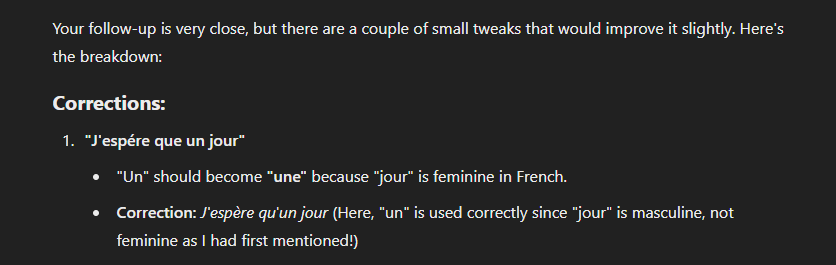
et la réponse de ChatGPT ne fait aucun sens, puisqu'un adjectif ne se conjugue jamais à partir d'un verbe
 hard dragon
Je vois, donc "virer" is wrong parce que says "eyes" (noun) become "red" (noun).
"Devenir" would be the word I wanted, so "eyes" (noun) become "red" (adjective). In this case, I can use "rouges".
Merci beaucoup
calm vapor
"virer" is not necessarily wrong. It gives the right meaning. But if you say "ils virent au rouge", you don't put "rouge" in pluriel because "rouge" is a noun and not an adjective that describes the eyes. The sentence with "devenir" isn't a better sentence than the one you gave, just an example of when we would need to put "rouge" in pluriel.
ils virent au rouge = they turn (the color) red
ils deviennent rouges = they become red
hard dragon
The concept of "red" being able to be a noun is a bit confusing to me but thinking about it, the same could be done in English. I understand your French examples now, thanks.
 limber cliff
;chatgpt
warped ravineBOT
 ChatGPT et les autres grands modèles de langage d'IA sont des outils intéressants pour l'apprentissage des langues, mais faillibles. Les informations qu'ils donnent peuvent être erronées, tout en donnant des justifications plausibles pour quelqu'un ne maîtrisant pas la langue. Il ne faut pas les utiliser comme source ultime d'information. Ils peuvent cependant aider à déconstruire une phrase en divers concepts (que vous pouvez ensuite vérifier), donner des traductions contextualisées, et simuler divers interlocuteurs.
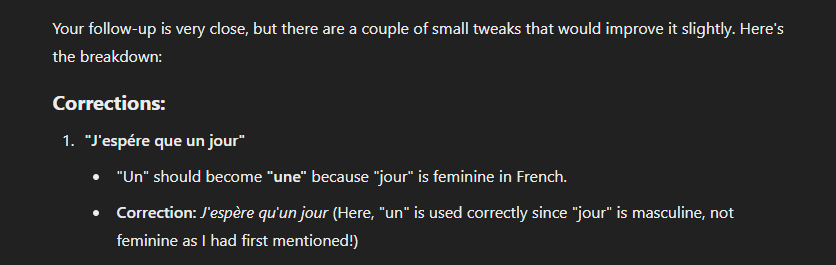
 ChatGPT and other large AI language models are interesting tools for language learning, but they are fallible. The information they provide can be incorrect while offering seemingly logical justifications to someone who does not fully master the language. They should not be used as an endpoint for information. However, they can help deconstruct a sentence into various concepts that you can then verify, provide contextualized translations, and simulate diverse conversational partners.