#questions-2
1 messages · Page 90 of 1
 plain umbra
plain umbra
plain umbra
Because "whenever" has two meanings, just like "when".
 swift bough
„Wenn du unseren Bus siehst, steig mal ein“
plain umbra
Yes, that's a different "whenever" from "Whenever will I die?"
plain umbra
Yeah.
 lucid tundra
hmmm, confusing
plain umbra
What part is confusing?
lucid tundra
the example „Wenn du unseren Bus siehst, steig mal ein“ I thought would be a clear expression of specific time
plain umbra
Really? What time would you answer such a statement with?
lucid tundra
an example of wenn would be, "Wenn er nervös ist, trinkt er zu viel" btw
swift bough
In dem Satz ist es entweder if/whenever
plain umbra
Yeah, that works. And that's the same thing as the other sentence.
The Bus one I mean.
swift bough
Ja
lucid tundra
ohh, makes sense
plain umbra
Wann is basically only a question word (also for indirect questions).
swift bough
Also „wenn“ kann auch „when“ bedeuten, es bezieht sich aber nie auf eine Zeitangabe.
plain umbra
Wann kommt der Bus? When does the bus come?
Ich weiß nicht, wann der Bus kommt. I don't know when the bus comes. (This one's an indirect question.)
 icy flax
Yo, ihr alle, schau mal, ich wollte sowas auf Deutsch sagen, wie kann ich es sprachüblich es aber formulieren?
"That could very well be the case, aber..."
Das könnte sehr wohl der Fall sein, jedoch...(?)
 fallow ledge
Ja die sind schöne und gut passende Phrasen.
Es steht zusätzlich zu diesen eine ganze Menge Optionen zur Auswahl, nämlich:
das könnte/kann/mag/dürfte/muss/müsste wohl der Fall sein, aber...
Es hängt nur davon ab, wie sicher der Sprecher vorkommen möchte.
Hier findet man ein bisschen mehr Information zum Thema; Modal Verben mit Subjektiver Bedeutung: https://www.deutschplus.net/pages/Subjektive_Bedeutung_der_Modalverben
@icy flax
icy flax
Danke, @fallow ledge, die subjektive Bedeutung der Modalen wird im C1 Buch gezeigten, aber ich war mir noch was unsicheres :)
Ich glaube ich habe einmal vom @long whale "sehr wohl" im Sinne von doubty~ "very well" gelesen, aber dachte mir ob es passend wäre. Vielen vielen Danke!! <3!
fallow ledge
Ich kenne sehr wohl nicht aber es könnte da sehr wohl gut passen 🤷♀️
Und ja da hast du recht, dieses Thema ist ein C1 Thema
Lässt sich oft in C1-Lehrbüchern finden, oder auch im Internet, falls man lust hat, mehr von Nuancen der Modal Verben zu erfahren
 mossy shard
How do you form a sentence with eigentlich?
Eigentlich dieses hier ist neuer.
Eigentlich ist dieses hier größer.
plain umbra
Verb in second position, as usual.
mossy shard
Thank you 🙂
 sharp acorn
You have these options:
Dieses hier ist eigentlich neuer.
Eigentlich ist dieses hier größer.
Neuer ist eigentlich dieses hier.
 elfin junco
how do i write german-specific alphabets in an english keyboard?
for example "ö" or "ß"? (i copied these letters :/)
 limpid sorrel
I don't understand the joke, I understand the first part but not 'Ich wünsche es Biden'
 thorn pelican
biden wird genau wie 'beiden' (both) ausgesprochen
limpid sorrel
Danke Schön 😄
 long whale
"That could very well be the case, aber..."
Das könnte sehr wohl der Fall sein, jedoch...
@icy flax Looks fine to me, yes - whether I said it before or not. ;)
mossy shard
What is the difference between rausgehen and ausgehen?
 sage mortar
Rausgehen means to leave some (indoor) space like a room/house but it can also be used for leaving places like park or a stadium while ausgehen means to go out to party or to go on a date
 fervent kernel
Worin unterscheiden sich durchführen und ausführen?
sage mortar
Ein Experiment, eine Kontrolle, und eine Operation werden zum Beispiel durchgeführt. Ein Befehl, ein Auftrag, und eine Arbeit werden ausgeführt. Bei diesen Beispielen würde es vielleicht ein bisschen komisch klingen, aber nicht wirklich etwas ausmachen, wenn ausführen und durchführen getauscht werden. Ausführen kann auch noch bedeuten etwas zu exportieren (aus dem Land bringen) oder jemanden auszugehen.
fervent kernel
Danke Saskia
 autumn sapphire
ausführen kann man auch befehle oder programme am computer
i wish i had known this before being forced to say shit like "executen" at work. And i may or may not have said "ein command rennen lassen" on at least one occasion 
fervent kernel
:kek:
Misst man eine physikalische Größe an einem Messgerät? oder gibts eine besser geeignete Präposition in dem fall? glaube "mit" passt besser oder?
@ mich bitte.
mossy shard
Thank you Saskia 🙂
icy flax
@icy flax Looks fine to me, yes - whether I said it before or not. ;)
@long whale 👍 👍 :)))
fervent kernel
Danke @icy flax
 mighty dust
Ist Futur II commonly found in day to day speech?
I'm having quite a bit of trouble distinguishing them from Futur I and the passive when listening to people talk
fallow ledge
@mighty dust not particularly
We can do a quick comparison between all of these forms tho
Lets start with futur 1
Morgen werde ich Käse essen. (Tomorrow im going to eat cheese)
Futur 2:
Morgen werde ich den Käse gegessen haben. (Tomorrow i will have eaten the cheese)
Passiv (present tense)
Der käse wird gegessen (the cheese is being eaten)
I know its a little tricky, but as a general rule, present tense is preferred over futur 1 (Morgen esse ich Käse) and futur 2 is rarely used
 solid hull
futur 2 is also mostly used for distant futures. Sounds weird anyway to use it for something that will happen tomorrow
mighty dust
Verstanden, danke~
fallow ledge
My understanding of futur 2 is that is a past event set to happen in the future @solid hull
Aus der Perspektive von Morgen, habe ich den Käse schon gegessen.
Morgen werde ich den Käse schon gegessen haben
solid hull
yeah something that is going to be completed before something else in the future, it's basically the perfect tense but in the future I guess
fallow ledge
Its not used often anyways
solid hull
true and id guess it's because there arent that many instances where you'd talk about a scenario like that, on top of the fact that German tends to prefer sentences in the present tense grammatically with future value
fallow ledge
All of this very true
But on the other hand, its very funny jamming too many verbs into a sentence
solid hull
lol stimmt
 broken coral
Gibt es einen Weg oder Regel, zu wissen, wenn „dass“ ausgelassen werden kann (außer Konjunktiv 1)?
Zum Beispiel: „Ich hoffe, dass er dir gut geht“ statt „Ich hoffe, es geht dir gut“.
sharp acorn
omitting dass works if you are using what is called a "bridge verb". (like hoffen, glauben, denken) This is a rather obscure grammar topic.
Since dass is a conjunction, when you leave out dass from two statements, you technically un-conjoin them, so they become two separated statements.
You can omit dass from statements like "ich hoffe, es geht dir bald besser" and "ich glaube, er will ihn töten"
but not, "ich will, dass es dir bald besser geht."
since wollen is not a bridge verb, so it cannot work without dass...
You can say "Ich glaube, er kommt morgen an. " because glauben is a bridge verb, but you cannot remove dass from "Ich bezweifele, dass er morgen ankommt."
then, generally in indirect speech, if you leave out "dass" it sounds like you agree with the second statement.
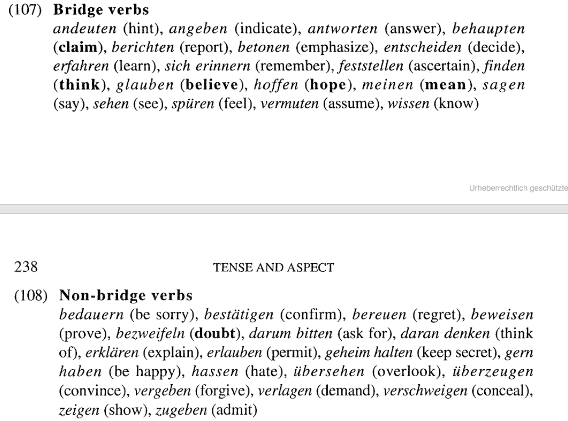
 waxen snow
Would using genetive be okay here? "Ich denke dass die Aktion der Kira nicht effektiv ist"
sharp acorn
(but did you perhaps mean Kita?)
waxen snow
@sharp acorn My teacher mentioned that genetive is not used with names in spoken and written language
No Kira was the name in the text
autumn sapphire
(gen__i__tive)
Is Kira a person name? In that case no, use Aktion von Kira or Kiras Aktion
mossy shard
Lisa ruft in Restaurant an.
Can someone tell me what "in" is in this sentence?
AFAIK in is a prepositon which means "to."
Also can I change it to, "Lisa ruft das Restaurant an"?
 delicate tiger
Just wrong, second version is correct
long whale
Lisa ruft
inim Restaurant an.Can someone tell me what "in" is in this sentence?
AFAIK in is a prepositon which means "to."
Also can I change it to, "Lisa ruft das Restaurant an"?
@mossy shard
Also possible: "Lisa ruft beim (= bei dem) Restaurant an.
You wouldn't really say "Lisa ruft das Restaurant an", since the restaurant isn't going to talk to her. You'd use this with a single person: "Lisa ruft ihre Mutter an", or "Lisa ruft Tom an". :)
mossy shard
I saw it on a website and got really confused about it. Thank you so much!!
 dawn jackal
wie kann ich darauf eingehen , bei unklar stimme bei den telefonaten.wenn ich nicht so gut den kunden hören kann
long whale
AFAIK in is a prepositon which means "to."
@mossy shard This is a way of thinking which will get you into lots of trouble, I'm afraid. 🤷 Unfortunately, it's not really possible to say "this German preposition" = "this prepostion in French/English/Martian". :)
dawn jackal
Ich habe vorher gehört "ich versetehe sehr schelcht" aber das klingt unhöflich
long whale
You could add "sorry": "Verzeihung, ich kann Sie nicht verstehen", for example. :)
dawn jackal
Danke Susana
fervent kernel
And what would be a polite way of asking someone to speak slower cause u can't understand them when they speak so fast?
thorn pelican
Könnten sie bitte langsamer sprechen
broken coral
Danke für die sehr detaillierte Antwort!
@sharp acorn
Bearbeitung: Gibt es mehr „bridge verbs“, als alle, die in der Liste sind, oder gibt es einen Regel, um zu wissen, wenn ein Wort ein bridge verb ist?
sharp acorn
ja, die Liste da ist nicht vollständig.
hmmm ... naja, vielleicht ist die Regel so: man fragt sich, ob der Hauptsatz der Logik nach auch alleinstehend und unabhängig da stehen kann, ohne ergänzt werden zu müssen.
Diese Logik ist vielleicht nicht auf alle anwendbar, scheint aber so ungefähr zu funktionieren.
mir fällt ein, ...Aussage
ich nehme an, ...Aussage
ich schätze, ...Aussage
andernfalls musst du einfach den Nebensatz erstmal mit "dass" bilden, bis du erfährst oder liest, dass es auch ohne "dass" gebildet werden kann.
swift bough
Urteil = ||verdict/sentence ||
Beurteilung = ||assessment/judgement/evaluation||
@fervent kernel
broken coral
@sharp acorn ach so! Lass mich mal versuchen.
- Es scheint, das ist so.
- Sie erwarten, sie werden gewinnen.
- Wir gehen davon aus, es wurde schon gemacht.
sharp acorn
• Es scheint, das ist so. → Es scheint so. / Es scheint, dass ... / Es scheint[,] ...[so] zu sein. / Es scheint, als wäre das ...[so]. / Es scheint so, als ob... [das so wäre: ..]
I believe that the reason this one needs to use a different construction is becuase the verb itself makes the mood change. Instead of "giving information", you are making a "hypotheitcal assumtion", so you often use the subjunctive instead of the indicative.
With this verb you will very often hear this construction: "Es scheint so, als ob..." followed by a subordinate clause in the subjunctive after "ob", instead of "dass".
• ~~Sie erwarten, sie werden gewinnen.~~Sie erwarten, dass sie gewinnen [/werden]. / Sie erwarten zu gewinnen.
erwarten just doesn't work as a bridge verb.
• Wir gehen davon aus, es wurde schon gemacht.
This one just sounds like two completely separate sentences that aren't logically connected to eachother and should have a "." between them.
Wir gehen davon aus, dass es schon gemacht wurde. →"dass" is neccessary in order to keep the logical connection between the statement and that it is something you expect.
When you remove dass in this case, "Es wurde schon gemacht" turns into a statement that you beleive to be true.
What you can do here, is put the "davon ausgehen" behind the statement which could logically connect them again.
"Es wurde schon gemacht, davon gehen wir [zumindest] aus."
The purpose of dass is to show a logical dependency of a clause to the previous one. When you remove the conjunction "dass", you also remove the clause's relation to eachother...
I am not sure if there is more logic behind this other than, "does it make sense to separate them?" Mabye that isn't a logic either and you just have to learn by experience which verbs are bridge verbs and which are not.
broken coral
Dankeschön!
Es erscheint mir, dass das wie *gezeigt vielleicht nicht so viel Logik dahinter hat. :/ @sharp acorn
Bearbeitung: nicht „gezeigte“
fervent kernel
Hey folks, got a message today and need help with understanding the sentiment (I'm struggling to understand if I should contact the person in December or they will contact me). Would someone be able to help me with translation? Thanks a lot!
Ich setze eine Wiedervorlage für Anfang Dezember und melde mich dann sobald als möglich mit einem Vorladungsschreiben.
 proven sphinx
Sobald als möglich? That should be "sobald wie möglich"...
It's the person who wrote this who will contact you.
This entire sentence sounds a bit odd. Was this written by a native speaker?
fervent kernel
It was written by a native speaker (government official) 😲
thorn pelican
sobald als möglich also comes up a fuckload of times in the dwds korpus
duden says both work
except with a space
 worthy igloo
is there a german equivalent for “empty nester”? aka a parent whose children have grown up and gone off to live their own lives
long whale
Not to my knowledge. If I had to translate it, I'd probably say "Eltern erwachsener Kinder", although it should technically be rather "Eltern, deren Kinder ausgezogen/aus dem Haus sind", since grown-up children might go on living at home. A possibility might be "Nestflüchter-Eltern" (but that's one which just occurred to me, there don't seem to be any results on google). 🤷
@worthy igloo
 spring tulip
does eigentümlich has the same meaning of neugierig (curiuous) ?
proven sphinx
eigentümlich = idiosyncratic
 cobalt thistle
Peculiar
proven sphinx
Yeah.
spring tulip
Ok ,danke
 brazen shadow
thorn pelican
brazen shadow
thorn pelican
please only ask a question in one channel
spring tulip
welche unterschied zwischen ernsthaft und ernstlich ?
worthy igloo
@long whale i see! thank you for these various options 
 heavy stratus
What do people make of the grammar in 'Willst du mit mich nächste Woche Kleidung einkaufen gehen?'. I feel like the word order is fine, but I'm missing one of those mysterious german commas somewhere
 shadow pecan
commas are useful to separate clauses (subordinate clauses for ex). I don't think it is needed here, unless you want to change it to add "um zu"
Also, don't forget that "mit" is always followed by dative
heavy stratus
Thank you! @shadow pecan
worthy igloo
was bedeutet hier „das lässt wirklich tief blicken“?
swift bough
Wieso fehlt da „sich“? @sharp acorn
sharp acorn
because it lets US see deep insight
if it was "sich blicken lassen" then it would be that it was revealing itself or showing itself
but here it is lettung US (not itself) look deep inside the truth
the difference is who is doing the "blick"ing
es lässt [uns] tief blicken - we can see deep insight
es lässt sich blicken - it makes itself visible
swift bough
Ich wurde wohl wegen der Auslassung von „uns“ etwas verwirrt
Normalerweise wird das nicht ausgelassen finde ich
broken coral
Warum „doch mal“ hier?
 latent wadi
even more polite command
broken coral
@swift bough das war auch verwirrend für mich, aber das ist eine Art Passivform.
Von wenigstens höflich zu höflicher ist es:
- Senden Sie ein Foto.
- Senden Sie mal ein Foto.
- Senden Sie doch mal ein Foto?
Und wäre es noch in Ordnung sein, wenn ich es ohne doch „sagen“ würde?
latent wadi
jap
sharp acorn
"[verb]en Sie doch mal!" turns a command into something like a friendly suggestion. In English I might say , "Why don't you [verb]?" or "How about you [verb]?"
broken coral
Danke @latent wadi
Und ach so. Und der Unterschied zwischen „mal“ und „doch mal“ hier denn?
solid hull
Normalerweise wird das nicht ausgelassen finde ich
@swift bough Ich denke in diesem Fall gibt es einen Bedeutungsunterschied, und zwar bringt der erste Satz (ohne uns) zum Ausdruck, dass niemand besonderer als Objekt des Satzes gegolten und jener bloß im Allgemeinen gemeint wird, so wie im Beispiel: es wird gesungen. Man weiß nicht, wer singt oder von wem etwas gesungen wird. Der 2te Satz stellt einfach dar, wer das Objekt im Satze ist, es wird also genauer bezeichnet. Darüber bin ich mir nicht zu 100% sicher und könnte etwas in den Satz reininterpretiert haben
ach Jim der Ehrenmann, da wollte ich dich grad fragen was du dazu meinst lol (oh vielleicht antwortest du erstmal auf Christophrrbs Frage , ups.. fast übersehen)
 sand trout
What's the difference between "Sie sind" und "Du bist"? Is sie sind just a formal version of du bist?
fallow ledge
Yes
du bist, singular informal address
ihr seid, plural informal address
Sie sind, singular and plural formal address
@sand trout
sand trout
Danke!
fallow ledge
du doesn’t need to be capitalised
Generally
You can use Du/Ihr when writing emails to work colleges in a chilled out work environment.
But normally youd use Sie at work
broken coral
@fallow ledge und wenn es eine legere Veranstaltung bei der Arbeit gibt, wechselt man zu „du“? Zum Beispiel, auf einer Party bei der Arbeit.
thorn pelican
whether you use du or Sie with someone isn't a flexible thing. It's not based on the environment you're on but your relationship with that person @broken coral
with work colleagues that could be a more formal relationship or a more friendly one depending on the workplace. but once you use du with someone it's considered a bit weird to go back to Sie
sharp acorn
I'd just add that in Germany in 2020 there are lots of new businesses, start-ups and these days it is much more common to use "du" with your work collegues than "Sie" and that many businesses these days strive to have a "flache Hierarchie" (flat hierarchy) where everyone uses "du" within the company, as this is understood by many to give a business a more welcoming atmosphere.
Even in these types of businesses, customers are still addressed with Sie.
The respectful form Sie is used for people you are formal with or not familiar with. Basically, teachers, overseers, people with direct authority over you, strangers, especially those who are visibly older than you, people you just meet for the first time and want to show respect to, and people you only interact with to do business with.
I like to tell English speakers who don't have this word that it is something like speaking to someone as "Sir or Madam" or calling them by their last name.
If you had a work collegue named Stefan Hoffmann and you called him Herr Hoffmann on your first day, but became friendly with him at a party and he said, "I'm Stefan, it's okay you can call me du", then you will forever call him du, Stefan from then on. You won't ever switch back to calling Stefan "Sie" or "Herr Hoffmann", unless you wanted to let him know in a cold and passive agressive way that your friendship is officially over.
What form of address you will use with a company is usually something you can see in the Stellenanzeige - job description
I would say about 90% of them use du or Du these days instead of Sie
 steel walrus
fellas, i am once again in need of hilfe, so im doin a lesson and it says ich will das kaufen = i want to buy it. and i understand it but what i dont quite get yet is how does das kaufen = buy it? and how can there be a das behind a verb? i thought that was for name of things, people etc
steel walrus
ok, so a better translation of that phrase would be "i want to buy that", right?
thorn pelican
yep
thorn pelican
it's a matter of literal, vs natural translations
'das' in that sentence is literally equivalent to 'that', but in english in that situation it's more common to use the direct pronoun 'it'
it's like how in german how are you is how goes it to you, but you don't translate wie geht es dir to how goes it to you, but rather to how are you because that phrase expresses the same sentiment / idea in english
steel walrus
yeah, i think i get what you mean. i think what many learning resources do is teach the interpretation of the goal language rather a direct translation, so that's probrably whats going on here. appreciated but i wish they would also teach the literal translation, it'd really help along the way
thorn pelican
what learning resources are you currently using to learn?
steel walrus
duolingo, busuu and that aprticular phrase came from lingvist, also using some other apps that teach words individually which helps with learning the die,der, das of words. so basically apps only, might need a book soon
tho
oh and youtube plus some random websites
thorn pelican
I strongly recommend a grammar-focused resource such as a textbook. something that really takes the time to explain the grammar
steel walrus
yeah, i definetely need a book, and even an online tutor in the future, but as far as books go, im doing some research on the side, hopefully i will find a good book that explains things well, i hate it when authors assume i know what theyre thinking and skip important info.
broken coral
whether you use du or Sie with someone isn't a flexible thing. It's not based on the environment you're on but your relationship with that person @broken coral
with work colleagues that could be a more formal relationship or a more friendly one depending on the workplace. but once you use du with someone it's considered a bit weird to go back to Sie
Ich habe gelesen, dass wenn zwei sich duzen, aber beispielsweise in einer Sitzung mit anderen sind, die die zwei siezen, dann werden sie wechseln wegen der Umgebung.
Und ich würde sagen, dass die Konzept von Siezen und Duzen noch ein bisschen schwieriger ist für Amerikaner zu verstehen, weil wir im Prinzip niemanden in unserer Altersgruppe mit Nachname ansprechen, es sei denn vielleicht eine Person grüßt oder stellt eine andere vor bei einer Präsentation, oder die Person ist Jahre älter als die andere.
Bearbeitung: *niemanden, nicht niemand
 hot anvil
Was ist der Unterschied zwischen unsicher, ungewiss und verunsichert?
 wet rock
Unsicher - offensichtlich nicht sicher [Unsure]
Ungewiss - [uncertain]
Verunsichert - sich nicht sicher fühlen/sein über etw. [Unsettled]
@hot anvil
Da ich selber ungewiss nie wirklich verwende finde ich spontan keine gute Erklärung
 celest dock
I'm using a pronunciation trainer to learn the sounds better, and according to that anki card, the word "der Aal"'s IPA is "[aːl]". The problem is, according to IPA's wikipedia, that sound is an open front unrounded vowel, which isn't a sound available in standard German. What fits better in my opinion, is the open back unrounded vowel, which is ɑ, not a like the card claims. So which is true?
thorn pelican
a: does indeed exist in standard german
fervent kernel
eigentlich ?
thorn pelican
mmhm
 dense dust
Standard german does have /a/ and /aː/ as short and long a
thorn pelican
the very first two words
hat and Bahn
in standard germany german pronunciation ɑ only really appears in loanwords / foreign words
celest dock
it says it doesn't on it's wiki, is it wrong?

Wikiwand
The open front unrounded vowel, or low front unrounded vowel,[1] is a type of vowel sound, used in some spoken languages. It is one of the eight primary cardinal vowels, not directly intended to correspond to a vowel sound of a specific language but rather to serve as a fundam...
not for standard german I mean
thorn pelican
yeah that's not standard german which is why i specified standard germany german
celest dock
according to it, that vowel's representation is "a" though
thorn pelican
yes
celest dock
but you just said it exists in standard german
thorn pelican
yes it does
i thought you were pointing to the back vowel
in wassermassen in altbayern
celest dock
ok sorry my bad I misunderstood
thanks
wait I still don't get it
according to that wiki page I just sent front doesn't exist in standard German
thorn pelican
it does though
try this one
https://en.m.wikipedia.org/wiki/German_orthography
German orthography is the orthography used in writing the German language, which is largely phonemic. However, it shows many instances of spellings that are historic or analogous to other spellings rather than phonemic. The pronunciation of almost every word can be derived fro...
wikipedia can be sporadic and innacurate at times
i can assure you a: is a very normal part of standard german
sand trout
Hopefully a simple question, but
what's the difference between "von" and "auf"?
thorn pelican
the short answer is a lot
the long answer is very long
in terms of location "von" is just like from
e.g. I'm going from the store to the library
in terms of location "auf" is just like on (top of)
e.g. i am sitting on the desk
in terms of anything that does not describe a location it gets a lot more complicated because prepositions are well, complicated
sand trout
So, for example, can you say
"Wir sind auf der Opernplatz!"?
Or something along the lines of
"Der apfel auf der Tag."?
thorn pelican
Auf dem Opernplatz
once you move outside of physical locations, preposition usage is highly idiomatic. There are certain verb-preposition combinations you have to learn by rote, and there are some (long) guidelines on which prepositions only generally are used for what.
but the most important thing to learn is that the preposition usages (excluding location) will often not match up with your native language (especially if it's english)
E.g.
I turn the machine off
in a location sense 'ab' means 'off'
but in that idiomatic phrase turn the machine off, germans use 'aus' as in 'i go out the door'
 undone sparrow
@thorn pelican auf dem Opernplatz.
Man kann eine Maschine auch abschalten
thorn pelican
not the best example but the one that came to find first
undone sparrow
yeah sorry for the nitpicking, just wanted to point it out that both are possible
thorn pelican
no worries
it's similar but in reverse with 'turn the light off'
machen/schalten das Licht aus
'turn the light out' can be said but at least here it's a lot less common than off
 storm pike
so i was searching up how what cases mean
and i got this: "whether it is the subject (nominative), the direct object (accusative), the indirect object or object of a preposition (dative), or if it is a possessive (genitive) form."
but im still kinda confused on what this means when it translates to german
 near folio
ich bin mir nicht ganz sicher, was genau deine Frage ist. Kannst du bitte deine Frage näher erklären?
Wir haben FAQs für jeden Kasus, du kannst sie in #botchannel aufrufen (z.B. >faq Nominativ), wenn du willst
storm pike
ttyty
heavy stratus
Is 'also' a bit like saying 'um'? It seems that people sometimes use it when trying to find words mid conversation or construct new sentences. I haven't noticed this much amongst native speakers
plain umbra
It means like "so..." in English.
 eternal linden
and it does happen pretty frequently among native speakers
plain umbra
Maybe it just seems less common because learners have to think a lot more between sentences.
So learners usually use filler words a lot more.
heavy stratus
Okay cool, thanks guys. It just seemed that people would say 'also', pause for some time and then come up with a new sentence and that didn't seem to happen with natives at least from what I've seen.
sharp acorn
we use also, all the time, just without the long awkward pauses
icy flax
@heavy stratus search my audio in questions few days ago. Thats a native german speaking. She said thousand alsos and halts in almost every sentence. The frequency they use "also" is comparable to americans using "like". 😹
 hushed tangle
Kann man "verfügbar/ Verfügbarkeit" für Personen benutzen?
z.B " Ist der Arzt für Dienst verfügbar? " usw...
ansonsten wie würde man es ausdrücken?
dawn jackal
gibt es doch Unterscheidung zwischen gerade eben und jetzt ?
 next crane
Someone please help me understand the difference between Bereich Gegend and Fläche.
(Please tag me when you answer his, as I have turned the group notifications off😅)
thorn pelican
bereich: area/region both phsyically and methaphorically. when physical typically in terms of 3d space.
gegend: vincinity/local area/a city quarter
fläche: the 2d area of something like the surface of a square or sphere, or a large typically flat / near flat expanse of area like planes or a golf's fairway
thorn pelican
der Ruhebereich in train - the quiet carriage
der Bereich der Kunst - the area of art
fläche is not just mathematical area but focus on the surfaces of things
next crane
So to summarise
Bereich- idk how to describe it, a vague idea of area?? Something like a category...a metaphor.
Fläche- literally the area covered by something.
Gegend- area related to place, like the area of the criminals 👀😅
Am I right?
thorn pelican
Bereich is also a physicall area like the area in a room.
i don't know if gegend could be used for a criminals area but 'city quarter' is a close bet.
i recommend reading the defenitions in a dictionary like the duden or dwds.de to gain a better understanding of the differences

 undone sparrow
nice dekk mate
 subtle jungle
“Ja” in the middle of sentences is for emphasis, right?
long whale
I guess you could say that, yes. :) @subtle jungle
icy flax
@icy flax I think that highly depends on where the person is from in Germany
@undone sparrow erkläres, bitte.
Meinst du denn, dass "halt" und "also" Sagen eher auf Gegend ankommen 🤯 🤯 . Sowas wusste ich nicht. Bitte bitte mehr Input :)
sharp acorn
Also, "also" höre ich überall
"halt" gibt es vorwiegend in südlichen Regionen
im Norden sagt man statt "halt" häufig "eben"
laut Quellen sind beide überall zu hören
die Häufigkeit von "eben"
die Häufigkeit von halt
sie können und werden auch häufig zusammen verwendet "halt eben"
"das ist halt eben so"
Die Karten zeigen die Relative Auftretenshäufigkeit von eben und halt innerhalb der einzelnen Areale im Verhältnis zueinander (in %)
Die beiden Partikeln eben und halt können gebraucht werden, um die Offensichtlichkeit eines Sachverhalts zu unterstreichen.
Dabei wird überall mehrheitlich bis fast ausnahmslos die Partikel "eben" verwendet: "Wenn nicht jetzt, dann kommt es eben im nächsten Winter zum Einsatz." (Mitteldeutsche Zeitung).
In den meisten Arealen ist daneben aber auch " halt " gebräuchlich, nur in D-nord, D-mittelost, D-südwest und A-west kommt diese Partikel etwas seltener vor: "Die ersten drei Spiele waren ja gut, da haben halt ein paar Prozent gefehlt." (Schwarzwälder Bote).
In der Fachliteratur wird gelegentlich angegeben, dass die Partikel "halt" außerhalb von CH nicht standardsprachlich sei. Dies kann folglich durch die Variantengrammatik nicht bestätigt werden.
swift bough
In Niedersachsen hab ich eigentlich recht häufig „halt“ gehört, aber auch „eben“.
icy flax
Kenne persönlich zwei Berliner, die ganz oft beide benutzen, Jim. Und wo haste die Karte übringens gefunden? Sehen was schön, aber könnten besser herstellt werden. Die Farbe sind was schwer zu unterschieden.
Buoh, bin echt überrascht, dass die Partikeln eig regionalisch sind. Warum sagen die Lehrer sowas nicht beim Deutschkurs und auch keine soweit von mir gelesenen Deutschbücher zeigten das? Immer so gut die Chance wir haben von euch hier im Server mehr fortzulernen! 👍 😹  👍
👍
Das Halt lese ich immer als das "Well.." von Englisch. Sehen mir so aus ganz analog einander zu sein.
thorn pelican
für mich ist 'halt' ganz nicht analog zu 'well'
und vielleicht weil modal Partikeln normalerweise überhaupt nicht unterrichtet werden
Insbesondere nicht vor C
'Na' ist mehr wie 'well' und 'halt' hat für mich gar kein englisches Analog
swift bough
„Also“ ist auch wie „well“, manchmal auch „so“
sharp acorn
Kenne persönlich zwei Berliner, die ganz oft beide benutzen, Jim.
Vielleicht hast du da was falsch verstanden. Wie bereits erklärt: Beide Wörter werden überall verwendet.
Es sind also keine rein regionalen Wörter. Beide gehören zum Standardsprachgebrauch. Wie häufig man sie verwendet hat je nach Region andere Tendenzen. Heißt keineswegs, dass ein Mensch aus einer bestimmten Region nur das eine Wort und niemals das andere sagen wird. Sie werden überall beide verwendet, auch häufig zusammen "halt eben".
Keines der beiden Wörter wird ausschließlich im Norden oder im Süden verwendet, sondern überall. Bloß nicht überall mit der gleichen Häufigket. Das ist es, was die Karten auch darstellen, nämlich die relative Häufigkeit der beiden Wörter zu einander in verschieden Regionen, wobei zu bemerken ist, dass 'eben' leicht häufigere Verwendung im Norden findet und 'halt' leicht häufiger im Süden.
Und wo haste die Karte übringens gefunden?
Den Link habe ich auch bereits gepostet, direkt unter dem Beitrag.
und ja die Farbe ist schon ungünstig gewählt, da stimme ich dir zu, vor allem da so viele Menschen eine Rot/Grün-Schwäche haben
sharp acorn
fervent kernel
hallo, was heißt eigentlich die zwei Wörter,, in sich''
ich habe versucht sie im Wörterbuch nachzuschlagen, aber da ergibt sich daraus nix..
ich bin auf die Wörter ,,in sich geschlossen'' gestoßen, und die haben zwar eine selbständige Bedeutung, aber ,,in sich'' hat allein keine Bedeutung (zumindest laut dict.cc ).
Kann ,,in sich'' halt nicht allein stehen?
long whale
Kann ,,in sich'' halt nicht allein stehen?
@fervent kernel I'd say you're right, those two words are only used in certain idioms/expressions. There is "in sich gekehrt", for example, which literally means that a person has "turned in on himself/herself", i.e. they're the opposite of outgoing, extrovert. :)
fervent kernel
i see, i got an sich and in sich all mixed up, because with an sich i can just use it with any verbs. but in sich i guess not 😅
 thorny urchin
Dunno if it helps to form a better understanding but contex reverso shows pretty much the same: https://context.reverso.net/vertaling/duits-engels/in+sich
Vertalingen in context van "in sich" in Duits-Engels van Reverso Context: sich in der Nähe, sich in den letzten, sich in Längsrichtung, sich in Richtung, Widerspruch in sich
fervent kernel
thanks as always susana 
long whale
You're welcome, as always, Gran. ;)
 pure kernel
I'm not sure what people say in two places of this video: https://www.zdf.de/nachrichten/heute-in-europa/heute---in-europa-vom-31-oktober-2019-100.html
Can you help me?
11:40 does she say "Rosenkränze"?
11:48 I don't get the phrase between "Gruseltour durchs Labyrinth" and "Gänsehaut inklusive"

Unsere Themen: Megahochzeit in der Automobilbranche – Fusion von Fiat Chrysler und PSA/ John Bercow nimmt seinen Hut – Unterhausprecher verlässt Westminster/ Gruselführung auf dem Zentralfriedhof – Halloween im nächtlichen Wien
undone sparrow
"nicht mit einfachen Seilen, sondern mit geweihten Rosenkränzen"
"morbider Charme und Gänsehaut inklusive" @pure kernel
pure kernel
Danke schön! Es ist in der Tat skurril. Es wundert mich nicht, dass ich das nicht verstanden habe 😅
pure kernel
🤔 Ja, fast wie Metaphern in Poesie
 glossy marsh
🤔 Ja, fast wie Metaphern in Poesie
Nice simile. ^^
icy flax
und vielleicht weil modal Partikeln normalerweise überhaupt nicht unterrichtet werden
Insbesondere nicht vor C
@thorn pelican https://yourdailygerman.com/halt-halten-meaning/
A fun look at the meaning of German "halt" and an interesting insight into why native speakers use it all the time.
icy flax
@sharp acorn nee, ich habs doch richtig verstanden. Den Link hab ich aber ja übersehen :(
Und ja, ich kenne zwei Berliner, die kaum erhebliche Kraft vertreten (egal wie häufig sie halt verwenden), um die vom einen wohl ausführlichen Studie resultierten Ergebnisse zu widersprechen. Sowas meinte ich niemals.
und was damit?
@thorn pelican der da erklärt viele von den Bedeutungen. Eine ist nähmlich jenes von mir obergenante "well...".
dawn jackal
Gibt es noch eine Unterscheidung zwischen erörtern und diskutieren ?
near folio
@dawn jackal ich weiß selber nicht, aber ich habe diese Seite gefunden, auf der eine ähnliche Frage gestellt wurde: https://www.gutefrage.net/frage/wesentlicher-unterschied-zwischen-eroertern-und-kommentieren

gutefrage
Ich würde den Unterscheid folgendermaßen beschreiben: Wenn man etwas erörtert, sollen möglichst viele Informationen zu einem Thema zusammengetragen werden, ohne jedoch eine…
fervent kernel
hi guys, does "was meinst du" make sense? or should i use "wie meinst du"? or do they mean different things
long whale
If you want to ask "What's your opinion? What do you think about this?" then "Was meinst du?" would be appropriate. If you want to ask "What do you mean? I don't understand" then it's "Was meinst du damit?" or if you did understand but would like the other person to be more specific, you could ask "Wie meinst du das?" ("damit" and "das" would refer to the thing the other person just said) @fervent kernel
fervent kernel
thanks a lot susana ❤️
 thorn cradle
What should be the subject line for an e-mail for a course enquiry in german?
If you want to ask "What's your opinion? What do you think about this?" then "Was meinst du?" would be appropriate. If you want to ask "What do you mean? I don't understand" then it's "Was meinst du damit?" or if you did understand but would like the other person to be more specific, you could ask "Wie meinst du das?" ("damit" and "das" would refer to the thing the other person just said) @fervent kernel
@long whale thnxxx 😇
sharp acorn
Frage zum Kurs
Question about the course
? something like that?
icy flax
Oh! @sharp acorn I was about to type Frage über den Kurs. The word Frage also accepts this and "um" as well, right?
sharp acorn
"Frage über den Kurs" is also fine!
"um" doesn't work in this situation
you could also go with a very formal sounding:
"Frage bezüglich des Kurses"
Frage zum Kurs is the most natural option
from stackexchange:
über (about) is rarely used when it comes to questions, at most with the verbs "ausfragen" or "befragen":
Er wurde von der Reporterin über seinen Nachbarn ausgefragt.

Die Polizei befragte den Lenker über den Hergang des Unfalls.
🤯 das vergesse ich nie mehr :) danke!!
fervent kernel
if i say i have cooked something do i say Ich habe der/den/dem??? (x) gekocht=???
sharp acorn
yes you say "Ich habe (x) gekocht" and then the thing that you cooked is in the accusative case becuase it is .. well the thing you cooked
nominative - the person who coooked it
accusative - the thing you cooked
fervent kernel
Frage zum Kurs
Question about the course
? something like that?
@sharp acorn Und ist ,,ich frage nach dem Kurs" richtig?
Weil wenn ich mich nicht irre das Verb fragen die präposition nach verlangt..
sharp acorn
correct , but in that case it is slightly different , instead of having a question about the course, here you seem to be asking for the course itself, you are searching for it or figuring out if it exists or is available? Asking about the course's state of being. Maybe you forgot to enroll and you're calling to see if you can sign up late: "Gut, dann ruf ich an und fage nach dem Kurs."
Man verwendet die Präposition “nach” in Kontexten, in denen Sie etwas suchen, etwas verfolgen oder etwas nachgehen wollen:
Der Vater fragt nach dem Weg.
Ich frage nach dem Sinn meines Lebens.
Der Chef hat nach dem Kellner gefragt, aber der Kellner ist nicht gekommen.
zu
Man verwendet die Präposition “zu” mit der grundlegenden Bedeutung, sich einem bestimmten Thema zu nähern, um es zu entdecken.
Ich möchte eine Frage zu diesem Thema stellen.
Der Polizist hat eine Frage zum Vorleben des Verbrechers.
Die Autorin wird zum Inhalt des Buches befragt.
oder manhat eine Frage bezüglich (+Genitiv) etwas, das heißt, was das Thema betrifft, betreffed diese Thematik...
dawn jackal
iat eintretn hat die gleiche Bedeutung von beitreten ? as to join oder gibt es eine Unterscheidung zwischen ihnen ?
delicate tiger
In einen Verein eintreten vs Einem Verein beitreten
 hushed cave
hallo, ist applaudieren dasselbe als klatschen?
long whale
If it's about an audience showing approval - yes.
hallo, ist applaudieren dasselbe
alswie klatschen?
@hushed cave :)
subtle jungle
why does “Maria steht voll auf den neuen Barista” translate to “Maria is really into the new barista”? I thought “steht” meant “stands”?
long whale
"steht" means "stands". "auf jemanden/etwas stehen" = "to be into someone/something" It's an idiom/a colloquial expression, in German and in English. 🤷
@subtle jungle
subtle jungle
@long whale ach so, danke
broken coral
@long whale „stand on“ auf Englisch?
swift bough
Nicht wortwörtlich
Auf jemanden/etwas stehen = to be into someone/something
Denn das ist wie man „auf jdn/etw stehen“ übersetzt
Also ins Englische
hushed cave
@long whale danke
If it's about an audience showing approval - yes.
@hushed cave :)
@long whale und welche ist der unterschied?
hushed cave
quesiton to everybody lol
sharp acorn
applaud and clap are different verbs right? So can you find the difference?
applaudieren, klatschen, applaud, clap
Was ist der Unterschied oder wo ist der Unterschied
falls du kein Englisch sprechen solltest, oder so was, erkläre ich es nochmal ausführlich,
klatschen ist eine Bewegung, bei dem man die Hände laut und mit genug Wucht gegeneinander (oder gegen ein anderes Objekt) schlagen lässt, sodass ein Schall entsteht
applaudieren ist das Klatschen als Zeichen der Anerkennung nach einer Vorstellung
subtle jungle
I am working on comparisons and I was wondering why “ich schwimme besser als er” is correct instead of “ich schwimme besser als ihm”?
fervent kernel
I think its because in the sentence you are comparing the nominatives.
Let's say : ich kaufe lieber einen Stück Milchschokolade als eine Brezel.
Here is brezel in akkusativ,
 celest frost
ein Stück Milchschokolade
This is Akkusativ Neutrum
I am working on comparisons and I was wondering why “ich schwimme besser als er” is correct instead of “ich schwimme besser als ihm”?
@subtle jungle "als" is a comparative so the subsequent pronoun copies the case of the former most of the time.
e.g.:
Ich bin schlauer als er. (Nominativ)
Meiner Frau gefiel der Film besser als seiner (Genitiv)
Ihm gefiel der Film besser als mir. (Dativ)
Ihn interessierte der Film mehr als mich (Akkusativ)
long whale
@celest frost Um, if you made up the examples, then "Meiner Frau gefiel der Film besser als seiner" is Dativ (Wem gefiel der Film besser?) Genitiv would be "Die Ladekapazität meines Handys ist größer als die des deinen/deines Handys", for example. ;)
 harsh pier
Der Text handelt von dem Jungen der im Restaurant ein Missverständnis aufgrund von Vorurteilen über den schwarzen Mann hatte, von dem er glaubte, er esse von seinem Teller
ist der Satz richtig geschrieben ??
proven sphinx
That sentence is very hard to read, since it's pretty complex and long.
celest frost
(answered him via DM)
wet rock
You can use als when you compare things where one is greater than the other
You use wie when they're the same
Er ist älter als ich
Ich bin genau so groß wie er
 ionic ibex
Oh the ich in the first exp and the er in the 2nd one is not in Akk form?
swift bough
ne
 tall arrow
Wenn ich bei meiner Arbeit viel verdienen wurde , ich kaufe ein neues Auto .
wenn mir meine Arbeit keinen Spass machen wurde , ich ins Kino gehen.
is this correct
 outer wren
What’s the difference between “indem” and “in dem”?
fallow ledge
@outer wren indem is a conjunction meaning „by“:
Ich werde besser in Kunst, indem ich jeden Tag zeichne. (Ill get better at art by drawing everyday.)
in dem is the preposition in paired with the dative masculine or neuter definitive article, which translates to „in the(masc. neut.)“
This is often shortened to im
Ich bin im (in dem) Park. (Im in the park)
outer wren
Ohh so “indem” is like “durch” then? @fallow ledge
fallow ledge
Durch follows a function more similar to „through“ in english
I dont think it can replace indem, but im gonna do a little research before i can definitely say that
Hmm Im inclined to say no there
outer wren
Thank you so much 🙌🏼
fallow ledge
No worries
long whale
@fallow ledge Well, the grammar is different, of course, but: Wie wird man besser in Kunst? - 1. Durch Üben. 2. Indem man übt. Duden Bedeutung 2a: https://www.duden.de/rechtschreibung/durch_hindurch_mittels_waehrend
fallow ledge
Yeah i was stuck up on thinking of it as a one-one replacement for indem, but yeah if you switch up the grammar a little then it works quite well
undone sparrow
doesn't it have to be durch Üben, Susana?
dawn jackal
ist das richtig zu sagen ? "im Allgemeinen das war eine gute Erfahrung, wovon ich so viel gelernt habe"
fervent kernel
im Allgemeinen war das eine gute Erfahrung, von der ich so viel gelernt habe
"von der" statt wovon. (Aber ich denke wovon könnte auch richtig sein)
Und das Verb 'war' steht in der zweiten Position im Hauptsatz
 bitter saffron
„Das Buch“ is one book
„Die Bücher“ is plural
Das Buch = Book
Die Bücher = Books
The -ü, er is for
u changes to ü when we say the plural word and we add -er at the end
B__ü__ch__er__
glossy marsh
This happens a lot with vowels: they become umlauts.
Dach -> Dächer
Fach -> Fächer
Etc.
 tulip blaze
the plural of Dach is Däch?
glossy marsh
Lol, my mind was already on the next plural.
 hoary prawn
thanks guys 
hot anvil
Was ist der Unterschied zwischen eine Tat und eine Handlung?
 wise pendant
Der Unterschied liegt in der Verwendung, also im Kontext.
 unkempt cedar
Hallo ich habe eine kurze Frage. Welche preposition sollte ich verwenden wenn ich sage "ich habe das "auf/in/?? " linkedin gesehen
fervent kernel
Auf@unkempt cedar
proven sphinx
Ja, ich würde auch "auf" sagen. Auf Facebook, Twitter, LinkedIn, YouTube usw.
unkempt cedar
Vielen Dank
glossy marsh
Im Internet aber auf einer Webseite.
icy flax
Sagt man im Netz auch? @glossy marsh
Btw, im Google was gefunden, oder beim Google was gefunden? Oder sonst was?
 icy flax
Tyyy jungsss
 ocean canopy
In the song "99 Luftballons", there is a line that says "von 99 Luftballons, auf ihrem Weg zum Horizont". Since "auf" is a preposition that can go either accusative or dative, why did Nena use dative when the balloons are clearly moving? Is it more of a change-of-state thing that distinguishes between accusative or dative? I learned that it depends on motion.
So my thought is that it should be "auf ihren Weg", but I am probably wrong. Just wanting to know why 
long whale
It's "auf dem Weg [nach X] sein" = to be on one's way [to X]
(And just to make it more confusing, there's "sich auf den Weg [nach X] machen" = to start out [for X])
@ocean canopy
ocean canopy
Oh ok I understand
long whale
What can I say? You're right. Logically, Akkusativ would fit better - it's just that you need Dativ in this case. 🤷
ocean canopy
Haha no problem. I think what I am understanding is that the "movement" vs "no movement" is more abstract
So you mentioned that the "auf dem Weg" implies a state of being, whereas "sich auf den Weg machen" going from the state of not on your way, to being on your way
long whale
Well, "movement" is misleading, really. What you need for Akkusativ is "movement towards somewhere". Just movement alone is not enough.
However, this doesn't really help with "auf dem Weg". 🤷
So you mentioned that the "auf dem Weg" implies a state of being, whereas "sich auf den Weg machen" going from the state of not on your way, to being on your way
@ocean canopy Yeah - if it helps. :)
ocean canopy
Vielen Dank :))) I am really glad I asked
swift bough
Eigentlich ergibt für mich in dem Fall der Dativ mehr Sinn als der Akkusativ. Die Luftballons „befinden sich“, sozusagen, auf ihrem Weg. Sie bewegen sich nicht von selbst zu einem Ort namens „Weg“, sondern sie sind auf dem Weg.
plain umbra
@long whale @ocean canopy Like Nate said, dative actually makes more sense there. If it were accusative you would be more saying "onto the way".
I am onto the way vs I am on the way.
A path is something you are located on, even if you are moving. It's the exact same thing as when you're taking a walk "im Park". You're not exiting or entering the park. You're located inside it. Even if you're walking around.
ocean canopy
@plain umbra Thank you! I figured that might have been the explanation. This makes so much more sense
I guess maybe it would be a good idea in these situations to avoid thinking super literally
 vernal epoch
can someone help me translate sentences into konjunktiv
plain umbra
I guess maybe it would be a good idea in these situations to avoid thinking super literally
@ocean canopy I would say thinking literally is fine. It's just that the definition "movement vs no movement" isn't correct by itself. It's more like "movement vs no movement with respect to the specific preposition and object you're considering".
Example:
The cat jumps onto the table in the house.
Die Katze springt auf den Tisch im Haus.
The cat was off the table, now it's on. So it's movement/change w.r.t. "auf" and the table. -> akk
The cat did not come into the house; it was already there. So there's no movement/change w.r.t. "in" and the house. -> dat
ocean canopy
Got it
Wait a minute then
WAIY
WAIT
FORGET THAT
Ich bin blöd
Me forgetting that "zu" is exclusively a dative preposition 
 outer epoch
what is the difference between Die and Den
 whole tusk
die is femine and den is male akkusative\plural dative
 serene birch
"Ich habe die Schule sehr schön gefunden, weil sie groß und wunderbar gewesen ist" Is this correct? I have to write in perfekt
long whale
If it's for an exercise, then it's correct, yes. However, in Standard German, Präteritum is what's usually used for sein/haben and modal verbs. :) @serene birch
 sturdy salmon
Hi! I'm not sure whether to use the imperfect or the perfect for this sentence: "we went to the same school". Should it be "wir gingen in die gleiche Schule" or "wir sind in die gleiche Schule gegangen"?
fervent kernel
@sturdy salmon I think it should be: “Wir haben in die gleiche Schule gegangen. “
sturdy salmon
Thank you! Is that because going to the same school is more of a general action in the past, rather than a one-off event? I'm still trying to get my head round what each tense is used for aha
fervent kernel
You could also say something like: “Wir haben in die Schule zusammen gegehen.” Yeah, it’s because the event happened in the past.
 timber merlin
Hey everyone, I and my friend were arguing about the correctness of a sentence which is "Danach ich bin nach Hause zurückgekommen aber ich habe meinen Schlüsseln gefunden nicht können."
Is this sentence grammaticaly correct ?
 woven sparrow
I am the friend or the correct one if you will
sturdy salmon
I'm not sure about most of the sentence, but the first part definitely isn't right because the verb always needs to be the second idea! So it should be "Danach bin ich..." :)
timber merlin
oh right I forgot about that but the part we were arguing about is the second part 🙂
fervent kernel
I am not totally sure about the second part either, but I think it should be “... ich habe meine Schlüssel nich gefunden“. I would suggest saying “Ich habe meine Schlüssel verloren”. Better to say you have lost your keys than you couldn’t find your keys I think.
long whale
Hi! I'm not sure whether to use the imperfect or the perfect for this sentence: "we went to the same school". Should it be "wir gingen in die gleiche Schule" or "wir sind in die gleiche Schule gegangen"?
@sturdy salmon In writing, use Präteritum (gingen), in spoken German, use Perfekt (sind gegangen). Otherwise, your sentences are fine. :)
It should be: “Wir
habensind in die gleiche Schule gegangen. “
@fervent kernel "gehen" always requires a form of "sein" in Perfekt. :)
fervent kernel
Thanks for correcting @long whale 👍
long whale
"Danach
ichbin ich nach Hause zurückgekommen**,** aber ichhabekonnte meinen Schlüsselngefundennichtkönnenfinden."
@timber merlin
timber merlin
I haven't learnt the präteritum versions of modal verbs yet that's why I wrote the sentence this way.
long whale
No, we don't. (Some Germans do, but it's regional and not considered correct in Standard German.) :)
woven sparrow
nice thanks my digga
timber merlin
thanks a lot guys, i appreciate it.
 echo spear
wozu soll das denn gut sein ? ( does that mean why this would be so good for me ? )
echo spear
oh okay thank u @proven sphinx
subtle jungle
why does “Der Mann springt von der Leiter” use dative? iirc, dative means there’s no movement/movement stays in one place?
woven sparrow
von always takes dative dont question it just memorize
subtle jungle
got it 😔👍
proven sphinx
There are only a few prepositions that can take both the dative and the accusative. All the others are restricted to just one single case.
subtle jungle
and for those prepositions, do I just have to memorize what the case is?
woven sparrow
in general the rule applies like in your sentence
man is not jumping the ladder
he is jumping from or i guess on the ladder
ladder is indirectly affected here
but in german very few rules ALWAYS apply
proven sphinx
Ich zeichne auf die Wand.
Die Zeichnung ist auf der Wand.
It's movement vs location.
woven sparrow
there is in too like you can "ins Kino gehen" here in takes accusative because there is movement (direction)
proven sphinx
Ich gehe hinter die Tür.
Ich bin hinter der Tür.
Yeah, "im Kino gehen" sounds like you're walking around inside the movie theater itself.
subtle jungle
It's movement vs location.
@proven sphinx ok, that’s very helpful. Thanks. Sometimes it’s just puzzling trying to figure out exactly why something is in dative versus accusative 😅
heavy stratus
Is 'dem' or 'der' always necessary when using 'mit' to indicate travelling by a certain method? Zum Beispiel, stattdessen "Gunhild fährt mit dem Auto zur Kneipe", kann man "Gunhild fährt mit Auto zur Kneipe" sagen?
The second seems to more accurately say 'by car' instead of 'by the car', at least to me
autumn sapphire
usage patterns for articles in german are different from english. In general, german uses them much more
fervent kernel
@heavy stratus Mhm, it is
In Ägypten braucht man Arabisch [zu sprechen] (if you use a modal verb like muss or soll then it'd be ''sprechen''). Arabisch ist die offizielle Sprache in Ägypten/Ägyptens. Selbst spreche ich Arabisch als [meine] Muttersprache, Englisch und ein bisschen Deutsch. Ich lerne Deutsch, weil ich nach Deutschland auswandern würde/werde (würde means that you would emigrate, werde means that you will). Wir lernen Englisch als erste Fremdsprache in der Schule, dann kommt Französisch oder Deutsch. Mehrsprachigkeit ist, glaube ich, einerseits positiv, wenn man mehrere Sprachen kann, andererseits kann es auch problematisch sein, wenn man z.B Ausländer ist. Es ist ein bisschen schwer zu kommunizieren. Die Geschäftsbeziehung und die Geschäftsvehandlung werden auch schwer mit Mehrsprachigkeit. @rough cradle
All in all, not too many mistakes
 rough cradle
Thx for your efforts 🙏
in " wenn man kann Sprachen"
"Wenn " here always make the verb at the end ,is that right or i miss something?
@fervent kernel
fervent kernel
kann is at the end
I just mentioned that languages always go with the verb ''kann''
I know German - Ich kann Deutsch
rough cradle
Ach so, vielen dank👍
plain umbra
"Wenn " here always make the verb at the end ,is that right or i miss something?
@rough cradle Yes, that's right.
fervent kernel
still not 100% sure on how to identify whether dative or accusative, I know that jemandem is dative and jemanden is accusative
this is dative right?
fervent kernel
thank you :)
 winter hamlet
'm' ending is always dative
 primal gust
ist "Ich mag Fussball nicht spielen" richtig ?
oder "ICh mag Fussball spielen nicht"
Kannt man sagt "Ich spiele gerne computerspiele" ???
 snow totem
ja kann man( yes u can)
primal gust
Danke
fervent kernel
can someone explain what a past particle is?
and is abgestellt the correct verb for putting an object down, like a book
plain umbra
A past participle is a form of the verb used to make Perfekt tense (and Passiv, but you'll learn that later).
Like in English you have:
I eat -> I have eaten
German:
Ich esse -> Ich habe gegessen
fervent kernel
vielen dank
so how would I say to put down?
like I believe to pick up is aufheben
but I couldn't find a definite answer I was happy with revising
long whale
"to put" often corresponds to "stellen/setzen/legen", "to put down" usually corresponds to "abstellen/absetzen/ablegen" or "hinstellen/hinlegen".
"stellen" is what you'd use for putting something upright (like a book on a shelf), "legen" is what you use for putting something in a horizontal position, like a newspaper (you could never use "stellen" with a newspaper). "setzen" can be used for things which have an obvious "right way round" aspect, like a cup, a vase or a suitcase.
Plus, "setzen" is usually for things you'll be taking up again within a short time, "legen/stellen" are not.
@fervent kernel
serene birch
What sounds better?
Während wir im Restaurant gewesen sind, haben wir miteinander gesprochen.
Wir haben miteinander gesprochen, während wir im Restaurant gewesen sind.
glossy marsh
They sound the same to me, though I find the former places more emphasis on the talking and the latter the being in the restaurant.
 acoustic cape
Hallo allerseits, gibt es internationale Studenten auf diesem Server, die bereit sind, diesem Abiturienten Ratschläge zu geben?
Entschuldigung für meinen Deutsh
acoustic cape
Aber ist es nicht im akkusative ?
glossy marsh
Es ist das Deutsch, nicht der Deutsch.
 half junco
can someone clarify this to me:
Why did we use (dem Anwalt) in the second position in dativ while we put (dem baby) first position in the second phrase ?
-ich muss dieses Problem dem Anwalt übergeben
-Ich gebe dem Baby einen Kus
 icy cove
can someone clarify this to me:
Why did we use (dem Anwalt) in the second position in dativ while we put (dem baby) first position in the second phrase ?-ich muss dieses Problem dem Anwalt übergeben
-Ich gebe dem Baby einen Kus
@half junco Ersten Satz ist falsch.
Ich muss dem Anwalt dieses Problem übergeben.
Wenn es keine Pronomen gibt, dann Nominativ-Dativ-Akkusativ.
Ich schreibe meinem Chef den Brief.
Ich schreibe Ihnen den Brief.
Aber
Ich schreibe den meinem Chef
und Ich schreibe den Ihnen.
swift bough
Eigentlich ist das schon korrekt, also „Ich muss dieses Problem dem Anwalt übergeben“, die Reihenfolge ist hier egal, es bedeutet das Gleiche.
Aber der andere Satzbau ist wenigstens häufiger
fervent kernel
What does "Wall" mean in this sentence: "Dann überqueren Sie die Brücke am Wall und gehen bis zum Marktplatz." Or is it the name of a place?
thorn pelican
Ein Wall is like an embankement or rampart
fervent kernel
Yes, I googled it, but I thought it was something different in this context because I didn't get how they'd cross over an embankment
fervent kernel
Ohh okayy, thank youu^-^
half junco
@icy cove ah thanks a lot ❤️
heavy stratus
According to my textbook, the preposition 'bei' can mean 'with/at/in'. I can understand 'at', but why would you use it instead of 'mit' to mean 'with', and why would you use it instead of 'in der/in dem' to mean 'in'?
fervent kernel
According to my textbook, the preposition 'bei' can mean 'with/at/in'. I can understand 'at', but why would you use it instead of 'mit' to mean 'with', and why would you use it instead of 'in der/in dem' to mean 'in'?
@heavy stratus Ich bin bei meinen Großeltern is a good example
I'm with/at my grandparents
sharp acorn
a good explanation of "bei" in that usage would be that it means "in the accompaniment of"
Meaning, use and verbs with the German preposition 'bei'
here is a website that shows all the different usages and offers an english explanation
heavy stratus
@fervent kernel @sharp acorn thank you both!
fervent kernel
is aufeinander the same as saying auf einer andere?
specifically i mean wether they are interchangable in sentences
aufeinander is preferable
this was the specific context
"manchmal ist eine freunde viellecht eifersuchtig auf einer andere oder..."
Is that a sentence of yours
glossy marsh
is aufeinander the same as saying auf einer andere?
@fervent kernel No.
Aufeinander is on top of each other.
Auf eine andere ... is on or of another.
fervent kernel
;-0 wuttt i was sure aufeinander was also of anothere 2
glossy marsh
Manchmal ist eine Freundin eifersüchtig auf eine andere.
Jealous of another.
fervent kernel
i c its difficult to tell sometimes when im listening and not reading a text
so would this be fine then "dann versuchen wir alles often zu besprechen, diese schweirigkeiten konnen Sogar unsere beziehen zu einander sterken?"
wait its fine i understand that ^
whats the noun use after oder?
oder eine ...... uber etwas
near folio
eine andere oder eine ärgert sich über etwas
fervent kernel
:0
im actually knew that verb aswell 😢
its a verb right?
sich ärgern uber
damnnn
it is a verb
take your time
i didint notice the sich at all i thought it was ergertsicht...
welp i have learned umlauts are hard to pick up ;-;
ä is hard to pick up
ü and ö are fairly easy to recognize or?
near folio
es braucht Zeit, bis dein Gehirn das ä und das sich automatisch hört
das über klang fast wie um für meine Ohren
aber ja, das Verb lautet sich über etw. ärgern, also muss es über sein
fervent kernel
Sie klingen ganz unterschiedlich oder?
Aber da ist vielleicht meine Aussprache Schuld 🙂
near folio
mm, für Anfänger wäre der Unterschied vielleicht etwas schwierig zu erkennen
fervent kernel
yeah your right i rarely use schon in my writing and since i just started listening revision (terrible i know) i didint realise the comparison was so marked
Schon - jetzt - nun are a trifecta that can more or less be used like synonyms
That's what I gathered
ich kann nicht so gut deutsch dass ich spreche nur es 😦
There are subtle differences
i c
Besides, in school we were at first taught this terrible habit of pronouncing ö like jo and ü like ju
near folio
forvo ist eine gute Seite, falls du hören willst, wie Wörter ausgesprochen werden
https://forvo.com/word/schon/#de
https://forvo.com/word/schön/#de

Forvo.com
Pronunciation guide: Learn how to pronounce schon in German with native pronunciation. schon translation and audio pronunciation
Forvo.com
Pronunciation guide: Learn how to pronounce schön in German, Bavarian with native pronunciation. schön translation and audio pronunciation
fervent kernel
Thing is - the more you try and perfect your own pronunciation, the more you start to understand other people
At least that's what it seems like
hmm thats a good point
ive found since i usually study with flashcards and things whenever i listen to texts i get caught off...
even if its the same word ive studied like ärgen
Because the people who I know who still have a hard Eastern European accent cannot get used to the German tendencies of pronunciation
Therefore they also can't get used to German speech in general
icy flax
So guys, this is a English-English question. I am trying to remember this super classic English idiom that sounded like "nealy dealy". I guess it was two -ly words and it meant something in the lines of "doing a thing rightly/tidy and clean/exactly how it is meant to be". I've heard it thousand times but it does not ring a bell...
 signal stag
@icy flax Perhaps you mean the opposite of that, "willy nilly"?
signal stag
👼
dawn jackal
gibt es noch eine Unterscheidung zwischen nachshlagen und suchen ?
autumn sapphire
Ich hab tausende Leute gefragt
@icy flax well presumably you asked for exactly the opposite of what you were looking for so no wonder they couldn't help you. Just making sure that it's clear, willy-nilly means doing something without much consideration for the consequences, without appropriately holding back, and stuff like that, not doing it tidy and clean
long whale
gibt es
nocheinen Unterschied zwischen nachschlagen und suchen ?
@dawn jackal Yes, there is a difference: nachschlagen = to look something up in a book; suchen = to look for
:)
icy flax
@icy flax well presumably you asked for exactly the opposite of what you were looking for so no wonder they couldn't help you. Just making sure that it's clear, willy-nilly means doing something without much consideration for the consequences, without appropriately holding back, and stuff like that, not doing it tidy and clean
@autumn sapphire yeaah! I got it! Sadly I always understood it the other way around. I even thought the etymology could b a fictional character from US literature, who is known for doing eveything right or sth in these lines. Btw, would you say this idiom is an American one? Ppl in NZ seem to not say it.
long whale
Definitely English in origin: https://www.grammarphobia.com/blog/2020/11/willy-nilly.html (Of course, I wouldn't know about current usage.) :)@icy flax
icy flax
u and ur shady links, @long whale ! ❤️ whata website! "wyllan nyllan" it is so old!
autumn sapphire
I've heard it from Brits too
fervent kernel
What is the difference between strong and weak verbs? And how can you recognize them?
 candid terrace
What is the difference between strong and weak verbs? And how can you recognize them?
Strong and weak verbs refer to verbs that use something called ablaut to mark tense vs. those that use affixes. Ablaut is just a fancy term for vowel changes. English has these too, sing, sang, sung vs. pour, poured, poured.
Essen is a strong verb, so, ich esse, ich aß (the change to i in for du isst and er isst is a diff. thing.)
Likewise fangen, ich fange, ich fing.
Compare to a weak verb, lernen: ich lerne, ich lernte.
Another is arbeiten: ich arbeite, ich arbeitete.
Other Germanic languages have the same deal:
Icelandic, strong - ég syng, ég söng. Weak: ég baka, ég bakaði.
Norwegian (nynorsk), strong - eg syng, eg song. Weak - eg virker, eg virket.
Dutch, strong: ik weet, ik wist. Weak: ik werk, ik werkte.
Some verbs are kind of in the middle, this is sometimes because in their history they've shifted from one category to the other.
I can't think of any convenient German examples for that though.
fervent kernel
Thank you! This is very useful
 weary gulch
Gesellschaft
weary gulch
Wenn man verheiratet ist, ist es besser für die Kinder und auch für die Gesellschaft. full sentence
Gesellschaft does also mean society
that's the case in this case 😄
 dark swan
Yes.
fervent kernel
i see thats interesting statement hes making lol
listening practice is so hard 😢
wir kamandern?
wir kamandern sagen das heiraten etwas positive ist es?
lol ik thats not a word but thats the closest sound it makes to my ears 😢
fervent kernel
:0
weary gulch
oh and it's WIE kann man da sagen, not wir
fervent kernel
arhgosuhere.... its such simple vocab aswel but the fact thats its auditory it just throws me off so bad
proven sphinx
"Wie kann man da sagen, dass Heiraten etwas Positives ist?"
Hmm, should "heiraten" be capitalized or not. It's without an article, but it's really short for "das Heiraten".
fervent kernel
i actually just realised it was a rhetorical question just now lmao
proven sphinx
I think it should be capitalized.
weary gulch
yes it should
proven sphinx
Those are always the tricky cases.
fervent kernel
ich will heiraten aber erst wenn ich _______ dreißig jahre alt bin, viele leute heiraten wenn sie zu jung sind und dann gibt es probleme es ist besser ein paar jahre zu warten und das leben besser zu verstehen bevor man heiraten
just missing that word but i think everything else is fine...
 shell anchor
hey gang, can someone explain the change of jede?
jeder Tag ist langweilig
ich studiere jeden Tag
weary gulch
ich will heiraten aber erst wenn ich mindestens dreißig jahre alt bin, viele leute heiraten wenn sie zu jung sind und dann gibt es probleme es ist besser ein paar jahre zu warten und das leben besser zu verstehen bevor man heirateT. @fervent kernel
delicate tiger
@fervent kernel "ich will heiraten, aber erst wenn ich mindestens dreißig Jahre alt bin. Viele Leute heiraten wenn sie zu jung sind und dann gibt es Probleme. Es ist besser ein paar Jahre zu warten und das Leben besser zu verstehen bevor man heiratet"
fervent kernel
thank u 🙏 , also ah my gad so much vocab to memorise
long whale
hey gang, can someone explain the change of jede?
jeder Tag ist langweilig
ich studiere jeden Tag
@shell anchor Go to #botchannel, call up the faq for cases. If that doesn't help, come back. ;)
fervent kernel
do you guys find listening wierd? ur native speakers so it depends if u learned or just aquired english but when i listening to german its like my brain is trying to understand but also translate at the same time lmao.... like a battle? do u guys get that or nope lel
 pseudo vortex
oh, i know exactly what you're talking about, i do the same
fervent kernel
ich bin die alteste tochter eine ______ familie deshalb habe ich keine freund und ich brauche keine freund denn meine zukunft würt vor meinem eltern geplannt sie haben meinem mann ____ und wir werden in drei jahren heiraten. meinem _____ habe ich zwei mal getroffen aber ich kann nicht sage das ich ihn gut kenne. er ist nett sehr intelligent und höflich und das wichtigste fur mein vater erkommt aus einen gute familie in der turkei.
viele menschen findet diese tradition verhältet?? aber fur mich "hat sie für teile" ____ ist nicht fur alle menschen _____.
i am bacc lel
this ones a bit thicc overall its quite interesting but i didint understand what it meant bie verhältet and hat sie fur teile
weary gulch
Ich bin die älteste Tochter einer türkischen Familie, deshalb habe ich keinen Freund und ich brauche keinen Freund, denn meine Zukunft wird von meinen Eltern geplant. Sie haben meinen Mann schon gewählt und wir werden in 3 Jahren heiraten. Meinen Bräutigam Erdem(right?) habe ich 2 mal getroffen, aber ich kann nicht sagen, dass ich ihn gut kenne. Er ist nett, sehr intelligent und höflich. Und das Wichtigste für meinen Vater, er kommt aus einer guten Familie in der Türkei. Viele Menschen finden diese Tradition veraltet, aber für mich hat sie Vorteile. Eine arrangierte Heirat ist nicht für alle Menschen geeignet. @fervent kernel
fervent kernel
"ich brauche keinen Freund" is it keinen bcz it means plural when saying friends?
weary gulch
it's not plural
shell anchor
@shell anchor Go to #botchannel, call up the faq for cases. If that doesn't help, come back. ;)
@long whale im sorry im so dumb but i really dont get it
fervent kernel
i hear keinen in the audio but i was confused about the grammer
shell anchor
is it because one is a time period and one is a kind of statement
 pale moat
'ich brauche den Freund'
fervent kernel
is it bcz the brauche makes the kein infinitive then?
shell anchor
these days and everyday
fervent kernel
;-; just when you think youve finished revising grammer
it comes back and slaps u in the face
"denn meine Zukunft wird von meinen Eltern geplant" this is a prtty wierd sentence lol... because my future is planned by my parents... right?... but when u break it down... wird von.. so will be by (future).... my parents... planned (past tense)
find it weird how it contains both future and past tenses
it makes sense when i say it but it becomes weird when i try to understand it and attempt to reciprocate it in a different context lollll#
"denn meine Zukunft wird von meinen Eltern geplant" this is a prtty wierd sentence lol... because my future is planned by my parents... right?... but when u break it down... wird von.. so will be by (future).... my parents... planned (past tense)
@fervent kernel its kinda like the past and future cancel out into present?.. no?
ohh vortiele not fur tiele.... makes sense....
weary gulch
"wird von meinen Eltern geplant" ist Präsens Passiv
fervent kernel
ive heard of that lol
welp ill add that to my list of gramer i need to study
for the sie haben meinen mann schon gewählt ;the schon sounded like schön to me??? theres a clip of me pronouncing the difference, what do you think...
weary gulch
you're not the only one who's stumbling about this issue. for a native schon and schön sound very different.
how you said it, I wouldn't know what you mean. Both sound more like schön to me.
fervent kernel
thats confusing lol
weary gulch
there was this website where you could listen to natives pronouncing words.... can anyone post the link?
fervent kernel
oh i rmb wait
weary gulch
that could help with the difference between schon and schön
Forvo.com
The largest pronunciation dictionary in the world. All the words in all the languages pronounced by native speakers
weary gulch
😄
fervent kernel
oh damn
i actually see what you mean
i thought the schon would be a more flat sound if that makes sense
so when the speaker dragged out the o noise i thought it was like the umlaut oe
its still prtty hard tho lol
my conclusion was lol schon sounds like schawn meanwhile schön can be said in a couple of ways
oh my god what have i done 🤣
weary gulch
shawn is pretty close but not exactly the sound
fervent kernel
i tried ;-; lmao
weary gulch
schön is almost perfect. schon not yet but I can definetely tell which word you are saying now 😉 good progress
fervent kernel
nice!!
weary gulch
yeah very impressive improvements when comparing the last audio file with this one
fervent kernel
thanks man that means a lot lol sometimes its a bit frustrating when i feel like im not improving at all
long whale
is it because one is a time period and one is a kind of statement
@shell anchor In "jeder Tag ist langweilig", "jeder Tag" is in Nominativ, while time expressions are usually in Akkusativ: jeden Tag (every day), jeden Monat (every month), diesen Dienstag spiele ich Tennis (this Tuesday, I'm playing tennis). :)
shell anchor
cool thanks
mossy shard
Hallo! I just wanna ask if this sentence ist correct. Thank you 🙂
Max mochte zu Roberts Geburtstagsparty.
fervent kernel
Hallo! I just wanna ask if this sentence ist correct. Thank you 🙂
Max mochte zu Roberts Geburtstagsparty.
@mossy shard Max möchte zur Geburtstagsparty von Robert
mossy shard
Thanks 🙂
 severe matrix
yo
how can i say something like
"because of that, my score continuously decreased"
proven sphinx
Deswegen hat sich mein Spielstand ständig verringert?
It depends on what "score" refers to. You mean like in a game?
glossy marsh
I assume they mean meine Punktzahl.
severe matrix
Deswegen hat sich mein Spielstand ständig verringert?
It depends on what "score" refers to. You mean like in a game?
@proven sphinx academics
proven sphinx
Deswegen haben sich meine Noten kontinuerlich verschlechtert.
severe matrix
Noted, thanks g
proven sphinx
We don't use an academic "score" here, really.
We just keep using the same grades that we've used since primary school.
severe matrix
Ahh you're german
I see
My country's kinda behind in academics compared to the rest of the world so yeah lmao
proven sphinx
But I assume you're referring to grades, right?
severe matrix
Yess
proven sphinx
All right, then "Noten" should fit.
proven sphinx
Da ich nicht viel studiert habe, haben sich meine Noten kontinuierlich verschlechtert.
Something like this.
severe matrix
I see, thanks!
autumn sapphire
My country's kinda behind in academics compared to the rest of the world so yeah lmao
@severe matrix this is just a matter of doing it differently, not necessarily better or worse. Raven is Swiss btw, though as far as this is concerned I believe the German system is similar to it
severe matrix
I suppose, yeah
proven sphinx
@autumn sapphire Yeah, except that the grades are inverted. In Germany, 1 is the best grade and 6 is the worst grade, whereas in Switzerland, 1 is the worst grade and 6 is the best grade.
This is also supposedly where the myth that "Einstein failed math" comes from, since he was born in Germany, but studied in Switzerland.
autumn sapphire
Lol really?
pure kernel
Switzerland is the odd one here, cuz Austria does it too. Maybe it's because of the French-speaking part of Switzerland and not to make things even more complicated
proven sphinx
Nah, it's because Standard German and High German have strictly defined roles here, so you either speak one or the other. There is no continuum between the two.
Wait...
I thought this was a different channel. You're talking about the grades, right? Kek.
fervent kernel
Ich bin au us de schwiiz
solid hull
eine Frage... Sollte ich darauf verzichten "Jedem das Seine" zu sagen? Angeblich soll dieses Sprichwort etwas mit den Nazis zu tun haben. Ich habe es nachgeschlagen und es stimmt, dass es in Konzentrationslagern benutzt wurde (dem "Arbeit macht frei" ähnlich.) Das wusste ich überhaupt nicht bis heute, und ich habe das Sprichwort mehrmals um Deutsche herum verwendet, ohne einmal dafür korrigiert zu werden. Ist es heutzutage negativ besetzt?
proven sphinx
Das höre ich aber heute zum ersten Mal.
solid hull
na, ich auch
delicate tiger
also zumindest in Deutschland ist der Zusammenhang relativ bekannt, sollte man nicht unbedingt verwenden
solid hull
hmm ok, das merk ich mir. Danke
proven sphinx
@delicate tiger Was würde man denn sonst sagen?
dawn jackal
how can I say " take your time " in german ?
proven sphinx
Nimm dir Zeit.
Yeah.
But it's not "Nimm deine Zeit", if you were to translate it literally.
delicate tiger
@proven sphinx "jeder nach seiner Fasson (Façon/Fassong?)" hat teilweise ähnliche Bedeutung
solid hull
hmm, könnte man auch "wenn es dir schmeckt.." sagen? ist mir erst gerade als eine Möglichkeit eingefallen, aber keine Ahnung ob es in jedem Zusammenhäng ginge@delicate tiger
 dry lava
he stated that.. = er hat behauptet, dass.. ?
swift bough
Behaupten ist eher „to assert/claim“ @dry lava
 random pulsar
Wie sagt man "Chemical engineer" auf Deutsch?
@safe perch Chemieingenieur
hmm, könnte man auch "wenn es dir schmeckt.." sagen? ist mir erst gerade als eine Möglichkeit eingefallen, aber keine Ahnung ob es in jedem Zusammenhäng ginge@delicate tiger
@solid hull Du könntest sagen „Jedem, wie es ihm gefällt“ oder „Jedem, wie es ihm passt“
solid hull
macht Sinn, danke schön
 safe perch
Danke @random pulsar
 granite spade
Kann mir jemand folgende Grammatik erklären: "Den Untergang des Ostgotenreiches hat es [die Exekution des Boethius] zwar nicht verursacht, aber doch aus der Ferne vorbereiten helfen." Ich verstehe nämlich die Struktur mit "hat...vorbereiten helfen" nicht. Ist das wie mit... "Ich habe ihn es tun lassen" ?
 neon hornet
hey guys I need to ask some question, how to use wo or wohnen?
I'm kinda confused on how to use wo kommen sie or wie wohnen sie...
Trying to translate both words to english
thank you for the answers.
 short sky
wo kommen sie is more of a generalized question no?
mighty dust
"Wie wohnen sie" doesn't really exist iirc
Wo - where
wie - how
Wie heißen Sie? (lit. How are you called?)
Wo wohnen Sie? (lit. Where do you live?)
Woher kommen Sie? (lit. Where do you come from?)
@neon hornet
short sky
Wohnen iirc asks you where specifically you live
Address or city I think
Woher kommen is just asking “where you from?”
neon hornet
@mighty dust Thank you for the explanation. @short sky thank you for the reply.
tall arrow
how to say : i want to show you my photo
ich mochte dir meine fotos sehen ??
ist das richtig oder falsch
 wary lantern
Maybe i would say zeigen instead of sehen
I know sehen means to see, but I'm not sure whether it has or not the meaning of showing sth
@tall arrow
sharp acorn
it is "Ich möchte dir meine Fotos zeigen"
Thadsa is correct
etwas (akk) sehen means to see (sth)
jemandem (dat) etwas (akk) zeigen mean to show (someone something).
icy flax
Kann mir jemand folgende Grammatik erklären: "Den Untergang des Ostgotenreiches hat es [die Exekution des Boethius] zwar nicht verursacht, aber doch aus der Ferne vorbereiten helfen." Ich verstehe nämlich die Struktur mit "hat...vorbereiten helfen" nicht. Ist das wie mit... "Ich habe ihn es tun lassen" ?
@granite spade "helped setting the field for.."
@granite spade, https://de.m.wikipedia.org/wiki/Ersatzinfinitiv
Der Ersatzinfinitiv (lateinisch infinitivus pro participio) ist ein Phänomen der deutschen Grammatik: In bestimmten Fällen ersetzt ein Infinitiv das Partizip Perfekt.
Nach den Grundregeln der Flexion des Verbs werden Perfekt und Plusquamperfekt mit haben bzw. sein und dem Part...
primal gust
Whats the difference between unser unsere and unseren
fervent kernel
try and answer the question what the difference between ein, eine, einen... is and you'll answer the question you asked
pale moat
gender and case
fervent kernel
und passt im unterricht immer gut auf, vielleicht ist da...
ive always been a bit unsure when it comes to auf
what is its use in that sentence?
does it act as a connective....
between the main and sub clauses?
never seen dat b4 pls explain so i can use it in my own writing lel :3 thank u in advance
delicate tiger
-> aufpassen
fervent kernel
Ohhhh just seperable verb
thank u vry much
that throws me off lmao
the definition of aufpassen i memorised was watch out
in that case its pay attention lol, theres never a guarantee you will understand vocab you memorise i guess
fervent kernel
Coming across the word in context definitely helps
My teacher always used to say 'und zwar' and I never really understood the meaning and usage of it for the longest time, despite knowing the english translation. But one day it just naturally came out while speaking, with the right usage, and that was honestly one of my fav moments while learning German
broken coral
Wie sagt man „to put up“ auf Deutsch?
z.B. „I had to put the toys up before we left.“
 dawn musk
Aufgemacht=to put up ?
fervent kernel
@broken coral wdym by put up in that context?
Like build the toys? Or put them up on a shelf? Or keep them standing (in case of action figures) instead of lying down?
 patent flare
How do you say ‘hello how are you?’ In German
delicate tiger
Hallo, wie geht es dir/Ihnen
delicate tiger
have you learned about formal speech/writing?
pale moat
(online dir is always fine tho)
 stoic mauveBOT
FAQ not found. Try >explain all.
pale moat
explain all
stoic mauveBOT
See a listed FAQ with >faq [name]
:small_blue_diamond: Accusative
Aliases: Akkusativ
:small_blue_diamond: Adjective Declension
Aliases: adjective endings, Adjektivdeklination
:small_blue_diamond: Anki
Aliases: flashcards
:small_blue_diamond: Beide vs. Beides
Aliases: Beides vs. Beide, Beides, Beide
:small_blue_diamond: Best way to learn German
Aliases: learn fast, learn German fast, learn efficiently, best way to learn, fastest way to learn, most efficient way to learn
:small_blue_diamond: CEFR levels
Aliases: lvl, CEFR
:small_blue_diamond: Cases
Aliases: case, grammatical case
:small_blue_diamond: DACH
:small_blue_diamond: Dative
Aliases: Dativ
:small_blue_diamond: Duolingo
Aliases: duo
:small_blue_diamond: Eszett
Aliases: Scharfes S, ẞ, ß
:small_blue_diamond: FAQ
:small_blue_diamond: Formal and informal speech
Aliases: duzen vs. siezen, Sie, Du vs. Sie
:small_blue_diamond: Gender patterns
:small_blue_diamond: Genitive
Aliases: Genitiv
Page 1/4 (52 entries)
pale moat
faq formal and informal speech
stoic mauveBOT
Formal and informal speech
You may have heard of du vs. Sie. What's the difference?
Du is informal speech, and you use it when talking to friends, family, children, young people, and on the internet. The verb meaning to be on du-basis with someone is duzen, and you can use it to ask whether it's ok to switch from Sie to du. While talking to multiple people on informal basis, the plural pronoun is ihr.
- Hast du Hunger?
- Du bist ein Idiot.
- Ich komme mit dir.
- Was macht ihr?
Sie (note that the capitalisation is important here) is formal speech, and it's used with strangers, older people, on the workplace (unless you've agreed to use du instead), and in other formal situations. The counterpart to duzen is siezen. This pronoun can be used both for singular and plural, so, when you're addressing multiple people formally, you use Sie. Grammatically, Sie declines like the 3rd person plural pronoun sie, even when talking to just one person.
- Haben Sie Hunger?
- Sie sind ein Idiot.
- Ich komme mit Ihnen.
- Was machen Sie?
patent flare
Oooh
fervent kernel
can someone break this down for me daher gibt es wenig zu jungen glichen zu tun, so it means; therefore, there are little .... to do
im confused on glichen?
jungen i assume is like an adjective-> so youngish ...
Im guessing it's meant to be Jugendlichen
Therefore, there's little for the young people/youth to do
i see
its wierd i cant find glichen in dictionaries tho
yea that's why I think I jungen glichen was meant to be Jugendlichen
It makes more sense too
i see thats so thats a construction of two things tho? is lichen a seperate word? like can i say altendlichen?
No it's its own word meaning youth/teenager
It's actually a noun for the adjective jugendlich
that makesssss a lottttttt more sense i didint get that lmao
i definetly have seen jugendlich b4 but i just forgot it bcz it seemed so unfamiliar
i looked at the transcript aswell
i was originally changing this from speech ot text
so its actually : Daher gibt es wenig für Jugendliche zu tun
which makes a lot more sense lol
the zu kinda confused me although it played a small role
Glad it's clearer now
thank u 😄
long whale
Wie sagt man „to put up“ auf Deutsch?
z.B. „I had to put the toys up before we left.“
@broken coral As in "not leave them lying around"? "wegräumen" :)
long whale
Kann mir jemand folgende Grammatik erklären: "Den Untergang des Ostgotenreiches hat es [die Exekution des Boethius] zwar nicht verursacht, aber doch aus der Ferne vorbereiten helfen." Ich verstehe nämlich die Struktur mit "hat...vorbereiten helfen" nicht. Ist das wie mit... "Ich habe ihn es tun lassen" ?
@granite spade Unless I'm very much mistaken, it's an error. IMO, it ought to be "vorzubereiten geholfen". @icy flax Yes, I know about Ersatzinfinitiv, but I just don't think it's possible here. At least, the sentence doesn't sit at all well with me. 🤷
plain umbra
@kindred arrow Please use #botchannel for that.
 kindred arrow
oh sorry
icy flax
@long whale, ich habe deinen Kommentar nicht kommen sehen! Why is it an error? And, how can Ersatzinfinitiv be used so that it sits well with you?
autumn sapphire
Isn't it only used for modals?
Maybe I'm talking out of my address
Arse
I mean in a sense i am talking out of my address ig
fervent kernel
So I'm looking at Bühnendeutsch right and I think to myself "Who adheres to this"
Like alveolar trills
Pronunciation of R in all positions
Pronunciation of final e as a clear eh sound instead of a schwa, no schwa elision
Does anyone take these rules seriously
What's a schwa
Uh sound
thorn pelican
ersatzinfinitiv is used with modals lassen and wahrnehmungsverben @autumn sapphire
fervent kernel
More or less
thorn pelican
brauchen, heißen, lassen, sehen, hören, fühlen, helfen
autumn sapphire
So I'm looking at Bühnendeutsch right and I think to myself "Who adheres to this"
@fervent kernel presumably people in theatre but I've never been so i don't know
thorn pelican
fervent kernel
Cause many ppl mention it as a sort of pronunciation standard
But it doesn't seem that way
long whale
@autumn sapphire Under Ersatzinfinitiv, this is what wikipedia says: "die Verben brauchen, heißen, lassen, sehen, hören, fühlen, helfen (bei den drei zuletzt genannten Verben schwankt der Gebrauch)." Unfortunately, they don't elaborate - and I can't seem to find much about this anywhere else, either - on what they mean by "schwankt der Gebrauch". Still, I mean, I can see how you could say "Er will die Party vorbereiten helfen" (even though I'd prefer "Er will dabei helfen, die Party vorzubereiten"), but for the life of me I can't see how you could build a sentence with "hat/hatte" and "helfen" in infinitive. 🤷
autumn sapphire
Cause many ppl mention it as a sort of pronunciation standard
@fervent kernel who? Frankly never heard anyone say that
Sounds like a pretentious thing to do
icy flax
From what I got in Wikipedia, it says that the usage of the three last ones are diminishing. Therefore, it makes complete sense to me that a native finds the sentece not siting well.
"Ich habe das nicht kommen sehen" is a normal sentence to hear, right? I deduced from that "habe ... vorbereiten helfen" also would. Still, I cannot bother enough to search further in books, linguee and etc for the occurence of it to test the hypothesis whether the usage is simply obsolete or not.
As a last remark, I also dislike the way it was written. I prefer the very well structured "vorzubereiten geholfen".
Thanks for the replies, @autumn sapphire and @long whale.
autumn sapphire
Yeah
granite spade
@long whale @icy flax @autumn sapphire Thanks for the replies. I figured it was an Ersatzinfinitiv too (I just couldnt think of the name of this, hence my simple lassen example) except I don't think I'd ever seen it used with helfen before, so it came as a surprise. I've checked the section for Erstatzinfinitive in Durrell's Grammar and Usage and indeed it claims it is more common to find helfen with a bare infinitive rather than geholfen. Their example is: "Sie hat ihm den Koffer tragen helfen" being more usual than "Sie hat ihm den Koffer tragen geholfen". For context, the sentence I quoted is from an introduction to Boethius' Consolatio philosophiae written by a Swiss philologist sometime in the 20th C, which may account for its unusual choice of construction
neon hornet
@sullen hill Hallo, wie geth es Ihnen?
I need to ask some question:
Point: 3 Sheena: is it correct if I say: Ich kommen aus Deutschaldn, aus Ko(:)ln. Er woher kommen sie?
Pont 4 (Munich is beautiful): Munich ist wunderscho(:)nen.
is my answer correct? thanks
plain umbra
@sullen hill How are you? = Wie geht's dir?
@neon hornet If you can't type umlauts, you can write them like this:
ö = oe
ü = ue
ä = ae
Do you know about present tense verb conjugation?
neon hornet
no I just started basic germany
I use everything about germany pdf
so it's really basic
plain umbra
Okay, I recommend to take a step back and start with the basics first. These sentences are a bit complicated if you didn't learn the basics yet.
plain umbra
I see. I don't know it.
From the exercise, I think it's just getting you to copy the sentences from what Ulrike said.
Rather than make up your own.
Like Ulrike says "Guten Tag! Mein Name ist Ulrike Peters."
So for the next line you just do: Guten Tag! Mein Name ist [name].
neon hornet
ah okay
plain umbra
Otherwise, I'm not sure how it expects you to know that stuff.
So if it expects you to write sentences you don't know without explaining... I would get a different book.
neon hornet
Where should I start from the basic resources?
plain umbra
Like I said, there's a pdf Basic German which you can use.
neon hornet
There's a bunch of grammar books and vocabulary
plain umbra
It's the first link.
plain umbra
Yes.
neon hornet
Alright I'll jump to that. Thank you
plain umbra
Start with that and then also use these for extra practice: http://www.nthuleen.com/teach/grammar.html
And I recommend using this as well.
faq nicos
stoic mauveBOT
nicos
Nicos Weg is a free online program aimed at helping people learn German. It includes video, audio, text, grammar explanations, notes, vocabulary, and exercises. It also includes very useful cultural and bureaucratic information, such as how to open a bank account, while teaching you the relevant grammar and vocabulary.
It’s fairly popular and well-recommended, but keep in mind that you can’t learn a language with only one resource, even if it’s a good one!
You can find the courses here: https://learngerman.dw.com/en/overview/
You can also see various other courses for learners by dw.com here: https://www.dw.com/en/learn-german/s-2469/
plain umbra
Try using all 3 of those and see how it goes.
neon hornet
@plain umbra Danke Schoen 😄
plain umbra
No problem. And don't forget to ask here if you get stuck on something.
 sullen hill
@plain umbra do you have a good book or google PDF to start learning German with 0 learning for me?
 hollow ether
pretty sure someone linked u the resources yesterday
and u can use the same book as base mentioned above
subtle jungle
is this actually a saying in German?
fervent kernel
Yes
sullen hill
Im currently learning the German alphabet now and it normal that I don’t (barely) understand a single German words yet?
I mean Kleine isn’t small?
Du hast = you have?
You have a small nose?
Is my nose small? (Correct me plz)
fervent kernel
Im currently learning the German alphabet now and it normal that I don’t (barely) understand a single German words yet?
Yes since you're a beginner
Is my nose small? (Correct me plz)
Luan, is my nose small?
Yes Mel! You have a small nose
sullen hill
Ok and I saw that it mention "keep in mind that you can’t learn a language with only one resource, even if it a good one" so it mean I would need to go through like a ton of courses?
Dw seem a good beginning German course
sullen hill
Yea
fervent kernel
and there's many German learning blogs and this server itself is also a good resource
sullen hill
I would need to study more to save those sentence in my head bc now I don’t remember how to say that in German
I see that German is close off to English
Meine is similar to mine
But what difference between meine and mein?
fervent kernel
The gender / case
sullen hill
Meine is feminine?
fervent kernel
oui

 sullen hill
Lol
Gonna try to look if dw is on apple store
Maybe not
So when I’m speaking to a girl I say "du hast eine kleine nase" and boy is "du hast ein klein nase"?
fervent kernel
If only it were that simple 😩
But no. Each noun has its own gender. There are 3 genders in german
Nase is a 'female' noun
plain umbra
Ok and I saw that it mention "keep in mind that you can’t learn a language with only one resource, even if it a good one" so it mean I would need to go through like a ton of courses?
@sullen hill It just means that you have to be independent and learn how to use different resources. There's no resource out there which teaches you every skill. You need to use a mixture of things.
sullen hill
Ok
And you guys have something for me, like a thing that can remember well if which word is feminine, masculine or neutral?
Bc i think I can mistaken words with gender noun
Or just a tip
plain umbra
You need to always memorize the gender along with the noun when you learn it.
For example, if you learn the word for dog, you don't learn just "Hund". You learn "der Hund".
Compound nouns take the gender of the final word in the compound. For example:
der Tisch
der Schreibtisch
Same gender.
So you don't have to memorize for compound nouns.
If you already know the final noun's gender.
 pure compass
my tip is to memorise words and their gender by heart and as you get more advanced in the language you begin to recognise word groups that have a certain grammatical gender. there are some loose rules for this, like nouns beginning with Ge- being neutral, nouns ending with -schaft being feminine, etc
but learning the rules for this at the beginning is more complicated than learning the gender of nouns by heart i think
sullen hill
Too much word to memorize
plain umbra
If you can memorize the noun, you can memorize the article with it. It doesn't require any extra work.
pure compass
don't forget to learn the plural too 😛
plain umbra
As long as you do it when you first learn the word.
If you ignore it now and go back to relearn the genders later, it is a lot more work. So better to do it from the start.
And there's no way to avoid it. It's just what you have to do, if you want to learn German.
pure compass
@sullen hill https://www.deutsch-als-fremdsprache-lernen.de/deutsche-grammatik-substantive-grammatisches-geschlecht/ this has some general rules
Deutsche Grammatik lernen: Das grammatische Geschlecht deutscher Substantive
but i think as a beginner just memorising and trying to find trends is better for learning
sullen hill
It me or acht (8) have a R sound in that? And I thought that (9) is nein and not neun
@sullen hill https://www.deutsch-als-fremdsprache-lernen.de/deutsche-grammatik-substantive-grammatisches-geschlecht/ this has some general rules
@pure compass well I don’t understand German yet
Deutsche Grammatik lernen: Das grammatische Geschlecht deutscher Substantive
sullen hill
Ohhhh ok i got it
fervent kernel
Kann Nummer auch Lied/Song heißen?
fervent kernel
i see,, thanks casca 😊
Ich nehme an, fette Nummer heißt sowas wie, very cool song ?
glossy marsh
Ah, yes!