 sour tiger
I am not an expert on those myself, but the basic principle is (if I understand it correctly):
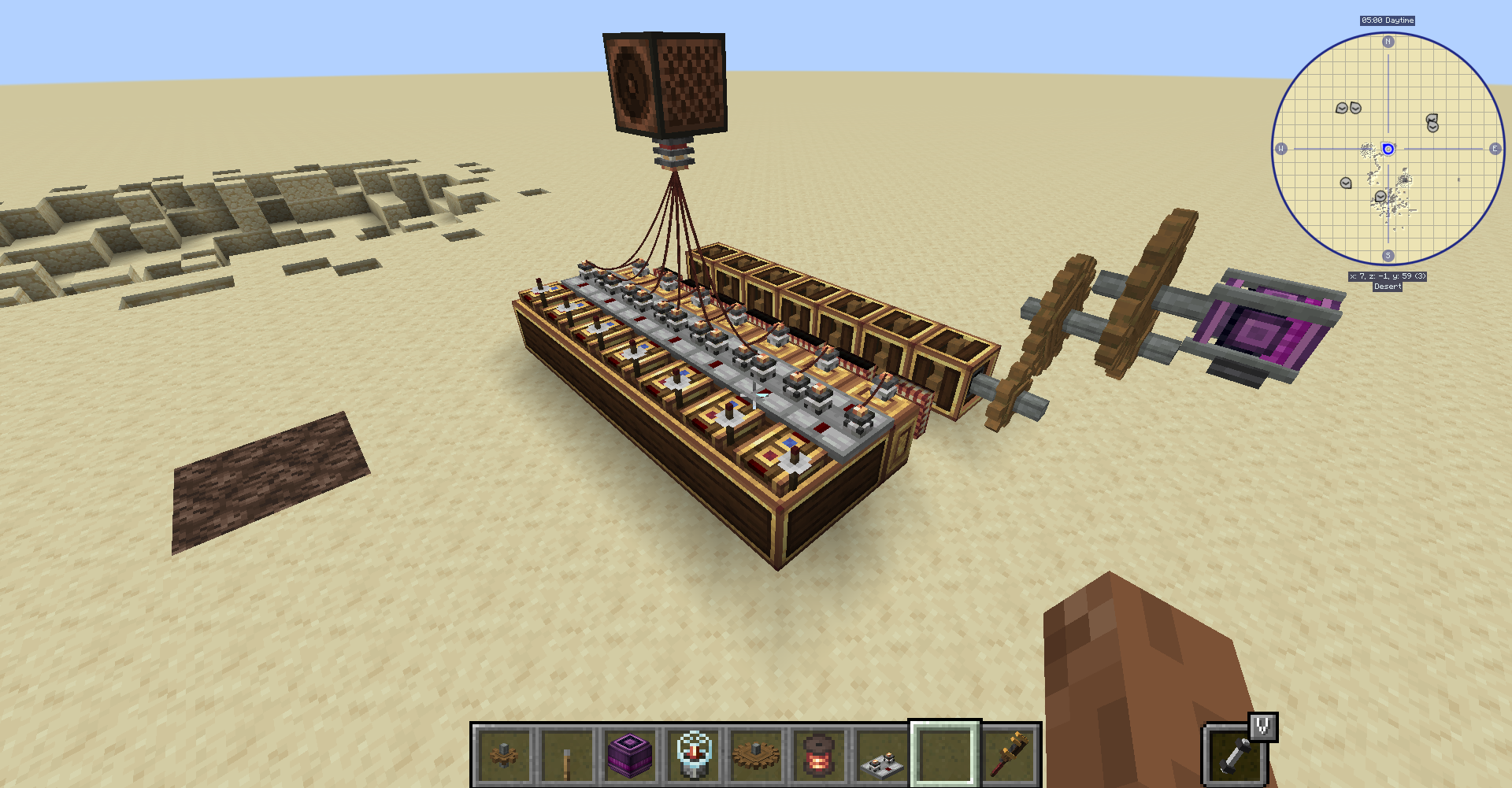
You got an array of steel wheels with differing amounts of teeth, rotating at a high speed (represented by encased cogs in my mockup).
Next to each wheel is a magnet, which is surrounded by a copper coil (represented by the tesla coils).
The rotation of the wheels creates inductive fields with the coiled magnets - the more teeth of a wheel pass the magnet per second, the higher the frequency (either achieved by more teeth or by higher RPM). So in short, each wheel-magnet combo is a small generator.
The coils in turn are connected to a speaker (or several? I'm not quite sure - in my mockup it's a speaker from Supplementaries), interrupted by contact switches (represented by redstone relays).
Usually, the contacts are open and the electricity generated by the wheels can't pass through. When you press a key on the keyboard however, the contact for that specific generator closes, and the electricity can travel to the speaker, creating a sound of that specific frequency.
So what you'd need to implement:
- A wheel unit, which can be rotated by regular Create means. Since it would require dozens of different recipes and blocks for each amount of teeth, it's probably simpler to just add one wheel unit block that can be adjusted with the wrench.
- A magnet-coil unit, which generates electricity if it detects a wheel rotating next to it. Wheels with more teeth create more FE, maybe?
- A speaker. The more FE it receives, the higher the tone (so each coil is connected to one speaker, unlike a real Hammond organ).
That would be the easiest solution - unless you want to be an absolute madlad and use only one speaker and dabble with electric frequencies and frequency modulation instead of FE.
Everything else is already in base Create and in Crafts & Additions.
Of course, Hammond organs are a bit more complicated than that and also have different modules, to create vibrato for example.
 craggy pecan

 velvet spade
 sly olive
 timber fossil

 sharp sparrow